


Search results
Search for "rearrangements" in Full Text gives 196 result(s) in Beilstein Journal of Organic Chemistry.
Gold-catalyzed intermolecular coupling of sulfonylacetylene with allyl ethers: [3,3]- and [1,3]-rearrangements
- Jungho Jun,
- Hyu-Suk Yeom,
- Jun-Hyun An and
- Seunghoon Shin
Beilstein J. Org. Chem. 2013, 9, 1724–1729, doi:10.3762/bjoc.9.198

- organic chemistry, mediating a variety of C–C and C–X (heteroatom) bond formations, various tandem reactions and rearrangements [1]. Despite these significant advances, overcoming entropic penalty in intermolecular coupling of alkenes with alkynes is still a major challenge in gold catalysis, reflected by
- -substituent, the steric nature of R2 and R3 substituents determined the ratio of [3,3]- versus [1,3]-products. Finally, R4 substituent at the allyl group (2n) retarded the transformation severely, indicating an unfavorable steric interaction. Unlike previous intramolecular [3,3]-sigmatropic rearrangements [13
- with a lower amount of the excess reactant. However, it is accompanied by a significant amount of byproduct(s) such as 4 and 5, resulting from the dissociation of the allyl C–O cleavage. While the linear allyl ethers preferred [3,3]-sigmatropic rearrangements, the presence of an α-substituent led to a

Graphical Abstract

Figure 1: Donor- and acceptor-substituted alkynes for Au-catalyzed intermolecular reactions.

Scheme 1: Proposed mechanism of the [3,3]- and [1,3]-rearrangement.

Scheme 2: Experiments to investigate the reaction mechanism.
A reductive coupling strategy towards ripostatin A
- Kristin D. Schleicher and
- Timothy F. Jamison
Beilstein J. Org. Chem. 2013, 9, 1533–1550, doi:10.3762/bjoc.9.175
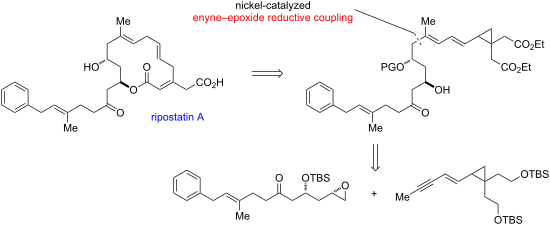
- titanacyclopentane that subsequently fragments in a stereospecific manner [31]. We were intrigued by the apparent difference in selectivity observed in cyclopropane rearrangements proceeding via a neutral pathway versus those proceeding by more polar or directed mechanisms. Although the E geometry of the central
- a β-ketoester. Retrosynthesis utilizing Rychnovsky’s cyanohydrin acetonide methodology. Nickel-catalyzed reductive coupling of alkynes and epoxides. Potential transition states and stereochemical outcomes for a concerted 1,5-hydrogen rearrangement. Rearrangements of vinylcyclopropanes to acylic 1,4

Graphical Abstract

Figure 1: Structures of the ripostatins.

Figure 2: Retrosynthesis of ripostatin A.

Scheme 1: Nickel-catalyzed reductive coupling of alkynes and epoxides.

Figure 3: Proposed retrosynthesis of ripostatin A featuring enyne–epoxide reductive coupling and rearrangemen...

Scheme 2: Potential transition states and stereochemical outcomes for a concerted 1,5-hydrogen rearrangement.

Scheme 3: Rearrangements of vinylcyclopropanes to acylic 1,4-dienes.

Scheme 4: Synthesis of cyclopropyl enyne.

Scheme 5: Synthesis of model epoxide for investigation of the nickel-catalyzed coupling reaction.

Scheme 6: Nickel-catalyzed enyne–epoxide reductive coupling reaction.

Scheme 7: Proposed mechanism for the nickel-catalyzed coupling reaction of alkynes or enynes with epoxides.

Scheme 8: Regioselectivity changes in reductive couplings of alkynes and 3-oxygenated epoxides.

Scheme 9: Enyne reductive coupling with 1,2-epoxyoctane.

Figure 4: Initial retrosynthesis of the epoxide fragment by using dithiane coupling.

Scheme 10: Synthesis of dithiane by Claisen rearrangement.

Scheme 11: Deuterium labeling reveals that the allylic/benzylic site is most acidic.

Scheme 12: Oxy-Michael addition to δ-hydroxy-α,β-enones.

Figure 5: Revised retrosynthesis of epoxide 5.

Scheme 13: Synthesis of functionalized ketone by oxy-Michael addition.

Figure 6: Retrosynthesis by using iodocylization to introduce the epoxide.

Scheme 14: Synthesis of ketone 57 using thiazolidinethione chiral auxiliary.

Figure 7: Retrosynthesis involving decarboxylation of a β-ketoester.

Scheme 15: Synthesis of β-ketoester 61.

Scheme 16: Decarboxylation of 61 under Krapcho conditions.

Scheme 17: Improved synthesis of 63 and attempted iodocyclization.

Figure 8: Retrosynthesis utilizing Rychnovsky’s cyanohydrin acetonide methodology.

Scheme 18: Synthesis of cyanohydrin acetonide and attempted alkylation with epoxide.

Scheme 19: Allylation of acetonide and conversion to aldehyde.

Scheme 20: Synthesis of the epoxide precursor by an aldol−decarboxylation sequence.
Copper(II)-salt-promoted oxidative ring-opening reactions of bicyclic cyclopropanol derivatives via radical pathways
- Eietsu Hasegawa,
- Minami Tateyama,
- Ryosuke Nagumo,
- Eiji Tayama and
- Hajime Iwamoto
Beilstein J. Org. Chem. 2013, 9, 1397–1406, doi:10.3762/bjoc.9.156
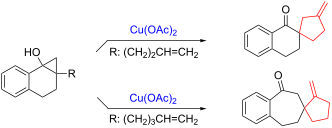
- -promoted ET and PET conditions. Using rearrangements of radicals and ions to distinguish mechanistic pathways for ET-reactions. Reductive ET reactions of the probe I (left) and oxidative ET reactions of probe II (right). Reaction of silyl ether 1a with Cu(OAc)2 in the absence or presence of n-Bu4NF. SmI2

Graphical Abstract

Scheme 1: Comparison of fragmentation reaction pathways of organic radical ions generated under the redox-rea...

Scheme 2: Using rearrangements of radicals and ions to distinguish mechanistic pathways for ET-reactions.

Figure 1: Radical anion and cation probe substances I and II, possessing 5-hexenyl structures.

Scheme 3: Reductive ET reactions of the probe I (left) and oxidative ET reactions of probe II (right).

Scheme 4: Reaction of silyl ether 1a with Cu(OAc)2 in the absence or presence of n-Bu4NF.

Scheme 5: SmI2-promoted preparation of 1 and subsequent reaction with CuX2.

Scheme 6: Reaction of cyclopropanol 1b with Cu(OAc)2.

Scheme 7: Plausible reaction pathways for the reaction of 1b with Cu(OAc)2.

Scheme 8: Reaction of cyclopropanol 1b with various copper(II) salts (CuX2).

Scheme 9: Formation of acetoamide 16 from the cation 13.

Scheme 10: Reaction of cyclopropanol 1c with various copper(II) salts (CuX2).

Scheme 11: Reaction of cyclopropanol 1d with various Cu(OAc)2.

Scheme 12: Comparison of reaction pathways of ring-expanded radical 27 and 28.
Exploration of an epoxidation–ring-opening strategy for the synthesis of lyconadin A and discovery of an unexpected Payne rearrangement
- Brad M. Loertscher,
- Yu Zhang and
- Steven L. Castle
Beilstein J. Org. Chem. 2013, 9, 1179–1184, doi:10.3762/bjoc.9.132
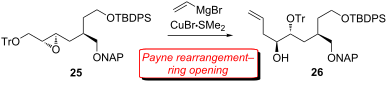
- complex [29] at the less-hindered carbon of the epoxide would provide 26. Acid- and Lewis acid promoted Payne rearrangements of epoxy alcohols [33][34] and epoxy methyl ethers [35] have been described, but we are unaware of any prior reports of Payne rearrangements of the bulkier epoxy trityl ethers

Graphical Abstract

Figure 1: Lyconadin A.

Scheme 1: Retrosynthetic analysis of 1.

Scheme 2: Synthesis of triether 15.

Scheme 3: Synthesis and attempted ring-opening of epoxide 17.

Scheme 4: Attempted protection of 14 and silyl migration.

Scheme 5: Synthesis and ring-opening rearrangement of epoxide 25.

Scheme 6: Proposed mechanism for generation of alcohol 26.

Scheme 7: Synthesis of epoxide 29 from alcohol 26 (asterisks indicate relative but not absolute stereochemist...
4-Pyridylnitrene and 2-pyrazinylcarbene
- Curt Wentrup,
- Ales Reisinger and
- David Kvaskoff
Beilstein J. Org. Chem. 2013, 9, 754–760, doi:10.3762/bjoc.9.85
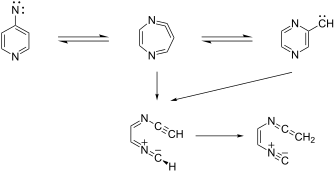
- vacuum thermolysis (FVT) conditions cyanocyclopentadiene 6 is formed (Scheme 1). Several other carbene–nitrene rearrangements have been reported [3][4][5]. In addition to the ring expansion (1–2–3), two ring opening reactions have been investigated in recent years. Type I ring opening takes place in

Graphical Abstract

Scheme 1: Phenylnitrene–2-pyridylcarbene rearrangement.
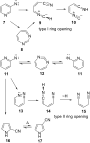
Scheme 2: Type I and type II ring opening and ring expansion in 3- and 2-pyridylnitrenes, respectively.

Scheme 3: FVT reactions of 4-azidopyridine (18), 2-(5-tetrazolyl)pyrazine (23) and triazolo[1,5-a]pyrazine (24...

Figure 1: Difference-IR spectrum of 2-diazomethylpyrazine (22) (positive peaks) in Ar matrix at 7 K, obtained...

Figure 2: Ar matrix IR-difference spectra showing the products of broadband UV photolysis of 4-azidopyridine (...
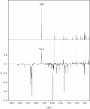
Figure 3: Top: calculated IR spectrum of 20 at the B3LYP/6-31G* level (wavenumbers scaled by 0.9613): ν’ (rel...

Figure 4: Bottom: IR spectrum from the matrix photolysis of azide 18 after the azide has been depleted comple...

Scheme 4: Photolysis reactions of azide 18 and triazole 24 in Ar matrix.
3-Pyridylnitrene, 2- and 4-pyrimidinylcarbenes, 3-quinolylnitrenes, and 4-quinazolinylcarbenes. Interconversion, ring expansion to diazacycloheptatetraenes, ring opening to nitrile ylides, and ring contraction to cyanopyrroles and cyanoindoles
- Curt Wentrup,
- Nguyen Mong Lan,
- Adelheid Lukosch,
- Pawel Bednarek and
- David Kvaskoff
Beilstein J. Org. Chem. 2013, 9, 743–753, doi:10.3762/bjoc.9.84
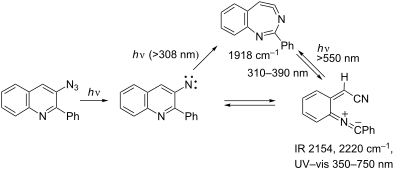
- either the nitrenes or the diazacycloheptatetraenes to nitrile ylides. Keywords: carbene-nitrene interconversion; diazepines; flash vacuum thermolysis; matrix photochemistry; nitrile ylides; reactive intermediates; Introduction A multitude of rearrangements of heterocyclic nitrenes have been described
- 47 → nitrile 48. The data demonstrate that carbene 55 does not convert thermally to nitrene 45. In other words, although carbene–nitrene rearrangements are known to occur [1][19] (see, e.g., Scheme 1 and Scheme 10 above), they may be bypassed when ring opening to nitrile ylides becomes more
- cyanopyrroles by FVT of tetrazolylpyrimidines. Rearrangements of pyrimidinylcarbenes to cyanopyrroles via nitrile ylides 31 and 37. Rearrangements of phenyl(dimethylpyrimidinyl)carbene. Photolysis of 3-azido-2-phenylquinoline. Preparative FVT of 3-azido-2-phenylquinoline. FVT of 2-phenyl-4-quinazolinylcarbene

Graphical Abstract

Scheme 1: 4-Pyridylnitrene–2-pyrazinylcarbene interconversion.

Scheme 2: Ring expansion and ring contraction in 2-pyridylnitrene (4).

Scheme 3: Ring opening and ring expansion in 3-pyridylnitrene (10).

Scheme 4: Ring opening and ring contraction in 3-pyridylnitrene (10) and diazacycloheptatetraene 16.

Figure 1: Energy profile for the ring opening and ring contraction in 3-pyridylnitrene 10 and 1,6-diazacycloh...

Scheme 5: Potential direct ring contraction in 3-pyridylnitrene (10).

Scheme 6: Ring contraction by ring opening to nitrile ylide 11.

Scheme 7: Generation of pyrimidinyldiazomethanes and pyrimidinylcarbenes.

Scheme 8: Formation of cyanopyrroles by FVT of tetrazolylpyrimidines.

Scheme 9: Rearrangements of pyrimidinylcarbenes to cyanopyrroles via nitrile ylides 31 and 37.

Scheme 10: Rearrangements of phenyl(dimethylpyrimidinyl)carbene.

Scheme 11: Photolysis of 3-azido-2-phenylquinoline.
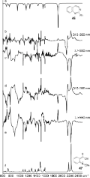
Figure 2: IR difference spectra from the photolysis of 3-azido-2-phenylquinoline (44) in Ar matrix. (a) Calcu...

Figure 3: UV–vis spectra from the sequential photolysis of 3-azido-2-phenylquinoline (44) in Ar matrix at 310...

Scheme 12: Preparative FVT of 3-azido-2-phenylquinoline.

Scheme 13: FVT of 2-phenyl-4-quinazolinylcarbene precursors.
A computational study of base-catalyzed reactions of cyclic 1,2-diones: cyclobutane-1,2-dione
- Nargis Sultana and
- Walter M. F. Fabian
Beilstein J. Org. Chem. 2013, 9, 594–601, doi:10.3762/bjoc.9.64
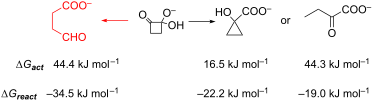
- rearrangements of biacetyl and benzil [11]. Car–Parrinello molecular dynamics simulations of the hydrolysis of formamide in basic solution indicated that the traditional view of attack by hydroxide anion rather than a first-solvation-shell water molecule is more likely; however, the more powerful electrophile

Graphical Abstract

Scheme 1: Reactions of 1,2-dicarbonyl compounds with base.

Scheme 2: Reactions of cyclic 1,2-diones with base.

Scheme 3: Possible intermediates, transition structures, and products considered for the reaction of cyclobut...

Figure 1: CEPA-1/def2-QZVPP calculated reaction paths for the reaction of 1·(H2O)2 + [OH(H2O)4]–.
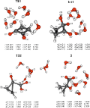
Figure 2: M06-2X/6-31+G(d,p) calculated structures of stationary points along the benzilic acid type rearrang...

Scheme 4: Reaction sequence calculated for an extended conformation of Int2.

Figure 3: Calculated structure of transition state TS3a. Distances are given in angstrom (Å), angles in degre...
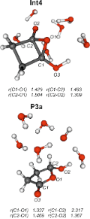
Figure 4: Calculated structures of pertinent stationary points along path C. Distances are given in angstroms...

Scheme 5: Actual path C obtained by the calculations (as in Scheme 3, Int1, TS4, Int4, and TS5 are hydrated by six wa...
Some aspects of radical chemistry in the assembly of complex molecular architectures
- Béatrice Quiclet-Sire and
- Samir Z. Zard
Beilstein J. Org. Chem. 2013, 9, 557–576, doi:10.3762/bjoc.9.61

- tendency for rearrangements and β-elimination; and a selectivity that is often complementary to that of ionic or organometallic reactions, making some protection steps superfluous. Radicals are ambiphilic species that can react with both electron-poor and electron-rich substrates, but the rates can differ

Graphical Abstract

Scheme 1: Key radical step in the total synthesis of (–)-dendrobine.

Scheme 2: Radical cascade in the total synthesis of (±)-13-deoxyserratine (ACCN = 1,1'-azobis(cyclohexanecarb...

Scheme 3: Formation of the complete skeleton of (±)-fortucine.
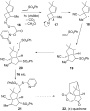
Scheme 4: Model radical sequence for the synthesis of quadrone.

Scheme 5: Radical cascade using the Barton decarboxylation.

Scheme 6: Simplified mechanism for the xanthate addition to alkenes.

Scheme 7: Synthesis of β-lactam derivatives.

Scheme 8: Sequential additions to three different alkenes (PhthN = phthalimido).

Scheme 9: Key cascade in the total synthesis of (±)-matrine (43).

Scheme 10: Synthesis of complex tetralones.

Scheme 11: Synthesis of functionalised azaindoline and indole derivatives.

Scheme 12: Synthesis of thiochromanones.

Scheme 13: Synthesis of complex benzothiepinones. Conditions: 1) CF3COOH; 2) RCHO / AcOH (PMB = p-methoxybenzy...

Scheme 14: Formation and capture of a cyclic nitrone.
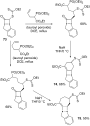
Scheme 15: Synthesis of bicyclic cyclobutane motifs.

Scheme 16: Construction of the CD rings of steroids.

Scheme 17: Rapid assembly of polyquinanes.

Scheme 18: Formation of a polycyclic structure via an allene intermediate.
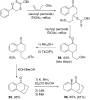
Scheme 19: A polycyclic structure via the alkylative Birch reduction.

Scheme 20: Synthesis of polycyclic pyrimidines and indoline structures.

Scheme 21: Construction of a trans-decalin derivative.
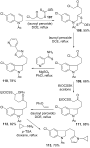
Scheme 22: Multiple uses of a chloroacetonyl xanthate.

Scheme 23: A convergent route to spiroketals.

Scheme 24: A modular approach to 3-arylpiperidines.

Scheme 25: A convergent route to cyclopentanols and to functional allenes.
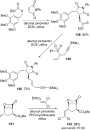
Scheme 26: Allylation and vinylation of a xanthate and an iodide.
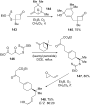
Scheme 27: Vinyl epoxides as allylating agents.

Scheme 28: Radical allylations using allylic alcohol derivatives.

Scheme 29: Synthesis of variously substituted lactams.

Scheme 30: Nickel-mediated synthesis of unsaturated lactams.
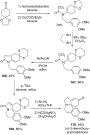
Scheme 31: Total synthesis of (±)-3-demethoxy-erythratidinone.

Scheme 32: Generation and capture of an iminyl radical from an oxime ester.
Caryolene-forming carbocation rearrangements
- Quynh Nhu N. Nguyen and
- Dean J. Tantillo
Beilstein J. Org. Chem. 2013, 9, 323–331, doi:10.3762/bjoc.9.37
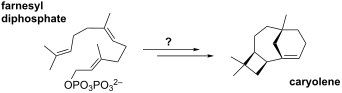
- formation, applying the principles derived from previous theoretical studies on terpene-forming carbocation rearrangements [8]. In this mechanism, formation of the C1–C11 bond was expected to result in secondary carbocation B, in analogy to previously characterized pathways to sesquiterpenes containing 11

Graphical Abstract
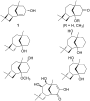
Figure 1: Caryol-1(11)-en-10-ol (1) and similar sesquiterpenoids. Note that a different atom numbering was us...

Scheme 1: Initially proposed mechanism for caryolene (caryol-1(11)-en-10-ol, 1) formation. Atom numbers for f...

Figure 2: Computed (top) and experimental (bottom, underlined italics) [2] 1H and 13C chemical shifts for 1 (low...

Figure 3: Computed minima and transition-state structure involved in the single-step conversion of A to C. Re...

Figure 4: IRC from TS-AC toward C. Relative energies were calculated at the B3LYP/6-31+G(d,p) level.
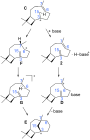
Scheme 2: Alternative mechanisms for caryolene formation.
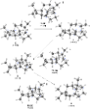
Figure 5: Computed pathway for the conversion of C to E. Relative energies shown (kcal/mol) were calculated a...

Figure 6: IRC from TS-GE toward E. Relative energies were calculated at the B3LYP/6-31+G(d,p) level. Selected...
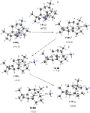
Figure 7: Computed pathway for the conversion of C to E in the presence of ammonia. Relative energies shown (...

Figure 8: Predicted energetics for the conversion of A to E in the absence (blue) and presence (auburn) of am...
Radical zinc-atom-transfer-based carbozincation of haloalkynes with dialkylzincs
- Fabrice Chemla,
- Florian Dulong,
- Franck Ferreira and
- Alejandro Pérez-Luna
Beilstein J. Org. Chem. 2013, 9, 236–245, doi:10.3762/bjoc.9.28
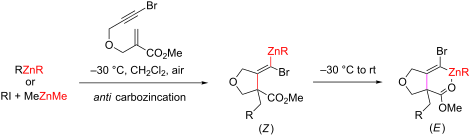
- dialkylzinc reagent via the intermediate formation of a zincate [48][49][50][51] (Scheme 3, path a). The stereoselectivity of such rearrangements is often dependent on the substrate structure, so the diastereopurity of 5 is not necessarily informative about that of 6 [48][49][50][51]. An alternative

Graphical Abstract

Scheme 1: Anticipated formation of alkylidene zinc carbenoids by reaction of dialkylzincs with β-(propargylox...

Scheme 2: Preparation of β-(propargyloxy)enoates having pendant haloalkynes. Reagents and conditions: (a) 2 (...

Scheme 3: Possible reaction pathways to account for the formation of product 5.

Scheme 4: Test experiments to gain insight into the mechanism of formation of alkylidene zinc intermediate 7.

Scheme 5: Mechanistic rationale for the reaction of dialkylzincs with β-(propargyloxy)enoate 3a.
Flow photochemistry: Old light through new windows
- Jonathan P. Knowles,
- Luke D. Elliott and
- Kevin I. Booker-Milburn
Beilstein J. Org. Chem. 2012, 8, 2025–2052, doi:10.3762/bjoc.8.229
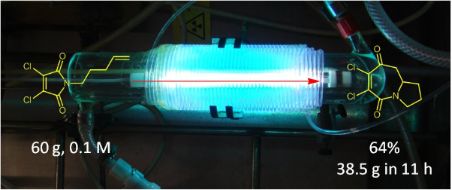

Graphical Abstract

Figure 1: An immersion-well batch reactor with 125 W medium pressure Hg lamp.

Figure 2: Transmission profile of a 0.05 M solution, ε = 200 M−1 cm−1.

Figure 3: Schematic of a typical microflow photochemical reactor (above) and detail of a triple-channel micro...

Figure 4: Schematic of a typical macroflow photochemical reactor (above) and images of the FEP photochemical ...

Scheme 1: [2 + 2] photocycloadditions of enones with enol derivatives.

Scheme 2: Competing reactions in an intramolecular [2 + 2] photocycloaddition.

Scheme 3: Diastereocontrolled cycloaddition of a cyclic enone with cyclopentene.

Scheme 4: Comparison of yields and reaction times for a batch reactor with a microflow system.

Scheme 5: Intramolecular [2 + 2] photocycloaddition.

Scheme 6: Paterno–Büchi reaction of benzophenone with an allylic alcohol.

Scheme 7: Photooxygenation of cyclopentadiene.

Scheme 8: Preparation of the anthelmintic ascaridole 23.

Scheme 9: Production of rose oxide 27 from (−)-β-citronellol (24).

Scheme 10: Photocatalytic alkylation of benzylamine.

Scheme 11: Photocatalytic reduction of 4-nitroacetophenone.

Scheme 12: Conversion of L-lysine to L-pipecolinic acid.

Scheme 13: Photocatalytic hydrodehalogenation.

Scheme 14: Photocatalytic aza-Henry reactions.

Scheme 15: Photocatalytic α-alkylation of aliphatic ketones.

Scheme 16: Decarboxylative photochemical additions.

Scheme 17: Photochemical addition of isopropanol to furanones.

Scheme 18: Photochemical addition of methanol to limonene.

Scheme 19: Light-promoted reduction of flavone.

Scheme 20: Photoreduction of benzophenone with benzhydrol.

Scheme 21: Barton reaction in a microflow system.

Scheme 22: Microflow synthesis of vitamin D3.

Scheme 23: photochemical chlorination of cyclohexane.

Scheme 24: photochemical cyanation of pyrene.

Scheme 25: Intermolecular [2 + 2] cycloaddition of maleimide (76) and intramolecular [2 + 2] cycloaddition of ...

Scheme 26: Intramolecular [5 + 2] cycloaddition of maleimide under flow conditions.

Scheme 27: Intramolecular [5 + 2] cycloaddition as a key step in the synthesis of (±)-neostenine.

Scheme 28: In situ generation of a thioaldehyde by photolysis of a phenacyl sulfide.

Scheme 29: Photodimerisation of maleic anhydride.

Scheme 30: [2 + 2] cycloaddition of a chiral enone with ethylene.

Scheme 31: Intramolecular [2 + 2] cycloaddition of a cyclopentenone.

Scheme 32: Photochemical Wolff rearrangement and cyclisation to β-lactams.

Scheme 33: Photochemical rearrangement of aryl azides.

Scheme 34: Rearrangement of quinoline N-oxides to quinolones.

Scheme 35: Photochemical rearrangement of cyclobutenones.

Scheme 36: Photoisomerisation en route to a vitamin-D derivative.

Scheme 37: Schematic of the Seeberger photooxygenation apparatus and sensitised photooxygenation of citronello...

Scheme 38: Sensitised photooxygenation of dihydroartemisinic acid.

Scheme 39: Photochemical preparation of CpRu(MeCN)3PF6.

Scheme 40: In situ photochemical generation and reaction of a [CpRu]+ catalyst.

Scheme 41: Intermolecular alkene–alkyne coupling with photogenerated catalyst.

Scheme 42: PET deoxygenation of nucleosides.

Scheme 43: Photochemical defluorination of DABFT.

Scheme 44: Aromatic azide reduction by visible-light-mediated photocatalysis.

Scheme 45: Examples of visible-light-mediated reactions.

Scheme 46: Visible-light-mediated formation of iminium ions.

Scheme 47: Examples of visible-light-mediated photocatalytic reactions.

Scheme 48: Anhydride formation from a visible-light-mediated process.

Scheme 49: Light-mediated conjugate addition of glycosyl bromide 141 to acrolein.

Scheme 50: Visible-light-mediated photocyclisation to [5]helicene.
The chemistry of bisallenes
- Henning Hopf and
- Georgios Markopoulos
Beilstein J. Org. Chem. 2012, 8, 1936–1998, doi:10.3762/bjoc.8.225
- dibromocyclopropane precursors) to carbene rearrangements followed by hydrogen shifts. The above C3-dimerization pathway (Scheme 3) via organozinc compounds goes back to Vermeer et al. and appears to be not only the most general route to alkylated conjugated bisallenes [27][28][29][30][31], but also to many other
- →bismethylenecyclobutene isomerization of the dialkynylated d,l- and meso-bisallenes, 122 and 123 respectively, in the solid state (Scheme 36) [119]. These rearrangements occur in high yield and with high stereoselectivity. When 122 was heated in benzene it isomerized to 145 in quantitative yield within 2 h. A thorough

Graphical Abstract

Figure 1: Loschmidt’s structure proposal for benzene (1) (Scheme 181 from [3]) and the corresponding modern stru...

Figure 2: The first isolated bisallenes.

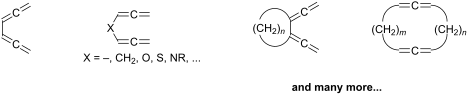
Figure 3: Carbon skeletons of selected bisallenes discussed in this review.

Scheme 1: The preparation of 1,2,4,5-hexatetraene (2).

Scheme 2: The preparation of a conjugated bisallene by the DMS-protocol.

Scheme 3: Preparation of the 3-deuterio- and 3,4-dideuterio derivatives of 24.

Scheme 4: A versatile method to prepare alkylated conjugated bisallenes and other allenes.

Scheme 5: A preparation of 3,4-dimethyl-1,2,4,5-hexatetraene (38).

Scheme 6: A (C6 + 0)-approach to 1,2,4,5-hexatetraene (2).

Scheme 7: The preparation of a fully alkylated bisallenes from a 2,4-hexadiyne-1,6-diol diacetate.

Scheme 8: The preparation of the first phenyl-substituted conjugated bisallenes 3 and 4.

Scheme 9: Selective hydrogenation of [5]cumulenes to conjugated bisallenes: another (C6 + 0)-route.

Scheme 10: Aryl-substituted conjugated bisallenes by a (C3 + C3)-approach.

Scheme 11: Hexaphenyl-1,2,4,5-hexatetraene (59) by a (C3 + C3)-approach.

Scheme 12: An allenation route to conjugated bisallenes.

Scheme 13: The preparation of 3,4-difunctionalized conjugated bisallenes.

Scheme 14: Problems during the preparation of sulfur-substituted conjugated bisallenes.

Scheme 15: The preparation of 3,4-dibromo bisallenes.

Scheme 16: Generation of allenolates by an oxy-Cope rearrangement.

Scheme 17: A linear trimerization of alkynes to conjugated bisallenes: a (C2 + C2 + C2)-protocol.

Scheme 18: Preparation of a TMS-substituted conjugated bisallene by a C3-dimerization route.

Scheme 19: A bis(trimethylsilyl)bisallene by a C3-coupling protocol.

Scheme 20: The rearrangement of highly substituted benzene derivatives into their conjugated bisallenic isomer...

Scheme 21: From fully substituted benzene derivatives to fully substituted bisallenes.

Scheme 22: From a bicyclopropenyl to a conjugated bisallene derivative.

Scheme 23: The conversion of a bismethylenecyclobutene into a conjugated bisallene.

Scheme 24: The preparation of monofunctionalized bisallenes.

Scheme 25: Preparation of bisallene diols and their cyclization to dihydrofurans.

Scheme 26: A 3,4-difunctionalized conjugated bisallene by a C3-coupling process.

Scheme 27: Preparation of a bisallenic diketone by a coupling reaction.

Scheme 28: Sulfur and selenium-substituted bisallenes by a [2.3]sigmatropic rearrangement.

Scheme 29: The biallenylation of azetidinones.

Scheme 30: The preparation of a fully ferrocenylated conjugated bisallene.

Scheme 31: The first isomerization of a 1,5-hexadiyne to a 1,2,4,5-hexatetraene.

Scheme 32: The preparation of alkynyl-substituted bisallenes by a C3-dimerization protocol.

Scheme 33: Preparation of another completely ferrocenylated bisallene.

Scheme 34: The cyclization of 1,5-hexadiyne (129) to 3,4-bismethylenecyclobutene (130) via 1,2,4,5-hexatetraen...
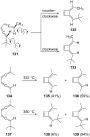
Scheme 35: Stereochemistry of the thermal cyclization of bisallenes to bismethylenecyclobutenes.

Scheme 36: Bisallene→bismethylenecyclobutene ring closures in the solid state.

Scheme 37: A bisallene cyclization/dimerization reaction.

Scheme 38: A selection of Diels–Alder additions of 1,2,4,5-hexatetraene with various double-bond dienophiles.

Scheme 39: The stereochemistry of the [2 + 4] cycloaddition to conjugated bisallenes.

Scheme 40: Preparation of azetidinone derivatives from conjugated bisallenes.

Scheme 41: Cycloaddition of heterodienophiles to a conjugated bisallene.

Scheme 42: Addition of triple-bond dienophiles to conjugated bisallenes.

Scheme 43: Sulfur dioxide addition to conjugated bisallenes.

Scheme 44: The addition of a germylene to a conjugated bisallene.

Scheme 45: Trapping of conjugated bisallenes with phosphinidenes.

Scheme 46: The cyclopropanantion of 1,2,4,5-hexatetraene (2).

Scheme 47: Photochemical reactions involving conjugated bisallenes.

Scheme 48: Base-catalyzed isomerizations of conjugated bisallenes.

Scheme 49: Ionic additions to a conjugated bisallene.

Scheme 50: Oxidation reactions of a conjugated bisallene.
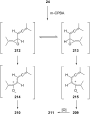
Scheme 51: The mechanism of oxidation of the bisallene 24.

Scheme 52: CuCl-catalyzed cyclization of 1,2,4,5-hexatetraene (2).

Scheme 53: The conversion of conjugated bisallenes into cyclopentenones.

Scheme 54: Oligomerization of a conjugated bisallene by nickel catalysts.
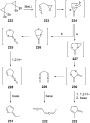
Scheme 55: Generation of 1,2,5,6-heptatetraene (229) as a reaction intermediate.

Scheme 56: The preparation of a stable derivative of 1,2,5,6-heptatetraene.

Scheme 57: A bisallene with a carbonyl group as a spacer element.

Scheme 58: The first preparation of 1,2,6,7-octatetraene (242).

Scheme 59: Preparation of 1,2,6,7-octatetraenes by (C4 + C4)-coupling of enynes.

Scheme 60: Preparation of 1,2,6,7-octatetraenes by (C4 + C4)-coupling of homoallenyl bromides.

Scheme 61: Preparation of 1,2,6,7-octatetraenes by alkylation of propargylic substrates.

Scheme 62: Preparation of two highly functionalized 1,2,6,7-octatetraenes.

Scheme 63: Preparation of several higher α,ω-bisallenes.

Scheme 64: Preparation of different alkyl derivatives of α,ω-bisallenes.

Scheme 65: The preparation of functionalized 1,2,7,8-nonatetraene derivatives.

Scheme 66: Preparation of functionalized α,ω-bisallenes.

Scheme 67: The preparation of an α,ω-bisallene by direct homologation of an α,ω-bisalkyne.

Scheme 68: The gas-phase pyrolysis of 4,4-dimethyl-1,2,5,6-heptatetraene (237).
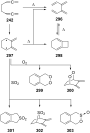
Scheme 69: Gas-phase pyrolysis of 1,2,6,7-octatetraene (242).

Scheme 70: The cyclopropanation of 1,2,6,7-octatetraene (242).

Scheme 71: Intramolecular cyclization of 1,2,6,7-octatetraene derivatives.

Scheme 72: The gas-phase pyrolysis of 1,2,7,8-nonatetraene (265) and 1,2,8,9-decatetraene (266).

Scheme 73: Rh-catalyzed cyclization of a functionalized 1,2,7,8-nonatetraene.

Scheme 74: A triple cyclization involving two different allenic substrates.

Scheme 75: Bicyclization of keto derivatives of 1,2,7,8-nonatetraene.

Scheme 76: The preparation of complex organic compounds from functionalized bisallenes.

Scheme 77: Cycloisomerization of an α,ω-bisallene containing a C9 tether.

Scheme 78: Organoborane polymers from α,ω-bisallenes.

Scheme 79: Preparation of trans- (337) and cis-1,2,4,6,7-octapentaene (341).

Scheme 80: The preparation of 4-methylene-1,2,5,6-heptatetraene (349).

Scheme 81: The preparation of acetylenic bisallenes.

Scheme 82: The preparation of derivatives of hydrocarbon 351.

Scheme 83: The construction of macrocyclic alleno-acetylenes.

Scheme 84: Preparation and reactions of 4,5-bismethylene-1,2,6,7-octatetraene (365).

Scheme 85: Preparation of 1,2-bis(propadienyl)benzene (370).

Scheme 86: The preparation of 1,4-bis(propadienyl)benzene (376).

Scheme 87: The preparation of aromatic and heteroaromatic bisallenes by metal-mediated coupling reactions.

Scheme 88: Double cyclization of an aromatic bisallene.

Scheme 89: Preparation of an allenic [15]paracyclophane by a ring-closing metathesis reaction of an aromatic α...

Scheme 90: Preparation of a macrocyclic ring system containing 1,4-bis(propadienyl)benzene units.

Scheme 91: Preparation of copolymers from 1,4-bis(propadienyl)benzene (376).

Scheme 92: A boration/copolymerization sequence of an aromatic bisallene and an aromatic bisacetylene.

Scheme 93: Formation of a layered aromatic bisallene.

Figure 4: The first members of the semicyclic bisallene series.

Scheme 94: Preparation of the first bis(vinylidene)cyclobutane derivative.
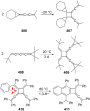
Scheme 95: Dimerization of strain-activated cumulenes to bis(vinylidene)cyclobutanes.

Scheme 96: Photodimerization of two fully substituted butatrienes in the solid state.

Scheme 97: Preparation of the two parent bis(vinylidene)cyclobutanes.

Scheme 98: The preparation of 1,3-bis(vinylidene)cyclopentane and its thermal isomerization.

Scheme 99: The preparation of the isomeric bis(vinylidene)cyclohexanes.

Scheme 100: Bi- and tricyclic conjugated bisallenes.
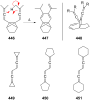
Scheme 101: A selection of polycyclic bisallenes.

Scheme 102: The first endocyclic bisallenes.

Figure 5: The stereochemistry of 1,2,6,7-cyclodecatetraene.

Scheme 103: The preparation of several endocyclic bisallenes.

Scheme 104: Synthesis of diastereomeric derivatives of 1,2,6,7-cyclodecatetraene.

Scheme 105: Preparation of a derivative of 1,2,8,9-cyclotetradecatetraene.

Scheme 106: The preparation of keto derivatives of cyclic bisallenes.

Scheme 107: The preparation of cyclic biscumulenic ring systems.

Scheme 108: Cyclic bisallenes in natural- and non-natural-product chemistry.

Scheme 109: The preparation of iron carbonyl complexes from cyclic bisallenes.

Figure 6: A selection of unknown exocyclic bisallenes that should have interesting chemical properties.

Scheme 110: The thermal isomerization of 1,2-diethynylcyclopropanes and -cyclobutanes.

Scheme 111: Intermediate generation of a cyclooctapentaene.

Scheme 112: Attempted preparation of a cyclodecahexaene.

Scheme 113: The thermal isomerization of 1,5,9-cyclododecatriyne (511) into [6]radialene (514).

Scheme 114: An isomerization involving a diketone derived from a conjugated bisallene.

Scheme 115: Typical reaction modes of heteroorganic bisallenes.

Scheme 116: Generation and thermal behavior of acyclic hetero-organic bisallenes.

Scheme 117: Generation of bis(propadienyl)thioether.

Scheme 118: The preparation of a bisallenic sulfone and its thermal isomerization.

Scheme 119: Bromination of the bisallenic sulfone 535.

Scheme 120: Metalation/hydrolysis of the bisallenic sulfone 535.

Scheme 121: Aromatic compounds from hetero bisallenes.

Scheme 122: Isomerization/cyclization of bispropargylic ethers.

Scheme 123: The preparation of novel aromatic systems by base-catalyzed isomerization of bispropargyl ethers.

Scheme 124: The isomerization of bisacetylenic thioethers to bicyclic thiophenes.

Scheme 125: Aromatization of macrocyclic bispropargylic sulfides.

Scheme 126: Preparation of ansa-compounds from macrocyclic bispropargyl thioethers.

Scheme 127: Alternate route for cyclization of a heterorganic bisallene.
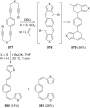
Scheme 128: Multiple isomerization/cyclization of “double” bispropargylic thioethers.

Scheme 129: Preparation of a bisallenyl disulfide and its subsequent bicyclization.

Scheme 130: Thermal cyclization of a bisallenyl thiosulfonate.

Scheme 131: Some reactions of heteroorganic bisallenes with two sulfur atoms.

Scheme 132: Further methods for the preparation of heteroorganic bisallenes.

Scheme 133: Cyclization reactions of heteroorganic bisallenes.

Scheme 134: Thermal cycloadditions of bisallenic tertiary amines.

Scheme 135: Cyclization of a bisallenic tertiary amine in the presence of a transition-metal catalyst.

Scheme 136: A Pauson–Khand reaction of a bisallenic ether.

Scheme 137: Formation of a 2:1adduct from two allenic substrates.

Scheme 138: A ring-forming silastannylation of a bisallenic tertiary amine.

Scheme 139: A three-component cyclization involving a heterorganic bisallene.

Scheme 140: Atom-economic construction of a complex organic framework from a heterorganic α,ω-bisallene.
Approaches to α-amino acids via rearrangement to electron-deficient nitrogen: Beckmann and Hofmann rearrangements of appropriate carboxyl-protected substrates
- Sosale Chandrasekhar and
- V. Mohana Rao
Beilstein J. Org. Chem. 2012, 8, 1393–1399, doi:10.3762/bjoc.8.161

- ] and the Hofmann [10][11][12][13] rearrangements – are not represented in these approaches. This is perhaps surprising, but understandable when the inherent instability of the requisite substrates is considered. Thus, in the Beckmann approach, the oximation of β-keto acid derivatives would be
- rearrangements, two of the standard methods for the introduction of the amino functionality into molecules. The strategy is enabled by efficient carboxyl protection via the 2,4,10-trioxaadamantane moiety, which stabilizes the respective precursor substrates to opportunistic side reactions. Overall yields are

Graphical Abstract

Scheme 1: The transformation of the phenacyltrioxaadamantane 1 to the N-benzoyltrioxaadamantylmethylamine 5 v...

Figure 1: Crystallographic ORTEP diagram at 30% ellipsoidal probability of oxime 3a (left) and amide 5a (righ...

Scheme 2: The transformation of the ethyl (trioxaadamantyl)acetate 6 to the N-(methoxycarbonyl)trioxaadamanty...

Figure 2: Crystallographic ORTEP diagrams at 30% ellipsoidal probability of carbamates 10a (left) and 10b (ri...
Valence isomerization of cyclohepta-1,3,5-triene and its heteroelement analogues
- Helen Jansen,
- J. Chris Slootweg and
- Koop Lammertsma
Beilstein J. Org. Chem. 2011, 7, 1713–1721, doi:10.3762/bjoc.7.201
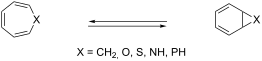
- -triene [14]. Besides the 1–2 interconversion, the C7H8 system is rich in rearrangements (Scheme 3). In 1957, Woods found that bicyclo[2.2.1]hepta-2,5-diene (12) converts to cycloheptatriene (1), which was postulated to proceed via diradical 11 and norcaradiene (2) [28]. Instead, pyrolysis of 1 yielded
- –18. Benzannulated azepines 27 and 28. Reported phosphepines 29–32. Valence isomerization of cyclohepta-1,3,5-triene (1) and its heteroelement analogues. Conformational ring inversions. Rearrangements of the parent cycloheptatriene 1 and norcaradiene 2. Reactivity of oxepine (3) and benzene oxide (4

Graphical Abstract

Scheme 1: Valence isomerization of cyclohepta-1,3,5-triene (1) and its heteroelement analogues.

Scheme 2: Conformational ring inversions.

Scheme 3: Rearrangements of the parent cycloheptatriene 1 and norcaradiene 2.

Figure 1: NICS(0) values of fluorinated heteropines.

Scheme 4: Reactivity of oxepine (3) and benzene oxide (4).

Figure 2: Stabilized thiepines 15–18.

Scheme 5: Valence isomerization of 1H-azepines.
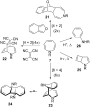
Scheme 6: Reactivity of 1H-azepine.

Figure 3: Benzannulated azepines 27 and 28.

Figure 4: Reported phosphepines 29–32.

Scheme 7: Phosphinidene generation from metal-complexed benzophosphepine 33.
Translation of microwave methodology to continuous flow for the efficient synthesis of diaryl ethers via a base-mediated SNAr reaction
- Charlotte Wiles and
- Paul Watts
Beilstein J. Org. Chem. 2011, 7, 1360–1371, doi:10.3762/bjoc.7.160
- ] (Figure 1). Installation of the diaryl ether can, however, be synthetically challenging, and this is illustrated by the wide number of techniques developed, which include Ullmann ether synthesis [6], Pummerer-type rearrangements [7], Buchwald–Hartwig couplings [8], phenolic additions to amines [9

Graphical Abstract

Figure 1: Illustration of synthetically interesting diaryl ethers.

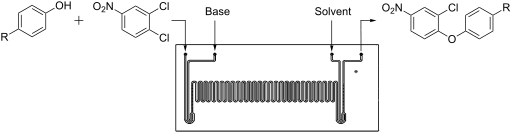
Scheme 1: Illustration of the model reaction used to compare the enabling technologies of microwave and micro...

Scheme 2: Illustration of the model reaction used to benchmark Labtrix S1 against batch and stopped-flow micr...

Figure 2: Photograph illustrating Labtrix® S1, the automated microreactor development apparatus from Chemtrix...

Figure 3: Schematic illustrating the 10 µL reactor manifold used for the SNAr reactions described herein (322...

Figure 4: Schematic illustration of the reactor manifold used to evaluate the continuous-flow synthesis of 2-...

Figure 5: Comparison of the results obtained in Labtrix® S1 with reported data generated in a microwave synth...

Figure 6: Screen shot from the Labtrix® S1 control software illustrating the system file that enables the use...

Figure 7: Summary of the results obtained for the organic base screen towards the SNAr reaction between DCNB (...

Figure 8: Illustration of the substituent effect on the synthesis of diaryl ethers under continuous flow (res...

Figure 9: Schematic illustrating the mixing of immiscible reagent streams in a microfluidic channel, whereby ...

Figure 10: Comparison of base effect on the synthesis of 2-chloro-1-(4-methoxyphenoxy)-4-nitrobenzene (7) (res...

Figure 11: Graphical representation of an automated flow reaction for equilibration and screening of reactor t...
Continuous flow photolysis of aryl azides: Preparation of 3H-azepinones
- Farhan R. Bou-Hamdan,
- François Lévesque,
- Alexander G. O'Brien and
- Peter H. Seeberger
Beilstein J. Org. Chem. 2011, 7, 1124–1129, doi:10.3762/bjoc.7.129
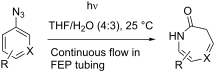
- reaction conditions using the flow reactor allowed minimization of secondary photochemical reactions. Keywords: azepinones; azides; continuous flow; nitrenes; photochemistry; Findings Although photochemical rearrangements are an important class of reactions for heterocycle synthesis [1][2], their use is
- column chromatography. Rearrangements of aryl azides bearing electron withdrawing substituents are better represented in the literature than their electron donating congeners [31], and this was reflected in our compound selection. Methyl 2-azidobenzoate (8b), the corresponding acid 8c and dimethyl 2

Graphical Abstract

Scheme 1: Products of aryl azide photolysis.

Scheme 2: Optimisation of the photolysis of aryl azide 8a.

Figure 1: Relationship between residence time and relative composition of the crude reaction mixture.

Scheme 3: Preparation of side product 10.

Scheme 4: General conditions for the photolysis of aryl azides in continuous flow.
Triazole–Au(I) complex as chemoselective catalyst in promoting propargyl ester rearrangements
- Dawei Wang,
- Yanwei Zhang,
- Rong Cai and
- Xiaodong Shi
Beilstein J. Org. Chem. 2011, 7, 1014–1020, doi:10.3762/bjoc.7.115
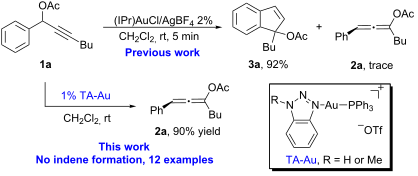

Graphical Abstract

Scheme 1: The counter ligands, an important factor in Au(I) catalysis.

Scheme 2: The challenge of the synthesis of allenes through gold activated alkynes.
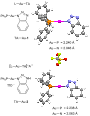
Scheme 3: X-ray crystal structures of the two different types of 1,2,3-triazole–Au complexes.

Scheme 4: Synthesis of α-iodoenone compounds from propargyl esters.

Figure 1: Chemoselective activation of alkyne over allene by the TA–Au catalysts.
Recent advances in the gold-catalyzed additions to C–C multiple bonds
- He Huang,
- Yu Zhou and
- Hong Liu
Beilstein J. Org. Chem. 2011, 7, 897–936, doi:10.3762/bjoc.7.103
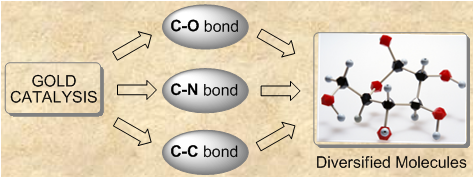
- intramolecular substrate rearrangements (Scheme 18). 2.4 Propargylic alcohols and propargylic carboxylate rearrangements Pennell et al. reported Meyer–Schuster rearrangements of propargylic alcohols 102 at room temperature in toluene with 1–2 mol % PPh3AuNTf2, in the presence of 0.2 equiv of 4
- . reported a general gold-catalyzed direct oxidative homo-coupling of non-activated arenes 207 (Scheme 38). The reaction protocol tolerates a wide range of functional groups [92]. All halogens survive the reaction, which provides the potential for further reactions. 4.2 Rearrangements and ring enlargement A
- gold-catalyzed rearrangement of 6-alkynylbicyclo[3.1.0]hexen-2-enes 209 has been developed [93]. In this reaction, divergent structural rearrangements are observed in the absence/presence of nucleophiles. The process results in a novel five-to-six-membered ring expansion that involves cleavage of the

Graphical Abstract

Scheme 1: Gold-catalyzed addition of alcohols.
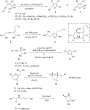
Scheme 2: Gold-catalyzed cycloaddition of alcohols.

Scheme 3: Ionic liquids as the solvent in gold-catalyzed cycloaddition.

Scheme 4: Gold-catalyzed cycloaddition of diynes.

Scheme 5: Gold(I) chloride catalyzed cycloisomerization of 2-alkynyl-1,5-diols.

Scheme 6: Gold-catalyzed cycloaddition of glycols and dihydroxy compounds.

Scheme 7: Gold-catalyzed ring-opening of cyclopropenes.

Scheme 8: Gold-catalyzed intermolecular hydroalkoxylation of alkynes. PR3 = 41–45.

Scheme 9: Gold-catalyzed intramolecular 6-endo-dig cyclization of β-hydroxy-α,α-difluoroynones.

Scheme 10: Gold-catalyzed intermolecular hydroalkoxylation of non-activated olefins.

Scheme 11: Preparation of unsymmetrical ethers from alcohols.

Scheme 12: Expedient synthesis of dihydrofuran-3-ones.

Scheme 13: Catalytic approach to functionalized divinyl ketones.
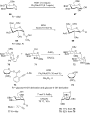
Scheme 14: Gold-catalyzed glycosylation.

Scheme 15: Gold-catalyzed cycloaddition of aldehydes and ketones.

Scheme 16: Gold-catalyzed annulations of 2-(ynol)aryl aldehydes and o-alkynyl benzaldehydes.

Scheme 17: Gold-catalyzed addition of carboxylates.

Scheme 18: Dual-catalyzed rearrangement reaction of allenoates.

Scheme 19: Meyer–Schuster rearrangement of propargylic alcohols.

Scheme 20: Propargylic alcohol rearrangements.

Scheme 21: Gold-catalyzed synthesis of imines and amine alkylation.

Scheme 22: Hydroamination of allenes and allenamides.

Scheme 23: Gold-catalyzed inter- and intramolecular amination of alkynes and alkenes.

Scheme 24: Gold-catalyzed cycloisomerization of O-propioloyl oximes and β-allenylhydrazones.

Scheme 25: Intra- and intermolecular amination with ureas.

Scheme 26: Gold-catalyzed cyclization of ortho-alkynyl-N-sulfonylanilines and but-3-yn-1-amines.

Scheme 27: Gold-catalyzed piperidine ring synthesis.

Scheme 28: Ring expansion of alkylnyl cyclopropanes.

Scheme 29: Gold-catalyzed annulations of N-propargyl-β-enaminones and azomethine imines.
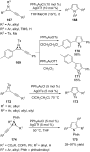
Scheme 30: Gold(I)-catalyzed cycloisomerization of aziridines.

Scheme 31: AuCl3/AgSbF6-catalyzed intramolecular amination of 2-(tosylamino)phenylprop-1-en-3-ols.

Scheme 32: Gold-catalyzed cyclization via a 7-endo-dig pathway.

Scheme 33: Gold-catalyzed synthesis of fused xanthines.

Scheme 34: Gold-catalyzed synthesis of amides and isoquinolines.

Scheme 35: Gold-catalyzed oxidative cross-coupling reactions of propargylic acetates.

Scheme 36: Gold-catalyzed nucleophilic addition to allenamides.

Scheme 37: Gold-catalyzed direct carbon–carbon bond coupling reactions.

Scheme 38: Gold-catalyzed C−H functionalization of indole/pyrrole heterocycles and non-activated arenes.

Scheme 39: Gold-catalyzed cycloisomerization of cyclic compounds.

Scheme 40: Gold-catalyzed cycloaddition of 1-aryl-1-allen-6-enes and propargyl acetates.

Scheme 41: Gold(I)-catalyzed cycloaddition with ligand-controlled regiochemistry.

Scheme 42: Gold(I)-catalyzed cycloaddition of dienes and enynes.

Scheme 43: Gold-catalyzed intramolecular cycloaddition of 3-alkoxy-1,5-enynes and 2,2-dipropargylmalonates.

Scheme 44: Gold-catalyzed intramolecular cycloaddition of 1,5-allenynes.

Scheme 45: Gold(I)-catalyzed cycloaddition of indoles.

Scheme 46: Gold-catalyzed annulation reactions.

Scheme 47: Gold–carbenoid induced cleavage of a sp3-hybridized C−H bond.

Scheme 48: Furan- and indole-based cascade reactions.

Scheme 49: Tandem process using aromatic alkynes.

Scheme 50: Gold-catalyzed cycloaddition of 1,3-dien-5-ynes.

Scheme 51: Gold-catalyzed cascade cyclization of diynes, propargylic esters, and 1,3-enynyl ketones.

Scheme 52: Tandem reaction of β-phenoxyimino ketones and alkynyl oxime ethers.

Scheme 53: Gold-catalyzed tandem cyclization of enynes, 2-(tosylamino)phenylprop-1-yn-3-ols, and allenoates.

Scheme 54: Cyclization of 2,4-dien-6-yne carboxylic acids.

Scheme 55: Gold(I)-catalyzed tandem cyclization approach to tetracyclic indolines.

Scheme 56: Gold-catalyzed tandem reactions of alkynes.

Scheme 57: Aminoarylation and oxyarylation of alkenes.

Scheme 58: Cycloaddition of 2-ethynylnitrobenzene with various alkenes.

Scheme 59: Gold-catalyzed tandem reactions of allenoates and alkynes.

Scheme 60: Gold-catalyzed asymmetric synthesis of 2,3-dihydropyrroles.

Scheme 61: Chiral [NHC–Au(I)]-catalyzed cyclization of enyne.

Scheme 62: Gold-catalyzed hydroaminations and hydroalkoxylations.

Scheme 63: Gold(I)-catalyzed asymmetric hydroalkoxylation of 1,3-dihydroxymethyl-2-alkynylbenzene chromium com...

Scheme 64: Gold-catalyzed synthesis of julolidine derivatives.

Scheme 65: Gold-catalyzed the synthesis of chiral fused heterocycles.

Scheme 66: Gold-catalyzed asymmetric reactions with 3,5-(t-Bu)2-4-MeO-MeOBIPHEP.

Scheme 67: Gold-catalyzed cyclization of o-(alkynyl) styrenes.

Scheme 68: Asymmetric gold(I)-catalyzed redox-neutral domino reactions of enynes.

Scheme 69: Gold(I)-catalyzed enantioselective polyene cyclization reaction.

Scheme 70: Gold(I)-catalyzed enantioselective synthesis of benzopyrans.

Scheme 71: Gold(I)-catalyzed enantioselective ring expansion of allenylcyclopropanols.
Gold-catalyzed propargylic substitutions: Scope and synthetic developments
- Olivier Debleds,
- Eric Gayon,
- Emmanuel Vrancken and
- Jean-Marc Campagne
Beilstein J. Org. Chem. 2011, 7, 866–877, doi:10.3762/bjoc.7.99

- . Direct propargylic substitutions: Scope of nucleophiles. Meyer–Schuster rearrangements. Silyl-protected propargyl alcohols in propargylic substitutions. Acetylacetone as nucleophile in direct propargylic substitution. Enantiomerically enriched propargylic alcohols. Scope of ‘activated’ alcohols in direct

Graphical Abstract

Scheme 1: Gold-catalyzed propargylic substitutions.

Scheme 2: Propargylic substitution: scope of substrates.

Scheme 3: Propargylic substitutions on allylic/propargylic substrates.

Scheme 4: Direct propargylic substitutions: Scope of nucleophiles.

Scheme 5: Meyer–Schuster rearrangements.

Scheme 6: Silyl-protected propargyl alcohols in propargylic substitutions.

Scheme 7: Acetylacetone as nucleophile in direct propargylic substitution.

Scheme 8: Enantiomerically enriched propargylic alcohols.

Scheme 9: Scope of ‘activated’ alcohols in direct substitution reactions.

Scheme 10: BF3 vs AuCl3 in propargylic substitutions [25].

Scheme 11: The use of bis-nucleophiles in direct propargylic substitutions.
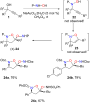
Scheme 12: Tandem reactions from protected hydroxylamines and propargylic alcohols. P = Cbz, PhSO2.

Scheme 13: Tentative hydrolysis of bis-adduct 24a.

Scheme 14: Iron-catalyzed propargylic substitutions.

Scheme 15: Isoxazolines formation.

Scheme 16: Addition of nucleophiles to isoxazolines.

Scheme 17: Potential mechanistic pathways.

Scheme 18: Synthesis of furans from homoproargylic alcohols.

Scheme 19: Synthesis of furans.

Scheme 20: Propargylic substitutions: Synthetic applications. GH2 = Grubbs–Hoveyda 2nd generation catalyst.
When gold can do what iodine cannot do: A critical comparison
- Sara Hummel and
- Stefan F. Kirsch
Beilstein J. Org. Chem. 2011, 7, 847–859, doi:10.3762/bjoc.7.97
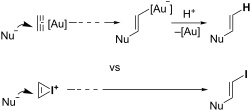
- . Nevertheless, heteroatom nucleophiles having no protons attached react in gold-catalyzed carboalkoxylations [63][64][65][66] and related processes where the analogous electrophilic processes are unknown. Catalyzed propargylic ester rearrangements [67][68] also remain the realm of gold-complexes since such

Graphical Abstract

Scheme 1: Mechanistic scenarios for alkyne activation.

Scheme 2: Synthesis of 3(2H)-furanones.

Scheme 3: Synthesis of furans.

Scheme 4: Formation of dihydrooxazoles.

Scheme 5: Variation on indole formation.

Scheme 6: Formation of naphthalenes.
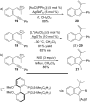
Scheme 7: Formation of indenes.

Scheme 8: Iodocyclization of 3-silyloxy-1,5-enynes.

Scheme 9: 5-Endo cyclizations with concomitant nucleophilic trapping.

Scheme 10: Reactivity of 3-BocO-1,5-enynes.

Scheme 11: Intramolecular nucleophilic trapping.

Scheme 12: Approach to azaanthraquinones.

Scheme 13: Carbocyclizations with enol derivatives.

Scheme 14: Gold-catalyzed cyclization modes for 1,5-enynes.

Scheme 15: Iodine-induced cyclization of 1,5-enynes.
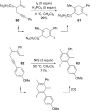
Scheme 16: Diverse reactivity of 1,6-enynes.
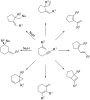
Scheme 17: Iodocyclization of 1,6-enynes.

Scheme 18: Cyclopropanation of alkenes with 1,6-enynes.

Scheme 19: Cyclopropanation of alkenes with 1,6-enynes.
Isotopic labelling studies for a gold-catalysed skeletal rearrangement of alkynyl aziridines
- Paul W. Davies,
- Nicolas Martin and
- Neil Spencer
Beilstein J. Org. Chem. 2011, 7, 839–846, doi:10.3762/bjoc.7.96
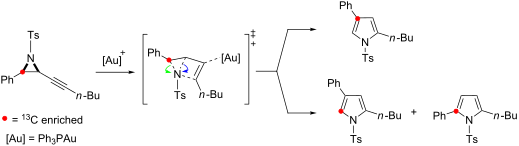
- aziridines into 2,4-disubstituted pyrroles. Two isotopomers of the expected skeletal rearrangement product were identified using 13C-labelling and led to a revised mechanism featuring two distinct skeletal rearrangements. The mechanistic proposal has been rationalised against the reaction of a range of 13C
- the most common fundamental steps in these skeletal rearrangements involves C–C bond fission through 1,2-migration. This step is triggered by the generation of carbocationic character, which is generally stabilised in some form, either by an adjacent gold atom or through extended delocalisation. While
- , and hence the isotopomeric reaction selectivity, is controlled by the relative ability of the substituents to stabilise the respective cations in favour of a particular pathway. The observed skeletal rearrangements are consistent with either a 1,2-aryl shift or a 1,2-(metal-stabilised)-vinyl shift in

Graphical Abstract

Scheme 1: Gold-catalysed cycloisomerisations of aryl–alkynyl aziridine to pyrroles.

Scheme 2: Working mechanism to rationalise the formation of two regiosomeric pyrroles in the gold catalysed c...

Scheme 3: Bond fissions featured in the proposed mechanistic hypothesis and the initial mechanism probe.

Scheme 4: Preparation of D-labelled alkynyl aziridine 4. DMP = Dess–Martin periodinane.

Scheme 5: Reaction of deuterated alkynyl aziridine 4 in the skeletal rearrangement reaction.

Scheme 6: Preparation of 13C-enriched alkynyl aziridines.

Scheme 7: Cycloisomerisation of 11 in the skeletal rearrangement reaction.

Scheme 8: Cycloisomerisation of 11 to give 2,5-disubstituted pyrrole.

Scheme 9: Cycloisomerisation of 14 in the skeletal rearrangement reaction.

Scheme 10: Cycloisomerisation of 15 in the skeletal rearrangement reaction.

Scheme 11: Revised mechanism for the formation of 2,4-isomers by skeletal rearrangement.

Scheme 12: Synthesis of alkynyl aziridines 30 and 31.

Scheme 13: Electronic effects on the outcome of the skeletal rearrangement processes.

Scheme 14: Mechanistic rationale for the deuterium labelling study using Ph3PAuCl/AgOTf.
Highly efficient gold(I)-catalyzed Overman rearrangement in water
- Dong Xing and
- Dan Yang
Beilstein J. Org. Chem. 2011, 7, 781–785, doi:10.3762/bjoc.7.88
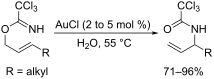
- have been used for different types of [3,3]-sigmatropic rearrangements [14][15], only Pd(II) and Hg(II) salts have found wide application in Overman rearrangements. In recent years, gold catalysts have been successfully applied to a series of [3,3]-sigmatropic rearrangements, such as the rearrangement


Synthetic applications of gold-catalyzed ring expansions
- David Garayalde and
- Cristina Nevado
Beilstein J. Org. Chem. 2011, 7, 767–780, doi:10.3762/bjoc.7.87
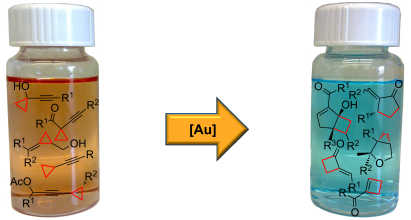
- on transition metal promoted rearrangements of bicyclo[1.1.0]butanes [11]. Thus Ru–carbonyl complexes promote the rearrangement of 1,2,2-trimethylbicyclo[1.1.0]butane (1) to yield diene 2 and the cyclopropyl derivative 3 (Scheme 1, reaction 1: a,b for 2 and 3), whilst pentafluorophenylcopper tetramer
- into the angular triquinane ventricosene in six steps (Scheme 23). 6 Ring expansions involving propargyl acyloxy rearrangements Propargyl carboxylates 80 can be π-activated by gold towards 1,2-acyloxy migration and/or [3,3]-sigmatropic rearrangement. Two different, but mechanistically related
- organic chemist. Transition metal promoted rearrangements of bicyclo[1.1.0]butanes. Gold-catalyzed rearrangements of strained rings. Gold-catalyzed ring expansions of cyclopropanols and cyclobutanols. Mechanism of the cycloisomerization of alkynyl cyclopropanols and cyclobutanols. Proposed mechanism for

Graphical Abstract

Scheme 1: Transition metal promoted rearrangements of bicyclo[1.1.0]butanes.

Scheme 2: Gold-catalyzed rearrangements of strained rings.

Scheme 3: Gold-catalyzed ring expansions of cyclopropanols and cyclobutanols.

Scheme 4: Mechanism of the cycloisomerization of alkynyl cyclopropanols and cyclobutanols.

Scheme 5: Proposed mechanism for the Au-catalyzed isomerization of alkynyl cyclobutanols.

Scheme 6: Gold-catalyzed cycloisomerization of 1-allenylcyclopropanols.

Scheme 7: Gold-catalyzed cycloisomerization of cyclopropylmethanols.

Scheme 8: Gold-catalyzed cycloisomerization of aryl alkyl epoxides.

Scheme 9: Gold-catalyzed synthesis of furans.

Scheme 10: Transformations of alkynyl oxiranes.

Scheme 11: Transformations of alkynyl oxiranes into ketals.

Scheme 12: Gold-catalyzed cycloisomerization of cyclopropyl alkynes.

Scheme 13: Gold-catalyzed synthesis of substituted furans.

Scheme 14: Proposed mechanism for the isomerization of alkynyl cyclopropyl ketones.

Scheme 15: Cycloisomerization of cyclobutylazides.

Scheme 16: Cycloisomerization of alkynyl aziridines.

Scheme 17: Gold-catalyzed synthesis of disubstituted cyclohexadienes.

Scheme 18: Gold-catalyzed synthesis of indenes.

Scheme 19: Gold-catalyzed [n + m] annulation processes.

Scheme 20: Gold-catalyzed generation of 1,4-dipoles.

Scheme 21: Gold-catalyzed synthesis of repraesentin F.

Scheme 22: Gold-catalyzed ring expansion of cyclopropyl 1,6-enynes.

Scheme 23: Gold-catalyzed synthesis of ventricos-7(13)-ene.

Scheme 24: 1,2- vs 1,3-Carboxylate migration.

Scheme 25: Gold-catalyzed cycloisomerization of vinyl alkynyl cyclopropanes.

Scheme 26: Proposed mechanism for the cycloisomerization of vinyl alkynyl cyclopropanes.

Scheme 27: Gold-catalyzed 1,2-acyloxy rearrangement/cyclopropanation/cycloisomerization cascades.

Scheme 28: Formal total synthesis of frondosin A.

Scheme 29: Gold-catalyzed rearrangement/cycloisomerization of cyclopropyl propargyl acetates.
When cyclopropenes meet gold catalysts
- Frédéric Miege,
- Christophe Meyer and
- Janine Cossy
Beilstein J. Org. Chem. 2011, 7, 717–734, doi:10.3762/bjoc.7.82
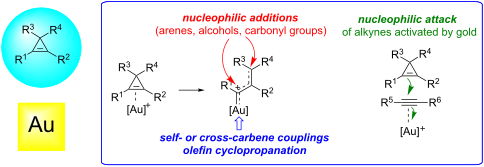
- secondary benzylic cyclopropyl cation). The gold carbene 31 was captured by the aromatic group at C3 via an intramolecular Friedel–Crafts reaction. Subsequent elimination of AcOH from compound 33 then delivered methylene indene 30 (Scheme 14) [21]. Other gold-catalyzed rearrangements of cyclopropenes that

Graphical Abstract

Scheme 1: General reactivity of cyclopropenes in the presence of gold catalysts.

Scheme 2: Cationic organogold species generated from cyclopropenone acetals.

Scheme 3: Rotation barriers around the C2–C3 bond (M06 DFT calculations).

Scheme 4: Au–C1 bond length in organogold species of type D.

Scheme 5: Gold-catalyzed addition of alcohols or water to cyclopropene 8.

Scheme 6: Gold-catalyzed addition of alcohols to cyclopropene 10.

Scheme 7: Mechanism of the gold-catalyzed addition of alcohols to cyclopropenes.

Scheme 8: Synthesis of tert-allylic ethers from cyclopropenes and allenes.

Scheme 9: Oxidation of the intermediate gold–carbene with diphenylsulfoxide.

Scheme 10: Gold, copper and Lewis acid-catalyzed reactions of cyclopropene 18.

Scheme 11: Mechanism of the Lewis acid-catalyzed reactions of cyclopropene 18.

Scheme 12: Gold-catalyzed rearrangement of vinylcyclopropenes 25.

Scheme 13: Gold-catalyzed rearrangement of cyclopropenes 27 to indenes 28.

Scheme 14: Gold-catalyzed rearrangement of cyclopropenes 29 to indenes 30.

Scheme 15: Gold-catalyzed rearrangement of cyclopropenyl ester 34a.

Scheme 16: Gold-catalyzed reactions of cyclopropenyl esters 34b–34d.

Scheme 17: Gold-catalyzed reactions of cyclopropenylsilane 34e.

Scheme 18: Gold-catalyzed rearrangement of cyclopropenylmethyl acetates.

Scheme 19: Mechanism of the gold-catalyzed rearrangement of cyclopropenes 39.

Scheme 20: Gold-catalyzed cyclopropanation of styrene with cyclopropene 8.

Scheme 21: Representative reactions of carbene precursors on gold metal.

Scheme 22: Intermolecular olefin cyclopropanation with gold carbenes generated from cyclopropenes.

Scheme 23: Gold-catalyzed formation of trienes from cyclopropenes and furans.

Scheme 24: Gold-catalyzed formation of trienes from cyclopropenes and furans.

Scheme 25: Gold-catalyzed formation of trienes from cyclopropenes and furans.

Scheme 26: Gold-catalyzed cycloisomerization of cyclopropene-ene 59.

Scheme 27: Gold-catalyzed cycloisomerization of substituted allyl cyclopropenyl carbinyl ethers 62a–62f.
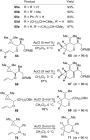
Scheme 28: Gold-catalyzed cycloisomerization of cyclopropene-enes.

Scheme 29: Gold-catalyzed cycloisomerization of cyclopropene-ynes.

Scheme 30: Formation of products arising from a double cleavage process in the gold-catalyzed cycloisomerizati...

Scheme 31: Gold-catalyzed cycloisomerization of cyclopropene-ynes involving a double cleavage process.

Scheme 32: Gold-catalyzed reaction of cyclopropene-ynes, cyclopropene-enes and cyclopropene-allenes.
The arene–alkene photocycloaddition
- Ursula Streit and
- Christian G. Bochet
Beilstein J. Org. Chem. 2011, 7, 525–542, doi:10.3762/bjoc.7.61
- photocycloaddition followed by rearrangements. Stable [2 + 2] photocycloadducts. Ortho photocycloadditions with alkynes. Intramolecular ortho photocycloaddition and rearrangement thereof. Intramolecular ortho photocycloaddition to access propellanes. Para photocycloaddition with allene. Photocycloadditions of

Graphical Abstract

Scheme 1: Photochemistry of benzene.

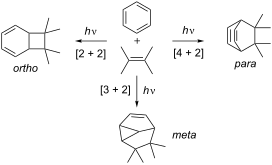
Scheme 2: Three distinct modes of photocycloaddition of arenes to alkenes.

Scheme 3: Mode selectivity with respect of the free enthalpy of the radical ion pair formation.

Scheme 4: Photocycloaddition shows lack of mode selectivity.

Scheme 5: Mechanism of the meta photocycloaddition.

Scheme 6: Evidence of biradiacal involved in meta photocycloaddition by Reedich and Sheridan.

Scheme 7: Regioselectivity with electron withdrawing and electron donating substituents.

Scheme 8: Closure of cyclopropyl ring affords regioisomers.

Scheme 9: Endo versus exo product in the photocycloaddition of pentene to anisole [33].

Scheme 10: Regio- and stereoselectivity in the photocycloaddition of cyclopentene with a protected isoindoline....

Scheme 11: 2,6- and 1,3-addition in intramolecular approach.

Scheme 12: Linear and angularly fused isomers can be obtained upon intramolecular 1,3-addition.

Scheme 13: Synthesis of α-cedrene via diastereoselective meta photocycloaddition.

Scheme 14: Asymmetric meta photocycloaddition introduced by chirality of tether at position 2.

Scheme 15: Enantioselective meta photocycloaddition in β-cyclodextrin cavity.

Scheme 16: Vinylcyclopropane–cyclopentene rearrangement.

Scheme 17: Further diversification possibilities of the meta photocycloaddition product.

Scheme 18: Double [3 + 2] photocycloaddition reaction affording fenestrane.

Scheme 19: Total synthesis of Penifulvin B.

Scheme 20: Towards the total synthesis of Lacifodilactone F.

Scheme 21: Regioselectivity of ortho photocycloaddition in polarized intermediates.

Scheme 22: Exo and endo selectivity in ortho photocycloaddition.

Scheme 23: Ortho photocycloaddition of alkanophenones.

Scheme 24: Photocycloadditions to naphtalenes usually in an [2 + 2] mode [79].

Scheme 25: Ortho photocycloaddition followed by rearrangements.

Scheme 26: Stable [2 + 2] photocycloadducts.

Scheme 27: Ortho photocycloadditions with alkynes.

Scheme 28: Intramolecular ortho photocycloaddition and rearrangement thereof.

Scheme 29: Intramolecular ortho photocycloaddition to access propellanes.

Scheme 30: Para photocycloaddition with allene.

Scheme 31: Photocycloadditions of dianthryls.

Scheme 32: Photocycloaddition of enone with benzene.

Scheme 33: Intramolecular photocycloaddition affording multicyclic compounds via [4 + 2].

Scheme 34: Photocycloaddition described by Sakamoto et al.

Scheme 35: Proposed mechanism by Sakamoto et al.

Scheme 36: Photocycloaddition described by Jones et al.

Scheme 37: Proposed mechanism for the formation of benzoxepine by Jones et al.

Scheme 38: Photocycloaddition observed by Griesbeck et al.

Scheme 39: Mechanism proposed by Griesbeck et al.

Scheme 40: Intramolecular photocycloaddition of allenes to benzaldehydes.



