


Search results
Search for "decarboxylation" in Full Text gives 252 result(s) in Beilstein Journal of Organic Chemistry. Showing first 200.
Bifunctional phase-transfer catalysis in the asymmetric synthesis of biologically active isoindolinones
Beilstein J. Org. Chem. 2015, 11, 2591–2599, doi:10.3762/bjoc.11.279
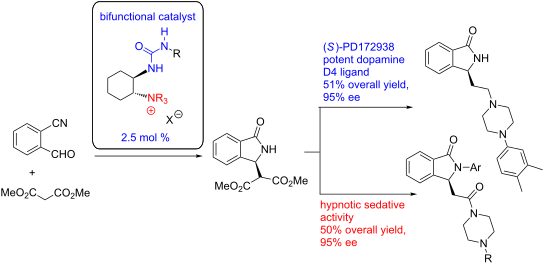
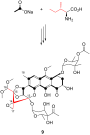
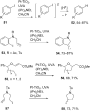
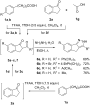
- to obtain both the enantiomers of chiral bioactive compounds. In this case, we focused on (R,R)-8a, which afforded the required (S)-7 (the absolute configuration has been previously determined by vibrational circular dichroism) [31]. Asymmetric synthesis of 9 by decarboxylation of (S)-7 Although
- poor enantioselectivity (ee <10%) [9], while racemic analogues of 9 were resolved in the past in very low yields [4]. This disappointing picture prompted us to find a viable access route to enantioenriched 9. We thus investigated the decarboxylation of the chiral dimethyl 2-(S)-(1-oxoisoindolin-3-yl
- )malonate ((S)-7), according to Scheme 2. We firstly focused on two well-known mild procedures in order to avoid the classical harsh acidic conditions. Disappointingly, modifications of the Krapcho decarboxylation performed with a LiCl/H2O/DMF mixture under reflux [36][37] led to partial racemization of the


Synthesis of Xenia diterpenoids and related metabolites isolated from marine organisms
Beilstein J. Org. Chem. 2015, 11, 2521–2539, doi:10.3762/bjoc.11.273
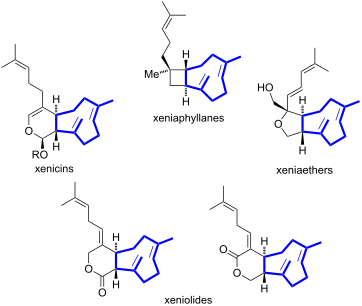
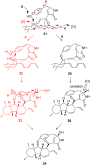
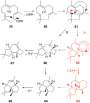
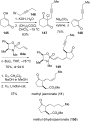
- of ethyl (phenylsulfonyl)acetate, a methylsulfonyl anion equivalent, to cyclobutene ester 49 followed by a sequence consisting of saponification, regioselective decarboxylation and reesterification to afford methyl ester 50. The ester group was reduced with lithium aluminum hydride and the resulting







Recent highlights in biosynthesis research using stable isotopes
Beilstein J. Org. Chem. 2015, 11, 2493–2508, doi:10.3762/bjoc.11.271
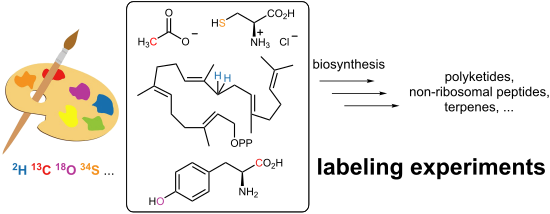
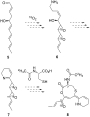
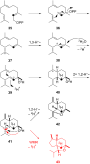
- incorporation pattern in the tricyclic aromatic moiety suggests a normal PKS assembly line. Moreover, a decarboxylation step is indicated by incorporation of the acetate methyl carbon atom into C-18. In contrast, the origins of C-13 to C-17 remained unclear because of low incorporation of acetate into this part











Biocatalysis for the application of CO2 as a chemical feedstock
Beilstein J. Org. Chem. 2015, 11, 2370–2387, doi:10.3762/bjoc.11.259
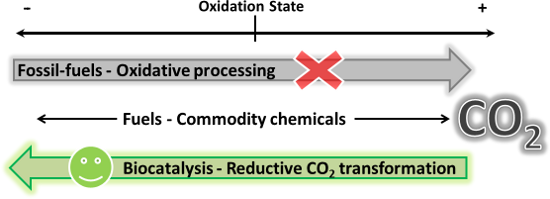
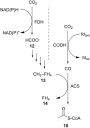
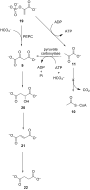
- decarboxylation. In some autotrophs this pathway is known to operate in the reverse (reductive) direction resulting in CO2 fixation through carboxylation [52]. Autotrophic fixation through the reductive TCA cycle was first described by Arnon and Buchanan [53], and hence is also referred to as the Arnon–Buchanan






Convenient preparation of high molecular weight poly(dimethylsiloxane) using thermally latent NHC-catalysis: a structure-activity correlation
Beilstein J. Org. Chem. 2015, 11, 2261–2266, doi:10.3762/bjoc.11.246
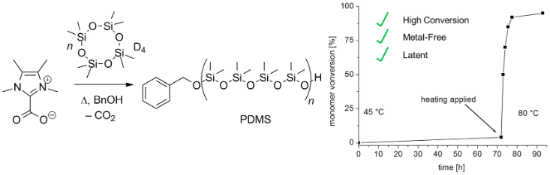
- 5Me-Me-CO2. Note that the fivefold monomer excess was used in case of BnOH being present. Thermal activation of a 5Me-Me-CO2/BnOH/D4 (1:5:500) composition after a latency period of 72 h. NHC-carboxylates part of this study (top) and polymerization scheme with initial thermal decarboxylation and final


2-Hetaryl-1,3-tropolones based on five-membered nitrogen heterocycles: synthesis, structure and properties
Beilstein J. Org. Chem. 2015, 11, 2179–2188, doi:10.3762/bjoc.11.236
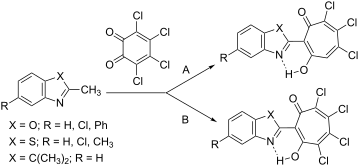
- compounds. At the same time, the related molecular system of 1,3-tropolone has been insufficiently investigated. Therefore, the development of methods for the synthesis of 1,3-tropolones and the study of their properties is of considerable interest. The parent compound was first obtained via decarboxylation


![[Graphic 3]](/bjoc/content/inline/1860-5397-11-236-i8.png?max-width=637&scale=1.18182) N···H–O equilibrium in solutions of 2-hetaryl-5,6,7-trichloro- and 4,...
N···H–O equilibrium in solutions of 2-hetaryl-5,6,7-trichloro- and 4,...


C–H bond halogenation catalyzed or mediated by copper: an overview
Beilstein J. Org. Chem. 2015, 11, 2132–2144, doi:10.3762/bjoc.11.230
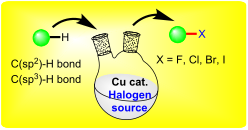
- -component annulation intermediate 60 which led to the formation of indolizine 61 via oxidative decarboxylation. And the bromination of 61 took place in situ to give products 59 via an unprecedented dehydrogenative bromination (Scheme 19). By making use of the copper-mediated arene C–H bond halogenation


Preparative semiconductor photoredox catalysis: An emerging theme in organic synthesis
Beilstein J. Org. Chem. 2015, 11, 1570–1582, doi:10.3762/bjoc.11.173
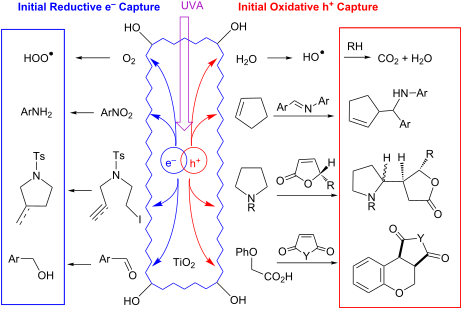
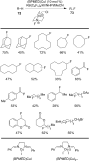
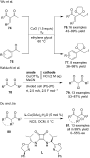
- both solution [38][54][55], and solid state studies [62]. This decarboxylation is favorable for precursors that generate stabilized RXCH2• radicals, thus explaining the superior yields and conversions recorded. Radical stabilization from the simple aliphatic acids of Scheme 5 (top) is minimal; so back







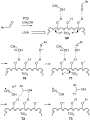
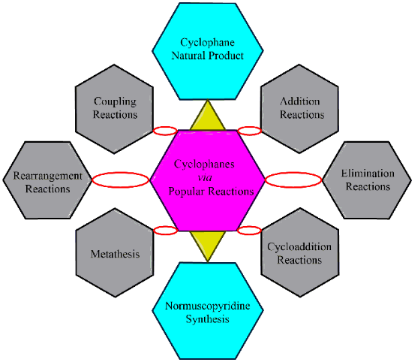
Selected synthetic strategies to cyclophanes
Beilstein J. Org. Chem. 2015, 11, 1274–1331, doi:10.3762/bjoc.11.142
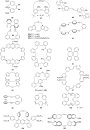
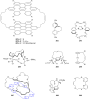
- , 1,3-cyclododecadiene (337) was reacted with maleic anhydride to give the DA product 338 (21%). Later, the DA adduct 338 was heated under reflux in 10% aq tetrahydrofuran to afford the diacid, which on decarboxylation in the presence of lead tetraacetate in a toluene/pyridine mixture delivered compound






Radical-mediated dehydrative preparation of cyclic imides using (NH4)2S2O8–DMSO: application to the synthesis of vernakalant
Beilstein J. Org. Chem. 2015, 11, 1008–1016, doi:10.3762/bjoc.11.113
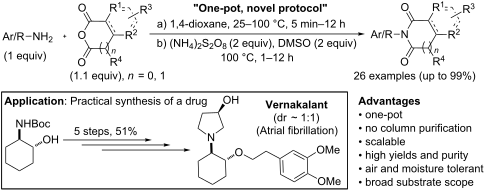
- synthesis of imides from the combination of aliphatic amines and unsaturated anhydrides. Plausibly, the intermediate amic acid in these cases may be prone to decarboxylation [57] and radical polymerization similar to the acrylamide polymerization using APS as a radical initiator [55]. Encouraged by this


DBU-promoted carboxylative cyclization of o-hydroxy- and o-acetamidoacetophenone
Beilstein J. Org. Chem. 2015, 11, 906–912, doi:10.3762/bjoc.11.102

- thermodynamically stable coumarins. Importantly, the use of an intramolecular in situ trap avoids the problem of decarboxylation during workup. In case of o-acetamidoacetophenones, an acyl migration from nitrogen to carbon was observed. The cross experiment showed that the N to C acyl shift occurred


An intramolecular C–N cross-coupling of β-enaminones: a simple and efficient way to precursors of some alkaloids of Galipea officinalis
Beilstein J. Org. Chem. 2015, 11, 884–892, doi:10.3762/bjoc.11.99

- Knoevenagel/reduction/hydrolysis/decarboxylation pathway (steps a–d in Scheme 4) to carboxylic acid 10 suffered from low yields of the last two steps (total yield 33%). The attempt to obtain 5a directly from 9 by means of Krapcho decarboxylation [33] failed, as the product was contaminated with inseparable


Trifluoromethyl-substituted tetrathiafulvalenes
Beilstein J. Org. Chem. 2015, 11, 647–658, doi:10.3762/bjoc.11.73
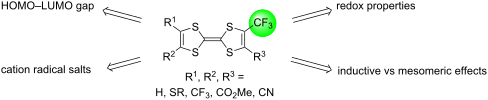
- and Discussion Syntheses The reported preparation of 2bc is based on the coupling reaction of the trithiocarbonate 5 with the dithiocarbonate 6bc, affording also the symmetrical coupling product 4bc (Scheme 3) [31]. Further decarboxylation of 2bc with LiBr/DMF afforded 1c while reaction with NH3 in




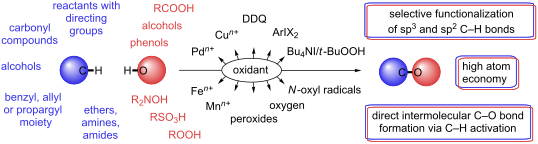
Cross-dehydrogenative coupling for the intermolecular C–O bond formation
Beilstein J. Org. Chem. 2015, 11, 92–146, doi:10.3762/bjoc.11.13






Sequential decarboxylative azide–alkyne cycloaddition and dehydrogenative coupling reactions: one-pot synthesis of polycyclic fused triazoles
Beilstein J. Org. Chem. 2014, 10, 3031–3037, doi:10.3762/bjoc.10.321
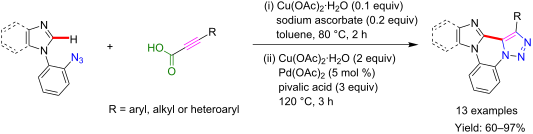
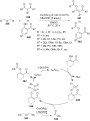
- formation of 4 is described in Scheme 5. Initially alkynoic acid 2 undergoes decarboxylation to form the copper acetylide (A) in the presence of the Cu+ catalyst which is generated by the reduction of Cu2+ with sodium ascorbate. The obtained copper acetylide undergoes regioselective [3 + 2] cycloaddition


Aspergiloid I, an unprecedented spirolactone norditerpenoid from the plant-derived endophytic fungus Aspergillus sp. YXf3
Beilstein J. Org. Chem. 2014, 10, 2677–2682, doi:10.3762/bjoc.10.282
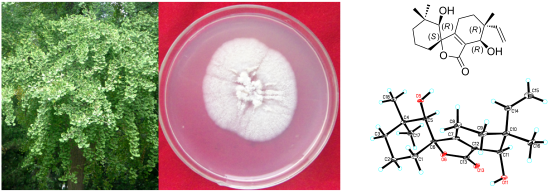
- intermediate 2 undergoes decarboxylation to form 3 through Baeyer–Villiger oxidation to form the 7-membered lactone 4, then hydrolyzation, decarboxylation and lactonization to finally give aspergiloid I (1). Aspergiloid I (1) was evaluated for its cytotoxicity against eleven human cancer cell lines, K562


Gold(I)-catalysed synthesis of a furan analogue of thiamine pyrophosphate
Beilstein J. Org. Chem. 2014, 10, 2580–2585, doi:10.3762/bjoc.10.270
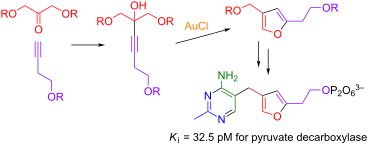
- ; pyruvate decarboxylase; thiamine diphosphate; Introduction The biologically active form of vitamin B1 is thiamine diphosphate (ThDP, 1, Figure 1), which is an essential cofactor and involved in a number of metabolic pathways, including oxidative and non-oxidative decarboxylation of α-keto acids (e.g
- Breslow [3][4], is given in Scheme 1. After formation of the ThDP ylid, the keto group of the substrate is attacked by the thiazolium C-2 carbanion to form the tetrahedral pre-decarboxylation intermediate 2-(2-lactyl)-ThDP, LThDP. It has been proposed that the covalent attachment of pyruvate to form LThDP
- introduces significant strain, the release of which is a driving force for the decarboxylation [5]. The effects of this type of strain on bond angles and lengths have recently been observed in a high resolution crystal structure of another ThDP-dependent enzyme, transketolase [6]. Another important factor of


(CF3CO)2O/CF3SO3H-mediated synthesis of 1,3-diketones from carboxylic acids and aromatic ketones
Beilstein J. Org. Chem. 2014, 10, 2270–2278, doi:10.3762/bjoc.10.236
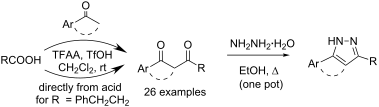
- recently reported by us [27] and decarboxylation was subsequently carried out, 1,3-diphenylphosphorylated acetone 5 could be obtained (reaction 2 in Scheme 2). The two-stage one-pot reaction of γ-phenylbutanoic acid (1c) and 3-hydroxy-1-adamantylacetic acid (1k) gave as a result the trifluoroacetylated


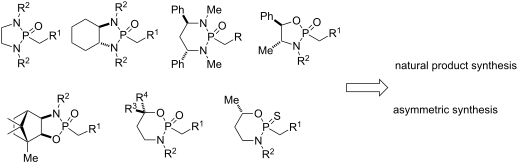
Application of cyclic phosphonamide reagents in the total synthesis of natural products and biologically active molecules
Beilstein J. Org. Chem. 2014, 10, 1848–1877, doi:10.3762/bjoc.10.195
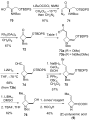
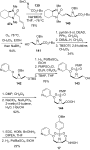
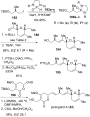
- palladium catalysis and subsequent decarboxylation yielded enone 118 as a single diastereomer. Addition of the Li anion of phosphonamide 24c to enone 118 afforded adduct 119 as a single isomer, with the attack occurring to the less hindered face of the enone. Further elaboration of the side chain was








An economical and safe procedure to synthesize 2-hydroxy-4-pentynoic acid: A precursor towards ‘clickable’ biodegradable polylactide
Beilstein J. Org. Chem. 2014, 10, 1365–1371, doi:10.3762/bjoc.10.139
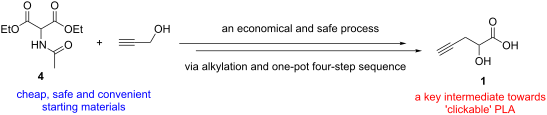
- synthetic route to prepare 1 using cheap and commercially available diethyl 2-acetamidomalonate (4) and propargyl alcohol. The desired product 1 was obtained via alkylation of malonate 4 with propargyl tosylate followed by a one-pot four-step sequence of hydrolysis, decarboxylation, diazotization and
- economical and safe procedure using diethyl 2-acetamidomalonate (4) and propargyl alcohol as starting materials to synthesize 1. The synthesis was completed via alkylation of malonate 4 with propargyl tosylate followed by a one-pot four-step sequence of hydrolysis, decarboxylation, diazotization and
- sequential hydrolysis of amide and esters, and decarboxylation of the resulting malonic acid. The resulting intermediate 6 was not isolated and used directly for the subsequent reaction. Notably, basic treatment of 5 as discussed in literature [31][33] would not allow conversion of 5 to 6 in a convenient one


Syntheses of fluorooxindole and 2-fluoro-2-arylacetic acid derivatives from diethyl 2-fluoromalonate ester
Beilstein J. Org. Chem. 2014, 10, 1213–1219, doi:10.3762/bjoc.10.119
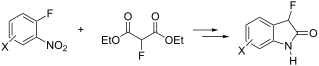
- ester is utilised as a building block for the synthesis of 2-fluoro-2-arylacetic acid and fluorooxindole derivatives by a strategy involving nucleophilic aromatic substitution reactions with ortho-fluoronitrobenzene substrates followed by decarboxylation, esterification and reductive cyclisation
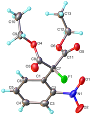
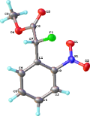
- structure of isolated diester 3 was confirmed by X-ray crystallography (Figure 1). In initial experiments, decarboxylation of 3 by reaction with potassium hydroxide gave good yields of the corresponding 2-fluoro-2-arylacetic acid 4a. However, in subsequent experiments, we found that further purification of
- the diester 3 after the initial SNAr step was not necessary and decarboxylation of crude diester 3 gave 4a very efficiently. Consequently, in all analogous experiments (Table 1), crude product diesters of type 3 were isolated and used without further purification, allowing the ready synthesis of a





A convenient enantioselective decarboxylative aldol reaction to access chiral α-hydroxy esters using β-keto acids
Beilstein J. Org. Chem. 2014, 10, 969–974, doi:10.3762/bjoc.10.95
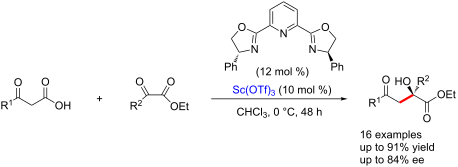
- did not improve in the cases of methyl, isopropyl or benzyl esters (Table 2, entries 2–4). The mechanism of the reaction was proposed based on the kinetic studies of the malonic acid half thioester system by Shair [33]. Essentially β-keto acids can undergo decarboxylation or deprotonation to generate
- enolates. Though in the case of enzymatic reactions, decarboxylation occurs first to form the enolates, followed by condensation with esters; it is believed that in the scandium-catalysed aldol process of β-keto acid, similar to the case of malonic acid half thioesters, decarboxylation happens after the
- addition to the ester (Scheme 2). First, deprotonation and enolisation of 9 followed by addition of α-keto ester 2 gives intermediate 11. After decarboxylation to afford 12, a protonation step occurs late in the reaction pathway to form the aldol product 3 and completes the mechanistic cycle. Conclusion We


Aza-Diels–Alder reaction between N-aryl-1-oxo-1H-isoindolium ions and tert-enamides: Steric effects on reaction outcome
Beilstein J. Org. Chem. 2014, 10, 848–857, doi:10.3762/bjoc.10.81
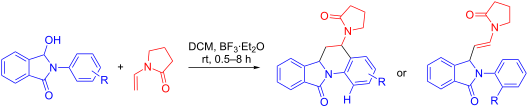
- N-aryl-3-hydroxyisoindolinones with diethyl malonate and subsequent hydrolysis, decarboxylation and Friedel–Crafts acylation sequence also result in the formation of isoindolo[2,1-a]quinolones [16][17]. N-aryl-3-hydroxyisoindolinones with an aptly positioned alkene moiety at the ortho position of


Dimerisation, rhodium complex formation and rearrangements of N-heterocyclic carbenes of indazoles
Beilstein J. Org. Chem. 2014, 10, 832–840, doi:10.3762/bjoc.10.79
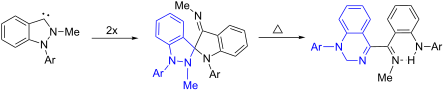
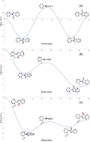
- indazole 3 has been generated by thermal decarboxylation of indazolium-3-carboxylates 1 [20] which belong to the class of pseudo-cross-conjugated heterocyclic mesomeric betaines (Scheme 1). Its properties have been calculated [20][21] and examined by means of vibrational spectroscopy [21]. It was shown
- that pseudo-cross-conjugated mesomeric betaines decarboxylate readily in the absence of stabilizing effects such as hydrogen bonds to protic solvents or water of crystallization [18][19]. Thus, the Gibbs free energy difference for the decarboxylation of 1,2-dimethylindazolium-3-carboxylate under






A novel family of (1-aminoalkyl)(trifluoromethyl)- and -(difluoromethyl)phosphinic acids – analogues of α-amino acids
Beilstein J. Org. Chem. 2014, 10, 722–731, doi:10.3762/bjoc.10.66
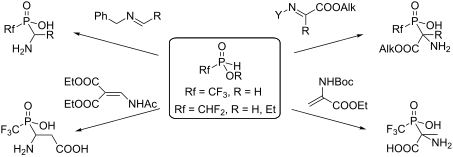
- 8. Insoluble in the reaction mixture phosphinic acid 37 was filtered off and characterized. 31P NMR analysis of filtrate showed the presence of adduct 35 and the decarboxylation product 36 in an approximate 1:10 ratio along with starting esters 3 and 4 and (trifluoromethyl)phosphonic acid (10) (<5
- to the activated C=C double bond of malonate 38 followed by hydrolysis and decarboxylation to generate adduct 39 in two steps (Scheme 10). Conclusion In conclusion, we have presented a variety of approaches to novel fluorinated (1-aminoalkyl)phosphinic acids starting from the appropriate fluorinated





