Search results
Search for "small molecules" in Full Text gives 239 result(s) in Beilstein Journal of Organic Chemistry. Showing first 200.
Synthesis and biological evaluation of novel N-α-haloacylated homoserine lactones as quorum sensing modulators
Beilstein J. Org. Chem. 2014, 10, 2539–2549, doi:10.3762/bjoc.10.265
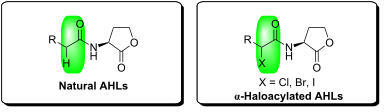
- proximity of carbonyl groups can influence the conformation of molecules by an n→π* interaction [16][17]. Newberry and Raines, very recently proposed that tailored small molecules, that could attenuate this n→π* interaction, in which the lone pair (n) of the N-acyl oxygen overlays with the π* orbital of the



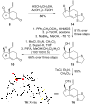
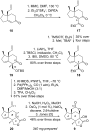
Formal total syntheses of classic natural product target molecules via palladium-catalyzed enantioselective alkylation
Beilstein J. Org. Chem. 2014, 10, 2501–2512, doi:10.3762/bjoc.10.261
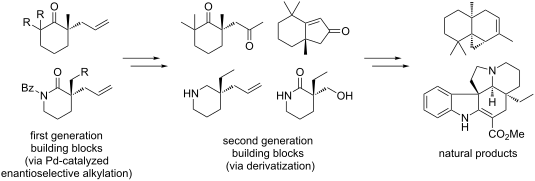
- chemistry, further elaboration allows access to many bioactive small molecules. In our lab alone, this palladium-catalyzed alkylation has enabled the enantioselective total syntheses of dichroanone [4], elatol [5], cyanthiwigins [6][7][8], carissone [9], cassiol [10], chamigrenes [11], and liphagal [12



A small azide-modified thiazole-based reporter molecule for fluorescence and mass spectrometric detection
Beilstein J. Org. Chem. 2014, 10, 2470–2479, doi:10.3762/bjoc.10.258
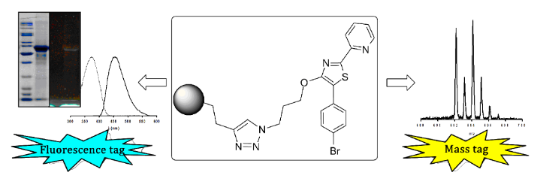
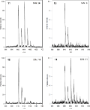
- fluorescence, UV absorption and MS properties are concerned. Visualization of small molecules by mass spectrometric detection To demonstrate the universal application possibilities, we next coupled reporter molecules with a synthetic reactive group as commonly used in ABPP approaches. The alkyne-modified (2E
- . We show model experiments that demonstrate the suitability of the molecule in labeling small molecules and in ABPP investigations. Fluorescence and MS offer orthogonal opportunities for detection and make this reporter a universal tool for targeting molecules of different sizes and properties
- by introduction of charged species like ammonium or phosphonium for ionization in the positive mode [18][19][20]. Bromine [19][21][22] or chlorine [23] containing tags were also introduced as they generate a unique isotopic pattern and therefore enhance recognition and identification of labeled small



Synthesis of novel conjugates of a saccharide, amino acids, nucleobase and the evaluation of their cell compatibility
Beilstein J. Org. Chem. 2014, 10, 2406–2413, doi:10.3762/bjoc.10.250
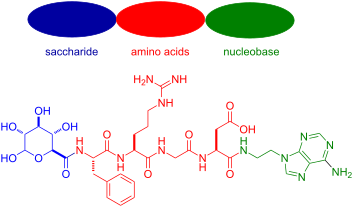
- evolution, nature selects saccharides, peptides, and nucleobases as the fundamental building blocks for the creation of biomacromolecules, which lay the molecular foundations of life. This simple fact and the self-assembly of small molecules in water have inspired us to explore the conjugates of those three


Molecular recognition of AT-DNA sequences by the induced CD pattern of dibenzotetraaza[14]annulene (DBTAA)–adenine derivatives
Beilstein J. Org. Chem. 2014, 10, 2175–2185, doi:10.3762/bjoc.10.225
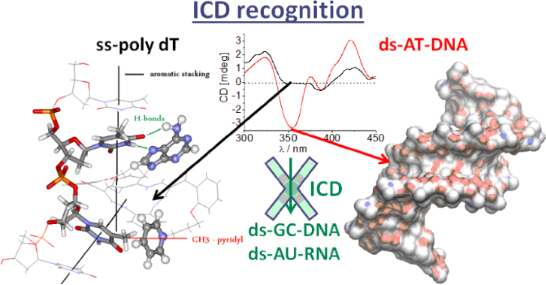
- /RNA intercalation, minor or major groove binding, and external electrostatic binding [1]. However, non-covalent interactions involving small molecules (Mw < 600) can only rely on a small number of interacting groups, while the steric parameters of DNA/RNA binding sites are also quite limited
- in proteins which use selective binding interactions of an arginine-rich side arm inside the AT sequence minor groove to broaden the related DNA major groove, within which the protein biological action takes place [5]. However, the majority of known small molecules are not able to distinguish AT
- interactions. The polynucleotide secondary structure is chiral itself, and any binding-induced conformational changes are reflected in the CD spectrum [19]. Moreover, the uniform binding of achiral small molecules within chiral DNA/RNA helix results in an induced CD spectrum (ICD) of the small molecule


Syntheses of 15N-labeled pre-queuosine nucleobase derivatives
Beilstein J. Org. Chem. 2014, 10, 1914–1918, doi:10.3762/bjoc.10.199
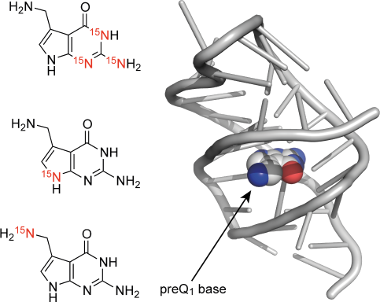
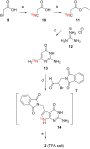
- preQ1 base. The new derivatives carry the potential for modern NMR spectroscopic applications to study the recognition process of these small molecules with RNA aptamer domains from the three preQ1 riboswitch classes known to this date [4][5][18]. Experimental General.Chemical reagents and solvents were



Theoretical study of the adsorption of benzene on coinage metals
Beilstein J. Org. Chem. 2014, 10, 1775–1784, doi:10.3762/bjoc.10.185
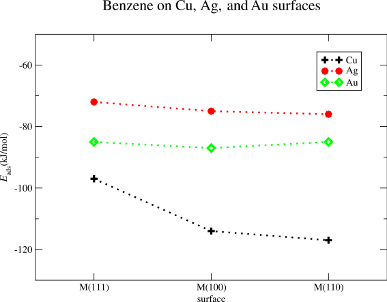
- PBE-D3 followed by single-point calculations with PBE-D3(ABC) for adsorption energies. Surprisingly, we realize that the RevPBE-D3 and RevPBE-D3(BJ) methods, which yield a more realistic description of the adsorption of small molecules on ionic surfaces [26], seem to be not suitable for the present


Synthesis, characterization and DNA interaction studies of new triptycene derivatives
Beilstein J. Org. Chem. 2014, 10, 1290–1298, doi:10.3762/bjoc.10.130
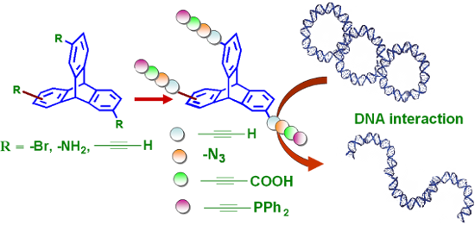
- functionalities) with DNA. According to a literature survey, many metal-free small molecules are known to modify structural organization of DNA through recognition, binding, cleavage or crosslinking and reportedly have widespread applications in biology [26]. Targeting of DNA by several DNA-damaging agents have


Automated solid-phase peptide synthesis to obtain therapeutic peptides
Beilstein J. Org. Chem. 2014, 10, 1197–1212, doi:10.3762/bjoc.10.118
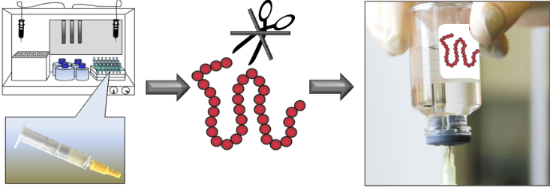
- side effects, which is considered as the greatest benefit of peptides and proteins over small molecules [7][8]. Moreover, small organic compounds are not able to address protein–protein interactions as their counterparts, the peptides/proteins [9]. Peptides share all superiorities of proteins but are
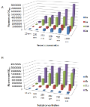
- respective protecting groups are illustrated. Blue arrows indicate basic and red/purple arrows indicate acidic conditions. Dashed boxes stress the COOH-side-chain protecting group of glutamic acid exemplarily, used in each strategy. “Drugability” attributes of peptide therapeutics compared with small
- molecules. PEGylated and lipidated peptide and protein drugs on the market, as stated by the FDA [11]. Acknowledgements We gratefully acknowledge the Graduate School “Leipzig School of Natural Sciences-Building with Molecules and Nano-objects” (BuildMoNa) and the financial support from the EU and the Free


Atherton–Todd reaction: mechanism, scope and applications
Beilstein J. Org. Chem. 2014, 10, 1166–1196, doi:10.3762/bjoc.10.117



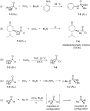


Integration of enabling methods for the automated flow preparation of piperazine-2-carboxamide
Beilstein J. Org. Chem. 2014, 10, 641–652, doi:10.3762/bjoc.10.56
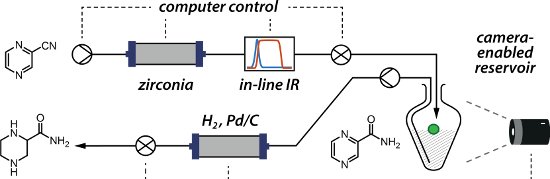
- for the facile integration of laboratory hardware, we chose the goal of the efficient synthesis of small molecules which are essential for the generation of fragment-based libraries for medicinal chemistry research programmes. “3D Fragments” have become very attractive recently due to their potential




Secondary amine-initiated three-component synthesis of 3,4-dihydropyrimidinones and thiones involving alkynes, aldehydes and thiourea/urea
Beilstein J. Org. Chem. 2014, 10, 287–292, doi:10.3762/bjoc.10.25
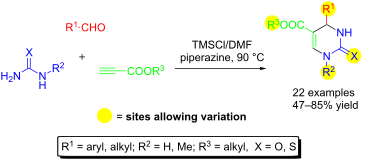
- ] and enaminones [34]. On the other hand, as frequently utilized building blocks in organic synthesis, alkynes have been known to possess versatile reactivity in the synthesis of small molecules. For example, a previous protocol employing aryl alkynes, aldehydes and urea/thiourea has been found to


Plakilactones G and H from a marine sponge. Stereochemical determination of highly flexible systems by quantitative NMR-derived interproton distances combined with quantum mechanical calculations of 13C chemical shifts
Beilstein J. Org. Chem. 2013, 9, 2940–2949, doi:10.3762/bjoc.9.331
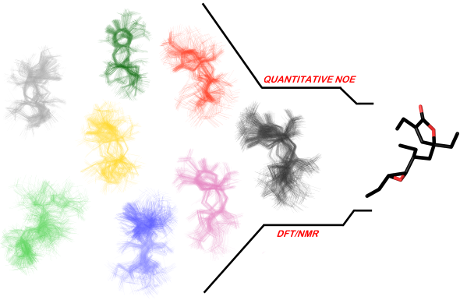
- , resulting in MAE and STD values higher than expected for a quantitative NOE-distance investigation of small molecules in our experience. However, the analysis of the limited number of reliable NOEs gave distances (Supporting Information File 1, Table S4) which fitted best with stereoisomer 1a as the


Synthesis and determination of the absolute configuration of (−)-(5R,6Z)-dendrolasin-5-acetate from the nudibranch Hypselodoris jacksoni
Beilstein J. Org. Chem. 2013, 9, 2925–2933, doi:10.3762/bjoc.9.329
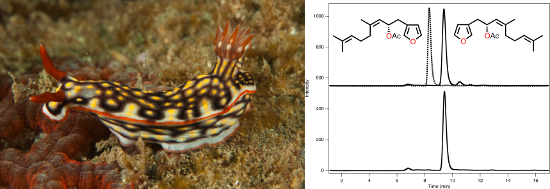
- inspired synthetic chemists as synthetic targets [1]. Similarly, extensive studies of marine chemical ecological interactions have enriched our knowledge of biological and evolutionary patterns, and of the role of small molecules in chemical defensive strategies underwater [2][3]. Nudibranchs (Mollusca
- : Gastropoda: Opisthobranchia) are a group of marine animals that use small molecules for a variety of purposes, including communication, reproduction, and defense against predation [4][5]. These molecules have been extensively studied and as of 2012, seven out of the 20 natural products of marine origin


Charge-transfer interaction mediated organogels from 18β-glycyrrhetinic acid appended pyrene
Beilstein J. Org. Chem. 2013, 9, 2877–2885, doi:10.3762/bjoc.9.324
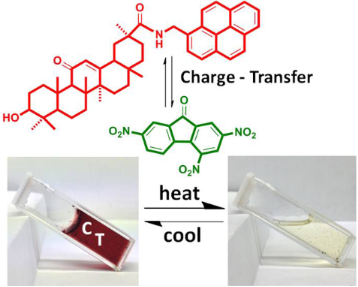
- driving forces for the formation of such self-assembled fibrillar networks include hydrogen-bonding interaction, van der Waals force, π–π stacking, and donor–acceptor interaction [7][8][9][10]. Since LMWGs are often thermally reversible and the gelation can be triggered by pH or the addition of small
- molecules (cations, anions), they can potentially be used in biomedicine [11][12][13], sensing [14][15], optoelectronics [16][17], and other applications [18][19]. Among different LMWGs, the two-component gel has attracted recent attention due to their strength, stability and other properties which can be




Modulating NHC catalysis with fluorine
Beilstein J. Org. Chem. 2013, 9, 2812–2820, doi:10.3762/bjoc.9.316
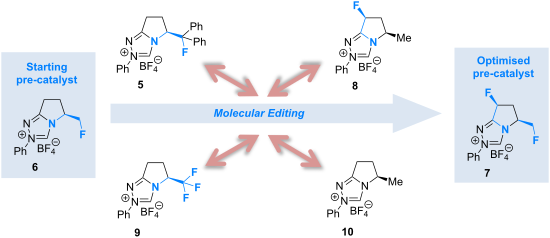
- of functional small molecules [13][14][15][16][17][18][19][20][21][22], often for application in organocatalysis [1]. Common to these studies has been the strategic incorporation of a fluoro substituent vicinal to a catalytically active amino group. Subsequent generation of a (partial) positive


Multigramme synthesis and asymmetric dihydroxylation of a 4-fluorobut-2E-enoate
Beilstein J. Org. Chem. 2013, 9, 2660–2668, doi:10.3762/bjoc.9.301
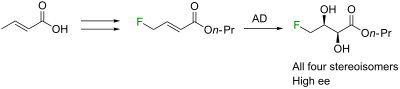
- sulfonamide which can accelerate hydrolysis and catalytic turnover was also added to the reaction mixtures [26]. Yields for the dihydroxylation chemistry were variable (44–80%); even though they are diols, these small molecules proved volatile. Reproducible yields (>55%) could be achieved if care was taken




Recent advances in transition metal-catalyzed Csp2-monofluoro-, difluoro-, perfluoromethylation and trifluoromethylthiolation
Beilstein J. Org. Chem. 2013, 9, 2476–2536, doi:10.3762/bjoc.9.287
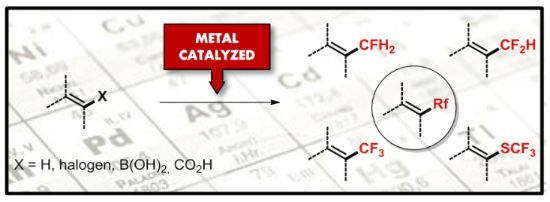
- reaction, including natural product related or complex small molecules (Figure 18) [37]. 3.3.3 Ni-catalyzed perfluoroalkylation of Csp2–H bonds. Two early reports by Y.-Z. Huang et al. described Ni-catalyzed perfluoroalkylation of anilines, benzene, furan, thiophene and pyrrole using ω-chloroperfluoroalkyl


Crystal design using multipolar electrostatic interactions: A concept study for organic electronics
Beilstein J. Org. Chem. 2013, 9, 2367–2373, doi:10.3762/bjoc.9.272
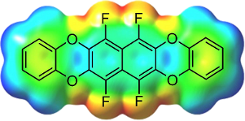
- techniques [3]. High charge carrier mobilities are a particularly critical prerequisite for application in backplanes for OLED displays. The highest charge carrier mobilities in organic compounds have so far been reported for single crystals of small molecules [4], the “classics” among them being acenes such


The chemistry of amine radical cations produced by visible light photoredox catalysis
Beilstein J. Org. Chem. 2013, 9, 1977–2001, doi:10.3762/bjoc.9.234
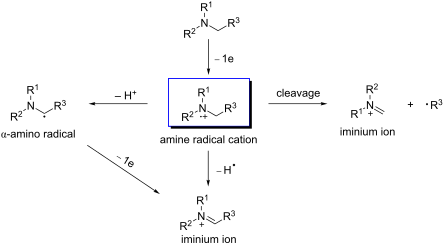
- radical by Ru(I), followed by protonation provides a secondary amine 155. Conclusion Visible light photoredox catalysis provides a unique way to activate small molecules such as amines. The dual nature of the photocatalyst’s photoexcited state as both oxidant and reductant allows accepting or donating one
- electron strictly dependent upon the small molecules encountered. Amines typically act as an electron donor to reductively quench the photoexcited state while they are oxidized to the corresponding amine radical cations. The resulting nitrogen radical cations are highly useful reactive intermediates that




Self-assembly of 2,3-dihydroxycholestane steroids into supramolecular organogels as a soft template for the in-situ generation of silicate nanomaterials
Beilstein J. Org. Chem. 2013, 9, 1826–1836, doi:10.3762/bjoc.9.213
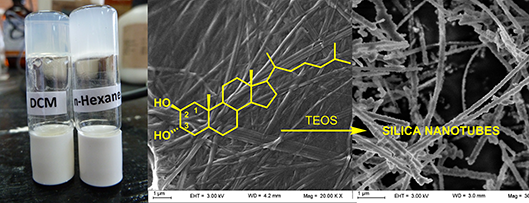
- , electrochemistry, light-harvesting materials and so on [1][2][3][4][5][6]. These small molecules self-assemble into regular supramolecular structures through non covalent interactions such as ion–ion, dipole–dipole, hydrogen bonding, π–π stacking, van der Waals, host–guest, and ion coordination, and in so doing


Synthesis of the reported structure of piperazirum using a nitro-Mannich reaction as the key stereochemical determining step
Beilstein J. Org. Chem. 2013, 9, 1737–1744, doi:10.3762/bjoc.9.200
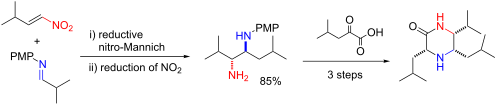
- ]. They have been used to synthesise many nitrogen-containing functional groups including α-amino carbonyls [2][3], peptidomimetics [4], natural products [5][6][7][8][9][10] and many heterocyclic small molecules [11][12][13][14][15][16][17][18][19][20][21][22][23][24] of importance to drug discovery


ML212: A small-molecule probe for investigating fluconazole resistance mechanisms in Candida albicans
Beilstein J. Org. Chem. 2013, 9, 1501–1507, doi:10.3762/bjoc.9.171
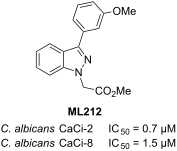
- chemosensitizers of the pathogenic fungus Candida albicans [11]. The C. albicans clinical isolates used in this study demonstrate a range of resistance to the widely prescribed triazole antimycotic fluconazole (Flc) [12], and the objective was to identify novel small molecules capable of surmounting this inherent



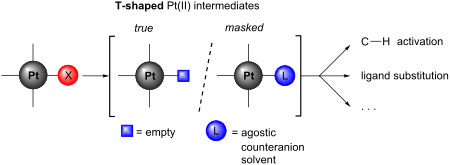
True and masked three-coordinate T-shaped platinum(II) intermediates
Beilstein J. Org. Chem. 2013, 9, 1352–1382, doi:10.3762/bjoc.9.153





Synthesis of the tetracyclic core of Illicium sesquiterpenes using an organocatalyzed asymmetric Robinson annulation
Beilstein J. Org. Chem. 2013, 9, 1135–1140, doi:10.3762/bjoc.9.126
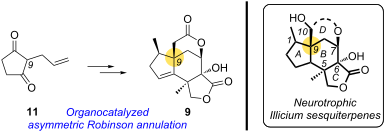
- the central neural system and considerable manufacturing cost [6][7]. These limitations have stimulated the search for small molecules that can enhance or mimic neurotrophin activity as potential drug leads [8][9][10][11][12]. Majucin-type Illicium sesquiterpenes (Figure 1) [13], such as majucin (1