Search results
Search for "charge transfer" in Full Text gives 375 result(s) in Beilstein Journal of Nanotechnology. Showing first 200.
A Ni(OH)2 nanopetals network for high-performance supercapacitors synthesized by immersing Ni nanofoam in water
Beilstein J. Nanotechnol. 2019, 10, 281–293, doi:10.3762/bjnano.10.27
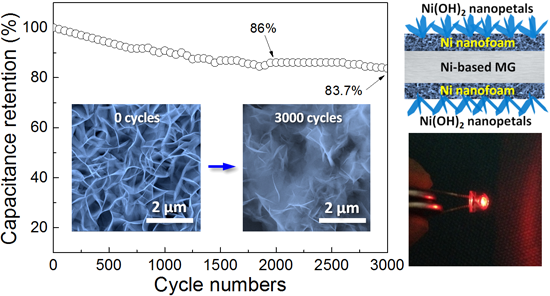
- peaks, which is related to the poor conductivity (larger ohmic resistance) of Ni(OH)2 nanopetals [21][43]. Larger ohmic resistance leads to slow kinetics of charge transport and interfacial charge transfer of the material. Thus, the electrode reaction rate slows down, resulting in a reduced
- reservoir” structure is badly damaged. This results in a decrease in the surface area of active materials and subsequently leads to the decline in the volumetric capacitance of the electrode. Impedance spectroscopy To better understand the kinetics of the charge transfer within the electrodes, EIS
- straight line at low frequencies. The semicircle represents the charge transfer impedance (Rct) for the redox reaction of Ni(OH)2/NiOOH at the electrode/electrolyte interface. The straight line at low frequencies indicates the diffusive resistance of the electrolyte ions (Warburg impedance) [49]. The




Wet chemistry route for the decoration of carbon nanotubes with iron oxide nanoparticles for gas sensing
Beilstein J. Nanotechnol. 2019, 10, 105–118, doi:10.3762/bjnano.10.10
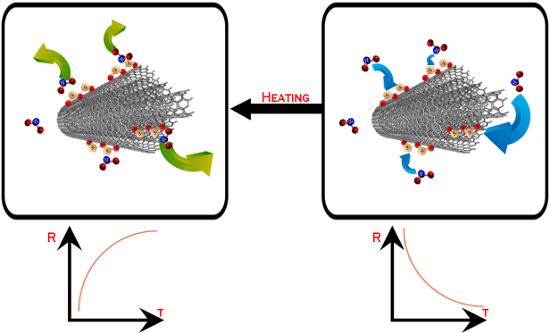
- into more reactive species that, in turn, interact with CNTs. In addition, such nanoparticles shift the Fermi level of CNTs, adsorb target molecules, and help in mediating the charge transfer between adsorbates and CNTs [6][10]. Several metal oxides have been reported as useful for decorating CNTs and




Amorphous NixCoyP-supported TiO2 nanotube arrays as an efficient hydrogen evolution reaction electrocatalyst in acidic solution
Beilstein J. Nanotechnol. 2019, 10, 62–70, doi:10.3762/bjnano.10.6
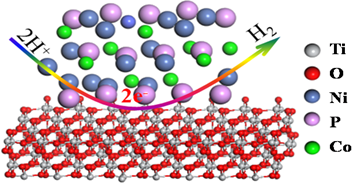
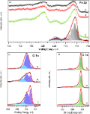
- −), suggesting a small electron density transfer from Ni and Co to P [37]. This charged structure is very beneficial for improving surface activity toward HER. A critical means to improve the charge transfer of HER is to enhance the conductivity of the electrocatalysts. Doping or hybridization to form a
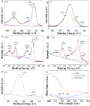
- active site density, and thus the electrocatalytic activity. The Nyquist and Bode plots are displayed in Figure 8. In the Nyquist plot, the arc radius of the high-frequency section corresponds to the impedance of charge transfer between electrolyte and the catalyst surface, and the ones of the low
- -frequency area correspond to the impedance of charge transport inside the electrode [15][42][43][44]. In Figure 8a, the Nyquist curves are shown as two arcs with different radius in the high and low frequency, suggesting that the catalytic reaction was limited by the charge transfer step. The arc radii of




Electrolyte tuning in dye-sensitized solar cells with N-heterocyclic carbene (NHC) iron(II) sensitizers
Beilstein J. Nanotechnol. 2018, 9, 3069–3078, doi:10.3762/bjnano.9.285
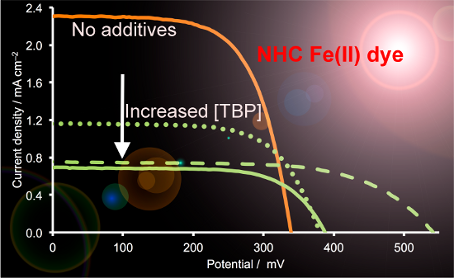
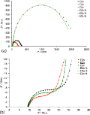
- impedance spectroscopy (EIS) is an important technique for the investigation of interfaces in DSCs [49][50]. Fitting of the Nyquist and Bode plots, which are used to describe the EIS results, leads to parameters including the recombination resistance (Rrec), electron/hole transport resistance (Rtr), charge
- -transfer resistance at the counter electrode (RPt) and the active layer surface chemical capacitance (Cµ). All experiments in the following discussion were performed at VOC conditions. The equivalent circuit model used in this study consisted of five elements (Figure S2, Supporting Information File 1). A



Hydrogen-induced plasticity in nanoporous palladium
Beilstein J. Nanotechnol. 2018, 9, 3013–3024, doi:10.3762/bjnano.9.280
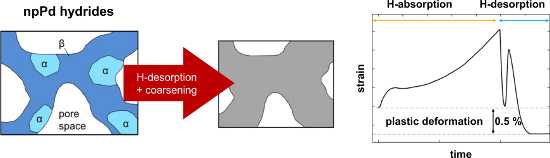
- charge transfer during hydrogen loading, especially at strongly negative potentials, a calculation based on the recorded charge flow during hydrogenation might overestimate the hydrogen concentration in the samples. Therefore, the atomic ratio of hydrogen and palladium H/Pd (cf) was determined based on


Graphene-enhanced metal oxide gas sensors at room temperature: a review
Beilstein J. Nanotechnol. 2018, 9, 2832–2844, doi:10.3762/bjnano.9.264
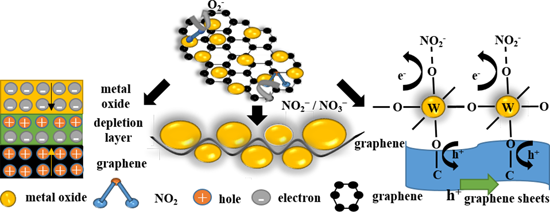
- concentrations of NO2, while the pure WO3 and graphene sensors did not respond to NO2 at room temperature. The authors claimed that the reason for room-temperature sensing of the composite sensor was the effective charge transfer between graphene and WO3 nanospheres by chemical bonds. The research group



Controlling surface morphology and sensitivity of granular and porous silver films for surface-enhanced Raman scattering, SERS
Beilstein J. Nanotechnol. 2018, 9, 2813–2831, doi:10.3762/bjnano.9.263
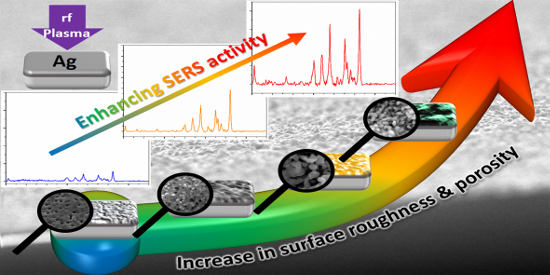
- and depends on the local electromagnetic field at the metal surface while the chemical enhancement depends on the analyte itself and results from an effective charge transfer between the noble metal and the adsorbed probe molecule [5][6]. While the Raman effect is intrinsically weak and typically does





Variation of the photoluminescence spectrum of InAs/GaAs heterostructures grown by ion-beam deposition
Beilstein J. Nanotechnol. 2018, 9, 2794–2801, doi:10.3762/bjnano.9.261
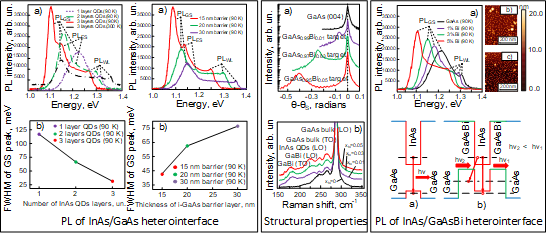
- -GaAs layer thickness, on the one hand, limits the fluctuation of QD heights in vertically stacked arrays and stabilizes them and, on the other hand, improves the charge transfer due to the resonant tunneling between the vertical InAs QD layers. Photoluminescence properties of InAs/GaAsBi


Au–Si plasmonic platforms: synthesis, structure and FDTD simulations
Beilstein J. Nanotechnol. 2018, 9, 2599–2608, doi:10.3762/bjnano.9.241
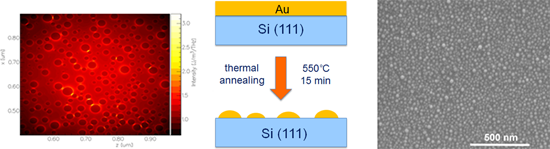
- same spectra measured for the as-prepared film and for bulk Au are added. The binding energy of the Au 4f core-level shifts, depending on cluster size, cluster–substrate interactions, cluster morphology and charge transfer between cluster and substrates [23][24]. Additionally, the peak ratio of the Au



High-temperature magnetism and microstructure of a semiconducting ferromagnetic (GaSb)1−x(MnSb)x alloy
Beilstein J. Nanotechnol. 2018, 9, 2457–2465, doi:10.3762/bjnano.9.230
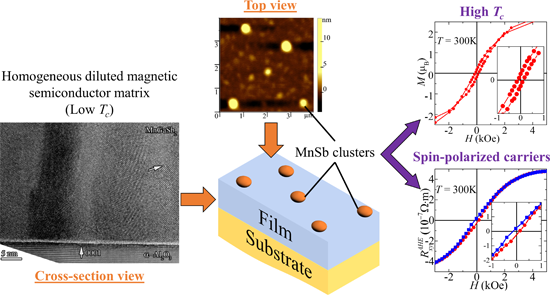
- interaction is affected by the appearance of Schottky barriers at the MnSb/GaSb boundaries. Basically, these type of barriers appear on the semiconductor/metal interfaces providing a tunneling charge transfer across the boundary, if the barrier is high enough. In the present case, Schottky barriers may appear



Thickness-dependent photoelectrochemical properties of a semitransparent Co3O4 photocathode
Beilstein J. Nanotechnol. 2018, 9, 2432–2442, doi:10.3762/bjnano.9.228
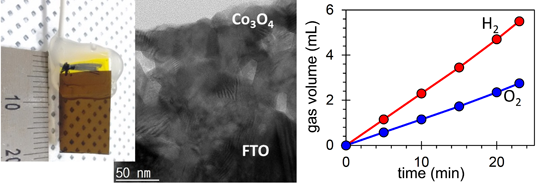
- RHE, and the operation of the photocathode. The value of the onset potential (Von), which is the condition attributed to a minimum charge transfer of the cell, was found to be just below that of the OER potential. All of the Co3O4 samples exhibited a photoresponse, suggesting photoabsorption and the
- and PEC cells under this condition exhibit the minimum charge transfer. Additional details on the identification of band edges and VFB in the Co3O4 samples can be found elsewhere [20]. Figure S2 and Figure S3 (Supporting Information File 1) provide analysis of the MS characteristics including the



SERS active Ag–SiO2 nanoparticles obtained by laser ablation of silver in colloidal silica
Beilstein J. Nanotechnol. 2018, 9, 2396–2404, doi:10.3762/bjnano.9.224
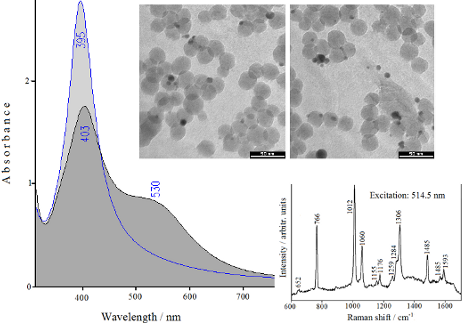
- adsorbed on colloidal silver nanoparticles allow a SERS observation also for excitation in the near-IR spectral region [38][39][40]. This effect is attributable to the formation of charge-transfer complexes [41], which ensure SERS enhancement, even in the absence of an efficient resonance effect when the
- molecule → metal electronic charge-transfer and the long N–Ag bond distance, reported in Table 2. Moreover, the large difference between the complexation energies of the two proposed complexes indicates that the molecule by far prefers to bind to the positively charged silver atom than to a neutral one
- . The interaction of the molecule with Ag+ results in the formation of a complex characterized by a large charge transfer, more than half the electronic charge (Table 2). This model complex well reproduces the SERS frequencies, as well as those observed in the Raman spectrum of the Ag(I) coordination


Intrinsic ultrasmall nanoscale silicon turns n-/p-type with SiO2/Si3N4-coating
Beilstein J. Nanotechnol. 2018, 9, 2255–2264, doi:10.3762/bjnano.9.210
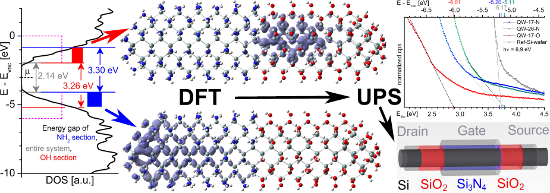
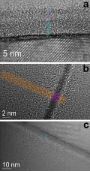
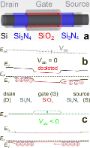
- embedded in Si3N4, presenting the entire system under investigation within one approximant. An interface charge transfer (ICT) of electrons from the usn-Si volume to the anions of the embedding dielectric – nitrogen (N) or oxygen (O) – is at the core of the energy shift [14]. We explain the shift of usn-Si





The role of adatoms in chloride-activated colloidal silver nanoparticles for surface-enhanced Raman scattering enhancement
Beilstein J. Nanotechnol. 2018, 9, 2236–2247, doi:10.3762/bjnano.9.208
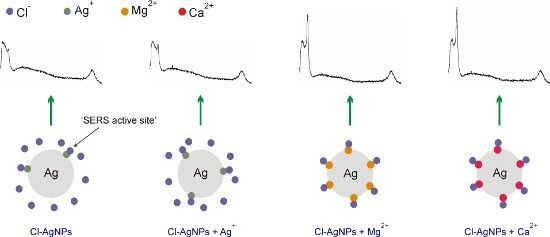
- cross-section of the adsorbed molecule. The charge-transfer electronic transition can be explained as follows [8][12][13][14]: The chemical mechanism of SERS involves the absorption of a photon and the excitation of an electron from the Fermi level of the metallic nanoparticle (M) to the LUMO orbital



Dumbbell gold nanoparticle dimer antennas with advanced optical properties
Beilstein J. Nanotechnol. 2018, 9, 2188–2197, doi:10.3762/bjnano.9.205
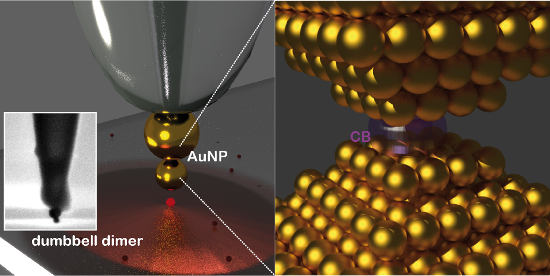
- strength or the signal enhancement, and the achievable confinement of the light in plasmonic nanostructures [10][11][12][13][14]. Furthermore, this stimulated the discussion of the onset of non-classical phenomena, such as, screening effects, non-localities and charge transfer in coupled plasmonic systems
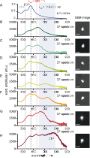
- characterized by a red-shift and a broadening of the BDP mode or even exhibit an additional peak (CTP-charge transfer plasmon mode) in the NIR region. The latter is indicative for the onset of charge transfer mechanisms. The origin for these deviations is not evident from the geometrical structure of the




Metal-free catalysis based on nitrogen-doped carbon nanomaterials: a photoelectron spectroscopy point of view
Beilstein J. Nanotechnol. 2018, 9, 2015–2031, doi:10.3762/bjnano.9.191
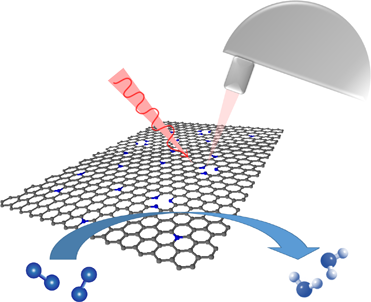
- intercalation of metal atoms [99]. The authors reported the calculated and experimental Dirac point positions for different pyridinic/graphitic ratios (Figure 7). There is a counterbalancing effect between the two doping types that obscures the evaluation of the effective charge transfer to/from the dopant
- pyridinic and graphitic N, compared to the DFT calculation results (black circles connected by dashed lines). The numbers denote the total concentration of nitrogen (NP + NG). Solid lines demonstrate the hypothetical situation when pyridinic N provides no charge transfer while graphitic N donates one




Multimodal noncontact atomic force microscopy and Kelvin probe force microscopy investigations of organolead tribromide perovskite single crystals
Beilstein J. Nanotechnol. 2018, 9, 1695–1704, doi:10.3762/bjnano.9.161
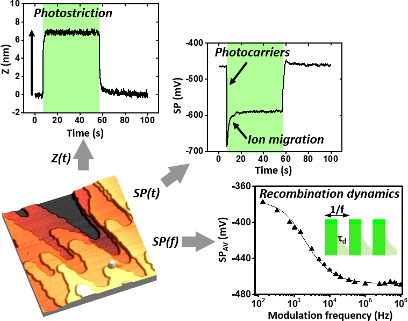
- single exponential, yielding time constants for the SPV dynamics of 11.4 s and 2.1 s during the 1st and 2nd illumination sequences, respectively. (a) Scheme illustrating how charge transfer from surface states bends the energy bands of p-type MAPbBr3. The built-in electric field (resulting from the


Nitrogen-doped carbon nanotubes coated with zinc oxide nanoparticles as sulfur encapsulator for high-performance lithium/sulfur batteries
Beilstein J. Nanotechnol. 2018, 9, 1677–1685, doi:10.3762/bjnano.9.159
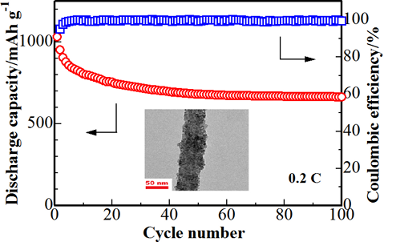
- the small size of ZnO nanoparticles (6.2 nm) in the composite, which both enhanced charge transfer and conductivity. Along with this, the NCNT network provides a large micro-scaffold in the S/ZnO@NCNT composite to accommodate S and Li ions, and, therefore, to buffer the volume expansion/shrinkage


Free-radical gases on two-dimensional transition-metal disulfides (XS2, X = Mo/W): robust half-metallicity for efficient nitrogen oxide sensors
Beilstein J. Nanotechnol. 2018, 9, 1641–1646, doi:10.3762/bjnano.9.156
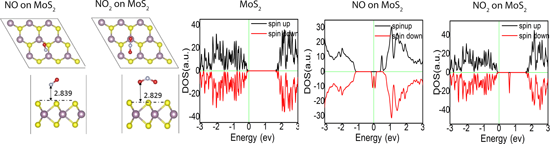
- NO2 are free radical gas molecules with a magnetic moment of 1µB. To fully understand the NOx adsorption mechanism, it is important to understand the interactions between the monolayer and the adsorbate molecules. Investigations [8][28] revealed that charge transfer occurs from the XS2 (X = Mo, W


Spatial Rabi oscillations between Majorana bound states and quantum dots
Beilstein J. Nanotechnol. 2018, 9, 1527–1535, doi:10.3762/bjnano.9.143
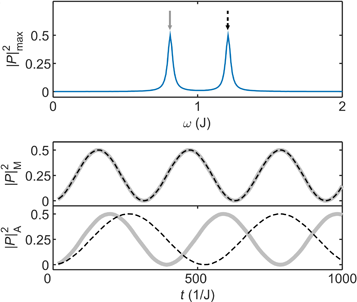
- the states and , namely a charge oscillation between the left and right quantum dots. This is a nonlocal coherent charge transfer process between the quantum dots mediated by the two Majorana bound states. For comparison, we illustrate the results for quantum dot occupation mediated through Andreev


Cr(VI) remediation from aqueous environment through modified-TiO2-mediated photocatalytic reduction
Beilstein J. Nanotechnol. 2018, 9, 1448–1470, doi:10.3762/bjnano.9.137
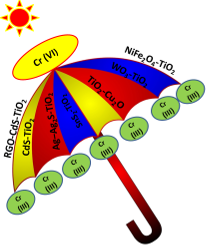
- photocatalytic reduction of Cr(VI) along with their good recoverability and recyclability. Keywords: charge transfer; Cr(VI) reduction; heterojunction; modified TiO2; photocatalysis; spinel oxides; Review Introduction The increase in the global population demands rapid growth of industrialization and
- activity by achieving a more efficient charge separation, increasing the lifetime of the charge carriers, inhibiting the recombination of electron–hole pairs and facilitating interfacial charge transfer to adsorbed substrates [91][92]. In this review we have focused on modification of nanostructured TiO2
- place by the sulfate redox couple attached to nitrogen-doped TiO2 [63]. Hydrogenated defect-promoted black titania exhibits much higher absorption and photocatalytic activity [94][95]. The recombination and charge transfer efficiency can be understood from PL spectra. The PL emission intensity is


Ag2WO4 nanorods decorated with AgI nanoparticles: Novel and efficient visible-light-driven photocatalysts for the degradation of water pollutants
Beilstein J. Nanotechnol. 2018, 9, 1308–1316, doi:10.3762/bjnano.9.123
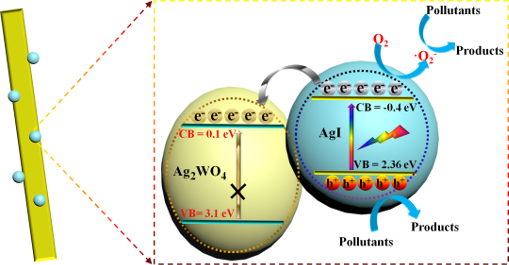
- the formation of the AgI/Ag2WO4 heterojunctions, thereby facilitating the charge transfer between them [12]. Subsequently, the optical properties of as-prepared photocatalysts were investigated by UV–vis diffuse reflectance spectroscopy (DRS) analysis (Figure 4). As indicated from Figure 4, pure
- charge transfer rate and a more effective separation of charge carriers. On the basis of the above discussion, the excellent photocatalytic activity of AgI/Ag2WO4 is concluded to be due to the broadening of the photo-absorption range from the ultraviolet to the visible light range (Figure 4) and the




Induced smectic phase in binary mixtures of twist-bend nematogens
Beilstein J. Nanotechnol. 2018, 9, 1297–1307, doi:10.3762/bjnano.9.122
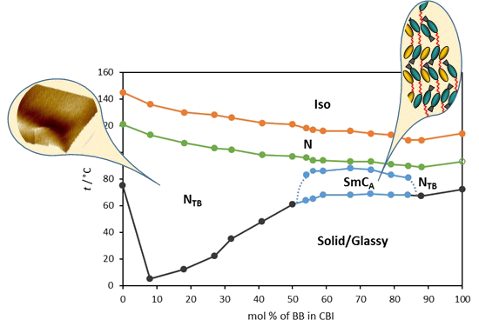
- ) with 4-cyano-4’-pentylbiphenyl (5CB) [13]. It has been associated with the formation of charge transfer (CT) complexes between strong donor and acceptor compounds. However, the induction of a smectic phase may also be the result of weak CT interactions, together with other effects such as dipole–dipole
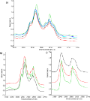
- . The temperature-dependent FTIR measurements revealed that the origin of the intercalated smectic is likely to be a conformational disorder of terminal chains instead of a charge transfer (CT) complex or dipole-induced dipole interaction. Comparison of the packing models of pure BB and CBI–BB mixtures




Semi-automatic spray pyrolysis deposition of thin, transparent, titania films as blocking layers for dye-sensitized and perovskite solar cells
Beilstein J. Nanotechnol. 2018, 9, 1135–1145, doi:10.3762/bjnano.9.105
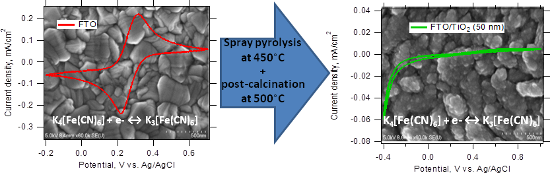
- the defect causes not only the delamination of the titania film from FTO, but also the slowdown of charge transfer kinetics (accompanied by a strong increase in ΔEpp). The barrier properties after post calcination were fairly good for the 0.05 M TAA precursor and the largest layer thickness (200 SCs


Electro-optical interfacial effects on a graphene/π-conjugated organic semiconductor hybrid system
Beilstein J. Nanotechnol. 2018, 9, 963–974, doi:10.3762/bjnano.9.90
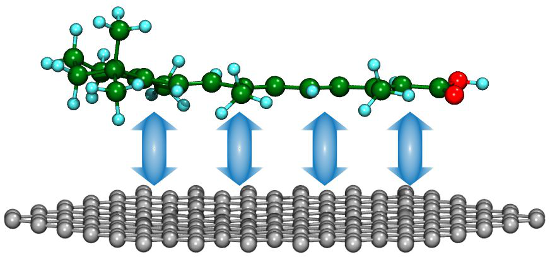
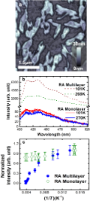
- monolayers across the graphene surface (Figure 1c, Figure 2b,d). Besides molecular structural configuration, the charge transfer within the graphene/RA hybrid has also been estimated via ab initio calculations. The results indicate that electrons are transferred from graphene to RA molecules, resulting in p
- variation of α for both functionalized graphene (Gf) and RA upon illumination may reflect slight changes on the hybrid dielectric constant upon charge transfer (doping). Such charge transfer, including photo-generated charges, may also account for the observed variation of parameter γ in Table 1, which is
- is possible, which could indicate any effect of graphene-induced organization and charge transfer on RA surface potential. Therefore, Figure 5c also portrays the surface potential histogram of a thick amorphous RA film (a-RA) in dark condition. This somewhat broad histogram may reflect several