


Search results
Search for "energy" in Full Text gives 1405 result(s) in Beilstein Journal of Organic Chemistry. Showing first 200.
Electrochemical reduction of unsaturated carbon–carbon bonds via 3d transition-metal catalysis
Beilstein J. Org. Chem. 2026, 22, 955–981, doi:10.3762/bjoc.22.75
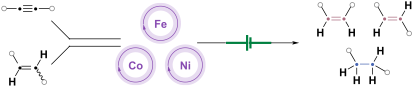
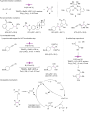
- along an energetically viable pathway with a notably low barrier, consistent with a concerted mechanism. These findings collectively delineate the proposed Z-selective reduction catalytic cycle. Moreover, bond dissociation energy analysis revealed that the relatively weak Co–H (42.4 kcal mol−1) and Co–C
- revealed the emergence of new absorption features upon alkyne addition, consistent with the formation of a vinyl–Co(III) intermediate. DFT calculations further demonstrated that variation of the salen ligand framework modulates the Co–C bond-dissociation energy (BDE) of the vinyl–cobalt intermediate








Synthesis of sterically shielded piperidine nitroxides via acid-catalyzed heterocyclization of β-aminoketone derivatives with ketones
Beilstein J. Org. Chem. 2026, 22, 948–954, doi:10.3762/bjoc.22.74
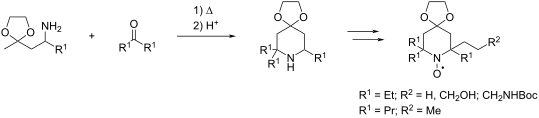
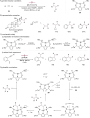
- use as catalysts for alcohol oxidation [8], electrode active materials in energy storage devices (batteries) [9], as well as antioxidants and superoxide dismutase (SOD) mimetics [10]. Their sterically shielded analogs, such as 2,2,6,6-tetraethylpiperidine-1-oxyl (TEEPO), were initially developed for


Recent advances in copper-catalyzed direct hydroamination of alkenes with (hetero)aromatic amines
Beilstein J. Org. Chem. 2026, 22, 925–947, doi:10.3762/bjoc.22.73
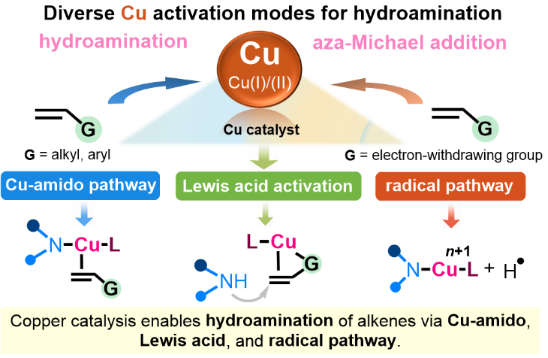
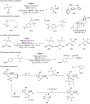
- CuCo2O4 catalyst was prepared via an oxalate decomposition method and extensively characterized using powder X-ray diffraction, field-emission scanning electron microscopy, and energy dispersive X-ray spectroscopy. Structural analysis revealed the formation of microsheet-like architectures with high






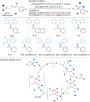

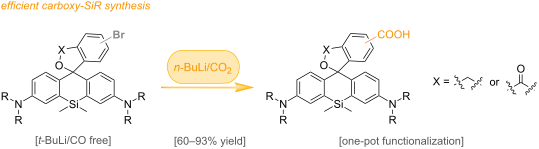
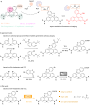
A practical CO2-mediated synthesis of 5,6-carboxylated silicon-rhodamines for targeted probe development
Beilstein J. Org. Chem. 2026, 22, 915–924, doi:10.3762/bjoc.22.72
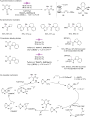
- , 22578443, 22378385, 22278394, 22507121, and 22508383); the Chinese Academy of Sciences Project for Young Scientists in Basic Research Grant No.YSBR-104; the Energy Revolution S&T Program of Yulin Innovation Institute of Clean Energy, Grant No.E412050705; the Liaoning Binhai Laboratory (LBLD-2024-07); the



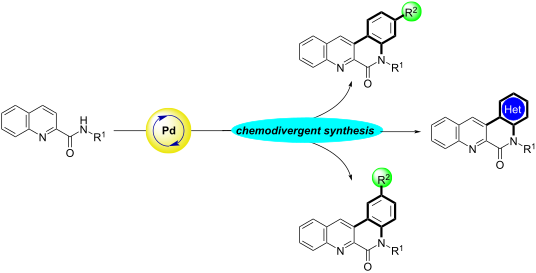
Palladium-catalyzed benzocyclization reactions of quinoline-2-carboxamides via sequential C–H/N–H functionalization
Beilstein J. Org. Chem. 2026, 22, 905–914, doi:10.3762/bjoc.22.71
- paper is based on results obtained from a project, JPNP23006, commissioned by the New Energy and Industrial Technology Development Organization (NEDO). This work was supported by Kobe University.




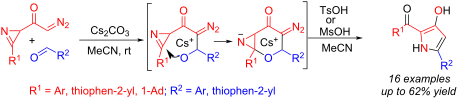
Cascade transformation of 2-(diazoacetyl)-2H-azirines to 2-aroyl-3-hydroxy-1H-pyrroles via condensation with aromatic aldehydes
Beilstein J. Org. Chem. 2026, 22, 897–904, doi:10.3762/bjoc.22.70
- , to our knowledge, no derivative of trans-2-oxa-7-azabicyclo[4.1.0]heptane has been prepared [25][26]. According to our DFT calculations, trans-2-oxa-7-azabicyclo[4.1.0]heptane has a 42.6 kcal/mol higher Gibbs energy than the cis isomer, and the introduction of two sp2-hybridized carbons, as in
- ) exhibiting a lower relative Gibbs free energy than the starting compounds. According to the calculations, the reaction of azirine 1a and benzaldehyde 2c results in the formation of two diastereomers, (RR,SR)- and (RR,RR)-A, which can undergo a conformational transition to intermediates (RR,SR)- and (RR,RR)-B
- diastereoisomer (1RR,3RR,6RR)-Phe-4 has a Gibbs free energy 1.95 kcal/mol higher than the diastereoisomer (1RR,3SR,6RR)-Phe-4 (Scheme 3), i.e., under the conditions of the equilibrium reaction at 298 K, the diastereoisomer (1RR,3SR,6RR)-Phe-4 should be the main product (the ratio of diastereoisomers (1RR,3SR,6RR


Diastereodivergent electrophilic trapping of α-boryl lithium derivatives
Beilstein J. Org. Chem. 2026, 22, 882–887, doi:10.3762/bjoc.22.68
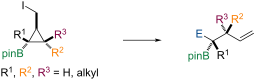
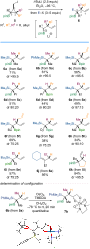
- revealed that the electrophile preferentially approaches from the face opposite the coordinating lithium cation, with the lowest-energy transition state stabilized by a lithium cation–vinyl interaction (see A in Scheme 1) [34]. Results and Discussion The intricate interplay of the coordination and steric




The trans-influence in gold chemistry from a catalytic perspective
Beilstein J. Org. Chem. 2026, 22, 838–856, doi:10.3762/bjoc.22.66
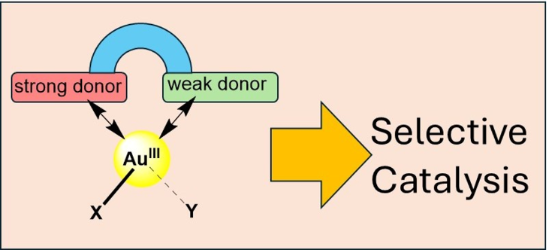
- strengthening of a metal–ligand bond M–X as the result of another ligand L in trans position to X. The term refers to a ground-state property of a complex, such as M–X bond dissociation energy and bond length, and is therefore dictated by thermodynamics. “Trans-influence” is closely related to but distinct from
- electron-rich trialkylphosphines, increased the proportion of N-bonded thiocyanate [24]. More recently, Espinet and co-workers used solution microcalorimetry with in-situ generated HI to provide bond dissociation energy scales for the Au–C bonds in R–Au(PPh3) (R = Me, aryl or alkynyl), and further to
- small energy differences that arise from a combination of steric and electronic factors. Equally important is the use of calculated rather than crystallographically determined bond-length parameters to establish a scale of ligand characteristics. As Budzelaar and co-workers have pointed out [27


Unsymmetrical sulfoxides with sterically hindered catechol fragment: synthesis, structure, electrochemical properties, and antiradical activity
Beilstein J. Org. Chem. 2026, 22, 828–837, doi:10.3762/bjoc.22.65
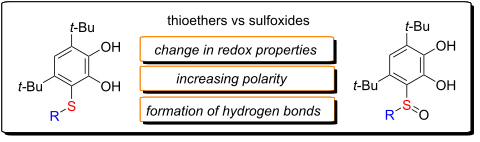
- presence of the readily oxidizable catechol core. The presence of a redox-active catechol moiety adjacent to the sulfoxide group can significantly influence the formation of intra- and intermolecular hydrogen bonds and affect the O–H bond dissociation energy, which in turn may substantially impact the
- 1.82–1.91 V. The value of Epox2 for the above-mentioned compounds is shifted anodically by 0.26–0.31 V relative to the corresponding thioethers, reflecting an increase in the Gibbs free energy (ΔG) of the electrooxidation process by 12–15 kcal/mol. Redox transformations at the sulfur atom occur in


Knoevenagel condensation of 4,5- and 1,8-diazafluorenes
Beilstein J. Org. Chem. 2026, 22, 803–812, doi:10.3762/bjoc.22.62
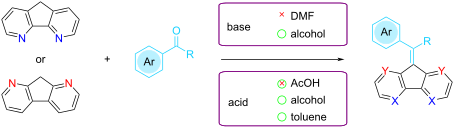
- sample preparation and 6 hours later. HRMS were obtained with a Thermo Scientific Double Focusing System (DFS) high-resolution mass spectrometer. Samples were introduced into the mass spectrometer by direct inlet. Electron ionization with 70 eV energy was used. Measurements of the exact masses of




Halogenated azobenzene acrylates: from efficient solution photoswitching to stable solid-state photochromic materials
Beilstein J. Org. Chem. 2026, 22, 782–794, doi:10.3762/bjoc.22.60
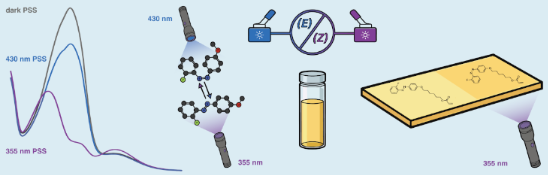
- -configuration) after irradiation with UV light. Furthermore, when a fluorescent pyrene moiety was embedded into the azopeptoids, the emission wavelength could be significantly modulated via the photoinduced azobenzene E/Z switch by allowing Förster resonance energy transfer (FRET) [14]. Azobenzene has also been
- analogue 1f, indicating an oxidation of the phenolic moiety is more difficult. As summarized in Table 2 and visualized in the energy level diagram (Figure 3), the electrochemical measurements point to the steady HOMO and LUMO energies and their differences ΔE = 3.05–3.09 eV. The experimental data are
- utilization as molecular photoswitches. Molecular structure of investigated compounds 1a–f and known azobenzene derivatives A–C exploited in thermal sensing. Representative TGA (left) and DSC (right) curves of compounds 1c (black) and 1d (red). Energy level diagram of the electrochemically measured (black


Synthesis and biological evaluation of new brassinosteroid analogs with C-22 benzoate function
Beilstein J. Org. Chem. 2026, 22, 753–762, doi:10.3762/bjoc.22.57
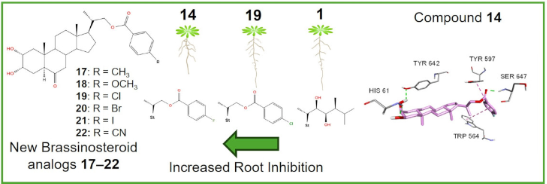
- [37][38]. Interestingly, the interpretation of the obtained data is commonly carried out in terms of the binding energy of BRs analogs to the active site of A. thaliana, which is calculated from molecular docking studies [28]. Herein, the difference of bending angles induced by analogs 12, 14 and 17
- of A. thaliana. The results provide information on the most probable configuration, the main interactions, and the binding energy as a function of the chemical structure of BR analogs. The lower binding energy is commonly associated to the most active BR analog. Thus, docking results have allowed to
- BAK1 [50][51]. Furthermore, BRL2 was also excluded from the analysis because it does not exhibit high-affinity binding to brassinolide and is therefore considered non-functional in ligand perception within this signaling context. The calculated binding energy values are presented in Table 4


Rongalite addition to dienones: diastereoselectivity in cyclic sulfone synthesis; stereochemical rationalization and prospects as a general conjugate nucleophile
Beilstein J. Org. Chem. 2026, 22, 742–752, doi:10.3762/bjoc.22.56

- product, we used density functional theory (DFT) and conformational search techniques based on tight-binding methods to find the energetically minimized structure of 7 (see Supporting Information File 1 for details on all computations). The lowest energy structure is depicted in Figure 3. It shows a
- work, by which we were able to locate transition states for reactions to give trans-12a and the unobserved cis-12b (Figure 4). The activation energy difference to reach TS-12a, leading to 12a and TS-12b, leading to 12b was found to be a significant 4.7 kcal/mol in favor of TS-12a (see Supporting
- reaction of this type. What follows is an examination of the transition state structures leading to the trans and cis-isomers 12a and 12b; although the transition states leading to 1a and 1b may differ slightly in energy, they are very similar in appearance to those for 12a and 12b. Examination of the




Harnessing light energy with molecules
Beilstein J. Org. Chem. 2026, 22, 680–682, doi:10.3762/bjoc.22.52

- Liebig University Giessen, 35392 Giessen, Germany Center of Materials Research (LaMa/ZfM), Justus Liebig University Giessen, 35392 Giessen, Germany 10.3762/bjoc.22.52 Photoirradiation is one of the most effective ways of introducing energy into a molecule with high spatiotemporal resolution. From
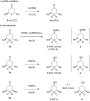
- photoexcited states, molecules can relax via various pathways, which essentially converts photon energy to other forms of energy, including chemical and thermal energy. This thematic issue highlights various photochemical processes, for example by which some of the photon energy is stored within the molecule
- structural modifications of the chromophores, aiming for example at moving their absorption from the ultraviolet spectral region to the visible region. This is of importance for efficient exploitation of solar energy, i.e., matching molecular absorption with the solar emission spectrum, or for photodynamic
Using generative AI to transform peptide hits into small molecule leads
Beilstein J. Org. Chem. 2026, 22, 672–679, doi:10.3762/bjoc.22.51
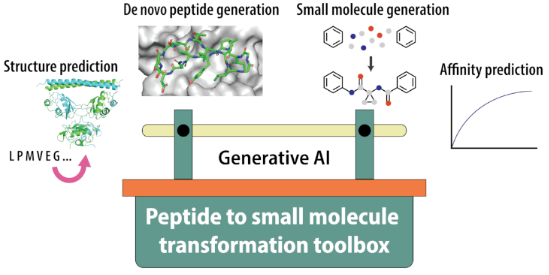
- molecule candidates, providing potential alternatives to traditional computationally expensive physics-based workflows such as docking, MD, and free-energy perturbation (FEP) calculations for affinity estimation. For example, Boltz-2 features a strong emphasis on affinity prediction in addition to its core


Photoorganocatalytic trifluoromethylation of (het)arenes in green conditions
Beilstein J. Org. Chem. 2026, 22, 662–671, doi:10.3762/bjoc.22.50
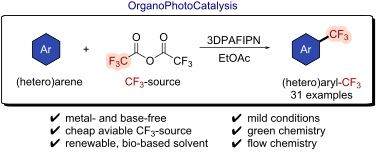
- -catalyzed [8], organic photocatalyst-mediated, or electrochemical transformations [9], and also include continuous-flow processes [6][10][11][12][13]. Given that photocatalytic reactions align with the principles of green chemistry, particularly energy efficiency and the use of catalytic pathways, such
- CF3 radical, is an endothermic process. The subsequent attack of the electrophilic CF3 radical on the benzene ring, accompanied by its oxidation, proceeds through exothermic steps. The proton transfer to the solvent constitutes the most favorable step, resulting in an overall free energy change (ΔG




Hydrogen production from formic acid catalyzed by NHC–Cu complexes
Beilstein J. Org. Chem. 2026, 22, 620–627, doi:10.3762/bjoc.22.48
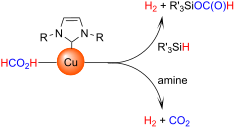
- sustainable energy sources is nowadays one of biggest challenges faced by the scientific community and society. Because of its high energy content, hydrogen has been proposed as a possible solution [1][2][3][4][5]. However, the problems connected to its generation, delivery, and storage are limitations to the



Computational prediction of C–H hydricities and their use in predicting the regioselectivity of electron-rich C–H functionalisation reactions
Beilstein J. Org. Chem. 2026, 22, 603–610, doi:10.3762/bjoc.22.46
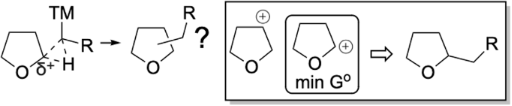
- –N, C–C, and C–X bond formations, carbene insertions, and oxidative transformations. Comparative analysis with ALFABET, a bond dissociation energy (BDE)-based ML model, reveals that hydricity predictions, when combined with steric accessibility, correctly identify the reactive site in eight out of
- host of other reactivity predictors. Keywords: bond dissociation energy; hydricity; hydride affinity; hydride-transfer reactions; machine learning (ML); quantum chemistry (QM); Introduction Bond dissociation energies (BDEs) and pKa values for C–H bonds are often used to rationalise and predict the
- Butina clustering using pairwise heavy-atom root mean square deviation (RMSD) with a threshold of 0.5 Å [12][15]. To identify the lowest-energy conformer, we subsequently re-optimise the remaining conformers in DMSO with the semiemprical quantum chemistry method GFN2-xTB[16] and apply the ALPB implicit


![[Graphic 6]](/bjoc/content/inline/1860-5397-22-46-i8.svg?max-width=637&scale=1.18182)


Continuous-flow carbonyl hydrogenation under subatmospheric to atmospheric hydrogen pressure enabled by robust heterogeneous Pt–Fe catalysts
Beilstein J. Org. Chem. 2026, 22, 575–582, doi:10.3762/bjoc.22.43
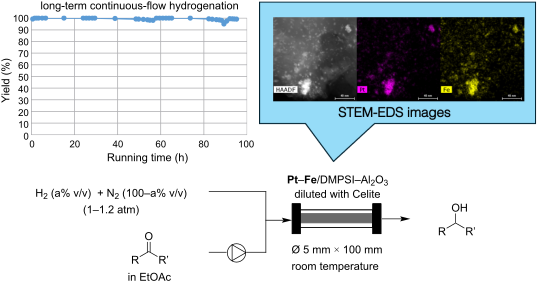
- ]. Recently, continuous-flow organic synthesis has attracted much attention from both academia and industry, because it offers numerous advantages, such as not only a high productivity with limited space but also realizing green sustainable syntheses minimizing required energy and resources. When
- produced by sustainable energy, because purifying and pressurizing hydrogen gas consumes large amounts of energy comparable to the energy required to generate green hydrogen [34]. We set up a continuous-flow system in which a mixture of H2 and N2 was introduced by two individually regulated mass-flow
- conditions is adaptable to sustainable chemical synthesis, minimizing energy consumption and enabling the use of green hydrogen. In addition, the newly obtained insights regarding the relationships among the Fe/Pt ratios in the catalysts, the bimetallic structure, and the resulting catalytic performance for


Molecular tweezer–peptide conjugates disrupt the protein–protein interaction between survivin and histone H3 essential in mitosis
Beilstein J. Org. Chem. 2026, 22, 557–567, doi:10.3762/bjoc.22.41
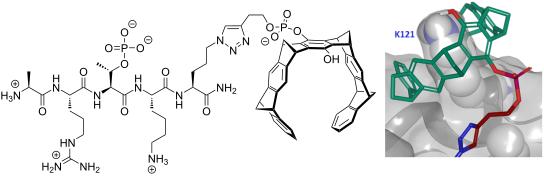
- . demonstrated that survivin contributes most of the binding energy to this critical complex with histone H3 [8]. In 2011, a crystal structure was solved depicting structural details of the H3 N-terminus (1–21) bound by survivin’s BIR domain (Figure 2). Only the first six residues (ARpTKQT) show electron density
- Ca2+ cation from the crystallization buffer, is visible next to the cavity (Figure S12 in Supporting Information File 1). From recent complexation experiments with lipids, it is known that even uncharged alkyl groups may occupy the tweezer cavity and gain binding energy through dispersive interactions
- between tweezer and peptide must be considerably shortened; loss of Lys-4 would thus substantially lower the overall binding energy. Extended linkers on the other hand may allow complexation of well-accessible Lys-120, 129 or Lys-130. Just one more glycine placed between the H3 peptide and 5




Experimental and DFT studies on the regioselective methanolysis of 5-azido-9-oxabicyclo[6.1.0]nonan-4-yl 4-nitrobenzoate isomers
Beilstein J. Org. Chem. 2026, 22, 547–556, doi:10.3762/bjoc.22.40
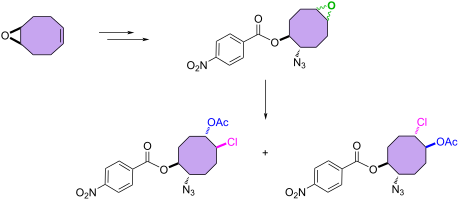
- computations were performed to gain insights into the mechanism underlying regioselectivity for the methanolysis of the isomeric epoxides 9 (Figure 3). Detailed mechanistic routes involving all possible intermediates responsible for the regioselectivity step were constructed and the free energy barriers for
- formed in both pathways. Free energy computations indicate that the intermediate 12 is thermodynamically more stable by 4.9 kcal mol−1 compared to intermediate 15. The nucleophilic attack by chloride ion bifurcates into two paths, namely C1- (route a) and C2-attacks (route b) for intermediates 12 and 15
- correlates well with the computed activation barriers and the divergence of the competing reaction pathways. In this context, despite the presence of a hydrogen-bonding interaction in TS2, TS1 is lower in energy due to a more favourable cyclooctane conformation. Notably, the relatively small energy


Get a better glimpse on sequential photoreactions of trisnorbornadienes with 19F NMR spectroscopy
Beilstein J. Org. Chem. 2026, 22, 527–534, doi:10.3762/bjoc.22.38
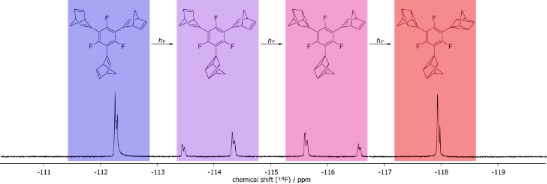
- exemplarily with a trifluorinated trisnorbornadienylbenzene that 19F NMR spectroscopy may be applied as a useful complementary method for the investigation of sequential photoreactions. The trisnorbornadiene core structure was used as it figures as promising scaffold for molecular solar thermal (MOST) energy
- thermal energy storage; photochemistry; photochromism; quadricyclanes; Introduction Photochromic compounds, which change their physical and chemical properties reversibly upon irradiation, figure as a versatile basis for the development of functional materials, whose performance can be switched or
- controlled by light [1][2][3][4]. To add to that, the photochromic reaction allows to convert the energy of the applied light into chemical energy, which can thus be stored and eventually released on demand as heat in the back reaction. Therefore, photochromic reactions constitute the centerpiece of the


Synthesis and uranyl(VI) extraction performance of a calix[4]pyrrole–tetrahydroxamic acid receptor
Beilstein J. Org. Chem. 2026, 22, 486–494, doi:10.3762/bjoc.22.36
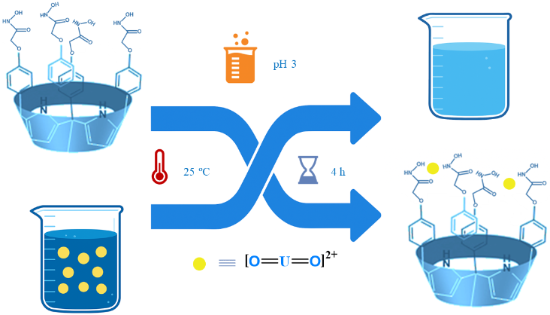
- Lebanese Atomic Energy Commission, National Council for Scientific Research CNRS –L, P.O. Box: 11-8281, Riad el soleh, 1107 2260, Beirut, Lebanon 10.3762/bjoc.22.36 Abstract The contamination of water by uranium poses a serious threat to ecosystems and human health, creating a need for efficient and
- extraction by PCP HA. Supporting Information Supporting Information File 6: Experimental part. Acknowledgements The authors express their gratitude to the Lebanese Atomic Energy Commission- LAEC and the Unité de Chimie Environnementale et Interactions sur le Vivant- UCEIV for their support of this work


Recent advances in the stereoselective synthesis of distal biaxially chiral molecules
Beilstein J. Org. Chem. 2026, 22, 461–479, doi:10.3762/bjoc.22.34
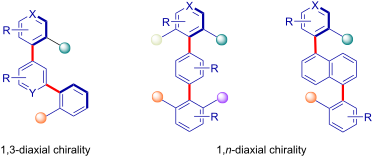
- "-ternaphthalene compounds [35]. This work significantly advanced the development of bi- and multiaxial chirality. The synthesis of multiaxial chiral molecules requires appropriate steric hindrance to elevate the rotational energy barrier of each chiral axis [36], and the spatial interactions between axes are
- prioritizing the construction of axially chiral diastereomers with the highest energy barriers to reduce the venture of subsequent epimerization. At the same time, the higher barrier diastereomer served as a chiral template for building the stereoconfiguration of axial chiral bonds. Remarkably, this strategy


Structural reassignment of compound 968, an allosteric glutaminase inhibitor
Beilstein J. Org. Chem. 2026, 22, 455–460, doi:10.3762/bjoc.22.33
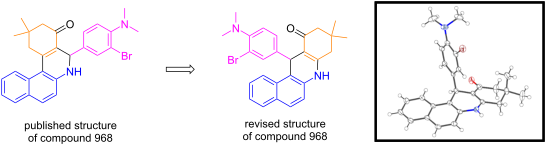
- oxidatively deaminated to the TCA cycle intermediate α-ketoglutarate for energy production and additional biosynthetic pathways. There are two glutaminase isozymes in humans: KGA is encoded by the GLS1 gene and is expressed mainly in the kidney and brain and LGA encoded by the GLS2 gene is expressed mainly in





