Search results
Search for "fine chemicals" in Full Text gives 96 result(s) in Beilstein Journal of Organic Chemistry.
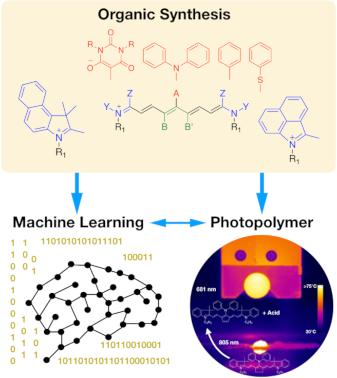
Photophysics and photochemistry of NIR absorbers derived from cyanines: key to new technologies based on chemistry 4.0
Beilstein J. Org. Chem. 2020, 16, 415–444, doi:10.3762/bjoc.16.40


Oligomeric ricinoleic acid preparation promoted by an efficient and recoverable Brønsted acidic ionic liquid
Beilstein J. Org. Chem. 2020, 16, 351–361, doi:10.3762/bjoc.16.34
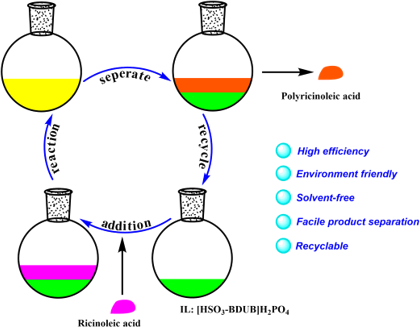
- biomass provides an alternative avenue to liberate us from the reliance on petroleum resource [1]. Nowadays, fuels, fine chemicals and functional molecules/materials can be derived from biomass such as lignocellulose and plant oils [2][3], wherein the plant oils play an important role in the polymer


Carbazole-functionalized hyper-cross-linked polymers for CO2 uptake based on Friedel–Crafts polymerization on 9-phenylcarbazole
Beilstein J. Org. Chem. 2019, 15, 2856–2863, doi:10.3762/bjoc.15.279
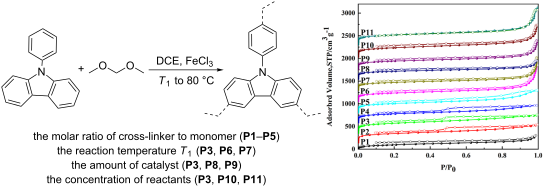
- from Aladdin Chemical Reagent Corp. (Shanghai, China). FeCl3 were acquired from the Macklin Chemical Reagent Ltd Co. (Shanghai, China). Methanol, THF, HCl, and distilled water were obtained from TONG GUANG Fine Chemicals Company (Beijing, China). Unless stated otherwise, all solvents and chemicals were


Recent advances on the transition-metal-catalyzed synthesis of imidazopyridines: an updated coverage
Beilstein J. Org. Chem. 2019, 15, 1612–1704, doi:10.3762/bjoc.15.165
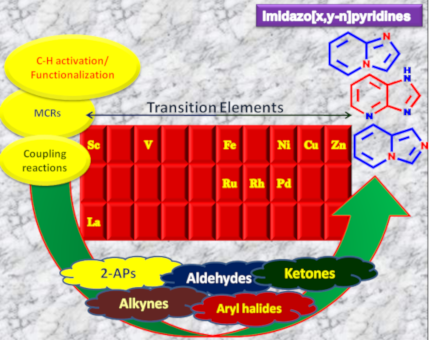


Mechanochemical Friedel–Crafts acylations
Beilstein J. Org. Chem. 2019, 15, 1313–1320, doi:10.3762/bjoc.15.130
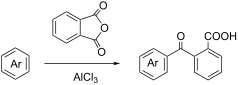
- in fine chemicals production [1][2]. In recent years, public awareness of the negative impact of chemical processes on the environment instigates chemists to improve processes by the reduction of waste material, energy consumption and reagents (materials). In this respect, carrying out FCR at room


Synthesis of non-racemic 4-nitro-2-sulfonylbutan-1-ones via Ni(II)-catalyzed asymmetric Michael reaction of β-ketosulfones
Beilstein J. Org. Chem. 2019, 15, 1289–1297, doi:10.3762/bjoc.15.127
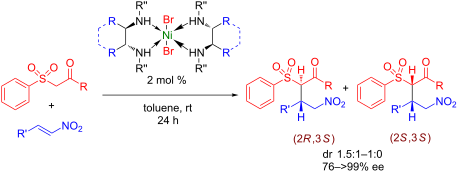
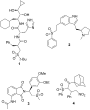
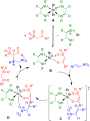
- frequently used in the synthesis of organic fine chemicals and natural compounds. In addition to using the sulfonyl group as an auxiliary, it is also included in some chiral bioactive molecules, such as remikiren (1, renin inhibitor for the treatment of hypertension) [5][6], eletriptan (2, Relpax®, serotonin




Olefin metathesis catalysts embedded in β-barrel proteins: creating artificial metalloproteins for olefin metathesis
Beilstein J. Org. Chem. 2018, 14, 2861–2871, doi:10.3762/bjoc.14.265
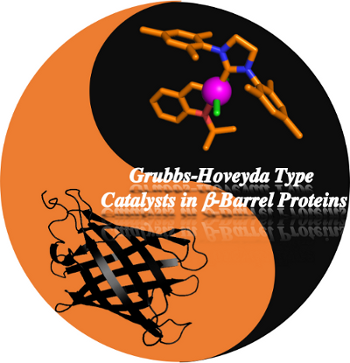
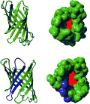
- metathesis into natural metabolic pathways to allow synthesis of fine chemicals [14]. Also, a targeted reaction in a certain environment within a living cell with a precise release or activation of the catalyst would enable new ways of drug delivery. The challenge to overcome this regard is the deactivation


A switchable [2]rotaxane with two active alkenyl groups
Beilstein J. Org. Chem. 2018, 14, 2074–2081, doi:10.3762/bjoc.14.181
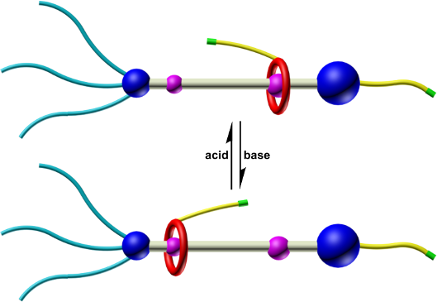
- Xiu-Li Zheng Rong-Rong Tao Rui-Rui Gu Wen-Zhi Wang Da-Hui Qu Key Laboratory for Advanced Materials and Institute of Fine Chemicals, School of Chemistry and Molecular Engineering, East China University of Science and Technology, 130 Meilong Road, Shanghai, 200237, China 10.3762/bjoc.14.181


Cobalt-catalyzed nucleophilic addition of the allylic C(sp3)–H bond of simple alkenes to ketones
Beilstein J. Org. Chem. 2018, 14, 2012–2017, doi:10.3762/bjoc.14.176
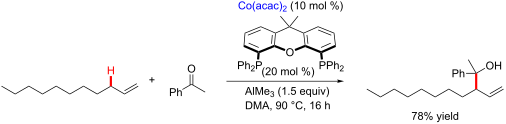
- -olefins (CxH2x) are abundantly present in nature or are readily accessible, they should be appropriate starting materials for C–C bond forming reactions to create organic frameworks of value-added compounds such as natural products, drugs, and fine chemicals. There have been tremendous synthetic methods


A self-assembled photoresponsive gel consisting of chiral nanofibers
Beilstein J. Org. Chem. 2018, 14, 1994–2001, doi:10.3762/bjoc.14.174
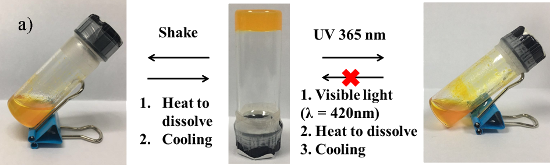
- Lei Zou Dan Han Zhiyi Yuan Dongdong Chang Xiang Ma Key Laboratory for Advanced Materials and Institute of Fine Chemicals, School of Chemistry & Molecular Engineering, East China University of Science & Technology, Shanghai 200237, China 10.3762/bjoc.14.174 Abstract A novel compound based on a


Spectroelectrochemical studies on the effect of cations in the alkaline glycerol oxidation reaction over carbon nanotube-supported Pd nanoparticles
Beilstein J. Org. Chem. 2018, 14, 1428–1435, doi:10.3762/bjoc.14.120
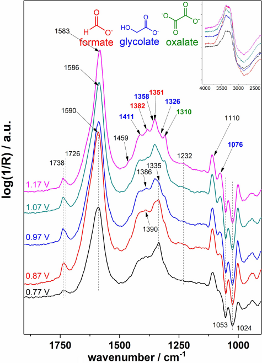
- complicates the total oxidation reaction, because numerous intermediates occur that need to be oxidized efficiently without poisoning the catalyst. Another important utilization of glycerol is the electrosynthesis of fine chemicals. It is a highly suitable precursor for valuable chemicals such as DL-glyceric
- acid, mesoxalic acid and 1,3-dihydroxyacetone (DHA). These products are conventionally obtained by oxidation using rather unselective oxidants. Especially DHA is of great interest due to its use in the cosmetic industry, as a precursor for further value-added fine chemicals [9] and as a monomer for
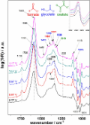
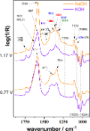
- fine chemicals it is important to extend the knowledge about this effect. In this study we used Pd nanoparticles (NPs) deposited on functionalized carbon nanotubes (Pd/xCNT, x = N or O) for catalyzing the glycerol oxidation reaction (GOR). Pd/NCNT has been investigated recently in the ethanol


2-Iodo-N-isopropyl-5-methoxybenzamide as a highly reactive and environmentally benign catalyst for alcohol oxidation
Beilstein J. Org. Chem. 2018, 14, 971–978, doi:10.3762/bjoc.14.82

- iodine; iodobenzamide; organic catalysis; oxidation; oxone; Introduction The development of an efficient and environmentally benign organic synthesis is required for minimizing material use, energy consumption, and environmental pollution in the production of both bulk and fine chemicals. Oxidation is a



Volatiles from the xylarialean fungus Hypoxylon invadens
Beilstein J. Org. Chem. 2018, 14, 734–746, doi:10.3762/bjoc.14.62
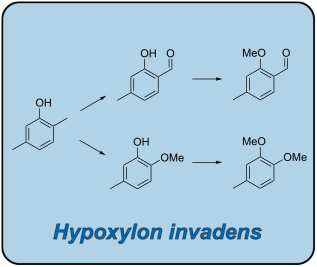
- were available from standard suppliers of fine chemicals and thus the structure of another regioisomer cannot fully be excluded for 14, but the closure of the biosynthetic gap by 2-methoxy-5-methylphenol intriguingly favours this structural assigment for 14. The alternative structure of 2-methoxy-4


Nanoreactors for green catalysis
Beilstein J. Org. Chem. 2018, 14, 716–733, doi:10.3762/bjoc.14.61
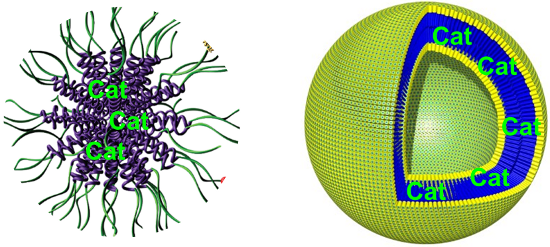
- switching procedures can be prevented. Although this requires still much development, it is to be expected that in the near future nanoreactors will be key to a more sustainable production of fine chemicals. Assembly of catalyst-functionalized amphiphilic block copolymers into polymer micelles and vesicles


High-yielding continuous-flow synthesis of antimalarial drug hydroxychloroquine
Beilstein J. Org. Chem. 2018, 14, 583–592, doi:10.3762/bjoc.14.45
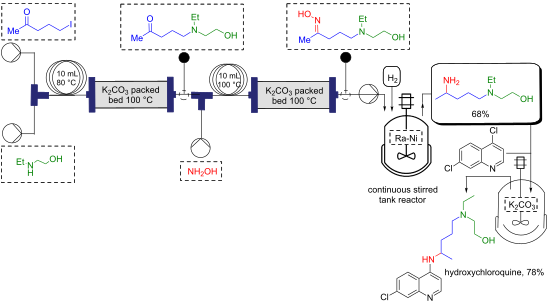
- , USA 10.3762/bjoc.14.45 Abstract Numerous synthetic methods for the continuous preparation of fine chemicals and active pharmaceutical ingredients (API’s) have been reported in recent years resulting in a dramatic improvement in process efficiencies. Herein we report a highly efficient continuous


Diels–Alder cycloadditions of N-arylpyrroles via aryne intermediates using diaryliodonium salts
Beilstein J. Org. Chem. 2018, 14, 354–363, doi:10.3762/bjoc.14.23
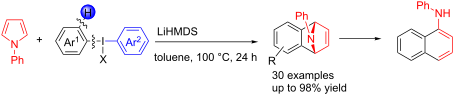
- Huangguan Chen Jianwei Han Limin Wang Key Laboratory for Advanced Materials, Institute of Fine Chemicals, School of Chemistry & Molecular Engineering, East China University of Science and Technology, 130 Meilong Road, Shanghai 200237, P. R. China Shanghai–Hong Kong Joint Laboratory in Chemical


Automating multistep flow synthesis: approach and challenges in integrating chemistry, machines and logic
Beilstein J. Org. Chem. 2017, 13, 960–987, doi:10.3762/bjoc.13.97
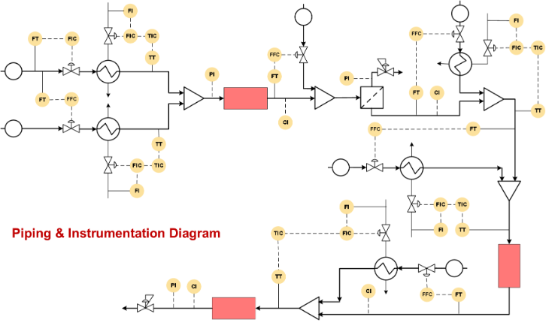
- have applications in fine chemicals, agrochemicals, and pharmaceuticals. Multistep syntheses enable the synthesis of complex molecules, which otherwise would be practically impossible if performed in a single step. In multistep flow synthesis, the general approach is to mix the reagents in a suitable




Continuous-flow processes for the catalytic partial hydrogenation reaction of alkynes
Beilstein J. Org. Chem. 2017, 13, 734–754, doi:10.3762/bjoc.13.73
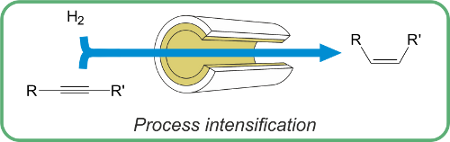
- liquid phase is a reaction of high relevance to the manufacture of a multitude of fine chemicals [1] including pharmaceutical building blocks, agrochemicals, food additives, flavours and fragrances [2][3]. It is also crucial in the bulk polymer industry to achieve the complete elimination of alkynes and
- observed in the fine-chemicals sector [22][23], as a consequence of the additives and manipulations required to achieve satisfactory selectivity. Indeed, the implementation of continuous-flow practices in the pharmaceutical industry is considered one of the most strategic fields of innovation toward
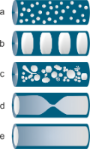
- , selective liquid phase flow processes for the fine-chemicals synthesis, including partial hydrogenations, usually requires a more intimate contact with the heterogeneous catalyst to be efficient. One example is the so-called "confinement effect" found in mesoporous catalytic materials [77][78]. Catalytic








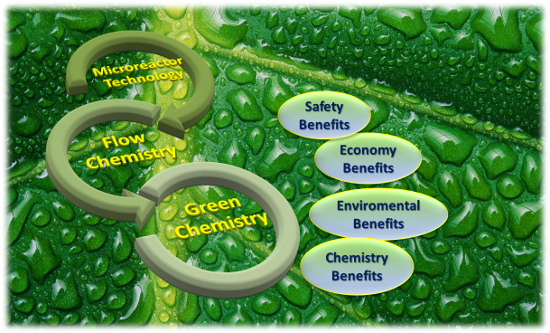
Contribution of microreactor technology and flow chemistry to the development of green and sustainable synthesis
Beilstein J. Org. Chem. 2017, 13, 520–542, doi:10.3762/bjoc.13.51
- through the reactor together with the reactants, is employed. At the end of the process, a separation step would be required in order to remove the catalyst and byproducts. On the other hand, heterogeneous catalysis is widely used in the synthesis of bulk and fine chemicals. In a continuous-flow process






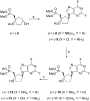
Revaluation of biomass-derived furfuryl alcohol derivatives for the synthesis of carbocyclic nucleoside phosphonate analogues
Beilstein J. Org. Chem. 2017, 13, 251–256, doi:10.3762/bjoc.13.28
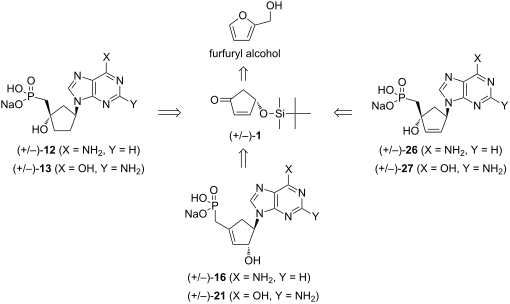
- catalytic hydrogenation of furfural; the latter is obtained from the dehydration of xylose, a 5-carbon sugar derived from vegetal biomass. Furfuryl alcohol finds widespread application in the chemical industries and for example is employed for the production of synthetic fibers, fine chemicals, etc. In fine




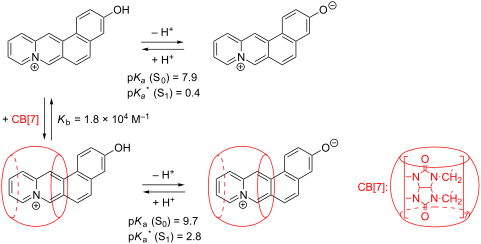
Interactions between photoacidic 3-hydroxynaphtho[1,2-b]quinolizinium and cucurbit[7]uril: Influence on acidity in the ground and excited state
Beilstein J. Org. Chem. 2017, 13, 203–212, doi:10.3762/bjoc.13.23
- their versatility as functional dyes. Experimental General The employed fine chemicals (Sigma-Aldrich, Acros or Alfa Aesar) were reagent grade and used without further purification. NMR spectroscopy: Bruker Avance 400 (1H: 400 MHz, 13C: 100 MHz) or Varian VNMR-S 600 (1H: 600 MHz, 13C: 150 MHz); at 25 °C


Self-optimisation and model-based design of experiments for developing a C–H activation flow process
Beilstein J. Org. Chem. 2017, 13, 150–163, doi:10.3762/bjoc.13.18
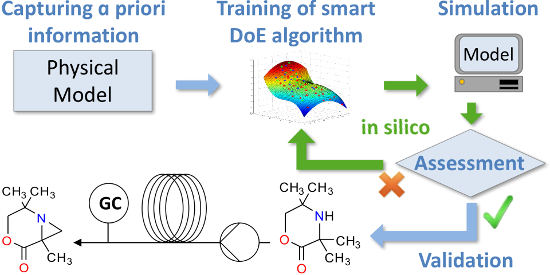
- ; flow chemistry; process modelling; self-optimisation; Introduction The development of manufacturing processes to produce functional molecules, such as pharmaceuticals or fine chemicals, often relies on experience and trial-and-error, rather than on mechanistic process models [1]. The only reason for


Diels–Alder reactions of myrcene using intensified continuous-flow reactors
Beilstein J. Org. Chem. 2017, 13, 120–126, doi:10.3762/bjoc.13.15
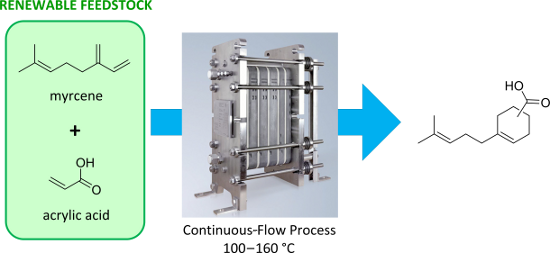
- ; Introduction Over the past years, great attention has been devoted to finding alternative, renewable feedstocks to fossil oil for the production of fuel and industrial chemicals. Especially, high value added products from fine chemicals, specialty chemicals or the pharmaceuticals sector allow for a ‘drop-in


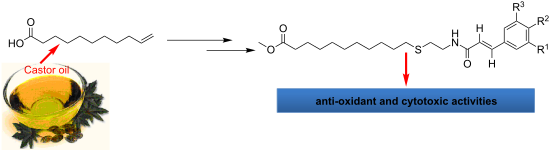
Synthesis and evaluation of anti-oxidant and cytotoxic activities of novel 10-undecenoic acid methyl ester based lipoconjugates of phenolic acids
Beilstein J. Org. Chem. 2017, 13, 26–32, doi:10.3762/bjoc.13.4
- purchased from Sd Fine Chemicals (Mumbai, India) and were of the highest grade of purity available. Instruments 1H and 13C NMR spectra were recorded on a Bruker Avance operating at 700/500 MHz and 175/125 MHz. The NMR spectra were referenced to δ 7.26 ppm and δ 77.0 ppm in CDCl3 solvent for 1H and 13C


Silica-supported sulfonic acids as recyclable catalyst for esterification of levulinic acid with stoichiometric amounts of alcohols
Beilstein J. Org. Chem. 2016, 12, 2173–2180, doi:10.3762/bjoc.12.207
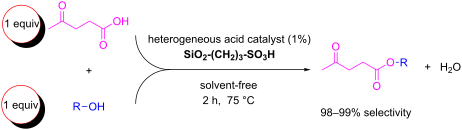
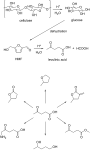
- context, levulinic acid, which is easily obtained from cellulose, is valuable since it can be transformed into a variety of industrially relevant fine chemicals. Here we present a simple protocol for the selective esterification of levulinic acid using solid acid catalysts. Silica supported sulfonic acid
- , respectively. All of these polymers are the subject of many studies [5][6][7][8][9][10][11]. Levulinic acid (LA) is one of the most important platform chemicals as it is a versatile building block for a variety of value-added agrochemicals, fine chemicals and pharmaceutical intermediates [12][13] (Scheme 1
- free, 75 °C, 2 h. Synthesis of levulinic acid from ligno-cellulosic feedstocks and its principal uses to access fine chemicals. Screening of different solid acids in the esterification reaction of levulinic acid with 1-pentanol. Variation of the acid/alcohol ratio. Variation of the reaction temperature