


Search results
Search for "UV–vis spectroscopy" in Full Text gives 152 result(s) in Beilstein Journal of Organic Chemistry.
Synthesis of 6,13-difluoropentacene
Beilstein J. Org. Chem. 2020, 16, 2136–2140, doi:10.3762/bjoc.16.181
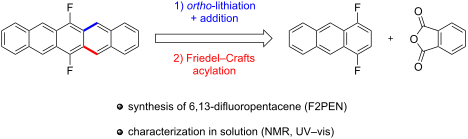
- HOMO–LUMO gap of 6,13-difluoropentacene was determined via UV–vis spectroscopy and compared to other fluorinated pentacenes. Keywords: fluorinated acenes; Friedel–Crafts reaction; ortho-lithiation; synthesis; Introduction Pentacenes are a prototype in the field of organic semiconductors due to their
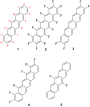
- degradation in degassed C6D6 was slow enough to obtain a clean 1H NMR spectrum (see Supporing Information File 1) [17]. Next, the HOMO–LUMO gap of 5 was investigated via UV–vis spectroscopy in solution (Figure 2). The λmax was determined to be at 597 nm, which corresponds to a HOMO–LUMO gap of ΔE = 2.08 eV



The charge-assisted hydrogen-bonded organic framework (CAHOF) self-assembled from the conjugated acid of tetrakis(4-aminophenyl)methane and 2,6-naphthalenedisulfonate as a new class of recyclable Brønsted acid catalysts
Beilstein J. Org. Chem. 2020, 16, 1124–1134, doi:10.3762/bjoc.16.99
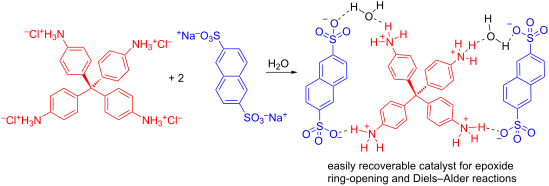
- components of F-1 were catalytically active, and hence that the reaction was partly catalyzed heterogeneously and partly promoted by the leached catalyst under the experimental conditions. To investigate this in more detail, studies on the solubility of F-1 in MeOH were conducted by UV–vis spectroscopy at
- ) ranging from 5.0 to 3.8. The solubility of F-1 in water was determined by UV–vis spectroscopy to be 0.9 g/L. This corresponded to approximately 50% of the catalyst F-1 being dissolved in the water phase of the reactions reported in Table 1, runs 12–14. The concentration of the ammonium groups was then 4.0




Aldehydes as powerful initiators for photochemical transformations
Beilstein J. Org. Chem. 2020, 16, 833–857, doi:10.3762/bjoc.16.76
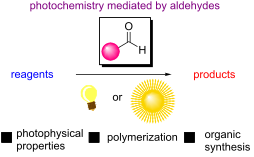
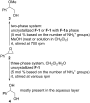
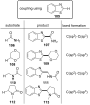
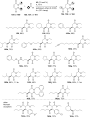
- fluorescence quenching studies, UV–vis spectroscopy experiments, calculation of the quantum yield, a cutoff experiment below 400 nm, GC–MS analysis, and NMR spectroscopic mechanistic experiments. They also concluded that an energy transfer mechanism could not be possible since the solvent employed affected the






Synthesis of C70-fragment buckybowls bearing alkoxy substituents
Beilstein J. Org. Chem. 2020, 16, 681–690, doi:10.3762/bjoc.16.66
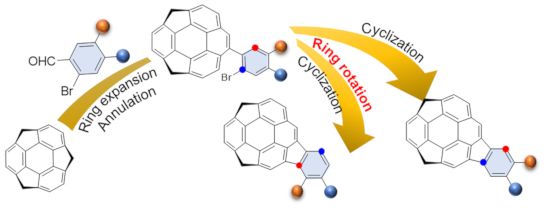
- and optical properties were investigated by single crystal X-ray analysis and UV–vis spectroscopy. In the synthesis of dioxole derivative 5b, the regioisomer 5c was also produced. The yield of 5c was increased by increasing the reaction temperature, indicating that the rearrangement might involve the
- expansion by Wagner–Meerwein rearrangement, followed by Pd-catalyzed annulation (Figure 1) [18]. An UV–vis spectroscopy study revealed that the electronic character of 1 rather resembled that of an indenopyrene moiety than that of benzopyrene. Our synthetic route allows to easily introduce substituents on


Efficient synthesis of 3,6,13,16-tetrasubstituted-tetrabenzo[a,d,j,m]coronenes by selective C–H/C–O arylations of anthraquinone derivatives
Beilstein J. Org. Chem. 2020, 16, 544–550, doi:10.3762/bjoc.16.51
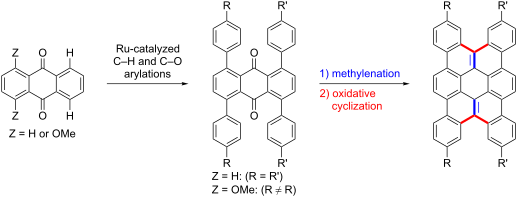
- the substituents in compounds 7 on their optical properties was studied by UV–vis spectroscopy (Figure 1). The UV–vis spectra of 7aa, 7bb, and 7ba were measured in chloroform, and the normalized UV–vis spectra are shown in Figure 1. These compounds showed similar peak patterns between 300 and 500 nm


p-Pyridinyl oxime carbamates: synthesis, DNA binding, DNA photocleaving activity and theoretical photodegradation studies
Beilstein J. Org. Chem. 2020, 16, 337–350, doi:10.3762/bjoc.16.33
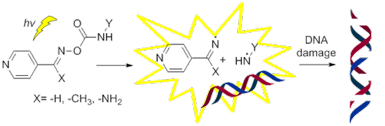
- cause of the activity. Therefore, the interaction of selected compounds, i.e., 11 and 12, with CT DNA was monitored by UV–vis spectroscopy and viscosity measurements. Additionally, the EB−displacing ability of the compounds was evaluated by fluorescence emission spectroscopy. The UV–vis spectra of a CT
- classic DNA intercalator EB (Kb = 1.23 × 10⁵ M−1) as previously reported [69]. The data obtained by the UV–vis spectroscopy studies most probably indicate the interaction of the compounds with CT DNA. However, the exact mode of binding is not safe to be proposed before more experimental data can be
- identity. General procedures for the syntheses, as well as data and pictures of all spectra are provided in Supporting Information File 1. Interaction with CT DNA DNA-binding studies with UV–vis spectroscopy The binding constants of compounds 11 and 12 to CT DNA (Kb) were calculated by the Wolfe–Shimer


Recent developments in photoredox-catalyzed remote ortho and para C–H bond functionalizations
Beilstein J. Org. Chem. 2020, 16, 248–280, doi:10.3762/bjoc.16.26
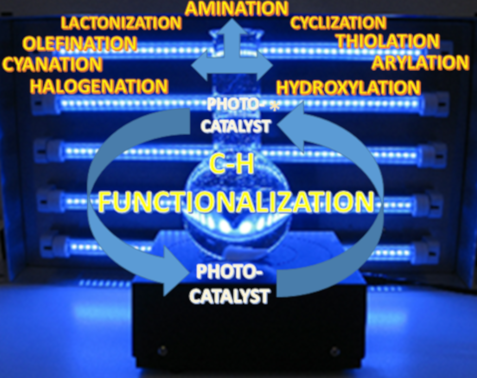
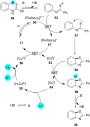
- efficient brominations, they employed sodium bromide in the presence of oxygen. The activation of the photocatalyst through protonation was shown by cyclic voltammetry, and the other interactions were revealed by emission quenching experiments and UV–vis spectroscopy. As can be seen in Scheme 21, the group










The interaction between cucurbit[8]uril and baicalein and the effect on baicalein properties
Beilstein J. Org. Chem. 2020, 16, 71–77, doi:10.3762/bjoc.16.9
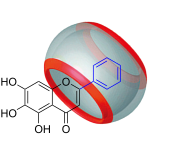
- corresponding properties of the inclusion complex were studied using 1H NMR, IR and UV–vis spectroscopy and DTA. The results showed that BALE forms an inclusion compound (1:1) with Q[8], and the properties of baicalein are changed by cucurbit[8]uril. Keywords: baicalein; cucurbit[8]uril; host–guest interaction
- solution using 1H NMR, UV–vis and IR spectroscopy, and DTA. The properties of the BALE–Q[8] inclusion complex, such as stability, solubility, in vitro antioxidant activity and release performance were studied by means of UV–vis spectroscopy. Results and Discussion Host–guest interactions Q[8] and BALE in


Starazo triple switches – synthesis of unsymmetrical 1,3,5-tris(arylazo)benzenes
Beilstein J. Org. Chem. 2020, 16, 22–31, doi:10.3762/bjoc.16.4
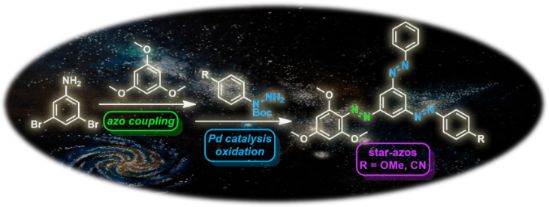
- 20% was achieved, whereas the methoxy derivative 3b could be isolated in a good yield of 59%. Having both tris(arylazo)benzenes 3a/3b in hand, UV–vis spectroscopy was used for preliminary investigations on the photophysical properties of the molecular triple switches 3. Both tris(arylazo)benzenes 3a


Synthesis and characterization of bis(4-amino-2-bromo-6-methoxy)azobenzene derivatives
Beilstein J. Org. Chem. 2019, 15, 3000–3008, doi:10.3762/bjoc.15.296
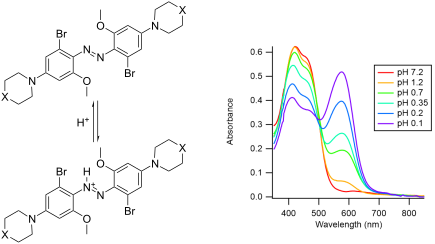
- absorbance at 440 nm was diminished and that at 330 nm slightly enhanced (Figure 3). An estimated PSS of ca. 60% Z-isomer was calculated as described in the Experimental section. Thermal relaxation from the PSS was monitored by UV–vis spectroscopy, recording a spectrum every minute. As shown in Figure 3, a
- monitored by UV–vis spectroscopy, recording a UV–vis spectrum every 3 minutes, and a half-life of 12.6 minutes was obtained. The formation of the azonium ion of 5 in aqueous solution was explored thereafter. Addition of hydrochloric acid to a neutral solution of 5 was carried out. Spectra at different pH
- , 2H), 4.11 (s, 6H), 3.45 (m, 8H), 3.00 (m, 8H); 13C NMR (126 MHz, DCM-d2) δ 158.9, 154.0, 140.2, 123.0, 111.5, 107.2, 66.9, 57.3, 45.1; HRMS (m/z): [M + H]+ calcd for C22H29Br2N6O2, 567.0719; found, 567.0713. UV–vis spectroscopy UV–vis spectra were recorded on a PerkinElmer LAMBDA 35, Shimadzu UV


Photoreversible stretching of a BAPTA chelator marshalling Ca2+-binding in aqueous media
Beilstein J. Org. Chem. 2019, 15, 2801–2811, doi:10.3762/bjoc.15.273
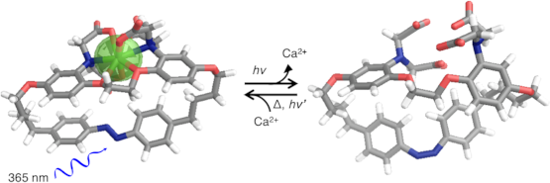
- optical bench equipped with a 150 W Hg–Xe lamp and a monochromator [40]. Samples (40 μM) were stirred during the irradiation and the amount of converted material was determined at 2 min intervals by UV–vis spectroscopy following the disappearance of the band at 362 nm. The error in the photoreaction


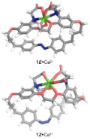


In search of visible-light photoresponsive peptide nucleic acids (PNAs) for reversible control of DNA hybridization
Beilstein J. Org. Chem. 2019, 15, 2500–2508, doi:10.3762/bjoc.15.243
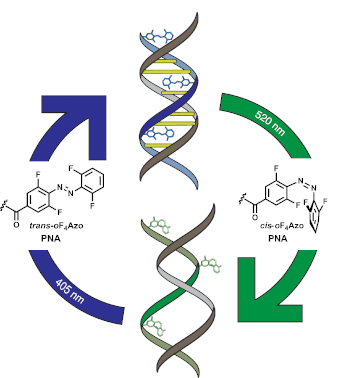
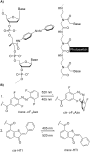
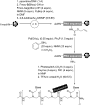
- the PNAs, UV–vis spectroscopy of 20 μM solutions in phosphate buffer (10 mM NaH2PO4, 150 mM NaCl, pH 7.4) confirmed that PNA incorporation did not significantly affect the photochromism (Figures S24, S20, S30 and S33, Supporting Information File 1). This verifies the integrity of the chromophores
- complementary DNA. For this purpose, we decided to measure thermal melting curves. Beforehand we verified the photostability of cis-PNA12(oF4Azo) (3) in the temperature ramp from 20 °C to 90 °C by UV–vis spectroscopy. We observed that the cis-isomer was always stable during the whole temperature range (Figure



Experimental and computational electrochemistry of quinazolinespirohexadienone molecular switches – differential electrochromic vs photochromic behavior
Beilstein J. Org. Chem. 2019, 15, 2473–2485, doi:10.3762/bjoc.15.240
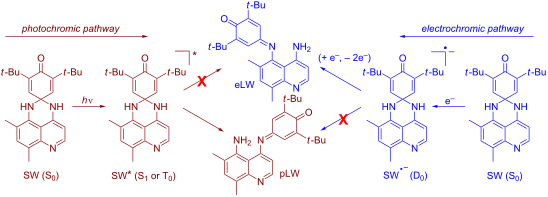
- small molecule organic electrochromism [6][7][9]. One example that combines photochromic and electrochromic behavior (the latter of an unusual sort) is the class of perimidinespirohexadienones 1 (PSHDs) whose synthesis, electrochemistry and UV–vis spectroscopy were reported by Minkin and co-workers [10
- peaks was consistent with UV–vis spectroscopy that indicated a significant amount of a LW isomer upon solvation, and repetitive electrochemical scans exhibited the anticipated growth of the LW reduction–oxidation peaks as more of the LW isomer was generated electrochemically (Figure 3b, solid blue
- electrochemical grade and used as received. Photochromes 1a,b were prepared according to the literature [10]. Photochromes 3a,b were prepared as we previously reported [21]. Instrumentation Photochemical irradiations and UV–vis spectroscopy were performed as previously described [21] on 3 mL or 4 mL argon-purged




Effect of ring size on photoisomerization properties of stiff stilbene macrocycles
Beilstein J. Org. Chem. 2019, 15, 2408–2418, doi:10.3762/bjoc.15.233
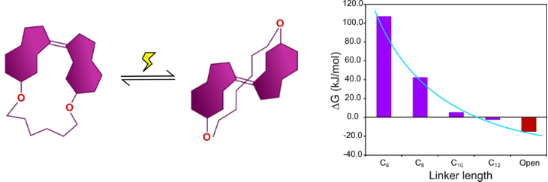
- spectroscopy. Photoisomerizations (followed by UV–vis spectroscopy) CHCl3 solutions of products (Z)-1d and stiff stilbene were irradiated after degassing by argon bubbling for 15 min. As reaction vessels, 10 mm quartz UV–vis cuvettes were used. The course of isomerization was assessed by UV–vis spectroscopy




Azologization and repurposing of a hetero-stilbene-based kinase inhibitor: towards the design of photoswitchable sirtuin inhibitors
Beilstein J. Org. Chem. 2019, 15, 2170–2183, doi:10.3762/bjoc.15.214
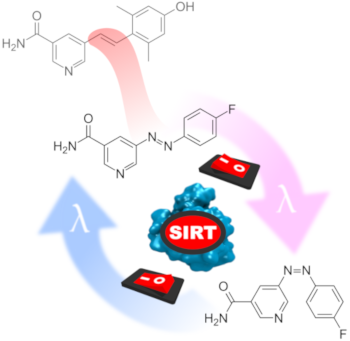
- are oxidized to 2- and 4-azaphenantrene (not shown), respectively [50]. Photochemistry of compounds 2b and 2f was investigated via UV–vis spectroscopy, LC–HRMS and NMR spectroscopy. Compound 2b represents the core structure of the azastilbenes investigated, whereas in 2f the influence of ortho
- methylation was intended to be examined. For UV–vis spectroscopy 50 µM solutions in 5% DMSO (v/v) in enzyme assay buffer were used, as this reflects the enzyme assay conditions. However, for LC-HRMS and NMR analysis, a higher concentration of 10 mM in methanol was necessary to receive reliable chromatograms


Synthesis and anion binding properties of phthalimide-containing corona[6]arenes
Beilstein J. Org. Chem. 2019, 15, 1976–1983, doi:10.3762/bjoc.15.193
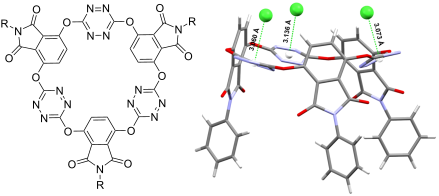
- . Upon complexation with a halide, the planar aromatic ring adopted a heavily pinched boat conformation, a result consistent with theoretical prediction [49]. We also examined the host–guest interaction in solution phase employing NMR and UV–vis spectroscopy and fluorescence technology. Unfortunately


Functional panchromatic BODIPY dyes with near-infrared absorption: design, synthesis, characterization and use in dye-sensitized solar cells
Beilstein J. Org. Chem. 2019, 15, 1758–1768, doi:10.3762/bjoc.15.169
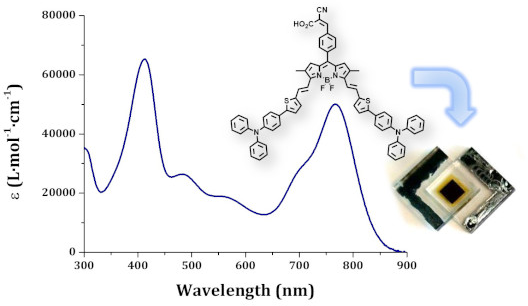
- were computed by density functional theory modelling (DFT) and characterized through UV–vis spectroscopy and cyclic voltammetry (CV) measurements. Finally, we report preliminary results obtained using these functional dyes as photosensitizers in dye-sensitized solar cells (DSSCs). Keywords: boron
- were investigated using UV–vis spectroscopy, and we show that they can absorb light up to 900 nm in solution and 1000 nm in solid state, after grafting on anatase-TiO2 mesoporous films. The cyclic voltammetry (CV) measurements indicate that the compounds have HOMO and LUMO energy levels suitable for an




Reversible end-to-end assembly of selectively functionalized gold nanorods by light-responsive arylazopyrazole–cyclodextrin interaction
Beilstein J. Org. Chem. 2019, 15, 1407–1415, doi:10.3762/bjoc.15.140
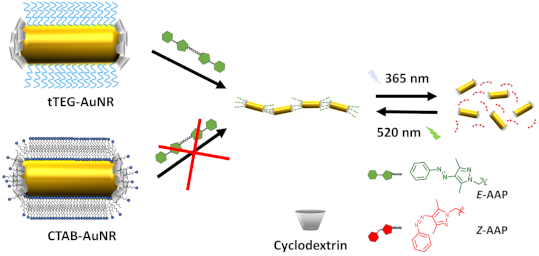
- [44]. Furthermore, the ζ-potential is known to be highest in deionized water and highly pH-dependent [45]. The ligand exchange reaction was also analyzed by UV–vis spectroscopy (Figure 1b). The synthesized [CTAB]AuNR show the two expected absorption maxima at λ = 525 nm for the TSPR band and at λ
- light-responsive assembly was further investigated via UV–vis spectroscopy (Figure 2c and d). The spectrum measured after injection of dAAP shows a broadened LSPR maximum with a red shift of λ = 7 nm while the TSPR band remains unchanged. This indicates longitudinal coupling of AuNR as a result of the
- ). Even upon addition of rather high concentrations of mAAP (100 µM) no strong shift can be observed by UV–vis spectroscopy, indicating that supramolecular cross-linking is essential for end-to-end assembly of the AuNR. Conclusion In summary, we reported a supramolecular system based on the reversible


Enantioselective Diels–Alder reaction of anthracene by chiral tritylium catalysis
Beilstein J. Org. Chem. 2019, 15, 1304–1312, doi:10.3762/bjoc.15.129
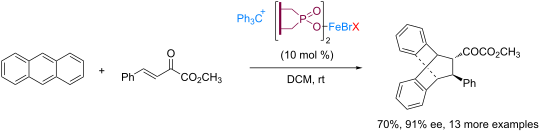
- formation of tritylium ions (Scheme 2a). The stimulated trityl cation generation was probed by UV–vis spectroscopy. As shown in Figure 1a, when treated with different Lewis acids, trityl phosphate TP showed a variable tendency to dissociate into the free tritylium ion pair with InBr3 as the most active


Bambusuril analogs based on alternating glycoluril and xylylene units
Beilstein J. Org. Chem. 2019, 15, 1268–1274, doi:10.3762/bjoc.15.124
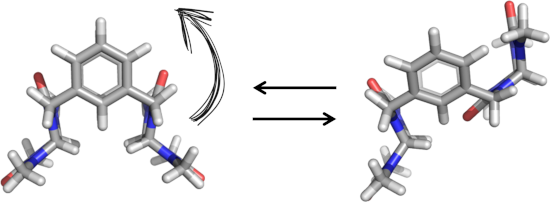
- bind inorganic anions with high binding affinity and selectivity in both organic media and water [13][14]. Previously we used bambusurils to recognize and quantify anions in their complex mixtures at sub-micromolar concentrations by means of NMR [15]. However, sensing of anions by less expensive UV–vis
- spectroscopy was not possible due to the low absorption of bambusurils within the UV–vis region. Therefore, we decided to investigate the synthesis of bambusuril derivatives and analogs containing chromophores in their structure. Initially we tested post-macrocyclic functionalization resulting in bambusurils


Extending mechanochemical porphyrin synthesis to bulkier aromatics: tetramesitylporphyrin
Beilstein J. Org. Chem. 2019, 15, 1149–1153, doi:10.3762/bjoc.15.111
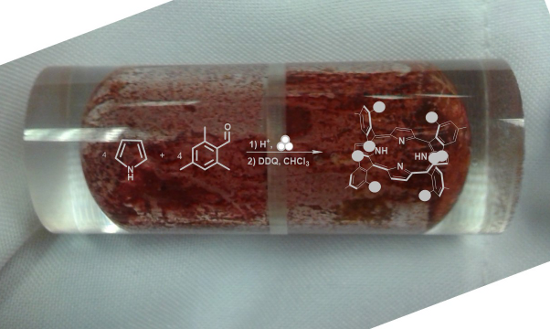
- filtrate. The filtrate was passed through a silica gel column using 1:3 ethyl acetate/hexanes as the mobile phase. Fractions containing porphyrin, as determined by thin-layer chromatography and UV–vis spectroscopy were combined and the solvent was removed using a rotary evaporator. meso-Tetrakis[2,4,6


Precious metal-free molecular machines for solar thermal energy storage
Beilstein J. Org. Chem. 2019, 15, 1096–1106, doi:10.3762/bjoc.15.106
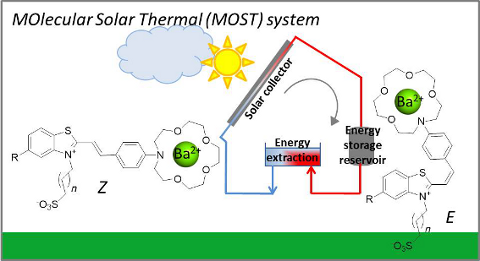
- were proved by NMR spectroscopy, elemental analysis, IR and UV–vis spectroscopy. Photophysical properties Steady-state absorption and emission spectroscopy Next we elucidated the photophysical properties of the chosen compounds and determined their suitability to be used as MOST systems. First, we




Coordination chemistry and photoswitching of dinuclear macrocyclic cadmium-, nickel-, and zinc complexes containing azobenzene carboxylato co-ligands
Beilstein J. Org. Chem. 2019, 15, 840–851, doi:10.3762/bjoc.15.81
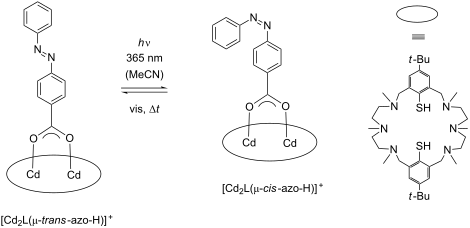
- carboxylate (azo-H), p'-hydroxy-p-azobenzene carboxylate (azo-OH), p'-dimethylamine-p-azobenzene carboxylate (azo-NMe2), and p'-(methoxycarbonyl)azobenzene-p-oxymethylcarboxylic acid (azo-CO2Me) were synthesized (Figure 2). Their preparation and structural characterization by NMR, IR, UV–vis spectroscopy
- = |2.59| cm−1 were determined [13]. UV–vis spectroscopy All new compounds were further investigated by electronic absorption spectroscopy. The electronic absorption spectra were recorded in acetonitrile (1, 2 and 5–9) or dimethyl sulfoxide (3, 4) solution in the 190 to 1200 nm spectral range. Figure 11






Synthesis of acylglycerol derivatives by mechanochemistry
Beilstein J. Org. Chem. 2019, 15, 811–817, doi:10.3762/bjoc.15.78
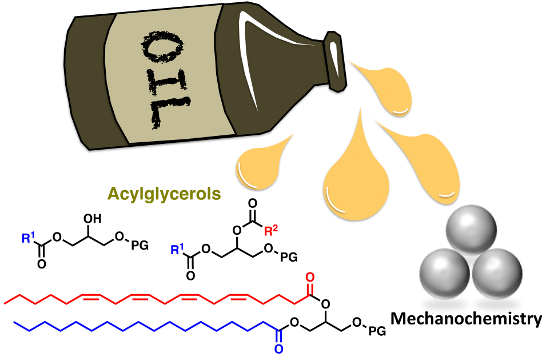
- ) was separated from the unreacted starting materials, and analyzed by UV–vis spectroscopy (Figure 3). Comparison of the UV–vis spectra of 6a and 10a/10a’ showed the successful conjugation of the DAG with the coumarin moiety [47]. Conclusion The implementation of ball milling techniques has provided the


Synthesis of functionalized diazocines for application as building blocks in photo- and mechanoresponsive materials
Beilstein J. Org. Chem. 2019, 15, 727–732, doi:10.3762/bjoc.15.68
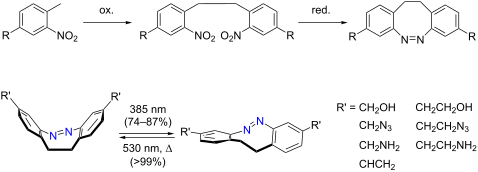
- were investigated by NMR and UV–vis spectroscopy and the results are listed in Table 1. Photostationary states (PSS) as well as half-lives (t1/2) were determined in acetonitrile at 300 K and 298.15 K, respectively. The (cis → trans) and (trans → cis) isomerization were achieved by irradiation into the
- ; iii) Zn, Ba(OH)2 H2O/EtOH, and CuCl2/O2, NaOH/MeOH; iv) Ti(Cl)4, DCM; v) ADMP, DBU, THF; vi) PPh3, H2O, THF; viii) TsCl, DMAP, TEA, DCM, and t-BuOK, THF. Photostationary states (300 K), absorption maxima and half-lives (298.15 K), determined by 1H NMR and UV–vis spectroscopy in acetonitrile





