


Search results
Search for "acid catalysis" in Full Text gives 114 result(s) in Beilstein Journal of Organic Chemistry.
Fluorohydration of alkynes via I(I)/I(III) catalysis
Beilstein J. Org. Chem. 2020, 16, 1627–1635, doi:10.3762/bjoc.16.135
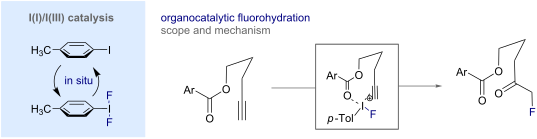
- fluorination of acetophenone derivatives was achieved using iodosylarenes and commercially available NEt3/HF 1:5 to generate the ArIF2 species in situ is also highly pertinent [39][40] (Figure 1A). Elegant reports describing the conversion of internal alkynes to α-fluoroketones via π-acid catalysis were also


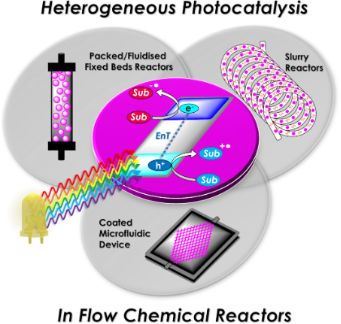
Heterogeneous photocatalysis in flow chemical reactors
Beilstein J. Org. Chem. 2020, 16, 1495–1549, doi:10.3762/bjoc.16.125










Ferrocenyl-substituted tetrahydrothiophenes via formal [3 + 2]-cycloaddition reactions of ferrocenyl thioketones with donor–acceptor cyclopropanes
Beilstein J. Org. Chem. 2020, 16, 1288–1295, doi:10.3762/bjoc.16.109
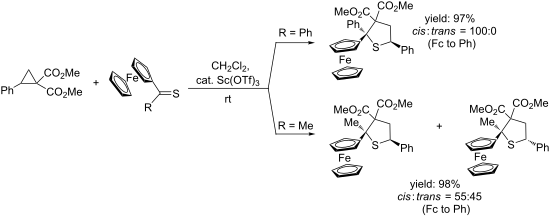
- by means of spectroscopic methods (R = CF3). In a recent work, an alternative, efficient and useful method for the synthesis of highly functionalized tetrahydrothiophenes of type 6 was reported [9] (Scheme 2). Under Lewis acid catalysis, formal [3 + 2]-cycloadditions of aromatic and cycloaliphatic


The charge-assisted hydrogen-bonded organic framework (CAHOF) self-assembled from the conjugated acid of tetrakis(4-aminophenyl)methane and 2,6-naphthalenedisulfonate as a new class of recyclable Brønsted acid catalysts
Beilstein J. Org. Chem. 2020, 16, 1124–1134, doi:10.3762/bjoc.16.99
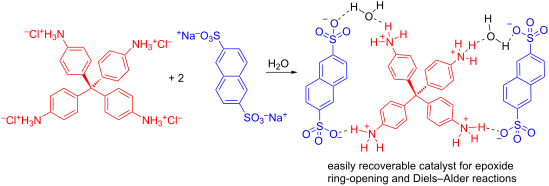
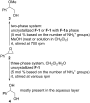
- ). Both the pH of the medium (specific acid catalysis) and general acid catalysis by the ammonium groups of F-1 were potentially important for the ring opening reactions. The ring openings were conducted in three different media: neat methanol, a mixture of methanol and dichloromethane, and a mixture of
- × 10−2 M in water. Assuming that the average pKa value of the ammonium groups of the protonated form of TAPM was around 4.0, the pH value of the solution would be between 4 and 5. It is therefore most likely that F-1 operated via the general acid catalysis mechanism in this solvent mixture. As the pKa
- value of anilinium cations will only change to a small extent when the solvent is changed from water to methanol, the same general acid catalysis mechanism would be expected to occur in reactions carried out in methanol. For comparison, the commercially available (and most often used heterogeneous




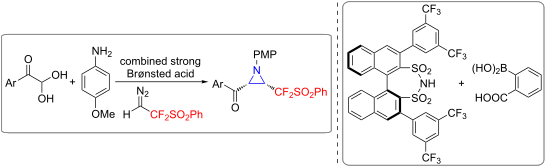
Asymmetric synthesis of CF2-functionalized aziridines by combined strong Brønsted acid catalysis
Beilstein J. Org. Chem. 2020, 16, 638–644, doi:10.3762/bjoc.16.60


[1,3]/[1,4]-Sulfur atom migration in β-hydroxyalkylphosphine sulfides
Beilstein J. Org. Chem. 2020, 16, 88–105, doi:10.3762/bjoc.16.11
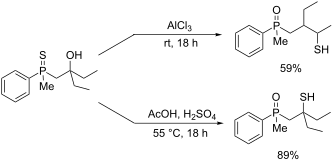
- conditions clearly showed that distinct reaction mechanisms were responsible for the substrate’s transformation under Lewis and Brønsted acid catalysis, but both seemed to include the preliminary formation of alkenylphosphine sulfide. This was shown for the Brønsted acid-mediated reaction (Table 4) but
- enantiomerically enriched 53 and 46. Synthesis of substrates for this study. Reaction of β-hydroxyalkylphosphine sulfides with Lewis-acidic AlCl3. Reaction of β-hydroxyalkylphosphine sulfides with Brønsted-acidic H2SO4. Control experiments under Brønsted acid catalysis. Supporting Information Supporting


Bacterial terpene biosynthesis: challenges and opportunities for pathway engineering
Beilstein J. Org. Chem. 2019, 15, 2889–2906, doi:10.3762/bjoc.15.283
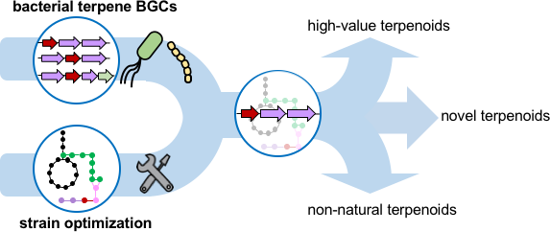
- sesquiterpenes (type I TCs), diterpenes can either be generated by type I TCs or type II TCs [11][55]. Type II TCs initiate carbocation formation by Brønsted acid catalysis to protonate a terminal isoprene double bond or an epoxide ring (Figure 5b) [56]. Thus, cyclization mediated by type II TCs leads to an


Indium-mediated C-allylation of melibiose
Beilstein J. Org. Chem. 2019, 15, 2458–2464, doi:10.3762/bjoc.15.238
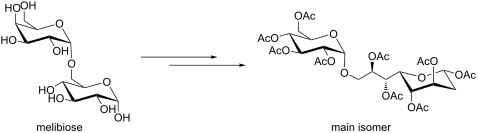
- the need for acid catalysis or other promotors [15]. This was also observed in our studies reflected in the significantly higher conversion rates employing indium versus tin (Table 1, entries 1 and 3). With respect to the solvent system, different ratios of an ethanol/water mixture were investigated


Cyclopropanation–ring expansion of 3-chloroindoles with α-halodiazoacetates: novel synthesis of 4-quinolone-3-carboxylic acid and norfloxacin
Beilstein J. Org. Chem. 2019, 15, 2156–2160, doi:10.3762/bjoc.15.212
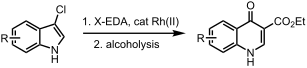
- conditions without the need for external acid catalysis. These relatively mild reaction conditions should be applicable to a large substrate scope. We anticipated that our novel cyclopropanation–ring expansion reaction would apply to 3-chloroindol derivatives, and designed a simple and straightforward


Enantioselective Diels–Alder reaction of anthracene by chiral tritylium catalysis
Beilstein J. Org. Chem. 2019, 15, 1304–1312, doi:10.3762/bjoc.15.129
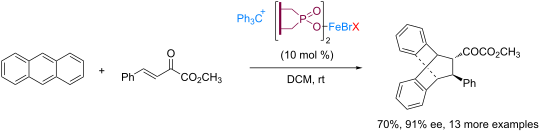
- anion; tritylium salt; Introduction Carbocation Lewis acid catalysis has grown significantly over the last two decades [1][2][3][4][5][6][7][8][9][10][11][12][13]. The development of asymmetric carbocation catalysts has been long pursued but remains a challenging task. One strategy is to design and
- investigated in Lewis acid catalysis over the past decades, a chiral counter anion [34][35] with metal elements as the central atom, however, was seldom reported. Typically, the tritylium salts with weakly coordinating anions can be synthesized through a simple halide abstraction from the trityl halide in the
- , Scheme 3a). The electron-rich nature of dimethylanthracene may account for catalysis with the iron salts. On the other hand, an opposite chiral induction in this case is a clear indication of distinctive carbocation catalysis instead of metal Lewis acid catalysis in the presence of trityl chloride. In


Steroid diversification by multicomponent reactions
Beilstein J. Org. Chem. 2019, 15, 1236–1256, doi:10.3762/bjoc.15.121
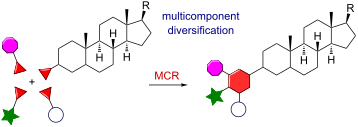
- reaction reported in 1893 comprises the acid–catalyzed condensation of ethyl acetoacetate, benzaldehyde and urea to generate 3,4-dihydropyrimidin-2(1H)-one [41]. From that time, the reaction was extended to Lewis-acid catalysis and the use of other solvents such as methanol or aprotic solvents such as THF


A three-component, Zn(OTf)2-mediated entry into trisubstituted 2-aminoimidazoles
Beilstein J. Org. Chem. 2019, 15, 1061–1064, doi:10.3762/bjoc.15.103
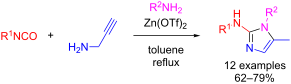
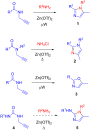
- propargylureas (leading to 2-imidazolones) and extend the range of Lewis acid-catalyzed azole syntheses based on N-carbonyl propargylamines. Keywords: alkyne hydroamination; cyclocondensation; Lewis acid catalysis; multicomponent reactions; propargylurea; Introduction The pioneering publications of Beller and
- turned our attention to propargylureas 4. These have been previously converted to the respective 2-imidazolones via base-promoted intramolecular amination of the propargyl group [5][6]. However, such transformations have not been studied under transition metal or Lewis acid catalysis. Moreover, the



Synthesis of a novel category of pseudo-peptides using an Ugi three-component reaction of levulinic acid as bifunctional substrate, amines, and amino acid-based isocyanides
Beilstein J. Org. Chem. 2019, 15, 852–857, doi:10.3762/bjoc.15.82
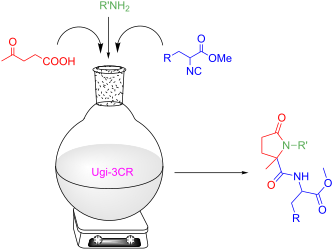
- by acid catalysis from renewable resources, such as sugars, lignocellulosic biomass and waste materials [18]. It can be used as a bifunctional precursor for the synthesis of pharmaceuticals, plasticizers, and different additives [19]. Furthermore, it is recognized as an excellent starting material


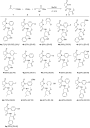


Tuning the stability of alkoxyisopropyl protection groups
Beilstein J. Org. Chem. 2019, 15, 746–751, doi:10.3762/bjoc.15.70
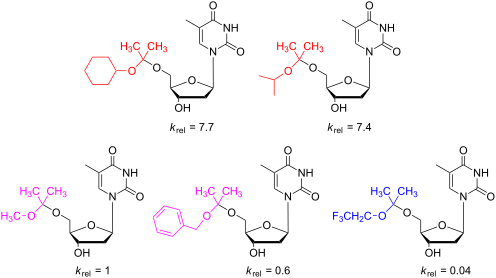
- . The vinyl ether hydrolysis has earlier shown to be even a subject of general acid catalysis [13][14]. It is useful to compare the stabilities of the acetal protections to those of the 4,4’-dimethoxytrityl protecting group used in oligonucleotide synthesis. Directly comparable data are hard to find


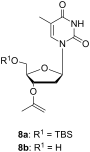

Cross metathesis-mediated synthesis of hydroxamic acid derivatives
Beilstein J. Org. Chem. 2018, 14, 3070–3075, doi:10.3762/bjoc.14.285

- important demonstration of the protocol is the preparation of the unusual amino acid component of the bioactive cyclic peptide Chap-31. Keywords: α-amino acid; catalysis; cross metathesis; hydroxamates; Introduction Cross-metathesis reactions (CM) have rapidly grown [1][2][3] to be a reliable method for


Synthesis of cis-hydrindan-2,4-diones bearing an all-carbon quaternary center by a Danheiser annulation
Beilstein J. Org. Chem. 2018, 14, 2597–2601, doi:10.3762/bjoc.14.237

- takes place from polyfunctionalized cyclohexanones or related compounds through a Michael reaction [7], successive inter- and intramolecular radical processes [8], intramolecular carbene addition/cyclization [9][10], aldol cyclizations either under Lewis acid catalysis [11] or from diazoketones in the


Functionalization of graphene: does the organic chemistry matter?
Beilstein J. Org. Chem. 2018, 14, 2018–2026, doi:10.3762/bjoc.14.177
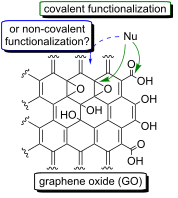
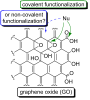
- stability [41][42]. Additionally, some researchers have used the acid catalysis [39] or grinding-induced process [40] for the esterification reaction, and the changes in the spectra (e.g., IR, XPS) were not prominent enough to imply the formation of covalent ester-type linkages. In the grinding-induced case


Phosphodiester models for cleavage of nucleic acids
Beilstein J. Org. Chem. 2018, 14, 803–837, doi:10.3762/bjoc.14.68
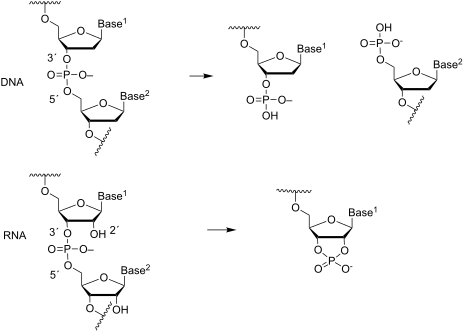
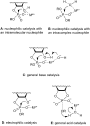
- nucleotide are extensively used in mechanistic studies of protein nucleases and ribozymes. Rate accelerating 3´-bridging substitution has been used to find out whether the chemical step really is rate-liming and 5´-substitution to verify that some small ribozymes utilize general acid catalysis [40]. The
- linkage has undergone rapid initial protonation. In other words, a monoanionic phosphorane is obtained by a specific acid/general base mechanism that is experimentally equivalent to general acid catalysis. The monoanionic phosphorane is stable enough to pseudorotate and may, hence, undergo isomerization



Mannich base-connected syntheses mediated by ortho-quinone methides
Beilstein J. Org. Chem. 2018, 14, 560–575, doi:10.3762/bjoc.14.43
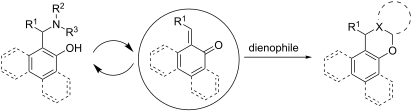
- indole polyheterocycles 49 and 50 in good yields with 90–99% ee. One of the latest publications around this topic has been reported by Deb et al. [86][87]. Various 2-(aminoalkyl)phenols or 1-(aminoalkyl)naphthols 51 were reacted with indoles under Brønsted acid catalysis resulting in 3-(α,α-diarylmethyl


From dipivaloylketene to tetraoxaadamantanes
Beilstein J. Org. Chem. 2018, 14, 1–10, doi:10.3762/bjoc.14.1

- need for acid catalysis. As in the case of the addition of arylamines, monodecarboxylation takes place, and in the presence of a strong acid, they are converted to the tetraoxaadamantanes 28 and 29 (65–93%) [35]. Several bisdioxine derivatives of aromatic di- and triamines as well as crown-ether





Acid-catalyzed ring-opening reactions of a cyclopropanated 3-aza-2-oxabicyclo[2.2.1]hept-5-ene with alcohols
Beilstein J. Org. Chem. 2017, 13, 2888–2894, doi:10.3762/bjoc.13.281
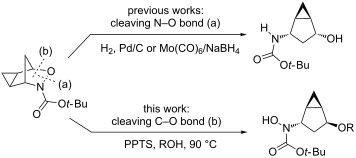
- reactions. The scope of the reaction was successfully expanded to include primary, secondary, and tertiary alcohol nucleophiles. Through X-ray crystallography, the stereochemistry of the product was determined which confirmed an SN2-like mechanism to form the ring-opened product. Keywords: acid catalysis


Synthesis of 2-aminosuberic acid derivatives as components of some histone deacetylase inhibiting cyclic tetrapeptides
Beilstein J. Org. Chem. 2017, 13, 2153–2156, doi:10.3762/bjoc.13.214

- and the synthesis of peptides of biological relevance. Keywords: α-amino acid; catalysis; chiral pool; cross metathesis; cyclic peptides; Introduction α-Aminosuberic acid (Asu) is a component of apicidin F (1, Figure 1) belonging to an interesting class of cyclic tetrapeptides displaying


New approaches to organocatalysis based on C–H and C–X bonding for electrophilic substrate activation
Beilstein J. Org. Chem. 2016, 12, 2834–2848, doi:10.3762/bjoc.12.283
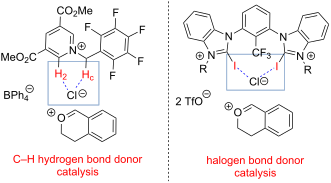
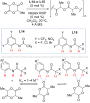
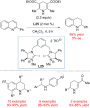
- reactive complex with the LUMO. These results are further backed up by control experiments demonstrating that catalytic quantities of hydroiodic acid were less effective in promoting this reaction than molecular iodine, and hidden Brønsted acid catalysis is unlikely to be operational in these studies. In
- after 24 h. Remarkably, when the catalyst loading was reduced to 1 mol %, the product could still be obtained in 69% yield after 96 h. Although the hidden acid catalysis due to the trace amounts of HI was not ruled out, the proposed N-halogen bond formation between quinolone and perfluoroiododecane
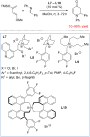
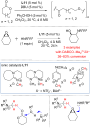
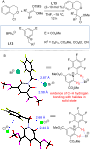
- out hidden acid catalysis due to the formation of trace quantities of HBr through hydrolysis of the substrate. To further enhance the reactivity of the halogen bond donors, Huber and colleagues later designed 5-iodo-1,2,3-triazolium-based multidentate salts L18 [83][84]. Triazolium salts L18 were








O-Alkylated heavy atom carbohydrate probes for protein X-ray crystallography: Studies towards the synthesis of methyl 2-O-methyl-L-selenofucopyranoside
Beilstein J. Org. Chem. 2016, 12, 2828–2833, doi:10.3762/bjoc.12.282

- introduction of the methylseleno moiety was performed by nucleophilic substitution of the α-bromide in 5 with methylselenol obtained by in situ reduction of dimethyl diselenide with NaBH4 [23]. The obtained crude methyl β-selenofucoside was anomerized under Lewis acid catalysis to give the anomeric mixture in


Palladium-catalyzed ring-opening reactions of cyclopropanated 7-oxabenzonorbornadiene with alcohols
Beilstein J. Org. Chem. 2016, 12, 2189–2196, doi:10.3762/bjoc.12.209

- , the dihydronaphthalenols can fully aromatize to form various substituted naphthalene derivatives 11. This has been accomplished through acid catalysis with various alcohol nucleophiles [31]. The last type of predicted ring opening (type 3) which has not yet been observed involves the attack of the





