


Search results
Search for "bicyclic" in Full Text gives 422 result(s) in Beilstein Journal of Organic Chemistry. Showing first 200.
The Groebke–Blackburn–Bienaymé reaction in its maturity: innovation and improvements since its 21st birthday (2019–2023)
Beilstein J. Org. Chem. 2024, 20, 1839–1879, doi:10.3762/bjoc.20.162
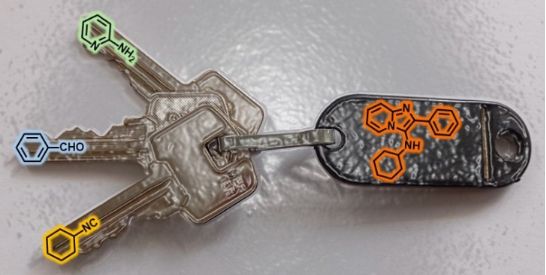
- using 30 equiv of AcOH in DMA, with no damage of DNA observed. The GBB reaction, under these mild conditions, demonstrated a wide range of scope. Different aldehydes were tested: benzaldehydes with different substituents, heteroaromatic and bicyclic aromatic aldehydes, all giving good results. Only
- -substituted 1H-imidazo[1,5-a]imidazole scaffold. This scaffold has a significant relevance in drug synthesis and was not deeply studied yet. As depicted in Scheme 22, 5-amino-1H-imidazole-4-carbonitrile (57) was used as heterocyclic amidine, to obtain the desired bicyclic adducts 58. The solvent choice was






Oxidative fluorination with Selectfluor: A convenient procedure for preparing hypervalent iodine(V) fluorides
Beilstein J. Org. Chem. 2024, 20, 1785–1793, doi:10.3762/bjoc.20.157
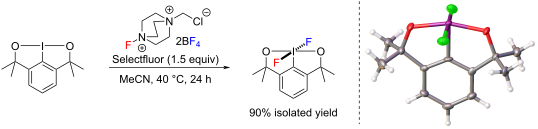
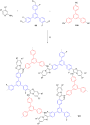
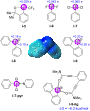
- ) fluorides in good isolated yields (72–90%). Stability studies revealed that bicyclic difluoro(aryl)-λ5-iodane 6 was much more stable in acetonitrile-d3 than in chloroform-d1, presumably due to acetonitrile coordinating to the iodine(V) centre and stabilising it via halogen bonding. Keywords: fluorination
- them easily because they normally require harsh fluorinating reagents. The synthesis of hypervalent iodine(V) fluoride 3 was reported by Amey and Martin in 1979 using the highly toxic gas, trifluoromethyl hypofluorite (Scheme 2A), and they later prepared bicyclic hypervalent iodine(V) fluoride 4 using
- ) fluorides by reacting iodine(III) precursors with commercially available Selectfluor. The method avoids large excesses of reagents and pure iodine(V) fluorides are isolated after a simple work-up. Results and Discussion Preparation of bicyclic difluoro(aryl)-λ5-iodanes Two different types of bicyclic


Chemo-enzymatic total synthesis: current approaches toward the integration of chemical and enzymatic transformations
Beilstein J. Org. Chem. 2024, 20, 1693–1712, doi:10.3762/bjoc.20.151
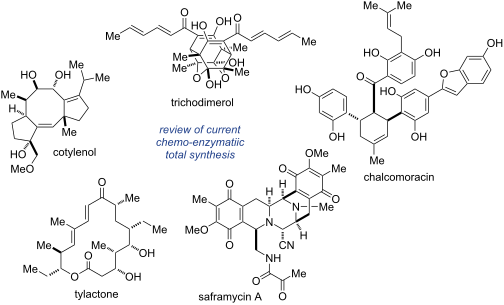
- to form bicyclic thioester 89 with incorporation of a stereogenic center at C1. The Red domain liberates bicyclic aldehyde 90 by reducing the resulting thioester 89, while the A domain again activates another molecule of tyrosine derivative 86, facilitating its loading onto the PCP domain. In the




Methyltransferases from RiPP pathways: shaping the landscape of natural product chemistry
Beilstein J. Org. Chem. 2024, 20, 1652–1670, doi:10.3762/bjoc.20.147
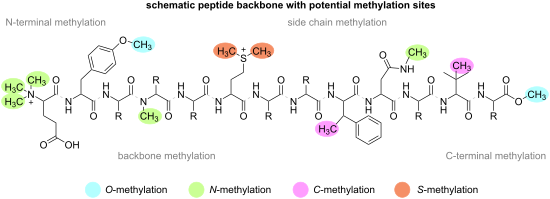
- sections. Myxococcus xanthus DK1622 and other strains of M. xanthus produce the peptide cittilin A (Figure 4). The novel RiPP class of cittilins was established based on its unique bicyclic structure. Experimental evidence suggests that O-methylation occurs in the last biosynthetic step by the MT CitC [65




Mining raw plant transcriptomic data for new cyclopeptide alkaloids
Beilstein J. Org. Chem. 2024, 20, 1548–1559, doi:10.3762/bjoc.20.138

- potential unique precursor peptide sequences. Examination of possible cores suggested that the producers closely related to C. argentea (A. bettzickiana and Amaranthus tricolor [edible amaranth] are likely to make bicyclic burpitides but may vary in the cycle size and identity of the cyclized residues
- (Figure 7 and Supporting Information File 1, Figures S13–S15). While unusual, this motif could be biosynthetically related to the alpha-hydroxy modification seen in vignatic acid [35]. These potential compounds are bicyclic which resemble the bicyclic motif found in moroidin from the closely related C





Selectfluor and alcohol-mediated synthesis of bicyclic oxyfluorination compounds by Wagner–Meerwein rearrangement
Beilstein J. Org. Chem. 2024, 20, 1462–1467, doi:10.3762/bjoc.20.129
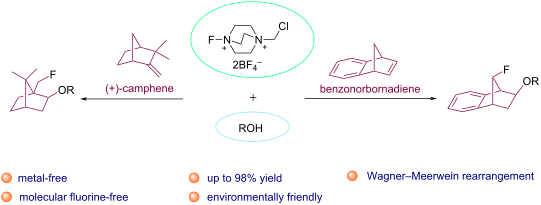
- of Arts and Sciences, Amasya University, Amasya, Turkey 10.3762/bjoc.20.129 Abstract Herein, we report the first environmentally friendly systematic fluoroalkoxylation reactions in bicyclic systems. New oxyfluorination products were obtained with excellent yields (up to 98%) via Wagner–Meerwein
- rearrangement using benzonorbornadiene and the chiral natural compound (+)-camphene as bicyclic alkenes, selectfluor as an electrophilic fluorine source, and water and various alcohols as nucleophile sources. The structure of bicyclic oxy- and alkoxyfluorine compounds was determined by NMR and QTOF-MS analyses
- . Keywords: alkoxyfluorine compounds; bicyclic alkene; oxyfluorination; selectfluor; Wagner–Meerwein rearrangement; Introduction Organofluorines are of great importance in the pharmaceutical and agrochemical industries, as the presence of fluorine has a serious effect on the biological activities of organic


Synthetic applications of the Cannizzaro reaction
Beilstein J. Org. Chem. 2024, 20, 1376–1395, doi:10.3762/bjoc.20.120
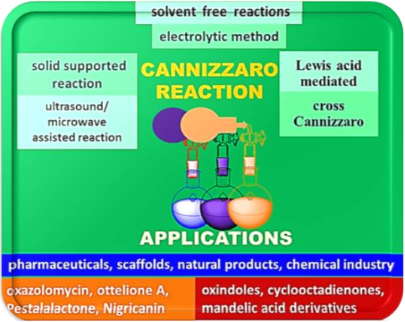
- intramolecular Cannizzaro reaction while accomplishing the synthesis of the bicyclic core structure of proposed ottelione A (47) [85]. Commencing from the Diels–Alder adduct 48, an enzymatic desymmetrization of the reduced diol 49 formed the enantiopure 50 (ee >99%). A cascade of reaction sequences delivered the
- a bicyclic ketal motif. The method illustrates the potent use of an aldol-crossed-Cannizzaro reaction to form the quaternarized pentol 79 from the aldehyde 78 in 94% yield and >99.8% purity after recrystallization. This symbolizes the efficient applicability of the Cannizzaro reaction for the








Computation-guided scaffold exploration of 2E,6E-1,10-trans/cis-eunicellanes
Beilstein J. Org. Chem. 2024, 20, 1320–1326, doi:10.3762/bjoc.20.115

- natural products containing a foundational 6/10-bicyclic framework and can be divided into two main classes, cis and trans, based on the configurations of their ring fusion at C1 and C10. Previous studies on two bacterial diterpene synthases, Bnd4 and AlbS, revealed that these enzymes form cis- and trans
- rearrangement; DFT calculations; diterpene; electrophilic cyclization; eunicellane; Introduction The eunicellane diterpenoids are a family of nearly 400 natural products that present a conserved 6/10-bicyclic hydrocarbon framework [1][2][3]. Mostly known from soft corals [2], but with a growing number of
- family members in bacteria and plants [4], these diterpenoids have four main structural differences: the number and location of oxidized carbons, the absence or presence of transannular ether bridges, the configuration (cis or trans) of the bicyclic ring fusion, and the presence and configuration (E or Z


Stability trends in carbocation intermediates stemming from germacrene A and hedycaryol
Beilstein J. Org. Chem. 2024, 20, 1189–1197, doi:10.3762/bjoc.20.101
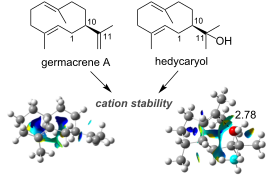
- the germacrene A and hedycaryol-derived carbocations. This study focused on twelve hydrocarbons derived from germacrene A and twelve from hedycaryol, which can be divided into three groups: four molecules containing 6-6 bicyclic rings, four 5-7 bicyclic compounds with the carbocation being on the
- seven-membered ring and the remaining four 5-7 bicyclic compounds with the carbocation on the five-membered ring. The variations in energy within the groups of carbocations (i.e., 6-6 and two kinds of 5-7 bicyclic carbocations) can be ascribed to intramolecular repulsion interactions, as seen from non
- C6 position of the C6–C7 double bond leads to 4 distinct 6-6 bicyclic cationic stereoisomers (A–D, Figure 1). Reprotonation at the C3-position of the C2–C3 double bond forms 6-6 bicyclic compounds that are not observed in nature for eudesmanes as they proceed via a secondary carbocation [16


Novel route to enhance the thermo-optical performance of bicyclic diene photoswitches for solar thermal batteries
Beilstein J. Org. Chem. 2024, 20, 1053–1068, doi:10.3762/bjoc.20.93
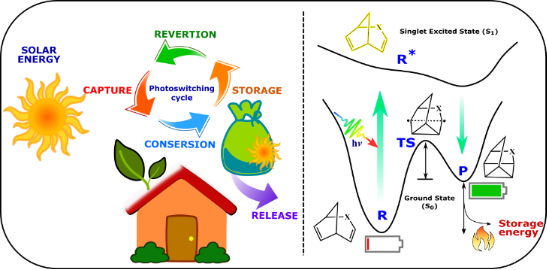
- we report our attempt to enhance both the thermochemical and photophysical properties in a single-bridged bicyclic diene (BBD)-based photoswitch by elongating the unsaturated bridge with different heteroatomic units. To elucidate the best elongation unit, the energy storage capacity and the TBR
- /kg), and TBR barrier (121.76 kJ/mol) of prototype NBD/QC in the gas phase. The outcomes render useful insights into the stability and properties of bicyclic diene-based photoswitches having elongated unsaturated bridges and indeed paves the way for the rational design of practical MOST systems
- . Keywords: bridged bicyclic diene (BBD); molecular solar thermal (MOST) energy storage; reversible photoswitches; unsaturated bridge elongation; Introduction Energy is an inevitable necessity of society and its rate of consumption is continuously increasing across the world due to increasing population and


(Bio)isosteres of ortho- and meta-substituted benzenes
Beilstein J. Org. Chem. 2024, 20, 859–890, doi:10.3762/bjoc.20.78
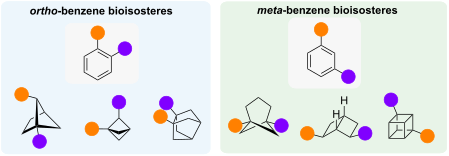
- employed their method for the synthesis of 1,2,3-trisubsituted BCPs and a number of other bridged bicyclic scaffolds. Comparison of physicochemical data of 1,2-BCHs and ortho-benzenes was reported by Mykhailiuk and co-workers (Figure 5) [36]. Lipophilicity of 1,2-BCHs was measured by experimental
- and co-workers employed an intramolecular coupling of sulfonylhydrazones and boronates to access 1,2,3-trisubstituted BCPs (1,2,3-BCPs). They also showed that their method can be extended to the synthesis of different bicyclic systems [41]. The synthesis of bridge mono-fluorinated 1,2,3,-BCPs by
- ]. A wide variety of 1,2,3-BCPs bearing substituents in the bridge position were reported by Measom and co-workers in their study on the lithium–halogen exchange of 2-bromo-1,2,3-BCPs [78]. Larger bridged bicyclic structures such as bicyclo[2.1.1]hexane offer multiple different exit vectors for














Skeletal rearrangement of 6,8-dioxabicyclo[3.2.1]octan-4-ols promoted by thionyl chloride or Appel conditions
Beilstein J. Org. Chem. 2024, 20, 823–829, doi:10.3762/bjoc.20.74
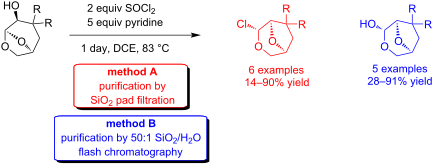
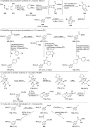
- the alkoxytriphenylphosphonium intermediate. Several reactions of the products were investigated to show the utility of the rearrangement. Keywords: bicyclic ring; cyrene; levoglucosenone; rearrangement; thionyl chloride; Introduction The 6,8-dioxabicyclo[3.2.1]octane derivative levoglucosenone (1
- reactions will increase the number of accessible materials that can be made from this biorenewable starting material, particularly if novel approaches for modifying the connectivity of the bicyclic ring system can be developed. The 6,8-dioxabicyclo[3.2.1]octane system is known to undergo a number of bond
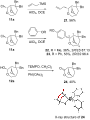
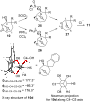
- at C4 determined the resultant ring system, as the σ* orbital is not accessible to external nucleophiles due to steric hindrance and the rigid conformation of the bicyclic ring system. When the C4–OH was equatorial, O8 migrated as it was aligned with the σ* orbital giving a 3,8-dioxabicyclo[3.2.1


Discovery and biosynthesis of bacterial drimane-type sesquiterpenoids from Streptomyces clavuligerus
Beilstein J. Org. Chem. 2024, 20, 815–822, doi:10.3762/bjoc.20.73
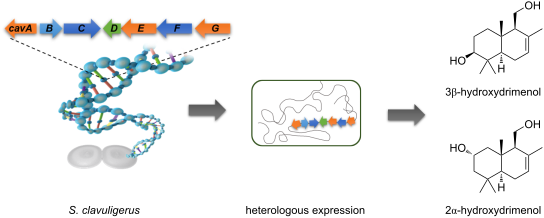
- University, Nanjing 211198, China 10.3762/bjoc.20.73 Abstract Drimane-type sesquiterpenoids (DMTs) are characterized by a distinctive 6/6 bicyclic skeleton comprising the A and B rings. While DMTs are commonly found in fungi and plants, their presence in bacteria has not been reported. Moreover, the


Advancements in hydrochlorination of alkenes
Beilstein J. Org. Chem. 2024, 20, 787–814, doi:10.3762/bjoc.20.72
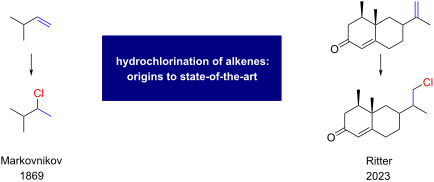
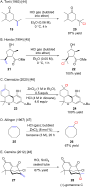
- [8]. In the presence of ammonium salts, a dilute solution of HCl in AcOH resulted in a 7:93 mixture of cis-30 and trans-30 (Table 1, entry 3), whereas an HCl solution in acetyl chloride produced a moderate 73:27 mixture (Table 1, entry 4). Grob also explored other bicyclic substrates such as






Synthesis and biological profile of 2,3-dihydro[1,3]thiazolo[4,5-b]pyridines, a novel class of acyl-ACP thioesterase inhibitors
Beilstein J. Org. Chem. 2024, 20, 540–551, doi:10.3762/bjoc.20.46
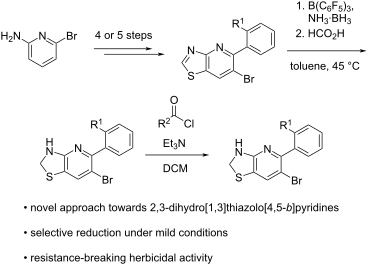
- bicyclic cinmethylin (1) and methiozolin (2), substituted 1,8-naphthyridine 4 does not contain any stereocenters but still displays promising efficacy against grass weeds. Further considering the rather low molecular weight (220 g/mol) and structural simplicity, compound 4 is a highly attractive initial
- 1,8-naphthyridine scaffold can also be formally substituted by an isothiazole group, as can be seen in isothiazolo[3,4-b]pyridine 6 [15]. Thus, several bicyclic heteroaromatic motifs containing two nitrogen atoms serve as structural surrogates of cinmethylin (1), bearing a substituted 7-oxabicyclo


Catalytic multi-step domino and one-pot reactions
Beilstein J. Org. Chem. 2024, 20, 254–256, doi:10.3762/bjoc.20.25

- advances in the field. A Review article by Pounder, Tam, and co-authors summarizes new transition-metal-catalyzed domino reactions of strained bicyclic alkenes, including both homo- and heterobicyclic alkenes highly useful for the construction of biologically significant compounds with multiple

Trifluoromethylated hydrazones and acylhydrazones as potent nitrogen-containing fluorinated building blocks
Beilstein J. Org. Chem. 2023, 19, 1741–1754, doi:10.3762/bjoc.19.127
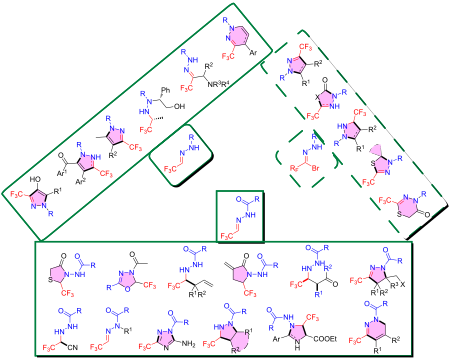
- trifluoroacetonitrile imine, are highly versatile in that they react with olefins, acetylenes, dimethyl fumarate, dimethyl maleate, β-diketones, β-keto esters, bicyclic olefins, and potassium isothiocyanate and isocyanate affording the corresponding trifluoromethyl-containing compounds, generally with good yields [51


Decarboxylative 1,3-dipolar cycloaddition of amino acids for the synthesis of heterocyclic compounds
Beilstein J. Org. Chem. 2023, 19, 1677–1693, doi:10.3762/bjoc.19.123
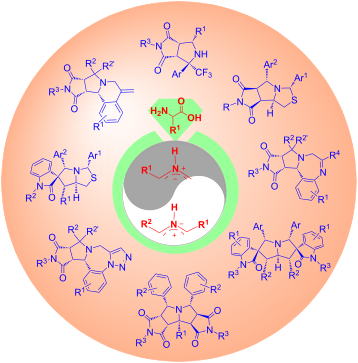
- AMYs B1 which then were reacted with nucleophiles to form C–H-functionalized pyrrolidines or subjected to the 1,3-dipolar cycloaddition with olefins to afford bicyclic compounds (Scheme 2A and B) [59][60]. We employed cyclic amines for the synthesis of spirooxindole-pyrrolidines 7a or 7b in good




Synthesis of 7-azabicyclo[4.3.1]decane ring systems from tricarbonyl(tropone)iron via intramolecular Heck reactions
Beilstein J. Org. Chem. 2023, 19, 1615–1619, doi:10.3762/bjoc.19.118
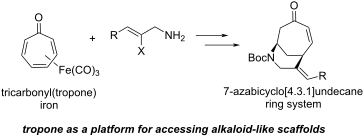
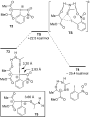
- our successful efforts to access this bridged bicyclic ring system. Results and Discussion As shown in Scheme 2a, the synthesis of the requisite Heck reaction precursor began with the addition of the known allylic amine 5 to tricarbonyl(tropone)iron, immediately followed by Boc-protection of the crude


One-pot nucleophilic substitution–double click reactions of biazides leading to functionalized bis(1,2,3-triazole) derivatives
Beilstein J. Org. Chem. 2023, 19, 1399–1407, doi:10.3762/bjoc.19.101
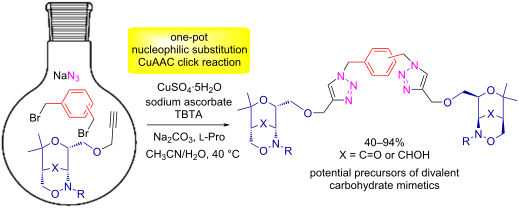
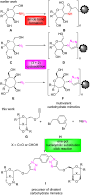
- good yields and furnished another set of multivalent carbohydrate mimetics [48][49][50]. In the current report, we want to disclose our experience with an “inverted” approach to multivalent systems [51]: bicyclic 1,2-oxazine derivatives of type G [52][53], which can be regarded as internally protected
- conditions found were studied with a second model reaction in order to examine its suitability for the synthesis of potential carbohydrate mimetic precursors (Scheme 3). Sodium azide, benzyl bromide (5) and enantiopure bicyclic 1,2-oxazin-4-one derivative 6 [53] which bears a propargylic ether moiety as
- transformation into divalent carbohydrate mimetics turned out to be a difficult task. We started the experiments with the hydrogenolysis of bicyclic 1,2-oxazin-4-ol 19 as simple model compound (Scheme 7). A methanol solution of 19 under an atmosphere of hydrogen was stirred for 17 h in the presence of palladium



Functional characterisation of twelve terpene synthases from actinobacteria
Beilstein J. Org. Chem. 2023, 19, 1386–1398, doi:10.3762/bjoc.19.100
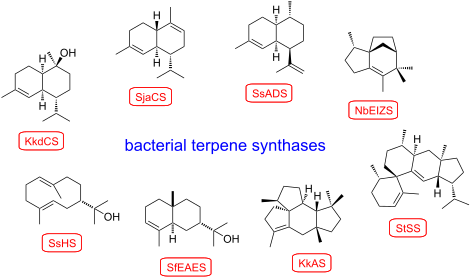
- in sesquiterpene biosynthesis that can be reactivated by reprotonation for a second cyclisation to eudesmane (6,6-bicyclic) or guaiane (7,5-bicyclic) sesquiterpene hydrocarbons or alcohols, respectively [46][47]. Starting from 26, such a protonation induced cyclisation can lead to C that is the




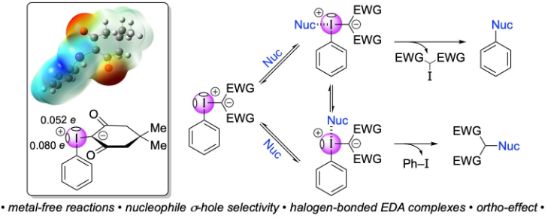
Exploring the role of halogen bonding in iodonium ylides: insights into unexpected reactivity and reaction control
Beilstein J. Org. Chem. 2023, 19, 1171–1190, doi:10.3762/bjoc.19.86
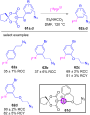
- was also viable with a selection of other mono- and bicyclic olefin motifs, undergoing intramolecular cyclopropanations in moderate to high yields (Scheme 3). They also conducted a mechanistic investigation to better understand this metal-free pathway, again on the premise that a free carbene
- intermediate was not viable under such mild conditions. The initially proposed ionic pathway (Figure 5, left) was abandoned as solvent effects had little influence on the reaction rate, and since no Wagner–Meerwein rearrangement products were detected with bicyclic olefin precursors. Radical-based pathways







The unique reactivity of 5,6-unsubstituted 1,4-dihydropyridine in the Huisgen 1,4-diploar cycloaddition and formal [2 + 2] cycloaddition
Beilstein J. Org. Chem. 2023, 19, 982–990, doi:10.3762/bjoc.19.73
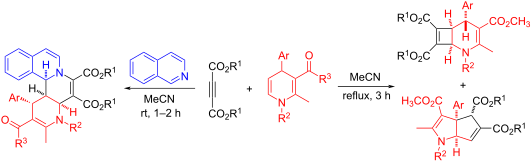
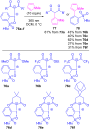
- structures of both bicyclic compounds 5a–o and 6a–o were fully characterized by various spectroscopy methods. The single crystal structures of compounds 5a (Figure 2) and 6f (Figure 3) were successfully determined by X-ray diffraction analysis. From Figure 2 (compound 5a), it can be seen that the
- acetylenedicarboxylate to give the adduct C. Then, the direct coupling of the positive charge and the negative charge affords the 2-azabicyclo[4.2.0]octa-3,7-diene 5. On the other hand, a carbenium ion D can be formed by migration of a hydrogen atom in intermediate C, which in turn converts into a fused bicyclic
- -dihydropyridines. Plausible reaction mechanism for the various products 4, 5, and 6. Optimizing the reaction conditions.a Synthesis of isoquinolino[1,2-f][1,6]naphthyridines 4a–o.a Synthesis of the bicyclic compounds 5a–o and 6a–o.a Supporting Information The crystallographic data of compounds 4k (CCDC 2260340


Bromination of endo-7-norbornene derivatives revisited: failure of a computational NMR method in elucidating the configuration of an organic structure
Beilstein J. Org. Chem. 2023, 19, 764–770, doi:10.3762/bjoc.19.56
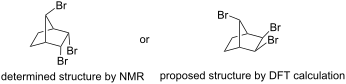
- atoms were determined by measuring the couplings between the relevant protons. Proton–proton couplings beyond the three bonds are observed frequently in some strained bicyclic compounds. The long-range coupling exists in a zigzag arrangement (Figure 2). In the case of norbornane if the bonding


Synthesis of medium and large phostams, phostones, and phostines
Beilstein J. Org. Chem. 2023, 19, 687–699, doi:10.3762/bjoc.19.50
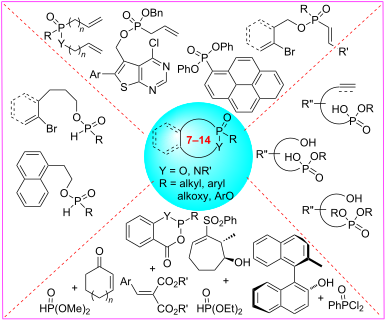
- ]. 2.2 Synthesis via [6 + 1] and [7 + 1] annulations The reactions of cyclohex-2-enone (87) and cyclohept-2-enone (88) with dimethyl phosphonate yielded dimethyl bicyclic phostone-phosphonates 89 and 90 under basic conditions in 59% yield via Michael addition, the nucleophilic hydrophosphonylation, and
- ]oxaphosphepin-5(4H)-one 2-oxides from 2-phenyl/alkoxy-4H-benzo[d][1,3,2]dioxaphosphinin-4-ones and dialkyl 2-benzylidenemalonates. Synthesis of bicyclic seven- and eight-membered phosphotones from cycloalk-2-enones and dimethyl phosphonate. Synthesis of binaphthylene-fused phosphotones from (M)-2'-methyl-[1,1
- '-binaphthalen]-2-ol and phenylphosphonic dichloride. Synthesis of bicyclic phosphotone from (1S,2R)-2-methyl-3-(phenylsulfonyl)cyclohept-3-en-1-ol and diethyl phosphonate. Funding The project was supported by the National Natural Science Foundation of China (No. 21772010).





