Search results
Search for "acetophenone" in Full Text gives 123 result(s) in Beilstein Journal of Organic Chemistry.
Catalytic asymmetric synthesis of biologically important 3-hydroxyoxindoles: an update
Beilstein J. Org. Chem. 2016, 12, 1000–1039, doi:10.3762/bjoc.12.98
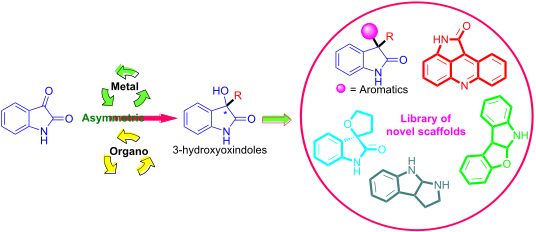
- enantioselectivities (up to 94% ee). A variety of substituted isatins were well tolerated under these conditions. In addition, the weak nucleophile acetophenone also reacted with isatins, giving the corresponding products with satisfactory results under the same conditions, although acetophenone was always considered


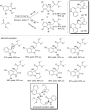


Scope and mechanism of the highly stereoselective metal-mediated domino aldol reactions of enolates with aldehydes
Beilstein J. Org. Chem. 2016, 12, 813–824, doi:10.3762/bjoc.12.80
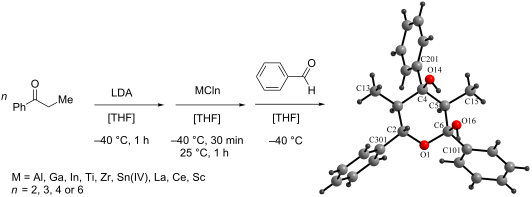
- product in the presence of base [41]. The variability in the ketone moiety proved to be rather restricted (Scheme 3). While in the case of propiophenone (1a) and butyrophenone (1f) moderate to good yields (≥50%) were obtained, the reaction with acetophenone (1e) did not furnish any domino aldol product at


Scope and limitations of the dual-gold-catalysed hydrophenoxylation of alkynes
Beilstein J. Org. Chem. 2016, 12, 172–178, doi:10.3762/bjoc.12.19
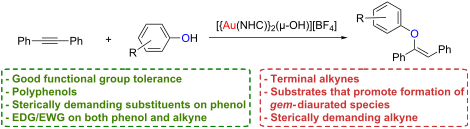
- as 10% of acetophenone, the corresponding hydration product. Furthermore, the formation of a new gold species, which was characterised as the previously reported σ,π-digold–acetylide species could also be observed. This diaurated species can be formed by reaction of [{Au(IPr)}2(µ-OH)][BF4] with




Synthesis and structures of ruthenium–NHC complexes and their catalysis in hydrogen transfer reaction
Beilstein J. Org. Chem. 2015, 11, 1786–1795, doi:10.3762/bjoc.11.194
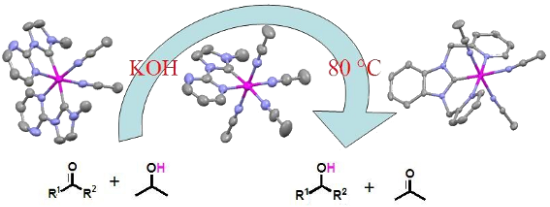
- ruthenium–NHC complexes presented above are stabilized by strong Ru–carbene bonds and contain 2–4 easily dissociating acetonitrile molecules, and are thus ideal catalysts. We tested their catalytic activities for transfer hydrogenation of ketones. Firstly, acetophenone was selected as the model substrate to
- evaluate the catalytic activities of complexes 1–3. The standard experiment was carried out at 80 °C with varied Ru loadings from 1 to 0.01 mol % and the results are summarized in Table 1. The reaction profiles show that acetophenone could be reduced to 1-phenylethanol in 89–99% yield within 0.5 h using 1
- the reaction time was extended to 1 and 3 h, respectively (Table 1, entries 3, 7, 11 and 4, 8, 12). At catalyst loadings of 0.01 mol %, TOF of 1–3 are 3000, 3233, and 3200 h−1 for transfer hydrogenation of acetophenone which are nearly identical to that of [Ru(MeCCmeth)2(CH3CN)2](BF4)2 (MeCCmeth = 1,1


Preparative semiconductor photoredox catalysis: An emerging theme in organic synthesis
Beilstein J. Org. Chem. 2015, 11, 1570–1582, doi:10.3762/bjoc.11.173
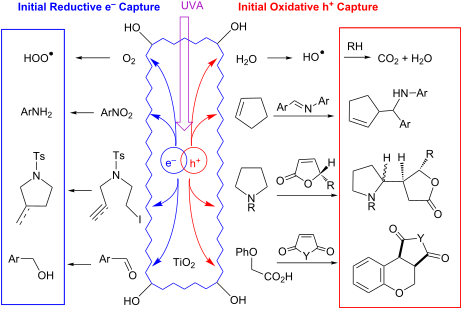
- 64 but a significant quantity of ring opened byproduct was also formed. Carbonyl compounds are also good electron acceptors and so SCPC hydrogenations seemed likely. Actually there is a literature precedent for photocatalytic hydrogenation of acetophenone derivatives with TiO2 [80][81]. We studied a







The synthesis of active pharmaceutical ingredients (APIs) using continuous flow chemistry
Beilstein J. Org. Chem. 2015, 11, 1194–1219, doi:10.3762/bjoc.11.134
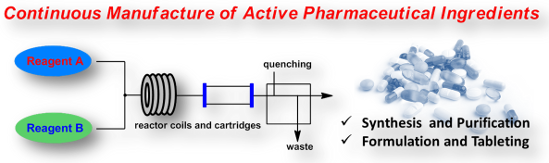
- this challenging compound was reported in 2013 and aims to evaluate the benefits of flow chemistry in order to avoid shortcomings of previous batch synthesis efforts particularly in regard to scale up [93]. The investigation first involved the preparation of the key acetophenone starting material 112


A new and convenient synthetic way to 2-substituted thieno[2,3-b]indoles
Beilstein J. Org. Chem. 2015, 11, 1000–1007, doi:10.3762/bjoc.11.112
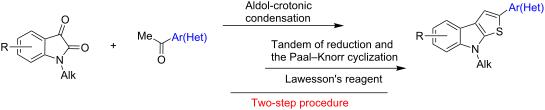
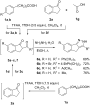
- significant preparative interest, since the target compounds are formed from isatins 7 and ketones 8 in four steps in low yields. The formation of model thieno[2,3-b]indole 12a from 1-ethylisatin (7a) and acetophenone (8a) has been studied in details, as the first step of our research (Scheme 3). The
- phosphorane derivative 13 which is formed by pre-functionalization of acetophenone (8a), and this approach can be regarded as an alternative synthetic route just in some specific cases. Thus, the two-step approach to convert isatins 7 into thieno[2,3-b]indoles 12 via intermediacy of 10 (Path B) has been
- acetophenone (8a) according to the synthetic procedure described above. Isatin 7c containing an n-hexyl substituent at the nitrogen atom has been applied to ensure a good solubility of the target product 12o, as well as of the intermediate 10o. It should be noted that bromination of 2-phenyl-substituted thieno


DBU-promoted carboxylative cyclization of o-hydroxy- and o-acetamidoacetophenone
Beilstein J. Org. Chem. 2015, 11, 906–912, doi:10.3762/bjoc.11.102

- corresponding products (Table 3, entries 2 and 3). The reactions using benzamido- (3d) and p-toluenesulfonamido- (3e) acetophenone gave complex mixtures and no carboxylative cyclization product was observed (Table 3, entries 4 and 5). A likely mechanism for the carboxylative cyclization of o


An intramolecular C–N cross-coupling of β-enaminones: a simple and efficient way to precursors of some alkaloids of Galipea officinalis
Beilstein J. Org. Chem. 2015, 11, 884–892, doi:10.3762/bjoc.11.99

- the starting substrates A simple retrosynthesis of enaminones 3 leads to the corresponding β-diketones 4 accessible through Claisen condensation of 3-phenylpropionic ester 5 with the appropriate acetophenone 6 (Scheme 3). The synthesis of ester 5 was accomplished according to Scheme 4. The classic


Copper-catalyzed cascade reactions of α,β-unsaturated esters with keto esters
Beilstein J. Org. Chem. 2015, 11, 213–218, doi:10.3762/bjoc.11.23

- hydride-catalyzed reductive aldolization of acetophenone [19]. Therefore, tert-butyl acrylate (1d) was used to replace methyl acrylate, and several biphosphorous ligands were screened for improving the diastereoselectivity (Table 3). Diastereomers of 3da were separated, which were subjected to further
- vs entry 1), and an effect of ligands on the diastereoselectivity of lactone was observed too. Xantphos was superior to other ligands. Overall, the diastereoselectivities were much lower than those in the reactions of tert-butyl acrylate with acetophenone and silane. The diastereoselectivity varied


Come-back of phenanthridine and phenanthridinium derivatives in the 21st century
Beilstein J. Org. Chem. 2014, 10, 2930–2954, doi:10.3762/bjoc.10.312



(2R,1'S,2'R)- and (2S,1'S,2'R)-3-[2-Mono(di,tri)fluoromethylcyclopropyl]alanines and their incorporation into hormaomycin analogues
Beilstein J. Org. Chem. 2014, 10, 2844–2857, doi:10.3762/bjoc.10.302
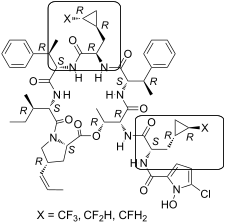
- acetophenone in only four steps in an overall yield of 30%. A similar protocol for the synthesis of 3-alkylphenylalanines was independently developed by Soloshonok et al. [56]. These authors used sodium hydroxide for the deprotonation of 10 and 1-phenylalkyl bromides for the alkylation of the enolate. Once




Superoxide chemistry revisited: synthesis of tetrachloro-substituted methylenenortricyclenes
Beilstein J. Org. Chem. 2014, 10, 2531–2538, doi:10.3762/bjoc.10.264
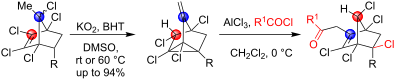
- norcamphor using o-amino acetophenone hydrochloride. Ladenberger and co-worker [27] observed the rearrangement of a lithiated-tetrachloronorbornyl intermediate to a tricyclene derivative in a study about stability of vinyl carbanions. Li and co-workers [28][29] have synthesized aryl/benzyl substituted




Electrocarboxylation: towards sustainable and efficient synthesis of valuable carboxylic acids
Beilstein J. Org. Chem. 2014, 10, 2484–2500, doi:10.3762/bjoc.10.260
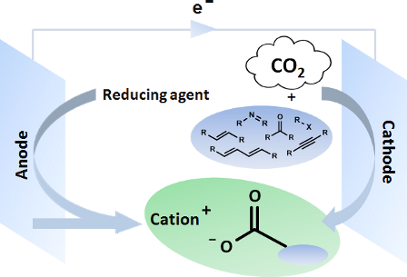
- was first described by Wawzonek, converting benzophenone and acetophenone to benzylic acid and 2-hydroxy-2-phenylpropionic acid, respectively [79]. This offers an electrochemical route for several commercially relevant α-aryl propionic acids, used as non-steroidal anti-inflammatory drugs (NSAIDs) [80
- electrocarboxylated in an undivided cell with stable anode. CO2 fixation in acetophenone was done in good yields in an undivided cell using a quaternary ammonium oxalate as an electrolyte and a sacrificial reducing agent [52][94][95][112][113]. Benzalanilines were carboxylated electrochemically with 79% faradaic


(CF3CO)2O/CF3SO3H-mediated synthesis of 1,3-diketones from carboxylic acids and aromatic ketones
Beilstein J. Org. Chem. 2014, 10, 2270–2278, doi:10.3762/bjoc.10.236
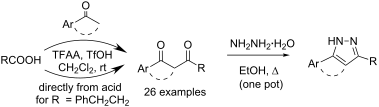
- of acetophenone (2e) only modestly increase the yield of diketone 3d from 64 to 69% (Table 2, entry 11), and usually we added equimolecular quantities of an acid and a ketone. An excess of acetic acid in acylation reactions (Table 2, entries 4, 8 and 13) was employed considering that this acid was
- acylation of the ketones by several functionally substituted carboxylic acids. Whereas glycine did not react with the ketones, β-alanine (1i) reacting with 1-indanone, 1-tetralone and acetophenone formed the corresponding trifluoroacylated β-aminodiketones 3u–w (reaction 1 in Scheme 2). A fuller acylation


Homogeneous and heterogeneous photoredox-catalyzed hydroxymethylation of ketones and keto esters: catalyst screening, chemoselectivity and dilution effects
Beilstein J. Org. Chem. 2014, 10, 1143–1150, doi:10.3762/bjoc.10.114
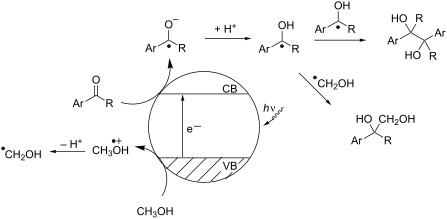
- -catalyzed photohydroxymethylation of ketones by methanol were investigated in order to evaluate the most active photocatalyst system. Dialkoxytitanium dichlorides are the most efficient species for chemoselective hydroxymethylation of acetophenone as well as other aromatic and aliphatic ketones. Pinacol
- photochemical homogenous titanium-catalyzed hydroxymethylation and to develop a truly catalytic process, we used a model reaction for catalyst screening (acetophenone/methanol) and applied the optimal homogenous reaction conditions involving titanium catalysis to other ketones and keto esters. Results Nature of
- different catalytic activities. In order to simulate the different complex stages, we applied different monomeric titanium complexes of the type TiCln(OiPr)4−n (n = 0, 1, 2, 3) [25][26][27] in the model process, the irradiation of a solution of acetophenone (3) in methanol (Scheme 2). In the absence of any


A convenient enantioselective decarboxylative aldol reaction to access chiral α-hydroxy esters using β-keto acids
Beilstein J. Org. Chem. 2014, 10, 969–974, doi:10.3762/bjoc.10.95
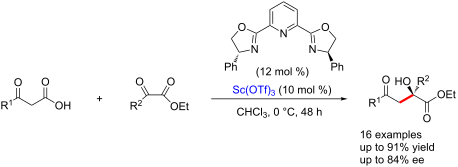
- ). Trace amount of side product acetophenone was formed through decarboxylative protonation of β-keto acid 1a, which was commonly observed in the case of chiral organic base catalysed decarboxylative additions. Further optimisation of the reaction conditions showed that CHCl3 was the best solvent choice in


Deoxygenative gem-difluoroolefination of carbonyl compounds with (chlorodifluoromethyl)trimethylsilane and triphenylphosphine
Beilstein J. Org. Chem. 2014, 10, 344–351, doi:10.3762/bjoc.10.32
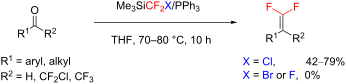
- . Although a non-activated ketone such as acetophenone is unreactive under similar conditions, activated ketones could undergo this Wittig olefination reaction. Representative results for the olefination at a slightly elevated temperature (80 °C) are shown in Figure 2. A range of aryl trifluoromethyl (6a–d


Substrate dependent reaction channels of the Wolff–Kishner reduction reaction: A theoretical study
Beilstein J. Org. Chem. 2014, 10, 259–270, doi:10.3762/bjoc.10.21
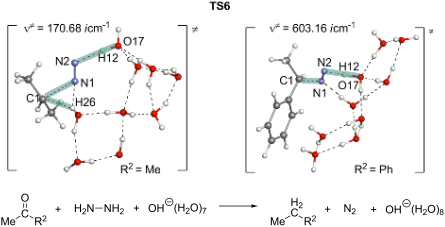
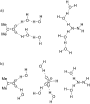
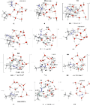
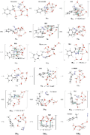
- , H2N–NH2 and OH−(H2O)7. Here, ketones are acetone and acetophenone. While routes of the ketone → hydrazone → diimine are similar, those from the diimines are different. From the isopropyl diimine, the N2 extrusion and the C–H bond formation takes place concomitantly. The concomitance leads to the
- product. For both ketone substrates, the diimines undergoing E2 reactions were found to be key intermediates. Keywords: acetone; acetophenone; DFT calculations; diimine intermediate; reduction reaction; transition states; Wolff–Kishner; Introduction The Wolff–Kishner (W-K) reduction is an organic
- mechanism variant or invariant with respect to the substrate, ketone or aldehyde? We addressed these questions by DFT calculations, which were carried out for two substrates, acetone and acetophenone. Reaction paths including proton transfers [16][17][18][19][20][21][22][23][24][25][26][27][28][29][30][31








New hydrogen-bonding organocatalysts: Chiral cyclophosphazanes and phosphorus amides as catalysts for asymmetric Michael additions
Beilstein J. Org. Chem. 2014, 10, 224–236, doi:10.3762/bjoc.10.18
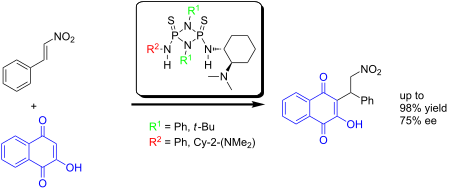
- ; Chakravarty et al. [24] tested an ansa-bridged BINOL-based PV-cyclodiphosphazane in the asymmetric reduction of acetophenone with BH3 (5–8% ee), while Gade et al. [25] recently introduced BINOL-based PIII-cyclodiphosphazane ligands to transition-metal catalysis (up to 84% ee). We anticipated that by


Synthesis of five- and six-membered cyclic organic peroxides: Key transformations into peroxide ring-retaining products
Beilstein J. Org. Chem. 2014, 10, 34–114, doi:10.3762/bjoc.10.6
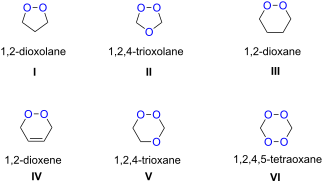
- reaction products were separated by column chromatography. 1-Hydroxy-1-phenylpentan-3-one (42) was isolated as a by-product in 16% yield [248]. The peroxidation of 1,4-dienes 43a,b with the Co(modp)2/Et3SiH/O2 system according to a similar reaction scheme gave dioxolanes 44a,b. Acetophenone (45) was




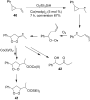


Efficient synthesis of dihydropyrimidinones via a three-component Biginelli-type reaction of urea, alkylaldehyde and arylaldehyde
Beilstein J. Org. Chem. 2013, 9, 2846–2851, doi:10.3762/bjoc.9.320
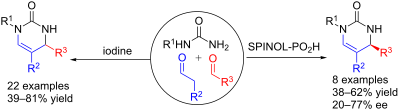
- chemistry [5][6][7][8]. Recently, many one-pot variants of Biginelli-type reactions for the preparation of novel DHPMs using various active methylene compounds [9][10][11][12][13][14][15], such as enaminone, cyclic β-diketones, acetophenone, benzocyclic ketones and β-oxodithioesters etc., have also been


Recent advances in transition metal-catalyzed Csp2-monofluoro-, difluoro-, perfluoromethylation and trifluoromethylthiolation
Beilstein J. Org. Chem. 2013, 9, 2476–2536, doi:10.3762/bjoc.9.287
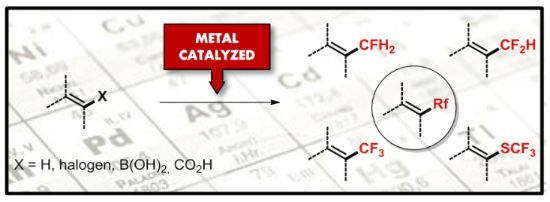
- materials; for instance, anisole and chloro- or iodobenzene gave an ortho > para ≈ meta preferential order of substitution, while toluene, acetophenone, N,N-dimethylaniline or nitrobenzene afforded the para-substituted compound as the major product. The reaction could be monitored by EPR, which showed an


Gold(I)-catalyzed 6-endo hydroxycyclization of 7-substituted-1,6-enynes
Beilstein J. Org. Chem. 2013, 9, 2242–2249, doi:10.3762/bjoc.9.263
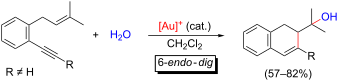
- )phenyllithium with geranyl bromide and 1n by two Wittig reactions from 2’-(phenylethynyl)acetophenone (see Supporting Information File 1). First, the hydroxycyclization of 1m, as a pure E isomer, under the previously established conditions afforded the dihydronaphthalene derivative 7m as a single isomer (Scheme



Regioselective carbon–carbon bond formation of 5,5,5-trifluoro-1-phenylpent-3-en-1-yne
Beilstein J. Org. Chem. 2013, 9, 2182–2188, doi:10.3762/bjoc.9.256
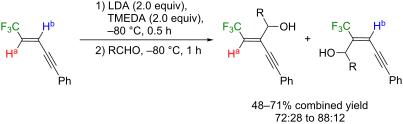
- . Their proportion seemed to be affected by the bulky substituent and pivalaldehyde attained the higher ratio of 88%. Although 5 and 6 were obtained in 50 to 70% combined yields by the reaction with aldehydes, lower reactivity was displayed by the less electrophilic and more hindered acetophenone