Search results
Search for "steric effects" in Full Text gives 180 result(s) in Beilstein Journal of Organic Chemistry.
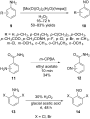
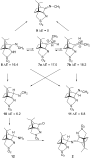
Conformational impact of structural modifications in 2-fluorocyclohexanone
Beilstein J. Org. Chem. 2017, 13, 1781–1787, doi:10.3762/bjoc.13.172

- bonding, hyperconjugation, electrostatic and steric effects. While the gauche effect, originated from hyperconjugative interactions, does not appear to cause some preferences for the axial conformation of organofluorine heterocycles, more classical effects indeed rule the conformational equilibrium of the


Syntheses of 3,4- and 1,4-dihydroquinazolines from 2-aminobenzylamine
Beilstein J. Org. Chem. 2017, 13, 1470–1477, doi:10.3762/bjoc.13.145
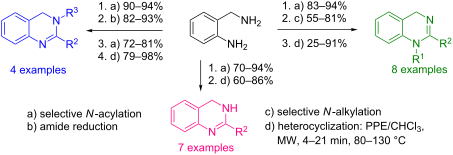
- resonance stabilization of the resulting 2-arylquinazolin-4(1H)-ones 6i,j (Scheme 3). The fact that the yield of the o-methylphenyl-substituted derivative 2j, in which this stabilization is reduced due to steric effects, was higher than for the phenyl-substituted derivative reinforces this hypothesis


A speedy route to sterically encumbered, benzene-fused derivatives of privileged, naturally occurring hexahydropyrrolo[1,2-b]isoquinoline
Beilstein J. Org. Chem. 2017, 13, 1413–1424, doi:10.3762/bjoc.13.138
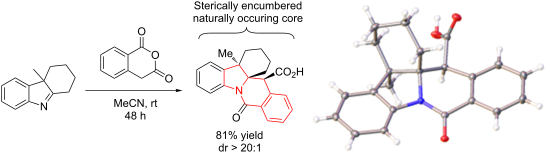
- 5). The tolerance of the reaction to the substitution pattern in the aromatic portion of the indolenines appears rather broad, both in terms of the electronic character of substituents and steric effects – although substituents in position 7 of the indolenine significantly affect the conformational


Conformational study of L-methionine and L-cysteine derivatives through quantum chemical calculations and 3JHH coupling constant analyses
Beilstein J. Org. Chem. 2017, 13, 925–937, doi:10.3762/bjoc.13.94
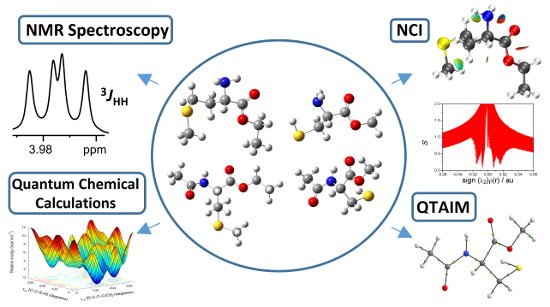
- atoms in molecules (QTAIM) and noncovalent interactions (NCI) methodologies, the conformational preferences for the compounds are not dictated by intramolecular hydrogen bonding, but by a joint contribution of hyperconjugative and steric effects. Keywords: amino acid derivatives; conformational




Transition-metal-free one-pot synthesis of alkynyl selenides from terminal alkynes under aerobic and sustainable conditions
Beilstein J. Org. Chem. 2017, 13, 910–918, doi:10.3762/bjoc.13.92
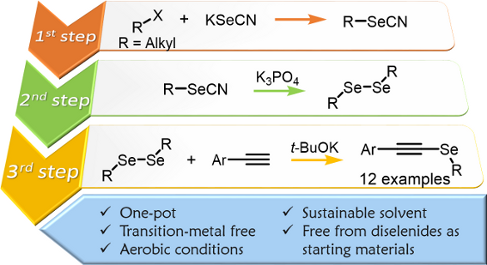
- environment and moderate acidity of the methylene protons in benzyl selenocyanate (7h) or dibenzyl diselenide (8h) may afford intermediates prone to decomposition, directly affecting formation of 5h. Furthermore, the electronic and steric effects offered by different substituents on the aryl moieties attached


Stabilization of nanosized titanium dioxide by cyclodextrin polymers and its photocatalytic effect on the degradation of wastewater pollutants
Beilstein J. Org. Chem. 2016, 12, 2873–2882, doi:10.3762/bjoc.12.286
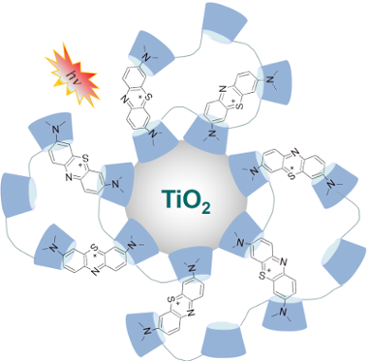
- as low concentration as 1% CMBCD-P and the turbidity remained <105% within 120 min of observation (Table 2). The stabilizing effect of the CD-based polymers especially of CMBCD-P can be attributed to steric effects caused by the adsorption of the polymer on the surface of nanoTiO2 particles. It forms



Methylenelactide: vinyl polymerization and spatial reactivity effects
Beilstein J. Org. Chem. 2016, 12, 2378–2389, doi:10.3762/bjoc.12.232
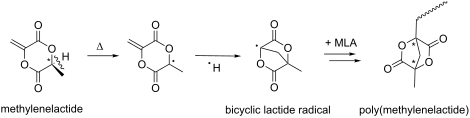
- 1). Since the polymerization kinetics are mainly controlled by steric effects and the polarity of the double bonds, we evaluated the electronic structure of the different monomers via 1H nuclear magnetic resonance (NMR) spectroscopy. As expected, the double bond protons of MLA at 5.77 and 5.56 ppm


Experimental and theoretical investigations into the stability of cyclic aminals
Beilstein J. Org. Chem. 2016, 12, 2280–2292, doi:10.3762/bjoc.12.221
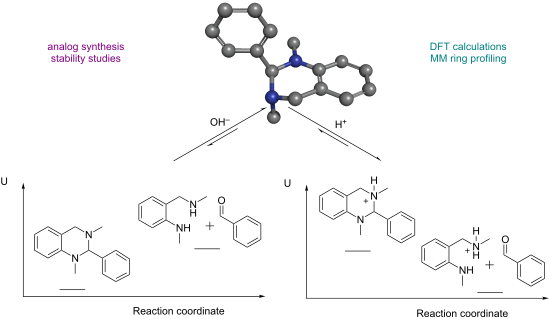
- both the N-1 and N-3 nitrogen atoms. At the same time the iPr and Ph moieties served as bulkier substituents for investigations into steric effects. Similar to the N-1 and N-3 nitrogen atoms, 4-t-Bu, 4-Me, 4-F and 4-CF3 groups were incorporated into the aromatic site at position 2 to investigate the





Stereo- and regioselectivity of the hetero-Diels–Alder reaction of nitroso derivatives with conjugated dienes
Beilstein J. Org. Chem. 2016, 12, 1949–1980, doi:10.3762/bjoc.12.184
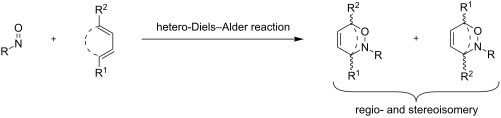
- hetero-Diels–Alder reaction. In the reaction of arylnitroso dienophiles containing a nitro group in close proximity to the reaction center, unsubstituted dienes show a higher reactivity than substituted dienes, due to steric effects. Mechanistic studies of the nitroso hetero-Diels–Alder reaction
- -lactams 63 (Scheme 16) [95], which is in accordance with the general prediction. The exclusive regioselectivity of this reaction is due to steric effects. Similar conclusions result from the reaction of 1,3-butadienes 65 with various nitroso heterodienophiles 66, giving proximal isomer 67 (Scheme 17) [85




Experimental and theoretical investigations on the high-electron donor character of pyrido-annelated N-heterocyclic carbenes
Beilstein J. Org. Chem. 2016, 12, 1884–1896, doi:10.3762/bjoc.12.178
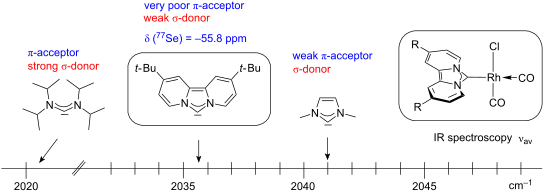
- electronic properties of the carbene influence the CO stretching modes, but also steric effects and the coupling of stretching modes. The latter two drawbacks have recently been overcome by calculating the metal–ligand electronic parameter (MLEP) [36]. Separating the influence of the σ-donor and π-acceptor


Practical synthetic strategies towards lipophilic 6-iodotetrahydroquinolines and -dihydroquinolines
Beilstein J. Org. Chem. 2016, 12, 1851–1862, doi:10.3762/bjoc.12.174
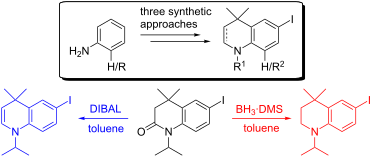
- reaction was conducted with a variety of quinolin-2-ones bearing differing alkyl substituents in order to ascertain whether steric effects promote collapse of the intermediate aluminium complex via fragmentation/elimination, and to assess the generality of this approach. Table 2 highlights the effect of


Flow carbonylation of sterically hindered ortho-substituted iodoarenes
Beilstein J. Org. Chem. 2016, 12, 1503–1511, doi:10.3762/bjoc.12.147
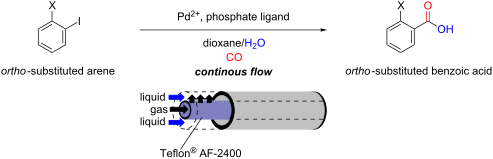
- . Structure D (Figure 2) is a top view of the crystal structure illustrating how the methyl group sits directly over the axial position of the palladium which would introduce steric effects inhibiting the CO coordination on the intermediate aryl complex. As the carbonylation step becomes slower, the competing


The hydrolysis of geminal ethers: a kinetic appraisal of orthoesters and ketals
Beilstein J. Org. Chem. 2016, 12, 1467–1475, doi:10.3762/bjoc.12.143
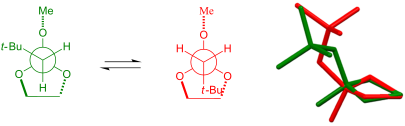
- presented (Figure 1). As anticipated, orthoacetates possessing ethoxy substituents are the most rapidly hydrolysed acyclic systems. Both entropic and steric effects are believed to account for the relatively fast rates of hydrolysis of cyclic orthoesters with respect to ketals. Rate increases within five


Synthesis of ferrocenyl-substituted 1,3-dithiolanes via [3 + 2]-cycloadditions of ferrocenyl hetaryl thioketones with thiocarbonyl S-methanides
Beilstein J. Org. Chem. 2016, 12, 1421–1427, doi:10.3762/bjoc.12.136
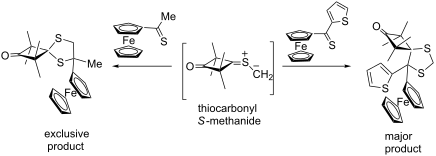
- results in the preferred concerted [3 + 2]-cycloaddition. It is well known that this mechanism, controlled by frontier-orbital (FMO) interactions, is strongly influenced by steric effects in the case of C=S dipolarophiles [8][17]. Conclusion The presented study indicated that ferrocenyl thioketones show


Reactivity studies of pincer bis-protic N-heterocyclic carbene complexes of platinum and palladium under basic conditions
Beilstein J. Org. Chem. 2016, 12, 1334–1339, doi:10.3762/bjoc.12.126
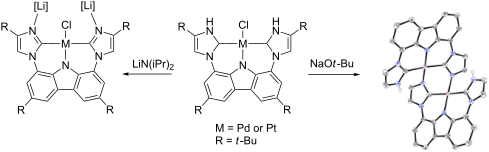
- even longer. In 1968, Wanzlick and Öfele separately synthesized mercury(II) and chromium(0) imidazol-2-ylidene complexes [3]. Nearly 50 years of NHC ligand research have demonstrated the importance of the electronic and steric effects that can be modified by altering the alkyl or aryl groups on each


Is conformation a fundamental descriptor in QSAR? A case for halogenated anesthetics
Beilstein J. Org. Chem. 2016, 12, 760–768, doi:10.3762/bjoc.12.76
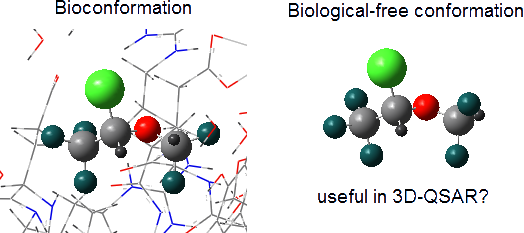
- dictated by hydrophobic interactions of R4 with amino acid residues and by low steric effects surrounding R1. Thus, 2D structural information provided by MIA descriptors (particularly related to the connectivity of different atoms in the present case) was capable of modeling and interpreting biochemical


Synthesis and in vitro cytotoxicity of acetylated 3-fluoro, 4-fluoro and 3,4-difluoro analogs of D-glucosamine and D-galactosamine
Beilstein J. Org. Chem. 2016, 12, 750–759, doi:10.3762/bjoc.12.75
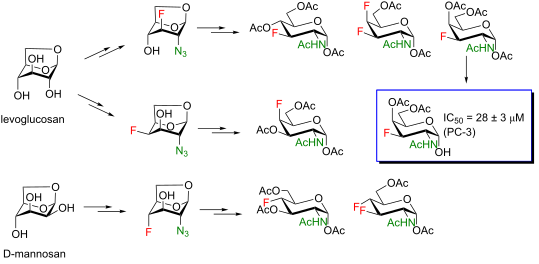
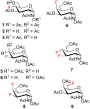
- groups at C-2 or C-4, or by an internal fluorine attack as in SNi substitution. A simple SN2 displacement leading to configurational inversion is probably suppressed by the steric effects of the axially positioned groups at C-2 and C-4, and repulsive effects of their aligned dipoles [51]. Compounds 11



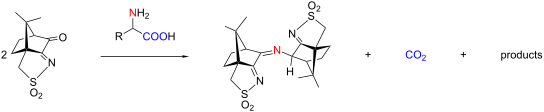
Strecker degradation of amino acids promoted by a camphor-derived sulfonamide
Beilstein J. Org. Chem. 2016, 12, 732–744, doi:10.3762/bjoc.12.73
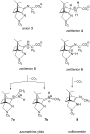
- Supporting Information File 4. The activation barriers for these reactions are very high (≈50 kcal/mol), a fact which clearly speaks against this path. We think that steric effects in general are responsible for the high barriers since the carboxyl group has to approach the bicyclic system from above or





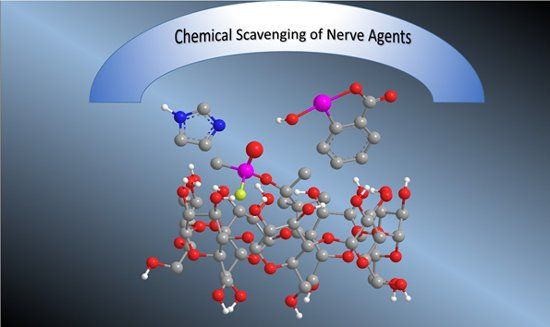
Interactions of cyclodextrins and their derivatives with toxic organophosphorus compounds
Beilstein J. Org. Chem. 2016, 12, 204–228, doi:10.3762/bjoc.12.23
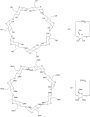
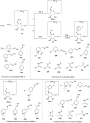
- binding constant values and the hydrophobicity of the pesticides, suggesting that steric effects are probably predominantly involved in complex formation. The inclusion of the apolar heterocyclic ring into the CD cavity is the most likely situation to occur. γ-CD has the largest secondary alcohols rim






Scope and limitations of the dual-gold-catalysed hydrophenoxylation of alkynes
Beilstein J. Org. Chem. 2016, 12, 172–178, doi:10.3762/bjoc.12.19
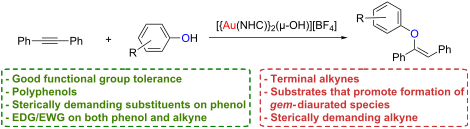
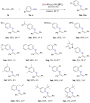
- hydroxy functional groups likely reduces this difference. To put these results in context, the previously reported methodology required 10 mol % of AuCl3 and 96 h in order to obtain similar yields for 4aq [26]. Moreover, only 7% of 4ap could be isolated after 168 h [26]. Electronic and steric effects on




Versatile deprotonated NHC: C,N-bridged dinuclear iridium and rhodium complexes
Beilstein J. Org. Chem. 2016, 12, 117–124, doi:10.3762/bjoc.12.13
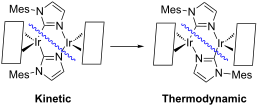
- complexes may be determined by steric effects of both monomeric moieties. To evaluate only the sterics, topographic steric maps were used, which are calculated through the SambVca package developed by Cavallo et al. [66]. This analysis allows the rationalization of the first coordination sphere around metal


Beyond catalyst deactivation: cross-metathesis involving olefins containing N-heteroaromatics
Beilstein J. Org. Chem. 2015, 11, 2223–2241, doi:10.3762/bjoc.11.241
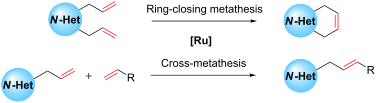
- the nitrogen atom, steric effects cannot be neglected. Another example of RCM involving alkenes that possess 2-chloropyridines was reported to produce dihydroisoquinoline 57 from 2,6-dichloro-3,4-diallylpyridine (56) [60]. The addition of benzoquinone prevented the isomerization of the double bond and
- for avoiding the nitrogen-induced deactivation of the catalyst by both electronic and steric effects (Scheme 22). Macrocycles embedding N-heteroaromatics have been prepared using a RCM reaction. Shirbate et al. used a RCM to synthesize normuscopyridine and analogues [62]. When a diastereomeric mixture


Stereochemistry of ring-opening/cross metathesis reactions of exo- and endo-7-oxabicyclo[2.2.1]hept-5-ene-2-carbonitriles with allyl alcohol and allyl acetate
Beilstein J. Org. Chem. 2015, 11, 1893–1901, doi:10.3762/bjoc.11.204

- the 2-hydroxy derivative (FG = OH) provided an equimolar ratio of both type A products. The authors have suggested that the observed regioselectivity comes from steric effects that favour formation of 1-3 over 1-2 metallacycles in the former case (see [20]). The completely regioselective ROCM of 2


A comprehensive study of olefin metathesis catalyzed by Ru-based catalysts
Beilstein J. Org. Chem. 2015, 11, 1767–1780, doi:10.3762/bjoc.11.192
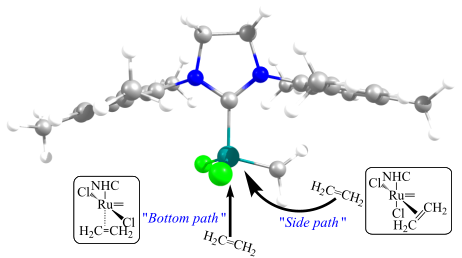
- and the conclusion was that any generalization could be done about the side/bottom stability of the coordination intermediate, as well as it is not possible for the first Grubbs catalysts [9]. Overall, the inclusion of a polar solvent and the absence of strong steric effects, i.e., with less bulky
- representative substrate, and is useful to focus on the study of steric effects of the substrate, reinforced the steric hindrance aspect replacing one or both mesityl groups of NHC ligand by methyl groups. Bearing the asymmetric catalysts 17–19, particularly complex 19 can be compared to 16 but introducing
- , respectively. Steric effects have little influence on the absolute C2H4 binding energy, E of 3rd column in Table 2, since rather similar values are calculated for 2 and 5 (−18.6 and −19.1 kcal/mol, respectively). Differently, electronic effects influence the ability of the Ru atom to capture C2H4, particularly




Consequences of the electronic tuning of latent ruthenium-based olefin metathesis catalysts on their reactivity
Beilstein J. Org. Chem. 2015, 11, 1458–1468, doi:10.3762/bjoc.11.158
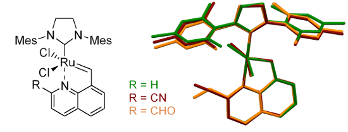
- assuming, that the isomerization of trans-5a to cis-5a is a concurring reaction, thus slowing down the polymerization reaction. The reason for the unexpectedly, at first sight, delayed initiation of 14 and 15 can most probably be attributed to steric effects. It is known that a coordination at the free
- occurrence of the cycloisomerization reaction, which are more important at higher temperatures of 140 °C. In ROMP, again the position of the trans–cis equilibrium is the most crucial factor governing the initiation efficacy. Additionally, it has been shown, that steric effects of the substitution are