Search results
Search for "conformer" in Full Text gives 201 result(s) in Beilstein Journal of Organic Chemistry. Showing first 200.
Thiophene-forming one-pot synthesis of three thienyl-bridged oligophenothiazines and their electronic properties
Beilstein J. Org. Chem. 2016, 12, 2055–2064, doi:10.3762/bjoc.12.194
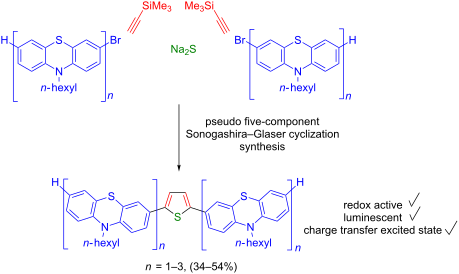
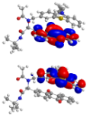
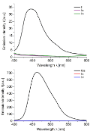
- = 298 K). DFT-calculated minimum conformer of the 2,5-bis(terphenothiazinyl)thiophene 3c (calculated with the B3LYP functional and the 6-311G(d,p) basis set). Relevant Kohn–Sham FMOs contributing to the S1 states that are assigned to the longest wavelengths absorption bands of thienyl-bridged


Varioloid A, a new indolyl-6,10b-dihydro-5aH-[1]benzofuro[2,3-b]indole derivative from the marine alga-derived endophytic fungus Paecilomyces variotii EN-291
Beilstein J. Org. Chem. 2016, 12, 2012–2018, doi:10.3762/bjoc.12.188
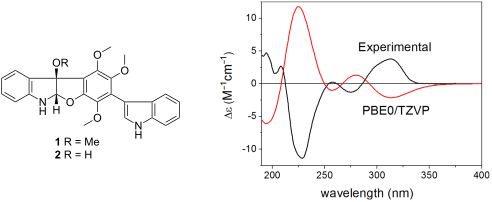
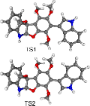
- Cotton effects (CEs) had the same sign for conformer A and B, while the lower-wavelength (<250 nm) CEs were significantly different. The hindered rotation along the biaryl linkage may have implied an additional stereogenic element, which would have enabled atropodiastereomers with axial chirality. In
- order to explore the possibility of axial chirality, torsional angle scans were performed on the lowest-energy M (conformer A) and P (conformer B) helicity gas-phase conformers or atropodiastereomers. Rotational energy barriers between the two isomers were estimated to be ca. 35–42 kJ/mol for TS1 (ωC12
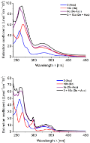
- compound 1. Structure and population of the low-energy B3LYP/6-31G(d) conformers (>2%) of (2R,3R)-1. Experimental ECD spectrum of 1 in MeCN compared with the computed PBE0/TZVP spectra of the lowest-energy M (ωC12−C13−C3’−C9’ = –46.1°, conformer A) and P (ωC12−C13−C3’−C9’ = 133.4°, conformer B) helicity



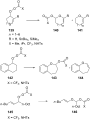
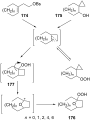
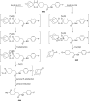
Rearrangements of organic peroxides and related processes
Beilstein J. Org. Chem. 2016, 12, 1647–1748, doi:10.3762/bjoc.12.162











Experimental and theoretical insights in the alkene–arene intramolecular π-stacking interaction
Beilstein J. Org. Chem. 2016, 12, 1616–1623, doi:10.3762/bjoc.12.158
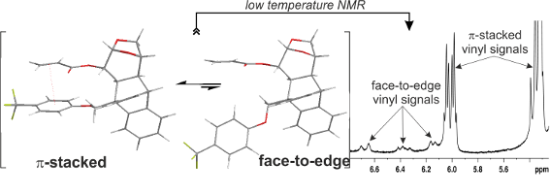
- approximately a 9:1 ratio, according to the relative area of the signals. Some authors have claimed that this effect could be due to a conformational equilibrium of s-cis and s-trans species that is shifted toward the s-trans conformer at lower temperatures [18][19][20][21]. Similar studies were carried out for




The hydrolysis of geminal ethers: a kinetic appraisal of orthoesters and ketals
Beilstein J. Org. Chem. 2016, 12, 1467–1475, doi:10.3762/bjoc.12.143
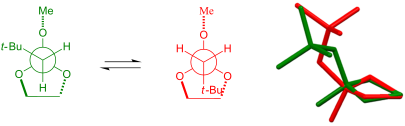
- ) ≈ 13:4. The antiperiplanar lone pair hypothesis (ALPH) proposes that the axial anomer of 4 constitutes the major conformer in solution [28], perhaps affording some stereoelectronic advantage to an early transition state which appears operative in the case of such acid-catalysed processes [29]. The
- structures (see Experimental section). The half-chair (C2) arrangement was found to be the only stable conformer for the 1,3-dioxolane ring with all other conformers being rotamers about the C(2)–CH2R and C(2)–OMe bonds [where R = H (5) or t-Bu (16)]. The orientation of the C(2)O–Me group is ignored from
- enthalpy. No such flattened conformer exists for 5. The calculations are consistent with the model presented earlier in Figure 4. The increasing steric demand of substituent R [i.e., R = H (5); → Et (9); → iPr (12) → t-Bu (16)] leads to transannular clashing with axial C(3)/(4)–H atoms and subsequent


Unusual traits of cis and trans-2,3-dibromo-1,1-dimethylindane on the way from 1,1-dimethylindene to 2-bromo-, 3-bromo-, and 2,3-dibromo-1,1-dimethylindene
Beilstein J. Org. Chem. 2016, 12, 1178–1184, doi:10.3762/bjoc.12.113
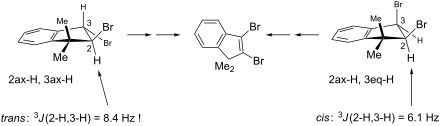
- conformer holds a pseudodiaxial, vicinal Br/H anti relationship and hence is (presumably) able to react somewhat faster. We abstained from separating trans-1 and cis-1 since the availability of two different mixtures facilitated the NMR assignments and because any cis-1/trans-1 mixture or the ensuing 3/4



Is conformation a fundamental descriptor in QSAR? A case for halogenated anesthetics
Beilstein J. Org. Chem. 2016, 12, 760–768, doi:10.3762/bjoc.12.76
- energies. These correspond to conformers 1, 2 and 3 of Table 1, the most stable ones in the gas phase and implicit solution. It is worth mentioning that, according to our calculations, the solvent has a little effect on the conformer populations, such as in enflurane [16], suggesting that intramolecular
- bonding is not a decisive interaction for the conformational equilibrium of isoflurane. Using a solvation model with explicit water, where specific solute–solvent interactions take place, conformer 1 is again the most stable form, suggesting that implicit solvation describes satisfactorily the actual
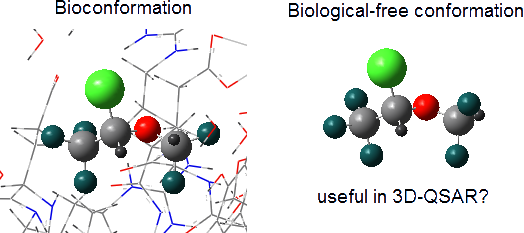
- differences in the Cl–C–O–C and C–O–C–H dihedral angles (±8° and 17°, respectively), the isoflurane structure bound to apoferritin (PDB code: 1XZ3 [9]) does not match any optimized conformer (Figure 1). So, does it make sense to use enzyme-free optimized conformations to obtain biochemical insights from 3D


cis–trans-Amide isomerism of the 3,4-dehydroproline residue, the ‘unpuckered’ proline
Beilstein J. Org. Chem. 2016, 12, 589–593, doi:10.3762/bjoc.12.57
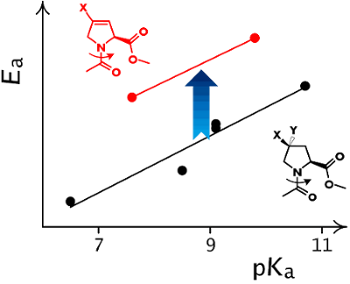
- energy the 3,4-double bond increased the relative stability of the s-trans conformer by 0.2–0.3 kJ/mol, whereas the 4-CF3-group demonstrated an opposite effect of about 0.3 kJ/mol (standard error ±0.1 kJ/mol). Despite both effects being rather marginal, this indicates that the increase of the


Effective in silico prediction of new oxazolidinone antibiotics: force field simulations of the antibiotic–ribosome complex supervised by experiment and electronic structure methods
Beilstein J. Org. Chem. 2016, 12, 415–428, doi:10.3762/bjoc.12.45
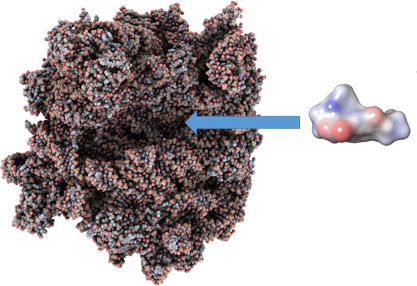
- on the following assumption: in order to avoid an enthalpic penalty, the conformer of a drug-like molecule in the unbound state has to be similar to the bioactive conformational state. The result of our MC scans is shown in Figure 2. An overall number of ca. 450 low energy (40kJ/mol window
- plot for all sampled conformers shows that the AMBER force field produces a homogeneous distribution of the low energy conformations, while the OPLS-AA low-RMSD structures are clustered in confined areas with a 10 kJ/mol wide conformer gap between 25–35 kJ/mol. We finally evaluated our force fields
- intensified our scan at this point in order to make sure that we will not produce false positive hits for the linezolid analogues. An initial phase with 5000 steps produced a low energy conformer very similar to the conformation of linezolid in the crystal structure. After another 5000 steps (starting from


Dynamic behavior of rearranging carbocations – implications for terpene biosynthesis
Beilstein J. Org. Chem. 2016, 12, 377–390, doi:10.3762/bjoc.12.41
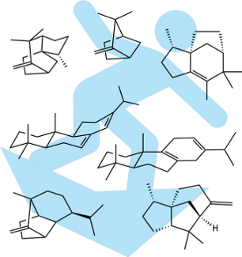
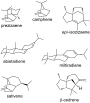
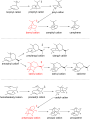
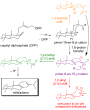
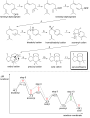
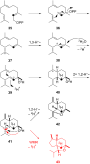
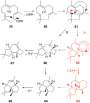
- (specifically, those derived from the conformer of the bisabolyl cation that most readily formed the cedryl cation in the dynamics simulations) into the crystallographically-determined structure of epi-isozizaene synthase revealed that some carbocations along the reaction coordinate were bound more strongly



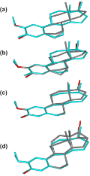
Inclusion complexes of 2-methoxyestradiol with dimethylated and permethylated β-cyclodextrins: models for cyclodextrin–steroid interaction
Beilstein J. Org. Chem. 2015, 11, 2616–2630, doi:10.3762/bjoc.11.281
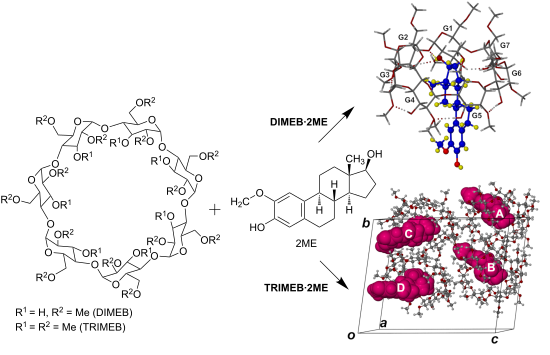
- present as two conformers in the ratio 0.61:0.39. One consequence of this is that there are two distinct positions for the O19–H phenolic group, each conformer forming a hydrogen bond with a different TRIMEB acceptor oxygen atom. Further details of this disorder and its implications are given below





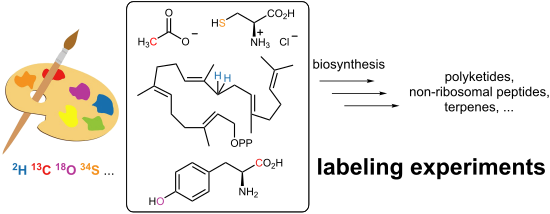
Recent highlights in biosynthesis research using stable isotopes
Beilstein J. Org. Chem. 2015, 11, 2493–2508, doi:10.3762/bjoc.11.271
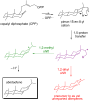
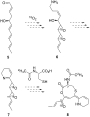
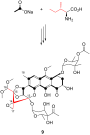
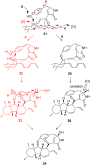
- 8) that prevented a full assignment of NMR data by conventional methods. To correlate a conformational signal set, (U-13C15)FPP was synthesized and 13C,13C-COSY showed the connected carbon skeleton for each conformer. The 15 obtained labeled natural products also allowed a detailed analysis of the











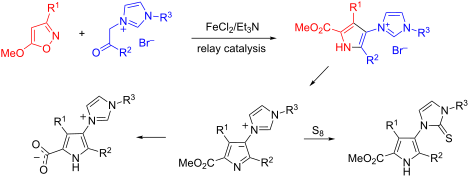
Fe(II)/Et3N-Relay-catalyzed domino reaction of isoxazoles with imidazolium salts in the synthesis of methyl 4-imidazolylpyrrole-2-carboxylates, its ylide and betaine derivatives
Beilstein J. Org. Chem. 2015, 11, 1732–1740, doi:10.3762/bjoc.11.189
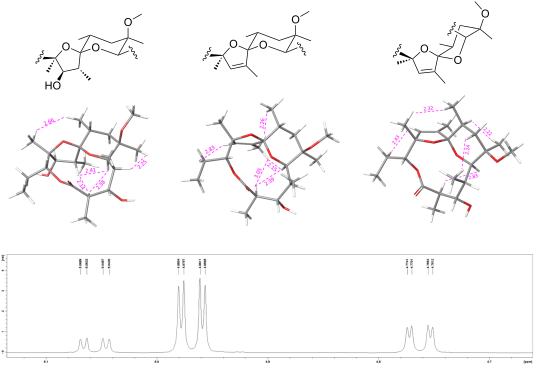
- corresponding solvent at 298 K. Calculated data are based on the most stable conformer of 2−6. Supporting Information Supporting Information File 246: Detailed experimental procedures including characterization data for all synthesized compounds, 1H and 13C NMR spectra for all new compounds. Computational


Structure and conformational analysis of spiroketals from 6-O-methyl-9(E)-hydroxyiminoerythronolide A
Beilstein J. Org. Chem. 2015, 11, 1447–1457, doi:10.3762/bjoc.11.157
- Determining the structure of the thermodynamically stable product 4 proved to be more challenging. Our initial hypothesis was that it was an anomerically stabilised 8C5 conformer of 3 with the 6-methoxy group in the more stable equatorial position. Molecular mechanics calculations, however, showed that such a




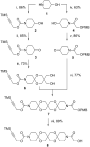
Articulated rods – a novel class of molecular rods based on oligospiroketals (OSK)
Beilstein J. Org. Chem. 2015, 11, 74–84, doi:10.3762/bjoc.11.11

- cooling to 0 °C the IM/IEX ratio is increased to 100:30 (Figure 4, green curve) and at 77 K in a solid EPA [25] matrix the excimer emission completely disappears (Figure 4, blue curve). This behavior underlines the above-mentioned dynamic character of the excimer and suggests that the conformer 32a-STR is




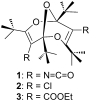
Molecular cleft or tweezer compounds derived from trioxabicyclo[3.3.1]nonadiene diisocyanate and diacid dichloride
Beilstein J. Org. Chem. 2015, 11, 1–8, doi:10.3762/bjoc.11.1
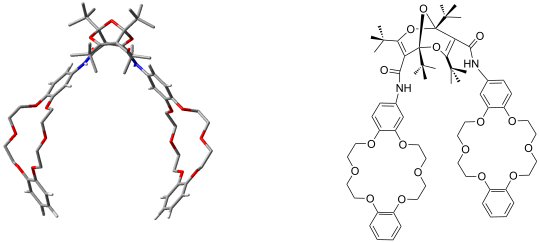
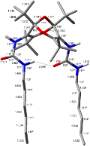
- of 4 and 5 (see Figure S2 and Figure S3, Supporting Information File 1), the lowest-energy conformers shown in Figure 6 and Figure 7 are in very good agreement with the X-ray structures. The nearly parallel dangling chains in the lowest-energy conformer of 4 are particularly noteworthy (Figure 6). As





Preparation of neuroprotective condensed 1,4-benzoxazepines by regio- and diastereoselective domino Knoevenagel–[1,5]-hydride shift cyclization reaction
Beilstein J. Org. Chem. 2014, 10, 2594–2602, doi:10.3762/bjoc.10.272
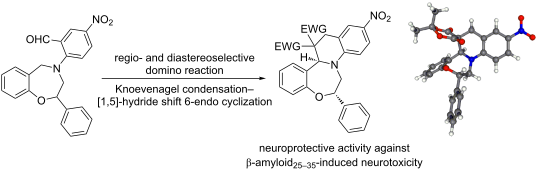
- compared with the computed ECD spectra of the gas-phase optimized conformers (>1%) of model compound (2S,15aS)-7d (1 conformer, B3LYP/TZVP) and (2S,15aS)-7b (2 conformers, BH&HLYP/TZVP). Bars represent the computed rotational strength values (R/8) of the lowest-energy conformer. c) Structure of the (2S


Pyrrolidine nucleotide analogs with a tunable conformation
Beilstein J. Org. Chem. 2014, 10, 1967–1980, doi:10.3762/bjoc.10.205
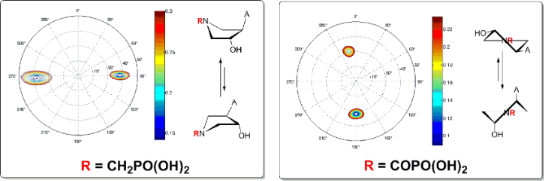
- interconverting conformer in solution, resulting in the observation of averaged experimental 3JHH. Nevertheless, even these averaged 3JHH can be used for conformational analysis by means of the program PSEUROT [10], which minimizes differences between experimental and calculated 3JHH, assuming a two-state
- pyrrolidine ring on its conformation. The conformation of phosphonomethyl derivatives 7 and 9 with trans configuration on 3’ and 4’ carbon atoms tends to occupy mainly (~60%) the 1T2 or 1E conformation in an equilibrium with the less populated (~40%) 1E conformer. This equilibrium is significantly shifted in
- hydrogen bonding between the 3’-OH group and the 4’-nucleobase substituent. A similar effect in the conformer populations was observed for phosphonoformyl derivatives. While trans derivatives 11 and 13 exist as an about 1:1 equilibrium mixture of 3T4 and 3T4 conformations, cis derivatives 12 and 14 prefer


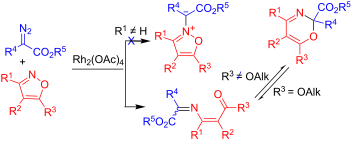
Isoxazolium N-ylides and 1-oxa-5-azahexa-1,3,5-trienes on the way from isoxazoles to 2H-1,3-oxazines
Beilstein J. Org. Chem. 2014, 10, 1896–1905, doi:10.3762/bjoc.10.197
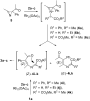
- of compound 3a in the crystal corresponds to the most stable conformer according to calculations at DFT B3LYP/6-31G(d) level in vacuo (ΔΔG298 K (equatorial/axial = 1.2 kcal/mol). One of the possible reasons for the higher stability of conformer 3a with a pseudo-axial methoxycarbonyl group in
- comparison to conformer 3a' with a pseudo-equatorial methoxycarbonyl group, is assumed to be the anomeric effect [24]. The lengthening of the C–CO2Me bond in conformer 3a compared to conformer 3a' (1.563/1.554 Å), corroborates this hypothesis. The pseudo-axia position of the methoxycarbonyl group is


The chemoenzymatic synthesis of clofarabine and related 2′-deoxyfluoroarabinosyl nucleosides: the electronic and stereochemical factors determining substrate recognition by E. coli nucleoside phosphorylases
Beilstein J. Org. Chem. 2014, 10, 1657–1669, doi:10.3762/bjoc.10.173
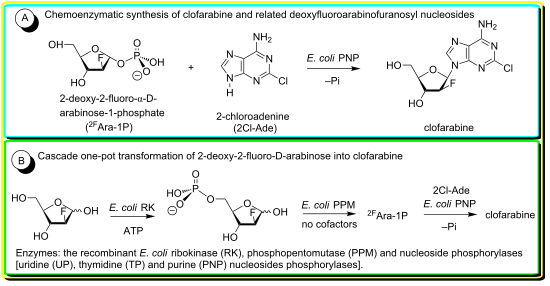
- characterized by the closely related total energy (ET) values were found for the α-anomer 12a. The slightly more stable conformation (C-3-exo conformer; ET = −732311.2 kcal/mol) is stabilized by the intramolecular C-3OH···−OP (1.68 Å) hydrogen bond and the close proximity of the C-5OH hydrogen and FC-2 fluorine
- atoms (C-5OH···FC-2 1.98 Å). The other structure (C-3-exo conformer; ET = −732310.1 kcal/mol) does not contain the intramolecular hydrogen bonds. The torsion angles of the vicinal hydrogen atoms H-1/H-2 and H-2/H-3, the hydrogen–fluorine (H-1/F and H-3/F) and hydrogen–phosphorus (H-1/P), and the carbon
- the less stable conformer (ET = −732297.1 kcal/mol) with a twist 3T2 spatial structure of the pentofuranose ring is in accordance with the experimental coupling constant of 5.40 Hz, whereas those of H-1/H-2 and H-2/H-3 disagree with the relevant couplings (Figure 3; for detailed information, see Table


Synthesis of the first examples of iminosugar clusters based on cyclopeptoid cores
Beilstein J. Org. Chem. 2014, 10, 1406–1412, doi:10.3762/bjoc.10.144
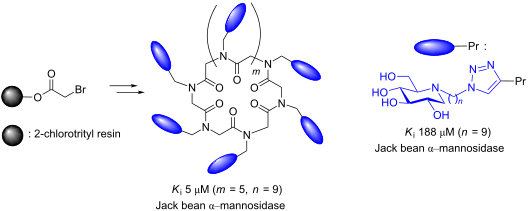
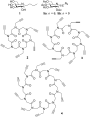
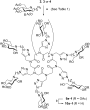
- by compound 9a (Figure 2i). This phenomenon, already observed for N-substituted cyclic α-peptoid derivatives [35][36][37][38][39], indicated the presence of more than one conformer in slow exchange on the NMR time scale. It is well known that the conformational heterogeneity is due to tertiary amide




Substitution effect and effect of axle’s flexibility at (pseudo-)rotaxanes
Beilstein J. Org. Chem. 2014, 10, 1299–1307, doi:10.3762/bjoc.10.131
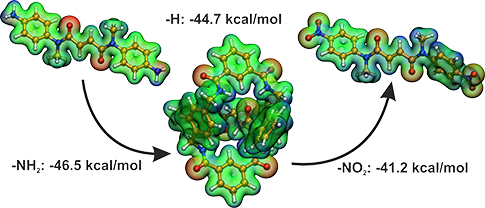
- for the understanding and the development of rotaxanes. Zerbetto et al. showed that the shuttling motion can be separated from the other degrees of freedom, and that the effective coordinate of the motion can be described as a double-minimum potential [18]. The co-conformer stability for rotaxane


The Ugi four-component reaction as a concise modular synthetic tool for photo-induced electron transfer donor-anthraquinone dyads
Beilstein J. Org. Chem. 2014, 10, 1006–1016, doi:10.3762/bjoc.10.100
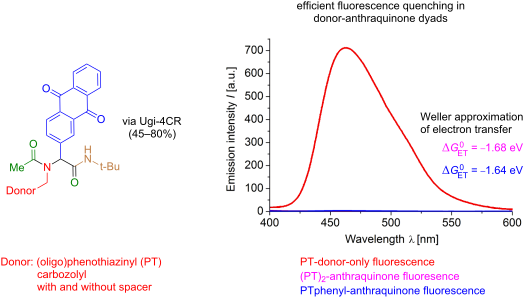
- pairs resulting in four stacked (hetero)aromatic units (Figure 2), so that the anthraquinone moieties of two molecules display an average distance of ~3.8 Å. Based upon the X-ray data quantum mechanical computations on this conformer were envisioned (vide infra). Electronic properties and electronic
- dyad 1 an electronic prerequisite for electronically favored electron-transfer processes in donor–acceptor systems is the spatial proximity of PT and AQ. This conformer is additionally stabilized by π-stacking of the donor and the acceptor, which is adopted in the solid state and results in a strong




Conformational analysis of 2,2-difluoroethylamine hydrochloride: double gauche effect
Beilstein J. Org. Chem. 2014, 10, 877–882, doi:10.3762/bjoc.10.84
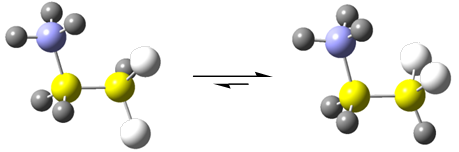
- one single fluorine gauche to the nitrogen atom (anti-gauche, ag) (Table 1). In fact, the most stable conformer of the neutral compound contains two fluorines gauche to the amino group, which presents both hydrogens directed toward fluorines, suggesting the formation of F···HN hydrogen bond. However
- . The conformational preference dramatically changes after protonation of 1 to give the 2,2-difluoroethylammonium cation (2), i.e. the conformer containing both fluorines gauche to the ammonium group (gg) is practically the single form in the equilibrium in the gas phase and, even in water solution
- , this conformer is calculated to amount to 90%. This preference is corroborated by NMR experiments (Supporting Information, File 1), because the measured 3JH,H and 3JH,F coupling constants (which have angular dependence according to the well known Karplus curve [12][13][14]) are consistent with the

Use of activated enol ethers in the synthesis of pyrazoles: reactions with hydrazine and a study of pyrazole tautomerism
Beilstein J. Org. Chem. 2014, 10, 752–760, doi:10.3762/bjoc.10.70

- Information File 1, Tables S2–S5 and S14) but because of energy reasons the relative population of the C conformer must be vanishing in agreement with experimental data. This was confirmed by calculated NMR spectra (Supporting Information File 1, Table S15). Nevertheless, DFT data indicate a much lower
- proportion of the B conformer than implied by the experimental data. In contrast to the A tautomer, the B and C tautomers have planar >C–C–N–N–C–C< chains. X-ray and DFT optimized structures of the A tautomer exhibit significant differences in torsional angles only (see Supporting Information File 1, Tables