


Search results
Search for "radical addition" in Full Text gives 141 result(s) in Beilstein Journal of Organic Chemistry.
Computational study of the rate constants and free energies of intramolecular radical addition to substituted anilines
Beilstein J. Org. Chem. 2013, 9, 1620–1629, doi:10.3762/bjoc.9.185

- und Theoretische Chemie der Rheinischen-Friedrich-Wilhelms-Universität Bonn, Beringstraße 4, D-53115 Bonn, Germany 10.3762/bjoc.9.185 Abstract The intramolecular radical addition to aniline derivatives was investigated by DFT calculations. The computational methods were benchmarked by comparing the
- was therefore employed in further calculations. Corrections for intramolecular London dispersion and solvation effects in the quantum chemical treatment are essential to obtain consistent and accurate theoretical data. For the investigated radical addition reaction it turned out that the polarity of
- ][7][8] proceeding via catalysis in single electron steps (for experimental results see Scheme 1) [9][10]. The C–C bond forming step of the catalytic cycle is an intramolecular alkyl radical addition to substituted anilines. Even though only rarely used, reaction sequences employing such steps in an


Stability of SG1 nitroxide towards unprotected sugar and lithium salts: a preamble to cellulose modification by nitroxide-mediated graft polymerization
Beilstein J. Org. Chem. 2013, 9, 1589–1600, doi:10.3762/bjoc.9.181
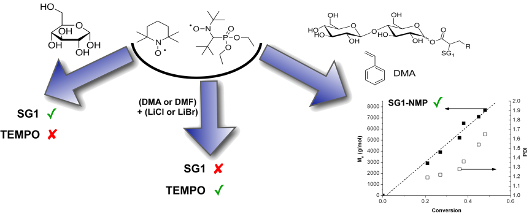
- of elaboration of this alkoxyamine has already been described elsewhere [28]. Briefly, the synthesis of the cello-SG1 alkoxyamine is performed in two steps: (i) acroylation of one hydroxy function of cellobiose to graft one acrylate function, (ii) intermolecular 1,2-radical addition (1,2-IRA) of the


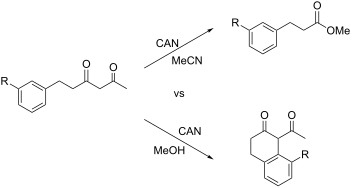
Mechanistic studies on the CAN-mediated intramolecular cyclization of δ-aryl-β-dicarbonyl compounds
Beilstein J. Org. Chem. 2013, 9, 1472–1479, doi:10.3762/bjoc.9.167
- initial rotational transition structure TS1a’ has a barrier of 2.5 kcal/mol, and the corresponding radical intermediate 2a’ is 0.6 kcal/mol above 1a’. For the radical addition to the aromatic ring, the energy barrier is 15.8 kcal/mol, and the product cyclohexadienyl radical 3a’ is 8.8 kcal/mol higher in
- position, path A is followed. Intramolecular cyclization of 7 occurs through radical addition to the aromatic ring forming intermediate 8. As demonstrated by the oxidation of substrate 1j, intramolecular cyclization of this radical occurs at the more electron-rich carbon atom of the δ-aryl rings. A second


Diastereoselective radical addition to γ-alkyl-α-methylene-γ-butyrolactams and the synthesis of a chiral pyroglutamic acid derivative
Beilstein J. Org. Chem. 2013, 9, 1432–1436, doi:10.3762/bjoc.9.161
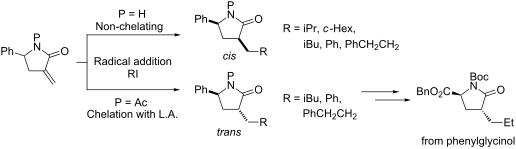
- ][7][8] and no reports on radical addition. We have already investigated diastereoselective alkyl radical additions to α-methylene-γ-phenyl- γ-lactam and reported that the N-unsubstituted lactam yields cis-α,γ-disubstituted lactams using (Me3Si)3SiH under UV irradiation, whereas the reactions of N
- , because N-pivaloyl gave high trans-selectivity of γ-phenyl substrate, yielded the chiral radical substrate 10. The trans-selective ethyl radical addition proceeded, yielding 11 with high diastereoselectivity, as we previously reported [9]. The trans-isomer was isolated by silica-gel column chromatography
- synthesize chiral pyroglutamic acid derivatives starting from (S)-phenylglycinol. Chelation of 5a and 5d. Radical addition to α-methylene-γ-phenyl-γ-butyrolactams. Synthesis of chiral substrate 10. Synthesis of chiral 4-butyl-L-pyroglutamic acid 13. Radical addition to 1 under non-chelating conditions


Preparation of optically active bicyclodihydrosiloles by a radical cascade reaction
Beilstein J. Org. Chem. 2013, 9, 1326–1332, doi:10.3762/bjoc.9.149
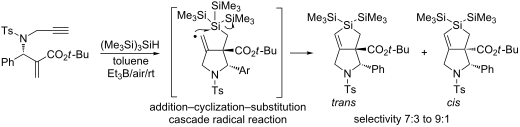
- reaction, radical addition–cyclization cascade followed by intramolecular radical substitution (SHi) occurred in one-pot to give optically active bicyclostannolanes in good yields [15]. We are interested in whether such a cascade SHi process might occur with other radical species. We have found that a


Metal-free aerobic oxidations mediated by N-hydroxyphthalimide. A concise review
Beilstein J. Org. Chem. 2013, 9, 1296–1310, doi:10.3762/bjoc.9.146
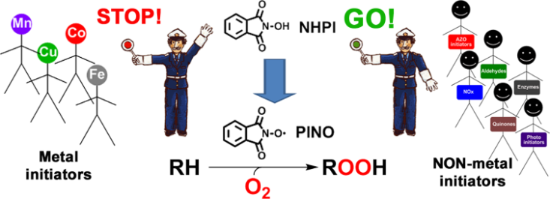
- selective oxidation of organic substrates. Radical addition of aldehydes and analogues to alkenes. NHPI/AIBN-promoted aerobic oxidation of 2,6-diisopropylnaphthalene. NHPI/AIBN-promoted aerobic oxidation of CHB. NMBHA/MeOAMVN promoted aerobic oxidation of PUFA. Alkene dioxygenation by means of N-aryl


Homolytic substitution at phosphorus for C–P bond formation in organic synthesis
Beilstein J. Org. Chem. 2013, 9, 1269–1277, doi:10.3762/bjoc.9.143

- literature [19][20][21]. This review deals with two transformations, radical phosphination by addition across unsaturated C–C bonds and substitution of organic halides. Review Radical addition of phosphination agents Stannylphosphines of the type R3Sn–PR’2 are known to undergo radical addition to carbon
- reported that diphenyl(trimethylstannyl)phosphine reacts not only with terminal alkynes but also with internal alkynes and allenes (Scheme 4) [24][25]. It is noteworthy that the regioselectivity of the radical addition to propynamide is opposite to that of the relevant ionic Michael addition. Considering
- , considerable polymerization takes place unless substrates or olefinic products are reasonably inert. Yorimitsu and Oshima reported radical addition of a P–S bond across alkyne by using diphenyl(organosulfanyl)phosphine (Table 4) [35]. The addition proceeds mainly in an anti fashion to afford the adducts


Cascade radical reaction of substrates with a carbon–carbon triple bond as a radical acceptor
Beilstein J. Org. Chem. 2013, 9, 1148–1155, doi:10.3762/bjoc.9.128
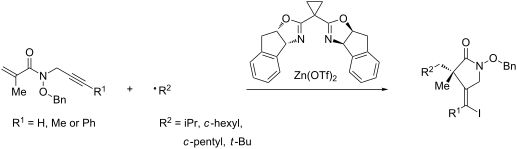
- hydroxamate ester as a chiral Lewis acid coordination moiety was first shown in an intermolecular reaction involving a radical addition and sequential allylation processes. Next, the effect of hydroxamate ester was studied in the cascade addition–cyclization–trapping reaction of substrates with a carbon
- 2002 that hydroxamic acid derivatives are useful achiral templates in enantioselective Diels–Alder reactions [69][70]. To study the effect of hydroxamate ester as an achiral template in the intermolecular radical reaction, our experiments began with the investigation of cascade radical addition
- substrates and the stereochemistry of cyclization. Substrates for testing the cascade transformation. E/Z-selectivity of 9Aa–Ca. Model for the enantioselective reaction. Effect of hydroxamate ester on intermolecular C–C bond-forming reactions. Cascade radical addition–cyclization–trapping reaction of 5 and




Interplay of ortho- with spiro-cyclisation during iminyl radical closures onto arenes and heteroarenes
Beilstein J. Org. Chem. 2013, 9, 1083–1092, doi:10.3762/bjoc.9.120
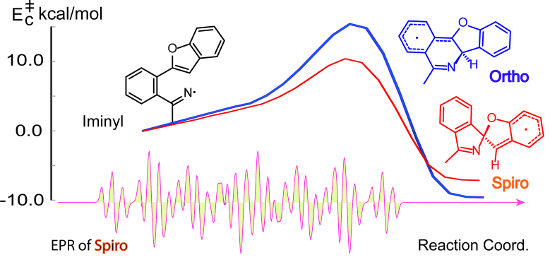
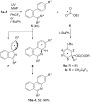
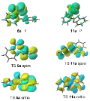
- system necessarily occurs. The most commonly encountered type is C-centred radical addition (often an aryl radical) to an aromatic or heteroaromatic ring ortho to the point of attachment of the tether. In Pschorr and related processes re-aromatisation follows with production of phenanthrene-type




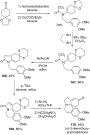
Some aspects of radical chemistry in the assembly of complex molecular architectures
Beilstein J. Org. Chem. 2013, 9, 557–576, doi:10.3762/bjoc.9.61

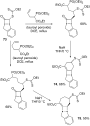
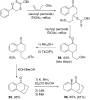
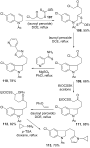
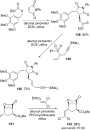
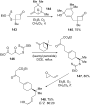
- tedious by more traditional routes. The possibility of iterating the radical addition allows for a convergent and highly modular assembly of complex scaffolds. The three successive additions outlined in Scheme 8 and leading to 37 illustrate nicely this approach [25]. One xanthate, 36, and three different
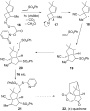
- strategy for creating complexity from simple starting materials. In this approach, the radical sequence brings together the functional groups necessary for the ionic transformation. One example is the sequence that follows the radical addition of xanthate 61 to an alkene depicted in Scheme 12. Exposure of
- the ready formation of bicyclic compound 72 [33]. The use of a phosphonate-containing alkene allows the assembly of numerous polycyclic structures by combining the radical addition of a ketone-bearing xanthate with an intramolecular Horner–Wadsworth–Emmons condensation. This strategy is highlighted in













Radical zinc-atom-transfer-based carbozincation of haloalkynes with dialkylzincs
Beilstein J. Org. Chem. 2013, 9, 236–245, doi:10.3762/bjoc.9.28
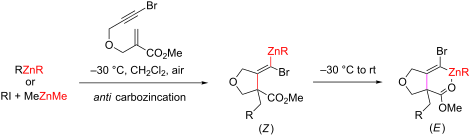
- )enoates bearing pendant haloalkynes would be ideally suited (Scheme 1). On the one hand it would provide a means to control totally the regioselectivity of the radical addition to the haloalkyne, and on the other hand the envisioned zinc atom transfer to an α-halo vinylic radical should be favorable as a


Highly selective synthesis of (E)-alkenyl-(pentafluorosulfanyl)benzenes through Horner–Wadsworth–Emmons reaction
Beilstein J. Org. Chem. 2012, 8, 1185–1190, doi:10.3762/bjoc.8.131
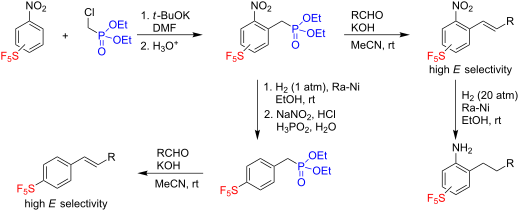
- chemical stability, high electronegativity and strong lipophilic character [2][3][4][5][6][7]. The availability of SF5-containing compounds is very limited. Aliphatic SF5-containing compounds are available through free-radical addition of toxic and expensive SF5Cl to unsaturated compounds [8][9], and


Tandem catalysis of ring-closing metathesis/atom transfer radical reactions with homobimetallic ruthenium–arene complexes
Beilstein J. Org. Chem. 2010, 6, 1167–1173, doi:10.3762/bjoc.6.133
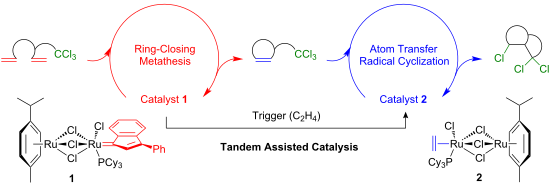
- compound was first reported in 2005 by Severin et al. who successfully used it as a catalyst for atom transfer radical addition (ATRA) and cyclization (ATRC) reactions [4][5]. In 2007, we further extended its application field to the related process of atom transfer radical polymerization (ATRP) [2


Novel multi-responsive P2VP-block-PNIPAAm block copolymers via nitroxide-mediated radical polymerization
Beilstein J. Org. Chem. 2010, 6, 756–765, doi:10.3762/bjoc.6.89
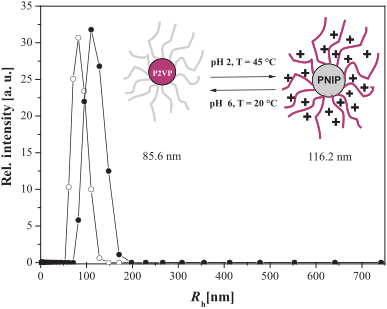
- the last few years. This includes nitroxide-mediated radical polymerization (NMRP) [18], atom transfer radical polymerization (ATRP) [19][20] and radical addition fragmentation chain transfer procedures (RAFT) [21][22]. The controlled polymerization of styrene, and analogous monomers such as 2


Controlling hazardous chemicals in microreactors: Synthesis with iodine azide
Beilstein J. Org. Chem. 2009, 5, No. 30, doi:10.3762/bjoc.5.30
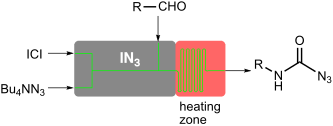
- Discussion The radical addition of azide to aldehydes 1 initially forms acyl azides 2 which directly rearrange in a Curtius rearrangement to the corresponding isocyanates 3. Isocyanates are very reactive themselves and offer a wide range of possible conversions. An excess of azide leads to the formation of


Part 1. Reduction of S-alkyl- thionocarbonates and related compounds in the presence of trialkylboranes/air
Beilstein J. Org. Chem. 2007, 3, No. 45, doi:10.1186/1860-5397-3-45
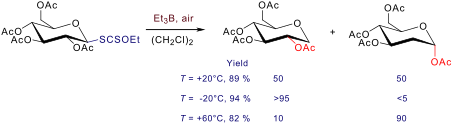
- is known to produce radicals at 20°C, or even much lower temperature (-78°C), we thought that trialkylboranes in the presence of dioxygen would be good candidates to trigger the radical addition of α-acyl S-xanthates onto olefins. When testing this hypothesis, we observed that compound 1a (Figure 1





