Search results
Search for "single electron transfer" in Full Text gives 146 result(s) in Beilstein Journal of Organic Chemistry.
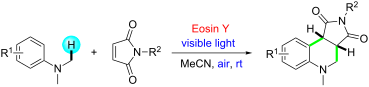
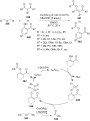
Eosin Y-catalyzed visible-light-mediated aerobic oxidative cyclization of N,N-dimethylanilines with maleimides
Beilstein J. Org. Chem. 2015, 11, 425–430, doi:10.3762/bjoc.11.48
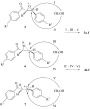
- undergo an oxidative or reductive quenching cycle [48][49][50]. In this mechanism, a single electron transfer (SET) from 1 to 3EY* generates the amine radical cation 4, and at the same time, 3EY* is reduced to the EY•−. In the presence of oxygen, the photoredox catalytic cycle of EY is finished via a SET



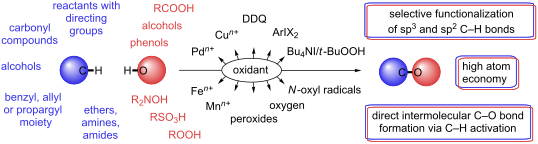
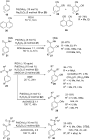
Cross-dehydrogenative coupling for the intermolecular C–O bond formation
Beilstein J. Org. Chem. 2015, 11, 92–146, doi:10.3762/bjoc.11.13


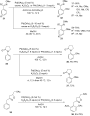




Come-back of phenanthridine and phenanthridinium derivatives in the 21st century
Beilstein J. Org. Chem. 2014, 10, 2930–2954, doi:10.3762/bjoc.10.312

- phenanthridines in excellent yields (>92%). The radical inhibitor 2,2,6,6-tetramethylpiperidin-1-oxyl (TEMPO) was applied to stop the transformation by a single electron transfer process. Intriguing combination of irradiation techniques (combined microwave-assisted and photochemical) offered a new route toward


Cyclization–endoperoxidation cascade reactions of dienes mediated by a pyrylium photoredox catalyst
Beilstein J. Org. Chem. 2014, 10, 1272–1281, doi:10.3762/bjoc.10.128
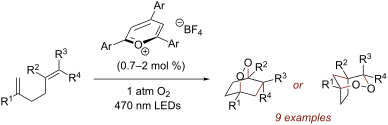
- intermediates are trapped by O2 and furnish the shown bicyclic products after reduction. Diversification strategy for endoperoxide synthesis by single electron transfer. E*red vs SCE [20]. Proposed mechanism for endoperoxide synthesis from tethered dienes. Competing formal [3,3] pathway. Reaction Optimization


Direct C–H trifluoromethylation of di- and trisubstituted alkenes by photoredox catalysis
Beilstein J. Org. Chem. 2014, 10, 1099–1106, doi:10.3762/bjoc.10.108
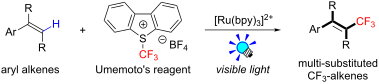
- visible-light-induced single-electron transfer (SET) processes [24][25][26][27][28][29][30][31][32]. On the other hand, we have intensively developed trifluoromethylations of olefins by the Ru and Ir photoredox catalysis using easy-handling and shelf-stable electrophilic trifluoromethylating reagents [33




On the mechanism of photocatalytic reactions with eosin Y
Beilstein J. Org. Chem. 2014, 10, 981–989, doi:10.3762/bjoc.10.97
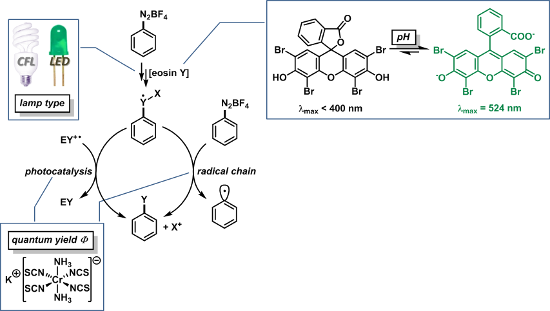
- Information File 1). Much effort has been directed at the oxidative quenching of eosin Y* (T1) with suitable electrophiles in order to generate aryl radicals by a light-driven single-electron transfer (SET) process (i.e., one-electron reduction of Ar–X, see Scheme 1). Due to their easy reducibility


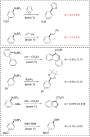
Visible-light photoredox catalysis enabled bromination of phenols and alkenes
Beilstein J. Org. Chem. 2014, 10, 622–627, doi:10.3762/bjoc.10.53
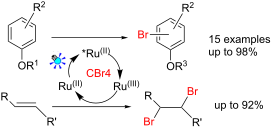
- . Recently, an intriguing and promising strategy for the application of photoredox catalysts to initiate single electron transfer processes have been developed [16][17][18][19][20][21][22]. Since the pioneering work from the groups of MacMillan [23][24][25], Stephenson [26][27][28], Yoon [29][30][31] and


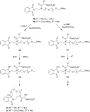
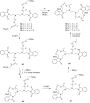
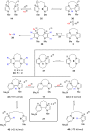
Direct and indirect single electron transfer (SET)-photochemical approaches for the preparation of novel phthalimide and naphthalimide-based lariat-type crown ethers
Beilstein J. Org. Chem. 2014, 10, 514–527, doi:10.3762/bjoc.10.47
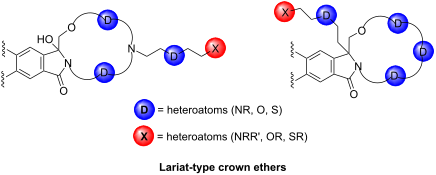
- imides; Review Since the 1970s, studies by a number of organic photochemists have demonstrated that a large number of unique single electron transfer (SET) mechanistic pathways are followed in photochemical reactions [1][2][3][4][5][6][7][8][9][10]. Owing to its potentially large energetic driving force




Deoxygenative gem-difluoroolefination of carbonyl compounds with (chlorodifluoromethyl)trimethylsilane and triphenylphosphine
Beilstein J. Org. Chem. 2014, 10, 344–351, doi:10.3762/bjoc.10.32
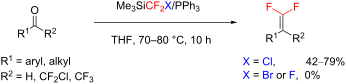
- occurs to give TMSCl with regeneration of PPh3; meanwhile, the trapping of :CF2 by PPh3 gives the ylide. In Path B, a phosphonium salt 10, which is formed via a single-electron transfer (SET) mechanism, undergoes a chloride ion-promoted desilylation reaction to afford Ph3P=CF2 [42][43]. However, we could


Regioselective 1,4-trifluoromethylation of α,β-unsaturated ketones via a S-(trifluoromethyl)diphenylsulfonium salts/copper system
Beilstein J. Org. Chem. 2013, 9, 2189–2193, doi:10.3762/bjoc.9.257
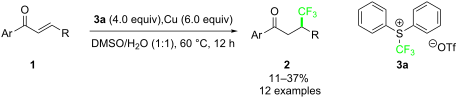
- -substituted enone also produced the desired product 2l (Table 2, entry 12). Based on these results, we hypothesized the reaction mechanism as shown in Scheme 2. First, the conjugate trifluoromethylation of α,β-unsaturated ketones would be initiated by a single-electron transfer between S-(trifluoromethyl


The chemistry of amine radical cations produced by visible light photoredox catalysis
Beilstein J. Org. Chem. 2013, 9, 1977–2001, doi:10.3762/bjoc.9.234
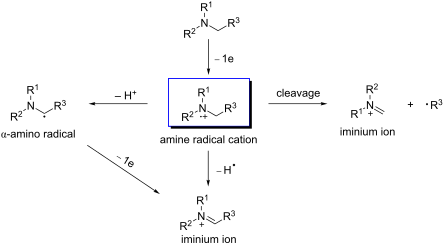
- share one common characteristic: a facile intersystem crossing (ISC) that allows the conversion of the initially formed singlet photoexcited state to the relatively long-lived triplet photoexcited state. The triplet photoexcited state’s long lifetime permits it to engage in single-electron transfer with
- to reductively quench the photoexcited state while they are oxidized to amine radical cations. This single-electron transfer process was investigated intensively in the late 1970s and early 1980s because amines were used as a sacrificial electron donor in water splitting [31][32] and carbon dioxide


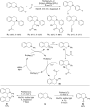


Electron self-exchange activation parameters of diethyl sulfide and tetrahydrothiophene
Beilstein J. Org. Chem. 2013, 9, 1448–1454, doi:10.3762/bjoc.9.164
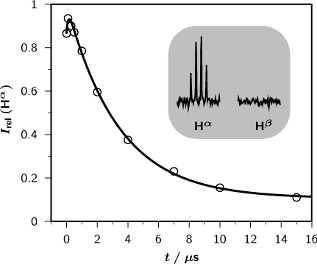
- solvent reorganization. Keywords: CIDNP; electron transfer; free radicals; kinetics; photochemistry; pyrylium salts; self-exchange; sulfides; Introduction Single-electron transfer is probably the simplest chemical process of an organic molecule, because usually no full bonds are broken or formed. For


Organocatalytic C–H activation reactions
Beilstein J. Org. Chem. 2012, 8, 1374–1384, doi:10.3762/bjoc.8.159
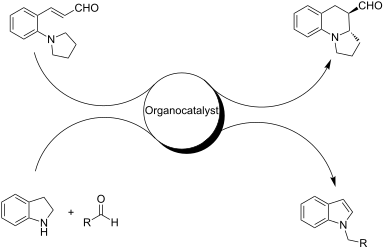
- a deuterium radical from THF-d8 to provide 23. The authors found a low conversion (2%) for 23 in the absence of Ph-phen indicating the involvement of Ph-phen in the radical generation. The authors explained that Ph-phen can act as a single-electron-transfer (SET) mediator because it has a low lying



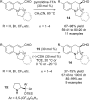


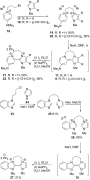
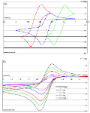
Hybrid super electron donors – preparation and reactivity
Beilstein J. Org. Chem. 2012, 8, 994–1002, doi:10.3762/bjoc.8.112
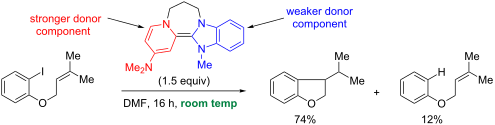
- to an iodoarene; single electron transfer would afford an aryl radical that would undergo cyclisation efficiently [17], while two-electron transfer to afford an aryl anion would afford an aryl anion that would not cyclise in DMF as solvent [18]. The reaction with 30 was conducted under slightly






Reduction of benzylic alcohols and α-hydroxycarbonyl compounds by hydriodic acid in a biphasic reaction medium
Beilstein J. Org. Chem. 2012, 8, 330–336, doi:10.3762/bjoc.8.36
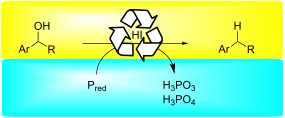
- stepwise reduction by single electron transfer (SET) accompanied by the oxidation of I− to I2. The iodine, generated in the second step, is recycled by reduction with red phosphorous, regenerating hydriodic acid. Admittedly, the above-mentioned TEMPO adduct could also be generated by nucleophilic


Highly substituted benzannulated cyclooctanol derivatives by samarium diiodide-induced cyclizations
Beilstein J. Org. Chem. 2010, 6, 1229–1245, doi:10.3762/bjoc.6.141
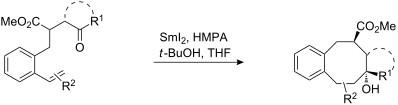
- -trig cyclizations to cycloheptanol derivatives have been observed. In examples with high steric hindrance the ketyl–aryl coupling can be a competing process. Keywords: cyclooctanes; ketones; ketyls; medium-sized rings; samarium diiodide; single electron transfer; styrene derivatives; radicals




Aromatic and heterocyclic perfluoroalkyl sulfides. Methods of preparation
Beilstein J. Org. Chem. 2010, 6, 880–921, doi:10.3762/bjoc.6.88
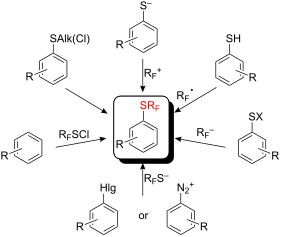
- disulfides with Li/liquid NH3 (Table 8), in much the same way as the described above for RFI [158][159]. 4.1.5. Other methods of initiating From the knowledge that the reaction mechanism is a single-electron transfer process involving RF• radicals, alternative methods to photochemical initiation have been


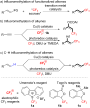
Shelf-stable electrophilic trifluoromethylating reagents: A brief historical perspective
Beilstein J. Org. Chem. 2010, 6, No. 65, doi:10.3762/bjoc.6.65
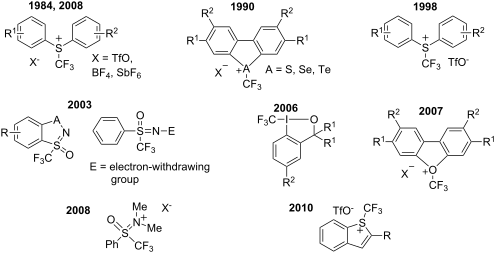
- studies with appropriate analytical tools should be conducted in order to obtain more insight on the transfer of the electrophilic CF3 group. A bimolecular nucleophilic substitution, SN2 type mechanism, is often suggested, although a single electron transfer mechanism cannot be ruled out depending on the


Convergent syntheses of LeX analogues
Beilstein J. Org. Chem. 2010, 6, No. 17, doi:10.3762/bjoc.6.17
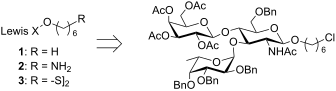
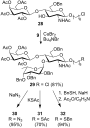
- conditions did not lead to the desired corresponding thiol or disulfide product but produced the hexyl glycoside 1. The mechanism proposed to explain this reductive desulfurization is shown in Scheme 4. It involves first a single electron transfer to the thioacetyl group that is followed by the cleavage of



Reduction of arenediazonium salts by tetrakis(dimethylamino)ethylene (TDAE): Efficient formation of products derived from aryl radicals
Beilstein J. Org. Chem. 2009, 5, No. 1, doi:10.3762/bjoc.5.1
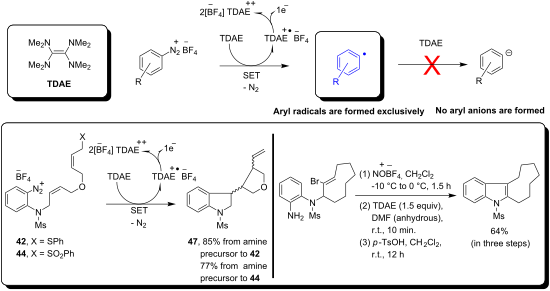
- Abstract Tetrakis(dimethylamino)ethylene (TDAE 1), has been exploited for the first time as a mild reagent for the reduction of arenediazonium salts to aryl radical intermediates through a single electron transfer (SET) pathway. Cyclization of the aryl radicals produced in this way led, in appropriate


Photosonochemical catalytic ring opening of α-epoxyketones
Beilstein J. Org. Chem. 2007, 3, No. 2, doi:10.1186/1860-5397-3-2
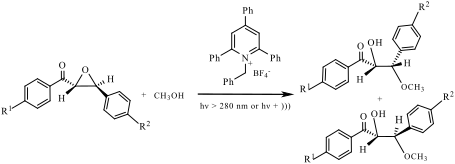
- -epoxyketones in the presence of various nucleophiles has received considerable attention in recent years, partially owing to current interest in single electron transfer (SET) process and also because of potential application in organic synthesis. Such reactions have been recognized as important processes not
- only in thermal but also in photochemical transformations. Single electron transfer (SET) induced ring opening reactions of epoxides and α-epoxyketones have demonstrated C-C and C-O bond cleavages through photo-induced electron transfer by various electron donors such as triethylamine (TEA), [21
- ] tribenzylamine (TBA) [20] and 1,3-dimethyl-2-phenylbenzimidazoline (DMPBI) [22][23][24] or thermally induced single electron transfer by electron donating compounds such as samarium diiodide, [25] tributyltin hydride [26] and bis(cyclopentadienyl)titanium(III) chloride. [27] Ring opening reactions of epoxides