


Search results
Search for "Appel reaction" in Full Text gives 27 result(s) in Beilstein Journal of Organic Chemistry.
Recent advancements in the synthesis of Veratrum alkaloids
- Morwenna Mögel,
- David Berger and
- Philipp Heretsch
Beilstein J. Org. Chem. 2025, 21, 2657–2693, doi:10.3762/bjoc.21.206
- -methylene group and an ester reduction/Appel reaction sequence to convert the ester moiety to an iodide leaving group. The right-hand fragment (E/F-ring) was synthesized from tert-butylsiloxyfuran 39. Commencing via an asymmetric allylic alkylation and an aza-Michael reaction, butanolide 40 was obtained in

Graphical Abstract

Scheme 1: Representatives of steroid alkaloid classes. Marked in blue is the steroidal cholestane framework, ...

Scheme 2: Subclasses of Veratrum alkaloids: jervanine, veratramine and cevanine-type [8].

Scheme 3: Flow chart presentation of the synthesis of (−)-englerin A developed by the Christmann group [10].
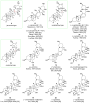
Scheme 4: Structures and year of synthesis of the three types of Veratrum alkaloids reported in the literatur...
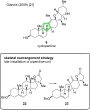
Scheme 5: Key step in the synthesis of cyclopamine (6) by the Giannis group [21].

Scheme 6: Overview of the semisynthesis of cyclopamine (6) reported by the Giannis group in 2009 [21].
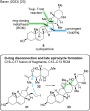
Scheme 7: Key steps in the synthesis of cyclopamine (6) by the Baran group [23].

Scheme 8: Overview of the total synthesis of cyclopamine (6) by the Baran group in 2023 [23].
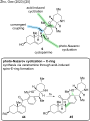
Scheme 9: Key steps in the synthesis of cyclopamine (6) by the Zhu/Gao group [25].
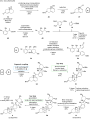
Scheme 10: Overview of the total synthesis of cyclopamine (6) by the group of Zhao/Gao in 2023 [25].
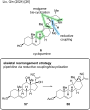
Scheme 11: Key steps in the synthesis of cyclopamine (6) by the Liu/Qin group [26].

Scheme 12: Overview of the semisynthesis of cyclopamine (6) by the Liu/Qin group in 2024 [26].
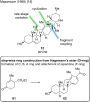
Scheme 13: Key steps in the synthesis of jervine (12) by the Masamune group [14].

Scheme 14: Overview of the total synthesis of jervine (12) by the Masamune group in 1968 [14].

Scheme 15: Color-coded schemes of the presented cyclopamine (6) syntheses by Giannis, Baran, Zhu/Gao, and Liu/...
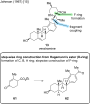
Scheme 16: Key steps in the total synthesis of veratramine (13) by the Johnson group [15].

Scheme 17: Overview of the total synthesis of veratramine (13) by the Johnson group in 1967 [15].
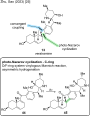
Scheme 18: Key steps in the synthesis of veratramine (13) by the Zhu/Gao group [25].

Scheme 19: Shortened overview of the total synthesis of veratramine (13) by the Zhu/Gao group in 2023 [25].
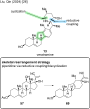
Scheme 20: Key steps in the synthesis of veratramine by the Liu/Qin group [26].

Scheme 21: Overview of the semisynthesis of veratramine (13) by the Liu/Qin group in 2024 [26].
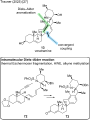
Scheme 22: Key steps in the synthesis of veratramine (13) by the Trauner group [27].

Scheme 23: Overview of the total synthesis of veratramine (13) by the Trauner group in 2025 [27].
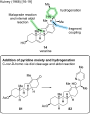
Scheme 24: Key steps in the synthesis of verarine (14) by the Kutney group [16-19].

Scheme 25: Overview of the total synthesis of verarine (14) by the Kutney group reported 1962–1968 [16-19].

Scheme 26: Color-coded schemes of the presented veratramine-type alkaloid synthesis of Zhu/Gao, Liu/Qin and Tr...
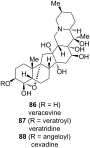
Scheme 27: Structures of veracevine (86), veratridine (87), and cevadine (88).

Scheme 28: Key step in the semisynthesis of verticine (15) by the Kutney group (1977) [20,46].

Scheme 29: Overview of the semisynthesis of verticine (15) by the Kutney group (1977) [20,46].

Scheme 30: Key step of the total synthesis of (±)-4-methylenegermine (17) by the Stork group (2017) [22].

Scheme 31: Overview of the total synthesis of (±)-4-methylenegermine (17) by the Stork group (2017) [22].

Scheme 32: Key step of the total synthesis of heilonine (16) by Cassaidy and Rawal (2021) [24].

Scheme 33: Overview of the total synthesis of heilonine (16) by Cassaidy and Rawal (2021) [24]. FGI: functional gr...
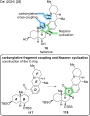
Scheme 34: Key steps of the synthesis of heilonine (16) by Dai and co-workers (2024) [28].

Scheme 35: Overview of the total synthesis of heilonine (16) by Dai and co-workers (2024) [28].
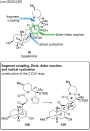
Scheme 36: Key steps of the total synthesis of zygadenine (18) reported by Luo and co-workers [29].
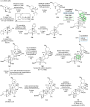
Scheme 37: Overview of the total synthesis of zygadenine (18) by Luo and co-workers (2023) [29].
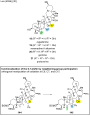
Scheme 38: Key step of the divergent total syntheses of highly oxidized cevanine-type alkaloids by Luo and co-...
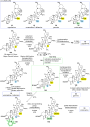
Scheme 39: Divergent syntheses of highly oxidized cevanine-type alkaloids by Luo and co-workers (2024) [30].
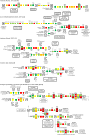
Scheme 40: Color-coded overview of the presented cevanine-type alkaloid syntheses [10,20,22,24,28-30,46]. LLS: longest linear sequen...
Synthesis of HBC fluorophores with an electrophilic handle for covalent attachment to Pepper RNA
- Raphael Bereiter and
- Ronald Micura
Beilstein J. Org. Chem. 2025, 21, 727–735, doi:10.3762/bjoc.21.56
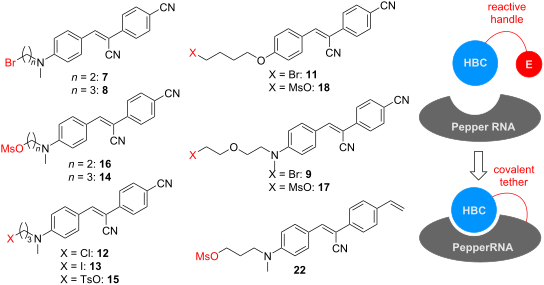
- to avoid precipitation of the compounds 7, 8, 9, and 11 during long (>12 h) incubation times). In view of these results, we further focused on HBC derivatives with the high-yielding C3 handle and sought a variation of the electrophile. Thus, adapted Appel reaction conditions using N-chlorosuccinimide

Graphical Abstract
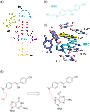
Figure 1: Structure-guided approach for engineering the (non-covalent) fluorescent light-up aptamer Pepper in...

Scheme 1: Chemical structures of the HBC dye family [7]. Variations to HBC530 highlighted in red color. All dyes...

Scheme 2: Synthesis of bromoalkyl HBC derivatives 7, 8, and 9.

Scheme 3: Synthesis of the HBC ether derivative 11.

Figure 2: Pepper aptamer reacts with different HBC derivatives. Chemical structures of the HBC derivatives us...

Scheme 4: Derivatization of the HBC fluorophore 5 to generate handles with distinct electrophilic groups.

Scheme 5: Synthesis of mesylated HBC fluorophores 16, 17, and 18.

Scheme 6: Synthesis of the bifunctional HBC fluorophore 22. For an application of 22 (pulldown of circular Pe...
A review of recent advances in electrochemical and photoelectrochemical late-stage functionalization classified by anodic oxidation, cathodic reduction, and paired electrolysis
- Nian Li,
- Ruzal Sitdikov,
- Ajit Prabhakar Kale,
- Joost Steverlynck,
- Bo Li and
- Magnus Rueping
Beilstein J. Org. Chem. 2024, 20, 2500–2566, doi:10.3762/bjoc.20.214

Graphical Abstract

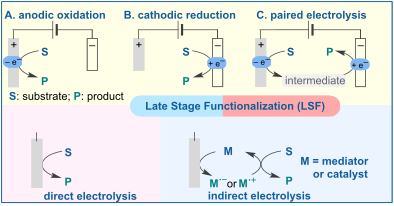
Figure 1: Classification of LSF reactions in this review.

Scheme 1: C(sp2)–H trifluoromethylation of heteroarenes.
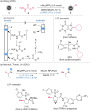
Scheme 2: C(sp2)–H and C(sp3)–H alkylation of complex molecules.

Scheme 3: Electrochemical oxidation-induced intermolecular aromatic C–H sulfonamidation.

Scheme 4: Bioconjugation of tyrosine with (a) phenothiazine and (b) urazole derivatives.

Scheme 5: Electrochemical iodoamination of indoles using unactivated amines.

Scheme 6: Allylic C(sp3)–H aminations with sulfonamides.

Scheme 7: Electrochemical benzylic oxidation of C–H bonds.
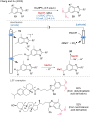
Scheme 8: Site-selective electrooxidation of methylarenes to aromatic acetals.

Scheme 9: Electrochemical activation of C–H by electron-deficient W2C nanocrystals.

Scheme 10: α-Acyloxy sulfide preparation via C–H/OH cross-dehydrogenative coupling.

Scheme 11: Aromatic C–H-bond thiolation.

Scheme 12: C(sp2)–H functionalization for the installation of sulfonamide groups.

Scheme 13: Preparation of (hetero)aryl chlorides and vinyl chloride with 1,2-dichloroethane. aCu(OAc)2 (0.05 e...

Scheme 14: Electrochemical dual-oxidation enables access to α-chlorosulfoxides.

Scheme 15: Regio- and chemoselective formyloxylation–bromination/chlorination/trifluoromethylation of alkenes.

Scheme 16: Aziridine formation by coupling amines and alkenes.

Scheme 17: Formation of iminosulfide ethers via difunctionalization of an isocyanide.

Scheme 18: Synthesis of 1,3-difunctionalized molecules via C–C-bond cleavage of arylcyclopropane.

Scheme 19: Electrooxidative amino- and oxyselenation of alkenes. VBImBr = 1-butyl-3-vinylimidazolium bromide.

Scheme 20: Electrooxidative dehydrogenative [4 + 2] annulation of indole derivatives.

Scheme 21: Electrochemical cyclization combined with alkoxylation of triticonazole.

Scheme 22: Electrochemically tuned oxidative [4 + 2] annulation of olefins with hydroxamic acids.

Scheme 23: Electrosynthesis of indole derivatives via cyclization of 2-ethynylanilines.

Scheme 24: Allylic C–H oxidation of mono-, di-, and sesquiterpenes.

Scheme 25: Oxidation of unactivated C–H bonds.

Scheme 26: Fluorination of C(sp3)–H bonds. rAP = rapid alternating polarity.

Scheme 27: C(sp3)–H α-cyanation of secondary piperidines.
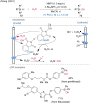
Scheme 28: Selective electrochemical hydrolysis of hydrosilanes to silanols.

Scheme 29: Organocatalytic electrochemical amination of benzylic C–H bonds.

Scheme 30: Iodide ion-initiated anodic oxidation reactions.

Scheme 31: Mn(III/IV) electro-catalyzed C(sp3)–H azidation.
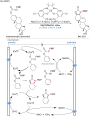
Scheme 32: Tailored cobalt–salen complexes enable electrocatalytic intramolecular allylic C–H functionalizatio...

Scheme 33: Cobalt–salen complexes-induced electrochemical (cyclo)additions.

Scheme 34: Electrochemical 1,2-diarylation of alkenes enabled by direct dual C–H functionalization of electron...

Scheme 35: Cobalt-electrocatalyzed atroposelective C–H annulation.

Scheme 36: Nickel-electrocatalyzed C(sp2)–H alkoxylation with secondary alcohols.

Scheme 37: Nickel-catalyzed electrochemical enantioselective amination.
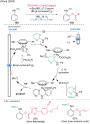
Scheme 38: Ruthenium-electrocatalyzed C(sp2)–H mono- and diacetoxylation.
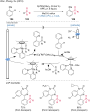
Scheme 39: Rhodium(III)-catalyzed aryl-C–H phosphorylation enabled by anodic oxidation-induced reductive elimi...

Scheme 40: Asymmetric Lewis-acid catalysis for the synthesis of non-racemic 1,4-dicarbonyl compounds.

Scheme 41: Electrochemical enantioselective C(sp3)–H alkenylation.

Scheme 42: Palladium-catalyzed electrochemical dehydrogenative cross-coupling.
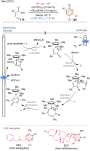
Scheme 43: Ir-electrocatalyzed vinylic C(sp2)–H activation for the annulation between acrylic acids and alkyne...

Scheme 44: Electrochemical gold-catalyzed C(sp3)–C(sp) coupling of alkynes and arylhydrazines.

Scheme 45: Photoelectrochemical alkylation of C–H heteroarenes using organotrifluoroborates.

Scheme 46: Mn-catalyzed photoelectro C(sp3)–H azidation.

Scheme 47: Photoelectrochemical undirected C–H trifluoromethylations of (Het)arenes.

Scheme 48: Photoelectrochemical dehydrogenative cross-coupling of heteroarenes with aliphatic C–H bonds.
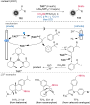
Scheme 49: C–H amination via photoelectrochemical Ritter-type reaction.

Scheme 50: Photoelectrochemical multiple oxygenation of C–H bonds.

Scheme 51: Accelerated C(sp3)–H heteroarylations by the f-EPC system.

Scheme 52: Photoelectrochemical cross-coupling of amines.

Scheme 53: Birch electroreduction of arenes. GSW = galvanized steel wire.

Scheme 54: Electroreductive deuterations.

Scheme 55: Chemoselective electrosynthesis using rapid alternating polarity.

Scheme 56: Electroreductive olefin–ketone coupling.

Scheme 57: Electroreductive approach to radical silylation.

Scheme 58: Electrochemical borylation of alkyl halides. CC = carbon close.

Scheme 59: Radical fluoroalkylation of alkenes.
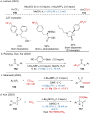
Scheme 60: Electrochemical defluorinative hydrogenation/carboxylation.

Scheme 61: Electrochemical decarboxylative olefination.

Scheme 62: Electrochemical decarboxylative Nozaki–Hiyama–Kishi coupling.
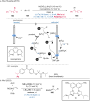
Scheme 63: Nickel-catalyzed electrochemical reductive relay cross-coupling.

Scheme 64: Electrochemical chemo- and regioselective difunctionalization of 1,3-enynes.

Scheme 65: Electrocatalytic doubly decarboxylative crosscoupling.

Scheme 66: Electrocatalytic decarboxylative crosscoupling with aryl halides.

Scheme 67: Nickel-catalyzed electrochemical reductive coupling of halides.

Scheme 68: Nickel-electrocatalyzed enantioselective carboxylation with CO2.

Scheme 69: Reductive electrophotocatalysis for borylation.
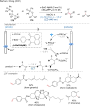
Scheme 70: Electromediated photoredox catalysis for selective C(sp3)–O cleavages of phosphinated alcohols to c...

Scheme 71: Stereoselective electro-2-deoxyglycosylation from glycals. MFE = methyl nonafluorobutyl ether.

Scheme 72: Electrochemical peptide modifications.

Scheme 73: Electrochemical α-deuteration of amides.

Scheme 74: Electrochemical synthesis of gem-diselenides.

Scheme 75: Site-selective electrochemical aromatic C–H amination.

Scheme 76: Electrochemical coupling of heteroarenes with heteroaryl phosphonium salts.
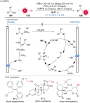
Scheme 77: Redox-neutral strategy for the dehydroxyarylation reaction.
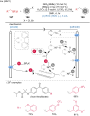
Scheme 78: Nickel-catalyzed electrochemical C(sp3)–C(sp2) cross-coupling of benzyl trifluoroborate and halides....
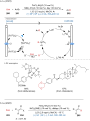
Scheme 79: Paired electrocatalysis for C(sp3)–C(sp2) coupling.

Scheme 80: Redox-neutral strategy for amination of aryl bromides.

Scheme 81: Redox-neutral cross-coupling of aryl halides with weak N-nucleophiles. aProtocol with (+) RVC | RVC...

Scheme 82: Nickel-catalyzed N-arylation of NH-sulfoximines with aryl halides.

Scheme 83: Esterification of carboxylic acids with aryl halides.

Scheme 84: Electrochemically promoted nickel-catalyzed carbon–sulfur-bond formation. GFE = graphite felt elect...

Scheme 85: Electrochemical deoxygenative thiolation by Ni-catalysis. GFE = graphite felt electrode; NFE = nick...
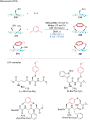
Scheme 86: Electrochemical coupling of peptides with aryl halides.

Scheme 87: Paired electrolysis for the phosphorylation of aryl halides. GFE = graphite felt electrode, FNE = f...

Scheme 88: Redox-neutral alkoxyhalogenation of alkenes.
Synthesis of ether lipids: natural compounds and analogues
- Marco Antônio G. B. Gomes,
- Alicia Bauduin,
- Chloé Le Roux,
- Romain Fouinneteau,
- Wilfried Berthe,
- Mathieu Berchel,
- Hélène Couthon and
- Paul-Alain Jaffrès
Beilstein J. Org. Chem. 2023, 19, 1299–1369, doi:10.3762/bjoc.19.96
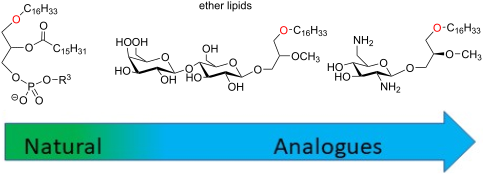

Graphical Abstract

Figure 1: Chemical structure of some natural ether lipids (ELs).

Figure 2: Synthesis of lyso-PAF and PAF from 1-O-alkylglycerol [64].

Figure 3: Synthesis of lyso-PAF from 1,3-benzylideneglycerol 3.1 [69].
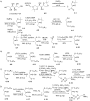
Figure 4: A) Synthesis of the two enantiomers of octadecylglycerol (4.6 and 4.10) from ᴅ-mannitol (4.1); B) s...

Figure 5: Four-step synthesis of PAF 5.6 from (S)-glycidol [73].

Figure 6: Synthesis of 1-O-alkylglycerol A) from solketal, B) from ᴅ- or ʟ-tartaric acid and the intermediate ...

Figure 7: Synthesis of EL building blocks starting from substituted glycidol 7.1a–c [82].

Figure 8: Synthesis of PAF 8.5 by using phosphoramidite 8.2 [86].

Figure 9: Synthesis of oleyl-PAF 9.7 from ʟ-serine [88].

Figure 10: Synthesis of racemic analogues of lyso-PAF 10.8 and PAF 10.9 featuring a phenyl group between the g...

Figure 11: Synthesis of racemic deoxy-lyso-PAF 11.7 and deoxy-PAF 11.8 [91].

Figure 12: Synthesis of racemic thio-PAF 12.8 [93].

Figure 13: Racemic synthesis of 13.6 to illustrate the modification of the glycerol backbone by adding a methy...

Figure 14: Racemic synthesis of 14.5 as an illustration of the introduction of methyl substituents on the glyc...

Figure 15: Synthesis of functionalized sn-2-acyl chains of PC-EL; A) Steglich esterification or acylation reac...

Figure 16: Synthesis of racemic mc-PAF (16.3), a carbamate analogue of PAF [102].

Figure 17: A) Synthesis of (R)-17.2 and (S)-17.6 starting from (S)-solketal (17.1); B) synthesis of N3-PAF (17...

Figure 18: Modification of the phosphocholine polar head to produce PAF analogues [81].

Figure 19: Racemic PAF analogues 19.3 and 19.5 characterized by the absence of the phosphate group [107].

Figure 20: Synthesis of PIP3-PAF (20.7) [108].

Figure 21: Large-scale synthesis of C18-edelfosine (21.8) [116].

Figure 22: Synthesis of C16-edelfosine (22.10) starting from isopropylidene-ʟ-glyceric acid methyl ester (22.1...

Figure 23: Phosphocholine moiety installation by the use of chlorophosphite 23.2 as key reagent [119].

Figure 24: Synthesis of rac-1-alkyl-2-O-methylglycerol (AMG) [120].

Figure 25: Synthesis of stereocontrolled 1-alkyl-2-O-methyl glycerol 25.9 (AMG) from dimethyl ᴅ-tartrate [81].

Figure 26: A) Racemic synthesis of thioether 26.4 [129,130], B) structure of sulfone analogue 26.5 [129].

Figure 27: Stereocontrolled synthesis of C18-edelfosine thioether analogue 27.8 [118].

Figure 28: Synthesis of thioether 28.4 that include a thiophosphate function [134].

Figure 29: Synthesis of ammonium thioether 29.4 and 29.6 [135].

Figure 30: Synthesis of the N-methylamino analogue of edelfosine 30.6 (BN52211) [138].

Figure 31: Synthesis of 1-desoxy analogues of edelfosine; A) with a saturated alkyl chain; B) synthesis of the...

Figure 32: Stereocontrolled synthesis of edelfosine analogue (S)-32.8 featuring a C18:1 lipid chain [142].

Figure 33: Synthesis of edelfosine analogues with modulation of the lipid chain; A) illustration with the synt...

Figure 34: Synthesis of phospholipid featuring a carbamate function to link the lipid chain to the glycerol un...

Figure 35: Synthesis of sesquiterpene conjugates of phospho glycero ether lipids [148].

Figure 36: Racemic synthesis of methyl-substituted glycerol analogues 36.7 and 36.10: A) synthesis of diether ...

Figure 37: Racemic synthesis of ilmofosine (37.6) [155,156].

Figure 38: A) Stereoselective synthesis of 38.5 via a stereoselective hydroboration reaction; B) synthesis of ...

Figure 39: Racemic synthesis of SRI62-834 (39.6) featuring a spiro-tetrahydrofurane heterocycle in position 2 ...

Figure 40: Racemic synthesis of edelfosine analogue 40.5 featuring an imidazole moiety in sn-2 position [160].

Figure 41: Racemic synthesis of fluorine-functionalized EL: A) Synthesis of 41.6 and B) synthesis of 41.8 [161-163].

Figure 42: A) Synthesis of the β-keto-ester 42.6 that also features a decyl linker between the phosphate and t...

Figure 43: Synthesis of phosphonate-based ether lipids; A) edelfosine phosphonate analogue 43.7 and B) thioeth...

Figure 44: Enantioselective synthesis of phosphonates 44.3 and 44.4 [171].

Figure 45: Racemic synthesis of phosphinate-based ether lipid 45.10 [172].

Figure 46: Racemic synthesis of edelfosine arsonium analogue 46.5 [173].

Figure 47: Synthesis of edelfosine dimethylammonium analogue 47.2 [118].

Figure 48: Synthesis of rac-C18-edelfosine methylammonium analogue 48.4 [176].

Figure 49: A) Synthesis of edelfosine N-methylpyrrolidinium analogue 49.2 or N-methylmorpholinium analogue 49.3...

Figure 50: A) Synthesis of edelfosine’s analogue 50.4 with a PE polar group; B) illustration of a pyridinium d...

Figure 51: A) Synthesis of 51.4 featuring a thiazolium cationic moiety; B) synthesis of thiazolium-based EL 51...

Figure 52: Synthesis of cationic ether lipids 52.3, 52.4 and 52.6 [135,183].

Figure 53: Synthesis of cationic carbamate ether lipid 53.5 [184].

Figure 54: Synthesis of cationic sulfonamide 54.5 [185].

Figure 55: Chemical structure of ONO-6240 (55.1) and SRI-63-119 (55.2).

Figure 56: Synthesis of non-ionic ether lipids 56.2–56.9 [188].

Figure 57: Synthesis of ether lipid conjugated to foscarnet 57.6 [189].

Figure 58: A) Synthesis of ether lipid conjugated to arabinofuranosylcytosine; B) synthesis of AZT conjugated ...

Figure 59: Synthesis of quercetin conjugate to edelfosine [191].

Figure 60: Synthesis of 60.8 (Glc-PAF) [194].

Figure 61: A) Synthesis of amino ether lipid 61.7 functionalized with a rhamnose unit and its amide analogue 6...

Figure 62: A) Synthesis of glucose ether lipid 62.4; B) structure of ether lipid 62.5 possessing a maltose uni...

Figure 63: A) Synthesis of glucuronic methyl ester 63.8; B) structure of cellobiose 63.9 and maltose 63.10 ana...

Figure 64: A) Synthesis of maltosyl glycerolipid 64.7; B) structure of lactose analogue 64.8 prepared followin...

Figure 65: A) Asymmetric synthesis of the aglycone moiety starting from allyl 4-methoxyphenyl ether; B) glycos...

Figure 66: A) Synthesis of ohmline possessing a lactose moiety. B) Structure of other glyco glycero lipids pre...

Figure 67: A) Synthesis of lactose-glycerol ether lipid 67.5; B) analogues possessing a maltose (67.6) or meli...

Figure 68: Synthesis of digalactosyl EL 68.6, A) by using trityl, benzyl and acetyl protecting groups, B) by u...

Figure 69: A) Synthesis of α-ohmline; B) structure of disaccharide ether lipids prepared by using similar meth...

Figure 70: Synthesis of lactose ether lipid 70.3 and its analogue 70.6 featuring a carbamate function as linke...

Figure 71: Synthesis of rhamnopyranoside diether 71.4 [196].

Figure 72: Synthesis of 1-O-hexadecyl-2-O-methyl-3-S-(α-ᴅ-1'-thioglucopyranosyl)-sn-glycerol (72.5) [225].

Figure 73: A) Preparation of lipid intermediate 73.4; B) synthesis of 2-desoxy-C-glycoside 73.10 [226].

Figure 74: Synthesis of galactose-pyridinium salt 74.3 [228].

Figure 75: Synthesis of myo-inositol derivative Ino-C2-PAF (75.10) [230].

Figure 76: A) Synthesis of myo-inositol phosphate building block 76.7; B) synthesis of myo-inositolphosphate d...

Figure 77: A) Synthesis of phosphatidyl-3-desoxy-inositol 77.4; B) synthesis of phosphono-3-desoxyinositol 77.9...

Figure 78: A) Structure of diether phosphatidyl-myo-inositol-3,4-diphosphate 78.1; B) synthesis of phosphatidy...

Figure 79: A) Synthesis of diether-phosphatidyl derivative 79.4 featuring a hydroxymethyl group in place of a ...

Figure 80: Synthesis of Glc-amine-PAF [78].

Figure 81: Synthesis of glucosamine ether lipid 81.4 and its analogues functionalized in position 3 of the ami...

Figure 82: Synthesis of fully deprotected aminoglucoside ether lipid 82.5 [246].

Figure 83: Synthesis of C-aminoglycoside 83.12 using Ramberg–Bäcklund rearrangement as a key step [250].

Figure 84: A) List of the most important glyco lipids and amino glyco lipids included in the study of Arthur a...

Figure 85: Synthesis of mannosamine ether lipid 85.6 [254].
Figure 86: A) Synthesis of glucosamine ether lipids with a non-natural ʟ-glucosamine moiety; B) synthesis of e...

Figure 87: A) Structure of the most efficient anticancer agents 87.1–87.4 featuring a diamino glyco ether lipi...

Figure 88: A) Synthesis of diamino glyco ether lipid 87.4; B) synthesis of bis-glycosylated ether lipid 88.10 [256]....

Figure 89: Synthesis of triamino ether lipid 89.4 [260].

Figure 90: Synthesis of chlorambucil conjugate 90.7 [261].

Figure 91: Three main methods for the preparation of glycerol ether lipid 91.3; A) from solketal and via a tri...

Figure 92: Four different methods for the installation of the phosphocholine polar head group; A) method using...

Figure 93: Illustration of two methods for the installation of saccharides or aminosaccharides; A) O-glycosyla...
Revisiting the bromination of 3β-hydroxycholest-5-ene with CBr4/PPh3 and the subsequent azidolysis of the resulting bromide, disparity in stereochemical behavior
- Christian Schumacher,
- Jas S. Ward,
- Kari Rissanen,
- Carsten Bolm and
- Mohamed Ramadan El Sayed Aly
Beilstein J. Org. Chem. 2023, 19, 91–99, doi:10.3762/bjoc.19.9
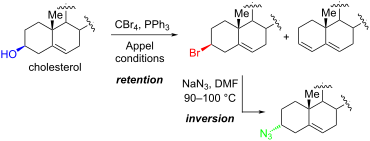
- –517. Keywords: Appel reaction; azidolysis; cholesterol; crystal structure; Walden inversion; Introduction 3β-Hydroxycholest-5-ene (cholesterol) is a structural and physiologic amphipathic steroid in human and animals as well. Cholesterol is an essential component of the plasma membrane, where it
- agreement with those reported by others [20][21][22]. This compound was erroneously assigned as 3α-bromocholest-5-ene [10]. The major, slightly more polar product of the Appel reaction was 3β-bromocholest-5-ene (4, Figure 4). It crystallized as colorless plates, and the structural and stereochemical
- ][10]. The current results correct the structure of cholesterols II and III to be in the α- and not, as reported before and shown in this Figure, in the β-configuration. Top: cholesterol (1) and the less polar product from the Appel reaction, cholesta-3,5-diene (9); bottom: X-ray structure of 9 with

Graphical Abstract

Figure 1: Chemical structure of three isomeric cholesterols.
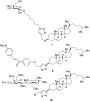
Figure 2: Selected previously described cholesterol derivatives with interesting antibacterial and cytotoxic ...

Scheme 1: Stereochemical outcome of OH/N3 transformations under different conditions.

Figure 3: Top: cholesterol (1) and the less polar product from the Appel reaction, cholesta-3,5-diene (9); bo...

Figure 4: Top: the more polar product from the Appel reaction 3β-bromocholest-5-ene (4); bottom: X-ray struct...

Figure 5: Top: 3α-azidocholest-5-ene (5) obtained by treatment of 4 with NaN3 in DMF; bottom: X-ray crystal s...

Scheme 2: Mechanistic interpretation of the conversion of cholesterol 1 into diene 9, bromide 4, and azides 5...
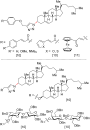
Figure 6: Compounds (next to 4, 5 and 9) to be corrected in refs. [10] and [11]. The respective bonds are highlighted...
Total synthesis of grayanane natural products
- Nicolas Fay,
- Rémi Blieck,
- Cyrille Kouklovsky and
- Aurélien de la Torre
Beilstein J. Org. Chem. 2022, 18, 1707–1719, doi:10.3762/bjoc.18.181
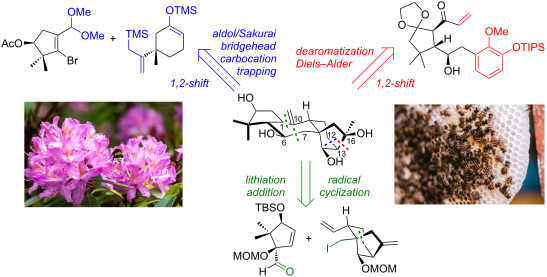
- TBS deprotection giving the bicyclo[3.2.1]octane subunit with a good yield of 74%. A sequence involving diastereoselective reduction of ketone 24 with SmI2, Appel reaction to convert the primary alcohol to the corresponding primary alkyl iodide followed by a MOM protection of the secondary alcohol

Graphical Abstract

Figure 1: General structure of grayanane natural products.

Scheme 1: Grayanane biosynthesis.
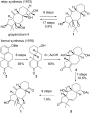
Scheme 2: Matsumoto’s relay approach.

Scheme 3: Shirahama’s total synthesis of (–)-grayanotoxin III.

Scheme 4: Newhouse’s syntheses of fragments 25 and 29.

Scheme 5: Newhouse’s total synthesis of principinol D.

Scheme 6: Ding’s total synthesis of rhodomolleins XX and XXII.

Scheme 7: First key step of Luo’s strategy.

Scheme 8: Luo’s total synthesis of grayanotoxin III.

Scheme 9: Synthesis of principinol E and rhodomollein XX.

Scheme 10: William’s synthetic effort towards pierisformaside C.

Scheme 11: Hong’s synthetic effort towards rhodojaponin III.

Scheme 12: Recent strategies for grayanane synthesis.
Chemical tuning of photoswitchable azobenzenes: a photopharmacological case study using nicotinic transmission
- Lorenzo Sansalone,
- Jun Zhao,
- Matthew T. Richers and
- Graham C. R. Ellis-Davies
Beilstein J. Org. Chem. 2019, 15, 2812–2821, doi:10.3762/bjoc.15.274
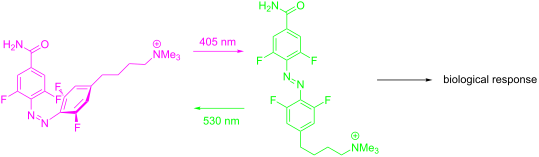
- % overall yield. Installation of the cationic head was performed in two steps: first bromination of 11 via Appel reaction, followed by treatment with trimethylamine to give 2 in 35% overall yield. Photoswitch 2 is the first example of a bifunctional, asymmetrically substituted 4FAB chromophore that actually

Graphical Abstract

Figure 1: Fluoro-AB derivatives and spectra. Structures of 4FAB-diamides [13] cis and trans configurations, and t...

Scheme 1: Synthesis of 4FABTA. a) Reagents and conditions: (a) 3-Butynol, PdCl2(PPh3)2, CuI, THF, rt, 93%; (b...
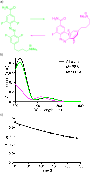
Figure 2: Photochemistry of 4FABTA (2), and thermodynamic stability in physiological buffer. a) Trans–cis pho...

Figure 3: Reaction of t-4FABTA (1) with thiols, and thermal stability of initial conjugate. a) Chemical react...

Figure 4: Testing photo-antagonism of 1 with genetically tagged nicotinic acetylcholine receptors. Currents f...

Figure 5: Photopharmacology with 4FABTA (2). Currents from neurons in the medial habenula in acutely isolated...
N-(1-Phenylethyl)aziridine-2-carboxylate esters in the synthesis of biologically relevant compounds
- Iwona E. Głowacka,
- Aleksandra Trocha,
- Andrzej E. Wróblewski and
- Dorota G. Piotrowska
Beilstein J. Org. Chem. 2019, 15, 1722–1757, doi:10.3762/bjoc.15.168


Graphical Abstract

Figure 1: Examples of three-carbon chirons.

Figure 2: Structures of derivatives of N-(1-phenylethyl)aziridine-2-carboxylic acid 5–8.

Figure 3: Synthetic equivalency of aziridine aldehydes 6.

Scheme 1: Synthesis of N-(1-phenylethyl)aziridine-2-carboxylates 5. Reagents and conditions: a) TEA, toluene,...

Scheme 2: Absolute configuration at C2 in (2S,1'S)-5a. Reagents and conditions: a) 20% HClO4, 80 °C, 30 h the...

Scheme 3: Major synthetic strategies for a 2-ketoaziridine scaffold [R* = (R)- or (S)-1-phenylethyl; R′ = Alk...

Scheme 4: Synthesis of cyanide (2S,1'S)-13. Reagents and conditions: a) NH3, EtOH/H2O, rt, 72 h; b) Ph3P, CCl4...

Scheme 5: Synthesis of key intermediates (R)-16 and (R)-17 for (R,R)-formoterol (14) and (R)-tamsulosin (15)....

Scheme 6: Synthesis of mitotic kinesin inhibitors (2R/S,1'R)-23. Reagents and conditions: a) H2, Pd(OH)2, EtO...

Scheme 7: Synthesis of (R)-mexiletine ((R)-24). Reagents and conditions: a) TsCl, TEA, DMAP, CH2Cl2, rt, 1 h;...

Scheme 8: Synthesis of (−)-cathinone ((S)-27). Reagents and conditions: a) PhMgBr, ether, 0 °C; b) H2, 10% Pd...

Scheme 9: Synthesis of N-Boc-norpseudoephedrine ((1S,2S)-(+)-29) and N-Boc-norephedrine ((1R,2S)-29). Reagent...

Scheme 10: Synthesis of (−)-ephedrine ((1R,2S)-31). Reagents and conditions: a) TfOMe, MeCN then NaBH3CN, rt; ...

Scheme 11: Synthesis of xestoaminol C ((2S,3R)-35), 3-epi-xestoaminol C ((2S,3S)-35) and N-Boc-spisulosine ((2S...

Scheme 12: Synthesis of ʟ-tryptophanol ((S)-41). Reagents and conditions: a) CDI, MeCN, rt, 1 h then TMSI, MeC...

Scheme 13: Synthesis of ʟ-homophenylalaninol ((S)-42). Reagents and conditions: a) NaH, THF, 0 °C to −78 °C, 1...

Scheme 14: Synthesis of ᴅ-homo(4-octylphenyl)alaninol ((R)-47) and a sphingolipid analogue (R)-48. Reagents an...

Scheme 15: Synthesis of florfenicol ((1R,2S)-49). Reagents and conditions: a) (S)-1-phenylethylamine, TEA, MeO...

Scheme 16: Synthesis of natural tyroscherin ((2S,3R,6E,8R,10R)-55). Reagents and conditions: a) I(CH2)3OTIPS, t...

Scheme 17: Syntheses of (−)-hygrine (S)-61, (−)-hygroline (2S,2'S)-62 and (−)-pseudohygroline (2S,2'R)-62. Rea...

Scheme 18: Synthesis of pyrrolidine (3S,3'R)-68, a fragment of the fluoroquinolone antibiotic PF-00951966. Rea...

Scheme 19: Synthesis of sphingolipid analogues (R)-76. Reagents and conditions: a) BnBr, Mg, THF, reflux, 6 h;...

Scheme 20: Synthesis of ᴅ-threo-PDMP (1R,2R)-81. Reagents and conditions: a) TMSCl, NaI, MeCN, rt, 1 h 50 min,...

Scheme 21: Synthesis of the sphingolipid analogue SG-14 (2S,3S)-84. Reagents and conditions: a) LiAlH4, THF, 0...

Scheme 22: Synthesis of the sphingolipid analogue SG-12 (2S,3R)-88. Reagents and conditions: a) 1-(bromomethyl...

Scheme 23: Synthesis of sphingosine-1-phosphate analogues DS-SG-44 and DS-SG-45 (2S,3R)-89a and (2S,3R)-89a. R...

Scheme 24: Synthesis of N-Boc-safingol ((2S,3S)-95) and N-Boc-ᴅ-erythro-sphinganine ((2S,3R)-95). Reagents and...

Scheme 25: Synthesis of ceramide analogues (2S,3R)-96. Reagents and conditions: a) NaBH4, ZnCl2, MeOH, −78 °C,...

Scheme 26: Synthesis of orthogonally protected serinols, (S)-101 and (R)-102. Reagents and conditions: a) BnBr...

Scheme 27: Synthesis of N-acetyl-3-phenylserinol ((1R,2R)-105). Reagents and conditions: a) AcOH, CH2Cl2, refl...

Scheme 28: Synthesis of (S)-linezolid (S)-107. Reagents and conditions: a) LiAlH4, THF, 0 °C to reflux; b) Boc2...

Scheme 29: Synthesis of (2S,3S,4R)-2-aminooctadecane-1,3,4-triol (ᴅ-ribo-phytosphingosine) (2S,3S,4R)-110. Rea...

Scheme 30: Syntheses of ᴅ-phenylalanine (R)-116. Reagents and conditions: a) AcOH, CH2Cl2, reflux, 4 h; b) MsC...

Scheme 31: Synthesis of N-Boc-ᴅ-3,3-diphenylalanine ((R)-122). Reagents and conditions: a) PhMgBr, THF, −78 °C...

Scheme 32: Synthesis of ethyl N,N’-di-Boc-ʟ-2,3-diaminopropanoate ((S)-125). Reagents and conditions: a) NaN3,...

Scheme 33: Synthesis of the bicyclic amino acid (S)-(+)-127. Reagents and conditions: a) BF3·OEt2, THF, 60 °C,...

Scheme 34: Synthesis of lacosamide, (R)-2-acetamido-N-benzyl-3-methoxypropanamide (R)-130. Reagents and condit...

Scheme 35: Synthesis of N-Boc-norfuranomycin ((2S,2'R)-133). Reagents and conditions: a) H2C=CHCH2I, NaH, THF,...

Scheme 36: Synthesis of MeBmt (2S,3R,4R,6E)-139. Reagents and conditions: a) diisopropyl (S,S)-tartrate (E)-cr...

Scheme 37: Synthesis of (+)-polyoxamic acid (2S,3S,4S)-144. Reagents and conditions: a) AD-mix-α, MeSO2NH2, t-...

Scheme 38: Synthesis of the protected 3-hydroxy-ʟ-glutamic acid (2S,3R)-148. Reagents and conditions: a) LiHMD...

Scheme 39: Synthesis of (+)-isoserine (R)-152. Reagents and conditions: a) AcCl, MeCN, rt, 0.5 h then Na2CO3, ...

Scheme 40: Synthesis of (3R,4S)-N3-Boc-3,4-diaminopentanoic acid (3R,4S)-155. Reagents and conditions: a) Ph3P...

Scheme 41: Synthesis of methyl (2S,3S,4S)-4-(dimethylamino)-2,3-dihydroxy-5-methoxypentanoate (2S,3S,4S)-159. ...

Scheme 42: Syntheses of methyl (3S,4S) 4,5-di-N-Boc-amino-3-hydroxypentanoate ((3S,4S)-164), methyl (3S,4S)-4-N...

Scheme 43: Syntheses of (3R,5S)-5-(aminomethyl)-3-(4-methoxyphenyl)dihydrofuran-2(3H)-one ((3R,5S)-168). Reage...

Scheme 44: Syntheses of a series of imidazolin-2-one dipeptides 175–177 (for R' and R'' see text). Reagents an...

Scheme 45: Syntheses of (2S,3S)-N-Boc-3-hydroxy-2-hydroxymethylpyrrolidine ((2S,3S)-179). Reagents and conditi...

Scheme 46: Syntheses of enantiomers of 1,4-dideoxy-1,4-imino-ʟ- and -ᴅ-lyxitols (2S,3R,4S)-182 and (2R,3S,4R)-...

Scheme 47: Synthesis of 1,4-dideoxy-1,4-imino-ʟ-ribitol (2S,3S,4R)-182. Reagents and conditions: a) AcOH, CH2Cl...

Scheme 48: Syntheses of 1,4-dideoxy-1,4-imino-ᴅ-arabinitol (2R,3R,4R)-182 and 1,4-dideoxy-1,4-imino-ᴅ-xylitol ...

Scheme 49: Syntheses of natural 2,5-imino-2,5,6-trideoxy-ʟ-gulo-heptitol ((2S,3R,4R,5R)-184) and its C4 epimer...

Scheme 50: Syntheses of (−)-dihydropinidine ((2S,6R)-187a) (R = C3H7) and (2S,6R)-isosolenopsins (2S,6R)-187b ...

Scheme 51: Syntheses of (+)-deoxocassine ((2S,3S,6R)-190a, R = C12H25) and (+)-spectaline ((2S,3S,6R)-190b, R ...

Scheme 52: Synthesis of (−)-microgrewiapine A ((2S,3R,6S)-194a) and (+)-microcosamine A ((2S,3R,6S)-194b). Rea...

Scheme 53: Syntheses of ʟ-1-deoxynojirimycin ((2S,3S,4S,5R)-200), ʟ-1-deoxymannojirimycin ((2S,3S,4S,5S)-200) ...

Scheme 54: Syntheses of 1-deoxy-ᴅ-galacto-homonojirimycin (2R,3S,4R,5S)-211. Reagents and conditions: a) MeONH...

Scheme 55: Syntheses of 7a-epi-hyacinthacine A1 (1S,2R,3R,7aS)-220. Reagents and conditions: a) TfOTBDMS, 2,6-...

Scheme 56: Syntheses of 8-deoxyhyacinthacine A1 ((1S,2R,3R,7aR)-221). Reagents and conditions: a) H2, Pd/C, PT...

Scheme 57: Syntheses of (+)-lentiginosine ((1S,2S,8aS)-227). Reagents and conditions: a) (EtO)2P(O)CH2COOEt, L...

Scheme 58: Syntheses of 8-epi-swainsonine (1S,2R,8S,8aR)-231. Reagents and conditions: a) Ph3P=CHCOOMe, MeOH, ...

Scheme 59: Synthesis of a protected vinylpiperidine (2S,3R)-237, a key intermediate in the synthesis of (−)-sw...

Scheme 60: Synthesis of a modified carbapenem 245. Reagents and conditions: a) AcOEt, LiHMDS, THF, −78 °C, 1.5...
Photocatalyic Appel reaction enabled by copper-based complexes in continuous flow
- Clémentine Minozzi,
- Jean-Christophe Grenier-Petel,
- Shawn Parisien-Collette and
- Shawn K. Collins
Beilstein J. Org. Chem. 2018, 14, 2730–2736, doi:10.3762/bjoc.14.251
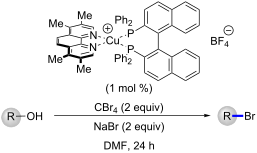
- reactivity manifolds, there exists the potential to discover new methods to construct important molecular fragments, as well as revamp traditional chemical transformations. One such process is the Appel reaction [5], which employs PPh3 and an electrophilic halogen source to promote the formation of an
- organic halide from the corresponding alcohol (Figure 1) [6][7]. The Appel reaction is representative of a host of transformations that require stoichiometric reagents to effect a functional group change of an alcohol. In 2011, Stephenson and co-workers reported that photocatalysis could be used to

Graphical Abstract
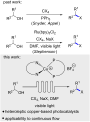
Figure 1: Alcohol→bromide functional group transformations.

Figure 2: Ligands used in the library generation of heteroleptic copper(I)-based complexes for photocatalysis....
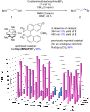
Figure 3: Evaluation of the library of copper-based complexes in photocatalytic alcohol→bromide conversion. R...

Figure 4: Experimental set-up for the photocatalytic conversion of alcohols to bromides. PFA tubing is wrappe...

Scheme 1: Copper-based photocatalysis for photocatalytic synthesis of an anhydride.
Non-metal-templated approaches to bis(borane) derivatives of macrocyclic dibridgehead diphosphines via alkene metathesis
- Tobias Fiedler,
- Michał Barbasiewicz,
- Michael Stollenz and
- John A. Gladysz
Beilstein J. Org. Chem. 2018, 14, 2354–2365, doi:10.3762/bjoc.14.211
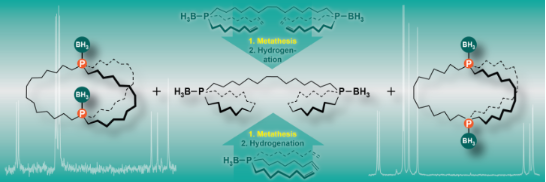
- the two phosphorus atoms was pre-formed. Thus, we set out to prepare a tetraalkenyl metathesis precursor as shown in Scheme 3. The first step, a previously reported reduction of commercial 1,14-tetradecanedioic acid to 1,14-tetradecanediol (7) [37], was followed by an Appel reaction to give 1,14

Graphical Abstract

Scheme 1: Syntheses of gyroscope like platinum and rhodium complexes and dibridgehead diphosphines derived th...
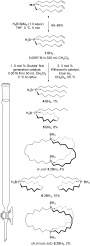
Scheme 2: Synthesis and alkene metathesis of the monophosphorus precursor 1·BH3.

Figure 1: The 13C{1H} NMR spectra (CDCl3, 100 MHz) of in,out-2·2BH3, (in,in/out,out)-2·2BH3, 6·2BH3, and the ...
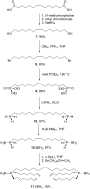
Scheme 3: Synthesis of the diphosphorus precursor 11·2BH3.
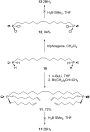
Scheme 4: Truncated approaches to the diphosphorus precursor 11·2BH3 from 10.
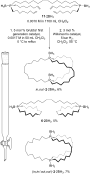
Scheme 5: Alkene metathesis of the diphosphorus precursor 11·2BH3.

Scheme 6: Schematic comparison of the key alkene metathesis steps in Scheme 2 and Scheme 5.

Scheme 7: Steps that set the in,in/out,out vs in,out stereochemistry of 2·2BH3 in Scheme 2 and Scheme 5.

Scheme 8: Another non-metal-templated approach to dibridgehead diphosphorus compounds.

Scheme 9: Previously synthesized dibridgehead diphosphine diboranes.

Scheme 10: Alkene metathesis of the tetraalkenyldiphosphine diborane 19·2BH3.
The chemistry and biology of mycolactones
- Matthias Gehringer and
- Karl-Heinz Altmann
Beilstein J. Org. Chem. 2017, 13, 1596–1660, doi:10.3762/bjoc.13.159
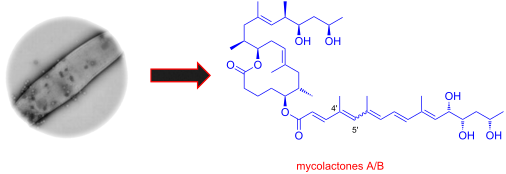

Graphical Abstract

Figure 1: Initial proposal for the core macrolactone structure (left) and the established complete structure ...
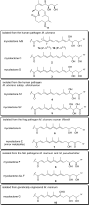
Figure 2: Mycolactone congeners and their origins.

Figure 3: Misassigned mycolactone E structure according to Small et al. [50] (11) and the correct structure (6) f...

Figure 4: Schematic illustration of Kishi’s improved mycolactone TLC detection method exploiting derivatizati...

Figure 5: Fluorescent probes derived from natural mycolactone A/B (1a,b) or its synthetic 8-desmethyl analogs...

Figure 6: Tool compounds used by Pluschke and co-workers for elucidating the molecular targets of mycolactone...

Figure 7: Synthetic strategies towards the extended mycolactone core. A) General strategies. B) Kishi’s appro...

Scheme 1: Kishi’s 1st generation approach towards the extended core structure of mycolactones. Reagents and c...

Scheme 2: Kishi’s 2nd generation approach towards the extended core structure of mycolactones. Reagents and c...

Scheme 3: Kishi’s 3rd generation approach towards the extended core structure of mycolactones. Reagents and c...

Scheme 4: Negishi’s synthesis of the extended core structure of mycolactones. Reagents and conditions: a) (i) ...

Scheme 5: Burkart’s (incomplete) 1st generation approach towards the extended core structure of mycolactones....
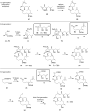
Scheme 6: Burkart’s (incomplete) 1st, 2nd and 3rd generation approach towards the extended mycolactone core s...

Scheme 7: Altmann’s synthesis of alkyl iodide 91. Reagents and conditions: a) (i) PMB-trichloroacetimidate, T...

Scheme 8: Final steps of Altmann’s synthesis of the extended core structure of mycolactones. Reagents and con...

Scheme 9: Basic principles of the Aggarwal lithiation–borylation homologation process [185,186].

Scheme 10: Aggarwal’s synthesis of the C1–C11 fragment of the mycolactone core. Reagents and conditions: a) Cl...

Scheme 11: Aggarwal’s synthesis of the linear C1–C20 fragment of the mycolactone core. Reagents and conditions...

Figure 8: Synthetic strategies towards the mycolactone A/B lower side chain.

Scheme 12: Gurjar and Cherian’s synthesis of the C1’–C8’ fragment of the mycolactone A/B pentaenoate side chai...

Scheme 13: Gurjar and Cherian’s synthesis of the benzyl-protected mycolactone A/B pentaenoate side chain. Reag...

Scheme 14: Kishi’s synthesis of model compounds for elucidating the stereochemistry of the C7’–C16’ fragment o...

Scheme 15: Kishi’s synthesis of the mycolactone A/B pentaenoate side chain. (a) (i) NaH, (EtO)2P(O)CH2CO2Et, T...

Scheme 16: Feringa and Minnaard's incomplete synthesis of mycolactone A/B pentaenoate side chain. Reagents and...

Scheme 17: Altmann’s approach towards the mycolactone A/B pentaenoate side chain. Reagents and conditions: a) ...

Scheme 18: Negishi’s access to the C1’–C7’ fragment of mycolactone A. Reagents and conditions: a) (i) n-BuLi, ...

Scheme 19: Negishi’s approach to the C1’–C7’ fragment of mycolactone B. Reagents and conditions: a) (i) DIBAL-...

Scheme 20: Negishi’s synthesis of the C8’–C16’ fragment of mycolactone A/B. Reagents and conditions: a) 142, BF...

Scheme 21: Negishi’s assembly of the mycolactone A and B pentaenoate side chains. Reagents and conditions: a) ...

Scheme 22: Blanchard’s approach to the mycolactone A/B pentaenoate side chain. a) (i) Ph3P=C(Me)COOEt, CH2Cl2,...

Scheme 23: Kishi’s approach to the mycolactone C pentaenoate side chain exemplified for the 13’R,15’S-isomer 1...

Scheme 24: Altmann’s (unpublished) synthesis of the mycolactone C pentaenoate side chain. Reagents and conditi...

Scheme 25: Blanchard’s synthesis of the mycolactone C pentaenoate side chain. Reagents and conditions: a) (i) ...

Scheme 26: Kishi’s synthesis of the tetraenoate side chain of mycolactone F exemplified by enantiomer 165. Rea...

Scheme 27: Kishi’s synthesis of the mycolactone E tetraenoate side chain. Reagents and conditions: a) (i) CH2=...

Scheme 28: Wang and Dai’s synthesis of the mycolactone E tetraenoate side chain. Reagents and conditions: a) (...

Scheme 29: Kishi’s synthesis of the dithiane-protected tetraenoate side chain of the minor oxo-metabolite of m...

Scheme 30: Kishi’s synthesis of the mycolactone S1 and S2 pentaenoate side chains. Reagents and conditions: a)...

Scheme 31: Kishi’s 1st generation and Altmann’s total synthesis of mycolactone A/B (1a,b) and Negishi’s select...

Scheme 32: Kishi’s 2nd generation total synthesis of mycolactone A/B (1a,b). Reagents and conditions: a) 2,4,6...

Scheme 33: Blanchard’s synthesis of the 8-desmethylmycolactone core. Reagents and conditions: a) (i) TsCl, TEA...

Scheme 34: Altmann’s (partially unpublished) synthesis of the C20-hydroxylated mycolactone core. Reagents and ...

Scheme 35: Altmann’s and Blanchard’s approaches towards the 11-isopropyl-8-desmethylmycolactone core. Reagents...

Scheme 36: Blanchard’s synthesis of the saturated variant of the C11-isopropyl-8-desmethylmycolactone core. Re...

Scheme 37: Structure elucidation of photo-mycolactones generated from tetraenoate 224.

Scheme 38: Kishi’s synthesis of the linear precursor of the photo-mycolactone B1 lower side chain. Reagents an...

Scheme 39: Kishi’s synthesis of the photo-mycolactone B1 lower side chain. Reagents and conditions: a) LiTMP, ...

Scheme 40: Kishi’s synthesis of a stabilized lower mycolactone side chain. Reagents and conditions: a) (i) TBD...
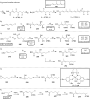
Scheme 41: Blanchard’s variation of the C12’,C13’,C15’ stereocluster. Reagents and conditions: a) (i) DIBAL-H,...

Scheme 42: Blanchard’s synthesis of aromatic mycolactone polyenoate side chain analogs. Reagents and condition...

Scheme 43: Small’s partial synthesis of a BODIPY-labeled mycolactone derivative and Demangel’s partial synthes...

Scheme 44: Blanchard’s synthesis of the BODIPY-labeled 8-desmethylmycolactones. Reagents and conditions: a) (i...
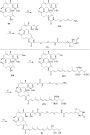
Scheme 45: Altmann’s synthesis of biotinylated mycolactones. Reagents and conditions: a) (i) CDI, THF, rt, 2 d...

Figure 9: Kishi’s elongated n-butyl carbamoyl mycolactone A/B analog.
Total synthesis of leopolic acid A, a natural 2,3-pyrrolidinedione with antimicrobial activity
- Atul A. Dhavan,
- Rahul D. Kaduskar,
- Loana Musso,
- Leonardo Scaglioni,
- Piera Anna Martino and
- Sabrina Dallavalle
Beilstein J. Org. Chem. 2016, 12, 1624–1628, doi:10.3762/bjoc.12.159
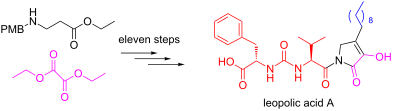
- DIBAL-H gave the corresponding primary alcohol, which was converted into bromide 5 by Appel reaction with PPh3 and CBr4. The phosphonium salt obtained from this bromide was subjected to a Wittig reaction with nonanal, to afford compound 6 [12]. Attempts to remove the PMB protecting group (CAN, DDQ, TFA

Graphical Abstract

Figure 1: Structure of leopolic acid A.

Scheme 1: Synthesis of leopolic acid A. Reagents and conditions: a) p-methoxybenzylamine, EtOH, rt, 12 h, 98%...
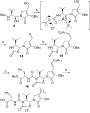
Scheme 2: Synthesis of compound 17. Reagents and conditions: a) Oxalyl chloride, DMSO, CH2Cl2, TEA, −78 °C to...
Discrete multiporphyrin pseudorotaxane assemblies from di- and tetravalent porphyrin building blocks
- Mirko Lohse,
- Larissa K. S. von Krbek,
- Sebastian Radunz,
- Suresh Moorthy,
- Christoph A. Schalley and
- Stefan Hecht
Beilstein J. Org. Chem. 2015, 11, 748–762, doi:10.3762/bjoc.11.85
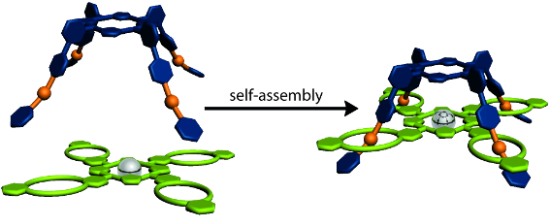
- then converted in dibromide 19 by an Appel reaction. Macrocyclization of 19 with 3,4-dihydroxybenzaldehyde under “pseudo high-dilution” conditions, i.e., slow addition of the two reactants into a solution of Cs2CO3 in DMF at 100 °C provides the corresponding crown ether aldehyde 20. Porphyrin synthesis

Graphical Abstract

Figure 1: Mono-, di-, and tetravalent axles A1, A2 and A4 and mono-, di-, and tetravalent hosts C1, C2 and C4...

Scheme 1: Overview of the synthesis of the guests A2 and A4. a) Pyrrole (4), BF3·Et2O, DDQ, CHCl3, rt; b) Zn(...

Scheme 2: Synthesis of crown ether hosts C4 and C2: a) K2CO3, LiBr, 17, 2-[2-(2-chloroethoxy)ethoxy]ethanol, ...
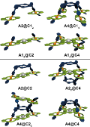
Figure 2: Schematic representation of the host–guests complexes. Top: complexes A2@C12, A4@C14, A12@C2 and A14...

Figure 3: 1H NMR (500 MHz, 298 K, CD2Cl2, 3 mM) of a) C1 (top), A2@C12 (middle) and A2 (bottom); b) C1 (top), ...
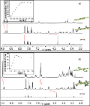
Figure 4: 1H NMR (500 MHz, 298 K, CD2Cl2, 3 mM) of a) C2 (top), A12@C2 (middle) and A1 (bottom) and b) C4 (to...

Figure 5: Normalized UV–vis absorption spectra (CH2Cl2, 3 μM) of A2, A4, C2 and C4 and their complexes formed...

Figure 6: ESI-Q-TOF-MS spectra (CH2Cl2, 0.2 µM; left hand side) and respective experimental and calculated is...

Figure 7: 1H NMR (500 MHz, 298 K, CD2Cl2, 1 mM) of a) C4 (top), A22@C4 (middle) and A2 (bottom); b) C2 (top), ...

Figure 8: 1H NMR (500 MHz, 298 K, CD2Cl2, 1 mM) of a) C4 (top), A4@C4 (middle) and A4 (bottom) and b) C2 (top...

Figure 9: Normalized UV–vis absorption spectra (CH2Cl2, 2 μM) of the guests A2 and A4 (black), the hosts C2 a...

Figure 10: ESI-Q-TOF-MS spectra (CH2Cl2, 0.2 µM; left hand side) and respective experimental and calculated is...
Articulated rods – a novel class of molecular rods based on oligospiroketals (OSK)
- Pablo Wessig,
- Roswitha Merkel and
- Peter Müller
Beilstein J. Org. Chem. 2015, 11, 74–84, doi:10.3762/bjoc.11.11

- modified Appel reaction [17]. The alkynes H can be protected by silylation (J) because only primary alkynes react in the CuAAC (Figure 3). The synthesis commences with 4-hydroxypiperidine (1), which was converted to piperidine-4-one 3 bearing a protected alkyne moiety as well as to piperidin-4-one 5 with a

Graphical Abstract

Figure 1: Typical OSK rod A with solubility enhancing sleeve (D) and building blocks B,C,E.

Figure 2: Fundamental structure of articulated rods (blue = legs, red = joint, green = terminal functionaliti...

Figure 3: Synthetic strategy towards articulated rods.
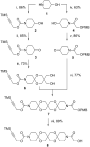
Scheme 1: Synthesis of building block 8 (i: trimethylsilylpropargyl-4-nitrophenylcarbonate. ii: Dess–Martin-p...

Scheme 2: Synthesis of articulated rod 11 (i: CBr4, PPh3, NaN3. ii: K2CO3/MeOH. iii: Cu/C DCM/MeOH 1:1, cat. ...

Scheme 3: Sequential deprotection of 11 and synthesis of triple articulated rod 14 (i: K2CO3/MeOH. ii: CBr4/P...

Scheme 4: Synthesis of articulated rods 23–25 with increased solubility (i: 4-hydroxypiperidine, DCC, HOBt. i...

Scheme 5: Macrocyclization of articulated rod 25.

Scheme 6: Synthesis of building blocks 27–29 (i: 1. pyrene-1-ylacetic acid, DCC/DMAP, 68%; 2. Dess–Martin per...

Scheme 7: Synthesis of articulated rods 32a–c (i: NaH, TMSCl, TMSOTf. ii: Cu/C, Et3N).

Scheme 8: Synthesis of articulated rods 33, 34 and 36.

Scheme 9: Synthesis of articulated rod 39 (i: cinnamoyl chloride, DMAP, pyridine. ii: DMF 120 °C).

Scheme 10: Synthesis of functionalized articulated rod 43 (i: PYBOP, Et3N. ii: KOH, H2O. iii: 32c, quant.).

Scheme 11: Stretched-folded equilibrium of pyrene labelled AR 32a.

Figure 4: Fluorescence spectra of AR 32a in EPA at different temperatures (c = 5·10−6 mol/L).

Figure 5: Monomer–excimer ratio IM/IEX of the fluorescence of 32a depending on solvent viscosity (DCE = 1,2-d...

Figure 6: Monomer–excimer ratio IM/IEX of the fluorescence of 32a depending on the addition of cyclodextrines...

Scheme 12: Formation of pseudorotaxanes from AR 32a and cyclodextrines.

Figure 7: Influence of Triton X-100 on the fluorescence spectra of 32a in aqueous solution. 32a was added fro...

Figure 8: Comparison of photochemical reactivity of 32b, 33a, 39 (left). Irradiation UV spectrum of 32b in AC...
First chemoenzymatic stereodivergent synthesis of both enantiomers of promethazine and ethopropazine
- Paweł Borowiecki,
- Daniel Paprocki and
- Maciej Dranka
Beilstein J. Org. Chem. 2014, 10, 3038–3055, doi:10.3762/bjoc.10.322
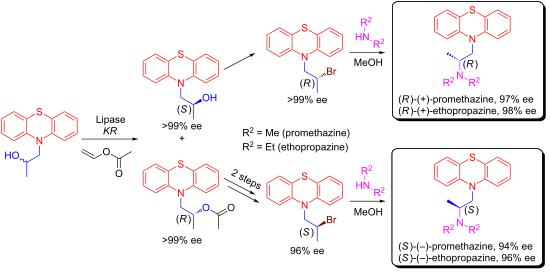
- (96% ee) despite using the same procedure as for the reaction between (S)-(+)-5 and PBr3. In addition, bromination of (S)-(+)-5 under Appel reaction conditions employing tetrabromomethane (CBr4) as a halide ion source used along with triphenylphosphine (Ph3P) was also investigated. Although this

Graphical Abstract

Scheme 1: Chemoenzymatic synthesis of enantioenriched enantiomers of promethazine 9 and ethopropazine 10. Rea...

Figure 1: Dependence of optical purities (% ee) of (R)-(−)-6a (red curve, ■) and (S)-(+)-5 (blue curve, ▲) on...

Scheme 2: Assignment of the stereochemistry of enantiopure alcohol (+)-5 resulting from derivatization with (R...

Figure 2: Description of substituents for determination of the absolute configuration of (+)-5 and ΔδRS value...
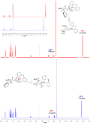
Figure 3: 1H NMR (CDCl3, 400 MHz) spectra of the (R)-MPA 11 (red colored line) and (S)-MPA and 12 (blue color...

Figure 4: An ORTEP plot of (S)-(+)-1-(10H-phenothiazin-10-yl)propan-2-ol (S)-(+)-5. The following crystal str...

Scheme 3: Amination of optically active bromo derivatives (R)-(+)-8 or (S)-(−)-8 in toluene.

Scheme 4: Amination of optically active bromo derivatives (R)-(+)-8 or (S)-(−)-8 in methanol.

Scheme 5: The proposed reaction mechanism for amination of optically active (S)-(−)-8 in methanol.
Rasta resin–triphenylphosphine oxides and their use as recyclable heterogeneous reagent precursors in halogenation reactions
- Xuanshu Xia and
- Patrick H. Toy
Beilstein J. Org. Chem. 2014, 10, 1397–1405, doi:10.3762/bjoc.10.143
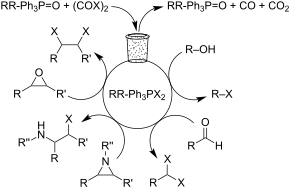
- halogenated products in high yields after simple purification. The polymer-supported triphenylphosphine oxides formed as a byproduct during these reactions could be recovered and reused numerous times with no appreciable decrease in reactivity. Keywords: Appel reaction; halogenation; organophosphorus
- reactions, such as those illustrated in Scheme 2: (1) the conversion of alcohols 4 to alkyl halides 5 (the Appel reaction), (2) the conversion of aldehydes 6 to 1,1-dihaloalkanes 7, (3) halogenation of aziridines 8 to form 2-haloamines 9, (4) halogenation of epoxides 10 to form 1,2-dihaloalkanes 11, (5) and

Graphical Abstract

Scheme 1: The Masaki–Fukui reaction and halophosphonium salt reduction.

Scheme 2: Representative reactions involving halophosphonium salts 3a,b.

Scheme 3: Catalytic Appel reactions reported by Denton and co-workers.

Figure 1: Rasta resins 14 and 15.

Scheme 4: Synthesis and applications of rasta resins 16 and 17a,b.

Scheme 5: Synthesis of bifuncitonal rasta resin 18.
Stereoselective synthesis of carbocyclic analogues of the nucleoside Q precursor (PreQ0)
- Sabin Llona-Minguez and
- Simon P. Mackay
Beilstein J. Org. Chem. 2014, 10, 1333–1338, doi:10.3762/bjoc.10.135
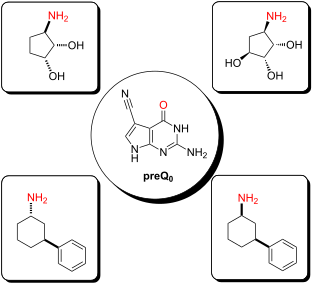
- both alcohols showed a diastereomeric purity of >99% by 1H NMR. Mitsunobu reaction on the secondary alcohols using DEAD or DIAD did not provide the desired azides [42][43] nor did a one-pot Appel reaction/nucleophilic substitution/Staudinger reaction protocol involving a double inversion of

Graphical Abstract

Figure 1: Biosynthetic pathway leading to nucleosides queuosine and archaeosine.
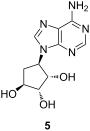
Figure 2: Chemical structure of noraristeromycin.

Figure 3: Synthesis of PreQ0 and chloro-intermediate 9. Reagents and conditions: (a) Methyl formate, NaOMe, P...

Figure 4: Synthesis of 15, a (1RS,2SR,3RS)-3-aminocyclopentane-1,2-diol derivative of PreQ0. Reagents and con...

Figure 5: Synthesis of 16, a (1S,2R,3S,4R)-4-aminocyclopentane-1,2,3-triol derivative of PreQ0. Reagents and ...

Figure 6: Synthesis of 21 and 22, 3-arylcyclohexylamine derivatives of PreQ0. Reagents and conditions: (a) Ph...
Concise, stereodivergent and highly stereoselective synthesis of cis- and trans-2-substituted 3-hydroxypiperidines – development of a phosphite-driven cyclodehydration
- Peter H. Huy,
- Julia C. Westphal and
- Ari M. P. Koskinen
Beilstein J. Org. Chem. 2014, 10, 369–383, doi:10.3762/bjoc.10.35
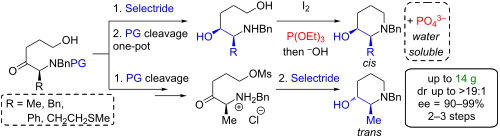
- MHz). Nevertheless, even with 4 equivalents of Selectride conversions of only up to 80% were observed. Unfortunately, subsequent Appel reaction of the diol anti-9a (dr = 25:1), synthesized through L-Selectride reduction in THF/CH2Cl2 (Table 4, entry 6), gave piperidinol 11a in a significantly

Graphical Abstract

Figure 1: Natural products and other bioactive piperidine derivatives of type B.

Figure 2: Retrosynthetic analysis of piperidines B (X = OH or leaving group, PG = protecting group).

Scheme 1: Synthesis of the protected amino acids 2. (a) KOH for 1b. b) PG–X = Cbz–Cl (1a–c), Boc2O (1d).

Scheme 2: Synthesis of hydroxy ketones 7 (R = Me (a), Bn (b), Ph (c) and EtSMe (d); PG = Cbz (a–c), Boc (d)).

Scheme 3: Synthesis of amides 5e and 5f and ketone 7e.

Scheme 4: Synthesis of amino alcohols syn-9a–d and oxazolidinone 10a. (for 7a–c conditions A: H2 (1 atm), Pd/...

Scheme 5: Competition between the Michaelis–Arbuzow process and the desired cyclodehydration of amino alcohol...

Scheme 6: Initial synthesis of the trans-piperidinol 11a in diminished enantiopurity. aThe amino alcohol 9a o...

Scheme 7: Synthesis of trans-piperidinol 11a in excellent ee.

Scheme 8: Synthesis of L-733,060·HCl.
Modulating NHC catalysis with fluorine
- Yannick P. Rey and
- Ryan Gilmour
Beilstein J. Org. Chem. 2013, 9, 2812–2820, doi:10.3762/bjoc.9.316
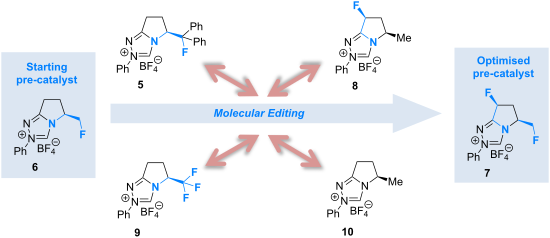
- . Synthesis of the monofluorinated pre-catalyst 8 (Scheme 2) commenced with an Appel reaction of alcohol 15 to prepare the primary bromide 18. Owing to the potentially labile nature of the primary bromide, this material was used without further purification in the next step. Reduction (H2, Pd/C) furnished the

Graphical Abstract

Figure 1: Exploring the effect of fluorine incorporation in triazolium pre-catalysts (2) for the enantioselec...

Figure 2: Target triazolium salts 5–10 for this study. The synclinal-endo conformation of 5 is shown [18]. Only t...

Scheme 1: Synthesis of the difluorinated triazolium salt 7 starting from commercially available N-Boc-trans-4...

Scheme 2: Synthesis of the monofluorinated triazolium salt 8.

Scheme 3: Synthesis of the trifluoromethylated and non-fluorinated pre-catalysts 9 and 10 for control studies....

Figure 3: X-ray crystal structures of triazolium salts 5·BF4−, 6·BF4− and 7·BF4− [42]. The tetrafluoroborate coun...

Figure 4: An overview of the molecular editing approach to catalyst development.
Total synthesis of (−)-epimyrtine by a gold-catalyzed hydroamination approach
- Thi Thanh Huyen Trinh,
- Khanh Hung Nguyen,
- Patricia de Aguiar Amaral and
- Nicolas Gouault
Beilstein J. Org. Chem. 2013, 9, 2042–2047, doi:10.3762/bjoc.9.242
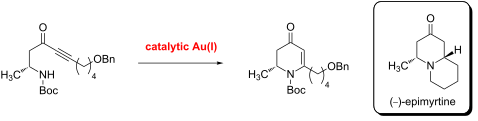
- stereospecifically the corresponding piperidone 4 in 80% yield. Subsequent bromination with CBr4 in the presence of PPh3 (Appel reaction) gave 5 in 84% yield. Finally, deprotection with 1 M SnCl4 in dichloromethane then neutralization by using K2CO3 afforded the final product (−)-epimyritine in a 80% yield. N-Cbz

Graphical Abstract

Scheme 1: Previously reported approach from β-aminoynones for the synthesis of pyridones.

Scheme 2: Retrosynthetic analysis of (−)-epimyrtine.

Scheme 3: Synthesis of (−)-epimyrtine.
The application of a monolithic triphenylphosphine reagent for conducting Ramirez gem-dibromoolefination reactions in flow
- Kimberley A. Roper,
- Malcolm B. Berry and
- Steven V. Ley
Beilstein J. Org. Chem. 2013, 9, 1781–1790, doi:10.3762/bjoc.9.207
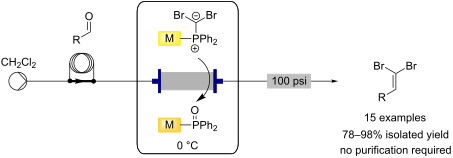
- possible to perform the Appel reaction using the same monolith and the relationship between the mechanisms of the two reactions is discussed. Keywords: bromination; flow chemistry; Ramirez gem-dibromoolefination reaction; solid-supported reagent; triphenylphosphine monolith; Introduction The advantages
- monolith to the Appel reaction (the transformation of alkyl alcohols to the corresponding bromides), we wished to investigate the application of this monolith to the closely related Ramirez gem-dibromoolefination reaction; the formation of gem-dibromoolefins from aldehydes or ketones. In 1962 Ramirez
- Appel reaction [51][52][53][54][55][56][57]. Following our success using a monolithic form of triphenylphosphine to facilitate the Appel reaction, we wanted to explore the use of this monolith for performing the Ramirez gem-dibromoolefination reaction in flow. The monolithic form of triphenylphosphine

Graphical Abstract

Scheme 1: Formation of gem-dibromoolefin 3 from the reaction of carbon tetrabromide and triphenylphosphine as...

Scheme 2: Formation of the triphenylphosphine monoliths.

Figure 1: a. An unfunctionalised triphenylphosphine monolith; b. Monolith after functionalisation with carbon...

Scheme 3: Functionalising the triphenylphosphine monolith to give the active Ramirez monolith using carbon te...

Scheme 4: Flow synthesis of gem-dibromoolefins using the functionalised triphenylphosphine monolith.

Scheme 5: Flow synthesis of bromides from the corresponding alcohols using the functionalised triphenylphosph...

Scheme 6: Mechanisms for the Ramirez and Appel reactions [41,59].
Bromination of hydrocarbons with CBr4, initiated by light-emitting diode irradiation
- Yuta Nishina,
- Bunsho Ohtani and
- Kotaro Kikushima
Beilstein J. Org. Chem. 2013, 9, 1663–1667, doi:10.3762/bjoc.9.190
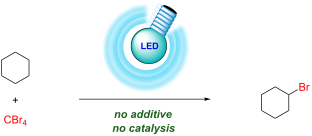
- useful bromide-containing precursors. For instance, alkyl alcohols can be converted to alkyl bromides in the presence of CBr4 and triphenylphosphine; this is known as the Appel reaction [28]. This combination can also be used to transform aldehydes into dibromoalkenes, which are useful precursors for the

Graphical Abstract

Figure 1: Action spectrum of bromination with CBr4, induced by LED irradiation (red line), and absorption spe...

Scheme 1: Plausible mechanism for bromination of cyclohexane with CBr4 induced by LED irradiation.

Figure 2: 13C NMR monitoring of reaction mixtures: (a) 0.50 mmol of CBr4, 0.10 mL of cyclohexane, and 0.40 mL...
A reductive coupling strategy towards ripostatin A
- Kristin D. Schleicher and
- Timothy F. Jamison
Beilstein J. Org. Chem. 2013, 9, 1533–1550, doi:10.3762/bjoc.9.175
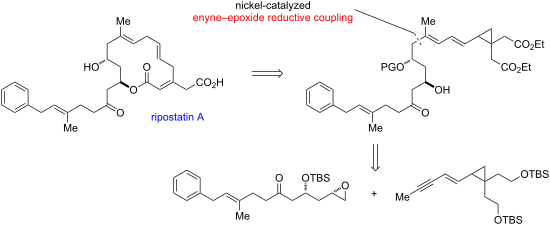
- product arising from cyclization onto the more distant double bond not detected [56]. We set out to access 55 from deprotonation of methyl ketone 57 on the less hindered side and alkylation with bromide 56. The E-allylic bromide was prepared rapidly, albeit in modest yield, with an Appel reaction [57] of

Graphical Abstract

Figure 1: Structures of the ripostatins.

Figure 2: Retrosynthesis of ripostatin A.

Scheme 1: Nickel-catalyzed reductive coupling of alkynes and epoxides.

Figure 3: Proposed retrosynthesis of ripostatin A featuring enyne–epoxide reductive coupling and rearrangemen...

Scheme 2: Potential transition states and stereochemical outcomes for a concerted 1,5-hydrogen rearrangement.

Scheme 3: Rearrangements of vinylcyclopropanes to acylic 1,4-dienes.

Scheme 4: Synthesis of cyclopropyl enyne.

Scheme 5: Synthesis of model epoxide for investigation of the nickel-catalyzed coupling reaction.

Scheme 6: Nickel-catalyzed enyne–epoxide reductive coupling reaction.

Scheme 7: Proposed mechanism for the nickel-catalyzed coupling reaction of alkynes or enynes with epoxides.

Scheme 8: Regioselectivity changes in reductive couplings of alkynes and 3-oxygenated epoxides.

Scheme 9: Enyne reductive coupling with 1,2-epoxyoctane.

Figure 4: Initial retrosynthesis of the epoxide fragment by using dithiane coupling.

Scheme 10: Synthesis of dithiane by Claisen rearrangement.

Scheme 11: Deuterium labeling reveals that the allylic/benzylic site is most acidic.

Scheme 12: Oxy-Michael addition to δ-hydroxy-α,β-enones.

Figure 5: Revised retrosynthesis of epoxide 5.

Scheme 13: Synthesis of functionalized ketone by oxy-Michael addition.

Figure 6: Retrosynthesis by using iodocylization to introduce the epoxide.

Scheme 14: Synthesis of ketone 57 using thiazolidinethione chiral auxiliary.

Figure 7: Retrosynthesis involving decarboxylation of a β-ketoester.

Scheme 15: Synthesis of β-ketoester 61.

Scheme 16: Decarboxylation of 61 under Krapcho conditions.

Scheme 17: Improved synthesis of 63 and attempted iodocyclization.

Figure 8: Retrosynthesis utilizing Rychnovsky’s cyanohydrin acetonide methodology.

Scheme 18: Synthesis of cyanohydrin acetonide and attempted alkylation with epoxide.

Scheme 19: Allylation of acetonide and conversion to aldehyde.

Scheme 20: Synthesis of the epoxide precursor by an aldol−decarboxylation sequence.
Carbohydrate-auxiliary assisted preparation of enantiopure 1,2-oxazine derivatives and aminopolyols
- Marcin Jasiński,
- Dieter Lentz and
- Hans-Ulrich Reissig
Beilstein J. Org. Chem. 2012, 8, 662–674, doi:10.3762/bjoc.8.74
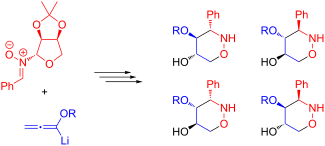
- were very likely formed by deprotonation at the benzylic position and subsequent elimination. Finally, freshly prepared unpurified 28 was subjected to the conditions of an Appel reaction [61] providing, after 16 hours at room temperature, pyrrolidine derivative 30 in 33% yield. Again, the relatively

Graphical Abstract

Scheme 1: Reactivity of N-glycosyl nitrones 1 towards dipolarophiles and nucleophiles leading to products of ...

Scheme 2: Additions of lithiated alkoxyallenes to L-erythrose-derived nitrone 1a leading to 3,6-dihydro-2H-1,...

Figure 1: By-products 4 and 5 isolated from the reaction of nitrone 1a with lithiated methoxyallene.
Figure 2: Single-crystal X-ray analysis of (3R)-3a (ellipsoids are drawn at a 50% probability level).

Figure 3: Model proposed for the addition of lithiated allenes to nitrone 1a.

Scheme 3: Speculative mechanistic suggestion for the formation of tetrasubstituted pyrrole derivative 5.

Scheme 4: Introduction of a 5-hydroxy group into 1,2-oxazine derivatives 3 by a hydroboration/oxidation proto...

Scheme 5: Samarium diiodide-induced ring opening of tetrahydro-2H-1,2-oxazine derivatives 12 and 13.

Scheme 6: Reaction of tetrahydro-2H-1,2-oxazine 18 with samarium diiodide. (a) NaH (1.4 equiv), BnBr (1.2 equ...

Scheme 7: Attempted synthesis of pyrrolidine derivatives from precursor 13. (a) TMSCl (1.5 equiv), imidazole,...

Scheme 8: Synthesis of TBS-protected tetrahydro-2H-1,2-oxazine 27 and its transformation into pyrrolidine der...
The application of a monolithic triphenylphosphine reagent for conducting Appel reactions in flow microreactors
- Kimberley A. Roper,
- Heiko Lange,
- Anastasios Polyzos,
- Malcolm B. Berry,
- Ian R. Baxendale and
- Steven V. Ley
Beilstein J. Org. Chem. 2011, 7, 1648–1655, doi:10.3762/bjoc.7.194
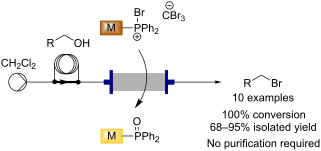
- 2NY, UK 10.3762/bjoc.7.194 Abstract Herein we describe the application of a monolithic triphenylphosphine reagent to the Appel reaction in flow-chemistry processing, to generate various brominated products with high purity and in excellent yields, and with no requirement for further off-line
- purification. Keywords: Appel reaction; bromination; flow chemistry; solid-supported reagent; triphenylphosphine monolith; Introduction Flow chemistry is well-established as a useful addition to the toolbox of the modern research chemist, with advantages accrued through increased efficiency, reproducibility
- application of this monolith to the transformation of an alkyl alcohol into the corresponding alkyl bromide by using carbon tetrabromide in the Appel reaction. In the 1960s Ramirez and co-workers reported the formation of a phosphine–methylene species when triphenylphosphine was mixed with carbon tetrabromide

Graphical Abstract

Scheme 1: The two proposed mechanistic pathways for the Appel reaction.

Scheme 2: Functionalisation of the triphenylphosphine monolith by using carbon tetrabromide in a recycling pr...

Figure 1: a. Unfunctionalised triphenylphosphine monolith; b. Monolith after fuctionalisation with carbon tet...

Scheme 3: Flow synthesis of bromides from alcohols by using the functionalised triphenylphosphine monolith.

Figure 2: Linear decrease of the brown decolourisation.



