


Search results
Search for "planar chirality" in Full Text gives 26 result(s) in Beilstein Journal of Organic Chemistry.
Kinetic resolution of racemic planar-chiral vinylcymantrenes by molybdenum-catalyzed asymmetric metathesis dimerization
Beilstein J. Org. Chem. 2026, 22, 568–574, doi:10.3762/bjoc.22.42
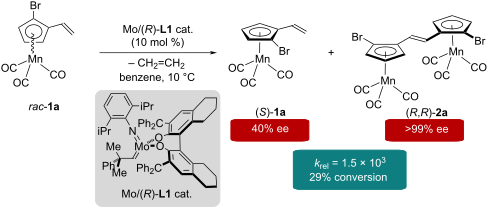
- resolution; molybdenum; olefin metathesis; planar chirality; Introduction The development of the well-defined molybdenum- [1][2] or ruthenium-alkylidene [3][4][5] catalysts has proven the olefin metathesis reaction to be a powerful tool in organic synthesis. Asymmetric extension is a recent trend in
- ], reveals that the molybdenum-catalyzed asymmetric metathesis reactions are powerful tools to control planar chirality in various transition-metal complexes. ORTEP drawing of the X-ray structure of (S,S)-(–)-2b with atom numbering (thermal ellipsoids set at the 30% probability level). Selected bond lengths


Synthesis and stereochemical analysis of dynamic planar chiral oxa[7]orthocyclophene
Beilstein J. Org. Chem. 2026, 22, 436–442, doi:10.3762/bjoc.22.30

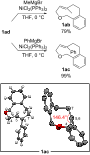
- oxacyclophene enabled the efficient and divergent synthesis of C6-substituted derivatives. The stereochemical analysis of the oxacyclophenes revealed that the iodo- and methyl-substituted derivatives have reasonable stereochemical stability. The planar chirality of the methyl-substituted oxacyclophene was
- successfully transformed into central chirality by epoxidation without loss of enantiomeric purity. Keywords: dynamic chirality; medium-sized heterocycle; orthocyclophene; planar chirality; stereochemical analysis; Introduction In the course of our study on planar chiral medium-sized cyclic molecules [1][2
- ][3][4][5][6][7][8][9][10], we previously synthesized hetera[7]orthocyclophenes 1 having a heteroatom-embedded ansa-chain (X = O or NR) and an (E)-alkene moiety (Figure 1) [6][9], and found that the orthocyclophenes exhibit dynamic planar chirality in a wide range of stereochemical stability depending




Screwing the helical chirality through terminal peri-functionalization
Beilstein J. Org. Chem. 2026, 22, 205–212, doi:10.3762/bjoc.22.14
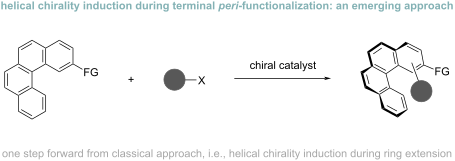
- frequently focused toward other types of chirality, like point chirality [3], axial chirality [4], and planar chirality [5][6][7], often overshadowing the potential of helical chirality. Point chirality has major applications in medicinal chemistry and several drug molecules contain point chirality centers
- substitution pattern along the plane of symmetry, is known as planar chirality, as seen in metallocene and cyclophanes. Molecules containing planar chirality have greater relevance in materials science and stereoselective transformations [12][13]. The fourth branch of the chiral tree is helical chirality. A


Measuring the stereogenic remoteness in non-central chirality: a stereocontrol connectivity index for asymmetric reactions
Beilstein J. Org. Chem. 2025, 21, 1995–2006, doi:10.3762/bjoc.21.155
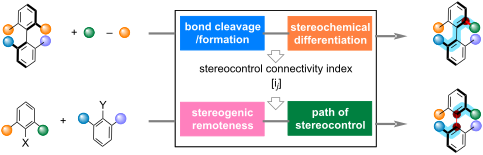
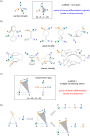
- , planar chirality, and “inherent chirality” are illustrated using the stereocontrol connectivity index produced following a unified 3-step process. Application of such stereochemical classification could facilitate the development of new synthetic methodologies and catalyst systems to construct diverse
- chiral molecules. Keywords: asymmetric reactions; axial chirality; catalysis; planar chirality; stereocontrol; Introduction Chirality is a ubiquitous and fundamental phenomenon in nature and thus holds an irreplaceable position in organic synthesis. At its most rudimental definition, chirality in a
- molecule is characterized by the absence of mirror planes and centers of inversion. Central chirality arises when four distinct substituents (a, b, c, and d) are arranged tetrahedrally around a central atom (Scheme 1A). Non-central chirality – such as axial and planar chirality – are becoming increasingly





Chiral phosphoric acid-catalyzed asymmetric synthesis of helically chiral, planarly chiral and inherently chiral molecules
Beilstein J. Org. Chem. 2025, 21, 1864–1889, doi:10.3762/bjoc.21.145
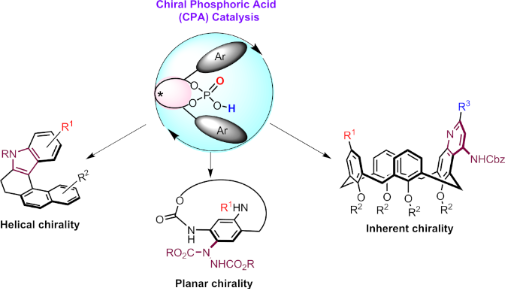
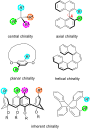
- .21.145 Abstract Chiral molecules, distinguished by nonsuperimposability with their mirror image, play crucial roles across diverse research fields. Molecular chirality is conventionally categorized into the following types: central chirality, axial chirality, planar chirality and helical chirality, along
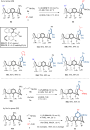
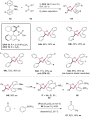
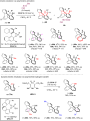
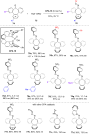
- within this domain. Keywords: asymmetric catalysis; chiral phosphoric acid; helical chirality; inherent chirality; planar chirality; Introduction Since the seminal works by Akiyama [1] and Terada [2] et al. in 2004 demonstrated the application of BINOL-derived chiral phosphoric acids (CPAs) in
- pharmaceutical, agrochemical and asymmetric synthesis as well as materials science, to name a few examples. Molecular chirality is typically classified into four types of chiral elements: central (point) chirality, axial chirality, planar chirality and helical chirality (Figure 2). Moreover, unique forms of










Photoswitches beyond azobenzene: a beginner’s guide
Beilstein J. Org. Chem. 2025, 21, 1808–1853, doi:10.3762/bjoc.21.143
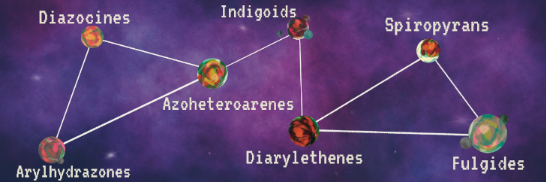
- led to a strong decrease in the thermal half-life, suggesting water is also involved in the Z–E thermal isomerisation process [70]. Bridged indigos have also been reported for which the Z-isomers are unstable. By bridging the two nitrogen atoms, these compounds show planar chirality and can be




Catalytic asymmetric reactions of isocyanides for constructing non-central chirality
Beilstein J. Org. Chem. 2025, 21, 1648–1660, doi:10.3762/bjoc.21.129
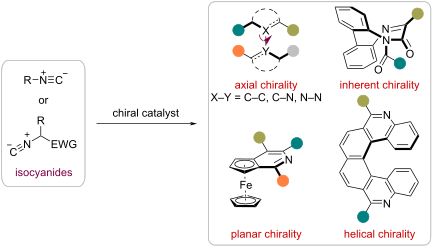
- . Additionally, we provide a perspective on the current limitations and future opportunities, aiming to inspire further advances in this area. Keywords: axial chirality; helical chirality; inherent chirality; isocyanide; planar chirality; Introduction Chirality represents a fundamental property of molecules
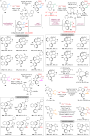
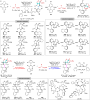
- non-central chiral compounds. a) Common types of chirality. b) Representative functional molecules bearing non-central chirality. Construction of planar chirality. Construction of axial chirality. Construction of inherent chirality. Construction of helical chirality. CPA-catalyzed enantioselective




Synthesis of optically active folded cyclic dimers and trimers
Beilstein J. Org. Chem. 2025, 21, 1603–1612, doi:10.3762/bjoc.21.124

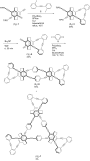
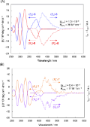
- observed between the dimer and trimer, despite the same absolute configuration of the planar chiral [2.2]paracyclophane units, which was reproduced by theoretical studies. Keywords: circularly polarized luminescence; oligomer; [2.2]paracyclophane; planar chirality; Introduction Cyclophane is a general
- molecular structure with stacked π-electron clouds [1][4][5][6]. The distance between benzene rings in [2.2]paracyclophane is extremely short (2.8–3.1Å), and thus the rotational motion of benzene rings is completely suppressed; therefore, planar chirality without chiral centers [7] appears by introducing



The Groebke–Blackburn–Bienaymé reaction in its maturity: innovation and improvements since its 21st birthday (2019–2023)
Beilstein J. Org. Chem. 2024, 20, 1839–1879, doi:10.3762/bjoc.20.162
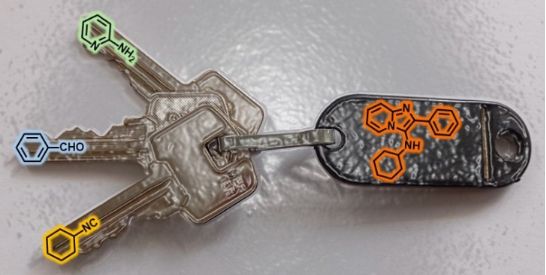
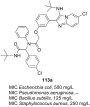
- cyclophanyl-imidazole-based library of ligands. The synthesis of ligands based on the [2.2]paracyclophane (PCP) moiety, thanks to its structural features and inherent planar chirality upon selective substitution, has been recently reviewed by the same author [46]. Starting from 4-formylcyclophane 37, a GBB






Photochromic derivatives of indigo: historical overview of development, challenges and applications
Beilstein J. Org. Chem. 2024, 20, 228–242, doi:10.3762/bjoc.20.23
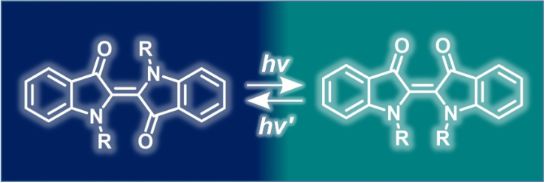
- isomerization and photochemical (only for 13a) isomerization [46]. Compounds 13 showed intrinsic planar chirality and their enantiomers could be separated by HPLC. Notably, upon thermal and photochemical isomerization of these compounds, no Z-isomers were detected and only the racemization took place. Such





Germacrene B – a central intermediate in sesquiterpene biosynthesis
Beilstein J. Org. Chem. 2023, 19, 186–203, doi:10.3762/bjoc.19.18

- photochemical E/Z isomerisation to 13 prior to [2 + 2] cycloaddition. Further photochemical products from 1 include 5, 15 that may be formed through a biradical mechanism, and rearranged 16 [51]. Germacrene B (1) has planar chirality (Scheme 4D), but recovery of the starting material from an incomplete
- ) Cyclisation of 1 to 9 and 10 upon treatment with alumina, B) conversion into (rac)-11 by treatment with diluted sulfuric acid in acetone, C) photochemical products from 1, and D) planar chirality of 1 and its derivative 17. Possible cyclisation reactions upon reprotonation of 1. A) Cyclisations to eudesmane






BINOL as a chiral element in mechanically interlocked molecules
Beilstein J. Org. Chem. 2022, 18, 508–523, doi:10.3762/bjoc.18.53
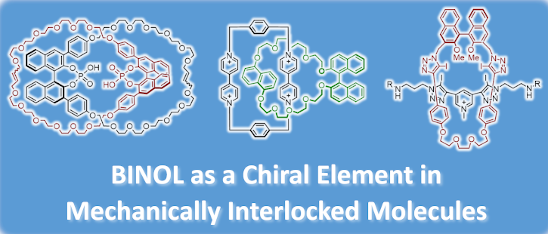
- planar chirality into at least one of the subcomponents. One of the most important chiral molecular frameworks in general is the 1,1'-binaphthyl-2,2'-diol unit (BINOL, see Figure 1). BINOL is an axially chiral molecule with a high configurational stability and a well-established synthetic chemistry
- and P isomers), similar to (S,S)-5 (see Figure 2). Secondly, the embedding of the DNP unit in the tetracationic cyclophane leads to an element of planar chirality (Rp and Sp isomers). Thus, for each configuration of BINOL, four different diastereoisomers are possible. However, for these specific
- rotaxanes, the helicity is predetermined by the planar chirality (based on the underlying macrocycle–macrocycle interactions), so that only two diastereoisomers remain for a given BINOL configuration (e.g., (R)-(Rp) and (R)-(Sp) in case of (R)-BINOL). In contrast to the axial chirality of the BINOL unit




New advances in asymmetric organocatalysis
Beilstein J. Org. Chem. 2022, 18, 240–242, doi:10.3762/bjoc.18.28
- Waser employed an isothiourea catalyst for esterification-mediated kinetic resolution of paracyclophane derivatives with planar chirality [19]. Parida and Pan showed that a Michael reaction coupled with an acyl transfer reaction between α-nitroketones and 4-arylidenepyrrolidine-2,3-diones can produce a
Breaking paracyclophane: the unexpected formation of non-symmetric disubstituted nitro[2.2]metaparacyclophanes
Beilstein J. Org. Chem. 2021, 17, 1518–1526, doi:10.3762/bjoc.17.109
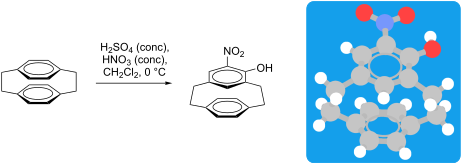
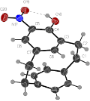
- nitronium ion must occur anti to the para ring of the cyclophane. Approach from the opposite face is blocked by the lower deck. Once oxidation has occurred conformational flipping of the meta deck is impossible and the planar chirality is locked [39]. It is possible that more cyclohexadienone cyclophane 6




Chiral isothiourea-catalyzed kinetic resolution of 4-hydroxy[2.2]paracyclophane
Beilstein J. Org. Chem. 2021, 17, 800–804, doi:10.3762/bjoc.17.68
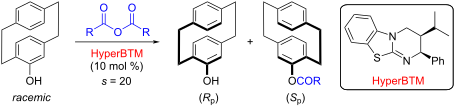
- ; planar chirality; Introduction Substituted [2.2]paracyclophanes are fascinating planar chiral molecules [1][2][3][4][5][6][7][8][9][10][11][12] which have been systematically investigated since Brown and Farthing discovered the formation of the unsubstituted and achiral parent [2.2]paracyclophane (1


Synthesis, enantioseparation and photophysical properties of planar-chiral pillar[5]arene derivatives bearing fluorophore fragments
Beilstein J. Org. Chem. 2019, 15, 1601–1611, doi:10.3762/bjoc.15.164
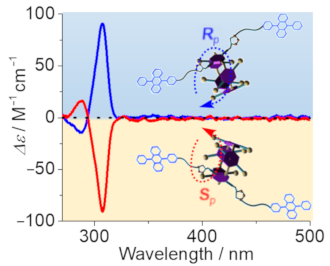
- that differs from the common macrocycles is the planar chirality resulting from the different orientations of the alkoxy substituents on the rims. Theoretically, eight conformers can be formed including diastereomeric ones: (Sp,Sp,Sp,Sp,Sp), (Rp,Sp,Sp,Sp,Sp), (Rp,Rp,Sp,Sp,Sp), (Rp,Sp,Rp,Sp,Sp) and



Determination of the absolute stereostructure of a cyclic azobenzene from the crystal structure of the precursor containing a heavy element
Beilstein J. Org. Chem. 2016, 12, 2211–2215, doi:10.3762/bjoc.12.212
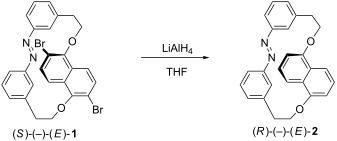
- Z-state of azobenzene, (iii) chiral in both states of the azobenzene unit. We have explored the property of planar chirality of these molecules and carried out the optical resolution to demonstrate various properties such as molecular brakes, chiroptical switches and chirality sensors for light and
- polygonal finger print texture [45]. Molecule (E)-1 contains a 2,6-dibromo-1,5-dihydroxynaphthalene part linked to an azobenzene unit through bismethylene spacers. The constricted rotation of the naphthalene unit in the cyclic structure gives planar chirality to this molecule with separable enantiomers. The


[2.2]Paracyclophane derivatives containing tetrathiafulvalene moieties
Beilstein J. Org. Chem. 2015, 11, 1917–1921, doi:10.3762/bjoc.11.207
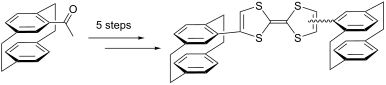
- a mixture of inseparable isomeric tetrathiafulvalenes 7 in 17% yield. Since compound 6 already exhibits planar chirality (racemate Rp/Sp), the theoretical number of stereoisomers of the tetrathiafulvalene 7 should be six as follows: cis-(Sp,Sp) with cis-(Rp,Rp) and trans-(Sp,Sp) with trans-(Rp,Rp


Inherently chiral calix[4]arenes via oxazoline directed ortholithiation: synthesis and probe of chiral space
Beilstein J. Org. Chem. 2014, 10, 2751–2755, doi:10.3762/bjoc.10.291
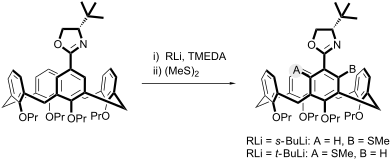
- . Currently we are looking at different catalytic systems, also based on the planar chiral ferrocenes, but which have shown the planar chirality of the ferrocene to be essential in determining the selectivity and/or efficiency of the transformations. Our ultimate aim is to establish whether or not the


De novo macrolide–glycolipid macrolactone hybrids: Synthesis, structure and antibiotic activity of carbohydrate-fused macrocycles
Beilstein J. Org. Chem. 2014, 10, 2215–2221, doi:10.3762/bjoc.10.229
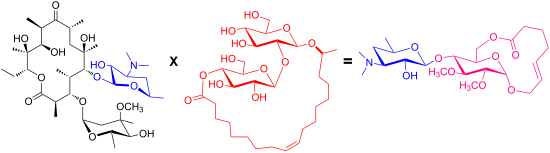
- backbone of the macrocycle whose chirality is dictated by the absolute configuration of the C4 stereogenic center. The topology is a defining feature of this family of [13]-macrodiolides. By virtue of the planar chirality, [13]-macrodiolides such as 3 have an axis of chirality associated with them. We were


Enantioselective synthesis of planar chiral ferrocenes via palladium-catalyzed annulation with diarylethynes
Beilstein J. Org. Chem. 2013, 9, 1891–1896, doi:10.3762/bjoc.9.222
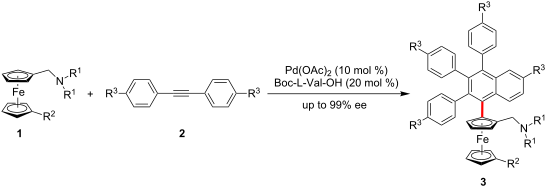
- Road, BDA, Beijing, 100176, China 10.3762/bjoc.9.222 Abstract When Boc-L-Val-OH was used as a ligand for the enantioselective Pd(II)-catalyzed annulation of N,N-substituted aminomethyl ferrocene derivatives with diarylethynes, ferrocenes with planar chirality could be achieved with excellent
- enantioselectivity (up to 99% ee). Keywords: annulation; asymmetric catalysis; C–H activation; ferrocene; palladium; planar chirality; Introduction Chiral ferrocene derivatives have been widely applied to asymmetric catalysis, materials science, biomedical research, etc. [1][2][3][4]. Particularly, ferrocenes with
- planar chirality are applied as efficient ligands or catalysts in asymmetric catalysis [5][6][7][8][9][10][11][12][13][14][15]. However, the typical method for introduction of planar chirality in the ferrrocene backbone is still utilizing the chiral auxiliaries strategy [16][17][18][19][20][21]. Snieckus


Rh(III)-catalyzed directed C–H bond amidation of ferrocenes with isocyanates
Beilstein J. Org. Chem. 2012, 8, 1844–1848, doi:10.3762/bjoc.8.212
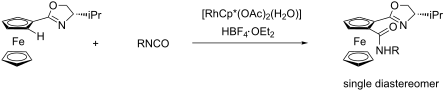
- reactivity. The absolute configuration of planar chirality in 3c was determined to be S by X-ray crystallography (Figure 1). The absolute configuration is consistent with the previous report of diastereoselective ortho-lithiation of 1b [27]. Conclusion In conclusion, a Cp*Rh(III)-catalyzed reaction between


Synthesis and structure of tricarbonyl(η6-arene)chromium complexes of phenyl and benzyl D-glycopyranosides
Beilstein J. Org. Chem. 2012, 8, 1059–1070, doi:10.3762/bjoc.8.118

- to the fact that the tricarbonylchromium ligand stabilizes both benzylic and homo-benzylic carbenium ions and carbanions [5][6]. Asymmetric ortho- or meta-substituted tricarbonyl(η6-arene)chromium compounds display planar chirality, which, in turn, makes these chiral complexes attractive catalysts


Carbamate-directed benzylic lithiation for the diastereo- and enantioselective synthesis of diaryl ether atropisomers
Beilstein J. Org. Chem. 2011, 7, 1327–1333, doi:10.3762/bjoc.7.156
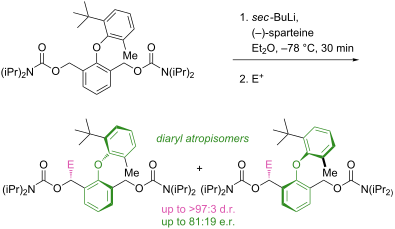
- -dimethylbenzene) with the aim of generating an atropisomeric product in enantiomerically enriched form (Scheme 1) [2]. Enantioselective lithiation has since then commonly been used to generate axial or planar chirality [3], in many cases by desymmetrising deprotonation of a functionalised aromatic system. The



Use of mixed Li/K metal TMP amide (LiNK chemistry) for the synthesis of [2.2]metacyclophanes
Beilstein J. Org. Chem. 2011, 7, 1249–1254, doi:10.3762/bjoc.7.145
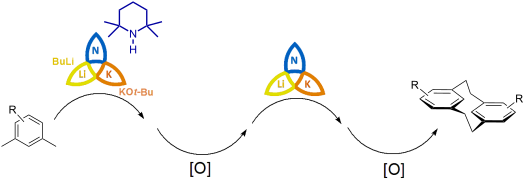
- oxidative coupling with 1,2-dibromoethane. The synthetic ease of this approach compares favourably with previously reported methods and allows for ready access to potentially useful planar chiral derivatives. Keywords: benzylic metalation; LiNK chemistry; [2.2]metacyclophane; oxidative coupling; planar
- chirality; Introduction While direct metalation reactions are an essential contribution to the repertoire of modern synthetic methods, an underlying and often underestimated challenge remains in the achievement of predictable selective metalations of substrates that offer several potential sites of





