Search results
Search for "charging" in Full Text gives 217 result(s) in Beilstein Journal of Nanotechnology. Showing first 200.
Flexible freestanding MoS2-based composite paper for energy conversion and storage
Beilstein J. Nanotechnol. 2019, 10, 1488–1496, doi:10.3762/bjnano.10.147
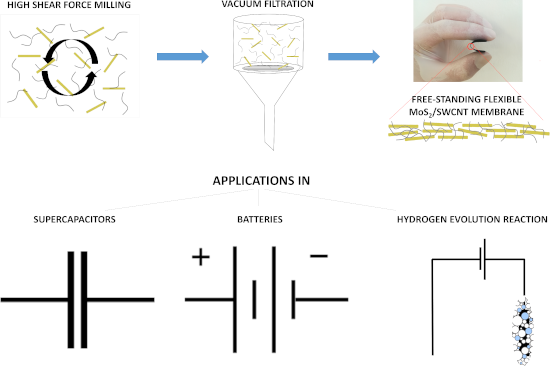
- paper for applications in supercapacitors (SCs). The capacitance was measured by a chronoamperometry technique in KCl solution (1 M) using different charging–discharging current densities (1–5 mA·cm−2) in a potential range determined by cyclic voltammetry (CV) shown in Supporting Information File 1
- electrode that comes into contact with the electrolyte solution S. The calculation was performed using equation: C = (2·I) / (S·U/t). The calculated values are summarized for each discharging current in Table 1. Charging–discharging curves of MoS2-based composite paper obtained using the chronoamperometry
- calomel reference electrode was used as the reference electrode and the measurements were performed in 1 M KCl solution. The exposed area was a disk with 0.94 mm diameter. In order to measure the charge–discharge curves, several charging–discharging currents (1–5 mA·cm−2) were used to charge the material


Hierarchically structured 3D carbon nanotube electrodes for electrocatalytic applications
Beilstein J. Nanotechnol. 2019, 10, 1475–1487, doi:10.3762/bjnano.10.146
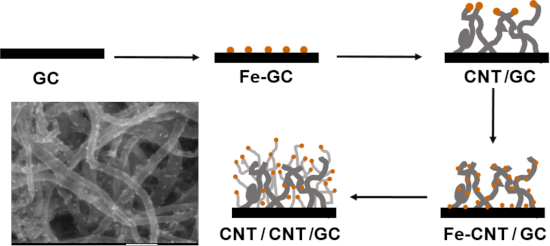
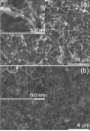
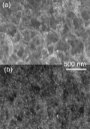
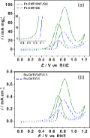
- displayed in Figure 7. The currents in the CVs are associated with the charging and decharging of the electrical double layer and denote the double-layer capacity, which can be regarded as an estimation of the surface area for the carbon-only samples. In addition to these currents, in the potential range
- scan rate of 5 mV s−1 was applied. Note that the oxidation current scales with the square root of the scan rate, while the double-layer charging current linearly scales with scan rate. Thus, the slow scan rate allows for a much more reliable determination of peak potentials and currents. The fifth





Fabrication of phase masks from amorphous carbon thin films for electron-beam shaping
Beilstein J. Nanotechnol. 2019, 10, 1290–1302, doi:10.3762/bjnano.10.128
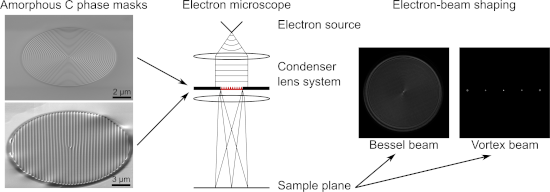
- (transmission) electron microscopy (S(T)EM). Phase-modulating thin-film devices (phase masks) made of amorphous silicon nitride are commonly used to generate a wide range of different beam shapes. An additional conductive layer on such a device is required to avoid charging under electron-beam irradiation
- , which induces unwanted scattering events. Results: Phase masks of conductive amorphous carbon (aC) were successfully fabricated with optical lithography and focused ion beam milling. Analysis by TEM shows the successful generation of Bessel and vortex beams. No charging or degradation of the aC phase
- , smooth, free-standing SixNy thin films are commercially available. Smooth thin films are a requirement for the successful fabrication of the thickness pattern. However, SixNy is an insulator and an additional conductive layer has to be deposited onto a SixNy-based PM to avoid charging by electron-beam



Tailoring the stability/aggregation of one-dimensional TiO2(B)/titanate nanowires using surfactants
Beilstein J. Nanotechnol. 2019, 10, 1024–1037, doi:10.3762/bjnano.10.103
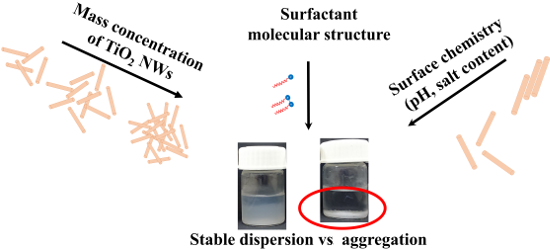
- /DTAB and TNW/12-2-12 systems was investigated in order to determine the effect of the surfactants on the surface charging in the respective dispersions. The measured variations of the zeta potential with pH are shown in Figure 6a,b. The two lowest monomer concentrations of both surfactants shifted the
- equilibria, a surface complexation model (SCM) was designed based on the one previously used to describe TNW charging in the absence of surfactants [48]. Not many surface complexation models involving surfactant adsorption are available. A recent example in the work of Tagavifar et al. involves a purely
- diffuse double layer model [57]. Here, we use a more complex model. The surface complexation model starts from the previous model developed for the bare TNWs. These fundamental charging settings are given in the first three lines of Table 2. Based on this, the zeta potential measurements in the presence


Concurrent nanoscale surface etching and SnO2 loading of carbon fibers for vanadium ion redox enhancement
Beilstein J. Nanotechnol. 2019, 10, 985–992, doi:10.3762/bjnano.10.99
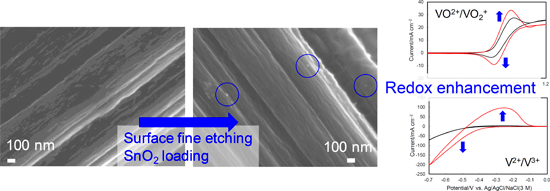
- voltammograms (CVs) obtained in an acidic electrolyte without vanadium ions are shown in Figure 4. The current in the voltammogram is composed from three components, i.e., the electrochemical double-layer charging current at the carbon–electrolyte interface, and the faradaic currents due to the redox reactions
- of the surface functional groups and the carbon surface oxidation. The electrochemical double-layer charging yields a constant current and a rectangular CV shape. The current depends on the extent of the exposure of the basal and edge planes, the specific capacitances of which are 16 and 50–70 μF·cm
- with high-purity water before the incorporation. The anolyte (40 cm3) and catholyte (20 cm3) were prepared by electrolysis (charging) of 1 M VOSO4 + 2 M H2SO4 until the full conversion of VO2+ to VO2+ and V2+. After the electrolysis, half of the anolyte was removed and the pre-discharge was carried out



Novel reversibly switchable wettability of superhydrophobic–superhydrophilic surfaces induced by charge injection and heating
Beilstein J. Nanotechnol. 2019, 10, 840–847, doi:10.3762/bjnano.10.84
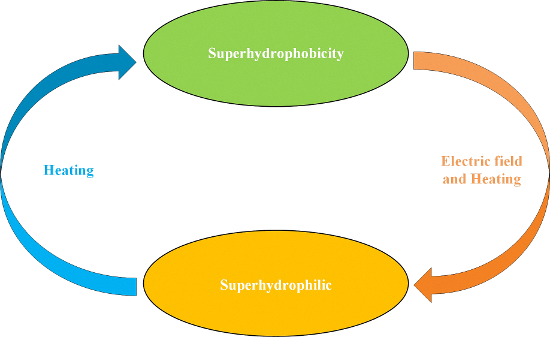
- . Influence of temperature on coating wettability To evaluate the effect of heating temperature on the coating wettability, the temperature was changed gradually while the voltage was kept at 2000 V and the charging time was kept at 2 min, and the results are shown in Figure 9. At room temperature, the
- the following: the increase of temperature will promote the thermal motion of the molecules in the solid, which in turn will help the charges inject into the solid surface during the process of electric field application. Effect of charging time on durability of superhydrophilicity When the charging
- time is too short, the coating wettability cannot change from its original state (superhydrophobic) to superhydrophilic. For example, at 2000 V and 150 °C, the contact angle of the coating changed from 150.5° to 40° after 1 min. Only when the charging time is increased, such as at 2 min, will the


An efficient electrode material for high performance solid-state hybrid supercapacitors based on a Cu/CuO/porous carbon nanofiber/TiO2 hybrid composite
Beilstein J. Nanotechnol. 2019, 10, 781–793, doi:10.3762/bjnano.10.78
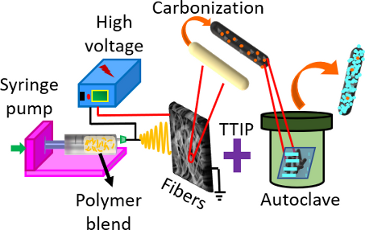
- triangular shape during the charging and discharging steps, indicating complete electric double layer behavior. The Cu/CuO/PCNF/TiO2 composite shows the long charge/discharge duration which results from the typical pseudo-capacitive performance of the TiO2 nanoparticles in the composite. The specific


Trapping polysulfide on two-dimensional molybdenum disulfide for Li–S batteries through phase selection with optimized binding
Beilstein J. Nanotechnol. 2019, 10, 774–780, doi:10.3762/bjnano.10.77
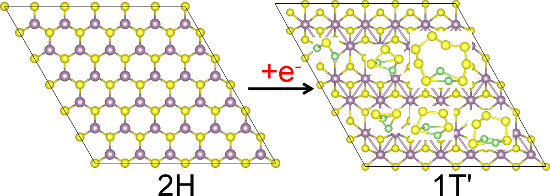
- ≤ 6), the final product of Li2S is formed upon discharging; and the charging process occurs through the reverse reactions [40]. The insulating nature of sulfur and the lithiation products (Li2S2 and Li2S), and the dissolution of higher-order Li2Sx (x = 4–8) are the main challenges in the application


On the transformation of “zincone”-like into porous ZnO thin films from sub-saturated plasma enhanced atomic layer deposition
Beilstein J. Nanotechnol. 2019, 10, 746–759, doi:10.3762/bjnano.10.74
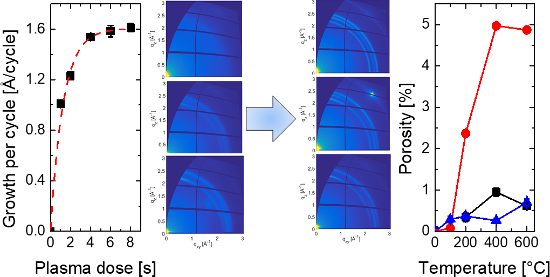
- charging was compensated using a dual beam charge neutralization, with a flux of low-energy electrons (ca. 1 eV) combined with positive Ar ions of very low energy (10 eV). Samples were sputter cleaned for 1 min with an Ar ion beam of 1 kV, 1 µA (raster size: 2 × 2 cm2). The acquired spectra were processed
- with CasaXPS software. The lattice O–Zn component of the O 1s spectrum was used as internal standard for charging correction and it was set to 529.8 eV [56]. Results and Discussion Optochemical characterization of the zincone-like layers Zincone-like layers were deposited by varying the plasma pulse


Review of time-resolved non-contact electrostatic force microscopy techniques with applications to ionic transport measurements
Beilstein J. Nanotechnol. 2019, 10, 617–633, doi:10.3762/bjnano.10.62
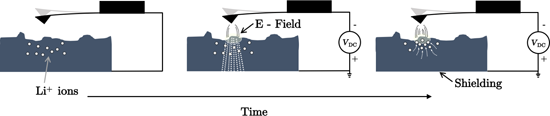
- difference (which can be used to extract the local work function) [1] and local piezoelectric response [2], and dynamic properties such as the charging and decay times of photoexcited carriers [3][4][5][6], and local activation energies for ionic transport [7][8]. These measurements play a crucial role in
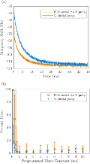
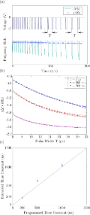
- build-up in the sample at the location of the AFM tip if an appropriate voltage is applied across the tip–sample gap. Measuring the resonance frequency shift as a function of time after the light is turned on/off then allows for the charging/discharging time to be directly acquired, revealing
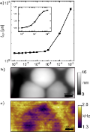
- information about charge generation and transport in the sample. This was first performed by Krauss et al. who observed charging of photoexcited CdSe nanocrystals by direct frequency shift measurements after illumination [26]. The concept outlined above can be applied to measure ionic transport in ionic





Coexisting spin and Rabi oscillations at intermediate time regimes in electron transport through a photon cavity
Beilstein J. Nanotechnol. 2019, 10, 606–616, doi:10.3762/bjnano.10.61
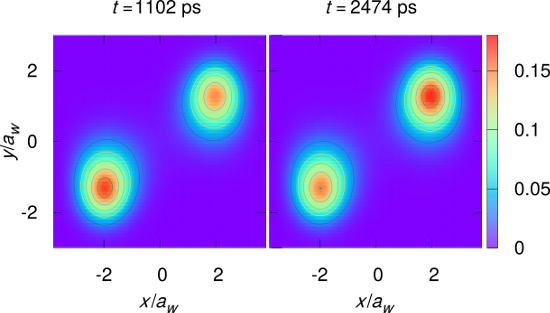
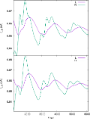
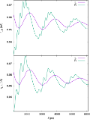
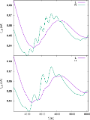
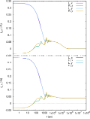
- state. We notice that the mean photon number in the system only assumes a considerable value during the late charging regime from 100 ps to 0.6 μs, when radiative transitions assist in moving charge from the states in the bias window to the ground state of the system [9]. The steady-state photon number


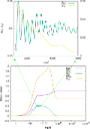
![[Graphic 40]](/bjnano/content/inline/2190-4286-10-61-i49.svg?max-width=637&scale=1.418184) and photon
and photon ![[Graphic 41]](/bjnano/content/inline/2190-4286-10-61-i50.svg?max-width=637&scale=1.418184) content in the open central system as a function of time. In additio...
content in the open central system as a function of time. In additio...

![[Graphic 60]](/bjnano/content/inline/2190-4286-10-61-i69.svg?max-width=637&scale=1.418184)
![[Graphic 61]](/bjnano/content/inline/2190-4286-10-61-i70.svg?max-width=637&scale=1.418184)
![[Graphic 62]](/bjnano/content/inline/2190-4286-10-61-i71.svg?max-width=637&scale=1.418184) and
and ![[Graphic 63]](/bjnano/content/inline/2190-4286-10-61-i72.svg?max-width=637&scale=1.418184) i...
i...
![[Graphic 76]](/bjnano/content/inline/2190-4286-10-61-i85.svg?max-width=637&scale=1.418184) in the steady state. The cavity pho...
in the steady state. The cavity pho...
A porous 3D-RGO@MWCNT hybrid material as Li–S battery cathode
Beilstein J. Nanotechnol. 2019, 10, 514–521, doi:10.3762/bjnano.10.52
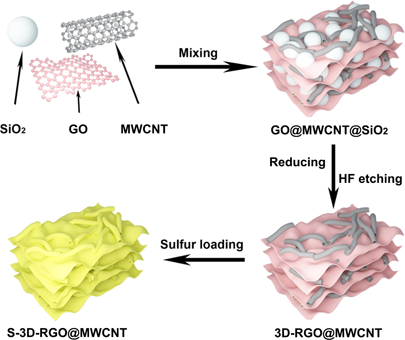
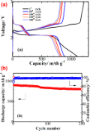
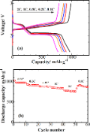
- mAh·g−1. After 200 charging/discharge cycles, a capacity of 805 mAh·g−1 and a coulombic efficiency of 98% were maintained, implying the shuttle effect was greatly suppressed by the composite matrix. In addition, the S-3D-RGO@MWCNT composite also exhibits an excellent rate capability. Keywords: carbon



Widening of the electroactivity potential range by composite formation – capacitive properties of TiO2/BiVO4/PEDOT:PSS electrodes in contact with an aqueous electrolyte
Beilstein J. Nanotechnol. 2019, 10, 483–493, doi:10.3762/bjnano.10.49
- candidates for storage because of fast charging/discharging processes, relatively simple structures, easy large-scale production and high power densities [5]. It is crucial to look for electrochemically stable electrode materials that exhibit high specific capacitance and can be rapidly and reversibly
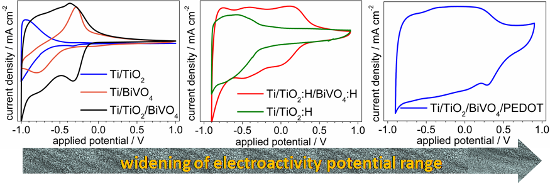
- rectangular shape of the cv curves is preserved for both low and high scan rates. Moreover, an almost linear relationship (R2 = 0.998) between scan rate and current density was obtained suggesting that prepared electrodes should not show a capacity drop as the current rate of charging/discharging increases




Advanced scanning probe lithography using anatase-to-rutile transition to create localized TiO2 nanorods
Beilstein J. Nanotechnol. 2019, 10, 412–418, doi:10.3762/bjnano.10.40
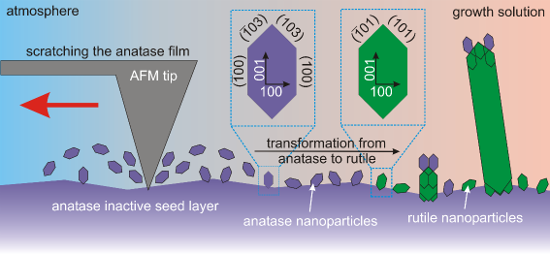
- growth observable at the breaking line. Nanorods growing around the breaking line might originate from anatase nanoparticles released during the breaking process. Besides surface roughening, charging is another candidate that could promote the growth on scratched regions. The tip causes a lot of friction
- charging by trapping of electrons from the electron beam in neutral traps such as OH groups [43]. However, this effect becomes significantly stronger with increasing beam intensity and remains for many days in a humid environment. Hence, it results more likely from electron-beam-induced surface smoothing
- [44][45] rather than from surface charging. The effect of the number of repetitions on the resulting structure is shown in Figure 4C. Even a single writing step (one scratch in forward and one in backward direction) is enough to obtain a clear contrast between the treated and the pristine sample


Transport signatures of an Andreev molecule in a quantum dot–superconductor–quantum dot setup
Beilstein J. Nanotechnol. 2019, 10, 363–378, doi:10.3762/bjnano.10.36
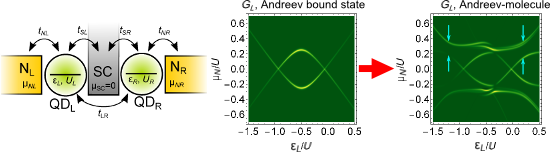
- bound states (ABSs) [33][34][35][36][37][38][39][40][41][42][43][44][45][46][47][48][49][50][51] via local Andreev reflection (LAR). Due to the charging energy on the QDs, the QD–SC–QD geometry prefers CAR over the LAR and leads to the expectation that CAR hybridizes the states of the two QDs



Nanoporous water oxidation electrodes with a low loading of laser-deposited Ru/C exhibit enhanced corrosion stability
Beilstein J. Nanotechnol. 2019, 10, 157–167, doi:10.3762/bjnano.10.15
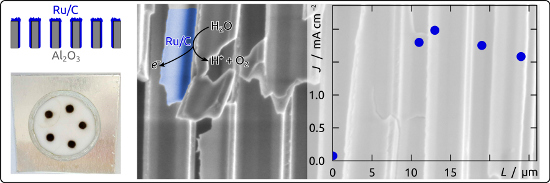
- system with a base pressure of 10−9 mbar. Adventitious carbon was removed from the surface by 1 min, 2 kV Ar+ ion sputtering. To prevent charging a combination of electron and ion neutralization was employed. The Ru 3d and O 1s XPS core level spectra were analyzed using a fitting routine which decomposes




Scanning probe microscopy for energy-related materials
Beilstein J. Nanotechnol. 2019, 10, 132–134, doi:10.3762/bjnano.10.12

- ongoing to address requirements of today and the future. These requirements are, for example, high power conversion efficiency, loss-free transport of energy, fast charging rates and high charging capacity. In order to fulfil these requirements, specific functional materials are being developed
Pull-off and friction forces of micropatterned elastomers on soft substrates: the effects of pattern length scale and stiffness
Beilstein J. Nanotechnol. 2019, 10, 79–94, doi:10.3762/bjnano.10.8





Zn/F-doped tin oxide nanoparticles synthesized by laser pyrolysis: structural and optical properties
Beilstein J. Nanotechnol. 2019, 10, 9–21, doi:10.3762/bjnano.10.2
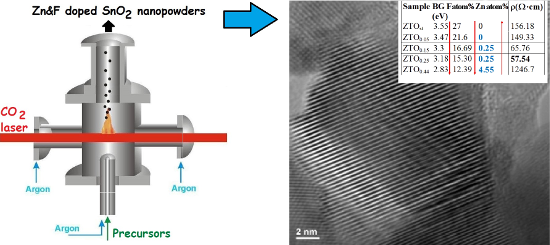
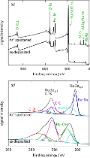
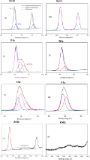
- in order to compensate the surface charging effects. From Figure 2 it can observed that in the case of ZTOst sample, Sn exhibits only one oxidation state, while the Zn doping is accompanied by the formation of a secondary SnO phase, see Figure 2a. Also, the binding energy of Sn in the Zn-doped SnO2



Hydrogen-induced plasticity in nanoporous palladium
Beilstein J. Nanotechnol. 2018, 9, 3013–3024, doi:10.3762/bjnano.9.280
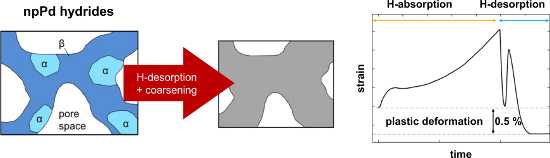
- counterparts considering the increasing importance of surface effects. The high surface-to-volume ratios in such materials allow for the control of bulk features by surface modifications. Electrostatic charging or electrochemical (surface) reactions are possible ways to influence metal surfaces in a well
- total, black curves) and, thus, hydrogen concentrations (compare Equation 1), while for desorption (red curves) the potential was held constant at −0.4 V similar to the potentiostatic experiment above (Figure 2). Monitoring the potential during the charging procedure revealed a transgression of the PdHβ
- reduction in double layer current of about 25% compared to the pristine, untreated npPd sample (black curve). The black curve shows a stronger contribution of pseudocapacitive surface charging, indicated by the larger deviation from the rectangular shape of ideal capacitors. A comparison of double-layer


Size limits of magnetic-domain engineering in continuous in-plane exchange-bias prototype films
Beilstein J. Nanotechnol. 2018, 9, 2968–2979, doi:10.3762/bjnano.9.276
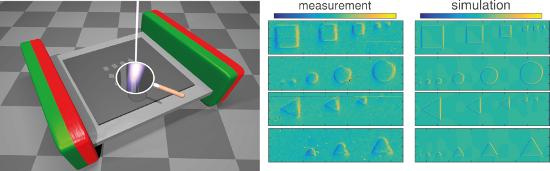
- resolution is limited by relatively thick polymer masks in combination with non-optimum edge steepness [36][37]. In addition, electrostatic charging of the mask [27] can lead to further beam broadening resulting in areas of gradually changing ion doses between bombarded and non-bombarded regions. Thus, at


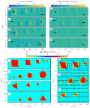


![[Graphic 63]](/bjnano/content/inline/2190-4286-9-276-i63.svg?max-width=637&scale=1.18182) .
. ![[Graphic 64]](/bjnano/content/inline/2190-4286-9-276-i64.svg?max-width=637&scale=1.18182) is the angle between the domain wall (DW) normal vector
is the angle between the domain wall (DW) normal vector ![[Graphic 65]](/bjnano/content/inline/2190-4286-9-276-i65.svg?max-width=637&scale=1.18182) and the local unidirectio...
and the local unidirectio...
Site-controlled formation of single Si nanocrystals in a buried SiO2 matrix using ion beam mixing
Beilstein J. Nanotechnol. 2018, 9, 2883–2892, doi:10.3762/bjnano.9.267
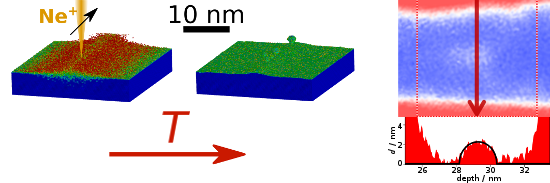
- NC-based SET device is to obtain lateral control over the formation of few or even a single Si NC using the ion beam approach. To obtain an estimate for the charging energy of the Coulomb island we use the self capacitance of a sphere C = 4πεε0rNC. In order to have Ec larger than 5 kT at room


Impact of the anodization time on the photocatalytic activity of TiO2 nanotubes
Beilstein J. Nanotechnol. 2018, 9, 2628–2643, doi:10.3762/bjnano.9.244
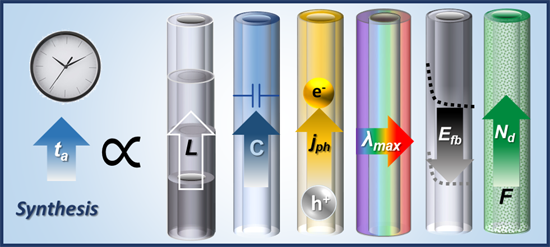
- fashion, where j corresponds to the charging of the electrode (i.e., capacitive current). This quasi-reversible behavior is indicative of a stable surface. In the potential range from 0.05 to 0.6 V/RHE, |j| increases for samples with higher ta and, since j is an extrinsic property, we attributed this to
- minimize the contribution of the charging current from the scan rate, linear-sweep voltammograms (LVS) were recorded at v = 5 mV/s in anodic direction from 0.05 to 1.0 V/RHE. A constant polarization at 0.05 V/RHE for 10 s was applied to the electrodes prior to running the LSV, as a pretreatment to minimize
- the initial charging spikes and to obtain a more accurate signal. The results are shown in Figure 5b and assessing those obtained from the CV measurements, provide support to the idea of j being a function of the nanotube length. The latter characteristic implies that the electrolyte is capable of


Pattern generation for direct-write three-dimensional nanoscale structures via focused electron beam induced deposition
Beilstein J. Nanotechnol. 2018, 9, 2581–2598, doi:10.3762/bjnano.9.240
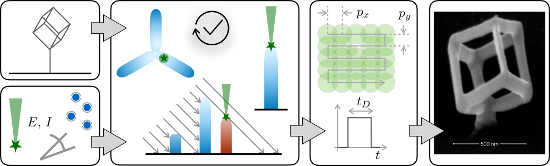
- addition, the resolution may suffer due to charging issues caused by the electron beam. Conversely, short dwell times increase the time fraction of the total process time in which the electron beam is not placed at a writing position but moved in between two consecutive writing positions due to the limited




Hydrothermal-derived carbon as a stabilizing matrix for improved cycling performance of silicon-based anodes for lithium-ion full cells
Beilstein J. Nanotechnol. 2018, 9, 2381–2395, doi:10.3762/bjnano.9.223
- requirements for automotive applications, e.g., extended driving range and fast charging ability. Such improvements can either be achieved by the optimized engineering of cell components or the development of new cell chemistries with advanced active materials [1][2][3][4][5][6]. In this context, it is
- -term cycling experiments were set as 0.01 V vs Li/Li+ and 1.50 V vs Li/Li+. During the rate performance experiments, cut-off potentials of 0.02 V vs Li/Li+ and 1.50 V vs Li/Li+ were chosen in order to avoid Li-metal plating at high charging rates. In the rate performance studies, specific charge
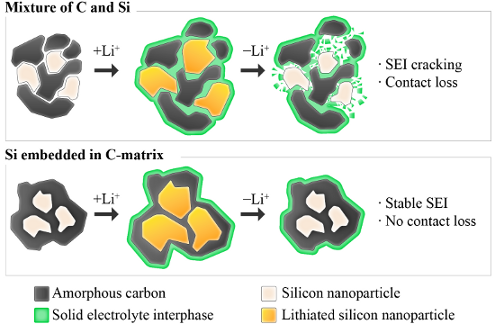
- at high charging rates. In order to verify if the incorporation of the Si into the carbon has a beneficial effect, a physical mixture of the pure carbon matrix and the pure Si-NPs was prepared in a ratio of 80:20, where the Si-NPs did not take part in the hydrothermal process. This mixture shows the