Search results
Search for "yellow" in Full Text gives 820 result(s) in Beilstein Journal of Organic Chemistry. Showing first 200.
The trans-influence in gold chemistry from a catalytic perspective
Beilstein J. Org. Chem. 2026, 22, 838–856, doi:10.3762/bjoc.22.66
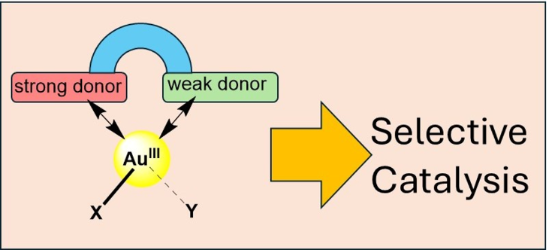
- isolated as a microcrystalline yellow solid that decomposes >−10 °C. The CO stretching frequency of 2167 cm−1 is 24 cm−1 higher than that of free 12CO and substantially higher than that of [(C^N^N)Pt–CO]+ (2094 cm−1). The calculated Au–CO bond enthalpy of −45.5 kcal/mol is about 7 kcal/mol less than that


Unsymmetrical sulfoxides with sterically hindered catechol fragment: synthesis, structure, electrochemical properties, and antiradical activity
Beilstein J. Org. Chem. 2026, 22, 828–837, doi:10.3762/bjoc.22.65
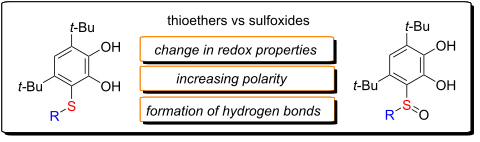
- color of the solution changes to pale yellow. This is confirmed by the appearance of an absorption maximum in the UV–visible spectrum at λmax = 402 nm (Figure S33 in Supporting Information File 1). This absorption band corresponds to a π→π* transition and is close to the λmax value characteristic of


Synthesis and structural elucidation of a novel bis-spirooxindole from isatin and ethylenediamine
Beilstein J. Org. Chem. 2026, 22, 813–820, doi:10.3762/bjoc.22.63
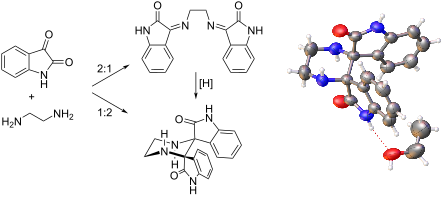
- give 25 as yellow crystals (1.06 g, 6.62 mmol, 67%). Mp = 169.5–170.4 °C; HRMS m/z: [M + H]+ calcd. for [C18H17N4O2 + H]+, 321.1352; found, 321.1358; IR (ATR) ν (cm−1): 3276, 1710, 1619, 1472, 744; 1H NMR (600 MHz, CD3OD) δ (ppm) 7.32 (ddd, J = 7.7, 1.1, 0.6 Hz, 2H, H4’, H4’’), 7.08 (td, J = 7.7, 1.2
- ’, C6’’), 127.7 (C, C3a’, C3’’a), 123.8 (CH, C4’, C4’’), 121.9 (CH, C5’, C5’’), 109.3 (CH, C7’, C7’’), 61.0 (C, C3’, C3’’), 38.1 (CH2, C1, C2). X-ray analysis of 25 [22][23][24]. Recrystallization of 25 in EtOH afforded a yellow crystal. Crystal data for C22H26N4O4 (M = 410.47 g/mol): monoclinic, space
- ). Reduction of 24 with NaBH4. NaBH₄ (95 mg, 2.52 mmol, 2 equiv) was added in portions to a stirred solution of 24 (0.40 g, 1.26 mmol, 1 equiv) in MeOH (15 mL) at room temperature. The mixture was stirred for 2 h, poured onto ice, and the resulting yellow precipitate of 25 was collected by filtration (295 mg


Knoevenagel condensation of 4,5- and 1,8-diazafluorenes
Beilstein J. Org. Chem. 2026, 22, 803–812, doi:10.3762/bjoc.22.62
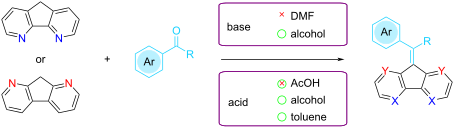
- and the data for compound 1,8-DPDAF is presented in Supporting Information File 1, note S1. Compound 4,5-DPDAF crystallizes as yellow needles. The conformation of the pyridine fragments is non-planar relative to the diazafluorene fragment due to sterical repulsion of the pyridine moieties and




Synthetic study of vic-bromination of diarylacetylenes, easy purification and separation
Beilstein J. Org. Chem. 2026, 22, 795–802, doi:10.3762/bjoc.22.61
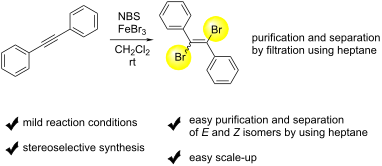
- CDCl3) δ 118.0, 128.4, 128.9, 129.1, 140.7 ppm; HRMS (ESI) m/z: [M + Na]+ calcd for C14H10Br2Na, 358.9041; found, 358.9028. (Z)-1,2-Dibromo-1,2-diphenylethylene (Z-2a) [7]: Yellow solid. 1H NMR (300 MHz, CDCl3) δ 7.10–7.22 (m, 10H) ppm; 13C NMR (75 MHz, CDCl3) δ 125.7, 128.0, 128.3, 129.8, 139.4 ppm



Halogenated azobenzene acrylates: from efficient solution photoswitching to stable solid-state photochromic materials
Beilstein J. Org. Chem. 2026, 22, 782–794, doi:10.3762/bjoc.22.60
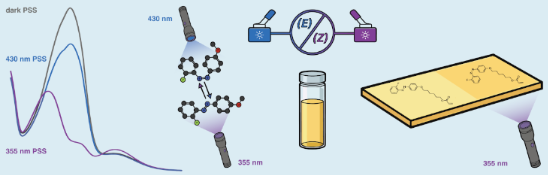
- film to study their behavior in the solid state at various concentrations (see the Supporting Information File 1 for a detailed procedure). Judging by naked eye, the E → Z photoswitch was clearly evident using monofluoro derivative 1a (Figure 10A–D). The original pale-yellow color changed into dark
- yellow upon irradiation with 355 nm LED (Figure 10A) reflecting the E → Z switch. The irradiated sample was kept in the dark at 22 °C and the magnitude of color change was visually verified after 20, 40, and 90 days as shown in Figure 10B–D. Even after 90 days in the dark, high color saturation was still


Synthesis of depressin, cryptomeridiol and 4-epi-cryptomeridiol enabled by a terpenoid chiral pool-producing platform
Beilstein J. Org. Chem. 2026, 22, 683–690, doi:10.3762/bjoc.22.53
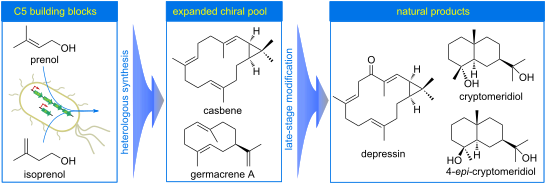
- derivative 16 (CCDC 2470579) as a brownish-yellow needle suitable for X-ray diffraction (Scheme 2b) [56][57], which confirmed the absolute configuration of the casbene skeleton and the position of the first allylic oxidation. It is also interesting to note that the three double bonds in this molecule are


Kinetic resolution of racemic planar-chiral vinylcymantrenes by molybdenum-catalyzed asymmetric metathesis dimerization
Beilstein J. Org. Chem. 2026, 22, 568–574, doi:10.3762/bjoc.22.42
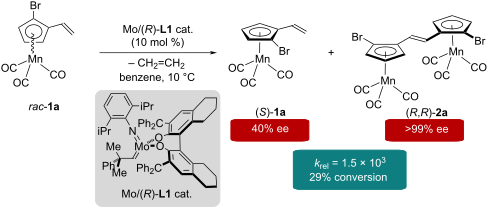
- configuration of (–)-2b Levorotatory AMD/KR product (–)-2b, which was obtained as in entry 8, Table 1 using Mo/(R)-L1 precatalyst, was recrystallized by slow diffusion of pentane into the concentrated diethyl ether solution. Crystals of (–)-2b were grown as light-yellow blocks. The X-ray crystallography


Molecular tweezer–peptide conjugates disrupt the protein–protein interaction between survivin and histone H3 essential in mitosis
Beilstein J. Org. Chem. 2026, 22, 557–567, doi:10.3762/bjoc.22.41
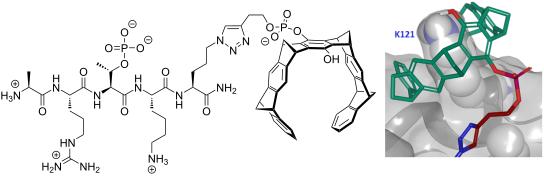
- vicinity of the histone H3 binding as well as the Ca2+ ion site are labeled and shown as CPK models. The tweezer skeleton is shown in green, the H3 peptide in yellow. Survivin–borealin–INCENP complex structures (PDB ID 2QFA) [5] with tweezer model, side and top views. The original design ("old tweezer
- threonine, complementary to the cationic surface patch on survivin. B) Click coupling (i) between the H3-T3ph peptide with C-terminal 5-azidoornithine 3 and butynyl tweezer 4a with subsequent deprotonation (ii) to the sodium salt of peptide tweezer 2a. Binding peptide yellow, ornithine grey, butynyl group




Experimental and DFT studies on the regioselective methanolysis of 5-azido-9-oxabicyclo[6.1.0]nonan-4-yl 4-nitrobenzoate isomers
Beilstein J. Org. Chem. 2026, 22, 547–556, doi:10.3762/bjoc.22.40
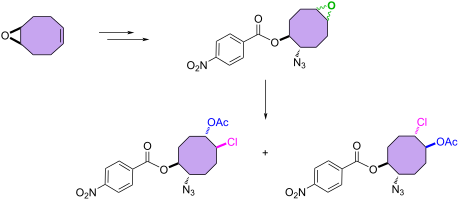
- . Purification by silica gel column chromatography eluting with EtOAc/hexane 5:95 provided azidol 7 [23] as slightly yellow oil (2.47 g, 14.77 mmol, 92%, lit. [23] 71%). 1H NMR (400 MHz, CDCl3) δ 5.69–5.61 (m, 1H), 5.60–5.52 (m, 1H), 3.79–3.65 (m, 2H), 2.56–2.36 (m, 2H), 2.27–2.09 (m, 4H), 1.81–1.67 (m, 2H); 13C
- slightly yellow crystals; mp 60–62 °C. 1H NMR (400 MHz, CDCl3) δ 8.29–8.19 (m, 4H, aromatic), 5.72–5.59 (m, 2H, H-4 and H-5), 5.36–5.27 (m, 1H, H-1), 3.96 (td, J = 9.2, 3.7 Hz, 1H, H-8), 2.60–1.71 (series of m, 8H, CH2); 13C NMR (100 MHz, CDCl3) δ 163.9, 150.8, 135.7, 131.1, 129.5, 128.3, 123.8, 77.7, 64.1
- at room temperature to obtain colourless crystals, mp: 101–102 °C. Compound 11 was recrystallized from the same solvent mixture at 0 °C and obtained as slightly yellow crystals, mp: 117–119 °C. (1S*,2S*,5S*,6S*)-6-Acetoxy-2-azido-5-chlorocyclooctyl 4-nitrobenzoate (10): 1H NMR (400 MHz, CDCl3) δ 8.34


Melifoliox B, a novel phloroglucin derivative isolated from Melicope barbigera (Rutaceae) and synthesis of new oxidation products from melifoliones A and B
Beilstein J. Org. Chem. 2026, 22, 535–546, doi:10.3762/bjoc.22.39
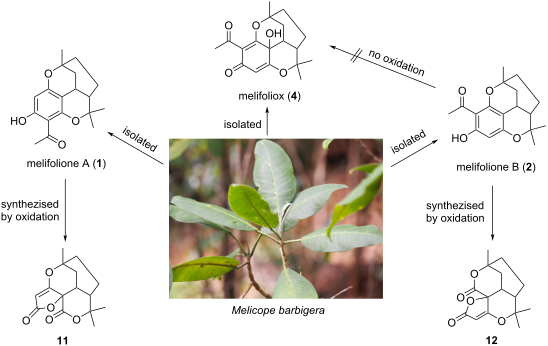
- mixture of melifolione A (1) and B (2) (181 mg, 0.6 mmol, ratio ca. 10:1) was dissolved in 16 mL acetonitrile. After addition of water (4 mL), the solution was cooled on ice and iodosobenzene diacetate (212 mg, 0.66 mmol) was added under stirring. The solution turned yellow and later orange. TLC control



Structural reassignment of compound 968, an allosteric glutaminase inhibitor
Beilstein J. Org. Chem. 2026, 22, 455–460, doi:10.3762/bjoc.22.33
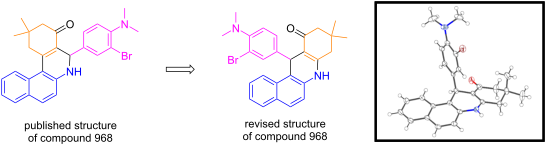
- , 130.92, 129.02, 128.68, 128.12, 127.49, 124.25, 122.93, 120.88, 118.45, 117.59, 116.53, 107.43, 50.77, 44.22, 35.30, 32.80, 29.56, 27.06. X-ray crystallography Crystals of compound 2 were grown by slow evaporation from a saturated acetone solution. A yellow, multi-faceted block of suitable size (0.362


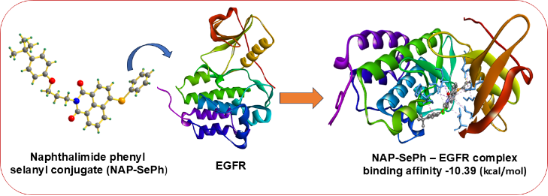
Synthesis and anti-cancer activity of naphthalimide–organylselanyl conjugates
Beilstein J. Org. Chem. 2026, 22, 416–435, doi:10.3762/bjoc.22.29
- mg, 0.75 mmol) in DMSO (7.5 mL) at room temperature under a nitrogen atmosphere. The mixture was stirred until the yellow colour had disappeared. The bromo compound 12 (465 mg, 1 mmol) was dissolved in THF (7.5 mL) and slowly added to the above reaction mixture, followed by stirring for an additional
- magnesium sulfate (MgSO₄) and concentrated under low pressure. Column chromatography was performed to purify the crude product using a solvent ratio of petroleum ether to ethyl acetate (85:15), which yielded a yellow solid. Yield: (295 mg, 54%). mp: 156–157 °C; 1H NMR (400 MHz, CDCl3) δ 8.62 (d, J = 7.3 Hz
- water was added to the reaction mixture, and the mixture was extracted with ethyl acetate. The organic layers were washed with water and brine, then dried on anhydrous MgSO4 and concentrated under reduced pressure. The crude yellow liquid was purified by column chromatography (petroleum ether/ethyl




Conformational analysis of difluoromethylornithine: factors influencing its gas-phase and bioactive conformations
Beilstein J. Org. Chem. 2026, 22, 237–243, doi:10.3762/bjoc.22.17
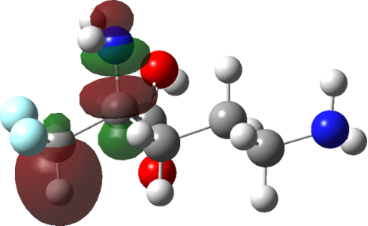
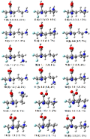
- amino acid residues and water molecules, while the ligand is delineated by a contour line to distinguish it from the binding cavity. Lowest-energy type-I, type-II, and type-III conformers of the zwitterionic form of (S)-DFMO. Color labels: H = blue, C = pink, N = orange, O = red, F = yellow. DFT




Base-promoted deacylation of 2-acetyl-2,5-dihydrothiophenes and their oxygen-mediated hydroxylation
Beilstein J. Org. Chem. 2026, 22, 192–204, doi:10.3762/bjoc.22.13
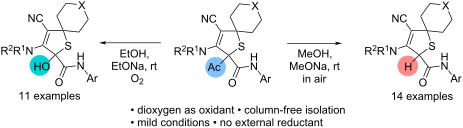
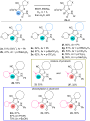
- elemental sulfur S6. Probably, the reaction is accompanied by the desulfurization of the oxidized intermediate, which causes the yellow color of the reaction solutions. The proposed mechanism for the developed transformations is depicted in Scheme 6. The reaction of dihydrothiophene 1a with sodium ethoxide




Streptoquinolines A and B, new antibacterial meroterpenoids produced by Streptomyces sp. TMPU-A0679
Beilstein J. Org. Chem. 2026, 22, 185–191, doi:10.3762/bjoc.22.12
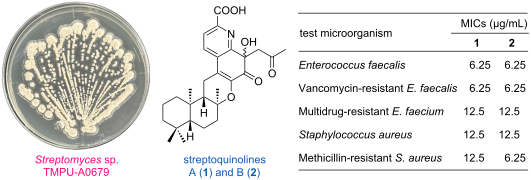
- , compounds 1 and 2 eluted with retention times of 37 and 34 min, respectively. Each eluate was concentrated and dried in vacuo to yield pure samples of 1 (7.50 mg) and 2 (8.05 mg), respectively, as a yellow oil. Assessment of MICs using the broth microdilution method Antibacterial activity was evaluated


Symmetrical D–π–A–π–D indanone dyes: a new design for nonlinear optics and cyanide detection
Beilstein J. Org. Chem. 2026, 22, 131–142, doi:10.3762/bjoc.22.6
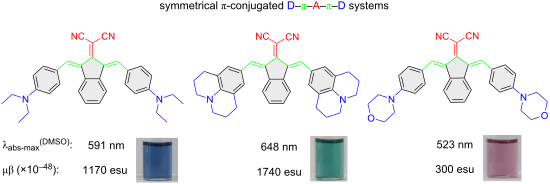
- groups is disrupted. These results strongly suggest the addition of cyanide to the vinyl bridge. Furthermore, the color of dyes 2a–c, blue, green, and pink, respectively, under ambient light changed to yellow when interacting with cyanide. The interaction mechanism was determined by 1H NMR, and the


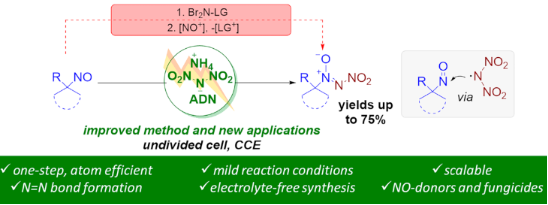
Sustainable electrochemical synthesis of aliphatic nitro-NNO-azoxy compounds employing ammonium dinitramide and their in vitro evaluation as potential nitric oxide donors and fungicides
Beilstein J. Org. Chem. 2025, 21, 2739–2754, doi:10.3762/bjoc.21.211
- ]/CPCM(MeCN) level of theory (in the case of >15 conformers, 15 most stable according to GFN2-xTB were analyzed). CV-curves of 0.01 M solutions of a) 1a (blue), b) 1f (azure), c) 1c (pink), d) 1i (yellow), e) S4 (red), f) S3 (green), g) S2 (brown), and h) S1 (orange) in 0.1 M n-Bu4NBF4 solution in MeCN

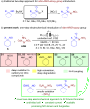




Total synthesis of asperdinones B, C, D, E and terezine D
Beilstein J. Org. Chem. 2025, 21, 2730–2738, doi:10.3762/bjoc.21.210
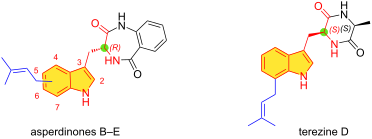
- equivalents of H2SO4 in water to obtain a mixture of six C-prenylated tryptophans from which the 7-prenyl isomer could be isolated in 4% yield after chromatography on a 10 g scale [27]. This direct prenylation method was then adapted for the synthesis of terezine D (6), which was isolated as a pale-yellow


Recent advancements in the synthesis of Veratrum alkaloids
Beilstein J. Org. Chem. 2025, 21, 2657–2693, doi:10.3762/bjoc.21.206
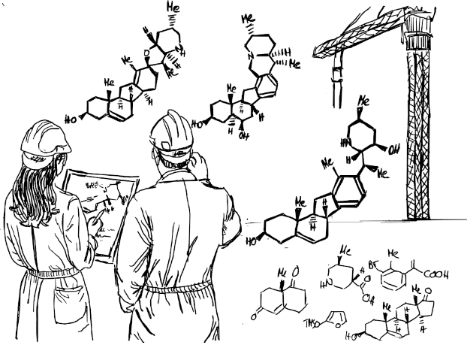
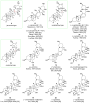
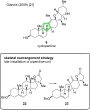
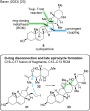
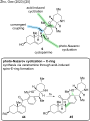
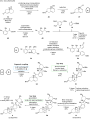
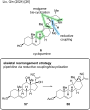
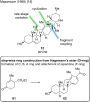
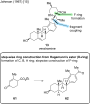
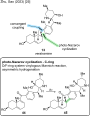
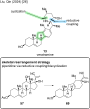
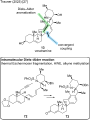
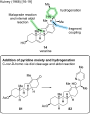
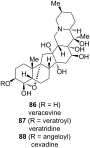
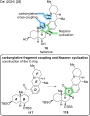
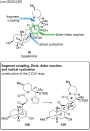
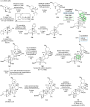
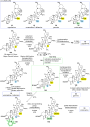
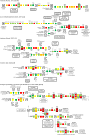
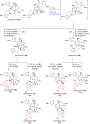
- of green for strategic connections, yellow for neutral, e.g., functional group interconversion and isomerization, orange for non-strategic reactions, and red for protecting group (PG) manipulations (Scheme 3). Protecting group manipulations refer to any protection or deprotection of a functional
- the semisynthesis of Liu/Qin [26] 15 years later. The only non-green transformations displayed at the start were a protecting group installation (red) and a condensation (yellow), which was needed for the C–H activation (light green). All other transformations connect either C–C or C–heteroatom bonds
















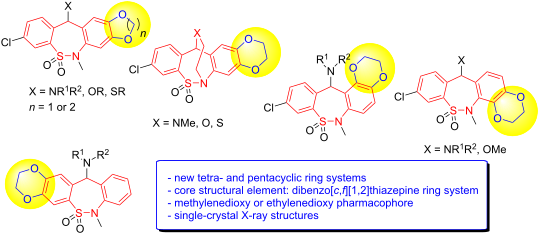
Synthesis of new tetra- and pentacyclic, methylenedioxy- and ethylenedioxy-substituted derivatives of the dibenzo[c,f][1,2]thiazepine ring system
Beilstein J. Org. Chem. 2025, 21, 2645–2656, doi:10.3762/bjoc.21.205
- (100 mL), the combined organic phases were dried over Na2SO4, evaporated, and the oily residue was triturated with a little amount of acetone to afford a second crop of crude 7 (8.45 g of pale yellow solid). The two crops were purified by dry-column flash chromatography on a short silica gel column
- chromatography (short aluminum oxide column, eluent: heptane/DCM 1:1, DCM) and isomer 8 (0.62 g, 2%) was isolated as pale yellow crystals. Mp 254‒256 °C (CH3CN); IR (KBr): 1665, 1485, 1344, 1111, 1061, 859 cm−1; 1H NMR (500 MHz, CDCl3): 7.96 (d, 4J = 2.0 Hz, 1H), 7.94 (d, 3J = 8.6 Hz, 1H), 7.63 (dd, 4J = 2.1 Hz
- flash chromatography on a short aluminum oxide column (thickness of stationary phase: 30 mm, eluent: heptane/DCM 1:1, DCM, DCM/MeOH 100:2). After evaporation of solvents in vacuo 21a (2.87 g, 91%) was obtained as pale yellow oil, which slowly solidified upon standing at ambient temperature. The melt


Synthesis of the tetracyclic skeleton of Aspidosperma alkaloids via PET-initiated cationic radical-derived interrupted [2 + 2]/retro-Mannich reaction
Beilstein J. Org. Chem. 2025, 21, 2470–2478, doi:10.3762/bjoc.21.189
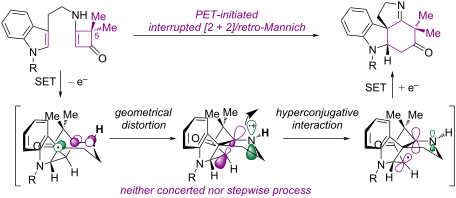
- free energies were calculated at the B3LYP-D3/def2-tzvp//B3LYP/6-31G(d) level in MeCN. b) Spin density of IN4 (isovalue = 0.004). c) IRC analysis of TS2 (red line) and bond-length changes of C19–C3 (yellow line) and C19–C12 (blue line) along IRC path. d) Mayer bond order changes of selected structures


The high potential of methyl laurate as a recyclable competitor to conventional toxic solvents in [3 + 2] cycloaddition reactions
Beilstein J. Org. Chem. 2025, 21, 2389–2415, doi:10.3762/bjoc.21.184
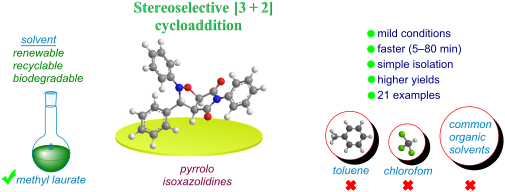
- solvents. Furthermore, the evidence suggests that the majority of these solvents is hazardous and their utilization is to be avoided. As demonstrated in Figure 8a, the color of the spheres of the customary proportional solvents employed in [3 + 2] cycloadditions is red or yellow, thereby substantiating the


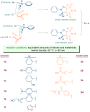


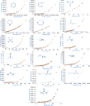


Recent advances in Norrish–Yang cyclization and dicarbonyl photoredox reactions for natural product synthesis
Beilstein J. Org. Chem. 2025, 21, 2315–2333, doi:10.3762/bjoc.21.177
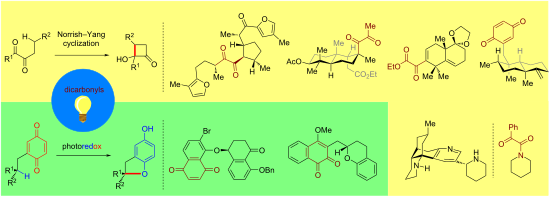
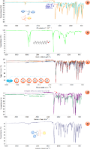
- : reactive substrates exhibited λmax < 460 nm (yellow-orange), whereas unreactive ones showed λmax > 460 nm (dark red-purple). This suggests insufficient excitation energy for Norrish type-II hydrogen abstraction in the latter. Such chromophore-dependent reactivity provides critical insights for designing




Insoluble methylene-bridged glycoluril dimers as sequestrants for dyes
Beilstein J. Org. Chem. 2025, 21, 2302–2314, doi:10.3762/bjoc.21.176
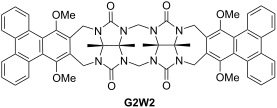
- , green; H-bonds, yellow-red striped. Cross-eyed stereoview of: a) a molecule of G2W1 in the crystal, b) the packing of G2W1 along the xz-diagonal in the crystal. Color code: C, grey; H, white; N, blue; O, red. a) Plot of removal efficiency of methylene blue (240 μM, 1 mL) from water after incubating with