Search results
Search for "hydration" in Full Text gives 142 result(s) in Beilstein Journal of Organic Chemistry.
Possible bi-stable structures of pyrenebutanoic acid-linked protein molecules adsorbed on graphene: theoretical study
Beilstein J. Org. Chem. 2024, 20, 570–577, doi:10.3762/bjoc.20.49
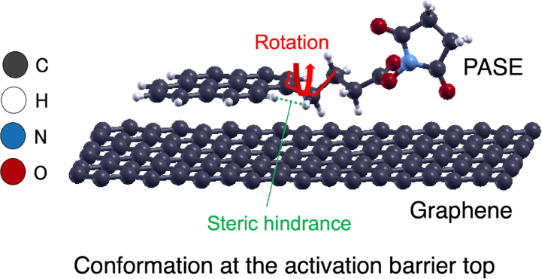
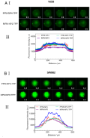
- molecules because the chain portion of PASE turns upward. Therefore, the stabilization energy of hydrogen-bond formation is greater in conformation 2 than in conformation 1. To improve the stability of conformation 2, hydration effects by electrostatic interactions between PASE and the solvent are also
- important. A selective hydration of the polar moiety while keeping the pyrene moiety stable can relatively strengthen the stability of conformation 2. Thus, as the polarity of the solvent increases, the probability of conformation 2 appearance is expected to increase. Mechanism of bi-stability in PASE on
- molecule turns upward, increasing the number of sites that can form hydrogen bonds with water molecules in conformation II. Therefore, the formation of hydrogen bonds can stabilize conformation II relatively more strongly than conformation I. The hydration effect also improves the stability of conformation


Ligand effects, solvent cooperation, and large kinetic solvent deuterium isotope effects in gold(I)-catalyzed intramolecular alkene hydroamination
Beilstein J. Org. Chem. 2024, 20, 479–496, doi:10.3762/bjoc.20.43
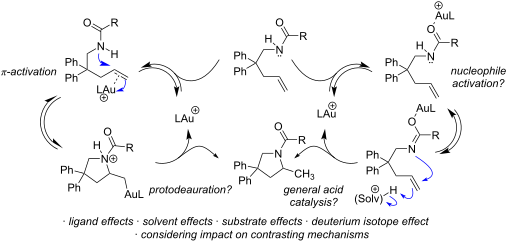
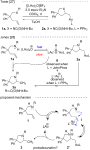
- less than half complete at the transition state [79]. In foundational work on alkene hydration by Evans and Kirby, a general acid-catalyzed mechanism is concluded, and small isotope effects are observed despite H–O bond breaking in the transition state [80]. In an excellent study by Borhan and co







1-Butyl-3-methylimidazolium tetrafluoroborate as suitable solvent for BF3: the case of alkyne hydration. Chemistry vs electrochemistry
Beilstein J. Org. Chem. 2023, 19, 1966–1981, doi:10.3762/bjoc.19.147
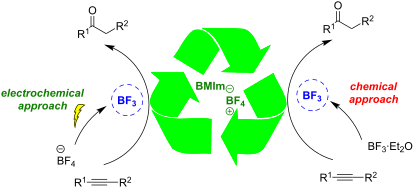
- , UK Department of Chemistry, Sapienza University of Rome, piazzale Aldo Moro, 5, 00185 Rome, Italy 10.3762/bjoc.19.147 Abstract In order to replace the expensive metal/ligand catalysts and classic toxic and volatile solvents, commonly used for the hydration of alkynes, the hydration reaction of
- costs. The developed method was efficaciously applied to different alkynes, achieving the desired hydration products with good yields. The results obtained using a conventional approach (i.e., adding BF3·Et2O) were compared with those achieved using BF3 electrogenerated in BMIm-BF4, demonstrating the
- possibility of obtaining the products of alkyne hydration with analogous or improved yields, using less hazardous precursors to generate the reactive species in situ. In particular, for terminal arylalkynes, the electrochemical route proved to be advantageous, yielding preferentially the hydration products vs


Effects of the aldehyde-derived ring substituent on the properties of two new bioinspired trimethoxybenzoylhydrazones: methyl vs nitro groups
Beilstein J. Org. Chem. 2023, 19, 1713–1727, doi:10.3762/bjoc.19.125
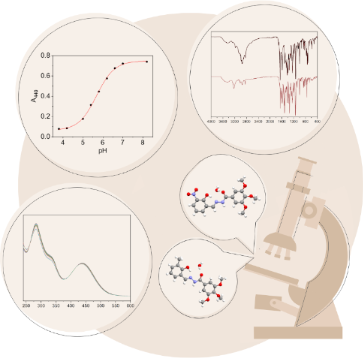
- beige and light-yellow solids with 78% and 44% yield, respectively. Thermal analyses between 25 and 350 °C were performed in order to verify the hydration status of the bulk. Regarding hdz-CH3, a weight loss of 9.78% from around 80 to 190 °C was observed, suggesting the presence of two crystallization




CO2 complexation with cyclodextrins
Beilstein J. Org. Chem. 2023, 19, 1021–1027, doi:10.3762/bjoc.19.78
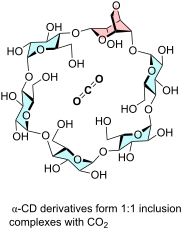
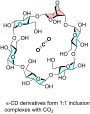
- split over two positions yielding in total 5.75 mol of water per CO2. The hydration is similar to that of native α-CD [13] and that of the krypton inclusion complex which has 5.28 water/Kr [14]. The CO2 molecule refines with an optimal occupancy of 0.84 and linear geometry (178.2(6)o) with C–O bond
- change in spectrum of 7 provided 7 and CO2 compete for the binding site. To avoid problems with formation of hydrogencarbonate the experiments were conducted in a buffer at pH 3 where only a minor fraction of the carbonic acid (pKa1 = 3.6) is dissociated and since the hydration constant of CO2 is small


Photoredox catalysis enabling decarboxylative radical cyclization of γ,γ-dimethylallyltryptophan (DMAT) derivatives: formal synthesis of 6,7-secoagroclavine
Beilstein J. Org. Chem. 2023, 19, 918–927, doi:10.3762/bjoc.19.70
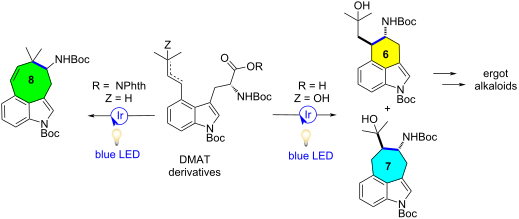
- interconvertible to each other by hydration or dehydration, i.e., a plausible precursor of the allylic alcohol would be the diene, and vice versa [90]. Since both 8 and 10 are easily obtainable from 2 by Mozoroki–Heck coupling with commercially available 2-methyl-3-buten-2-ol, ester hydrolysis (LiOH in THF/H2O


Nucleophile-induced ring contraction in pyrrolo[2,1-c][1,4]benzothiazines: access to pyrrolo[2,1-b][1,3]benzothiazoles
Beilstein J. Org. Chem. 2023, 19, 646–657, doi:10.3762/bjoc.19.46
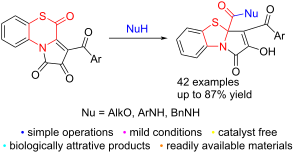
- (toluene, acetonitrile, DMSO-d6) at room temperature, or when these solutions were slightly heated, the compounds 5a,b,e dissociated to form APBTTs 1 (the solutions got violet color, characteristic of compounds 1) (Scheme 10). In the presence of water (including the atmospheric moisture), hydration




Transition-metal-catalyzed domino reactions of strained bicyclic alkenes
Beilstein J. Org. Chem. 2023, 19, 487–540, doi:10.3762/bjoc.19.38
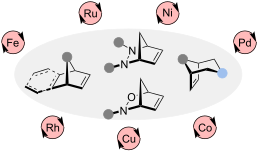
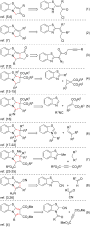
- bicyclic scope was limited as other bicycles such as norbornene failed to react. The authors propose the catalytic cycle begins with the Rh(III)-catalyzed hydration of the alkynol to produce 186 followed by a Sc(III)-catalyzed addition to form the transient hemiketal 187. Ortho-C–H activation generates 188











Discrimination of β-cyclodextrin/hazelnut (Corylus avellana L.) oil/flavonoid glycoside and flavonolignan ternary complexes by Fourier-transform infrared spectroscopy coupled with principal component analysis
Beilstein J. Org. Chem. 2023, 19, 380–398, doi:10.3762/bjoc.19.30
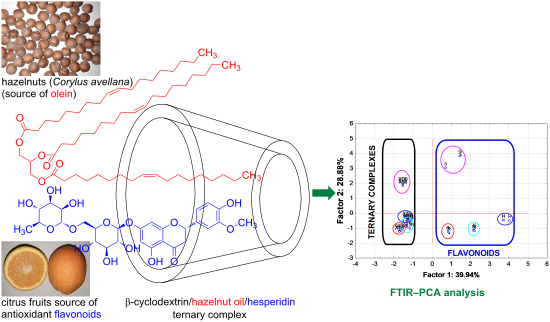
- %. The difference in the yield can be explained by the level of hydration, as was determined by TG (see below). For the 1:1:1 complexes, the mass loss is half in comparison with the water content of β-CD (6.4–7.4% for complexes and 14% for β-CD hydrate). On the other hand, the mass loss of the 3:1:1
- complexes is much higher (e.g., 11.8% for X3N complex). As a consequence, the 1:1:1 complexes lose relatively more hydration water than the corresponding 3:1:1 complexes. This can be explained by the high level of complexation for the 1:1:1 complexes. This aspect could be confirmed by thermal analysis
- especially appear for OH, CC and CH/CH2 bonds and groups. However, CD specific bands also appear for CH groups in the CD ring and α-type glycosidic bonds. Thus, a broad FTIR band corresponding to the stretching vibration of the O–H bonds in β-CD and hydration water molecules appears at ≈3301 cm−1. A weak



Combining the best of both worlds: radical-based divergent total synthesis
Beilstein J. Org. Chem. 2023, 19, 1–26, doi:10.3762/bjoc.19.1
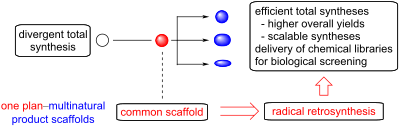
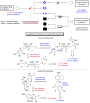
- reactions of transition metal hydrides (Fe, Co, Mn, etc) with alkenes (e.g., Mukaiyama hydration) [20]. The last decade saw the development of milder methods for generating carbon-centered radicals as the advancement of their reactivity in cross-coupling reactions, the concept of photoredox catalysis [21
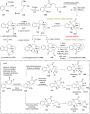
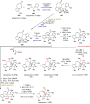
- Mukaiyama hydration [20] to furnish natural complexity. A similar approach was devised for the synthesis of modified meroterpenoids chevalone A (52), taondiol (53), decaturin E (54), and stypodiol (57, Scheme 4). For this purpose, tricycle 45 was prepared from compound 44 in gram-scale quantities by HAT
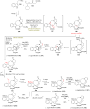
- (dba)3, SPhos, and Et3N in 86% yield. Reduction of the double bond with Pd/C followed by dual Stille coupling for the introduction of two methyl groups and Mukaiyama hydration utilizing Mn(dpm)3 and PhSiH3 furnished the misassigned structure for dysiherbol A (79). A revised structure was finally








Inline purification in continuous flow synthesis – opportunities and challenges
Beilstein J. Org. Chem. 2022, 18, 1720–1740, doi:10.3762/bjoc.18.182
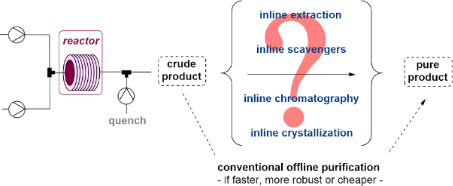
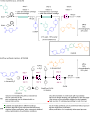
- technique after a synthetic transformation are highlighted in the following section (Scheme 14, Table 3). A continuous flow crystallization was performed using a trisegmented tubular crystallizer (KRAIC) coupled with a catalytic hydration of pyrazine carbonitrile [115]. After passing the reaction setup, the




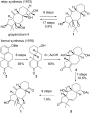
Total synthesis of grayanane natural products
Beilstein J. Org. Chem. 2022, 18, 1707–1719, doi:10.3762/bjoc.18.181
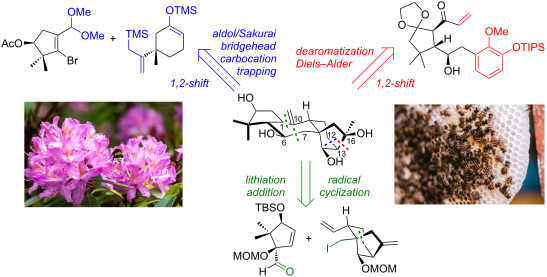
- enone 10 to the corresponding allylic alcohol, followed by a Au-catalyzed alkyne hydration, providing hemiketal 11. This intermediate was in equilibrium with hydroxy-ketone 12, which was suitable for a SmI2-promoted cyclization, affording intermediate 13 selectively, already bearing rings C and D. The
- corresponding ketone was achieved using Dess–Martin periodinane with a pyridine buffer. Addition of Me3SiCH2Li efficiently afforded the Peterson adduct 33. The 1,1-disubtituted alkene was then submitted to Mukaiyma hydration to form the tertiary alcohol, in presence of Mn(dpm)3, PhSiH3 and O2. Then, the ketone
- ketone methylation gave access to 56. Directed C1–C5 vanadium-mediated epoxidation followed by DBU treatment and TBS deprotection afforded 57 in one pot. The tertiary alcohol 58 was obtained as a single diastereomer after hydration of position C18. Subsequent reduction with DIBAL-H gave the desired




Preparation of β-cyclodextrin-based dimers with selectively methylated rims and their use for solubilization of tetracene
Beilstein J. Org. Chem. 2022, 18, 1596–1606, doi:10.3762/bjoc.18.170
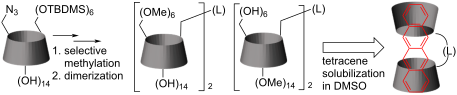
- titration of a DMSO to a DMSO with 5 vol % of water was carried out to manifest the contamination with water (see Supporting Information File 1). Therefore, the exothermic signal from the dilution of CDs in DMSO was attributed to the hydration of hydroxy and, to a lesser extent, methoxy groups from


Molecular diversity of the base-promoted reaction of phenacylmalononitriles with dialkyl but-2-ynedioates
Beilstein J. Org. Chem. 2022, 18, 991–998, doi:10.3762/bjoc.18.99

- produced a bridged cyclic 2-oxabicyclo[2.2.1]hept-5-ene D. The further hydration of intermediate D gave intermediate E, which was in turn transferred to cyclopentenyl intermediate F by the ring opening of the bridge ring. In the cyclopentenyl intermediate F, the hydroxy group and the amide group clearly


On Reuben G. Jones synthesis of 2-hydroxypyrazines
Beilstein J. Org. Chem. 2022, 18, 935–943, doi:10.3762/bjoc.18.93
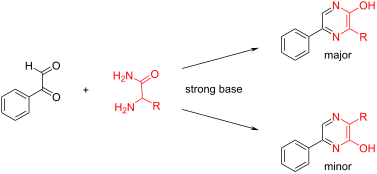
- amine) on the most electrophilic component of the α-ketoaldehyde (its aldehyde) to give intermediate 5. However, the ensuing cyclization (via a hydration of its imine bond to allow for a rotation) would then lead to compound 4 which is rarely the major reaction product. Since compound 3 is the main


Cs2CO3-Promoted reaction of tertiary bromopropargylic alcohols and phenols in DMF: a novel approach to α-phenoxyketones
Beilstein J. Org. Chem. 2022, 18, 420–428, doi:10.3762/bjoc.18.44
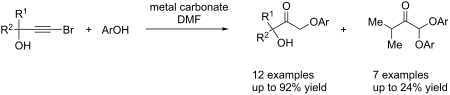
- highly selective hydration/acylation of tertiary bromopropargylic alcohols with carboxylic acids promoted by alkali metal carbonates [24]. The reaction proceeds via the ring-opening of 1,3-dioxolan-2-one intermediates formed with hydroxy and alkynyl groups of bromopropargylic alcohol and alkali metal
- in 6–9% preparative yield. Hydrocarbonates CsHCO3 and KHCO3 were also tested in the reaction, which gave 5-bromomethylene-1,3-dioxolan-2-one 6a as a major product in 29–36% yield (Table 1, entries 11 and 12). Considering that hydration occurs during the formation of phenoxyketone 4a, we added water
- formation of phenoxyhydroxyketone 4 proceeds via 1,3-dioxolan-2-one 6 generated from bromopropargylic alcohol 1 and Cs2CO3. Then, Br-substitution/hydration of 6 and the release of CO2 give product 4 (Scheme 7). Apparently, diphenoxyketone 5 results from decarboxylative conversion of 1,3-dioxolan-2-one 7


Tenacibactins K–M, cytotoxic siderophores from a coral-associated gliding bacterium of the genus Tenacibaculum
Beilstein J. Org. Chem. 2022, 18, 110–119, doi:10.3762/bjoc.18.12
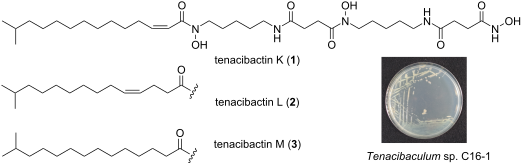
- /succinic acid module (Scheme 1, paths E1 and E2). The third elimination product, C15-ketene (structure in square brackets, Scheme 1) was not observed, but a pentadecenoate anion, appearing at m/z 239, warranted the existence of fragmentation path E3 and also the chain length of the acyl unit. Hydration of


α-Ketol and α-iminol rearrangements in synthetic organic and biosynthetic reactions
Beilstein J. Org. Chem. 2021, 17, 2570–2584, doi:10.3762/bjoc.17.172
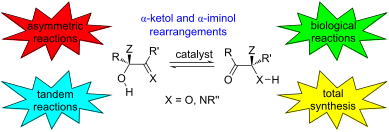
- . hypothesized that by conducting the reaction in the presence of water, the reaction would be diverted to an initial hydration followed by an α-ketol rearrangement [10]. First, it was determined with model 1-alkynylcyclobutanol derivative 24 that in anhydrous conditions, the major product was 25, resulting from
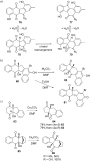
- the expected direct ring expansion (Figure 7). When the reaction was repeated in the presence of a single drop of water, however, only product 26 was observed, presumably by the hydration–rearrangement sequence. The intermediacy of the cyclobutyl α-ketol 27 was indirectly confirmed using diphenyl
- hypothesized by several groups that one could be the biological precursor of the other by means of a reversible hydration–rearrangement–dehydration sequence (Figure 16a) [24][25][26]. The presence of the diazo group in intermediates 78 and 79 is noteworthy in that this functional group has not yet been




Recent advances in the tandem annulation of 1,3-enynes to functionalized pyridine and pyrrole derivatives
Beilstein J. Org. Chem. 2021, 17, 2462–2476, doi:10.3762/bjoc.17.163
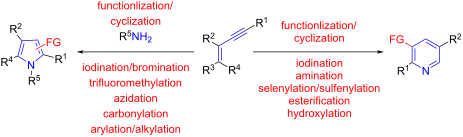
- corresponding plausible mechanism is shown in Scheme 19. Firstly, Au-coordinated alkyne undergoes regioselective hydration to form intermediate 48. Then, intramolecular nucleophilic attack by azide occurs to give 2-carbonyl intermediate 49. Subsequently, intermediate 49 will undergo aromatization as well as the




Synthesis of 5-arylacetylenyl-1,2,4-oxadiazoles and their transformations under superelectrophilic activation conditions
Beilstein J. Org. Chem. 2021, 17, 2417–2424, doi:10.3762/bjoc.17.158
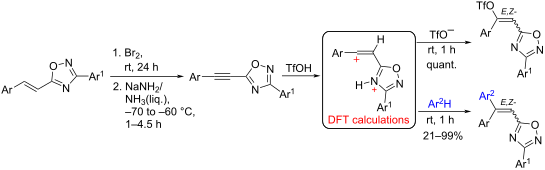
- ), oxadiazole 3a gave the product of hydration of the acetylene bond (4d, yield of 65%) existing in solution as equilibrium between ketone and enol forms in a ratio of 1.2:1 according to NMR data (see Supporting Information File 1). Then, reactions of 5-acetylenyl-1,2,4-oxadiazole 3a–d with arenes (benzene and


Post-functionalization of drug-loaded nanoparticles prepared by polymerization-induced self-assembly (PISA) with mitochondria targeting ligands
Beilstein J. Org. Chem. 2021, 17, 2302–2314, doi:10.3762/bjoc.17.148
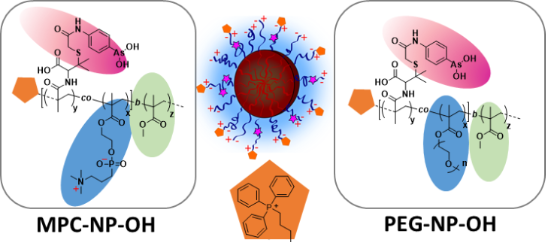
- of hydrophobic groups in the surface can reduce the hydration and limit cellular uptake [51][52]. It is therefore evident that more studies such as in-depth scattering studies are needed to fully elucidate the structure of the micelle [53]. Although TPP is present, it may not be fully available on






Synthesis of O6-alkylated preQ1 derivatives
Beilstein J. Org. Chem. 2021, 17, 2295–2301, doi:10.3762/bjoc.17.147
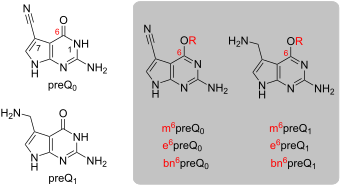
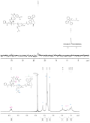
- solved by a hydration reaction sequence on a well-soluble dimethoxytritylated precursor via in situ oxime formation. The synthetic path now provides a solid foundation to access O6-alkylated 7-aminomethyl-7-deazaguanines for the development of RNA labeling tools based on the preQ1 class-I riboswitch
- aminomethyl group is accomplished by a hydration reaction sequence via in situ oxime formation. The route now provides a solid basis to generate O6-alkylated preQ1 derivatives for the development of RNA labeling tools utilizing the RNA scaffold of the preQ1 class-I riboswitch. Experimental General. Chemical


Constrained thermoresponsive polymers – new insights into fundamentals and applications
Beilstein J. Org. Chem. 2021, 17, 2123–2163, doi:10.3762/bjoc.17.138
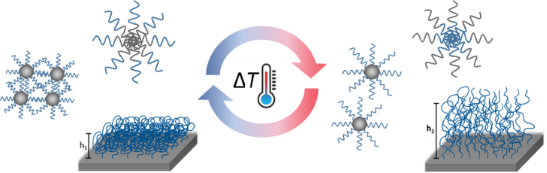
- entropic effect characterized by negative ∆mH and ∆mS values. The essential structural feature of such polymers is their amphiphilic structure of hydrophobic domains and hydrophilic groups, which can form hydrogen bonds with water. These interactions result in a highly ordered hydration shell when the
- for ∆mH and, due to the ordered hydration structures, to a negative entropy of mixing. As soon as the turbidity temperature is reached, the hydrophobic effect becomes dominant and water molecules are released, leading to a collapse of the hydration shell and a significant increase in entropy. The


An initiator- and catalyst-free hydrogel coating process for 3D printed medical-grade poly(ε-caprolactone)
Beilstein J. Org. Chem. 2021, 17, 2095–2101, doi:10.3762/bjoc.17.136
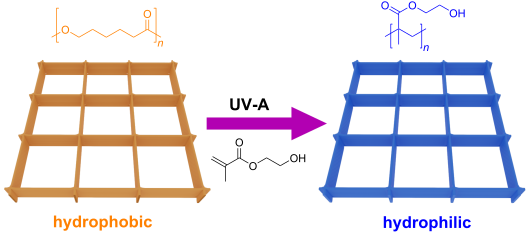
- wettability. However, both graphs also show a time-dependent wettability decrease in the first 30 min after the withdrawal from immersion which might be in consequence of a hydration loss through water evaporation. Interestingly, this tendency is only followed by the dried PHEMA-coated sample and not by the
- dried pristine PCL scaffold. An explanation for this observation might be PHEMA´s ability to absorb water as well as the relative indistinct hydration state of PCL compared to PHEMA when fully hydrated. Toluidine blue staining was used as a rapid, colorimetric readout as it selectively binds to PHEMA


Progress and challenges in the synthesis of sequence controlled polysaccharides
Beilstein J. Org. Chem. 2021, 17, 1981–2025, doi:10.3762/bjoc.17.129