Search results
Search for "cyclohexane" in Full Text gives 294 result(s) in Beilstein Journal of Organic Chemistry. Showing first 200.
Radical cation Diels–Alder reactions of arylidene cycloalkanes
Beilstein J. Org. Chem. 2022, 18, 1100–1106, doi:10.3762/bjoc.18.112
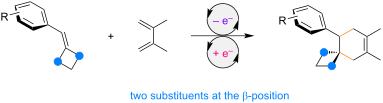
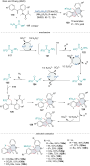
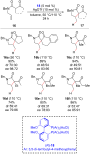
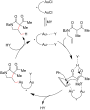
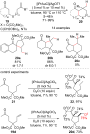
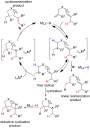
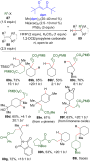
- compound 9 was obtained in good yield. The arylidene cyclopentane 6 and cyclohexane 7 were found to be less effective for the reaction and in particular, the former (6) was almost totally unsuccessful. Although the mechanism remains unclear, Knowles and Romanov-Michailidis recently reported that a similar


On Reuben G. Jones synthesis of 2-hydroxypyrazines
Beilstein J. Org. Chem. 2022, 18, 935–943, doi:10.3762/bjoc.18.93
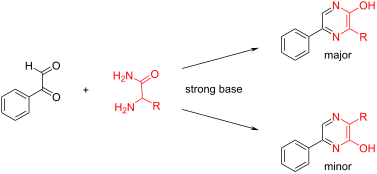
- relevant mixtures of cyclohexane and ethyl acetate, the complete elution of the less polar but also much less soluble 3,6-substituted isomers 4{1,1} or 4{1,2} took place before the occurrence of the fraction containing the more polar 3,5-substituted 2-hydroxypyrazines 3{1,1} or 3{1,2}. As listed in Table 1
- solution of sodium hydrogen carbonate, and extracted with ethyl acetate (3 × 50 mL). The organic phase was washed with water (50 mL), brine (30 mL), dried over magnesium sulfate, and concentrated to dryness. A chromatography over silica gel (cyclohexane/ethyl acetate 55:45) at 60 °C gave first compound 4
- water, and dried under vacuum at 60 °C. A chromatography over silica gel of this solid (cyclohexane/ethyl acetate 2:1) at 60 °C gave first a fraction containing compound 4{1,2} which was further purified by dispersion in a boiling mixture of toluene and cyclohexane (0.09 g, 3.5%) and then compound 3{1,2


Copper-catalyzed multicomponent reactions for the efficient synthesis of diverse spirotetrahydrocarbazoles
Beilstein J. Org. Chem. 2022, 18, 796–808, doi:10.3762/bjoc.18.80
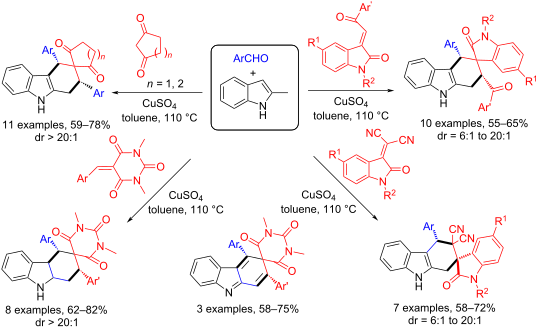
- examined the scope of aromatic aldehydes (Scheme 5), different substituents on the aromatic ring showed marginal effect on the yields. The spiro compounds 5a–g were successfully produced in moderate to excellent yields with excellent diastereoselectivity (dr > 20:1). Cyclohexane-1,3-dione also reacted





Continuous flow synthesis of azobenzenes via Baeyer–Mills reaction
Beilstein J. Org. Chem. 2022, 18, 781–787, doi:10.3762/bjoc.18.78
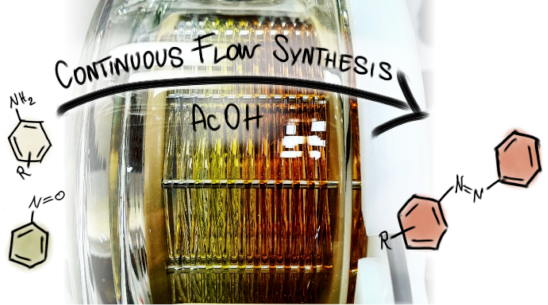
- cyclohexane to the reaction mixture after the tube reactor (Figure 3). The reaction solution with cyclohexane was continuously fed into a separating funnel containing brine. After phase separation, drying of the organic phase with MgSO4, and evaporation of the solvent, AB (1a) could be obtained in 98% yield


Identification of the new prenyltransferase Ubi-297 from marine bacteria and elucidation of its substrate specificity
Beilstein J. Org. Chem. 2022, 18, 722–731, doi:10.3762/bjoc.18.72
- methanol (1.0 L), dried under vacuum, and the resultant MeOH extract was then extracted with hexane (120 mL) and dried again under vacuum. The hexane extract was purified by flash chromatography (Biotage Isolera Prime) over a silica gel column (eluent: cyclohexane/EtOAc 100:0 to 80:20 to 0:100). The


Tri(n-butyl)phosphine-promoted domino reaction for the efficient construction of spiro[cyclohexane-1,3'-indolines] and spiro[indoline-3,2'-furan-3',3''-indolines]
Beilstein J. Org. Chem. 2022, 18, 669–679, doi:10.3762/bjoc.18.68
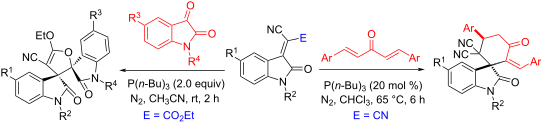
- functionalized spiro[cyclohexane-1,3'-indolines] in good yields and with good diastereoselectivity. On the other hand, the tri(n-butyl)phosphine-catalyzed reaction of 3-(ethoxycarbonylmethylene)oxindoles and bis-chalcones gave functionalized spiro[cyclohexane-1,3'-indolines] with different regioselectivity
- . Additionally, the tri(n-butyl)phosphine-promoted domino annulation reaction of isatins and ethyl isatylidene cyanoacetates produced spiro[indoline-3,2'-furan-3',3''-indolines] in satisfactory yields. Keywords: isatin; spiro[cyclohexane-1,3'-indoline]; spiro[indoline-3,2'-furan-3',3''-indoline]; spirooxindole
- functionalized various spiro[cyclohexane-1,3'-indolines] and related reactions. Results and Discussion Initially, the reaction conditions were optimized by using isatylidene malononitrile 1a and bis-chalcone 2a as standard reaction. Tertiary amines such as DMAP and DABCO did not catalyze this reaction (entries 1


Rapid gas–liquid reaction in flow. Continuous synthesis and production of cyclohexene oxide
Beilstein J. Org. Chem. 2022, 18, 660–668, doi:10.3762/bjoc.18.67
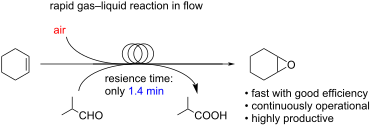
- conventional batch technique has irreconcilable limitations. Cyclohexene oxide is one of the key starting materials for manufacturing various functional organic compounds and materials such as polymers and chiral organic compounds with cyclohexane moiety [2][3][4][5][6]. Thus, an efficient and fast synthetic


Sesquiterpenes from the soil-derived fungus Trichoderma citrinoviride PSU-SPSF346
Beilstein J. Org. Chem. 2022, 18, 479–485, doi:10.3762/bjoc.18.50
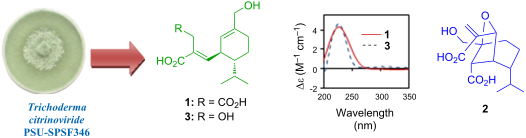
- as the chemical shifts of C-7 and C-15 (δC 69.2) constructed a cyclohexane ring with both a hydroxymethyl group and an oxy substituent at C-7, the isopropyl group at C-10 and other substituents at C-5 (δC 47.0) and C-6. The substituent at C-6 was assigned as a carboxyl group on the basis of the HMBC


Comparative study of thermally activated delayed fluorescent properties of donor–acceptor and donor–acceptor–donor architectures based on phenoxazine and dibenzo[a,j]phenazine
Beilstein J. Org. Chem. 2022, 18, 459–468, doi:10.3762/bjoc.18.48
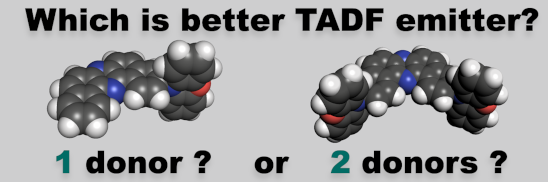
- -state photoluminescence (PL) spectra were acquired (Figure 2, and the summary of the properties presented in Table 1). The solutions were prepared with a variety of organic solvents at concentrations of ca. 10−5 M. It is noted that the solubility of 1 in cyclohexane is quite low, and thereby the
- concentration of the cyclohexane solution and the molar absorption coefficient ε were not determined. As is clearly seen from Figure 2, the absorption spectra were not affected by the dielectric constant of the solvents. In contrast, the emission peaks of the PL spectra drastically red-shifted from cyclohexane
- -type compound (λPL = 521 nm for POZ-DBPHZ) in cyclohexane. These data indicate that the effective length of π-conjugation is not affected by the number of donors, probably due to the right D–A dihedral angle for both compounds in the ground state. In contrary, the slight blue-shift of the PL spectra of


A resorcin[4]arene hexameric capsule as a supramolecular catalyst in elimination and isomerization reactions
Beilstein J. Org. Chem. 2022, 18, 337–349, doi:10.3762/bjoc.18.38
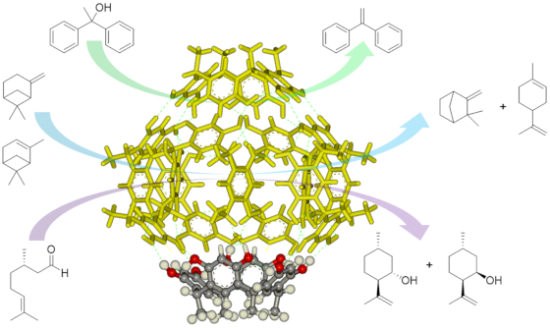
- and hexameric capsule A (16·8H2O) Compound 1 (500 mg) was triturated with cyclohexane (10 mL) and the latter was removed under vacuum with gentle heating in order to remove the azeotropic mixture of water/cyclohexane. The treatment with cyclohexane was repeated two more times. The solid product was
- left under high vacuum for 20 h to remove traces of cyclohexane. A mother solution of 1 (0.27 mmol, 6 equiv with respect to the hexameric capsule, 45 mM) was prepared with 6 mL of chloroform-d previously passed on basic alumina which provide sufficiently dry solvent. To favor dissolution the mixture


Flow synthesis of oxadiazoles coupled with sequential in-line extraction and chromatography
Beilstein J. Org. Chem. 2022, 18, 232–239, doi:10.3762/bjoc.18.27
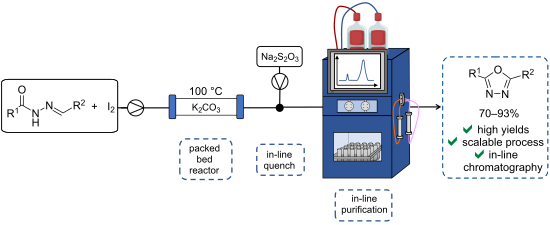
- realised by increasing the flow rate of the thiosulphate solution to remove sufficient DMSO in view of satisfactory separation being achieved. Due to the high polarity of the reaction mixture, moderately non-polar chromatographic conditions were required (3% EtOAc, 97% cyclohexane at start), with a


Asymmetric organocatalytic Michael addition of cyclopentane-1,2-dione to alkylidene oxindole
Beilstein J. Org. Chem. 2022, 18, 167–173, doi:10.3762/bjoc.18.18
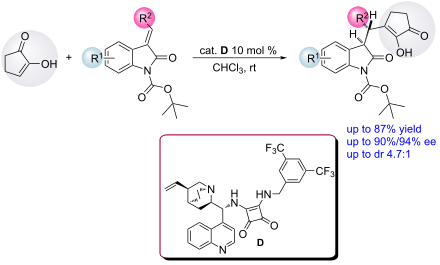
- molecular complexity. There are many examples of the organocatalytic synthesis of fused cycles starting from the cyclohexane-1,3-dione. For example, Rueping et al. demonstrated that the cyclohexane-1,3-dione undergoes a cascade reaction with α,β-unsaturated aldehydes [4] and they later employed the method


Iron-catalyzed domino coupling reactions of π-systems
Beilstein J. Org. Chem. 2021, 17, 2848–2893, doi:10.3762/bjoc.17.196
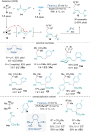
- observed. The efficiency of the reaction seems to be dependent on the deprotonation of the α-position of the olefinic malonate species. The authors noted decarbonylated products were obtained when cyclohexane carboxaldehyde and pivaldehyde were applied, consistent with the stability of the generated acyl


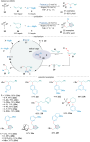


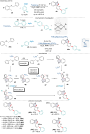









Synthesis and investigation on optical and electrochemical properties of 2,4-diaryl-9-chloro-5,6,7,8-tetrahydroacridines
Beilstein J. Org. Chem. 2021, 17, 2450–2461, doi:10.3762/bjoc.17.162
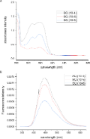
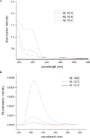
- and, as expected, the cyclohexane ring is not involved. In all cases, the electron densities of HOMO were localized in the π-bonding orbitals between the carbon backbone of the quinoline ring and its two external phenyls. The LUMO electron densities were mainly located in the π* antibonding orbitals
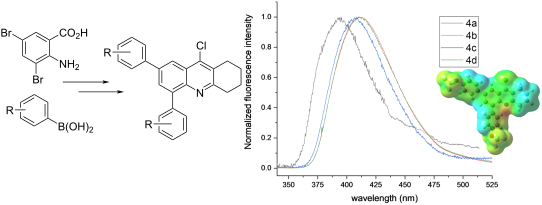
- visualize the region of the attractive and repulsive potential, respectively. For the phenyl-substituted derivative 4a, the blue-colored surface, located mainly at the cyclohexane ring, visualizes the electron deficiency (high electrostatic potential). The red regions, localized essentially at the nitrogen




Synthesis of 5-arylacetylenyl-1,2,4-oxadiazoles and their transformations under superelectrophilic activation conditions
Beilstein J. Org. Chem. 2021, 17, 2417–2424, doi:10.3762/bjoc.17.158
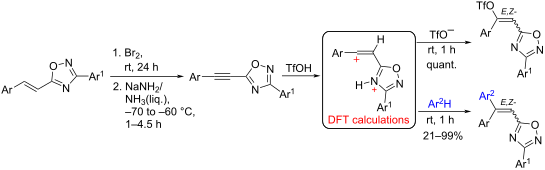
- in the same reaction in TfOH (compare entry 3 in Table 2 with data shown in Scheme 5). Thus, among the tested acidic reagents, TfOH showed better results for the hydroarylation of compounds 3. Additionally, the reaction of oxadiazole 3a with benzene in TfOH (rt, 1 h) in the presence of cyclohexane


Synthesis of O6-alkylated preQ1 derivatives
Beilstein J. Org. Chem. 2021, 17, 2295–2301, doi:10.3762/bjoc.17.147
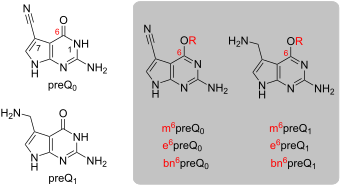
- combined organic layers were washed with brine and dried over magnesium sulfate. The solvents were removed and the remaining crude product was purified by flash column chromatography on silica gel (10–30% ethyl acetate in cyclohexane) to give 1.00 g of compound 4 (79%) as a white foam. TLC: 40% ethyl
- acetate in cyclohexane, Rf = 0.68; 1H NMR (300 MHz, CDCl3) δ 7.32–6.94 (m, 19H, HC(aromatic, DMTr) & HC(8)), 6.83–6.65 (m, 8H, HC(arom, DMTr)), 5.54 (s, 1H, HN(2)), 3.80 & 3.77 (s, 12H, H3CO(DMTr), 3.37 (s, 1H, H3CO(O6) ppm; 13C NMR (101 MHz, CDCl3) δ 162.4 (C(6)), 158.7 & 158.4 & 158.0 (C(aromatic, DMTr
- column chromatography on silica gel (10–25 % ethyl acetate in cyclohexane) to give 823 mg of compound 5 (82%) as a white foam. TLC: 30% ethyl acetate in cyclohexane Rf 0.51; 1H NMR (CDCl3, 400 MHz) δ 9.91 (s, 1H, CHO), 7.49 (s, 1H, HC(8)), 7.29–7.23 (m, 2H, HC(aromatic, DMTr), 7.20–7.11 (m, 6H, HC


Photoredox catalysis in nickel-catalyzed C–H functionalization
Beilstein J. Org. Chem. 2021, 17, 2209–2259, doi:10.3762/bjoc.17.143
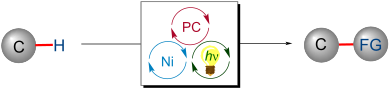
- . Notably, the photocatalytic conditions proved suitable for the benzylic C(sp3)−H and unactivated alkane cyclohexane C‒H arylations. The catalytic cycle is proposed to involve the oxidative addition of nickel(0) 4-IV into an aryl chloride 8a to form nickel(II) intermediate 4-V (Figure 4) [56]. The SET
- xanthone as the photocatalyst and NiCl2·6H2O as the nickel catalyst can efficiently catalyze the transformation of methylarenes 25 into arylacetic acids 91 under UV light irradiation (Scheme 47). Furthermore, the authors also applied this methodology to functionalize unactivated alkanes such as cyclohexane










Nomimicins B–D, new tetronate-class polyketides from a marine-derived actinomycete of the genus Actinomadura
Beilstein J. Org. Chem. 2021, 17, 2194–2202, doi:10.3762/bjoc.17.141
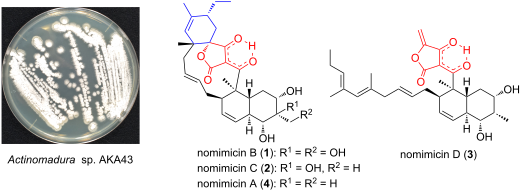
- ). Placement of the oxygenated carbon atom C8 between C7 and C9 and the attachment of the oxygenated methylene carbon atom C26 to C8 were deduced from the HMBC correlations from H7 and H9 to C8 and C26 and from H26 to C7, C8, and C9, thereby establishing a highly oxygenated cyclohexane ring. This six-membered
- (Table 2). A sequence of COSY correlations from the doublet methyl proton H26 to an oxymethine proton H7 via an oxymethine proton H9, together with HMBC correlations from H26 and H8 to C7 and H8 to C6, gave an oxygenated cyclohexane ring with a methyl substitution (Figure 6). COSY correlations were
- extended from H10 to a methylene proton H17, providing a carbon chain containing double bonds at C11/C12 and C15/C16. HMBC correlations from a singlet methyl hydrogen atom H25 to C4, C5, and C13 indicated closure of another cyclohexane ring, and thus a dehydrodecalin core with a side chain at C13 was


Constrained thermoresponsive polymers – new insights into fundamentals and applications
Beilstein J. Org. Chem. 2021, 17, 2123–2163, doi:10.3762/bjoc.17.138
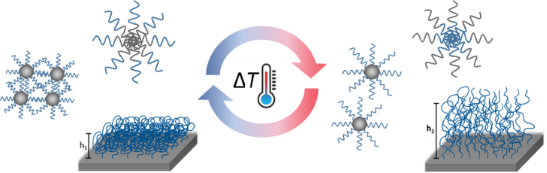
- the chains on a surface and the intermolecular interaction that occurs, vertical phase separation is suppressed in systems such as polystyrene in cyclohexane, in contrast to free dissolved chains [128]. However, at vanishingly small concentrations, classical brushes always exhibit a behavior
- (like polystyrene in cyclohexane), which always show an UCST. This critical point is usually located in the semi-dilute regime and the brush can contract discontinuously or continuously [114][131]. The more complex dependencies on χ leads to a bilayer-type profile, as has been shown for PNIPAAm [132


Natural products in the predatory defence of the filamentous fungal pathogen Aspergillus fumigatus
Beilstein J. Org. Chem. 2021, 17, 1814–1827, doi:10.3762/bjoc.17.124

- . In A. fumigatus, the fma cluster is located on the sub-telomeric region on chromosome 8 and is comprised of 15 genes. At the cellular level fumagillin is regulated by both cluster specific regulator FumR (FapR) and global regulator LaeA [95]. Fumagillin consists of a cyclohexane ring and
- decatetraenedioic acid connected via an ester bond. There is also a methoxy group, an epoxide and a terpene derived aliphatic chain that contains another epoxide, linked to cyclohexane. These unstable di-epoxides are responsible for the biological activity of fumagillin, which targets the active site of the


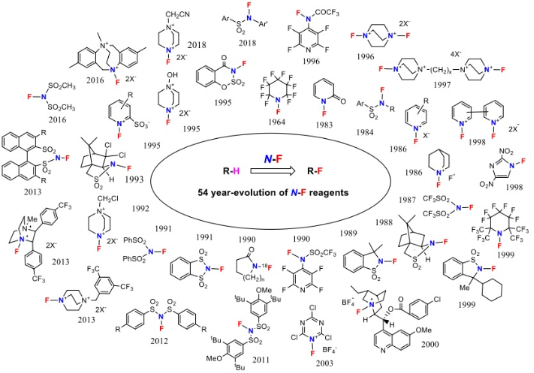
Development of N-F fluorinating agents and their fluorinations: Historical perspective
Beilstein J. Org. Chem. 2021, 17, 1752–1813, doi:10.3762/bjoc.17.123
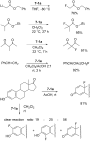
- ketones, as is illustrated with representative in Scheme 65. In addition, the Takeuchi group reported a spiro-type analogue, (2'S,3R,5'R)-2-fluoro-2'-methylethyl-5'-methyl-2H,4H-spiro[benzo[e][1,2]thiazine-3,1'-cyclohexane]-1,1-dione (28-7a) [94], as their third chiral reagent in this sultam series. As

























Chemical approaches to discover the full potential of peptide nucleic acids in biomedical applications
Beilstein J. Org. Chem. 2021, 17, 1641–1688, doi:10.3762/bjoc.17.116
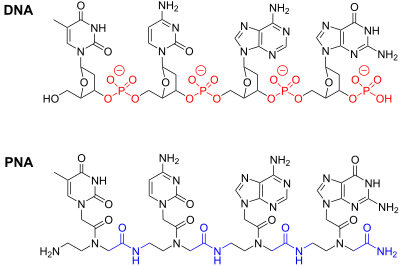
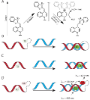
- co-workers [50] were the first to test restricting PNA backbone conformation by locking the backbone in a fused cyclohexane ring of either S,S or R,R configuration (chPNA, Figure 4). Both S,S or R,R chPNAs formed weaker complexes with complementary DNA and RNA than unmodified PNA [50]. Later, Kumar
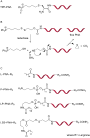
- -derived acbcPNA and cyclopentane-derived acpcPNA formed stable duplexes with matching DNA and RNA, while cyclohexane-derived achcPNA did not form complexes with either DNA or RNA, which was explained by unfavorable torsional angles and conformational rigidity of the cyclohexane backbone [62








2,4-Bis(arylethynyl)-9-chloro-5,6,7,8-tetrahydroacridines: synthesis and photophysical properties
Beilstein J. Org. Chem. 2021, 17, 1629–1640, doi:10.3762/bjoc.17.115
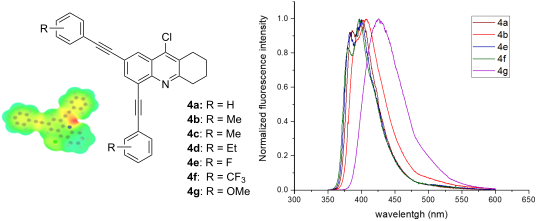
- prepared products are given in Table 4. For phenylethynyl-substituted product 4a, the blue colored surface, located mainly at the cyclohexane ring, visualizes the electron deficiency. While the red region, localized essentially at the nitrogen atom and its closer ethynyl group, show the electron abundance


Methodologies for the synthesis of quaternary carbon centers via hydroalkylation of unactivated olefins: twenty years of advances
Beilstein J. Org. Chem. 2021, 17, 1565–1590, doi:10.3762/bjoc.17.112
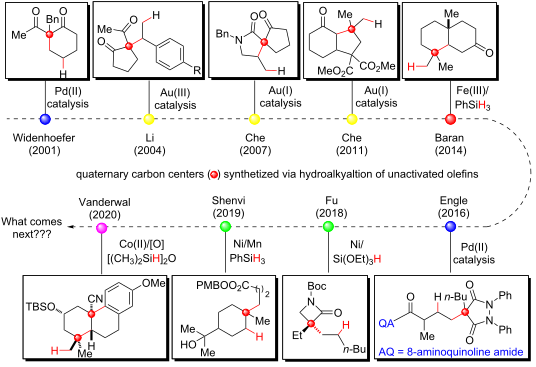
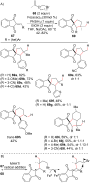
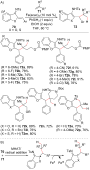
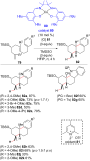
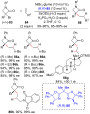
- carried out between 96 and completely deuterated cyclohexane 96-d12. A considerable decrease in the reaction yield was observed when the reaction was carried out in the presence of radical trapping reagents (Scheme 37B). Based on these observations, the C(sp3)–H homolytic bond cleavage appears to be the













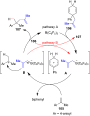
Nitroalkene reduction in deep eutectic solvents promoted by BH3NH3
Beilstein J. Org. Chem. 2021, 17, 1041–1047, doi:10.3762/bjoc.17.83
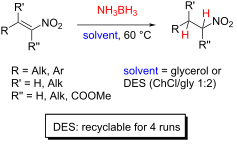
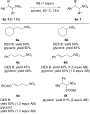
- . Ammonia borane also proved to be an efficient reagent for the reduction of both linear and branched aliphatic nitroolefins, affording the expected products in fair to good yield (Scheme 3). The reduction of (2-nitrovinyl)cyclohexane (5a) afforded product 6a in 60% yield in DES B. Analogously