Search results
Search for "dipolarophiles" in Full Text gives 71 result(s) in Beilstein Journal of Organic Chemistry.
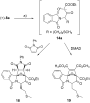
The regioselective synthesis of spirooxindolo pyrrolidines and pyrrolizidines via three-component reactions of acrylamides and aroylacrylic acids with isatins and α-amino acids
Beilstein J. Org. Chem. 2014, 10, 117–126, doi:10.3762/bjoc.10.8
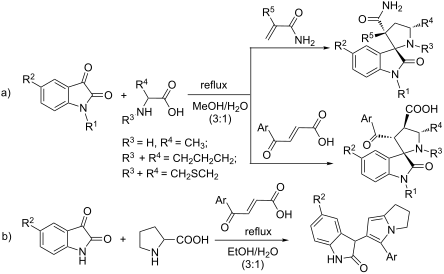
- aroylacrylic acids as dipolarophiles has been realized through a one-pot 1,3-dipolar cycloaddition protocol. Decarboxylation of 2'-aroyl-2-oxo-1,1',2,2',5',6',7',7a'-octahydrospiro[indole-3,3'-pyrrolizine]-1'-carboxylic acids is accompanied by cyclative rearrangement with formation of dihydropyrrolizinyl
- inhibitors [9][10]. The multicomponent 1,3-dipolar cycloaddition of azomethine ylides, generated in situ via decarboxylative condensation of isatins and α-amino acids with olefinic and acetylenic dipolarophiles, represents a key approach for the regio- and stereoselective construction of a variety of complex
- nonnatural α-amino acids [11][12][13], more than fifteen isatins [14], and 1,3-dipolarophiles, e.g. α,β-unsaturated ketones [15][16][17], maleimides [18][19], benzo[b]thiophene-1,1-dioxide [20], bis(arylmethylidene)acetones and -cycloalkanones [21][22], 1,4-naphthoquinone [23], arylidenemalonodinitriles [24




Less reactive dipoles of diazodicarbonyl compounds in reaction with cycloaliphatic thioketones – First evidence for the 1,3-oxathiole–thiocarbonyl ylide interconversion
Beilstein J. Org. Chem. 2013, 9, 2751–2761, doi:10.3762/bjoc.9.309

- diazoalkanes, diazoesters and diazoketones [1][2][3][4]. Due to their high dipolarophilic reactivity thioketones were given the name ‘superdipolarophiles’ [3][4]. It might be expected that these highly reactive dipolarophiles could also easily react with the deactivated 1,3-dipoles of 2-diazo-1,3-dicarbonyl
- . Results and Discussion Two cycloaliphatic thioketones that were previously studied in similar reactions with diazo compounds [14], were selected as dipolarophiles for the present study, namely 2,2,4,4-tetramethyl-3-thioxocyclobutanе-1-one (1a) [15] and adamantane-2-thione (1b) [16] (Figure 1). As for the




Synthetic scope and DFT analysis of the chiral binap–gold(I) complex-catalyzed 1,3-dipolar cycloaddition of azlactones with alkenes
Beilstein J. Org. Chem. 2013, 9, 2422–2433, doi:10.3762/bjoc.9.280
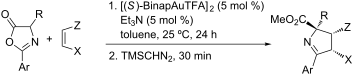
- outcome of the reaction. We also studied the last step of the catalytic cycle that ensures the recovery of the catalyst obtaining a favourable Gibbs energy of −55.3 kcal mol−1 (Scheme 5). No chemical reaction occurred when 5a was combined with other dipolarophiles such as fumarates, maleates, vinyl phenyl
- experiments supported the drawn absolute configuration of 15. Other different dipolarophiles were attempted to react with starting 7aa obtaining very complex mixtures including decomposed materials. In the most cases, reactions had to be refluxed for 24 h (110 °C, toluene) because microwave assisted




A one-pot synthesis of 3-trifluoromethyl-2-isoxazolines from trifluoromethyl aldoxime
Beilstein J. Org. Chem. 2013, 9, 2387–2394, doi:10.3762/bjoc.9.275
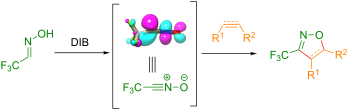
- simple and efficient metal-free protocol for the oxidation of trifluoromethyl aldoxime 2 into trifluoroacetonitrile oxide 4 and a one-pot synthesis of 1 through in situ cyclization of 4 with different dipolarophiles (Scheme 1). Results and Discussion Initially, another procedure for the preparation of
- ) calculated at the B3LYP/6-31G* level. FMO energy levels of dipole 4 and dipolarophiles 5a and 5k calculated at the B3LYP/6-31G* level. Continuous and dotted lines indicate the favored (ΔE = 5.407 eV for 5a and 6.673 eV for 5k) and the disfavored (ΔE = 8.178 eV for 5a and 7.955 eV for 5k) molecular orbital
- allylbenzene (5a). Synthesis of 3-trifluoromethyl-2-isoxazolines and isoxazoles by reaction between aldoxime 2 and olefins or alkynes in the presence of DIB. FMO coefficients of the 1,3-dipole 4 and representative dipolarophiles (atomic orbital is indicated in parentheses). Ring opening reaction of 3


The chemistry of amine radical cations produced by visible light photoredox catalysis
Beilstein J. Org. Chem. 2013, 9, 1977–2001, doi:10.3762/bjoc.9.234
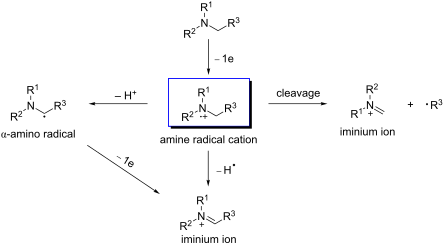
- that when tetrahydroisoquinolines (e.g., 41 and 45) were substituted with a methylene group attached to one or two esters, the initially formed iminium ions were readily converted to azomethine ylides. They subsequently underwent 1,3-dipolar cycloaddition with a range of dipolarophiles to form fused




Gold-catalyzed cyclization of allenyl acetal derivatives
Beilstein J. Org. Chem. 2013, 9, 1751–1756, doi:10.3762/bjoc.9.202
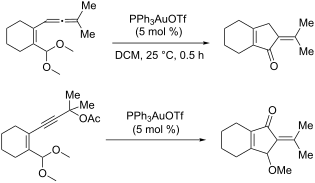
- one-pot procedure. We previously reported gold-catalyzed reactions of allenyl acetals with suitable dipolarophiles such as 1,3-diones to chemoselectively produce the cycloaddition product 2 [17] (Scheme 1). Similar reactions with nitrones stereoselectively delivered distinct formal cycloadducts 3 [18


[3 + 2]-Cycloadditions of nitrile ylides after photoactivation of vinyl azides under flow conditions
Beilstein J. Org. Chem. 2013, 9, 1745–1750, doi:10.3762/bjoc.9.201
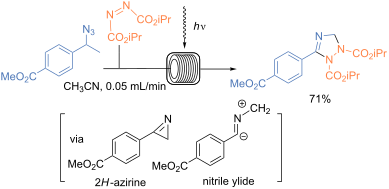
- with thermal formation of 2H-azirines. Photochemically, the ring of the 2H-azirines was opened to yield the nitrile ylides, which underwent a [3 + 2]-cycloaddition with 1,3-dipolarophiles. When diisopropyl azodicarboxylate serves as the dipolarophile, 1,3,4-triazoles become directly accessible starting
- photochemical process can efficiently be achieved. These facts led us to initiate an investigation on the photochemical activation of vinyl azides and the trapping of the intermediate nitrile ylides 3 [19] by different dipolarophiles exploiting the advantages of photo flow-chemistry [20][21]. Here, we report on
- azodicarboxylate (DIAD, 4e) as the dipolarophile (Scheme 5). Additionally, we found that even electron-deficient alkynes such as 4f can serve as dipolarophiles in these reactions (Scheme 6). However, the resulting pyrrole 5k could only be isolated in 26% yield. Alternatively, the in-situ generated nitrile ylide


Efficient continuous-flow synthesis of novel 1,2,3-triazole-substituted β-aminocyclohexanecarboxylic acid derivatives with gram-scale production
Beilstein J. Org. Chem. 2013, 9, 1508–1516, doi:10.3762/bjoc.9.172
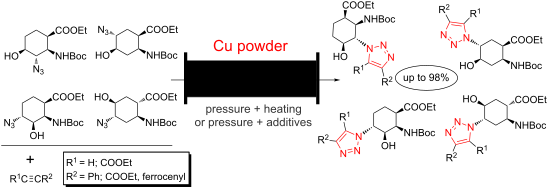
- dipolarophiles to yield a library of novel 1,2,3-triazole-modified cyclic β-amino acid derivatives. Compounds 11–14 were racemates, the structures in Table 1 show their relative stereochemistry. The CF syntheses were carried out under both conditions A and B in order to obtain a clear comparison between the



Diastereoselective synthesis of nitroso acetals from (S,E)-γ-aminated nitroalkenes via multicomponent [4 + 2]/[3 + 2] cycloadditions promoted by LiCl or LiClO4
Beilstein J. Org. Chem. 2013, 9, 838–845, doi:10.3762/bjoc.9.96
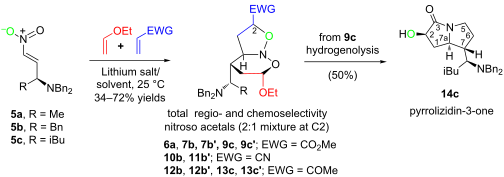
- nitroalkenes 5a–c as heterodienes, ethyl vinyl ether (EVE) as a dienophile, and selected electron-deficient alkenes as 1,3-dipolarophiles. The employment of different organic solutions of LiClO4 or LiCl as promoter systems provided the respective nitroso acetals with yields from 34–72% and good levels of
- 1) [1][2][3]. These compounds can act as dienophiles or 1,3-dipolarophiles to provide nitrocycloadducts of type 1 or nitroheterocycles of type 2, respectively [4][5]. In addition, nitroalkenes can act as heterodienes reacting with suitable dienophiles, often in the presence of a Lewis acid, to
- -dipolarophiles to furnish nitroso acetals of type 4 in an inter- or intramolecular fashion [1][2][3][8][9]. These nitroso acetals can be transformed into functionalized pyrrolizidin-3-ones and in sequence into alkaloid nuclei [1][3][10][11]. The majority of the tandem nitroalkene cycloadditions require the


A versatile and efficient approach for the synthesis of chiral 1,3-nitroamines and 1,3-diamines via conjugate addition to new (S,E)-γ-aminated nitroalkenes derived from L-α-amino acids
Beilstein J. Org. Chem. 2013, 9, 832–837, doi:10.3762/bjoc.9.95
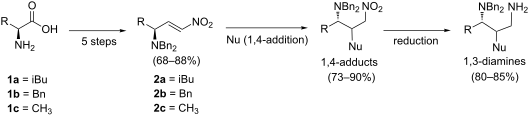
- nucleophiles [5][6][7][8][9][10], in Friedel–Crafts alkylations [11][12][13][14], and Baylis–Hillman reactions [15][16][17][18]. Furthermore, nitroalkenes can react as dipolarophiles in [3 + 2] cycloadditions [19][20][21][22], as dienophiles in [4 + 2] cycloadditions [23][24][25][26], and as heterodienes in


Parallel and four-step synthesis of natural-product-inspired scaffolds through modular assembly and divergent cyclization
Beilstein J. Org. Chem. 2012, 8, 930–940, doi:10.3762/bjoc.8.105
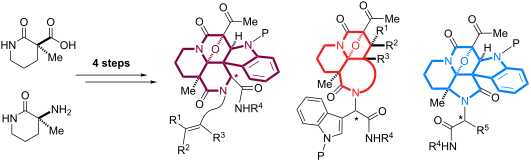
- diazotransfer, leading to cyclization precursors. The rhodium-catalyzed tandem cyclization and divergent cycloaddition gave rise to tetracyclic and hexacyclic scaffolds by the appropriate choice of dipolarophiles installed at modules 3 and 4. A different piperidine-based manifold 15 bearing an amino group was
- cycloadditions with the dipolarophiles installed at modules 3 and 4 leading to either tetracyclic 14 or hexacyclic 13. In this full account, we also employ a piperidine-based manifold 15 bearing an amino group in order to expand the applicability of the various building blocks in the four-step parallel synthesis
- the cycloadditions efficiently incorporated consecutive quaternary centers into the complex fused skeleton, overriding the considerable steric hindrance of the dipolarophiles composed of the tri- and even tetra-substituted olefin groups. To test the generality of the site-selective cycloaddition at



Carbohydrate-auxiliary assisted preparation of enantiopure 1,2-oxazine derivatives and aminopolyols
Beilstein J. Org. Chem. 2012, 8, 662–674, doi:10.3762/bjoc.8.74
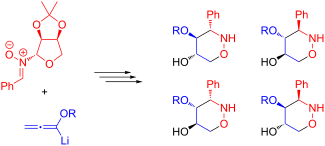
- of (3R)-3a (ellipsoids are drawn at a 50% probability level). Model proposed for the addition of lithiated allenes to nitrone 1a. Reactivity of N-glycosyl nitrones 1 towards dipolarophiles and nucleophiles leading to products of type A, B, C and D. Additions of lithiated alkoxyallenes to L-erythrose




Aryl nitrile oxide cycloaddition reactions in the presence of pinacol boronic acid ester
Beilstein J. Org. Chem. 2012, 8, 606–612, doi:10.3762/bjoc.8.67
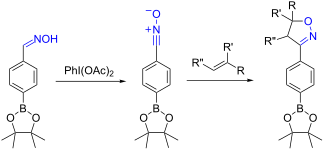
- dipolarophiles to yield aryl isoxazolines with the boronate ester function intact and available for subsequent reaction. Keywords: dipolar cycloaddition; heterocycle; nitrile oxide; hypervalent iodine oxidation; pinacol boronic acid esters; Introduction Metal-mediated coupling reactions to form carbon–carbon
- pinacolyl boronate esters have the advantage of being stable, readily handled compounds. The Huisgen 1,3-dipolar cycloaddition reaction is a powerful and versatile method for constructing five-membered heterocycles [12][13][14]. Nitrile oxide 1,3-dipoles react with carbon–carbon dipolarophiles, such as
- were pleased to discover that diacetoxyiodobenzene (DIB) [26][40] could cleanly convert the aldoxime to the corresponding nitrile oxide without decomposition of the boronate ester function. The nitrile oxide was trapped in situ with a variety of dipolarophiles to yield isoxazolines (Table 1). For mono


Intramolecular carbenoid ylide forming reactions of 2-diazo-3-keto-4-phthalimidocarboxylic esters derived from methionine and cysteine
Beilstein J. Org. Chem. 2012, 8, 433–440, doi:10.3762/bjoc.8.49
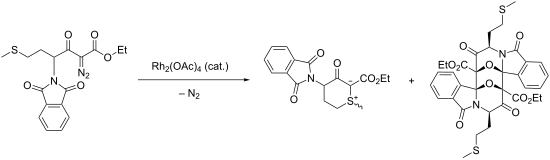
- rearrangement. The short-lived carbonyl ylides derived from methionine and S-benzylcysteine formed head-to-tail dimers by a [3 + 3]-cycloaddition and could be trapped with external dipolarophiles, while the S-allyl derivative 14c yielded the pentacyclic compound 17 by an intramolecular [3 + 2]-cycloaddition
- substructure. Trapping of carbonyl ylides with dipolarophiles In situ generated carbonyl ylides can be intercepted not only in intramolecular (as discussed above) but also in intermolecular [3 + 2] cycloaddition reactions (see, for example, [3][18][19][20][41][42]). By analogy with other 2-diazo-3-oxo-4
- ] cycloaddition with the dipolarophiles NPI and DMAD (notice that carbonyl ylide dimer 13a also results from an intermolecular cycloaddition reaction). With the cysteine-derived diazoesters 8b and c, on the other hand, it appears that the formation of the five-membered cyclic sulfonium ylides 12b and c and of the



Photochemical and thermal intramolecular 1,3-dipolar cycloaddition reactions of new o-stilbene-methylene-3-sydnones and their synthesis
Beilstein J. Org. Chem. 2011, 7, 1663–1670, doi:10.3762/bjoc.7.196
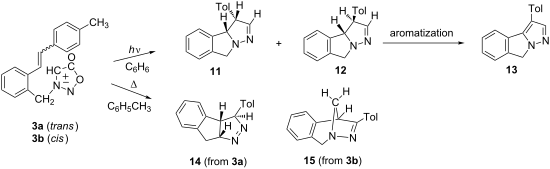
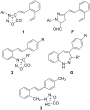
- hybrids of a number of mesomeric ionic structures (Figure 1). One of the most characteristic reactions of sydnones is the intermolecular 1,3-dipolar cycloaddition. In the presence of acetylenic or ethylenic dipolarophiles, sydnones undergo cycloaddition reactions, which can be induced thermally [4][6][7




Multistep flow synthesis of vinyl azides and their use in the copper-catalyzed Huisgen-type cycloaddition under inductive-heating conditions
Beilstein J. Org. Chem. 2011, 7, 1441–1448, doi:10.3762/bjoc.7.168
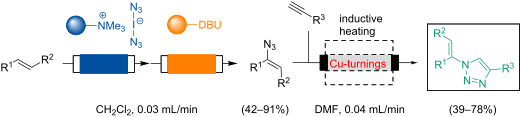
- , vinyl azides can be converted into the corresponding 2H-azirines by thermolysis or alternatively by photolysis [5]. The highly reactive azirines can further react as dipolarophiles, dienophiles, electrophiles or nucleophiles [6] thereby accessing oxazoles and isoxazoles [7]. In addition, 2H-azirines


Chiral gold(I) vs chiral silver complexes as catalysts for the enantioselective synthesis of the second generation GSK-hepatitis C virus inhibitor
Beilstein J. Org. Chem. 2011, 7, 988–996, doi:10.3762/bjoc.7.111
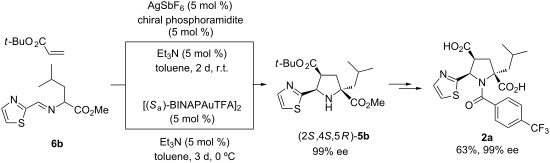
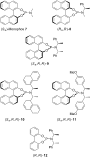
- of acrylates as dipolarophiles has only been explored with the 2-thienyliminoesters 6a. Therefore, based on our experience of silver(I)- and gold(I)-catalyzed 1,3-DC involving azomethine ylides derived from α-iminoester 6b and tert-butyl acrylate, we selected a series of known chiral phosphoramidite
- (Sa,R,R)-9 has also been similarly studied. In this case, the matched combination was determined in previous works that investigated the scope of enantioselective silver(I)-catalyzed 1,3-DC of azomethine ylides and dipolarophiles [25][29]. The enantioselectivities were moderate, even when using AgSbF6
- the approach of the mentioned dipolarophile. Conclusion In this work the complexity of the 1,3-DC reaction of azomethine ylides and dipolarophiles (in this case acrylates) was demonstrated. There are many parameters to control and a small variation can cause a dramatic effect in the overall




Synthesis of novel 5-alkyl/aryl/heteroaryl substituted diethyl 3,4-dihydro-2H-pyrrole-4,4-dicarboxylates by aziridine ring expansion of 2-[(aziridin-1-yl)-1-alkyl/aryl/heteroaryl-methylene]malonic acid diethyl esters
Beilstein J. Org. Chem. 2011, 7, 831–838, doi:10.3762/bjoc.7.95
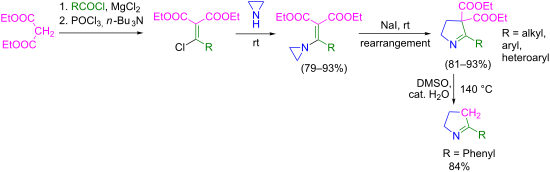
- converted into pyrrolines by ring expansion using various dipolarophiles [24][25] as well as by thermal ring expansion [26][27]. The literature also suggests that N-vinyl substituted aziridines can undergo iodide ion mediated ring expansion reactions to yield pyrroline derivatives [13][14]. However, iodide


Synthetic applications of gold-catalyzed ring expansions
Beilstein J. Org. Chem. 2011, 7, 767–780, doi:10.3762/bjoc.7.87
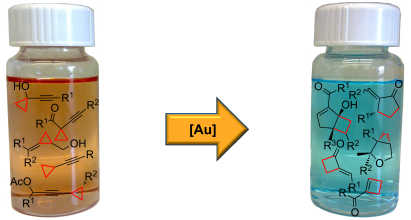
- cyclization events [51]. 1-(1-Alkynyl)cyclopropyl ketones 56 proved to be versatile building blocks for this purpose and gave, in the presence of indoles 57 as dipolarophiles, tetracyclic furans 58 in excellent yields (Scheme 20, reaction 1). NHC carbenes are preferred as ancillary ligands on the metal center
- . Upon coordination of the metal to the alkyne 59, the 1,4-dipole 61 can be formed from oxocarbenium 60. Carbonyl compounds and carbonyl derivatives, such as imines or silyl enol ethers, can also be used as dipolarophiles to generate bicyclic furans 62 in fairly good yields (Scheme 20, reaction 2
- ). Nitrones also reacted as dipolarophiles in the presence of AuCl3, even if in some cases copper catalysts were found to be more effective at triggering the corresponding annulations [52]. By contrast, when alkoxy vinyl ethers were employed as dipolarophiles, the cycloaddition takes place prior to the


Synthesis of densely functionalized enantiopure indolizidines by ring- closing metathesis (RCM) of hydroxylamines from carbohydrate- derived nitrones
Beilstein J. Org. Chem. 2007, 3, No. 44, doi:10.1186/1860-5397-3-44

- . [5][6][7][8][9][10][11][12][13][14][15][16][17][18] We accomplished the total syntheses of some indolizidine alkaloids and of several non-natural analogues employing chiral nitrones as key intermediates, either as dipolarophiles in 1,3-dipolar cycloaddition chemistry [19][20] or as electrophiles in



Photosonochemical catalytic ring opening of α-epoxyketones
Beilstein J. Org. Chem. 2007, 3, No. 2, doi:10.1186/1860-5397-3-2
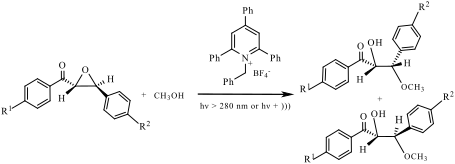
- trioxolane derivatives [32][33][34] or by dipolarophiles to form various tetrahydrofurans and dihydrofurans. [41] In the absence of appropriate dipolarophiles, cis/trans isomerization of the epoxide ring has been observed. [42] The cleavage of Cα-O or Cβ-O bonds has been confirmed either by rearrangement to