


Search results
Search for "glucose" in Full Text gives 369 result(s) in Beilstein Journal of Organic Chemistry. Showing first 200.
Synthesis of multiply fluorinated N-acetyl-D-glucosamine and D-galactosamine analogs via the corresponding deoxyfluorinated glucosazide and galactosazide phenyl thioglycosides
Beilstein J. Org. Chem. 2021, 17, 1086–1095, doi:10.3762/bjoc.17.85
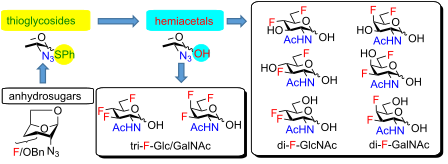
- synthesis of unprotected multiply-deoxyfluorinated monosaccharides, including a complete series of mono-, di-, and trifluorinated ᴅ-glucose [15], difluorinated [20] and tetrafluorinated [13] ᴅ-galactose, and 2,3,4-trifluoro analogs of ᴅ-mannose, ᴅ-galactose, ᴅ-allose, ᴅ-talose, and ᴅ-altrose [13][21



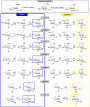
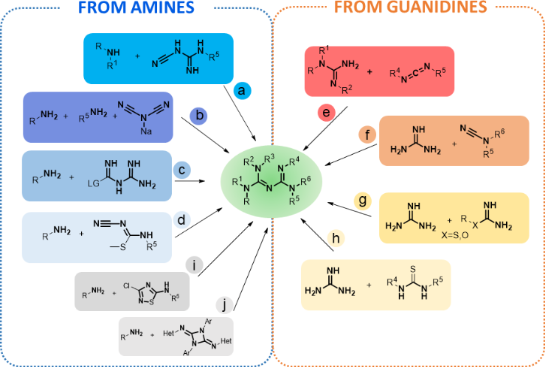
Synthetic accesses to biguanide compounds
Beilstein J. Org. Chem. 2021, 17, 1001–1040, doi:10.3762/bjoc.17.82


Metal-free glycosylation with glycosyl fluorides in liquid SO2
Beilstein J. Org. Chem. 2021, 17, 964–976, doi:10.3762/bjoc.17.78
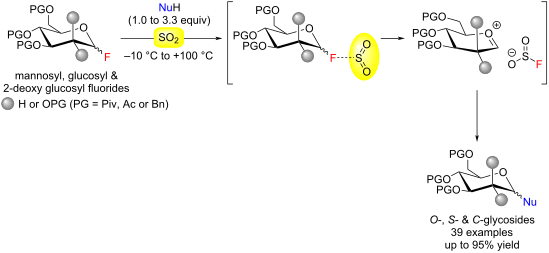
- armed and disarmed glucose and mannose-derived glycosyl fluorides in moderate to excellent yields. A series of pivaloyl-protected O- and S-mannosides, as well as one example of a C-mannoside, are synthesized to demonstrate the scope of the glycosyl acceptors. The formation of the fluorosulfite species
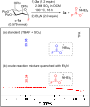
- through the neighboring ester type protecting group assistance. At lower temperatures the glycosylation yield was lower, although full conversion of glucosyl fluoride β-9 was still observed. Compared to the analogue mannose derivative α-1a, glucose β-9 turned out to be less stable and more prone to
- conclusion that the Lewis basic carbonyl oxygen of the acetyl group is more coordinated and less nucleophilic in liquid SO2 than the carbonyl oxygen of the pivaloyl group. The profile of side-products in this glucose series was similar to that observed for fluoride β-9 (see Supporting Information File 1



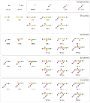
Simulating the enzymes of ganglioside biosynthesis with Glycologue
Beilstein J. Org. Chem. 2021, 17, 739–748, doi:10.3762/bjoc.17.64
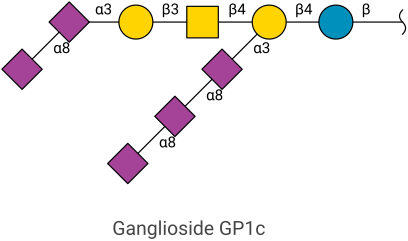
- linear chain comprising of up to four monosaccharide units, containing glucose, galactose and N-acetylgalactosamine, to which are attached a variable number of sialic acid (N-acetylneuraminic acid) residues. The sialic acid content of the oligosaccharide, being anionic at pH 7, results in an overall
- since been rescinded [21].) To this base string are added a list of the sialic acids attached to each monosaccharide in the core, counting using the Roman numeral system, starting from the base glucose (cf. Figure 1). From the non-reducing end, write the position on the core where a sialic acid (or
- extended with a galactose, β4-linked to the glucose, to form lactosylceramide, LacCer, catalyzed by β4Gal-T6 (EC 2.4.1.274). This is the first asialo-ganglioside, with core level 3. Two further extensions are possible, to yield core levels 2 and 1, by adding a GalNAc residue β4-linked to the preceding




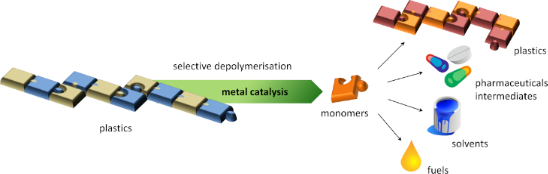
Valorisation of plastic waste via metal-catalysed depolymerisation
Beilstein J. Org. Chem. 2021, 17, 589–621, doi:10.3762/bjoc.17.53
- monobutyltin oxide, using substoichiometric amounts of isosorbide and succinic acid and no solvent at 230 °C reaction temperature. Isosorbide is a safe chemical [246] that is obtainable on the large scale from renewable glucose [247][248]. Because of this and due to the inherent rigid structure, conferring the






Metal-free visible-light-enabled vicinal trifluoromethyl dithiolation of unactivated alkenes
Beilstein J. Org. Chem. 2021, 17, 551–557, doi:10.3762/bjoc.17.49
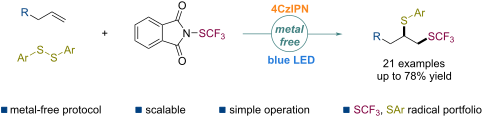
- corresponding SCF3 adducts. In addition, boldenone- and ᴅ-glucose-derived terminal alkenes were compatible with the conditions affording the corresponding products 5l and 5m in moderate to good yields. To gain insight into the reaction mechanism, control experiments were conducted under the standard conditions


Identification of volatiles from six marine Celeribacter strains
Beilstein J. Org. Chem. 2021, 17, 420–430, doi:10.3762/bjoc.17.38
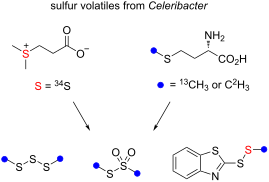
- incorporation was observed for the other two sulfur atoms of 41 prompted us to further investigate the biosynthetic origin of the benzothiazol-2-ylsulfanyl portion of 41 to establish its natural origin. Several feeding experiments with central primary metabolites including (13C6)glucose, (13C5)ribose and




Regioselective chemoenzymatic syntheses of ferulate conjugates as chromogenic substrates for feruloyl esterases
Beilstein J. Org. Chem. 2021, 17, 325–333, doi:10.3762/bjoc.17.30
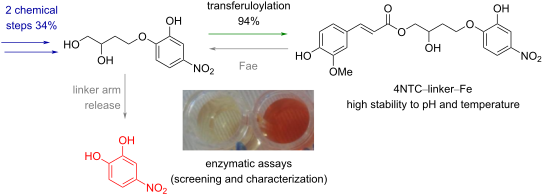
- /L ammonium chloride, 20 mL/L oleic acid, 10 g/L ᴅ-glucose, 2 g/L casamino acid, and 15 g/L bacto agar in 100 mM citrate–phosphate buffer at pH 5). The petri dishes were incubated for 48 h at 30 °C and then overlayered with a preparation of 1% (w/v) molten top agar containing the chromogenic


Direct synthesis of anomeric tetrazolyl iminosugars from sugar-derived lactams
Beilstein J. Org. Chem. 2021, 17, 115–123, doi:10.3762/bjoc.17.12
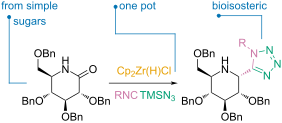
- iminosugar derivatives may be less obvious. Several pharmaceuticals are based on this scaffold including the glucose-derived nojirimycin, an antibiotic and glycosidase inhibitor [26] and 1-deoxygalactonojirimycin, known under the trade name Galafold®, which is utilized for the treatment of the Fabry disease
- standard Ugi–azide reaction conditions [35][36][37][38][39] in a one-pot, tandem process. Subjecting glucose-derived lactam 1 to such a procedure gave the desired product in good yield, but with virtually no diastereoselectivity, as shown in Scheme 2. Optimization and scope An initial optimization study
- conformer. Therefore, once the ground conformer of the oxocarbenium ion is established, this logic may be used to predict the reaction’s stereochemistry. The same principle may be successfully applied to reactions of iminium cations. We have previously shown that in the case of glucose- and galactose




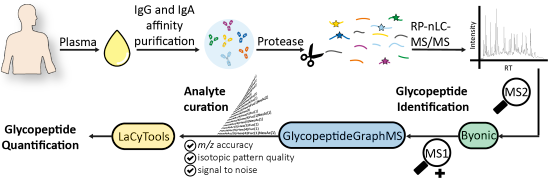
Semiautomated glycoproteomics data analysis workflow for maximized glycopeptide identification and reliable quantification
Beilstein J. Org. Chem. 2020, 16, 3038–3051, doi:10.3762/bjoc.16.253
- -glycans are attached to Ser or Thr. Glycan compositions can range from monosaccharides (e.g., Tn antigen for O-glycans [1]) to large polysaccharides (e.g., N-glycans of recombinant human erythropoietin [2]). The most common building blocks of human protein glycans are hexoses (glucose, galactose, and


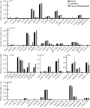
Secondary metabolites of Bacillus subtilis impact the assembly of soil-derived semisynthetic bacterial communities
Beilstein J. Org. Chem. 2020, 16, 2983–2998, doi:10.3762/bjoc.16.248
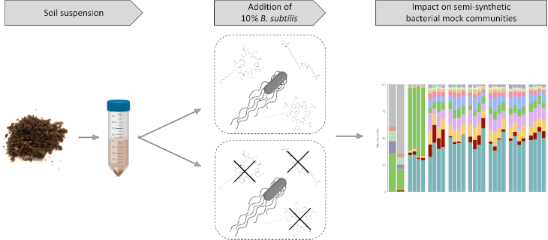
- g⋅L−1 dipotassium hydrogen phosphate, and 2.5 g⋅L−1 glucose. Semisynthetic mock community assay Semisynthetic soil communities were obtained from the soil of sampling site P5 (55.788800, 12.558300) [51][64]. 1 g soil was mixed in a 1:9 ratio with a 0.9% saline solution, vortexed on a rotary shaker


Selected peptide-based fluorescent probes for biological applications
Beilstein J. Org. Chem. 2020, 16, 2971–2982, doi:10.3762/bjoc.16.247

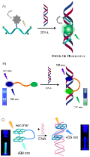
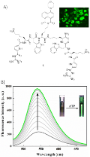
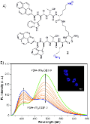
- serum albumin. Other biomolecules such as adenosine, adenosine monophosphate, adenosine triphosphate, phosphate, pyrophosphate, glucose, heparin, hyaluronic acid and chondroitin sulfate, and amino acids containing two carboxylates (glutamic acid and aspartic acid) have not increased the fluorescence
- biological analytes including such as adenosine, adenosine monophosphate (AMP), adenosine triphosphates (ATP), phosphate (Pi), pyrophosphate (PPi), ct-DNA, glucose, bovine serum albumin (BSA), glutamic acid and aspartic acid. They are also selective over the similar biological analytes hyaluronic acid or



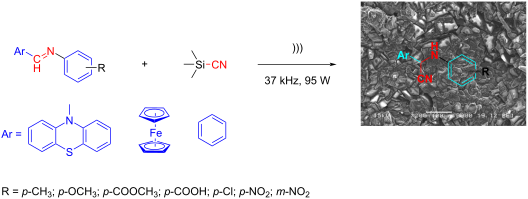
Ultrasound-assisted Strecker synthesis of novel 2-(hetero)aryl-2-(arylamino)acetonitrile derivatives
Beilstein J. Org. Chem. 2020, 16, 2929–2936, doi:10.3762/bjoc.16.242
- activity. The viability of Salmonella typhimurium TA98 and TA 100, respectively, was assessed by exposing the histidine dependent bacteria to compound 2c, 2i, and 2l, respectively, directly on minimal glucose agar plates in the presence or absence of the metabolic activation system S9. The number of


Fluorine effect in nucleophilic fluorination at C4 of 1,6-anhydro-2,3-dideoxy-2,3-difluoro-β-D-hexopyranose
Beilstein J. Org. Chem. 2020, 16, 2880–2887, doi:10.3762/bjoc.16.237
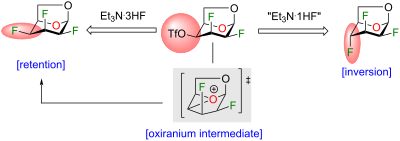
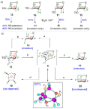
- (retention of configuration) with a 39% yield along with glucose 11 (inversion of configuration) in 31% yield (Table 1, entry 2) [20][30]. Moreover, the use of the talose analogue 4 generated exclusively the product with retention of configuration 12. This result was surprising since the only difference with
- alditol analogues was achieved. The strategy described herein will allowed us to achieve the synthesis of other polyfluorinated hexitol analogues in order to explore their physical properties. Previously described synthesis of 2,3,4-trifluorinated analogues of galactose 6, glucose 7, mannose 8, and talose



Easy access to a carbohydrate-based template for stimuli-responsive surfactants
Beilstein J. Org. Chem. 2020, 16, 2788–2794, doi:10.3762/bjoc.16.229
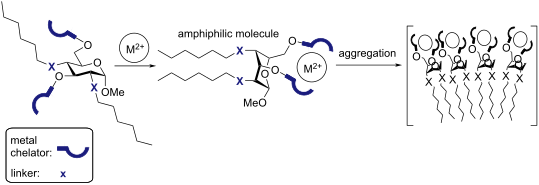
- for conformational switches but have, to our knowledge, never been used as stimuli-responsive surfactants [13][14]. The compounds would have the benefit of being generally inexpensive due to the high production of glucose. However, going from glucose to a conformational switch often involves time
- and lipophilic groups at a late stage of the synthesis (Figure 1a). The synthesis is centered around the cheap and commercially available levoglucosan, a glucose derivative that can be produced directly from cellulose [19]. This building block seemed ideal for the synthesis of a stimuli-responsive


Encrypting messages with artificial bacterial receptors
Beilstein J. Org. Chem. 2020, 16, 2749–2756, doi:10.3762/bjoc.16.225
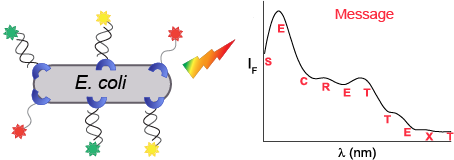
- -ODN-1 were incubated (50 μM each) with NiCl2·6H2O (2.5 mM) in Milli-Q water for 30 min. Meanwhile, the bacterial samples were collected by centrifugation at 6000g for 4 min. The pellets were washed twice with M9 medium (supplemented with 2% glucose) and resuspended in 99 μL of the medium to an OD600




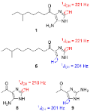
Nocarimidazoles C and D, antimicrobial alkanoylimidazoles from a coral-derived actinomycete Kocuria sp.: application of 1JC,H coupling constants for the unequivocal determination of substituted imidazoles and stereochemical diversity of anteisoalkyl chains in microbial metabolites
Beilstein J. Org. Chem. 2020, 16, 2719–2727, doi:10.3762/bjoc.16.222
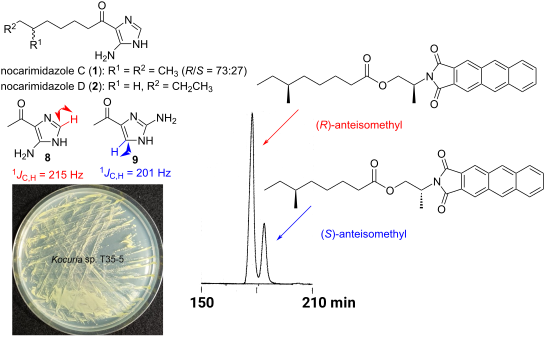
- production medium, which consists of 0.2% glucose, 2.5% soluble starch, 0.5% yeast extract, 0.5% polypeptone (Wako Pure Chemical Industries, Ltd.), 0.5% NZ-amine (Wako Pure Chemical Industries, Ltd.), 0.3% CaCO3, and 1% Diaion HP-20 (Mitsubishi Chemical Co.) in natural seawater (collected from Toyama Bay


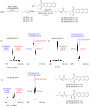

A consensus-based and readable extension of Linear Code for Reaction Rules (LiCoRR)
Beilstein J. Org. Chem. 2020, 16, 2645–2662, doi:10.3762/bjoc.16.215

- , “ G ” represents glucopyranose, the pyranose conformation of glucose, with ᴅ stereospecificity. Glucopyranose with ʟ stereospecificity is written as “ G’ ” (SRS1). Glucofuranose with ᴅ stereospecificity is written as “ G^ ” (SRS2), and glucofuranose with ʟ specificity is written as “ G~ ” (SRS3
- ). Similarly, galactofuranose, a common fungal monosaccharide, would be written “A^” Open form rule indicates that if the MS at the reducing end is open – a linear rather than cyclic MS, then the final character to the right of the string should be "o". For example, lactose, galactose β-linked to glucose would
- be written as AbG if the reducing end glucose is closed and AbGo if the glucose is open; the open "o" takes the place of the linkage in this context. If the glucose is phosphorylated, this structure would be written AbG[P]o. Modification rules specify a modification of a MS at certain positions (MR1


Water-soluble host–guest complexes between fullerenes and a sugar-functionalized tribenzotriquinacene assembling to microspheres
Beilstein J. Org. Chem. 2020, 16, 2551–2561, doi:10.3762/bjoc.16.207

- Department of Chemistry, Center for Molecular Materials (CM2), Bielefeld University, 33615 Bielefeld, Germany 10.3762/bjoc.16.207 Abstract A sugar-functionalized water-soluble tribenzotriquinacene derivative bearing six glucose residues, TBTQ-(OG)6, was synthesized and its interaction with C60 and C70
- ]. The acetyl protons of the protected glucose residues appear as eight distinct resonances. The 13C NMR spectrum shows a similar splitting. The triazole carbons resonate at δ = 123.71 and δ = 123.69 ppm and at δ = 143.88 and δ = 143.79 ppm, indicating two sets of magnetically nonequivalent linkers. This
- sodium cations requires further studies. Despite the unusual mass spectrometric behavior of the compound, the combined spectroscopic evidence strongly supports the identity of TBTQ-(OAcG)6. After deprotection of the glucose units, the acetyl signals disappeared in the 1H and 13C NMR spectra of the target


![[Graphic 2]](/bjoc/content/inline/1860-5397-16-207-i3.svg?max-width=637&scale=1.18182) C60 [TBTQ-(OG)6: 50 μM; C60: 50 μM] and (b) TBTQ-(OG)6
C60 [TBTQ-(OG)6: 50 μM; C60: 50 μM] and (b) TBTQ-(OG)6 


Computational tools for drawing, building and displaying carbohydrates: a visual guide
Beilstein J. Org. Chem. 2020, 16, 2448–2468, doi:10.3762/bjoc.16.199
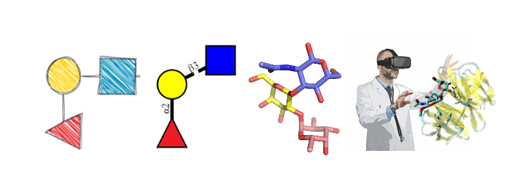
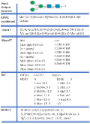
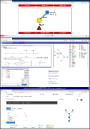
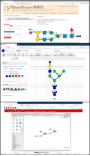
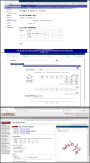
- a continuous development and evolution of the description of monosaccharides [2]. Glycans are puzzles to many chemists, and biologists as well as bioinformaticians. This complexity occurs at different levels (which makes it incremental). Amongst the most recognisable “sugars”, glucose is merely one
- glucose. And yet, monosaccharides are only the chemical units and the individual building blocks of much more complex molecules; the carbohydrates, also referred to as glycans. The glycan family can be grouped in the following categories: (i) oligosaccharides (comprising two to ten monosaccharides linked
- linkage as alpha or beta (or unknown) and to state the positions of the glycosyl acceptor and even donor. Cellulose and amylose are two glucose-based polysaccharides that differ only in the nature of their glycosidic bond, and yet they have entirely different shapes and so, biological roles. For the sake


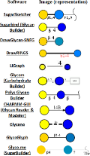




Recent developments in enantioselective photocatalysis
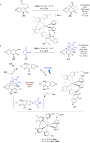
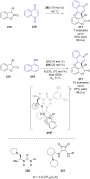
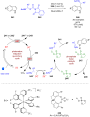
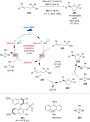
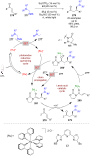
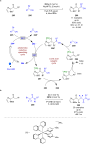
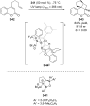
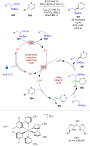
Beilstein J. Org. Chem. 2020, 16, 2363–2441, doi:10.3762/bjoc.16.197




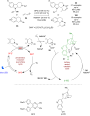


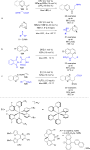
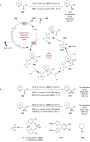
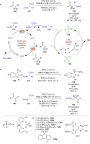
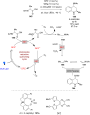
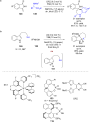


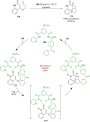
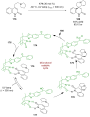















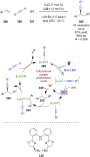


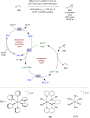
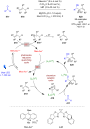
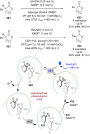


A proposed sustainability index for synthesis plans based on input provenance and output fate: application to academic and industrial synthesis plans for vanillin as a case study
Beilstein J. Org. Chem. 2020, 16, 2346–2362, doi:10.3762/bjoc.16.196
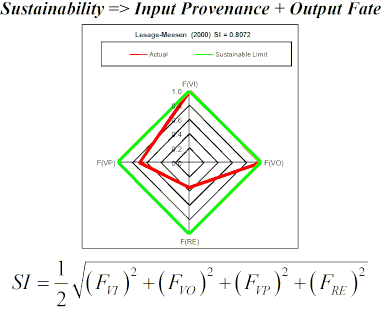
- alphabetical order along with temperature and pressure conditions for each reaction step. Table 2 summarizes the same alphabetized list showing the plan codes, starting materials used, and type of chemical process employed. Four plans involved biofermentation from ᴅ-glucose, ferulic acid, or isoeugenol [26][27
- scales that are several orders of magnitude longer than organism time scales. (4) Lignosulfonic acid liquor and sawdust were considered renewable inputs since they ultimately originate from trees. Ferulic acid and ᴅ-glucose were considered renewable inputs since they originate from sugar beet biomass [47
- 145, 105, and 101, respectively. Plans p11 (Lampman synthesis from sawdust), p10 (Ji synthesis from guaiacol), p14 (Mexican group SFE), p9 (Hibbert synthesis from lignosulfonic acid liquor), p21 (Soxhlet extraction from ground vanilla beans), and p6 (Frost biofermentation from ᴅ-glucose) have the


Host–guest interaction of cucurbit[8]uril with oroxin A and its effect on the properties of oroxin A
Beilstein J. Org. Chem. 2020, 16, 2332–2337, doi:10.3762/bjoc.16.194
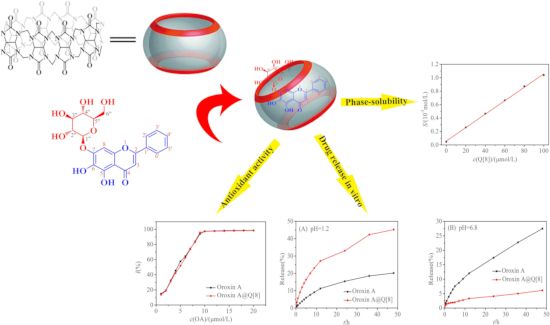
- the entry into the cavity of Q[8]. The proton peaks of the glycosidic H and glucose were shifted downfield, indicating that they were located at the portal of Q[8]. However, when OA is present in excess, some of the proton peaks of the OA aglycon moved upfield, and some move downfield, indicating that
- ] formed a host–guest complex in a ratio of 1:1. The aglycone of OA entered the cavity of Q[8] and the glucose was located at the portal of Q[8], with a binding constant of 1.299 × 10⁷ L·mol−1. The solubility of oroxin A was increased 22.47-fold when the concentration of the added Q[8] was 1.0 × 10⁻⁴ mol·L


The B & B approach: Ball-milling conjugation of dextran with phenylboronic acid (PBA)-functionalized BODIPY
Beilstein J. Org. Chem. 2020, 16, 2272–2281, doi:10.3762/bjoc.16.188
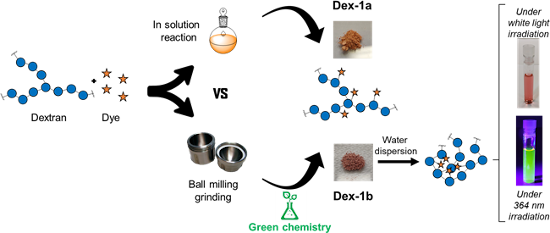
- excess of PBA (more than 60-fold excess of PBA to dextran, in a glucose/PBA 1:1 molar ratio reaction) was employed. However, the resulting dextran functionalization was low (1.6 PBA units out of 60 glucose units). In our studies we used PBA-BODIPY (1), a dye which proved to show excellent optical
- roughly equimolar amount of Dex and 1, in a glucose units/1 molar ratio of 60:1 (assuming an average molecular weight for Dex of 10 kDa). For the labeling in solution, Dex was dissolved in dry dimethyl sulfoxide (DMSO) and PBA-BODIPY (1) was added in roughly equimolar amounts (Scheme 1, route A). The
- compared to Dex. Therefore, mechanochemical reactions were carried out using a glucose units/1 molar ratio of 120:1 and 600:1. The conjugations yield was determined by measuring the absorption of the conjugates (λmax = 508–511 nm, Figure 2B and Supporting Information File 1, Figures S3 and S4), and


Clustering and curation of electropherograms: an efficient method for analyzing large cohorts of capillary electrophoresis glycomic profiles for bioprocessing operations
Beilstein J. Org. Chem. 2020, 16, 2087–2099, doi:10.3762/bjoc.16.176
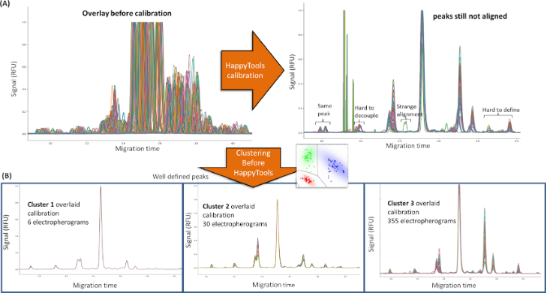
- , migration time is generally calculated by correlation with internal standards that bracket the time of elution of the glycans of interest [10]. This process is used to calculate a glucose unit (GU) which helps to align the datasets so that the GU of each glycan can be used to identify the glycan through
- based on a triple standard GU calculation [10][11] and database matching whilst the quantitation used HappyTools calibration and area calculation [14]. The GU calculation involved standardizing the migration time of the peaks by generating a ‘virtual’ glucose unit (GU) ladder calculated using the
- using dual pitch blade impellers stirring at 300 rpm. Different bioreactor operating conditions were evaluated. Triplicate experiments were performed for all operating conditions under study. In terms of the feeding strategy, 10% of EX-CELL Advanced CHO Feed 1 (with glucose) were added to all cultures





