


Search results
Search for "stereogenic centers" in Full Text gives 135 result(s) in Beilstein Journal of Organic Chemistry.
Synergistic chiral iminium and palladium catalysis: Highly regio- and enantioselective [3 + 2] annulation reaction of 2-vinylcyclopropanes with enals
Beilstein J. Org. Chem. 2016, 12, 1340–1347, doi:10.3762/bjoc.12.127
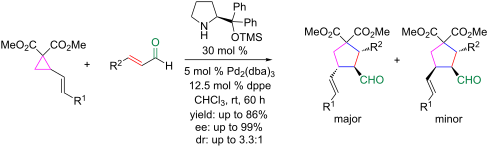
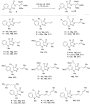
- catalytic regio- and enantioselective [3 + 2] annulation process, which offers a new approach to synthetically important heavily functionalized chiral cyclopentane structures 3, bearing at least 3 stereogenic centers in this one-pot operation [77][78]. To test the feasibility of the designed [3 + 2
- ] annulation process by the variation of vinylcyclopropanes and enals (Table 3). The results exhibit that the synergistic catalyzed enantioselective [3 + 2] annulation process serves as a general approach to structurally chiral cyclopentanes bearing 3-consecutive stereogenic centers with high regio- and


Synthesis of 2-oxindoles via 'transition-metal-free' intramolecular dehydrogenative coupling (IDC) of sp2 C–H and sp3 C–H bonds
Beilstein J. Org. Chem. 2016, 12, 1153–1169, doi:10.3762/bjoc.12.111
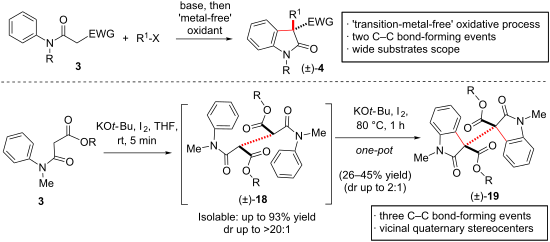
- ], sharing a vicinal all-carbon quaternary stereogenic centers with extreme steric congestion at the C3a–C3a' σ-bond as well as the attendant lability of this linkage. Under the optimized conditions, one-pot dimerization of β-N-arylamido ester 3a and b and 9a took place in the presence of 1.2 equivalents of





Modular synthesis of the pyrimidine core of the manzacidins by divergent Tsuji–Trost coupling
Beilstein J. Org. Chem. 2016, 12, 1111–1121, doi:10.3762/bjoc.12.107
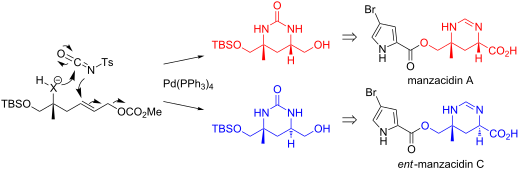
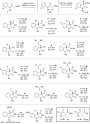
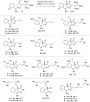
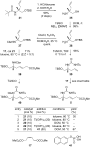
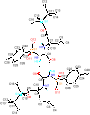
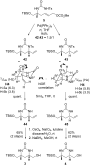
- , variously substituted 6-membered heterocycles of type 9 may be obtained in a general and concise fashion. Notably, this anionic relay process may directly generate up to four new stereogenic centers and thus demonstrates a high increase in structural complexity from readily available starting materials



Enantioselective carbenoid insertion into C(sp3)–H bonds
Beilstein J. Org. Chem. 2016, 12, 882–902, doi:10.3762/bjoc.12.87
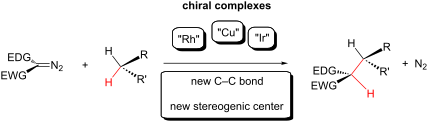
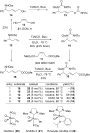
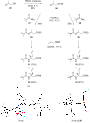
- is an important tool for the synthesis of complex molecules due to the high control of enantioselectivity in the formation of stereogenic centers. This paper presents a brief review of the early issues, related mechanistic studies and recent applications on this chemistry area. Keywords: C–H


From steroids to aqueous supramolecular chemistry: an autobiographical career review
Beilstein J. Org. Chem. 2016, 12, 684–701, doi:10.3762/bjoc.12.69
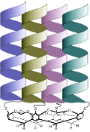
- stereogenic centers in the shown, phenyl ring “up” configuration. If one ring pointed “in”, then the cavity was no more. I had my doubters with this reaction, and it failed miserably with benzal chloride (we fished out <5% of the desired cavitand). However, if short R groups such as methyl were avoided and




The aminoindanol core as a key scaffold in bifunctional organocatalysts
Beilstein J. Org. Chem. 2016, 12, 505–523, doi:10.3762/bjoc.12.50
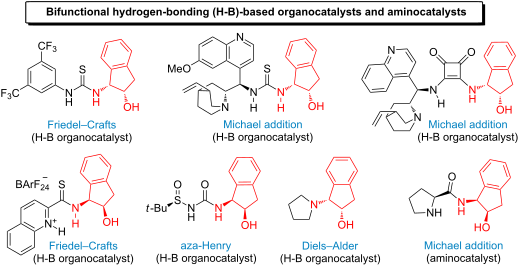
- (Figure 1). Some examples of these properties are rigidity, disposition of the two stereogenic centers, ability of the hydroxy and amino groups to coordinate to some metals or to act as hydrogen-bond donors/acceptors, the different catalytic activity of these chemical groups and their possible


(Thio)urea-mediated synthesis of functionalized six-membered rings with multiple chiral centers
Beilstein J. Org. Chem. 2016, 12, 462–495, doi:10.3762/bjoc.12.48
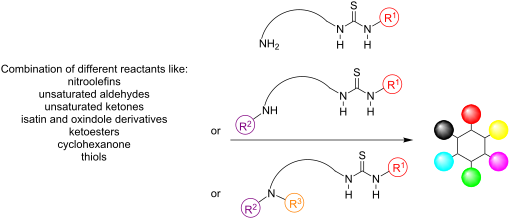
- -unsaturated aldehydes 108, affording the desired products 110 in moderate to good yields and good to excellent stereoselectivities (Scheme 35). Recently, Wang and co-workers disclosed an asymmetric synthesis of dihydrocoumarins 113 containing adjacent stereogenic centers, utilizing the cinchona-derived


Dynamic behavior of rearranging carbocations – implications for terpene biosynthesis
Beilstein J. Org. Chem. 2016, 12, 377–390, doi:10.3762/bjoc.12.41
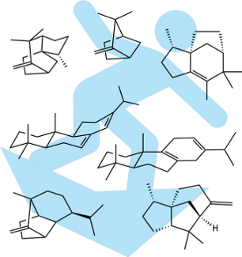
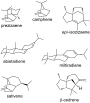
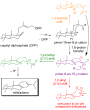
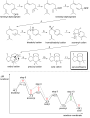
- a striking range of molecular architectures, varying in size and complexity (Figure 1) [1][2][3][4][5]. Some terpenes sport multiple stereogenic centers and multiple carbocyclic rings. These complex hydrocarbon frameworks are derived, however, from simple precursors lacking stereogenic centers and



Diastereoselective Ugi reaction of chiral 1,3-aminoalcohols derived from an organocatalytic Mannich reaction
Beilstein J. Org. Chem. 2016, 12, 139–143, doi:10.3762/bjoc.12.15

- subjected to an Ugi multicomponent reaction under classical or Lewis acid-promoted conditions with diastereoselectivities ranging from moderate to good. This approach represents a step-economical path to enantiomerically pure, polyfunctionalized peptidomimetics endowed with three stereogenic centers
- . Thus, this method offers an operationally simple route to enantiomerically pure complex structures like 6, introducing up to five diversity inputs and controlling three stereogenic centers (also thanks to the final chromatography). Compounds 6 are endowed with several functionalities that can be


Enantioselective additions of copper acetylides to cyclic iminium and oxocarbenium ions
Beilstein J. Org. Chem. 2015, 11, 2696–2706, doi:10.3762/bjoc.11.290
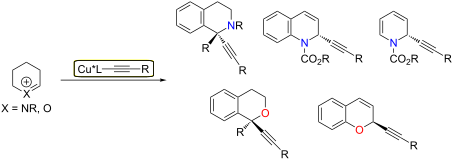
- chiral copper-based catalysts has enabled high yields and enantioselectivites in the formation of nitrogen- and oxygen-containing heterocycles with α-stereogenic centers. This review highlights both the accomplishments and the future work needed in this important area. Keywords: catalysis; copper
- ; enantioselectivity; iminium ion; oxocarbenium ion; Introduction Nitrogen and oxygen heterocycles with α-stereogenic centers represent important classes of biologicially active compounds [1][2][3][4][5][6][7]. Enantioselective addition of chiral nucleophiles to imines, iminium ions, carbonyls, or oxocarbenium ions





Recent advances in copper-catalyzed asymmetric coupling reactions
Beilstein J. Org. Chem. 2015, 11, 2600–2615, doi:10.3762/bjoc.11.280
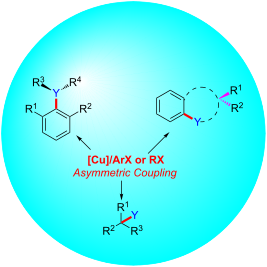
- stereogenic centers, derived from tartaric acid, giving the product as a single isomer in good yield (Scheme 11). Sugimura et al. [31] expanded this method by introducing chiral 1,3-diol-derived tethers into the substrates, delivering the corresponding coupling products in excellent diastereoselectivity


Copper-catalyzed asymmetric conjugate addition of organometallic reagents to extended Michael acceptors
Beilstein J. Org. Chem. 2015, 11, 2418–2434, doi:10.3762/bjoc.11.263
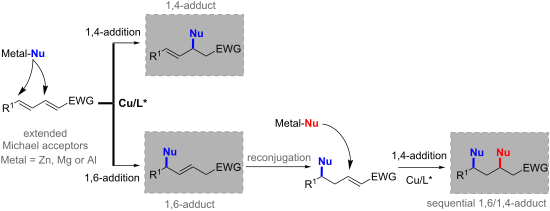
- it enables in a straightforward manner the sequential generation of two or more stereogenic centers. In the last decade, various chiral copper-based catalysts were evaluated in combination with different nucleophiles and Michael acceptors, and have unambiguously demonstrated their usefulness in the
- studied on a substrate scope. As shown in Scheme 2, tertiary and quaternary stereogenic centers could be generated using this methodology leading to products 19 in moderate to good yields and ees. In 2008, Alexakis and Mauduit evaluated a series of different chiral ligands in ACA reactions involving
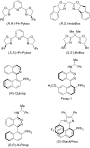
- (CuTC) and (R)-Binap L4, which afforded the desired final products bearing two stereogenic centers with excellent diastereoselectivies (93–97%). N-Heterocyclic carbenes (NHCs) have emerged, in these last two decades, as a powerful and versatile class of ligands, and appeared to be potent in many


The marine sponge Agelas citrina as a source of the new pyrrole–imidazole alkaloids citrinamines A–D and N-methylagelongine
Beilstein J. Org. Chem. 2015, 11, 2029–2037, doi:10.3762/bjoc.11.220
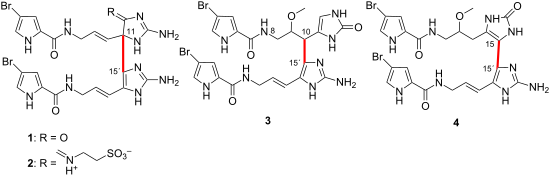
- guanidine moiety). The relative configuration of the stereogenic centers C-9 and C-10 was identical as described for nagelamide B (8). In contrast to citrinamine C (3), a different connection of the monomeric units was found for citrinamine D (4). Furthermore, 3 and 4 have an additional methoxy group at C-9


Chiral Cu(II)-catalyzed enantioselective β-borylation of α,β-unsaturated nitriles in water
Beilstein J. Org. Chem. 2015, 11, 2007–2011, doi:10.3762/bjoc.11.217
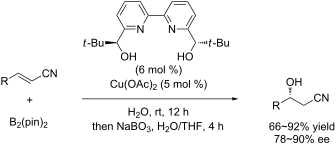
- linkage can be transformed into C–O, C–N, as well as into C–C bonds, while retaining stereogenic centers [1][2][3][4]. The nitrile group can be transformed into a range of functional groups, such as amides [5], carboxylic acids [6], aldehydes [7], esters [8], alcohols [9], and amines [10


Investigation of the role of stereoelectronic effects in the conformation of piperidones by NMR spectroscopy and X-ray diffraction
Beilstein J. Org. Chem. 2015, 11, 1973–1984, doi:10.3762/bjoc.11.213
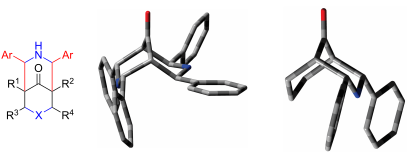
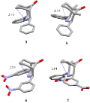
- repulsion between the LPEs of the nitrogen. Although 3, 5, 6, and 8 have four stereogenic centers, however, there is a mirror plane that passes through N(3), C(9), and C(7), so these compounds do not exhibit optical activity. Compounds 4 and 7 have a methyl group on the C(1) carbon, where there is no mirror




New palladium–oxazoline complexes: Synthesis and evaluation of the optical properties and the catalytic power during the oxidation of textile dyes
Beilstein J. Org. Chem. 2015, 11, 1175–1186, doi:10.3762/bjoc.11.132
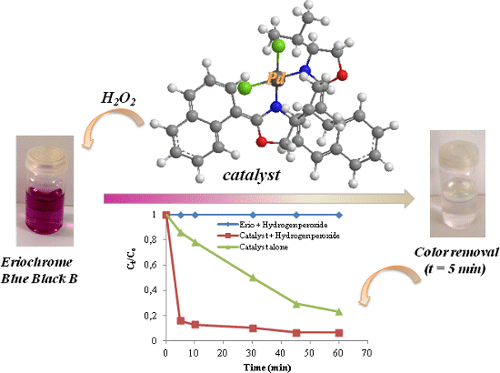
- structural features have been used in diverse reactions [8]. The importance of these ligands lies in the fact that the stereogenic centers are kept in close proximity to the metal and thereby having a strong and direct influence on the stereochemical course of the metal-catalyzed process. Oxazolines possess


Cathodic hydrodimerization of nitroolefins
Beilstein J. Org. Chem. 2015, 11, 1163–1174, doi:10.3762/bjoc.11.131
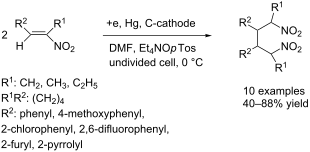
- configurations at the stereogenic centers. Hydrodimerization of 1 in dependence on the electrolyte composition. Hydrodimerization of 1a in dependence of temperature, conversion and cell type. Preparation of 1-aryl-2-nitroalkenes. Preparative hydrodimerization of nitroalkenes. δ-Values and multiplicities of the


Regioselective synthesis of chiral dimethyl-bis(ethylenedithio)tetrathiafulvalene sulfones
Beilstein J. Org. Chem. 2015, 11, 1105–1111, doi:10.3762/bjoc.11.124

- by the combination of chirality with the TTF motif, a certain number of families of precursors have been reported. They possess various types of chirality, i.e., stereogenic centers, axial, planar, helical chirality, and supramolecular chirality [17][18][19][20][21]. Since methylated BEDT-TTF


The reactions of 2-ethoxymethylidene-3-oxo esters and their analogues with 5-aminotetrazole as a way to novel azaheterocycles
Beilstein J. Org. Chem. 2015, 11, 385–391, doi:10.3762/bjoc.11.44
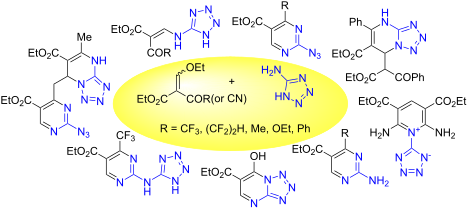
- heterocycle 10. Compound 10 was isolated as one diastereomer, but the relative configuration of its stereogenic centers was not determined. Moreover, we studied the reaction of ethyl 2-ethoxymethylidenecyanoacetate (1f) with 5-AT. It has been found that this reaction does not occur either in refluxing ethanol


The unexpected influence of aryl substituents in N-aryl-3-oxobutanamides on the behavior of their multicomponent reactions with 5-amino-3-methylisoxazole and salicylaldehyde
Beilstein J. Org. Chem. 2014, 10, 3019–3030, doi:10.3762/bjoc.10.320
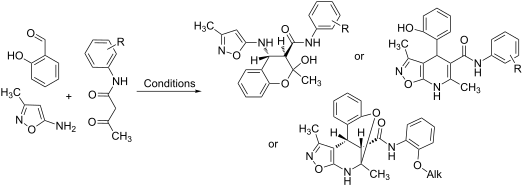
- signals for the other terminal substituents. The relative stereochemistry of the stereogenic centers at positions 3 and 4 of compound 4a was established by 1D and 2D NMR spectra. Thus, a 3J coupling constant of 11.7 Hz accounts for a trans-orientation. The NOESY experiment showed only a quite weak
- stereogenic centers at positions 4 and 12 of compound 6a was first established by analysis of the 1D and 2D NMR spectra. Thus, a 3J coupling constant of 1.9 Hz corresponds with a cis-orientation and the NOESY experiment additionally supports the proximity of this pair of protons. The structure of compound 6a
- with relative stereochemistry of stereogenic centers was finally corroborated by an X-ray diffraction study (Figure 5). The heterocycles of the polycyclic fragment adopt a chair-like conformation (the puckering parameters [29] are: S = 0.78, Θ = 32.8°, Ψ = 1.0° and S = 0.83, Θ = 38.0°, Ψ = 1.8° for the


(2R,1'S,2'R)- and (2S,1'S,2'R)-3-[2-Mono(di,tri)fluoromethylcyclopropyl]alanines and their incorporation into hormaomycin analogues
Beilstein J. Org. Chem. 2014, 10, 2844–2857, doi:10.3762/bjoc.10.302
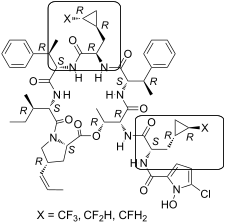
- isolated from a Streptomyces griseoflavus (strain W-384) fermentation broth by Zähner et al. in Tübingen, Germany and structurally identified by Zeeck et al. in Göttingen, Germany in 1989–1990 [3][4]. Once the absolute configuration of all the previously unassigned stereogenic centers in the




De novo macrolide–glycolipid macrolactone hybrids: Synthesis, structure and antibiotic activity of carbohydrate-fused macrocycles
Beilstein J. Org. Chem. 2014, 10, 2215–2221, doi:10.3762/bjoc.10.229
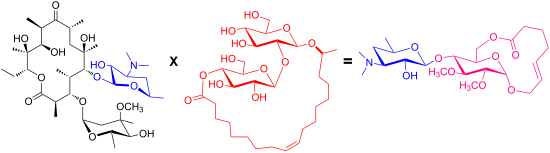
- , stereogenic centers and stereoelectronic effects combine to dictate the “topology” or overall fold of a macrocycle. The structure of β-D-galactose-[13]-macrodiolide 3 [9], derived from X-ray data, originated this line of investigation. It showed that both esters and the epoxide unit are each composed of four
- this case the macrocyclic ring. In total it is the balancing of a number of small factors such as rigidification by multi-atom planar units, absolute configuration of stereogenic centers and stereoelectronic effects that dictate the observed structures. Minimum inhibitory concentrations (MICs) against
- work, however, relates the role of the exo-anomeric effect on the low-energy conformation of macrocycles linked through an anomeric center. This weak stereoelectronic effect should be listed with other factors such as ring size, multi-atom planar units, and stereogenic centers as determinants of


Application of cyclic phosphonamide reagents in the total synthesis of natural products and biologically active molecules
Beilstein J. Org. Chem. 2014, 10, 1848–1877, doi:10.3762/bjoc.10.195
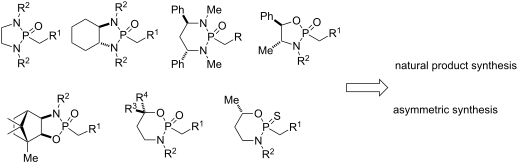
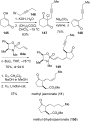
- α-alkyl phosphonamide, respectively [36]. Michael reactions The application of chiral, cyclic phosphonamides such as 28c in asymmetric Michael-type reactions has proven to be a powerful tool in natural product synthesis to generate up to three contiguous stereogenic centers in a single step with a








Rational design of cyclopropane-based chiral PHOX ligands for intermolecular asymmetric Heck reaction
Beilstein J. Org. Chem. 2014, 10, 1536–1548, doi:10.3762/bjoc.10.158
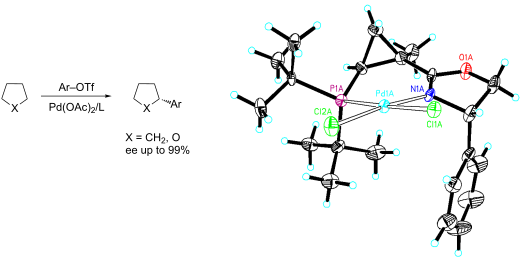
- approach to palladium may also be responsible for the observed decrease in the reaction rate. Based on this analysis, we rationalized that the “wrong” relative configuration of the stereogenic centers in ligands L1, L2 and L3 could be responsible for the observed marginal enantioselectivity of the


cis–trans Isomerization of silybins A and B
Beilstein J. Org. Chem. 2014, 10, 1047–1063, doi:10.3762/bjoc.10.105
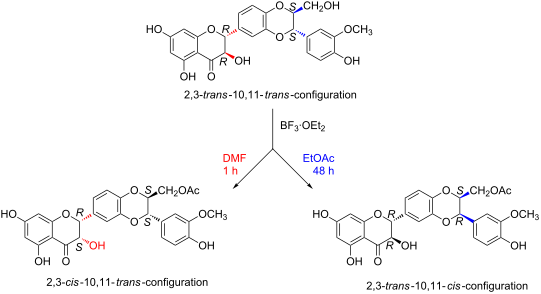
- analogues are considered to be composed of two separate π-conjugated subsystems, the 3-hydroxyflavonone moiety (with the stereogenic centers C-2 and C-3), and the 1,4-benzodioxane moiety (C-10 and C-11) (see Figure 4). In this simplification we cannot avoid the adverse effects caused by neglecting the
- effects of local perturbations on specific stereogenic centers. Thus, the interpretation of our experimental ECD spectra is mainly based on empirical comparison and correlation to those of i) the dihydroflavonols taxifolin (15) and epitaxifolin (16) isolated from Thujopsis dolobrata [16] and ii) various
- obtained by the isomerization of 1 using BF3·OEt2 in EtOAc. ECD spectrum of silybin B (1b) and its separation (in a crude approximation) into two π-conjugated moieties (3-hydroxyflavonone with stereogenic centers C-2, C-3 (in blue) and 1,4-benzodioxane with C-10,C-11) (in red) according to [2]. Synthetic





