


Search results
Search for "catalytic activity" in Full Text gives 326 result(s) in Beilstein Journal of Organic Chemistry. Showing first 200.
Copper-catalyzed enantioselective conjugate reduction of α,β-unsaturated esters with chiral phenol–carbene ligands
Beilstein J. Org. Chem. 2020, 16, 537–543, doi:10.3762/bjoc.16.50
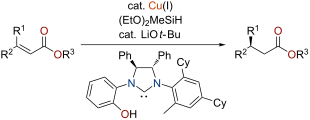
- plays crucial roles in both the catalytic activity and stereoselectivity [19][20][21]. Notably, these catalyst systems were also applicable for three-component coupling reactions using hydrosilanes as hydride reagents [17]. Based on this knowledge, we decided to investigate the effects of the phenol–NHC


Controlling alkyne reactivity by means of a copper-catalyzed radical reaction system for the synthesis of functionalized quaternary carbons
Beilstein J. Org. Chem. 2020, 16, 502–508, doi:10.3762/bjoc.16.45
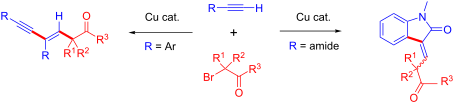
- produce 3g and 3h, respectively. An arylalkyne 1 possessing an electron-withdrawing group (ester) yielded 3i without affecting the reactivity of 2. Sulfur functional groups tend to decrease the catalytic activity of copper salts, but thienyl-substituted alkyne 1 reacted with 2a to produce 3j in 48% yield


Oligomeric ricinoleic acid preparation promoted by an efficient and recoverable Brønsted acidic ionic liquid
Beilstein J. Org. Chem. 2020, 16, 351–361, doi:10.3762/bjoc.16.34
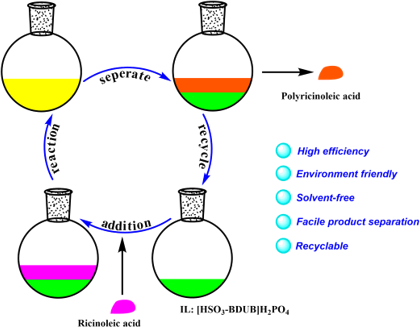
- mentioning that the IL catalyst can be used at least for five cycles with high catalytic activity. As a result, the protocol based on the IL catalyst, i.e. [HSO3-BDBU]H2PO4 shows great potential in industrial production of oligomeric ricinoleic acid from ricinoleic acid. Keywords: bio-lubricant; ionic
- excellent catalytic activity for this intermolecular esterification reaction and Brønsted acidic ionic liquids have been successfully used as catalyst in organic syntheses [29][30][31], we designed a series of Brønsted acidic ionic liquids and applied them as catalysts for the preparation of oligomeric
- the catalytic activity of these functional ILs was evaluated with the acid value of the product as it is a convenient index to monitor the degree of oligomerization by reflecting the concentration of carboxy groups in the system, which has been cross verified by HPLC method [19][28]. The results


Synthesis of 3-alkenylindoles through regioselective C–H alkenylation of indoles by a ruthenium nanocatalyst
Beilstein J. Org. Chem. 2020, 16, 140–148, doi:10.3762/bjoc.16.16
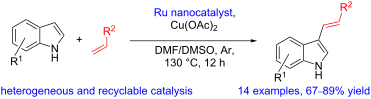
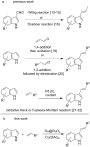
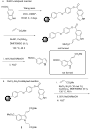
- ruthenium oxides/hydroxides on the surface. Ru nanocatalyst-catalysed C–H alkenylation of indoles After the synthesis of the RuNC, we explored the catalytic activity of the material in C–H alkenylation reactions of indole (1a). Initial optimisation of the conditions for the alkenylation reactions were
- results of the Hg poisoning test and, more importantly, the three-phase test, could allow us to reach the conclusion that the reactions were catalysed by a heterogeneous process. Role of the surface oxide and plausible mechanism One of the reasons for the high catalytic activity of the RuNC was the near
- target to synthesise zerovalent Ru nanoparticles. However, with respect to their catalytic ability, they are actually beneficial and responsible for the catalytic activity of the nanocatalyst towards the C–H activation reaction, since it has previously been shown that the presence of surface oxides on




Palladium-catalyzed Sonogashira coupling reactions in γ-valerolactone-based ionic liquids
Beilstein J. Org. Chem. 2019, 15, 2907–2913, doi:10.3762/bjoc.15.284
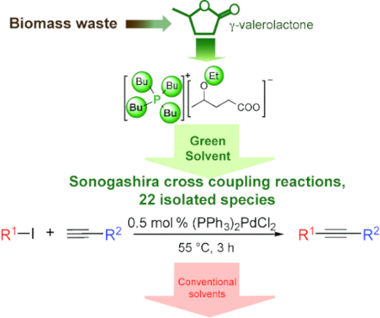
- and functionalized acetylenes under mild conditions. The reactions were performed by using 0.5 mol % catalyst loading and we pointed out that both copper and external base could be eliminated from the reaction mixture without any decrease in catalytic activity. The protocol was tested for a wide range


Self-assembled coordination thioether silver(I) macrocyclic complexes for homogeneous catalysis
Beilstein J. Org. Chem. 2019, 15, 2465–2472, doi:10.3762/bjoc.15.239
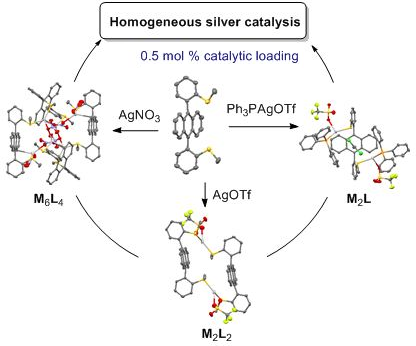
- of the two L2·(AgOTf)2 stereoisomers highlighted their different geometry. The catalytic activity of all silver(I) complexes was effective under homogeneous conditions in two tandem addition/cycloisomerization of alkynes using 0.5–1 mol % of catalytic loading. Keywords: coordination macrocycle


1,2,3-Triazolium macrocycles in supramolecular chemistry
Beilstein J. Org. Chem. 2019, 15, 2142–2155, doi:10.3762/bjoc.15.211
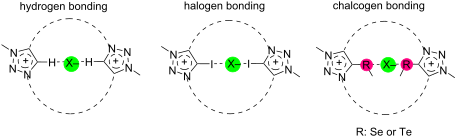
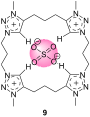
- reaction with the highest enantioselectivity. The importance of the bifunctional system for the catalytic activity and enantioselectivity was demonstrated by performing a series of reactions with lower activity and selectivity, utilizing free-base porphyrin 16h with triazolium moieties and the two




Naphthalene diimides with improved solubility for visible light photoredox catalysis
Beilstein J. Org. Chem. 2019, 15, 2043–2051, doi:10.3762/bjoc.15.201
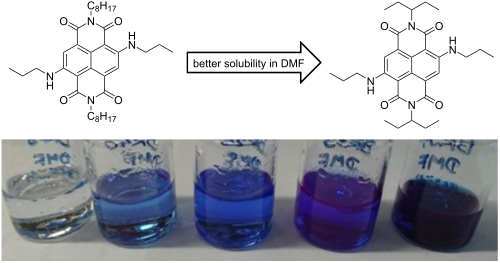
- potential was estimated to be approximately +1.0 V (vs SCE) which is sufficient to photocatalyze typical organic reactions. The photoredox catalytic activity in the visible light range was tested by the α-alkylation of 1-octanal as benchmark reaction. Irradiations were performed with LEDs in the visible
- catalytic activity was representatively tested by the MacMillan benchmark reaction [53]. For this type of photoredox catalytic reaction, solubility of cNDIs in DMF is a crucial prerequisite. Results and Discussion Synthesis of cNDIs 2–6 and their solubility The commercially available precursor for all NDIs
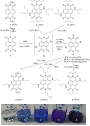
- can be assigned to the electron-donating effect of the n-propylamino groups. The key values for the photoredox catalytic activity (vide infra) are the excited state potential for the reduction, E*red(2*/2•−) = +0.92 V, and for the oxidation E*ox(2•+/2*) = −0.99 V. According to the categories for



Isolation and characterisation of irinans, androstane-type withanolides from Physalis peruviana L.
Beilstein J. Org. Chem. 2019, 15, 2003–2012, doi:10.3762/bjoc.15.196
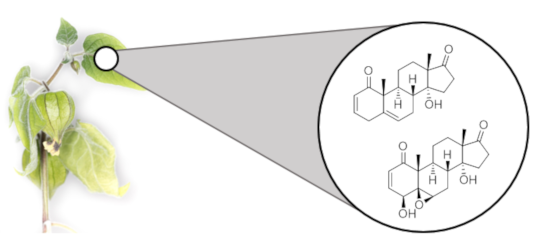
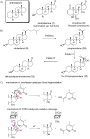
- identities of 22–28%, indicating that no P450 enzymes of these clans exist in P. peruviana. Although enzymes with similar catalytic activity might have evolved convergently in plants, the different substitution pattern in the side chain suggests that a side-chain cleavage mechanism distinct from mammals is



Recent advances on the transition-metal-catalyzed synthesis of imidazopyridines: an updated coverage
Beilstein J. Org. Chem. 2019, 15, 1612–1704, doi:10.3762/bjoc.15.165
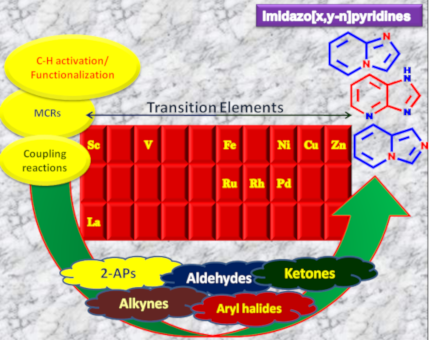
- -benzenedicarboxylate), Puthiaraj and co-workers have unprecedently discovered the catalytic activity of this metal-organic framework (MOF) for the synthesis of imidazo[1,2-a]pyridines [100]. The three-component, one-pot reaction between 1, 3 and nitromethane (10, Scheme 5) involved an intermolecular aza-Michael
- catalytic activity exhibited by Cu(0) NPs Chenglong et al. have reported an efficient, three-component one-pot reaction for the synthesis of imidazo[1,2-a]pyridines [111]. The protocol enjoyed a solvent-free domino reaction between compounds 3, 1 and 2 under nitrogen atmosphere at 120 °C (Scheme 15
- the past few years [57]. Recently, Buchwald and Castillo have reviewed the exceptional utility of Pd-catalyzed C–N cross-coupling reactions for the preparation of anilines and aniline derivatives [58]. In many of the reactions, palladium was used along with a co-catalyst to enhance its catalytic


Enantioselective PCCP Brønsted acid-catalyzed aza-Piancatelli rearrangement
Beilstein J. Org. Chem. 2019, 15, 1569–1574, doi:10.3762/bjoc.15.160
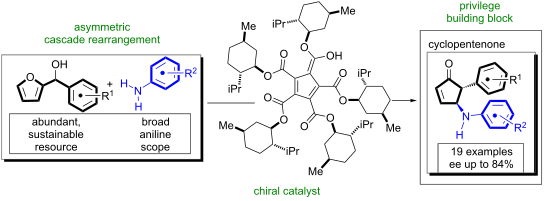
- 65% ee. At lower temperatures (30 °C and 23 °C (rt)) the selectivity increased to 73% and 78% ee, respectively. For consistency the optimization studies were all allowed to run for 48 h with higher temperatures being more efficient (Table 1, entries 1–3). Importantly, the catalytic activity did not


Molecular basis for the plasticity of aromatic prenyltransferases in hapalindole biosynthesis
Beilstein J. Org. Chem. 2019, 15, 1545–1551, doi:10.3762/bjoc.15.157
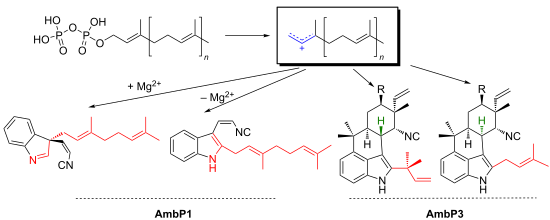
- orientation of the indole in HU and HA. As expectedly, W117 was shown to be important for the reaction through a point mutation study, in which W117A and W117F completely lost the catalytic activity. In the HU structure, the distance between C-2 of HU and C-3 of DMSPP (Figure 5A, a: 3.6 Å) is shorter than


A heteroditopic macrocycle as organocatalytic nanoreactor for pyrroloacridinone synthesis in water
Beilstein J. Org. Chem. 2019, 15, 1505–1514, doi:10.3762/bjoc.15.152
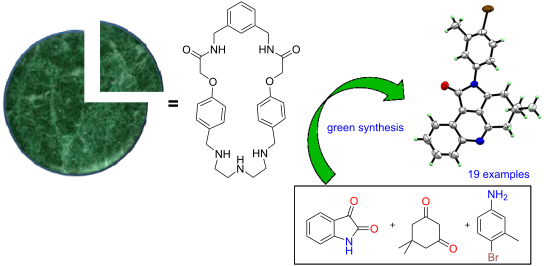
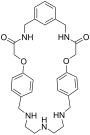
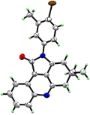
- ][47][48][49][50]. The multifunctional macrocycle BATA-MC (Figure 1) has been successfully applied as a wheel in the molecular rotors fields [51]. Considering its multiple binding sites (π-interactions, H-bonding site, cavity), we investigated the catalytic activity of this macrocycle. BATA-MC was
- is a molecular assembly of BATA-MC single molecules which may provide a suitable organic environment to the starting materials by π-interaction and H-bonding, and inevitably orients them into the necessary reactive positions. To represent the simple catalytic activity, we have chosen a part of the
- . Recyclability of the BATA-MC catalyst The BATA-MC catalyst was recovered by column chromatography and its recyclability was investigated in the synthesis of 4a to demonstrate the eco-friendly nature of the catalyst. The catalytic activity remained nearly unchanged up to five cycles as shown in Figure 7





Phylogenomic analyses and distribution of terpene synthases among Streptomyces
Beilstein J. Org. Chem. 2019, 15, 1181–1193, doi:10.3762/bjoc.15.115
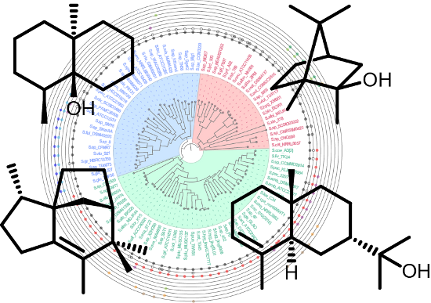
- of type I terpene synthases, including the aspartate-rich motif, the NSE triad, the pyrophosphate sensor and the RY pair [19][20][21]. Both domains have a catalytic activity, the N-terminal domain for the conversion of FPP into the intermediate sesquiterpene alcohol (1(10)E,5E)-germacradien-11-ol (12



Mechanochemistry of supramolecules
Beilstein J. Org. Chem. 2019, 15, 881–900, doi:10.3762/bjoc.15.86
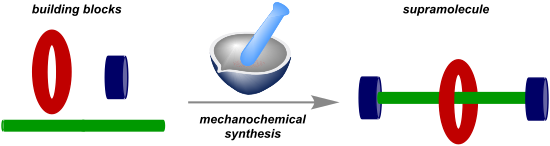
- , supramolecular catalysis proposes a much simpler model to understand the catalytic activity of enzymes. In 2010, MacGillivray and co-workers have demonstrated the concept of “supramolecular catalysis” in a hydrogen-bond-assisted self-assembled formation of a [2 + 2]-cycloaddition product. The reaction was found


New α- and β-cyclodextrin derivatives with cinchona alkaloids used in asymmetric organocatalytic reactions
Beilstein J. Org. Chem. 2019, 15, 830–839, doi:10.3762/bjoc.15.80
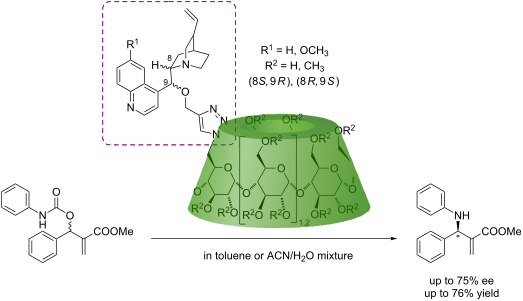
- derivatives monosubstituted with cinchona alkaloids (cinchonine, cinchonidine, quinine and quinidine) on the primary rim through a CuAAC click reaction. Subsequently, permethylated analogs of these cinchona alkaloid–CD derivatives also were synthesized and the catalytic activity of all derivatives was
- the primary side. Further characterization data are included in Supporting Information Files 1–3. Catalytic activity of cinchona–CD derivatives Lastly, the activity of all prepared CD derivatives was tested in asymmetric organocatalytic reactions. After unsuccessful application in Morita–Baylis
- afforded on one side lower enantiomer excesses (Table 3, entries 18–28), on the other hand, they showed some catalytic activity in the solvent mixture acetonitrile/H2O, which could be promising for future applications of these catalysts in water. The disubstituted CD derivative 11 was not active in this


Synthesis of acylglycerol derivatives by mechanochemistry
Beilstein J. Org. Chem. 2019, 15, 811–817, doi:10.3762/bjoc.15.78
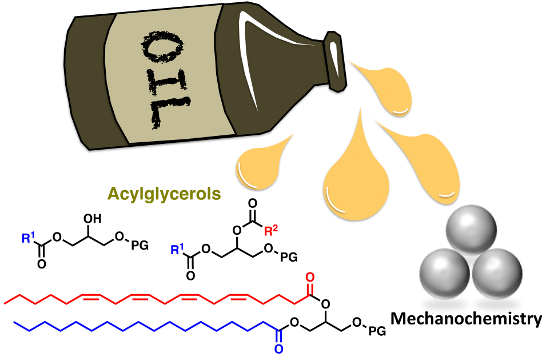
- nucleophiles [36]. Moreover, salen complexes endure mechanochemical conditions, as proven during their preparation in ball mills [37]. In addition, various related Jacobsen salen complexes have shown catalytic activity under solvent-free conditions [38]. Collectively, these precedents made this synthetic route


Hoveyda–Grubbs catalysts with an N→Ru coordinate bond in a six-membered ring. Synthesis of stable, industrially scalable, highly efficient ruthenium metathesis catalysts and 2-vinylbenzylamine ligands as their precursors
Beilstein J. Org. Chem. 2019, 15, 769–779, doi:10.3762/bjoc.15.73
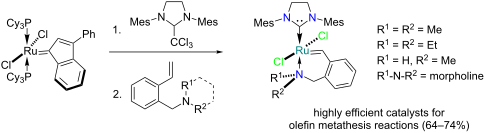
- possible to overcome this problem [44]. Thus, the pathways described in Schemes 1–3 permit one to vary the steric volume of substituents at the nitrogen atom in a wide range enabling synthesis of selective Grubbs catalysts with different catalytic activity. These styrenes were used in the preparation of
- should have the strongest effect on the catalytic activity. With the increase of the steric volume of substituents at the nitrogen atom, the ruthenium–nitrogen coordinate bond is extended, which makes it weaker. That should, obviously, increase the activity of the catalyst towards metathesis reactions
- process, temperature also exerts a strong influence on the catalytic activity of metallo complexes 11. None of catalysts 11 were active at room temperature (19–23 °С) towards the styrene cross metathesis, meaning that all reactions required temperatures higher than 30–35 °С. After all observations, we


Synthesis of polydicyclopentadiene using the Cp2TiCl2/Et2AlCl catalytic system and thin-layer oxidation of the polymer in air
Beilstein J. Org. Chem. 2019, 15, 733–745, doi:10.3762/bjoc.15.69
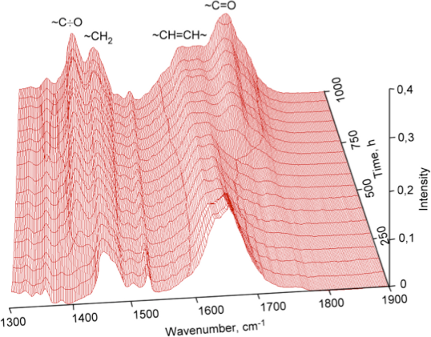
- catalytic activity of the Cp2TiCl2/organoaluminum compound is determined by the molar ratio of the components of the catalytic system [15]. The rate of transformation in the system depends both on the Al:Ti molar ratio and on the temperature [16]. UV spectra of toluene solutions of Cp2TiCl2 and AlEt2Cl




Back to the future: Why we need enzymology to build a synthetic metabolism of the future
Beilstein J. Org. Chem. 2019, 15, 551–557, doi:10.3762/bjoc.15.49
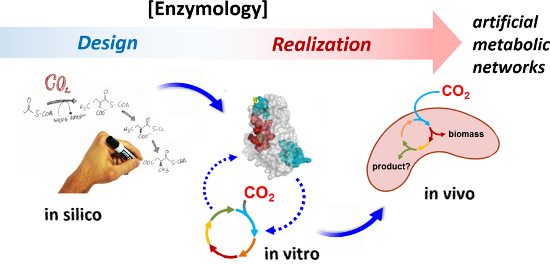
- point to search for enzyme variants that possess a desired catalytic activity. While existing databases might provide a good resource to find the parts to reconstruct level 3 pathways, this task becomes more challenging in respect to level 4 and level 5 designs that require new-to-nature reactions. How


Aqueous olefin metathesis: recent developments and applications
Beilstein J. Org. Chem. 2019, 15, 445–468, doi:10.3762/bjoc.15.39
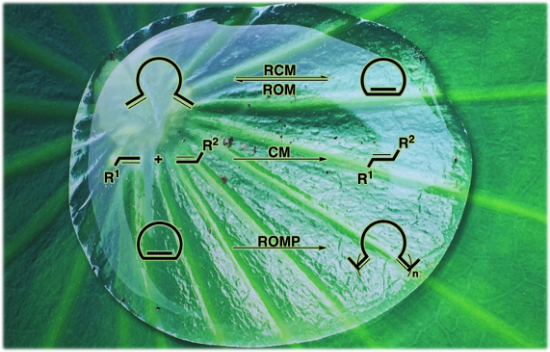
- on the catalytic activity of the reaction. In fact, catalyst and substrate are encapsulated into emulsion droplets formed in the reaction media above the aqueous layer, making the reaction proceed “on water” [21][22]. The introduction of amphiphilic molecules for aqueous micellar catalysis allows
- -metathesis of allyl alcohol (59) and the cis–trans isomerization of cis-butenedienol (Z-58). Metathesis catalysts bearing quaternary ammonium groups provide an attractive alternative to classical ruthenium catalysts. Although they do not represent a great improvement in terms of catalytic activity, they




Application of olefin metathesis in the synthesis of functionalized polyhedral oligomeric silsesquioxanes (POSS) and POSS-containing polymeric materials
Beilstein J. Org. Chem. 2019, 15, 310–332, doi:10.3762/bjoc.15.28
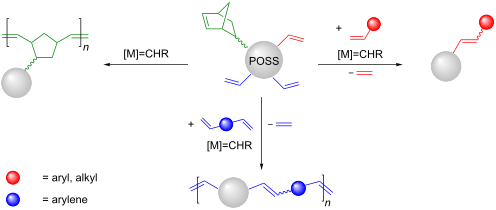
- and do not show catalytic activity in metathesis. The most important consequences of the above-described reactivity in metathesis of vinyl-substituted siloxanes, spherosilicates and silsesquioxanes are presented in Figure 2. It should be indicated that one of the consequences of the described
- allyltrimethoxysilane, ethyl undec-10-enylate, oct-7-enyltrimethoxysilane, 5-bromopentene, pent-4-en-1-ol) and styrene. Moreover, the catalytic activity of the first generation Grubbs’ catalyst (Ru-1) was demonstrated in CM of OVS with pent-4-en-1-ol and 5-bromopentene. It has been found that terminal alkenes undergo


Catalysis of linear alkene metathesis by Grubbs-type ruthenium alkylidene complexes containing hemilabile α,α-diphenyl-(monosubstituted-pyridin-2-yl)methanolato ligands
Beilstein J. Org. Chem. 2019, 15, 194–209, doi:10.3762/bjoc.15.19
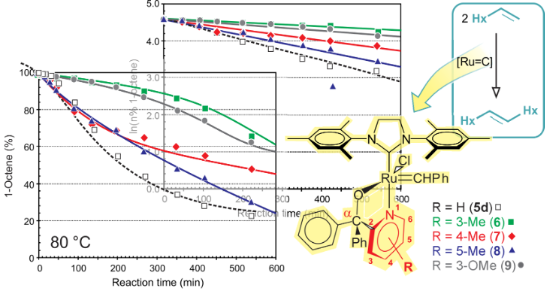
- -quinolinolate Grubbs 2-type derivative, patented by Slugovc and Wappel [15] for use in ROMP reactions, was found to be inactive (<1% conversion) for 1-octene metathesis at 60 °C [12]. Schachner et al. [16] evaluated the catalytic activity of 5b, 5d and related complexes for the ROMP of cyclooctene, CM of hex-5
- precatalyst 6 at 420 min. At 420 min, 1-octene conversion is 98.0% (110 °C), 93.0% (100 °C), 70.5% (90 °C), 19.4% (80 °C), 6.8% (70 °C) and 2.5% (60 °C). This shows the dramatic increase of the catalytic activity upon increasing the temperature. An investigation of the PMPs formation reveals a huge 66
- , on the overall metathesis reaction. During the course of PMPs formation, high catalytic activity for 9 is observed within 200 min at temperatures above 90 °C (ca. 60%), while the activity of the precatalyst showed a dramatic increase from 70 to 90 °C after ca. 500 min, similar to that of 6 (see


Silanediol versus chlorosilanol: hydrolyses and hydrogen-bonding catalyses with fenchole-based silanes
Beilstein J. Org. Chem. 2019, 15, 167–186, doi:10.3762/bjoc.15.17
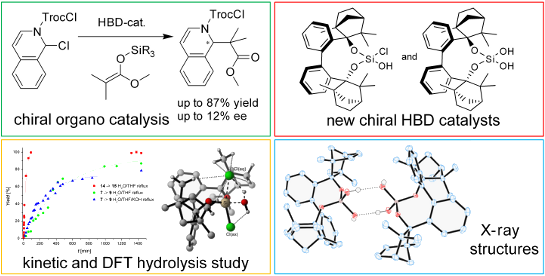
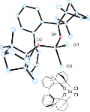
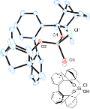
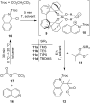
- )–2.05(2) Å) than with chlorosilanol 8 (OH···2.16(0) Å). Due to its two hydroxy units, the silanediol 9 shows higher catalytic activity as hydrogen bond donor than chlorosilanol 8, e.g., C–C coupling N-acyl Mannich reaction of silyl ketene acetals 11 with N-acylisoquinolinium ions (up to 85% yield and 12
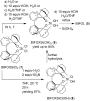
- (Scheme 6). The reactivity and stability of such an ion pair depend on the employed solvent. For this reaction and BIFOXSi(OH)2 (9) as catalyst, several solvents are tested (Table 7). In a nonpolar solvent like n-hexane, no catalytic activity is observed (Table 7, entry 1). In halogenated solvents as
- not show catalytic activity for the reaction of 18 with 11a, as the background reaction is slightly faster (54% vs 58%, Table 10, entries 9 and 13). With increasing of the steric demand of the nucleophilic silyl group, the background reaction slows down and chlorosilanol 8 has a positive influence on








Ammonium-tagged ruthenium-based catalysts for olefin metathesis in aqueous media under ultrasound and microwave irradiation
Beilstein J. Org. Chem. 2019, 15, 160–166, doi:10.3762/bjoc.15.16
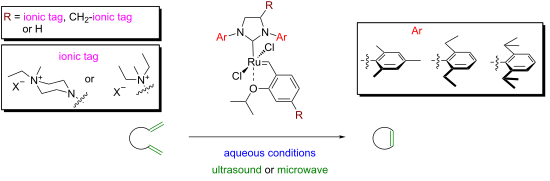
- Abstract The influence of microwave and ultrasonic irradiation on the performance of ammonium-tagged Ru-based catalysts in olefin metathesis transformations in aqueous media was studied. Differences in the catalytic activity in correlation with the nature of the present counter ion and the size of the N
- only in academia but also in industry [7][8][9][10][11][12]. However, there is still a large interest in improving the catalytic activity of the existing Ru-based metathesis catalysts as there is no universal catalyst for all the metathesis transformations. This is especially true for olefin metathesis
- (e.g., 50 mg mL−1 for 1a or 3a) whereas for those with I− as counter-ion is much lower (e.g., 4.0 mg mL−1 for 1b). In turn catalysts bearing PF6− or BF4− as counter ions are not soluble in water [71]. We have started our study with the comparison of the catalytic activity of complex 4b, having the





