


Search results
Search for "diazo" in Full Text gives 161 result(s) in Beilstein Journal of Organic Chemistry.
Enantioselective carbenoid insertion into C(sp3)–H bonds
- J. V. Santiago and
- A. H. L. Machado
Beilstein J. Org. Chem. 2016, 12, 882–902, doi:10.3762/bjoc.12.87
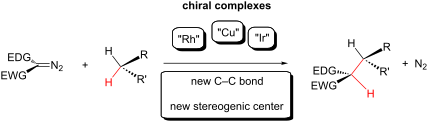
- activation; chiral catalysis; diazo compounds; total synthesis; Introduction One of the major challenges met in organic synthesis is the formation of carbon–carbon bonds, in particular in a stereoselective way. Nucleophilic substitution reactions, radical reactions, cross-coupling reactions and the Heck
- the carbenoid intermediate can change its reactivity and hence the selectivity of the carbenoid reaction. The most commonly used diazo compounds rely on the formation of a donor/acceptor carbenoid intermediate type. The EWG increases the electrophilicity and reactivity of the donor/acceptor carbenoid
- -cuparenone (8) through the construction of a five-membered ring prepared by an enantioselective carbenoid insertion into a C(sp3)–H bond (Scheme 3) [34]. To carry out the cyclization, the carbenoid was formed by the action of Rh2(OAc)4 on the diazo compound 6. That intermediate intramolecularly inserted into

Graphical Abstract

Figure 1: Singlet carbene, triplet carbene and carbenoids.

Figure 2: Classification of the carbenoid intermediates by the electronic nature of the groups attached to th...

Figure 3: Chiral bis(oxazoline) ligands used in enantioselective copper carbenoid insertion.

Scheme 1: Pioneering work of Peter Yates on the carbenoid insertion reaction into X–H bonds (where X = O, S, ...

Scheme 2: Copper carbenoid insertion into C(sp3)–H bond of a stereogenic center with full retention of the as...

Scheme 3: Carbenoid insertion into a C(sp3)–H bond as the key step of the Taber’s (+)-α-cuparenone (8) synthe...

Scheme 4: First enantioselective carbenoid insertion into C–O bonds catalyzed by chiral metallic complexes.

Figure 4: Chemical structures of complexes (R)-18 and (S)-18.

Scheme 5: Asymmetric carbenoid insertions into C(sp3)–H bonds of cycloalkanes catalyzed by chiral rhodium car...

Scheme 6: First diastereo and enantioselective intermolecular carbenoid insertion into tetrahydrofuran C(sp3)...

Scheme 7: Simplified mechanism of the carbenoid insertion into a C(sp3)–H bond.

Scheme 8: Nakamura’s carbenoid insertion into a C(sp3)–H bond catalytic cycle.

Scheme 9: Investigation of the relationship between the electronic characteristics of the substituent X attac...

Scheme 10: Empirical model to predict the stereoselectivity of the donor/acceptor dirhodium carbenoid insertio...

Scheme 11: Asymmetric insertion of copper carbenoids in C(sp3)–H bonds to prepare trans-γ-lactam.

Figure 5: Iridium catalysts used by Suematsu and Katsuki for carbenoid insertion into C(sp3)–H bonds.

Scheme 12: Chiral porphyrin iridium complex catalyzes the carbenoid insertion into bis-allylic C(sp3)–H bonds.

Scheme 13: Chiral porphyrin iridium complex catalyzes the carbenoid insertion into tetrahydrofuran C(sp3)–H bo...

Scheme 14: Chiral porphyrin–iridium complex catalyzes the intramolecular carbenoid insertion into C(sp3)–H bon...

Scheme 15: Chiral bis(oxazoline)–iridium complex catalyzes the carbenoid insertion into bis-allylic C(sp3)–H b...

Scheme 16: New cyclopropylcarboxylate-based chiral catalyst to enantioselective carbenoid insertion into the e...

Scheme 17: Regio- and enantioselective carbenoid insertion into the C(sp3)–H bond catalyzed by a new bulky cyc...

Scheme 18: Regio and diastereoselective carbenoid insertion into the C(sp3)–H bond catalyzed by a new bulky cy...

Scheme 19: 2,2,2-Trichloroethyl (TCE) aryldiazoacetates to improve the scope, regio- and enantioselective of t...

Scheme 20: Sequential C–H functionalization approach to 2,3-dihydrobenzofurans.

Scheme 21: Enantioselective intramolecular rhodium carbenoid insertion into C(sp3)–H bonds to afford cis-disub...

Scheme 22: Enantioselective intramolecular rhodium carbenoid insertion into C(sp3)–H bonds to afford cis-2-vin...

Scheme 23: First rhodium porphyrin-based catalyst for enantioselective carbenoid insertion into C(sp3)–H bond.

Scheme 24: Rhodium porphyrin-based catalyst for enantioselective carbenoid insertion into benzylic C(sp3)–H bo...
Recent advances in C(sp3)–H bond functionalization via metal–carbene insertions
- Bo Wang,
- Di Qiu,
- Yan Zhang and
- Jianbo Wang
Beilstein J. Org. Chem. 2016, 12, 796–804, doi:10.3762/bjoc.12.78

- (I) complexes. In some cases, high regioselectivity and enantioselectivity have been achieved in the C–H bond insertion of small alkanes. This review highlights the most recent accomplishments in this field. Keywords: alkane; diazo compounds; C–H bond functionalization; C–H bond insertion; metal
- chiral porphyrins D4-por*, the enantioselective intermolecular carbene insertion into C(sp3)–H bonds was achieved with moderate to high selectivities (Scheme 7). Besides, the reaction of diazo compounds with benzylic, allylic and alkane C(sp3)–H bonds afforded the insertion products in up to 80% yield

Graphical Abstract

Scheme 1: Pathway for transition-metal-catalyzed carbene insertion into C(sp3)–H bonds.

Scheme 2: Rh(II)-catalyzed site-selective and enantioselective C–H functionalization of methyl ether.

Scheme 3: Late-stage C–H functionalization with Rh(II)-catalyzed carbene C(sp3)–H insertion.

Scheme 4: The Rh(II)-catalyzed selective carbene insertion into benzylic C–H bonds.

Scheme 5: The structure–selectivity relationship.

Scheme 6: Rh-porphyrin complexes for catalytic intermolecular C–H insertions.

Scheme 7: Asymmetric intermolecular C(sp3)–H insertion with chiral Rh-porphyrin catalyst.

Figure 1: The structure of TpM catalysts.

Scheme 8: Ag-Tpx-catalyzed intermolecular C–H insertion between EDA and alkanes.

Scheme 9: Ag-Tpx-catalyzed C–H insertion of methane with EDA in scCO2.

Figure 2: Structure of TpM-type catalysts.

Scheme 10: Comparison of site-selectivities of C–H insertion in different reaction media.

Scheme 11: C(sp3)–H bond insertion catalyzed by trinuclear cluster Ag.

Scheme 12: Zn(II)-catalyzed C(sp3)–H bond insertion.
Diradical reaction mechanisms in [3 + 2]-cycloadditions of hetaryl thioketones with alkyl- or trimethylsilyl-substituted diazomethanes
- Grzegorz Mlostoń,
- Paulina Pipiak and
- Heinz Heimgartner
Beilstein J. Org. Chem. 2016, 12, 716–724, doi:10.3762/bjoc.12.71
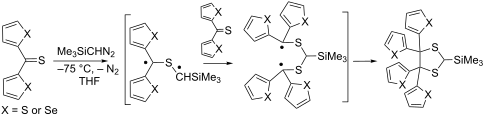
- products of the [3 + 2]-cycloaddition of the diazo dipole onto the C=S bond. The latter decompose only at higher temperature (ca. −40 °C) to generate thiocarbonyl S-isopropanide. In the absence of the starting thioketone, the corresponding thiiranes and/or ethene derivatives, formed from them via

Graphical Abstract

Scheme 1: ‘Head-to-head dimerization’ of diarylthioketone S-methanides 3a,b leading to 2,2,3,3-tetrasubstitut...

Scheme 2: Diradical nature of the reactive intermediate 3c in the reaction of phenyl selenophen-2-yl thioketo...

Scheme 3: Formation of thiiranes 8 and/or 1,3-dithiolanes 10 in the reaction of aryl/aryl, aryl/hetaryl and d...
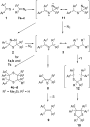
Scheme 4: Proposed competitive mechanisms in the reactions of aryl/hetaryl and dihetaryl thioketones 1 with 2...
Supramolecular polymer assembly in aqueous solution arising from cyclodextrin host–guest complexation
- Jie Wang,
- Zhiqiang Qiu,
- Yiming Wang,
- Li Li,
- Xuhong Guo,
- Duc-Truc Pham,
- Stephen F. Lincoln and
- Robert K. Prud’homme
Beilstein J. Org. Chem. 2016, 12, 50–72, doi:10.3762/bjoc.12.7
- [93]. Structures of the poly(acrylate)-based polymers PAAAzo (trans), PAAAzo (cis), PAA3α-CD and PAA6α-CD, and the effects of the stereochemistry and photo-isomerism of the diazo substituents of PAA3β-CD and PAA6β-CD on their host–guest complexation by the α-CD substituents of PAA3α-CD and PAA6α-CD

Graphical Abstract

Figure 1: Structures of α-, β- and γ-CD. Individual carbon atom numbering is shown for one D-glucopyranose su...

Figure 2: Associations of hydrophobic substituents (circled) (a) and their disruption through host–guest comp...

Figure 3: Decrease of aqueous solution viscosity at a shear rate of 50 s−1 due to α-CD (circles), β-CD (recta...

Figure 4: The effect of (a) α-CD, (b) β-CD and (c) γ-CD on the hydrophobic interactions between n-C18H37 subs...

Figure 5: The effect of SDS addition on viscosity shear rate dependence for 2 wt % aqueous PAAodn solutions c...

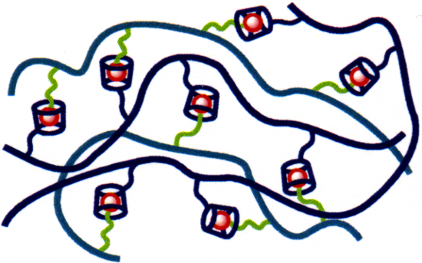
Figure 6: Host–guest complexation between polymers with cyclodextrin and hydrophobic substituents.

Figure 7: Variation of viscosity with mole ratio of CD substituents to hydrophobic substituents on poly(acryl...

Figure 8: Illustration of the competitive intermolecular host–guest complexation of either the adamantyl subs...

Figure 9: Competitive host–guest complexations in which either the adamantyl substituent (red) or the n-hexyl...

Figure 10: (a) Substituted chitosan in which acyl- and adamantyl-substitution is 5% and 12 %, respectively. (b...

Figure 11: The formation of a AD-PEG micelle followed by the formation of a AD-PEG/α-CD supramolecular hydroge...

Figure 12: Interaction of PEG-b-PAA block copolymer with cis-diamminedichloroplatinum(II), cisplatin, to form ...

Figure 13: Solution to hydrogel transitions (a)–(d) for a PAAddn segment in the presence of competitive photo-...

Figure 14: Structures of the poly(acrylate)-based polymers PAAAzo (trans), PAAAzo (cis), PAA3α-CD and PAA6α-CD...

Figure 15: Variation of viscosity of a PAA6α-CD/PAAAzo solution (circles) and a PAA3α-CD/PAAAzo solution (tria...

Figure 16: The structures proposed for the poly(ethylene glycol)-b-poly(ethylamine)-g-dextran·γ-CD, PEG-PEI-de...

Figure 17: Structure of poly(ethylene glycol) polyrotaxane with adamantyl end substituents, and its temperatur...

Figure 18: Copolymers of either (a) N,N-dimethylacrylamide (DMAA) or (b) N-isopropylacrylamine (NIPAAM) with 1...

Figure 19: The copolymer of isopropylacrylamine and methacrylated β-CD (a) and its complexation of the anions ...

Figure 20: Solution to hydrogel transitions for two segments of PAAddn in the presence of β-CD and change in t...

Figure 21: Preparation of a β-CD and adamantyl substituted acrylamide polymer hydrogel involving host–guest co...

Figure 22: Aqueous solutions of the polymers poly-β-CD and poly-α-BrNP form the poly-β-CD/poly-α-BrNP hydrogel ...

Figure 23: (a) Randomly β-CD substituted poly(acrylate), PAA-6β-CD. (b) Randomly ferrocenyl substituted poly(a...
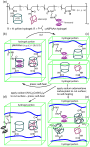
Figure 24: (a) The β-CD, adamantyl and ferrocenyl substituted pAAm and pNiPAAM polymers. (b) The β-CD, adamant...
Catalytic asymmetric formal synthesis of beraprost
- Yusuke Kobayashi,
- Ryuta Kuramoto and
- Yoshiji Takemoto
Beilstein J. Org. Chem. 2015, 11, 2654–2660, doi:10.3762/bjoc.11.285
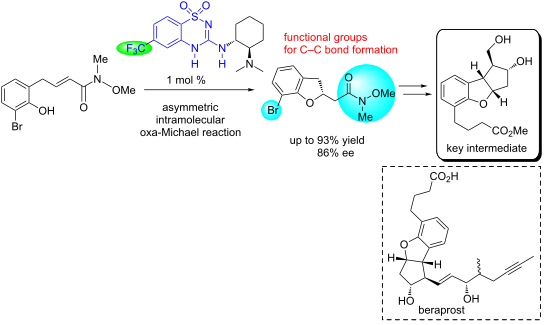
- condensation followed by diazo-transfer reaction. The chiral dihydrobenzofuran scaffold (5 or 6) could be synthesized by asymmetric intramolecular oxa-Michael reaction (AIOM) of α,β-unsaturated amides 7 or 8. Such reactions are generally considered to be challenging due to low nucleophilicity of the oxygen

Graphical Abstract

Figure 1: Structure of PGI2 and beraprost (1).

Scheme 1: Retrosynthetic analysis of beraprost (1).
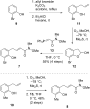
Scheme 2: Preparation of Michael precursors 7 and 8.

Scheme 3: First attempt at the synthesis of 2 from 6.
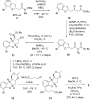
Scheme 4: Achievement of a formal synthesis of 2.
Synthesis of bi- and bis-1,2,3-triazoles by copper-catalyzed Huisgen cycloaddition: A family of valuable products by click chemistry
- Zhan-Jiang Zheng,
- Ding Wang,
- Zheng Xu and
- Li-Wen Xu
Beilstein J. Org. Chem. 2015, 11, 2557–2576, doi:10.3762/bjoc.11.276
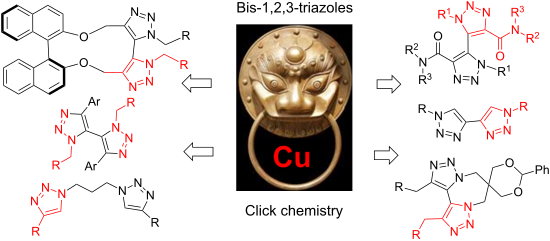
- diazo transfer agent (imidazole-1-sulfonyl azide) was performed to convert the amine group into the corresponding azide group, which provided a polymeric substrate for the second CuAAC reaction to give the desired bistriazoles (Scheme 23). In 2009, Zhu and co-workers found that copper(II) acetate (Cu

Graphical Abstract

Scheme 1: The synthesis of triazoles through the Huisgen cycloaddition of azides to alkynes.

Scheme 2: The synthesis of symmetrically substituted 4,4'-bitriazoles.

Scheme 3: The synthesis of unsymmetrically substituted 4,4'-bitriazoles.

Scheme 4: The stepwise preparation of unsymmetrical 4,4'-bitriazoles.

Scheme 5: The synthesis of 5,5'-bitriazoles.

Scheme 6: The synthesis of bistriazoles and cyclic 5,5’-bitriazoles under different catalytic systems.

Scheme 7: The double CuAAC reaction between helicenequinone and 1,1’-diazidoferrocene.

Scheme 8: The synthesis of 1,2,3-triazoles and 5,5’-bitriazoles from acetylenic amide.

Scheme 9: The amine-functionalized polysiloxane-mediated divergent synthesis of trizaoles and bitriazoles.

Scheme 10: The cyclic BINOL-based 5,5’-bitriazoles.

Scheme 11: The one-pot click–click reactions for the synthesis of bistriazoles.

Scheme 12: The synthesis of bis(indolyl)methane-derivatized 1,2,3-bistriazoles.

Scheme 13: The sequential, chemoselective preparation of bistriazoles.

Scheme 14: The sequential SPAAC and CuAAC reaction for the preparation of bistriazoles.

Scheme 15: The synthesis of D-mannitol-based bistriazoles.

Scheme 16: The synthesis of ester-linked and amide-linked bistriazoles.

Scheme 17: The synthesis of acenothiadiazole-based bistriazoles.
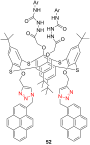
Scheme 18: The pyrene-appended thiacalix[4]arene-based bistriazole.

Scheme 19: The synthesis of triazole-based tetradentate ligands.

Scheme 20: The synthesis of phenanthroline-2,9-bistriazoles.

Scheme 21: The three-component reaction for the synthesis of bistriazoles.

Scheme 22: The one-pot synthesis of bistriazoles.

Scheme 23: The synthesis of polymer-bearing 1,2,3-bistriazole.

Scheme 24: The synthesis of bistriazoles via a sequential one-pot reaction.
Evidencing an inner-sphere mechanism for NHC-Au(I)-catalyzed carbene-transfer reactions from ethyl diazoacetate
- Manuel R. Fructos,
- Juan Urbano,
- M. Mar Díaz-Requejo and
- Pedro J. Pérez
Beilstein J. Org. Chem. 2015, 11, 2254–2260, doi:10.3762/bjoc.11.245
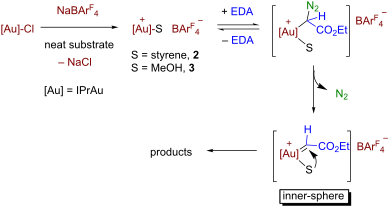
- of a gold(I) source and a diazo compound. It was not until 2005 that the first example of this transformation was reported by our group [15][16], when the complex IPrAuCl (1) (IPr = 1,3-bis(diisopropylphenyl)imidazole-2-ylidene), in the presence of NaBArF4 (BArF4− = tetrakis(3,5-bis(trifluoromethyl
- the well-known instability of some of the diazo reagents. The reactions shown in Scheme 2 and Scheme 3 have been explained through the appearance of a [LAu=CR1R2]+ intermediate, not detected nor isolated, that further reacts with a non-coordinated nucleophile (i.e., by means of an outer-sphere
- mechanism). Those intermediates are quite reactive, in contrast to similar but low reactive gold–carbene complexes recently and independently described by the groups of Fürstner [19] and Straub [20]. Scheme 4a shows a generally accepted mechanism for the metal-catalyzed carbene transfer from diazo compounds

Graphical Abstract

Scheme 1: The Au(I)-catalyzed skeletal rearrangement of the [2 + 2] cycloaddition of 1,6-enynes that involves...

Scheme 2: The catalytic activity of IPrAuCl + NaBArF4 in the carbene-transfer reaction to styrene or methanol....

Scheme 3: The gold-promoted decarbenation reaction described by Echavarren and co-workers.

Scheme 4: (a) General representation of the metal-catalyzed carbene-transfer reaction (olefin cyclopropanatio...

Figure 1: Plot of evolved nitrogen with time for the reactions of EDA with styrene or methanol.

Figure 2: Top: Plots of evolved nitrogen with time for the reactions of EDA with styrene (left) or methanol (...

Scheme 5: The outer- and inner-sphere routes for this transformation.

Figure 3: The experimental device for the measurement of N2 evolution.
Olefin metathesis in air
- Lorenzo Piola,
- Fady Nahra and
- Steven P. Nolan
Beilstein J. Org. Chem. 2015, 11, 2038–2056, doi:10.3762/bjoc.11.221
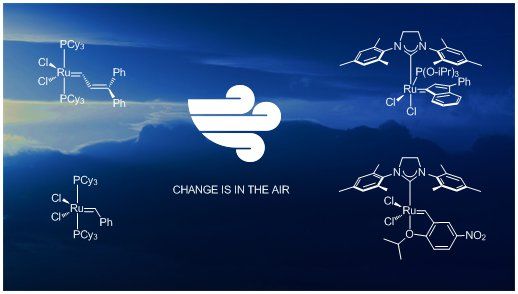
- reaction with styrene, avoiding the use of hazardous diazo compound 7 [82]. Towards the end of 2013, a report by Olszewski, Skowerski and co-workers showed how a variety of commercially available catalysts (Figure 12) could be employed in air with nondegassed ACS grade green solvents. Their results were in

Graphical Abstract

Scheme 1: Polymerization of 7-oxanorbornene in water.

Scheme 2: Synthesis of the first well-defined ruthenium carbene.

Scheme 3: Synthesis of Grubbs' 1st generation catalyst.

Figure 1: NHC-Ruthenium complexes and widely used NHC carbenes.

Scheme 4: Access to 21 from the Grubbs’ 1st generation catalyst and its one-pot synthesis.

Scheme 5: Synthesis of supported Hoveyda-type catalyst.

Figure 2: Scope of RCM reactions with supported Hoveyda-type catalyst. Reaction conditions: 24 (5 mol %), non...

Scheme 6: Synthesis of 33 by Hoveyda and Blechert.

Figure 3: Synthesis of chiral Hoveyda–Grubbs type catalyst and its use in RO/CM.

Scheme 7: Synthesis of 41.

Figure 4: RCM reactions in air using 41 as catalyst. Reaction conditions: 41 (5 mol %), MeOH (0.05 M), 22 °C,...

Figure 5: CM-type reactions in air using 41 as catalyst. Reaction conditions: 41 (5 mol %), 22 °C, 12 h, in a...

Figure 6: Grela's complex (54) and reaction scope in air. Reaction conditions: catalyst, substrate (0.25 mmol...
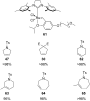
Figure 7: Abell's complex (61) and its RCM reaction scope in air. Reaction condition: 10 mol % of 61, refluxi...

Figure 8: Catalysts used by Meier in air.

Figure 9: Ammonium chloride-tagged complexes.

Figure 10: Scorpio-type complexes.

Scheme 8: Synthesis of Grubbs' 3rd generation catalyst.

Figure 11: Indenylidene complexes.

Figure 12: Commercially available complexes evaluated under air.

Figure 13: Grela's N,N-unsymmetrically substituted complexes.

Scheme 9: Synthesis of phosphite-based catalysts.

Figure 14: Catalysts used by the Cazin group.

Figure 15: RCM scope in air with catalysts 33, 85 and 98a. Reaction conditions: Catalyst, substrate (0.25 mmol...

Figure 16: Synthesis of Schiff base-ruthenium complexes.

Scheme 10: Schiff base–ruthenium complexes synthesized by Verpoort.

Scheme 11: Synthesis of mixed Schiff base–NHC complexes.

Figure 17: Veerport's indenylidene Schiff-base complexes.
Synthesis of quinoline-3-carboxylates by a Rh(II)-catalyzed cyclopropanation-ring expansion reaction of indoles with halodiazoacetates
- Magnus Mortén,
- Martin Hennum and
- Tore Bonge-Hansen
Beilstein J. Org. Chem. 2015, 11, 1944–1949, doi:10.3762/bjoc.11.210
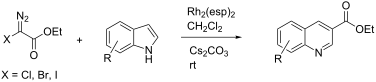
- transition metal-catalyzed C–H functionalization by diazo compounds [5][6][7][8]. The reactions of indoles with electrophilic metal-bound carbenes, or carbenoids, generated from diazo compounds, takes place under mild reaction conditions. The reaction has been studied for the three principle classes of

Graphical Abstract

Scheme 1: Synthesis of halo diazoacetates [17].

Scheme 2: The reaction between halodiazoacetates and indole.

Scheme 3: Proposed reaction pathway.

Scheme 4: Attempted cyclopropanation of N-Boc indole.

Scheme 5: The reaction between ethyl bromo diazoacetate and N-Me-indole.
Recent applications of ring-rearrangement metathesis in organic synthesis
- Sambasivarao Kotha,
- Milind Meshram,
- Priti Khedkar,
- Shaibal Banerjee and
- Deepak Deodhar
Beilstein J. Org. Chem. 2015, 11, 1833–1864, doi:10.3762/bjoc.11.199
- precursor 333 was obtained from diazo ester 331 in five steps. Further, the RRM of 333 with catalyst 2 furnished the required pyran derivative 334 (71%). Next, the fused ether 334 was transformed into the desired intermediate 335 in eight steps, which is a key intermediate required for the synthesis of

Graphical Abstract

Figure 1: Ruthenium alkylidene catalysts used in RRM processes.
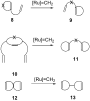
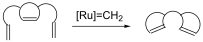
Figure 2: General representation of various RRM processes.

Figure 3: A general mechanism for RRM process.

Scheme 1: RRM of cyclopropene systems.

Scheme 2: RRM of cyclopropene with catalyst 2. (i) catalyst 2 (2.5 mol %), ethylene (24, 1 atm), (ii) toluene...

Scheme 3: RRM of various cyclopropene derivatives with catalyst 2. (i) catalyst 2 (2.5 mol %), CH2Cl2 (c = 0....

Scheme 4: RRM of substituted cyclopropene system with catalyst 2.

Scheme 5: RRM of cyclobutene system with catalyst 2.

Scheme 6: RRM approach to various bicyclic compounds.

Scheme 7: RRM approach to erythrina alkaloid framework.

Scheme 8: ROM–RCM sequence to lactone derivatives.

Scheme 9: RRM protocol towards the synthesis of lactone derivative 58.

Scheme 10: RRM protocol towards the asymmetric synthesis of asteriscunolide D (61).

Scheme 11: RRM strategy towards the synthesis of various macrolide rings.

Scheme 12: RRM protocol to dipiperidine system.

Scheme 13: RRM of cyclopentene system to generate the cyclohexene systems.

Scheme 14: RRM of cyclopentene system 74.

Scheme 15: RRM approach to compound 79.

Scheme 16: RRM approach to spirocycles.

Scheme 17: RRM approach to bicyclic dihydropyrans.

Scheme 18: RCM–ROM–RCM cascade using non strained alkenyl heterocycles.

Scheme 19: First ROM–RCM–ROM–RCM cascade for the synthesis of trisaccharide 97.

Scheme 20: RRM of cyclohexene system.

Scheme 21: RRM approach to tricyclic spirosystem.

Scheme 22: RRM approach to bicyclic building block 108a.

Scheme 23: ROM–RCM protocol for the synthesis of the bicyclo[3.3.0]octene system.

Scheme 24: RRM protocol to bicyclic enone.

Scheme 25: RRM protocol toward the synthesis of the tricyclic system 118.

Scheme 26: RRM approach toward the synthesis of the tricyclic enones 122a and 122b.

Scheme 27: Synthesis of tricyclic and tetracyclic systems via RRM protocol.

Scheme 28: RRM protocol towards the synthesis of tetracyclic systems.

Scheme 29: RRM of the propargylamino[2.2.1] system.

Scheme 30: RRM of highly decorated bicyclo[2.2.1] systems.

Scheme 31: RRM protocol towards fused tricyclic compounds.

Scheme 32: RRM protocol to functionalized tricyclic systems.

Scheme 33: RRM approach to functionalized polycyclic systems.

Scheme 34: Sequential RRM approach to functionalized tricyclic ring system 166.

Scheme 35: RRM protocol to functionalized CDE tricyclic ring system of schintrilactones A and B.

Scheme 36: Sequential RRM approach to 7/5 fused bicyclic systems.

Scheme 37: Sequential ROM-RCM protocol for the synthesis of bicyclic sugar derivatives.

Scheme 38: ROM–RCM sequence of the norbornene derivatives 186 and 187.

Scheme 39: RRM approach toward highly functionalized bridge tricyclic system.

Scheme 40: RRM approach toward highly functionalized tricyclic systems.

Scheme 41: Synthesis of hexacyclic compound 203 by RRM approach.

Scheme 42: RRM approach toward C3-symmetric chiral trimethylsumanene 209.

Scheme 43: Triquinane synthesis via IMDA reaction and RRM protocol.

Scheme 44: RRM approach to polycyclic compounds.

Scheme 45: RRM strategy toward cis-fused bicyclo[3.3.0]carbocycles.

Scheme 46: RRM protocol towards the synthesis of bicyclic lactone 230.

Scheme 47: RRM approach to spiro heterocyclic compounds.

Scheme 48: RRM approach to spiro heterocyclic compounds.

Scheme 49: RRM approach to regioselective pyrrolizidine system 240.

Scheme 50: RRM approach to functionalized bicyclic derivatives.

Scheme 51: RRM approach to tricyclic derivatives 249 and 250.

Scheme 52: RRM approach to perhydroindoline derivative and spiro system.

Scheme 53: RRM approach to bicyclic pyran derivatives.

Scheme 54: RRM of various functionalized oxanorbornene systems.

Scheme 55: RRM to assemble the spiro fused-furanone core unit. (i) 129, benzene, 55 °C, 3 days; (ii) Ph3P=CH2B...

Scheme 56: RRM protocol to norbornenyl sultam systems.

Scheme 57: Ugi-RRM protocol for the synthesis of 2-aza-7-oxabicyclo system.

Scheme 58: Synthesis of spiroketal systems via RRM protocol.

Scheme 59: RRM approach to cis-fused heterotricyclic system.

Scheme 60: RRM protocol to functionalized bicyclic systems.

Scheme 61: ROM/RCM/CM cascade to generate bicyclic scaffolds.

Scheme 62: RCM of ROM/CM product.

Scheme 63: RRM protocol to bicyclic isoxazolidine ring system.

Scheme 64: RRM approach toward the total synthesis of (±)-8-epihalosaline (300).

Scheme 65: Sequential RRM approach to decalin 304 and 7/6 fused 305 systems.

Scheme 66: RRM protocol to various fused carbocyclic derivatives.

Scheme 67: RRM to cis-hydrindenol derivatives.

Scheme 68: RRM protocol towards the cis-hydrindenol derivatives.

Scheme 69: RRM approach toward the synthesis of diversed polycyclic lactams.

Scheme 70: RRM approach towards synthesis of hexacyclic compound 324.

Scheme 71: RRM protocol to generate luciduline precursor 327 with catalyst 2.

Scheme 72: RRM protocol to key building block 330.

Scheme 73: RRM approach towards the synthesis of key intermediate 335.

Scheme 74: RRM protocol to highly functionalized spiro-pyran system 339.

Scheme 75: RRM to various bicyclic polyether derivatives.
Pyridine-promoted dediazoniation of aryldiazonium tetrafluoroborates: Application to the synthesis of SF5-substituted phenylboronic esters and iodobenzenes
- George Iakobson,
- Junyi Du,
- Alexandra M. Z. Slawin and
- Petr Beier
Beilstein J. Org. Chem. 2015, 11, 1494–1502, doi:10.3762/bjoc.11.162
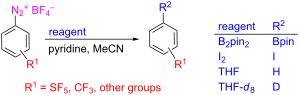
- for an efficient reaction. Alkali metal acetates are known to facilitate decomposition of aryldiazonium salts by the formation of diazoacetates and diazo anhydrides, which decompose to aryl radicals [76]. These additives were used in Meerwein arylation of isopropenyl acetate [77]. In our case, two

Graphical Abstract

Scheme 1: Borylation of aryldiazonium tetrafluoroborates 3. Reaction conditions: 3 (1 mmol), B2pin2 (1 mmol),...

Scheme 2: Proposed reaction mechanism.

Scheme 3: Reaction of diazonium salt 3i under borylation conditions.

Scheme 4: Suzuki–Miyaura reaction of boronates 2a and 2b with aryl iodides. Reaction conditions: 2 (1 mmol), ...

Scheme 5: Syntesis of boronic acid 8b and trifluoroborates 9. Reaction conditions for the synthesis of 8b: 2 ...

Scheme 6: Iodination of aryldiazonium tetrafluoroborates 3. Reaction conditions: 3 (1 mmol), I2 (1.1 mmol), p...
Selected synthetic strategies to cyclophanes
- Sambasivarao Kotha,
- Mukesh E. Shirbhate and
- Gopalkrushna T. Waghule
Beilstein J. Org. Chem. 2015, 11, 1274–1331, doi:10.3762/bjoc.11.142

Graphical Abstract

Figure 1: General representation of cyclophanes.

Figure 2: cyclophanes one or more with heteroatom.

Figure 3: Metathesis catalysts 12–17 and C–C coupling catalyst 18.

Figure 4: Natural products containing the cyclophane skeleton.

Figure 5: Turriane family of natural products.

Scheme 1: Synthesis of [3]ferrocenophanes through Mannich reaction. Reagents and conditions: (i) excess HNMe2...

Scheme 2: Synthesis of cyclophanes through Michael addition. Reagents and conditions: (i) xylylene dibromide,...

Scheme 3: Synthesis of normuscopyridine analogue 37 through an oxymercuration–oxidation strategy. Reagents an...

Scheme 4: Synthesis of tribenzocyclotriyne 39 through Castro–Stephens coupling reaction. Reagents and conditi...

Scheme 5: Synthesis of cyclophane 43 through Glaser–Eglinton coupling. Reagents and conditions: (i) 9,10-bis(...

Scheme 6: Synthesis of the macrocyclic C-glycosyl cyclophane through Glaser coupling. Reagents and conditions...

Scheme 7: Synthesis of cyclophane-containing complex 49 through Glaser–Eglinton coupling reaction. Reagents a...

Scheme 8: Synthesis of cyclophane 53 through Glaser–Eglinton coupling. Reagents and conditions: (i) K2CO3, ac...

Figure 6: Cyclophanes 54–56 that have been synthesized through Glaser–Eglinton coupling.

Figure 7: Synthesis of tetrasubstituted [2.2]paracyclophane 57 and chiral cyclophyne 58 through Eglinton coup...

Scheme 9: Synthesis of cyclophane through Glaser–Hay coupling reaction. Reagents and conditions: (i) CuCl2 (1...

Scheme 10: Synthesis of seco-C/D ring analogs of ergot alkaloids through intramolecular Heck reaction. Reagent...

Scheme 11: Synthesis of muscopyridine 73 via Kumada coupling. Reagents and conditions: (i) 72, THF, ether, 20 ...

Scheme 12: Synthesis of the cyclophane 79 via McMurry coupling. Reagents and conditions: (i) 75, decaline, ref...

Scheme 13: Synthesis of stilbenophane 81 via McMurry coupling. Reagents and conditions: (i) TiCl4, Zn, pyridin...

Scheme 14: Synthesis of stilbenophane 85 via McMurry coupling. Reagents and conditions: (i) NBS (2 equiv), ben...
Figure 8: List of cyclophanes prepared via McMurry coupling reaction as a key step.

Scheme 15: Synthesis of paracyclophane by cross coupling involving Pd(0) catalyst. Reagents and conditions: (i...

Scheme 16: Synthesis of the cyclophane 112 via the pinacol coupling and 113 by RCM. Reagents and conditions: (...

Scheme 17: Synthesis of cyclophane derivatives 122a–c via Sonogoshira coupling. Reagents and conditions: (i) C...

Scheme 18: Synthesis of cyclophane 130 via Suzuki–Miyaura reaction as a key step. Reagents and conditions: (i)...

Scheme 19: Synthesis of the mycocyclosin via Suzuki–Miyaura cross coupling. Reagents and conditions: (i) benzy...

Scheme 20: Synthesis of cyclophanes via Wurtz coupling reaction Reagents and conditions: (i) PhLi, Et2O, C6H6,...

Scheme 21: Synthesis of non-natural glycophanes using alkyne metathesis. Reagents and conditions: (i) G-I (12)...

Figure 9: Synthesis of cyclophanes via ring-closing alkyne metathesis.

Scheme 22: Synthesis of crownophanes by cross-enyne metathesis. Reagents and conditions: (i) G-II (13), 5 mol ...

Scheme 23: Synthesis of (−)-cylindrocyclophanes A (156) and (−)-cylindrocyclophanes F (155). Reagents and cond...

Scheme 24: Synthesis of cyclophane 159 derivatives via SM cross-coupling and RCM. Reagents and conditions: (i)...

Scheme 25: Sexithiophene synthesis via cross metathesis. Reagents and conditions: (i) 161, Pd(PPh3)4, K2CO3, T...

Scheme 26: Synthesis of pyrrole-based cyclophane using enyne metathesis. Reagents and conditions: (i) Se, chlo...

Scheme 27: Synthesis of macrocyclic derivatives by RCM. Reagents and conditions: (i) G-I/G-II, CH2Cl2, 0.005 M...

Scheme 28: Synthesis of enantiopure β-lactam-based dienyl bis(dihydrofuran) 179. Reagents and conditions: (i) ...

Scheme 29: Synthesis of a [1.1.6]metaparacyclophane derivative 183 via SM cross coupling. Reagents and conditi...

Scheme 30: Synthesis of a [1.1.6]metaparacyclophane derivative 190 via SM cross coupling. Reagents and conditi...

Scheme 31: Template-promoted synthesis of cyclophanes involving RCM. Reagents and conditions: (i) acenaphthene...

Scheme 32: Synthesis of [3.4]cyclophane derivatives 200 via SM cross coupling and RCM. Reagents and conditions...
Figure 10: Examples for cyclophanes synthesized by RCM.

Scheme 33: Synthesis of the longithorone C framework assisted by fluorinated auxiliaries. Reagents and conditi...

Scheme 34: Synthesis of the longithorone framework via RCM. Reagents and conditions: (i) 213, NaH, THF, rt, 10...

Scheme 35: Synthesis of floresolide B via RCM as a key step. Reagents and conditions: (i) G-II (13, 0.1 equiv)...

Scheme 36: Synthesis of normuscopyridine (223) by the RCM strategy. Reagents and condition: (i) Mg, THF, hexen...

Scheme 37: Synthesis of muscopyridine (73) via RCM. Reagents and conditions: (i) 225, NaH, THF, 0 °C to rt, 1....

Scheme 38: Synthesis of muscopyridine (73) via RCM strategy. Reagents and conditions: (i) NaH, n-BuLi, 5-bromo...

Scheme 39: Synthesis of pyridinophane derivatives 223 and 245. Reagents and conditions: (i) PhSO2Na, TBAB, CH3...

Scheme 40: Synthesis of metacyclophane derivatives 251 and 253. Reagents and conditions: (i) 240, NaH, THF, rt...

Scheme 41: Synthesis of normuscopyridine and its higher analogues. Reagents and conditions: (i) alkenyl bromid...

Scheme 42: Synthesis of fluorinated ferrocenophane 263 via a [2 + 2] cycloaddition. Reagents and conditions: (...

Scheme 43: Synthesis of [2.n]metacyclophanes 270 via a [2 + 2] cycloaddition. Reagents and conditions: (i) Ac2...

Scheme 44: Synthesis of metacyclophane 273 by a [2 + 2 + 2] co-trimerization. Reagents and conditions: (i) [Rh...

Scheme 45: Synthesis of paracyclophane 276 via a [2 + 2 + 2] cycloaddition reaction. Reagents and conditions: ...

Scheme 46: Synthesis of cyclophane 278 via a [2 + 2 + 2] cycloaddition reaction. Reagents and conditions: (i) ...

Scheme 47: Synthesis of cyclophane 280 via a [2 + 2 + 2] cycloaddition. Reagents and conditions: (i) [(Rh(cod)(...

Scheme 48: Synthesis of taxane framework by a [2 + 2 + 2] cycloaddition. Reagents and conditions: (i) Cp(CO)2 ...

Scheme 49: Synthesis of cyclophane 284 and 285 via a [2 + 2 + 2] cycloaddition reaction. Reagents and conditio...

Scheme 50: Synthesis of pyridinophanes 293a,b and 294a,b via a [2 + 2 + 2] cycloaddition. Reagents and conditi...

Scheme 51: Synthesis of pyridinophanes 296 and 297 via a [2 + 2 + 2] cycloaddition. Reagents and conditions: (...

Scheme 52: Synthesis of triazolophane by a 1,3-dipolar cycloaddition. Reagents and conditions: (i) propargyl b...

Scheme 53: Synthesis of glycotriazolophane 309 by a click reaction. Reagents and conditions: (i) LiOH, H2O, Me...

Figure 11: Cyclophanes 310 and 311 prepared via click chemistry.

Scheme 54: Synthesis of cyclophane via the Dötz benzannulation. Reagents and conditions: (i) THF, 100 °C, 12 h...

Scheme 55: Synthesis of [6,6]metacyclophane by a Dötz benzannulation. Reagents and conditions: (i) THF, 100 °C...

Scheme 56: Synthesis of cyclophanes by a Dötz benzannulation. Reagents and conditions: (i) THF, 65 °C, 3 h; (i...

Scheme 57: Synthesis of muscopyridine (73) via an intramolecular DA reaction of ketene. Reagents and condition...

Scheme 58: Synthesis of bis[10]paracyclophane 336 via Diels–Alder reaction. Reagents and conditions: (i) DMAD,...

Scheme 59: Synthesis of [8]paracyclophane via DA reaction. Reagents and conditions: (i) maleic anhydride, 3–5 ...

Scheme 60: Biomimetic synthesis of (−)-longithorone A. Reagents and conditions: (i) Me2AlCl, CH2Cl2, −20 °C, 7...

Scheme 61: Synthesis of sporolide B (349) via a [4 + 2] cycloaddition reaction. Reagents and conditions: (i) P...

Scheme 62: Synthesis of the framework of (+)-cavicularin (352) via a [4 + 2] cycloaddition. Reagents and condi...

Scheme 63: Synthesis of oxazole-containing cyclophane 354 via Beckmann rearrangement. Reagents and conditions:...

Scheme 64: Synthesis of cyclophanes 360a–c via benzidine rearrangement. Reagents and conditions: (i) 356a–d, K2...

Scheme 65: Synthesis of cyclophanes 365a–c via benzidine rearrangement. Reagents and conditions: (i) BocNHNH2,...

Scheme 66: Synthesis of metacyclophane 367 via Ciamician–Dennstedt rearrangement. Reagents and conditions: (i)...

Scheme 67: Synthesis of cyclophane by tandem Claisen rearrangement and RCM as key steps. Reagents and conditio...

Scheme 68: Synthesis of cyclophane derivative 380. Reagents and conditions: (i) K2CO3, CH3CN, allyl bromide, r...

Scheme 69: Synthesis of metacyclophane via Cope rearrangement. Reagents and conditions: (i) MeOH, NaBH4, rt, 1...

Scheme 70: Synthesis of cyclopropanophane via Favorskii rearrangement. Reagents and conditions: (i) Br2, CH2Cl2...

Scheme 71: Cyclophane 389 synthesis via photo-Fries rearrangement. Reagents and conditions: (i) DMAP, EDCl/CHCl...

Scheme 72: Synthesis of normuscopyridine (223) via Schmidt rearrangement. Reagents and conditions: (i) ethyl s...

Scheme 73: Synthesis of crownophanes by tandem Claisen rearrangement. Reagents and conditions: (i) diamine, Et3...

Scheme 74: Attempted synthesis of cyclophanes via tandem Claisen rearrangement and RCM. Reagents and condition...

Scheme 75: Synthesis of muscopyridine via alkylation with 2,6-dimethylpyridine anion. Reagents and conditions:...

Scheme 76: Synthesis of cyclophane via Friedel–Craft acylation. Reagents and conditions: (i) CS2, AlCl3, 7 d, ...

Scheme 77: Pyridinophane 418 synthesis via Friedel–Craft acylation. Reagents and conditions: (i) 416, AlCl3, CH...

Scheme 78: Cyclophane synthesis involving the Kotha–Schölkopf reagent 421. Reagents and conditions: (i) NBS, A...

Scheme 79: Cyclophane synthesis involving the Kotha–Schölkopf reagent 421. Reagents and conditions: (i) BEMP, ...

Scheme 80: Cyclophane synthesis by coupling with TosMIC. Reagents and conditions: (i) (a) ClCH2OCH3, TiCl4, CS2...

Scheme 81: Synthesis of diaza[32]cyclophanes and triaza[33]cyclophanes. Reagents and conditions: (i) DMF, NaH,...

Scheme 82: Synthesis of cyclophane 439 via acyloin condensation. Reagents and conditions: (i) Na, xylene, 75%;...

Scheme 83: Synthesis of multibridged binuclear cyclophane 442 by aldol condensation. Reagents and conditions: ...

Scheme 84: Synthesis of various macrolactones. Reagents and conditions: (i) iPr2EtN, DMF, 77–83%; (ii) TBDMSCl...

Scheme 85: Synthesis of muscone and muscopyridine via Yamaguchi esterification. Reagents and conditions: (i) 4...

Scheme 86: Synthesis of [5]metacyclophane via a double elimination reaction. Reagents and conditions: (i) LiBr...

Figure 12: Cyclophanes 466–472 synthesized via Hofmann elimination.

Scheme 87: Synthesis of cryptophane via Baylis–Hillman reaction. Reagents and conditions: (i) methyl acrylate,...

Scheme 88: Synthesis of cyclophane 479 via double Chichibabin reaction. Reagents and conditions: (i) excess 478...

Scheme 89: Synthesis of cyclophane 483 via double Chichibabin reaction. Reagents and conditions: (i) 481, OH−;...

Scheme 90: Synthesis of cyclopeptide via an intramolecular SNAr reaction. Reagents and conditions: (i) TBAF, T...

Scheme 91: Synthesis of muscopyridine (73) via C-zip ring enlargement reaction. Reagents and conditions: (i) H...

Figure 13: Mechanism of the formation of compound 494.

Scheme 92: Synthesis of indolophanetetraynes 501a,b using the Nicholas reaction as a key step. Reagents and co...

Scheme 93: Synthesis of cyclophane via radical cyclization. Reagents and conditions: (i) cyclododecanone, phen...

Scheme 94: Synthesis of (−)-cylindrocyclophanes A (156) and (−)-cylindrocyclophanes F (155). Reagents and cond...

Scheme 95: Cyclophane synthesis via Wittig reaction. Reagents and conditions: (i) LiOEt (2.1 equiv), THF, −78 ...

Figure 14: Representative examples of cyclophanes synthesized via Wittig reaction.

Scheme 96: Synthesis of the [6]paracyclophane via isomerization of Dewar benzene. Reagents and conditions: (i)...
DNA display of glycoconjugates to emulate oligomeric interactions of glycans
- Alexandre Novoa and
- Nicolas Winssinger
Beilstein J. Org. Chem. 2015, 11, 707–719, doi:10.3762/bjoc.11.81
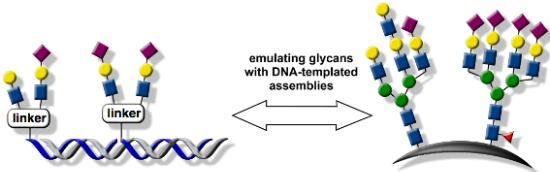
- density. Synthesis of glycoconjugate DNA by diazo-coupling. β-Galactose-modified deoxyuridine phosphoramidite used for solid-phase DNA synthesis and DNA display of glycan. (NHS)-carboxy-dT phosphoramidite as a general entry for the solid-phase synthesis of glycan–DNA conjugates. Preparation of the DNA

Graphical Abstract

Figure 1: DNA display of glycans.

Scheme 1: Synthesis of glycoconjugate DNA by diazo-coupling.

Scheme 2: β-Galactose-modified deoxyuridine phosphoramidite used for solid-phase DNA synthesis and DNA displa...

Scheme 3: (NHS)-carboxy-dT phosphoramidite as a general entry for the solid-phase synthesis of glycan–DNA con...

Figure 2: Multivalent triangular glycoDNA assemblies.

Scheme 4: Preparation of the DNA glycoconjugate by CuAAC.

Scheme 5: DNA glycoconjugation by sequential CuAAC.

Scheme 6: Selection with modified glycoconjugate aptamers (SELMA).

Scheme 7: Synthesis of PNA glycoconjugates (Mtt: 4-methyltrityl; R = H or (oligo)saccharide).

Figure 3: DNA display of PNA-tagged glycans designed to emulate HIV's gp120 epitope.

Figure 4: Combinatorial assembly and selection of two PNA glycoconjugate libraries on DNA templates.

Figure 5: DNA display of ligand bridging opposing binding sites in a lectin (ECL).

Figure 6: A glycan array prepared by hybridization of glycan–DNA conjugates and screening of RCA120.

Figure 7: Multivalent sugar-core glycoconjugate DNA.

Figure 8: Combinatorial self-assembly of PNA glycoconjugates on a DNA microarray.

Figure 9: General scheme of the 10,000 member PNA-encoded glycoconjugate library.

Figure 10: Oligomeric interaction with arrayed mono- and divalent ligands (represented as the black spheres) a...
On the strong difference in reactivity of acyclic and cyclic diazodiketones with thioketones: experimental results and quantum-chemical interpretation
- Andrey S. Mereshchenko,
- Alexey V. Ivanov,
- Viktor I. Baranovskii,
- Grzegorz Mloston,
- Ludmila L. Rodina and
- Valerij A. Nikolaev
Beilstein J. Org. Chem. 2015, 11, 504–513, doi:10.3762/bjoc.11.57
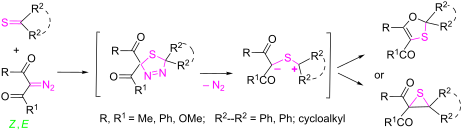
- , Poland 10.3762/bjoc.11.57 Abstract The 1,3-dipolar cycloaddition of acyclic 2-diazo-1,3-dicarbonyl compounds (DDC) and thioketones preferably occurs with Z,E-conformers and leads to the formation of transient thiocarbonyl ylides in two stages. The thermodynamically favorable further transformation of C
- , carbocyclic diazodiketones are much less reactive under similar conditions due to the locked cyclic structure and are unfavorable for the 1,3-dipolar cycloaddition due to the Z,Z-conformation of the diazo molecule. This structure results in high, positive values of the Gibbs free energy change for the first
- stage of the cycloaddition process. Keywords: diazocarbonyl compounds; 1,3-dipolar cycloaddition; 1,3-oxathioles; thiiranes; thiocarbonyl ylides; thioketones; Introduction Dipolar cycloadditions of diazo compounds have been of great interest for a long time as they provide a means for the preparation

Graphical Abstract

Scheme 1: The key experimental results on the DDC 1 reactions with thioketones 2 [19-21].

Figure 1: Diazo compounds 1 and thioketones 2 used in the study.

Scheme 2: General scheme for reactions of DDC 1 with thiobenzophenone (2a).

Figure 2: Optimized structures of the lowest energy Z,E-conformers of diazo compounds 1a–d.

Scheme 3: Reactions of the intermediate thiocarbonyl ylide 7'd via competative 1,5-EC (a) or 1,3-EC (b) follo...
Azirinium ylides from α-diazoketones and 2H-azirines on the route to 2H-1,4-oxazines: three-membered ring opening vs 1,5-cyclization
- Nikolai V. Rostovskii,
- Mikhail S. Novikov,
- Alexander F. Khlebnikov,
- Galina L. Starova and
- Margarita S. Avdontseva
Beilstein J. Org. Chem. 2015, 11, 302–312, doi:10.3762/bjoc.11.35
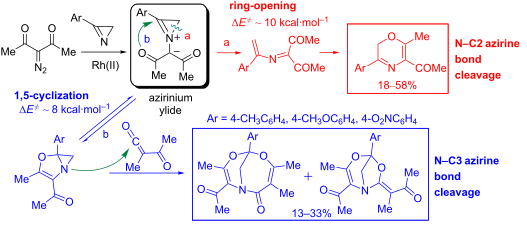
- ring opening into atropoisomeric oxazolium betaines and cyclization. Azirinium ylides generated from 2,3-di- and 2,2,3-triaryl-substituted azirines give rise to only 2-azabuta-1,3-dienes and/or 2H-1,4-oxazines. Keywords: 2-azabuta-1,3-dienes; azirines; diazo compounds; nitrogen ylides; 2H-1,4-oxazines
- , rhodium carbenoids derived from α-diazocarbonyl compounds transform 2H-azirines 1 to azirinium ylides 5 (Scheme 1) which undergo facile N–C2 bond cleavage to give 2-azabuta-1,3-dienes 3. Recently we showed that the use of α-diazo-β-ketoesters 2 in these reactions, which are finished by 1,6-cyclization of
- 5-acyl-substituted 2H-1,4-oxazines. They could, in principle, be prepared from azirines and α-diazo ketones or 2-diazo-1,3-diketones via ring opening across the N–C2 bond in the intermediate azirinium ylides to form 2-azabuta-1,3-dienes and subsequent cyclization of the latter into 2H-1,4-oxazines

Graphical Abstract

Scheme 1: Rh(II)-catalyzed synthesis of photochromic 2H-1,4-oxazines from 2H-azirines and α-diazo-β-ketoester...

Scheme 2: Rh(II)-catalyzed reaction of azirines 1a−g with diazo compounds 2a–c.

Figure 1: X-ray crystal structure of azadiene 3e.

Figure 2: X-ray crystal structures of compounds 6f and 7h.

Scheme 3: General scheme for the formation of compounds 4,6 and 7.

Scheme 4: Possible pathways for the formation of 6j and 7j from azirenooxazole 10j and ketene 12.

Figure 3: Energy profiles [DFT B3LYP/6-31+G(d,p), 357 K, 1,2-dichloroethane (PCM)] for the transformation of ...

Scheme 5: Rh2(Oct)4-catalyzed reaction of azirine 1g with diazo compound 2d in the presence of diazo compound ...

Scheme 6: Rh2(OAc)4-catalyzed reaction of azirine 1h with diazo compound 2c.

Figure 4: X-ray crystal structure of compound 17.

Scheme 7: Effect of the C5-substituent in the 2H-1,4-oxazine system on its photochromic activity.
Three-component synthesis of C2F5-substituted pyrazoles from C2F5CH2NH2·HCl, NaNO2 and electron-deficient alkynes
- Pavel K. Mykhailiuk
Beilstein J. Org. Chem. 2015, 11, 16–24, doi:10.3762/bjoc.11.3

- AS-136A [55]) (Scheme 3). Conclusion In summary, a novel approach to C2F5-substituted pyrazoles has been elaborated by a three-component reaction between C2F5CH2NH2·HCl, NaNO2 and electron-deficient alkynes. This method is highly practical: it does not require a) the pre-isolation of toxic diazo

Graphical Abstract

Figure 1: Bioactive compounds and agrochemicals with fluorinated pyrazoles.

Figure 2: Bioactive compounds with C2F5 group [34-36].

Figure 3: X-ray crystal structure of pyrazoles 10a, 19b and 20b [50].

Figure 4: Structure of the expected product 19a, and the observed isomeric one – 19b.

Scheme 1: Comparison of CF3CHN2 vs C2F5CHN2 in the reaction with alkyne 19.

Scheme 2: Synthesis of 3,4-disubstituted pyrazole 24.

Scheme 3: Synthesis of C2F5-substituted acids 25 and 27. In brackets are the known bioactive compounds DP-23, ...
Enantioselective synthesis of polyhydroxyindolizidinone and quinolizidinone derivatives from a common precursor
- Nemai Saha and
- Shital K. Chattopadhyay
Beilstein J. Org. Chem. 2014, 10, 3104–3110, doi:10.3762/bjoc.10.327
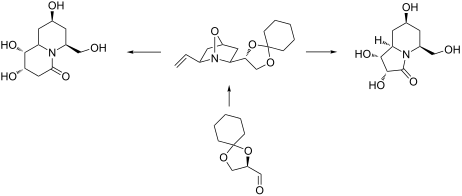
- other reasons, several novel methodologies have been developed towards the synthesis of polyhydroxylated indolizidine and quinolizidine derivatives as analogues of natural products which involved RCM [21][22][23][24], dipolar cycloaddition [25][26], nucleophilic substitution [27][28], diazo insertion

Graphical Abstract

Figure 1: Selected polyhydroxyindolizidine and quinolizidines of importance.

Figure 2: Target bicyclic imino sugars Ia and Ib from a common intermediate IV.

Scheme 1: Reagents and conditions: (i) Zn/AcOH, rt, 1 h, 86%. (ii) TBSOTf, DIPEA, CH2Cl2, −5 °C, 1 h, 91%. (i...

Scheme 2: Reagents and conditions: (i) OsO4, NMO, acetone/water, rt, 12 h, 96%. (ii) NaH, THF, BnBr, Bu4NI, 0...

Figure 3: Selected nOe correlations (A) and coupling constants (B) for compound 15.

Figure 4: 1H,1H COSY spectrum of compound 15.

Scheme 3: Reagents and conditions: (i) OsO4, NMO, acetone/water, 6 h, 95%. (ii) NaH, THF, BnBr, Bu4NI, 0 °C t...
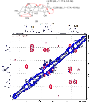
Figure 5: Selected nOe correlations and part NOESY spectrum of compound 23 in D2O (600 MHz).
Isoxazolium N-ylides and 1-oxa-5-azahexa-1,3,5-trienes on the way from isoxazoles to 2H-1,3-oxazines
- Alexander F. Khlebnikov,
- Mikhail S. Novikov,
- Yelizaveta G. Gorbunova,
- Ekaterina E. Galenko,
- Kirill I. Mikhailov,
- Viktoriia V. Pakalnis and
- Margarita S. Avdontceva
Beilstein J. Org. Chem. 2014, 10, 1896–1905, doi:10.3762/bjoc.10.197
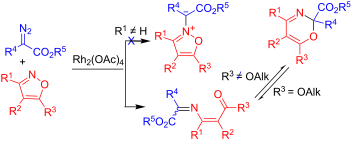
- Theoretical and experimental studies of the reaction of isoxazoles with diazo compounds show that the formation of 2H-1,3-oxazines proceeds via the formation of (3Z)-1-oxa-5-azahexa-1,3,5-trienes which undergo a 6π-cyclization. The stationary points corresponding to the probable reaction intermediates
- diazo esters with 5-alkoxyisoxazoles is a good approach to 1,4-di(alkoxycarbonyl)-2-azabuta-1,3-dienes. The reaction conditions for the preparation of aryl- and halogen-substituted 2H-1,3-oxazines and 1,4-di(alkoxycarbonyl)-2-azabuta-1,3-dienes from isoxazoles were investigated. Keywords: diazo esters
- ; isoxazoles; isoxazolium N-ylides; 2-azabuta-1,3-dienes; 2H-1,3-oxazines; Introduction Isoxazoles are versatile building blocks, which have found extensive use in organic synthesis [1][2][3]. However, reactions of isoxazoles with diazo compounds have scarcely been studied [1][2][3][4][5]. In 2008 Davies and

Graphical Abstract

Scheme 1: Mechanistic scheme of the formation of 2H-1,3-oxazine by the reaction of isoxazoles with a diazo co...

Scheme 2: Mechanistic scheme of the formation of 2H-1,3-oxazine by the reaction of azirine with a diazo compo...

Figure 1: Energy profiles for the transformations of ylides C, (3Z)-1-oxa-5-azahexa-1,3,5-triene D and oxazin...

Figure 2: Energy profiles for the transformations of (3Z)-1-oxa-5-azahexa-1,3,5-triene D and oxazines E deriv...

Scheme 3: Reaction of isoxazole 1a and diazo ester 2a.

Figure 3: Molecular structures of compounds 3a,k, displacement parameters are drawn at 50% probability level.

Figure 4: Molecular structures of compounds 4a,b, displacement parameters are drawn at 50% probability level.

Scheme 4: Isodesmic reactions for 1,3-oxazines 3d,e,n,o and 1-oxa-5-azahexa-1,3,5-trienes 4a,b,g,h.
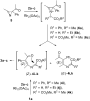
Scheme 5: Reaction of complementary isoxazole 1a and azirine 5 with diazo esters.
C–H-Functionalization logic guides the synthesis of a carbacyclopamine analog
- Sebastian Rabe,
- Johann Moschner,
- Marina Bantzi,
- Philipp Heretsch and
- Athanassios Giannis
Beilstein J. Org. Chem. 2014, 10, 1564–1569, doi:10.3762/bjoc.10.161
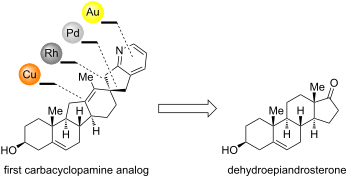
- analog that still exhibits similar inhibitory activity on hedgehog-signaling. For the sake of brevity of the overall synthetic sequence we defined carbacyclopamine analog 2 (see Figure 1) as our primary target. Results and Discussion A retrosynthetic analysis identified diazo compound 3 as a key
- was thought to establish the C-nor-D-homo steroid system, and a gold-catalyzed amination/annulation/aromatization sequence was planned to install the pyridine F-ring. Diazo compound 3 originates from diene 4 through standard transformations, the latter being accessible from commercially available and

Graphical Abstract

Figure 1: Structures of cyclopamine (1) and carbacyclopamine analog 2.

Scheme 1: Retrosynthetic analysis of carbacyclopamine analog 2.

Scheme 2: Synthesis of carbacyclopamine analog 2.
A tandem Mannich addition–palladium catalyzed ring-closing route toward 4-substituted-3(2H)-furanones
- Jubi John,
- Eliza Târcoveanu,
- Peter G. Jones and
- Henning Hopf
Beilstein J. Org. Chem. 2014, 10, 1462–1470, doi:10.3762/bjoc.10.150
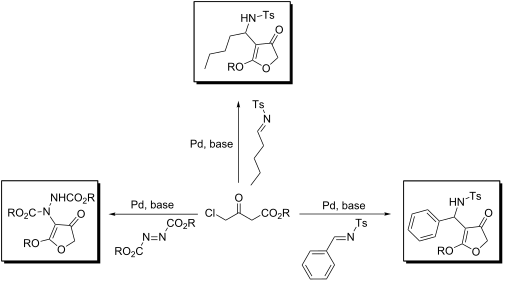
- palladium catalysis afforded 4-substituted furanones in good to excellent yields. 4-Hydrazino-3(2H)-furanones could also be synthesized from diazo esters in excellent yields by utilising the developed strategy. We could also efficiently transform the substituted furanones to aza-prostaglandin analogues
- closure of the primary adduct to form the furanone. In this paper, we report our investigations that extend the reaction to heteroatom-containing electrophiles such as imines and diazo esters. Results and Discussion Following the work on nitrostyrenes, Yan et al. also reported a two-step asymmetric route
- entry 2 of Table 2 we can confirm that palladium catalyzes the reaction. The generality of the reaction was checked with different diazo esters 19a–c with 4-chloroacetoacetate esters 2a and 2b under the optimized conditions (diazo ester (1.0 equiv), 4-chloroacetoacetate (1.1 equiv), Pd(PPh3)4 (5 mol

Graphical Abstract

Figure 1: Bioactive molecules I [19], II [26], III & IV [21,22] with 3(2H)-furanone moiety.

Scheme 1: Pd-catalyzed synthesis of 3(2H)-furanones from activated alkenes [40].

Scheme 2: Pd-catalyzed synthesis of 3(2H)-furanone from tosylimine 1a.

Figure 2: Generalisation with aromatic and aliphatic imines (reaction conditions: 1 (1.0 equiv), 2 (1.1 equiv...
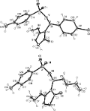
Figure 3: Thermal ellipsoid diagrams (50% probability levels) of 4-substituted-3(2H)-furanones 7 (above) and ...

Scheme 3: Mechanism of formation of the 3(2H)-furanone derivative from an imine.

Scheme 4: Pd-catalyzed synthesis of 3(2H)-furanone from diazoester 19a.

Figure 4: Generalisation with diazo esters (reaction conditions: 19 (1.0 equiv), 2 (1.1 equiv), Pd(PPh3)4 (5 ...

Scheme 5: Synthesis of aza-prostaglandin analogue.
Domino reactions of 2H-azirines with acylketenes from furan-2,3-diones: Competition between the formation of ortho-fused and bridged heterocyclic systems
- Alexander F. Khlebnikov,
- Mikhail S. Novikov,
- Viktoriia V. Pakalnis,
- Roman O. Iakovenko and
- Dmitry S. Yufit
Beilstein J. Org. Chem. 2014, 10, 784–793, doi:10.3762/bjoc.10.74

- ][17][18][19][20][21]. 2H-Azirines can react with ketenes both with cleavage and preservation of the three-membered ring [22][23][24][25][26]. It was found that acylketenes, which are generated in situ from diazo ketones, undergo cycloaddition with 3-mono- and 2,3-disubstituted-2H-azirines to afford 2
- application of the reaction is the nonselective mode of the Wolff rearrangement of the unsymmetrical diazo compounds. This generates a mixture of isomeric oxoketenes [27][28][29] and, as a result, a complex mixture of products is formed [22]. Moreover not all diazo compounds give oxoketenes easily [27][28][29
- ]. In particular, unsubstituted acylketenes, the reactivity of which towards azirines is until now unknown, cannot be generated from diazo compounds. An alternative source of acylketenes can be furan-2,3-diones, which have been used in reactions with nucleophiles and various cycloadditions [30][31][32

Graphical Abstract

Scheme 1: Reactions of furan-2,3-diones 1 and azirines 2.

Figure 1: Molecular structures of compounds 3а, 4b.

Scheme 2: The route of formation of compounds 3 and possible intermediates in route to compounds 4 and 5.

Figure 2: Energy profiles for the reactions of azirines 2a,c and acylketene 6a, as well as acylketene 6a with...

Scheme 3: Possible intermediates in routes to compounds 4 and 5.

Figure 3: Energy profiles for the reactions of dihydropyrazine 11a with acylketene 6a, as well as acylketene ...

Figure 4: Energy profiles for the reactions of azirines 2a,c with protonated azirines 14a,c. Relative free en...

Scheme 4: Isodesmic equation for evaluation of relative basicity of azirines 2c,a.

Scheme 5: Reaction of furandione 1a with azirine 2d.

Figure 5: Molecular structure of compound 17.

Scheme 6: Reaction of furandione 1d with azirine 2a.

Scheme 7: Reactions of compounds 3d and 18a with methanol.
Use of activated enol ethers in the synthesis of pyrazoles: reactions with hydrazine and a study of pyrazole tautomerism
- Denisa Tarabová,
- Stanislava Šoralová,
- Martin Breza,
- Marek Fronc,
- Wolfgang Holzer and
- Viktor Milata
Beilstein J. Org. Chem. 2014, 10, 752–760, doi:10.3762/bjoc.10.70

- ), 1,3-dipolar cycloaddition with diazo compounds as a source of N–N linkage, degradation of fused pyrazoles or rearrangement of other monocyclic heterocycles under chemical, thermal or photochemical conditions [4]. Upon reaction of hydrazine with symmetrical enol ethers, only a single product is formed

Graphical Abstract

Scheme 1: Preparation of enol ethers.

Scheme 2: Reaction of enol ethers with hydrazine hydrate.

Scheme 3: Pyrazoles 5.

Figure 1: Tautomers of 5a.

Figure 2: Tautomers of 5b (R = Me), 5c (R = Et).

Figure 3: Tautomers of 5b (R = Me), 5c (R = Et).

Figure 4: Tautomers of 5d.

Scheme 4: Reactions of hydrazine hydrate with dialkyl alkoxymethylidenemalonates.
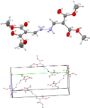
Figure 5: Crystal structure and crystal packing of compound 6a.

Figure 6: Key 1H (red), 13C (black) and 15N (blue) NMR chemical shifts (δ, ppm) in isomers A and B of compoun...
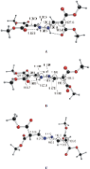
Figure 7: DFT optimized isomers of compound 6a. (Distances are in Å, angles are in degrees.)
Silver and gold-catalyzed multicomponent reactions
- Giorgio Abbiati and
- Elisabetta Rossi
Beilstein J. Org. Chem. 2014, 10, 481–513, doi:10.3762/bjoc.10.46
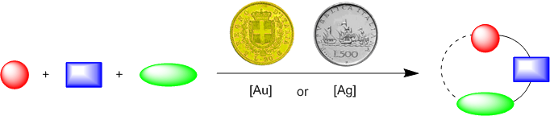
- been reported [59]. Preformed 2-(1-alkynyl)arylaldimines 27 have been used in a MCR involving tandem cyclization/three-component reactions with diazo compounds 37 and water or alcohols 38 in the presence of dirhodium acetate and silver triflate cooperative catalysis resulting in excellent yields of

Graphical Abstract

Scheme 1: General reaction mechanism for Ag(I)-catalyzed A3-coupling reactions.

Scheme 2: A3-coupling reaction catalyzed by polystyrene-supported NHC–silver halides.

Figure 1: Various NHC–Ag(I) complexes used as catalysts for A3-coupling.

Scheme 3: Proposed reaction mechanism for NHC–AgCl catalyzed A3-coupling reactions.

Scheme 4: Liu’s synthesis of pyrrole-2-carboxaldehydes 4.

Scheme 5: Proposed reaction mechanism for Liu’s synthesis of pyrrole-2-carboxaldehydes 4.

Scheme 6: Gold-catalyzed synthesis of propargylamines 1.

Scheme 7: A3-coupling catalyzed by phosphinamidic Au(III) metallacycle 6.

Scheme 8: Gold-catalyzed KA2-coupling.

Scheme 9: A3-coupling applied to aldehyde-containing oligosaccharides 8.

Scheme 10: A3-MCR for the preparation of propargylamine-substituted indoles 9.

Scheme 11: A3-coupling interceded synthesis of furans 12.

Scheme 12: A3/KA2-coupling mediated synthesis of functionalized dihydropyrazoles 13 and polycyclic dihydropyra...

Scheme 13: Au(I)-catalyzed entry to cyclic carbamimidates 17 via an A3-coupling-type approach.

Scheme 14: Proposed reaction mechanism for the Au(I)-catalyzed synthesis of cyclic carbamimidates 17.

Figure 2: Chiral trans-1-diphenylphosphino-2-aminocyclohexane–Au(I) complex 20.

Scheme 15: A3-coupling-type synthesis of oxazoles 21 catalyzed by Au(III)–salen complex.

Scheme 16: Proposed reaction mechanism for the synthesis of oxazoles 21.

Scheme 17: Synthesis of propargyl ethyl ethers 24 by an A3-coupling-type reaction.

Scheme 18: General mechanism of Ag(I)-catalyzed MCRs of 2-alkynylbenzaldehydes, amines and nucleophiles.

Scheme 19: General synthetic pathway to 1,3-disubstituted-1,2-dihydroisoquinolines.

Scheme 20: Synthesis of 1,3-disubstituted-1,2-dihydroisoquinolines 29.

Scheme 21: Synthesis of 1,3-disubstituted-1,2-dihydroisoquinolines 35 and 36.

Scheme 22: Rh(II)/Ag(I) co-catalyzed synthesis of 1,3-disubstituted-1,2-dihydroisoquinolines 40.

Scheme 23: General synthetic pathway to 2-amino-1,2-dihydroquinolines.

Scheme 24: Synthesis of 2-amino-1,2-dihydroquinolines 47.

Scheme 25: Synthesis of tricyclic H-pyrazolo[5,1-a]isoquinoline 48.

Scheme 26: Synthesis of tricyclic H-pyrazolo[5,1-a]isoquinolines 48.

Scheme 27: Cu(II)/Ag(I) catalyzed synthesis of H-pyrazolo[5,1-a]isoquinolines 48.

Scheme 28: Synthesis of 2-aminopyrazolo[5,1-a]isoquinolines 53.

Scheme 29: Synthesis of 1-(isoquinolin-1-yl)guanidines 55.

Scheme 30: Ag(I)/Cu(I) catalyzed synthesis of 2-amino-H-pyrazolo[5,1-a]isoquinolines 58.

Scheme 31: Ag(I)/Ni(II) co-catalyzed synthesis of 3,4-dihydro-1H-pyridazino[6,1-a]isoquinoline-1,1-dicarboxyla...

Scheme 32: Ag(I) promoted activation of the α-carbon atom of the isocyanide group.

Scheme 33: Synthesis of dihydroimidazoles 65.

Scheme 34: Synthesis of oxazoles 68.

Scheme 35: Stereoselective synthesis of chiral butenolides 71.

Scheme 36: Proposed reaction mechanism for the synthesis of butenolides 71.

Scheme 37: Stereoselective three-component approach to pirrolidines 77 by means of a chiral auxiliary.

Scheme 38: Stereoselective three-component approach to pyrrolidines 81 and 82 by means of a chiral catalyst.

Scheme 39: Synthesis of substituted five-membered carbocyles 86.

Scheme 40: Synthesis of regioisomeric arylnaphthalene lactones.

Scheme 41: Enantioselective synthesis of spiroacetals 96 by Fañanás and Rodríguez [105].

Scheme 42: Enantioselective synthesis of spiroacetals 101 by Gong [106].

Scheme 43: Synthesis of polyfunctionalized fused bicyclic ketals 103 and bridged tricyclic ketals 104.

Scheme 44: Proposed reaction mechanism for the synthesis of ketals 103 and 104.

Scheme 45: Synthesis of β-alkoxyketones 108.

Scheme 46: Synthesis of N-methyl-1,4-dihydropyridines 112.

Scheme 47: Synthesis of tetrahydrocarbazoles 115–117.

Scheme 48: Plausible reaction mechanism for the synthesis of tetrahydrocarbazoles 115–117.

Scheme 49: Carboamination, carboalkoxylation and carbolactonization of terminal alkenes.

Scheme 50: Oxyarylation of alkenes with arylboronic acids and Selectfluor as reoxidant.

Scheme 51: Proposed reaction mechanism for oxyarylation of alkenes.

Scheme 52: Oxyarylation of alkenes with arylsilanes and Selectfluor as reoxidant.

Scheme 53: Oxyarylation of alkenes with arylsilanes and IBA as reoxidant.
Recent applications of the divinylcyclopropane–cycloheptadiene rearrangement in organic synthesis
- Sebastian Krüger and
- Tanja Gaich
Beilstein J. Org. Chem. 2014, 10, 163–193, doi:10.3762/bjoc.10.14
- formal [4 + 3] cycloaddition [82]. Starting from 4-methoxyphenol (90) Friedel–Crafts acylation and cyclization provided bicycle 91. Wittig olefination furnished benzofuran 92. Diazotransfer using p-ABSA yielded the crucial diazo compound 93, which was used in the following enantioselective
- ethyl vinyl ether. The necessary diazo moiety was installed using tosylazide as a diazo-transfer reagent to yield 134. Copper catalyzed intramolecular cyclopropanation furnished bicycle 135. Reduction of the carbonyl moiety and protection of the resulting alcohol was followed by ether cleavage and
- -catalyzed cyclopropanation of silyl-enol-diazo compound 101 and Boc-protected pyrrole 147 resulted in the formation of intermediate cis-divinylcyclopropane 148, that rearranged under the reaction conditions to give the corresponding highly substituted bridged cycloheptadiene 149. Deprotection of the enolate

Graphical Abstract

Scheme 1: Vogel’s first approach towards the divinylcyclopropane rearrangement [4] and characterization of cis-d...

Scheme 2: Transition states for the Cope rearrangement and the related DVCPR. Ts = transition state.

Scheme 3: Two possible mechanisms of trans-cis isomerizations of divinylcyclopropanes.

Scheme 4: Proposed biosynthesic pathway to ectocarpene (21), an inactive degradation product of a sexual pher...

Scheme 5: Proposed biosynthesis of occidenol (25) and related natural compounds.

Scheme 6: Gaich’s bioinspired system using the DVCPR to mimick the dimethylallyltryptophan synthase. DMAPP = ...

Scheme 7: Iguchi’s total synthesis of clavubicyclone, part 1.

Scheme 8: Iguchi’s total synthesis of clavubicyclone, part 2.

Scheme 9: Wender’s syntheses of the two pseudoguainanes confertin (50) and damsinic acid (51) and Pier’s appr...
Scheme 10: Overman’s total synthesis of scopadulcic acid B.

Scheme 11: Davies’ total syntheses of tremulenolide A and tremulenediol A.

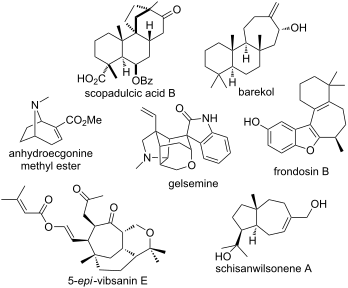
Scheme 12: Davies formal [4 + 3] cycloaddition approach towards the formal synthesis of frondosin B.

Scheme 13: Davies and Sarpongs formal [4 + 3]-cycloaddition approach towards barekoxide (106) and barekol (107...

Scheme 14: Davies formal [4 + 3]-cycloaddition approach to 5-epi-vibsanin E (115) containing an intermediate c...

Scheme 15: Echavarren’s total synthesis of schisanwilsonene A (126) featuring an impressive gold-catalzed casc...

Scheme 16: Davies early example of a formal [4 + 3]-cycloaddition in alkaloids synthesis.

Scheme 17: Fukuyama’s total synthesis of gelsemine, part 1.

Scheme 18: Fukuyama’s total synthesis of gelsemine, featuring a divinylcyclopropane rearrangement, part 2.

Scheme 19: Kende’s total synthesis of isostemofoline, using a formal [4 + 3]-cycloaddition, including an inter...

Scheme 20: Danishefsky’s total synthesis of gelsemine, part 1.

Scheme 21: Danishefsky’s total synthesis of gelsemine, part 2.

Scheme 22: Fukuyama’s total synthesis of gelsemoxonine.

Scheme 23: Wender’s synthetic access to the core skeleton of tiglianes, daphnanes and ingenanes.

Scheme 24: Davies’ approach towards the core skeleton of CP-263,114 (212).

Scheme 25: Wood’s approach towards actinophyllic acid.

Scheme 26: Takeda’s approach towards the skeleton of the cyanthins, utilitizing the divinylcyclopropane rearra...

Scheme 27: Donaldson’s organoiron route towards the guianolide skeleton.

Scheme 28: Stoltz’s tandem Wolff/DVCPR rearrangement.

Scheme 29: Stephenson’s tandem photocatalysis/arylvinylcyclopropane rearrangement.

Scheme 30: Padwa’s rhodium cascade involving a DVCPR.

Scheme 31: Matsubara’s version of a DVCPR.

Scheme 32: Toste’s tandem gold-catalyzed Claisen-rearrangement/DVCPR.

Scheme 33: Ruthenium- and gold-catalyzed versions of tandem reactions involving a DVCPR.

Scheme 34: Tungsten, platinum and gold catalysed cycloisomerizations leading to a DVCPR.

Scheme 35: Reisman’s total synthesis of salvileucalin B, featuring an (undesired) vinylcyclopropyl carbaldehyd...

Scheme 36: Studies on the divinylepoxide rearrangement.

Scheme 37: Studies on the vinylcyclopropanecarbonyl rearrangement.

Scheme 38: Nitrogen-substituted variants of the divinylcyclopropane rearrangement.
Synthesis of five- and six-membered cyclic organic peroxides: Key transformations into peroxide ring-retaining products
- Alexander O. Terent'ev,
- Dmitry A. Borisov,
- Vera A. Vil’ and
- Valery M. Dembitsky
Beilstein J. Org. Chem. 2014, 10, 34–114, doi:10.3762/bjoc.10.6

Graphical Abstract

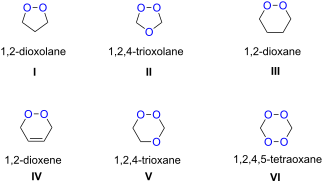
Figure 1: Five and six-membered cyclic peroxides.

Figure 2: Artemisinin and semi-synthetic derivatives.

Scheme 1: Synthesis of 3-hydroxy-1,2-dioxolanes 3a–c.

Scheme 2: Synthesis of dioxolane 6.

Scheme 3: Photooxygenation of oxazolidines 7a–d with formation of spiro-fused oxazolidine-containing dioxolan...

Scheme 4: Oxidation of cyclopropanes 10a–e and 11a–e with preparation of 1,2-dioxolanes 12a–e.

Scheme 5: VO(acac)2-catalyzed oxidation of silylated bicycloalkanols 13a–c.

Scheme 6: Mn(II)-catalyzed oxidation of cyclopropanols 15a–g.

Scheme 7: Oxidation of aminocyclopropanes 20a–c.

Scheme 8: Synthesis of aminodioxolanes 24.
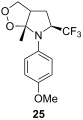
Figure 3: Trifluoromethyl-containing dioxolane 25.

Scheme 9: Synthesis of 1,2-dioxolanes 27a–e by the oxidation of cyclopropanes 26a–e.

Scheme 10: Photoinduced oxidation of methylenecyclopropanes 28.

Scheme 11: Irradiation-mediated oxidation.

Scheme 12: Application of diazene 34 for dioxolane synthesis.

Scheme 13: Mn(OAc)3-catalyzed cooxidation of arylacetylenes 37a–h and acetylacetone with atmospheric oxygen.
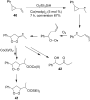
Scheme 14: Peroxidation of (2-vinylcyclopropyl)benzene (40).

Scheme 15: Peroxidation of 1,4-dienes 43a,b.

Scheme 16: Peroxidation of 1,5-dienes 46.

Scheme 17: Peroxidation of oxetanes 53a,b.

Scheme 18: Peroxidation of 1,6-diene 56.

Scheme 19: Synthesis of 3-alkoxy-1,2-dioxolanes 62a,b.

Scheme 20: Synthesis of spiro-bis(1,2-dioxolane) 66.

Scheme 21: Synthesis of dispiro-1,2-dioxolanes 68, 70, 71.

Scheme 22: Synthesis of spirohydroperoxydioxolanes 75a,b.

Scheme 23: Synthesis of spirohydroperoxydioxolane 77 and dihydroperoxydioxolane 79.

Scheme 24: Ozonolysis of azepino[4,5-b]indole 80.

Scheme 25: SnCl4-mediated fragmentation of ozonides 84a–l in the presence of allyltrimethylsilane.

Scheme 26: SnCl4-mediated fragmentation of bicyclic ozonide 84m in the presence of allyltrimethylsilane.

Scheme 27: MCl4-mediated fragmentation of alkoxyhydroperoxides 96 in the presence of allyltrimethylsilane.

Scheme 28: SnCl4-catalyzed reaction of monotriethylsilylperoxyacetal 108 with alkene 109.

Scheme 29: SnCl4-catalyzed reaction of triethylsilylperoxyacetals 111 with alkenes.

Scheme 30: Desilylation of tert-butyldimethylsilylperoxy ketones 131a,b followed by cyclization.

Scheme 31: Deprotection of peroxide 133 followed by cyclization.

Scheme 32: Asymmetric peroxidation of methyl vinyl ketones 137a–e.

Scheme 33: Et2NH-catalyzed intramolecular cyclization.

Scheme 34: Synthesis of oxodioxolanes 143a–j.

Scheme 35: Haloperoxidation accompanied by intramolecular ring closure.

Scheme 36: Oxidation of triterpenes 149a–d with Na2Cr2O7/N-hydroxysuccinimide.

Scheme 37: Curtius and Wolff rearrangements to form 1,2-dioxolane ring-retaining products.

Scheme 38: Oxidative desilylation of peroxide 124.

Scheme 39: Synthesis of dioxolane 158, a compound containing the aminoquinoline antimalarial pharmacophore.

Scheme 40: Diastereomers of plakinic acid A, 162a and 162b.

Scheme 41: Ozonolysis of alkenes.

Scheme 42: Cross-ozonolysis of alkenes 166 with carbonyl compounds.

Scheme 43: Ozonolysis of the bicyclic cyclohexenone 168.

Scheme 44: Cross-ozonolysis of enol ethers 172a,b with cyclohexanone.

Scheme 45: Griesbaum co-ozonolysis.

Scheme 46: Reactions of aryloxiranes 177a,b with oxygen.

Scheme 47: Intramolecular formation of 1,2,4-trioxolane 180.

Scheme 48: Formation of 1,2,4-trioxolane 180 by the reaction of 1,5-ketoacetal 181 with H2O2.

Scheme 49: 1,2,4-Trioxolane 186 with tetrazole fragment.

Scheme 50: 1,2,4-Trioxolane 188 with a pyridine fragment.

Scheme 51: 1,2,4-Trioxolane 189 with pyrimidine fragment.

Scheme 52: Synthesis of aminoquinoline-containing 1,2,4-trioxalane 191.

Scheme 53: Synthesis of arterolane.

Scheme 54: Oxidation of diarylheptadienes 197a–c with singlet oxygen.

Scheme 55: Synthesis of hexacyclinol peroxide 200.

Scheme 56: Oxidation of enone 201 and enenitrile 203 with singlet oxygen.

Scheme 57: Synthesis of 1,2-dioxanes 207 by oxidative coupling of carbonyl compounds 206 and alkenes 205.

Scheme 58: 1,2-Dioxanes 209 synthesis by co-oxidation of 1,5-dienes 208 and thiols.

Scheme 59: Synthesis of bicyclic 1,2-dioxanes 212 with aryl substituents.

Scheme 60: Isayama–Mukaiyama peroxysilylation of 1,5-dienes 213 followed by desilylation under acidic conditio...

Scheme 61: Synthesis of bicycle 218 with an 1,2-dioxane ring.

Scheme 62: Intramolecular cyclization with an oxirane-ring opening.

Scheme 63: Inramolecular cyclization with the oxetane-ring opening.

Scheme 64: Intramolecular cyclization with the attack on a keto group.

Scheme 65: Peroxidation of the carbonyl group in unsaturated ketones 228 followed by cyclization of hydroperox...

Scheme 66: CsOH and Et2NH-catalyzed cyclization.

Scheme 67: Preparation of peroxyplakoric acid methyl ethers A and D.

Scheme 68: Hg(OAc)2 in 1,2-dioxane synthesis.

Scheme 69: Reaction of 1,4-diketones 242 with hydrogen peroxide.

Scheme 70: Inramolecular cyclization with oxetane-ring opening.

Scheme 71: Inramolecular cyclization with MsO fragment substitution.

Scheme 72: Synthesis of 1,2-dioxane 255a, a structurally similar compound to natural peroxyplakoric acids.

Scheme 73: Synthesis of 1,2-dioxanes based on the intramolecular cyclization of hydroperoxides containing C=C ...

Scheme 74: Use of BCIH in the intramolecular cyclization.

Scheme 75: Palladium-catalyzed cyclization of δ-unsaturated hydroperoxides 271a–e.

Scheme 76: Intramolecular cyclization of unsaturated peroxyacetals 273a–d.

Scheme 77: Allyltrimethylsilane in the synthesis of 1,2-dioxanes 276a–d.

Scheme 78: Intramolecular cyclization using the electrophilic center of the peroxycarbenium ion 279.

Scheme 79: Synthesis of bicyclic 1,2-dioxanes.

Scheme 80: Preparation of 1,2-dioxane 286.

Scheme 81: Di(tert-butyl)peroxalate-initiated radical cyclization of unsaturated hydroperoxide 287.

Scheme 82: Oxidation of 1,4-betaines 291a–d.

Scheme 83: Synthesis of aminoquinoline-containing 1,2-dioxane 294.

Scheme 84: Synthesis of the sulfonyl-containing 1,2-dioxane.

Scheme 85: Synthesis of the amido-containing 1,2-dioxane 301.

Scheme 86: Reaction of singlet oxygen with the 1,3-diene system 302.

Scheme 87: Synthesis of (+)-premnalane А and 8-epi-premnalane A.

Scheme 88: Synthesis of the diazo group containing 1,2-dioxenes 309a–e.

Figure 4: Plakortolide Е.

Scheme 89: Synthesis of 6-epiplakortolide Е.

Scheme 90: Application of Bu3SnH for the preparation of tetrahydrofuran-containing bicyclic peroxides 318a,b.

Scheme 91: Application of Bu3SnH for the preparation of lactone-containing bicyclic peroxides 320a–f.

Scheme 92: Dihydroxylation of the double bond in the 1,2-dioxene ring 321 with OsO4.

Scheme 93: Epoxidation of 1,2-dioxenes 324.

Scheme 94: Cyclopropanation of the double bond in endoperoxides 327.

Scheme 95: Preparation of pyridazine-containing bicyclic endoperoxides 334a–c.

Scheme 96: Synthesis of 1,2,4-trioxanes 337 by the hydroperoxidation of unsaturated alcohols 335 with 1O2 and ...

Scheme 97: Synthesis of sulfur-containing 1,2,4-trioxanes 339.

Scheme 98: BF3·Et2O-catalyzed synthesis of the 1,2,4-trioxanes 342a–g.

Scheme 99: Photooxidation of enol ethers or vinyl sulfides 343.

Scheme 100: Synthesis of tricyclic peroxide 346.

Scheme 101: Reaction of endoperoxides 348a,b derived from cyclohexadienes 347a,b with 1,4-cyclohexanedione.

Scheme 102: [4 + 2]-Cycloaddition of singlet oxygen to 2Н-pyrans 350.

Scheme 103: Synthesis of 1,2,4-trioxanes 354 using peroxysilylation stage.

Scheme 104: Epoxide-ring opening in 355 with H2O2 followed by the condensation of hydroxy hydroperoxides 356 wi...

Scheme 105: Peroxidation of unsaturated ketones 358 with the H2O2/CF3COOH/H2SO4 system.

Scheme 106: Synthesis of 1,2,4-trioxanes 362 through Et2NH-catalyzed intramolecular cyclization.

Scheme 107: Reduction of the double bond in tricyclic peroxides 363.

Scheme 108: Horner–Wadsworth–Emmons reaction in the presence of peroxide group.

Scheme 109: Reduction of ester group by LiBH4 in the presence of 1,2,4-trioxane moiety.

Scheme 110: Reductive amination of keto-containing 1,2,4-trioxane 370.

Scheme 111: Reductive amination of keto-containing 1,2,4-trioxane and a Fe-containing moiety.

Scheme 112: Acid-catalyzed reactions of Н2О2 with ketones and aldehydes 374.

Scheme 113: Cyclocondensation of carbonyl compounds 376a–d using Me3SiOOSiMe3/CF3SO3SiMe3.

Scheme 114: Peroxidation of 4-methylcyclohexanone (378).

Scheme 115: Synthesis of symmetrical tetraoxanes 382a,b from aldehydes 381a,b.

Scheme 116: Synthesis of unsymmetrical tetraoxanes using of MeReO3.

Scheme 117: Synthesis of symmetrical tetraoxanes using of MeReO3.

Scheme 118: Synthesis of symmetrical tetraoxanes using of MeReO3.

Scheme 119: MeReO3 in the synthesis of symmetrical tetraoxanes with the use of aldehydes.

Scheme 120: Preparation of unsymmmetrical 1,2,4,5-tetraoxanes with high antimalarial activity.

Scheme 121: Re2O7-Catalyzed synthesis of tetraoxanes 398.

Scheme 122: H2SO4-Catalyzed synthesis of steroidal tetraoxanes 401.

Scheme 123: HBF4-Catalyzed condensation of bishydroperoxide 402 with 1,4-cyclohexanedione.

Scheme 124: BF3·Et2O-Catalyzed reaction of gem-bishydroperoxides 404 with enol ethers 405 and acetals 406.

Scheme 125: HBF4-Catalyzed cyclocondensation of bishydroperoxide 410 with ketones.

Scheme 126: Synthesis of symmetrical and unsymmetrical tetraoxanes 413 from benzaldehydes 412.

Scheme 127: Synthesis of bridged 1,2,4,5-tetraoxanes 415a–l from β-diketones 414a–l and H2O2.

Scheme 128: Dimerization of zwitterions 417.

Scheme 129: Ozonolysis of verbenone 419.

Scheme 130: Ozonolysis of O-methyl oxime 424.

Scheme 131: Peroxidation of 1,1,1-trifluorododecan-2-one 426 with oxone.

Scheme 132: Intramolecular cyclization of dialdehyde 428 with H2O2.

Scheme 133: Tetraoxanes 433–435 as by-products in peroxidation of ketals 430–432.

Scheme 134: Transformation of triperoxide 436 in diperoxide 437.

Scheme 135: Preparation and structural modifications of tetraoxanes.

Scheme 136: Structural modifications of steroidal tetraoxanes.

Scheme 137: Synthesis of 1,2,4,5-tetraoxane 454 containing the fluorescent moiety.

Scheme 138: Synthesis of tetraoxane 458 (RKA182).



