Search results
Search for "six-membered ring" in Full Text gives 147 result(s) in Beilstein Journal of Organic Chemistry.
Photovoltaic-driven organic electrosynthesis and efforts toward more sustainable oxidation reactions
Beilstein J. Org. Chem. 2015, 11, 280–287, doi:10.3762/bjoc.11.32
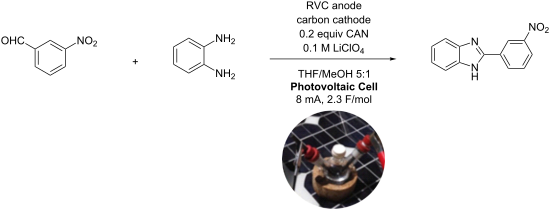
- barriers of quaternary carbon and six-membered ring formation. The use of the second nucleophile and a fast initial trapping reaction reduced the cation character of the radical cation intermediate, slowed competitive elimination reactions, and allowed for the desired quaternary carbon formation. In these


Design and synthesis of novel bis-annulated caged polycycles via ring-closing metathesis: pushpakenediol
Beilstein J. Org. Chem. 2014, 10, 2664–2670, doi:10.3762/bjoc.10.280
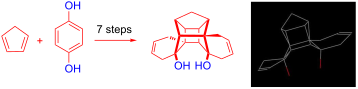
- allyl groups in PCUD can be converted to a six-membered ring by RCM [28]. Since the two allyl groups in the PCUD framework are far apart, they did not undergo a RCM reaction. Later, by introducing additional unsaturated fragments in the PCUD system one can generate multiple rings in the PCUD system by


Dimerisation, rhodium complex formation and rearrangements of N-heterocyclic carbenes of indazoles
Beilstein J. Org. Chem. 2014, 10, 832–840, doi:10.3762/bjoc.10.79
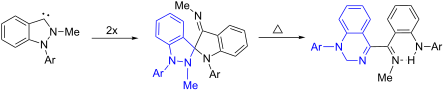
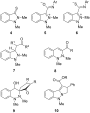
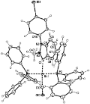
- obtained by slow evaporation of a saturated solution in methanol. This compound crystallized monoclinic. A molecular structure is shown in Figure 4. In the single crystal the NH group of the aniline (N18–H) forms a hydrogen bond to the imine group (N25) so that an almost planar six-membered ring is formed
- . The dihedral angle C11–C12–C17–N18 (crystallographic numbering) was determined to be 0.5(2)°. This six-membered ring is almost perpendicularly twisted in relation to the quinazoline ring [N1–C10–C11–C12 = −92.65(17)°]. Conclusion The N-heterocyclic carbene of indazole, indazol-3-ylidene, displays a






Isocyanide-based multicomponent reactions towards cyclic constrained peptidomimetics
Beilstein J. Org. Chem. 2014, 10, 544–598, doi:10.3762/bjoc.10.50

- temperature and the final tetrazoles 158a–c were obtained in moderate to good yields. Six-membered ring constraints Pipecolic acid In the previous section we discussed some important conformational properties of proline derivatives playing an important role in controlling peptide and protein secondary


Synthesis of 3,4-dihydro-1,8-naphthyridin-2(1H)-ones via microwave-activated inverse electron-demand Diels–Alder reactions
Beilstein J. Org. Chem. 2014, 10, 282–286, doi:10.3762/bjoc.10.24
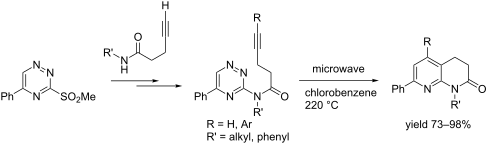
- optimal experimental conditions already reported with triazines [22][23][24]. In chlorobenzene at 220 °C (optimal reaction temperature for six-membered-ring formation), the corresponding cycloadducts 10–13 were obtained in high yields (Scheme 4, Table 3). We therefore developed an efficient method for the


Advancements in the mechanistic understanding of the copper-catalyzed azide–alkyne cycloaddition
Beilstein J. Org. Chem. 2013, 9, 2715–2750, doi:10.3762/bjoc.9.308




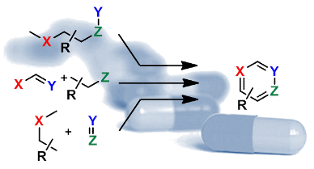
An overview of the synthetic routes to the best selling drugs containing 6-membered heterocycles
Beilstein J. Org. Chem. 2013, 9, 2265–2319, doi:10.3762/bjoc.9.265


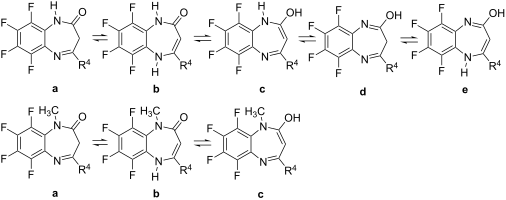
Structure of 1,5-benzodiazepinones in the solid state and in solution: Effect of the fluorination in the six-membered ring
Beilstein J. Org. Chem. 2013, 9, 2156–2167, doi:10.3762/bjoc.9.253


Organocatalyzed enantioselective desymmetrization of aziridines and epoxides
Beilstein J. Org. Chem. 2013, 9, 1677–1695, doi:10.3762/bjoc.9.192
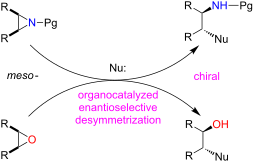
- ). Interestingly, the aziridines with a six-membered ring were desymmetrized to give the corresponding thioethers in excellent yields and enantioselectivities when the molar ratio of aziridine/nucleophile/catalyst is 1.0:1.5:0.1. For the unreactive acyclic and seven-membered ring aziridines, the good








Anodic coupling of carboxylic acids to electron-rich double bonds: A surprising non-Kolbe pathway to lactones
Beilstein J. Org. Chem. 2013, 9, 1630–1636, doi:10.3762/bjoc.9.186
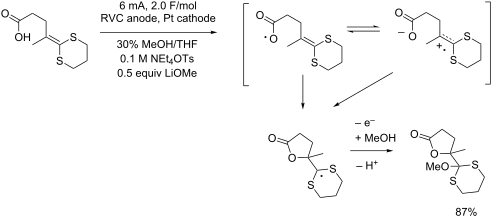
- trapping of a ketene dithioacetal derived radical cation by an amine was shown to lower the oxidation potential measured for the ketene dithioacetal by 460 mV [21], a value consistent with the potential measured here for 14a. The oxidation of 14b to afford the six-membered ring product also proceeded well


Structures of the reaction products of the AZADO radical with TCNQF4 or thiourea
Beilstein J. Org. Chem. 2013, 9, 1487–1491, doi:10.3762/bjoc.9.169

- AZADO molecule in the next step to give an addition product (a salt) resulting from the addition to one of the double bonds in the six-membered ring. Finally, the oxoammonium cation in the adduct will react with the counter anion from the less hindered site to afford the final product 5 with trans
- -membered ring in a trans-manner, as seen from its molecular structure (Scheme 1) (Figure 2). Therefore, a plausible mechanism of the reaction could be considered as shown in Scheme 2. First, a transient CT complex would be formed between 2 and 3 but it would be unstable enough to be attacked by another
- amount of TCNQF4 (3) did not give dark blue crystals but gave an orange solid. After purification, the orange crystals obtained were proved to be the addition product 5 and not a CT complex as seen from the X-ray analysis. Furthermore, the addition was found to take place to a double bond of the six


Anionic cascade reactions. One-pot assembly of (Z)-chloro-exo-methylenetetrahydrofurans from β-hydroxyketones
Beilstein J. Org. Chem. 2013, 9, 1319–1325, doi:10.3762/bjoc.9.148

- -methyleneketals [1][2][3]. This unique transformation is particularly efficient in the case of six-membered ring ketones (Scheme 1). In an attempt to extend the scope of this cascade process to acyclic ketones, acetone was submitted to the usual reaction conditions. To our surprise, the expected adduct 5 was





Host–guest complexes of mixed glycol-bipyridine cryptands: prediction of ion selectivity by quantum chemical calculations, part V
Beilstein J. Org. Chem. 2013, 9, 1252–1268, doi:10.3762/bjoc.9.142
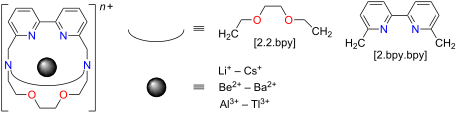
- ) building block causes a stronger contraction of the cryptand hole, since the two pyridine rings are stiffened by a third, weaker aromatic six-membered ring (according to Clar’s rule [72][73][74]) as was explained above. Hence, the subsequent substitution by (bpy) and (phen) moieties reduces the size of the


![[Graphic 2]](/bjoc/content/inline/1860-5397-9-142-i3.png?max-width=637&scale=0.295455) 2.2.bpy]+.
2.2.bpy]+.


Conformational analysis and intramolecular interactions in monosubstituted phenylboranes and phenylboronic acids
Beilstein J. Org. Chem. 2013, 9, 1127–1134, doi:10.3762/bjoc.9.125
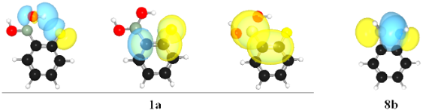
- constant. Better electron donors than fluorine (N, P and S) perform such an interaction. An intramolecular hydrogen bond F∙∙∙HO appears in 2-fluorophenylboronic acid and it contributes for the conformational stability, since a six-membered ring is formed from this interaction, which is more efficient than


Diastereoselective synthesis of nitroso acetals from (S,E)-γ-aminated nitroalkenes via multicomponent [4 + 2]/[3 + 2] cycloadditions promoted by LiCl or LiClO4
Beilstein J. Org. Chem. 2013, 9, 838–845, doi:10.3762/bjoc.9.96
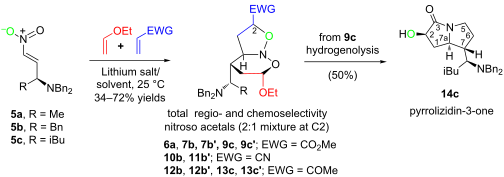
- resulting from the endo approach of the smaller dipolarophile MVK by the Re face of the nitronate. It is worthwhile to mention that, depending of the nitroso acetal structure, an opening of the six-membered ring is caused due to a greater sensitivity to the reaction medium, leading to generation of the
- could be corroborated by X-ray analysis of 11b, since the diastereoselection of the [4 + 2]-step was the same for all cycloadditions investigated (Figure 1 and Figure 2). The determination of the vicinal H,H constant coupling of the protons located in the six-membered ring was not so simple due to the


Ring opening of 2-aza-3-borabicyclo[2.2.0]hex-5-ene, the Dewar form of 1,2-dihydro-1,2-azaborine: stepwise versus concerted mechanisms
Beilstein J. Org. Chem. 2013, 9, 761–766, doi:10.3762/bjoc.9.86
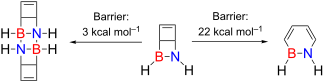
- unstable with respect to dimerisation or oligomerisation. In 1,2-dihydro-1,2-azaborine, such a dimerisation is not observed, probably due to the aromatic character of the six-membered ring. In 3, however, this aromatic stabilisation is no longer available. For the sake of simplicity, we only considered


A new intermediate in the Prins reaction
Beilstein J. Org. Chem. 2013, 9, 476–485, doi:10.3762/bjoc.9.51
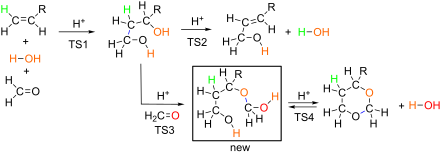
- was used, and water or glacial acetic acid was the solvent. A general Prins reaction is shown in Scheme 1. A typical Prins reaction is exhibited in Scheme 2 [4]. Here, the six-membered ring compound, 4,4-dimethyl-1,3-dioxane, is the major product along with 3-methyl-1,3-butane-diol. The 1,3-dioxane is
- the carbonyl group. In this case, 1,3-diol(Me) is the alcohol, and the second formaldehyde is of the C=O group. Closure of the six-membered ring from the ether(Me) [TS4(Me)] gives the product 4-methyl-1,3-dioxane, dioxane(Me). Thus, the obtained route (ii), precursor (Me) → diol(Me) → ether(Me





Polymerization of novel methacrylated anthraquinone dyes
Beilstein J. Org. Chem. 2013, 9, 453–459, doi:10.3762/bjoc.9.48
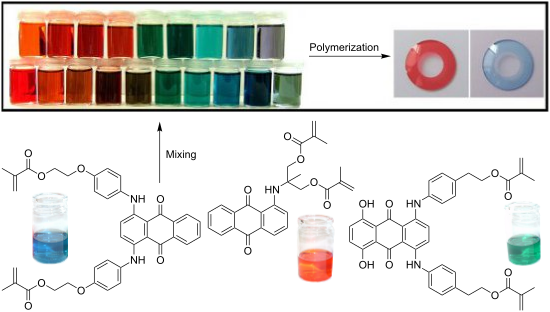
- be assumed that the driving force for the ring closure is the formation of a six-membered ring; however, the mechanism has not been investigated in detail so far. Since the ring closure does not affect the spectral properties, 14 can still be used as a polymerizable red dye. In this work, side



Design and synthesis of quasi-diastereomeric molecules with unchanging central, regenerating axial and switchable helical chirality via cleavage and formation of Ni(II)–O and Ni(II)–N coordination bonds
Beilstein J. Org. Chem. 2012, 8, 1920–1928, doi:10.3762/bjoc.8.223
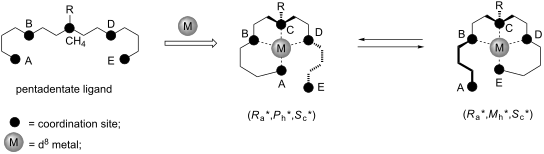
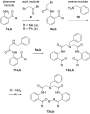
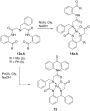
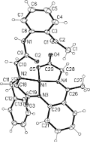
- diastereomeric complexes (Ra*,Ph*,Sc*)-2 and (Ra*,Mh*,Rc*)-3, which contain at least three elements of chirality, namely stereogenic center, axis and helix (Scheme 1). The structure of these complexes incorporated two five- and one six-membered ring displaying a square-planar geometry. It is worth mentioning



Determination of the relative configuration of tropinone and granatanone aldols by using TBDMS ethers
Beilstein J. Org. Chem. 2012, 8, 1877–1883, doi:10.3762/bjoc.8.216

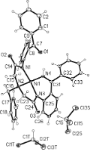
- (Figure 3) by X-ray diffraction. Atoms H1 and H8 were found in syn relation to each other, while the 1′-hydroxybenzyl group at C1 is on the exo side of the bicyclic tropane scaffold pointing towards the C4–N1–C7 bridge (pseudoaxial on the tropinone six-membered ring). The crystal structure is also


Evaluation of a chiral cubane-based Schiff base ligand in asymmetric catalysis reactions
Beilstein J. Org. Chem. 2012, 8, 1814–1818, doi:10.3762/bjoc.8.207
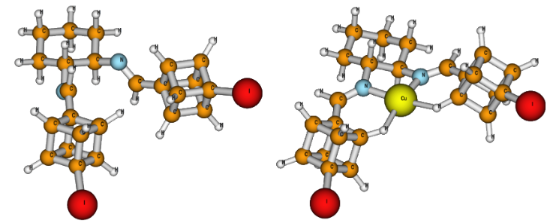
- cyclopropanation and Michael addition reactions. Although there was no increase in stereocontrol, upon computational evaluation using both M06L and B3LYP calculations, it was revealed that a pseudo six-membered ring exists, through H-bonding of a cubyl hydrogen to the copper core. This decreases the steric bulk
- complex. In addition, H-bonding with cubyl hydrogens and the copper core yielded a pseudo six-membered ring, which decreased the N–C–C–N dihedral angle. Structure of (1R,2R)-N,N’-bis[(4-iodocuban-1-yl)methylene]-trans-1,2-diamino cyclohexane (1). M06L DFT global minima for (a) (1R,2R)-N,N’-bis[(4


Imidazolinium and amidinium salts as Lewis acid organocatalysts
Beilstein J. Org. Chem. 2012, 8, 1798–1803, doi:10.3762/bjoc.8.205
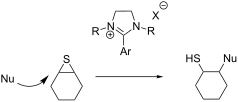
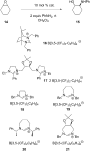
- geometry of 7-membered 1,3-diazepinium cations such as 19 does not allow the planar conformation to be kept, thus the positive charge is less delocalized over the NCN atoms (Scheme 4) [26][27][28][29]. Salt 16, incorporating a six-membered ring as the smallest ring, displayed a catalytic activity between





Cation affinity numbers of Lewis bases
Beilstein J. Org. Chem. 2012, 8, 1406–1442, doi:10.3762/bjoc.8.163
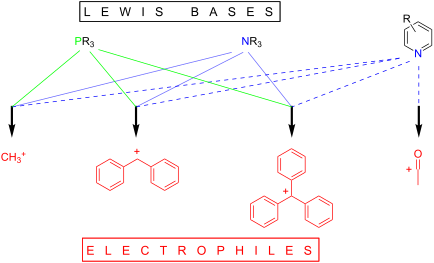
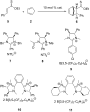
- -membered ring to bicyclic 3,4-diaminopyridines leads to tricyclic diaminopyridines 407, 408, and 410 and is accompanied by an increase in acetyl cation affinities above 240 kJ/mol. Annelation of a carbocyclic ring thus has a comparabel effect as already observed for DMAP (54) and its ring-extended forms
- respective ACA values (Table 14). Most of the 3,4-diaminopyridines (58, 59, 63, 399–408) show ACA values which are roughly between 235 and 243 kJ/mol. However, the introduction of a (thio)urea moiety as in 383–387, 389–394, and 397 lowers the ACA value by 10 to 25 kJ/mol. Annelation of an additional six


Binaphthyl-anchored antibacterial tripeptide derivatives with hydrophobic C-terminal amino acid variations
Beilstein J. Org. Chem. 2012, 8, 1265–1270, doi:10.3762/bjoc.8.142
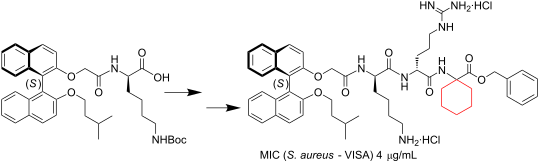
- hydrophobicity while increasing the hydrophilicity of the six-membered ring in 2c through inclusion of a ring oxygen atom, as in 2d, had a significant detrimental effect on the activity against the vancomycin-resistant strains VRE449 and VRE820. Interestingly, the placement of an extra methylene group in the


Conformational analysis, stereoelectronic interactions and NMR properties of 2-fluorobicyclo[2.2.1]heptan-7-ols
Beilstein J. Org. Chem. 2012, 8, 1227–1232, doi:10.3762/bjoc.8.137
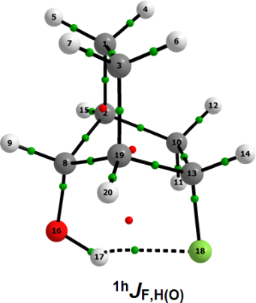
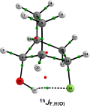
- perform well in estimating 19F-based couplings [23]), and a high correlation was found (R2 = 0.97), indicating that such an interaction, and thus the F∙∙∙HO intramolecular HB forming a six-membered ring, modulates the 1hJF,H(O) SSCC (Figure 4), which is governed by the Fermi contact term. The SSCC