


Search results
Search for "building blocks" in Full Text gives 940 result(s) in Beilstein Journal of Organic Chemistry. Showing first 200.
Carbonylative synthesis and functionalization of indoles
Beilstein J. Org. Chem. 2024, 20, 973–1000, doi:10.3762/bjoc.20.87
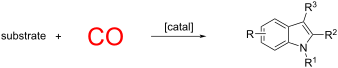
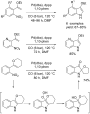
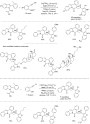
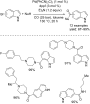
- vinyl propargylic esters could be employed as five-carbon atom building blocks in [5 + 2] cycloadditions with alkynes or alkenes by carbene intermediates. Starting from those results they envisaged the benzannulation of heteroaryl propargylic esters favored by CO [44]. The process led to the desired
- organic building blocks and pharmaceutical compounds. In this context, given the importance of indoles, in 2011, the groups by Lei and Li independently reported the C–H alkoxycarbonylation of indole derivatives [66][67]. In addition, Lei and co-workers also reported the N–H alkoxycarbonylation [66]. Both












Enhancing structural diversity of terpenoids by multisubstrate terpene synthases
Beilstein J. Org. Chem. 2024, 20, 959–972, doi:10.3762/bjoc.20.86
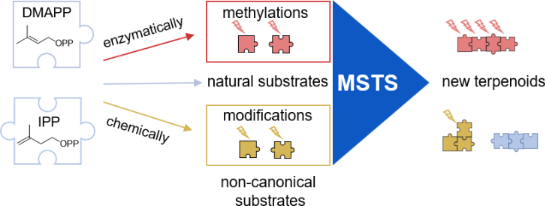
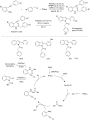
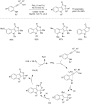
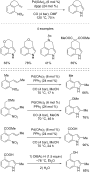
- broad range of bioactivities [2][3]. Despite their stunning diversity, all terpenes are biosynthetically derived from two general isomeric C5 building blocks, dimethylallyl diphosphate (DMAPP, 1) and isopentenyl diphosphate (IPP, 2), via the mevalonate (MVA) or methylerythritol 4-phosphate (MEP
- irregular C6 (91–95), C7 (96–100), and C8 diphosphates (101), which could serve as building blocks for the generation of new terpenoids [51] (Figure 7). Furthermore, a series of noncanonical C11, C12, C16, and C17 prenyl substrates were synthesized in Escherichia coli harboring heterologously expressed IPP
- [58]. Selcted SpSodMT variants provided ten C16 building blocks, including 103, plymuthenyl diphosphate (104), thorvaldsenyl diphosphate (105), weylandtenyl diphosphate (106), blixenyl diphosphate (107), kimlarsenyl diphosphate (108), serratinyl diphosphate (109), jacobsenyl diphosphate (110






Innovative synthesis of drug-like molecules using tetrazole as core building blocks
Beilstein J. Org. Chem. 2024, 20, 950–958, doi:10.3762/bjoc.20.85
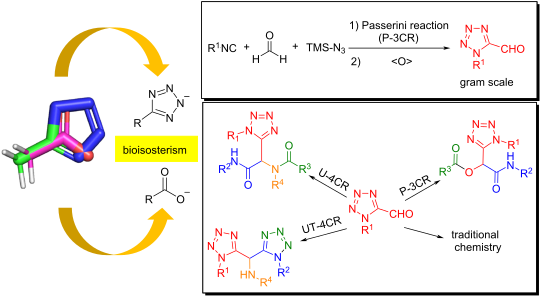
- introduced from their nitrile precursors through late-stage functionalization. In this work, we propose a novel strategy involving the use of diversely protected, unprecedented tetrazole aldehydes as building blocks. This approach facilitates the incorporation of the tetrazole group into multicomponent
- reactions or other chemistries, aiding in the creation of a variety of complex, drug-like molecules. These innovative tetrazole building blocks are efficiently and directly synthesized using a Passerini three-component reaction (PT-3CR), employing cost-effective and readily available materials. We further
- showcase the versatility of these new tetrazole building blocks by integrating the tetrazole moiety into various multicomponent reactions (MCRs), which are already significantly employed in drug discovery. This technique represents a unique and complementary method to existing tetrazole synthesis processes




Synthesis and properties of 6-alkynyl-5-aryluracils
Beilstein J. Org. Chem. 2024, 20, 898–911, doi:10.3762/bjoc.20.80
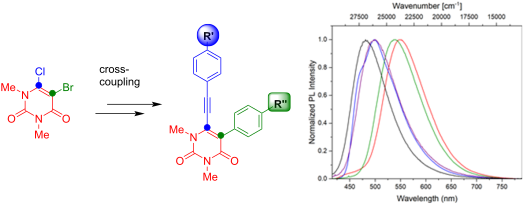
- -coupling; fluorescence; heterocycles; regioselectivity; Introduction Organic life is a complex interplay of many different building blocks. One of these building blocks is uracil. Discovered for the first time in 1901 by Alberto Ascoli, it is now known to be one of the four nucleobases of RNA [1]. It




(Bio)isosteres of ortho- and meta-substituted benzenes
Beilstein J. Org. Chem. 2024, 20, 859–890, doi:10.3762/bjoc.20.78
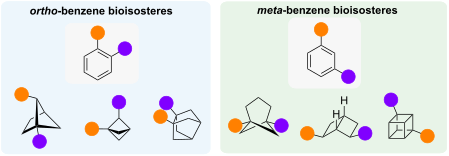
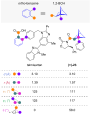
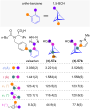
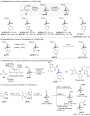
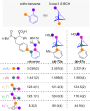
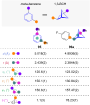
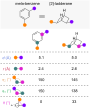
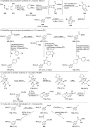
- the goal of this review but a number of pertinent examples will be highlighted (Figure 28). Bridge-substituted trisubstituted BCPs are potentially powerful building blocks offering unique substituent geometries for medicinal chemistry. A limited number of routes are available to these structures. Qin














Confirmation of the stereochemistry of spiroviolene
Beilstein J. Org. Chem. 2024, 20, 852–858, doi:10.3762/bjoc.20.77
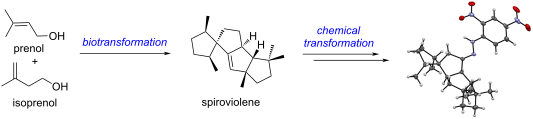
- originated from two key C5 building blocks, namely isopentenyl pyrophosphate (IPP) and dimethylallyl pyrophosphate (DMAPP), which are biosynthesized via either the methylerythritol phosphate (MEP) pathway or the mevalonic acid (MVA) pathway by using the primary metabolites. Different numbers of IPP and DMAPP


Skeletal rearrangement of 6,8-dioxabicyclo[3.2.1]octan-4-ols promoted by thionyl chloride or Appel conditions
Beilstein J. Org. Chem. 2024, 20, 823–829, doi:10.3762/bjoc.20.74
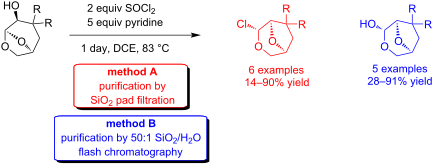
- reports of Karban et al. (Scheme 2) [19]. We envisaged that these hexose-derived building blocks with a 2,5-anhydro bond such as 5 could be useful materials for the construction of C-nucleosides such as formycin A (Figure 1) [22][23][24]. The preparation of C-glycosides usually involves the creation of
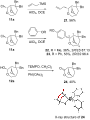
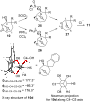
- levoglucosenone, cyrene and their derivatives, generating a unique set of bicyclic building blocks. Previous work on migration reactions in 6,8-dioxabicyclooctan-4-ols [18]. Mechanism for the rearrangement of 10, and Newman projection and the X-ray structure of 10d projected along the C4–C5 axis. Structures for


Discovery and biosynthesis of bacterial drimane-type sesquiterpenoids from Streptomyces clavuligerus
Beilstein J. Org. Chem. 2024, 20, 815–822, doi:10.3762/bjoc.20.73
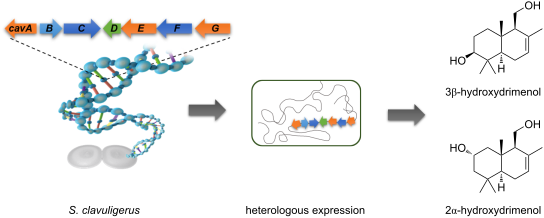
- Terpenoids, encompassing over 11,000 compounds (http://dnp.chemnbase.com), are the most diverse group of natural products found in nature [1]. All terpenoids are biosynthesized from C5 carbon units, which are sourced from the isoprenoid building blocks isopentenyl diphosphate (IPP) and dimethylallyl


SOMOphilic alkyne vs radical-polar crossover approaches: The full story of the azido-alkynylation of alkenes
Beilstein J. Org. Chem. 2024, 20, 701–713, doi:10.3762/bjoc.20.64
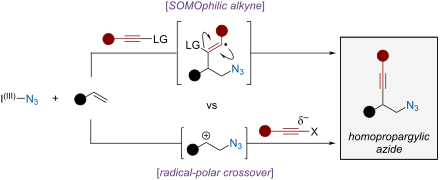
- building blocks bearing two of the most versatile functional groups, allowing a rich panel of functionalization. They have been used as intermediates in numerous syntheses to access bioactive compounds [1][2][3][4] or materials [5][6][7]. In addition, azide reduction affords homopropargylic amines, which


Synthesis of 2,2-difluoro-1,3-diketone and 2,2-difluoro-1,3-ketoester derivatives using fluorine gas
Beilstein J. Org. Chem. 2024, 20, 460–469, doi:10.3762/bjoc.20.41
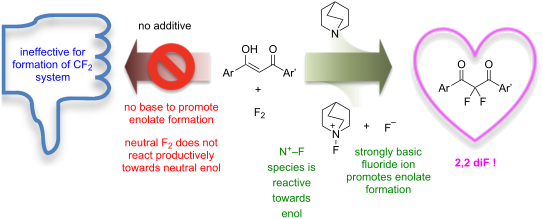
- enolization of the monofluoro-diketone intermediates. In addition, imines and α-diboryl ketone derivatives can also be transformed to 2,2-difluoroketones using an N–F electrophilic fluorinating reagent [18]. Alternatively, building blocks containing CF2 units such as ethyl bromodifluoroacetate and
- difluoromethylphenyl sulfoxide offer the possibility of transferring difluoromethylene groups directly into organic systems [19][20][21][22][23][24][25] and there is now a very extensive literature on carbon–carbon bond-forming reactions using these and other difluoromethylated building blocks [3][26][27][28][29][30


(E,Z)-1,1,1,4,4,4-Hexafluorobut-2-enes: hydrofluoroolefins halogenation/dehydrohalogenation cascade to reach new fluorinated allene
Beilstein J. Org. Chem. 2024, 20, 452–459, doi:10.3762/bjoc.20.40
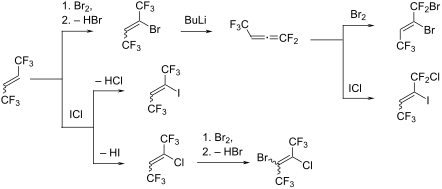
- agreement with the published data [23]. The most interesting outcome from our point of view was the formation of 1,1,4,4,4-pentafluorobuta-1,2-diene (11). 1,1-Difluoroallenes are building blocks for a great number of valuable transformations [28]. Therefore, the synthesis of new fluorinated allenes


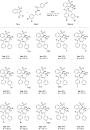
Synthesis of spiropyridazine-benzosultams by the [4 + 2] annulation reaction of 3-substituted benzoisothiazole 1,1-dioxides with 1,2-diaza-1,3-dienes
Beilstein J. Org. Chem. 2024, 20, 280–286, doi:10.3762/bjoc.20.29
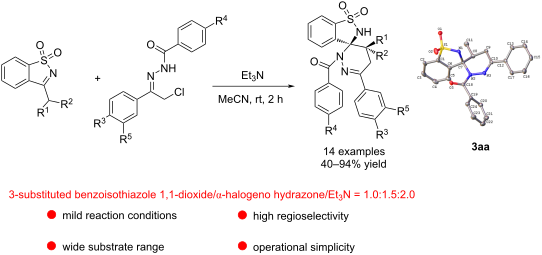
- ][20][21][22][23][24][25][26][27], which can be readily generated in situ from α-halogeno hydrazones, have been extensively applied in recent years as versatile building blocks in inverse-electron-demand Diels–Alder (IEDDA) reactions [28][29][30] to construct diverse nitrogen-containing heterocycles




Nucleophilic functionalization of thianthrenium salts under basic conditions
Beilstein J. Org. Chem. 2024, 20, 257–263, doi:10.3762/bjoc.20.26
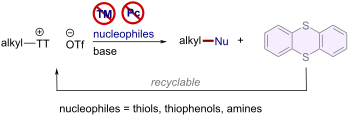
- ][5][6][7][8][9][10] have been extensively utilized as readily accessible synthetic building blocks in organic synthesis, particularly in the ipso-functionalization of C–S bonds. Of the sulfonium salts, organothianthrenium salts exhibit distinct structural properties and reactivities, thereby offering

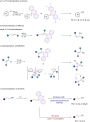


Catalytic multi-step domino and one-pot reactions
Beilstein J. Org. Chem. 2024, 20, 254–256, doi:10.3762/bjoc.20.25
- ; multi-step reactions; multicomponent reactions; one-pot synthesis; organocatalysis; tandem reactions; transition-metal-catalysis; The synthesis of pharmaceutical ingredients, natural products, agrochemicals, ligand systems, and building blocks for materials science has reached a high level of

Optimizations of lipid II synthesis: an essential glycolipid precursor in bacterial cell wall synthesis and a validated antibiotic target
Beilstein J. Org. Chem. 2024, 20, 220–227, doi:10.3762/bjoc.20.22
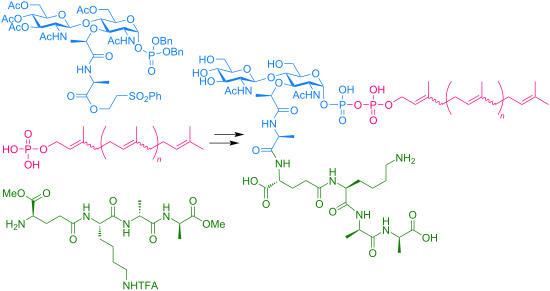
- analogues through the incorporation of alternative building blocks at different stages of synthesis. Keywords: chemical glycosylation; lipid II; peptidoglycan; polyprenyls; total synthesis; Introduction Lipid II (Figure 1) is an essential bacterial glycolipid involved in peptidoglycan biosynthesis [1]. It
- applications due to their improved solubility in aqueous systems. Assembly is achieved by integrating distinct carbohydrate, peptide, and polyprenyl phosphate building blocks. This modular synthetic method allows for the strategic substitution of constituent building blocks at different synthetic stages and


Multi-redox indenofluorene chromophores incorporating dithiafulvene donor and ene/enediyne acceptor units
Beilstein J. Org. Chem. 2024, 20, 59–73, doi:10.3762/bjoc.20.8
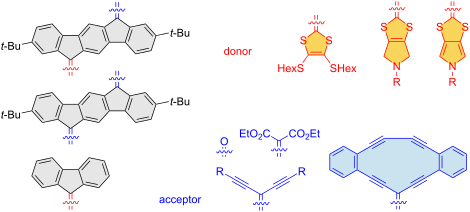
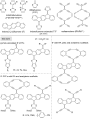
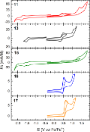
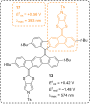
- expanded by pyrrolo annelation. The optical and redox properties of these compounds, in some cases carbon-rich, were studied by UV–vis absorption spectroscopy and cyclic voltammetry. Synthetically, the work explores IF diones or fluorenone as central building blocks by subjecting the carbonyl groups to a
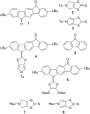
- other end of the IF core with electron-accepting moieties. An overview of general motifs targeted in this work is shown in Figure 1. Results and Discussion Synthesis The synthetic building blocks 1–8 used in this work are shown in Figure 2. The dione 1 and the ketones 4 and 6 were synthesized according
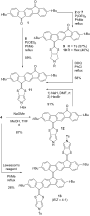
- to literature procedures [14][19][20], as were the 1,3-dithiole-2-thiones 2 and 3 [21]. Fluorenone 5 is commercially available. The new building blocks 7 and 8 were prepared according to related literature procedures [21], as described in Supporting Information File 1. Our first objective was to






Cycloaddition reactions of heterocyclic azides with 2-cyanoacetamidines as a new route to C,N-diheteroarylcarbamidines
Beilstein J. Org. Chem. 2024, 20, 17–24, doi:10.3762/bjoc.20.3
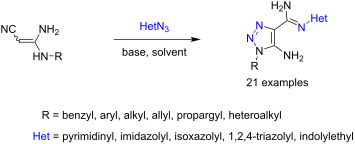
- -diaminoacrylonitriles 1 and azides 2 can serve as three atom building blocks (Figure 1), affording 5-amino-1,2,3-triazole-4-carbimidamides A (Scheme 1C), which could be suitable precursors for the desired compounds 3. With the starting 3,3-diaminoacrylonitriles 1 and azides 2 at hands they were subjected to the
- and elaboration of a novel tandem process, synthesis of starting building blocks and 21-st target compounds was made by chemistry team and founded by Russian Science Foundation, project number 23-13-00248. The study of cytotoxic effect of 7 compounds was financially supported by the Ministry of



Biphenylene-containing polycyclic conjugated compounds
Beilstein J. Org. Chem. 2023, 19, 1895–1911, doi:10.3762/bjoc.19.141
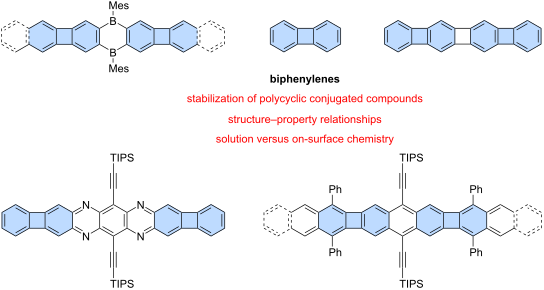
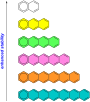
- understanding the correlations between structure and electronic properties, as these units serve as fundamental building blocks in graphite and carbon nanotubes [3]. The limited stability of this particular class of PAHs arises as a key challenge, primarily attributed to their extended conjugation. The longer



N-Boc-α-diazo glutarimide as efficient reagent for assembling N-heterocycle-glutarimide diads via Rh(II)-catalyzed N–H insertion reaction
Beilstein J. Org. Chem. 2023, 19, 1841–1848, doi:10.3762/bjoc.19.136
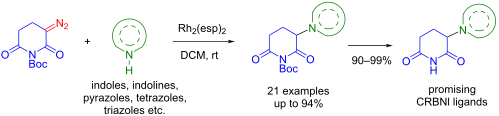
- heterocyclic fragment into the glutarimide core, creating potential CRBN ligands and crucial building blocks for assembling PROTACs. In this paper, a more convenient diazo reagent 5 is introduced and its effectiveness in reacting with a broad variety of NH-heterocycles and in providing N-Boc-protected


Substituent-controlled construction of A4B2-hexaphyrins and A3B-porphyrins: a mechanistic evaluation
Beilstein J. Org. Chem. 2023, 19, 1832–1840, doi:10.3762/bjoc.19.135
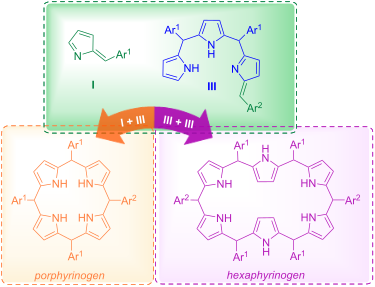
- building blocks in the fields of near-infrared (NIR) dyes [5], nonlinear optical (NLO) materials [2], and photosensitizers in photodynamic therapy [1], however, their synthesis is still a challenge for chemists. Hexaphyrins are one of the most investigated structures among expanded porphyrins owing to


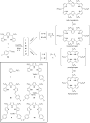

GlAIcomics: a deep neural network classifier for spectroscopy-augmented mass spectrometric glycans data
Beilstein J. Org. Chem. 2023, 19, 1825–1831, doi:10.3762/bjoc.19.134

- building blocks with distinct molecular structures, carbohydrates feature hundreds of building blocks – many of them coming in groups of closely related isomers with ambiguous molecular structures – and they form complex, branched arrangements due to the versatility of the glycosidic bond (position and


Recent advancements in iodide/phosphine-mediated photoredox radical reactions
Beilstein J. Org. Chem. 2023, 19, 1785–1803, doi:10.3762/bjoc.19.131
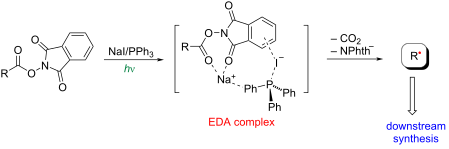
- ), specifically by extracting a hydrogen atom from the α-position of benzyl radicals A. The process described above led to the formation of the corresponding olefins 11, eliminating the need for a carbon–iodine bond formation step. Alkylation Diaziridines are highly versatile building blocks in synthesis, with




Trifluoromethylated hydrazones and acylhydrazones as potent nitrogen-containing fluorinated building blocks
Beilstein J. Org. Chem. 2023, 19, 1741–1754, doi:10.3762/bjoc.19.127
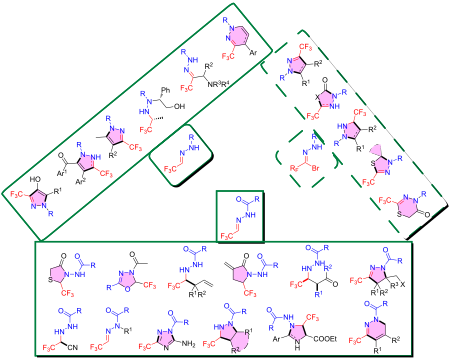
- Zhang Dongxu Department of Fire Protection Engineering, China Fire and Rescue Institute, Beijing 102202, P. R. of China 10.3762/bjoc.19.127 Abstract Nitrogen-containing organofluorine derivatives, which are prepared using fluorinated building blocks, are among the most important active fragments
- . Keywords: acylhydrazones; difluoromethylation; dihydropyridazine; fluorinated building blocks; hydrazones; imidazolidines; pyrazoles; pyrazolidines; pyrazolines; trifluoromethylation; Introduction The introduction of fluorine into pharmaceuticals, agrochemicals, and materials can significantly enhance
- building blocks offers another mainstream approach to introducing fluorine. Among these, di/trifluorodiazoethane [19][20][21][22], trifluoromethyl aldimines [23][24][25], trifluoroacetimidoyl halides [26], and fluoroalkyl N-sulfonyl hydrazones [27] have emerged as powerful nitrogen-containing fluorinated


Quinoxaline derivatives as attractive electron-transporting materials
Beilstein J. Org. Chem. 2023, 19, 1694–1712, doi:10.3762/bjoc.19.124
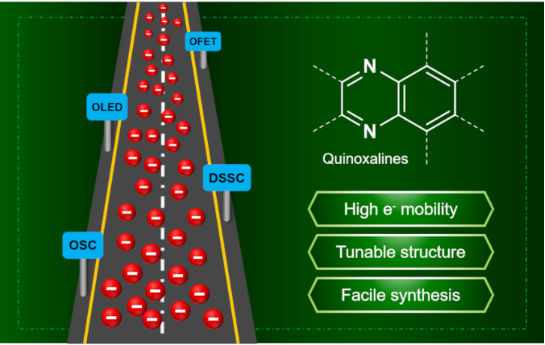
- high electron mobility and efficient charge transfer. In particular, Qx derivatives find use as non-fullerene acceptors (NFAs) in OSCs and as essential building blocks in sensitizers for DSSCs. The significance of Qx extends beyond to thermally activated delayed fluorescence (TADF) emitters and
- absorption, good dye regeneration, and promising NLO properties underscored the multifunctional nature of Qx derivatives as auxiliary acceptors [49]. Figure 5 depicts molecular structures of Qx derivatives used as building blocks of dyes and sensitizers. The device properties of such prominent materials are


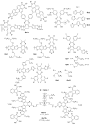
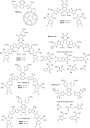


A deep-red fluorophore based on naphthothiadiazole as emitter with hybridized local and charge transfer and ambipolar transporting properties for electroluminescent devices
Beilstein J. Org. Chem. 2023, 19, 1664–1676, doi:10.3762/bjoc.19.122
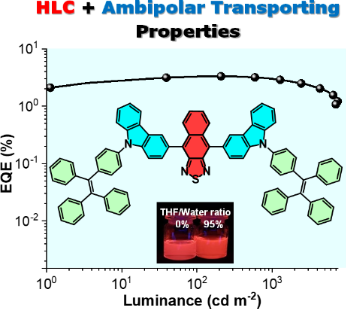
- . It has been reported that the performance of HLCT fluorophores greatly depends on the strength of donors, acceptors, and π spacers and the building blocks of HLCT should be carefully selected to regulate appropriate electron push–pull strength [32][35][47][48]. Here, a novel chromophore, 4,9-bis(9-(4





