


Search results
Search for "epoxidation" in Full Text gives 174 result(s) in Beilstein Journal of Organic Chemistry.
Recent applications of the divinylcyclopropane–cycloheptadiene rearrangement in organic synthesis
Beilstein J. Org. Chem. 2014, 10, 163–193, doi:10.3762/bjoc.10.14
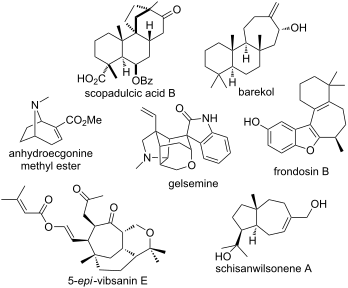
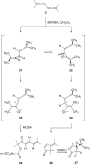
- in the formation of a bridged tetracycle after initial Heck coupling followed by carbo-palladation and subsequent β-hydride elimination [69][70][71]. Double bond regioisomers (between C7 & C8 or C13 & C14) were obtained. Oxidation with DDQ yielded the 1,6-unsaturated ketone 72. Selective epoxidation
- ). Deoxygenation with concomitant isomerization of the double bond according to Gevorgyan [100] was followed by epoxidation to provide barekoxide (106). Acid-catalyzed isomerization finally yielded barekol (107). Davies and coworkers [101][102][103] used the formal [4 + 3]-cycloaddition approach to access the
- ] applied the DVCPR in their total synthesis of gelsemine (146, see Scheme 20 and Scheme 21). Starting from bicycle 160 [140] epoxidation using mCPBA furnished epoxide 161 [141][142], which could be converted into vinylcyclopropanecarbaldehyde 162 upon rearrangement. Olefination using HWE-reagent 163




Synthesis of five- and six-membered cyclic organic peroxides: Key transformations into peroxide ring-retaining products
Beilstein J. Org. Chem. 2014, 10, 34–114, doi:10.3762/bjoc.10.6






The difluoromethylene (CF2) group in aliphatic chains: Synthesis and conformational preference of palmitic acids and nonadecane containing CF2 groups
Beilstein J. Org. Chem. 2014, 10, 18–25, doi:10.3762/bjoc.10.4
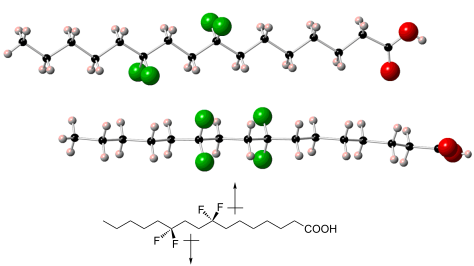
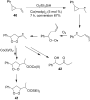
- ketone 14 was treated with DAST. Conversion to the CF2 group occurred in modest (45%) yield. Generally aliphatic ketones are less efficiently converted to CF2 groups with DAST in comparison to propargylic ketones. Progression of the resultant CF2 containing olefin 15 by epoxidation, chain extension and




N,N'-(Hexane-1,6-diyl)bis(4-methyl-N-(oxiran-2-ylmethyl)benzenesulfonamide): Synthesis via cyclodextrin mediated N-alkylation in aqueous solution and further Prilezhaev epoxidation
Beilstein J. Org. Chem. 2013, 9, 2834–2840, doi:10.3762/bjoc.9.318
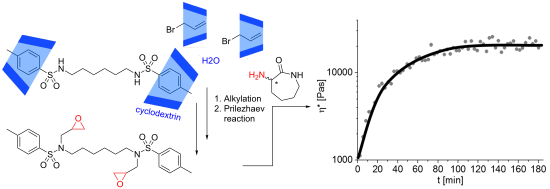
- concentrations [10][11][12]. An alternative route is a two-step reaction via N-allylation and further Prilezhaev epoxidation with peroxides [13][14][15]. The solubility of hydrophobic reactants in water can be increased significantly by cyclodextrins (CD) and thereby the use of organic solvents can be reduced
- -methylbenzenesulfonamide) (3), as precursor for the subsequent N-alkylation and further Prilezhaev epoxidation, was synthesized easily from p-toluenesulfonyl chloride (1) and hexamethylenediamine (2) [23]. The resulting crystalline sulfonamide was first described in 1927 prepared from 1,6-dibromohexane and p
- moieties to the hydroxy functions is likely [2]). Synthesis of sulfonamide 3, N-alkylation of 3 in organic solution and of CD-complex (3β) in aqueous phase to obtain 5 and the subsequent epoxidation with m-chloroperbenzoic acid (mCPBA) to yield product 6. Cyclization of L-(+)-lysine monohydrochloride to


Stereoselectively fluorinated N-heterocycles: a brief survey
Beilstein J. Org. Chem. 2013, 9, 2696–2708, doi:10.3762/bjoc.9.306
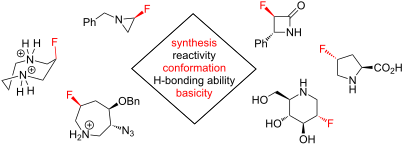
- ]-Wittig rearrangement, a diastereoselective epoxidation, and a microwave assisted transannular epoxide opening reaction. It is also noteworthy that the starting material 55 contains an extraneous fluorine atom which is deleted during the synthetic sequence; this approach takes advantage of the often low


Garner’s aldehyde as a versatile intermediate in the synthesis of enantiopure natural products
Beilstein J. Org. Chem. 2013, 9, 2641–2659, doi:10.3762/bjoc.9.300
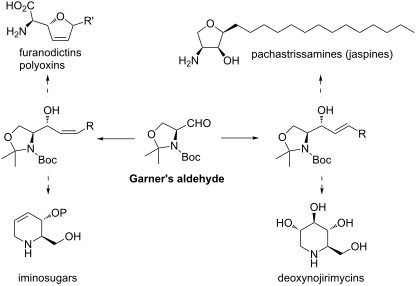
- conjugate addition [93], and a recent synthesis of lucentamycin A was achieved using this strategy [94]. Epoxidation of A leads to a highly functional intermediate C, which has been used in the synthesis of manzacidin B [95]. Among the plethora of olefination reactions, the Wittig [96][97] and Horner




Bidirectional cross metathesis and ring-closing metathesis/ring opening of a C2-symmetric building block: a strategy for the synthesis of decanolide natural products
Beilstein J. Org. Chem. 2013, 9, 2544–2555, doi:10.3762/bjoc.9.289
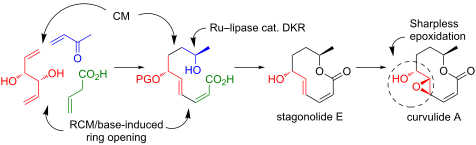
- carboxylic acid and (iii) a Ru–lipase-catalyzed dynamic kinetic resolution to establish the desired configuration at C9. Ring closure was accomplished by macrolactonization. Curvulide A was synthesized from stagonolide E through Sharpless epoxidation. Keywords: dienes; enzyme catalysis; lactones; metathesis
- reported upon incorporation of substituents has been reported in the course of an octalactin synthesis [61]. Having established a reliable route to stagonolide E, we investigated its epoxidation under Sharpless conditions [63]. We expected that this transformation would give either curvulide A [30] or one
- of its diastereomers, and help to resolve the remaining structural ambiguities, i.e. the absolute configurations at C4, C5 and C6. Based on the transition-state model for the Sharpless epoxidation of allylic alcohols bearing a stereogenic centre in the allylic position [64], we expected that






Synthesis of the spiroketal core of integramycin
Beilstein J. Org. Chem. 2013, 9, 2446–2450, doi:10.3762/bjoc.9.282
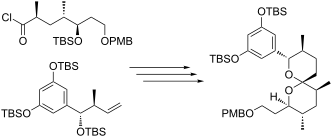
- PMB-protected 3-hydroxypropanal via Horner–Wadsworth-Emmons olefination, reduction to the allylic alcohol and Sharples epoxidation [8] (Scheme 2). Subsequent Cu-catalyzed epoxide-opening using methylmagnesium bromide [9] produced an inseparable mixture of 1,2- and 1,3-diol products, which upon
- epoxidation and Myers alkylation. Although the presented route achieves approximately the same overall yield of target compound as that of Floreancig [2] (11.2 vs 11.5%, respectively), it features utilization of easily scalable transformation and upon further optimization of the spiroketalization step would
- , Microbial drugs). Retrosynthetic analysis of integramycin. Synthesis of the aromatic subunit. Sharpless epoxidation/Myers alkylation approach to the C16–C22 carboxylic acid fragment. Coupling of the fragments and spiroketalization. Supporting Information Supporting Information File 527: Experimental


A protecting group-free synthesis of the Colorado potato beetle pheromone
Beilstein J. Org. Chem. 2013, 9, 2374–2377, doi:10.3762/bjoc.9.273
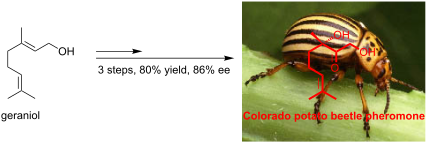
- decemlineata, has been developed based on a Sharpless asymmetric epoxidation in combination with a chemoselective alcohol oxidation using catalytic [(neocuproine)PdOAc]2OTf2. Employing this approach, the pheromone was synthesized in 3 steps, 80% yield and 86% ee from geraniol. Keywords: aggregation pheromone
- the secondary alcohol at C-2. The synthesis by Faraldos runs via epoxidation of fluoronerol, subsequent acetylation of the alcohol and solvolysis. In 2010, Waymouth reported the chemoselective, catalytic oxidation of glycerol to dihydroxyacetone (Scheme 1) using catalytic [(neocuproine)PdOAc]2OTf2 (2
- synthesis of the Colorado potato beetle pheromone (Scheme 2). An additional challenge was the presence of an alkene in the substrate, as the orthogonality of 2-catalyzed alcohol oxidations with alkenes had not been studied. In our approach, Sharpless asymmetric epoxidation of readily available geraniol or


Elucidation of the regio- and chemoselectivity of enzymatic allylic oxidations with Pleurotus sapidus – conversion of selected spirocyclic terpenoids and computational analysis
Beilstein J. Org. Chem. 2013, 9, 2233–2241, doi:10.3762/bjoc.9.262
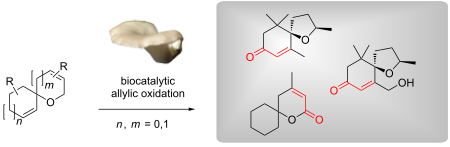
- detected similar oxidation products with PSA and rationalize their formation by an initial epoxidation of the endocyclic double bond to give the allyl epoxide 25, which might then be hydrolyzed to two diastereomeric alcohols 26a and 26b. The latter reaction is known for similar allyl epoxides under
- allylic CH-bonds. For β-ionone, for example, we have previously observed epoxidation to be the major oxidation pathway. It should be noted, that all three compounds 24, 26a and 26b are new derivatives of vitispirane 24 with potentially interesting properties as flavors. The relative stereochemistry of 26a
- vitispirane derivatives 24, 26a and 26b were isolated. In this case, the oxidation pathway is not favoring products of allylic oxidation but most likely those of epoxidation with subsequent hydrolysis of the epoxide. HPLC protocols with chiral stationary phases allow the separation of racemic mixtures of


Synthesis and biological activities of the respiratory chain inhibitor aurachin D and new ring versus chain analogues
Beilstein J. Org. Chem. 2013, 9, 1551–1558, doi:10.3762/bjoc.9.176
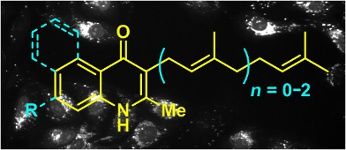
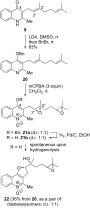
- naphthalene analogue, yet without totally explaining the observed cytotoxic activity of the compounds. Finally, a synthetic entry is given to the complete carboheterocyclic core of aurachin H through the N-oxidation/epoxidation of aurachin D and a shorter chain analogue, followed by subsequent biomimetic
- the double oxidation of the quinolone nitrogen and the olefin epoxidation (2',3'-position) of the farnesyl chain, with the epoxide being ring-opened with 5-exo selectivity by the 4-hydroxy group of the resulting 4-hydroxyquinoline N-oxide. Taking the geranyl analogue 9 as a model compound (Scheme 2
- spontaneous cyclization of intermediate 21b, which was not isolated. We also performed the same reaction sequence from aurachin D (4), giving the aurachin-H diepoxide with comparable yields [27]. After optimizing the selectivity of the epoxidation, this reaction may furnish a rapid strategy toward aurachin H


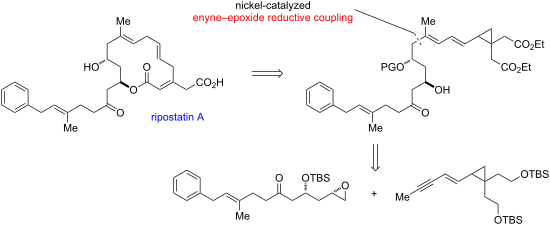
A reductive coupling strategy towards ripostatin A
Beilstein J. Org. Chem. 2013, 9, 1533–1550, doi:10.3762/bjoc.9.175
- using a route analogous to one reported by Smith [38]. Allylation of 24 with (+)-B-allyldiisopinocampheylborane generated the alcohol 25 in high yield and enantioselectivity. Directed epoxidation using VO(acac)2 and tert-butyl hydroperoxide was initially performed in order to furnish 27 directly


Efficient continuous-flow synthesis of novel 1,2,3-triazole-substituted β-aminocyclohexanecarboxylic acid derivatives with gram-scale production
Beilstein J. Org. Chem. 2013, 9, 1508–1516, doi:10.3762/bjoc.9.172
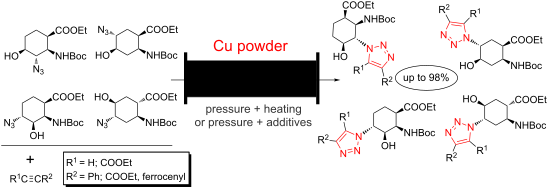
- -aminocyclohexanecarboxylates 11–14 were prepared previously by a diastereoselective epoxidation of the corresponding 2-aminocyclohexenecarboxylates, followed by a regioselective oxirane ring opening with NaN3 [68]. Three different alkynes (phenylacetylene, diethyl acetylenedicarboxylate and ethynyl ferrocene) were employed as



Metal-free aerobic oxidations mediated by N-hydroxyphthalimide. A concise review
Beilstein J. Org. Chem. 2013, 9, 1296–1310, doi:10.3762/bjoc.9.146
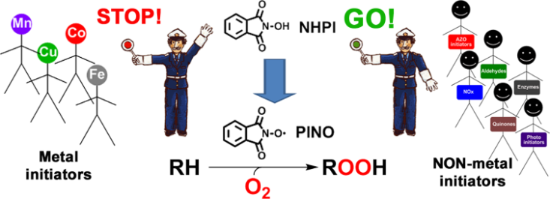
- aerobic oxidation of aldehydes could be performed for the in situ generation of the corresponding peracids in the presence of NHPI, promoting co-oxidative processes catalyzed by PINO. In an early protocol, we reported the NHPI-catalyzed selective aerobic epoxidation of α-olefins and cyclic olefins in the
- presence of stoichiometric amounts of aldehydes [52]. The experimental results revealed an opposite selectivity with respect to classical epoxidation by peracids, with internal olefins, which were unreactive under our operating conditions. We suggested a free-radical mechanism according to which the acyl
- aerobic oxidation of cellulose fibers. Molecule-induced homolysis by peracids. Molecule-induced homolysis of NHPI/m- chloroperbenzoic acid system. Proposed mechanism for the NHPI/CH3CHO/O2-mediated epoxidation. NHPI/CH3CHO-mediated aerobic oxidation of alkyl aromatics. Light-induced generation of PINO


Exploration of an epoxidation–ring-opening strategy for the synthesis of lyconadin A and discovery of an unexpected Payne rearrangement
Beilstein J. Org. Chem. 2013, 9, 1179–1184, doi:10.3762/bjoc.9.132
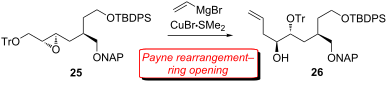
- stereoselective sequence involving a Myers alkylation and a Shi epoxidation. Ring-opening of this epoxide with a vinylcopper complex afforded alcohol 26 instead of the expected product 27. An unusual Lewis acid promoted Payne rearrangement of an α-trityloxy epoxide is proposed to account for this outcome
- . Keywords: Lewis acid; lyconadin A; Myers alkylation; Payne rearrangement; Shi epoxidation; Introduction Lyconadin A (1, Figure 1) was isolated from the club moss Lycopodium complanatum in 2001 by Kobayashi and co-workers [1]. Subsequent to this discovery, lyconadins B–F were isolated and characterized [2
- believed that this compound could be prepared from alkene 6 in two consecutive epoxidation–ring-opening sequences involving vinyl nucleophiles. We anticipated that a chiral catalyst such as one of the ketones developed by Shi and co-workers [15][16][17][18] would control the stereochemistry of the


Efficient regio- and stereoselective access to novel fluorinated β-aminocyclohexanecarboxylates
Beilstein J. Org. Chem. 2013, 9, 1164–1169, doi:10.3762/bjoc.9.130
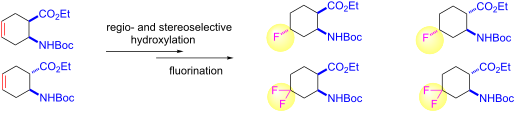
- –fluorine or oxo–fluorine exchange. Keywords: amino acids; epoxidation; fluorination; hydroxylation; stereoselective reaction; Introduction Fluorine chemistry is an expanding area of research that has generated increasing interest in pharmaceutical and medicinal chemistry in recent years because of its
- follows two different strategies. One is based on regio- and stereoselective hydroxylation via iodooxazine formation, followed by fluorination, while the other includes stereoselective epoxidation and regioselective oxirane opening, followed by hydroxy–fluorine exchange. In the former protocol, amino
- NaOEt in EtOH at 0 °C to furnish all-cis hydroxylated amino ester 5 with the hydroxy group on position 4 of the skeleton (Scheme 1, Figure 2). Hydroxylated amino ester 5 was also prepared via the alternative route involving stereoselective epoxidation. Cyclohexene β-amino ester 1 underwent C–C double




Synthesis of the tetracyclic core of Illicium sesquiterpenes using an organocatalyzed asymmetric Robinson annulation
Beilstein J. Org. Chem. 2013, 9, 1135–1140, doi:10.3762/bjoc.9.126
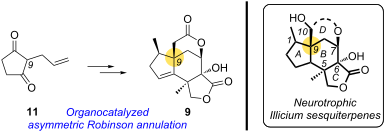
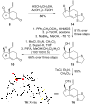
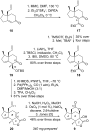
- (0)-catalyzed carbomethoxylation [87][88][89][90] produced the desired C-ring lactone 20 in 61% yield. Epoxidation of the C-6/C-7 enone with NaOH/H2O2 followed by oxidative cleavage of the C-11 terminal alkene under OsO4/NaIO4 conditions [91][92] afforded the corresponding C-11 aldehyde. Exposure of


Camera-enabled techniques for organic synthesis
Beilstein J. Org. Chem. 2013, 9, 1051–1072, doi:10.3762/bjoc.9.118
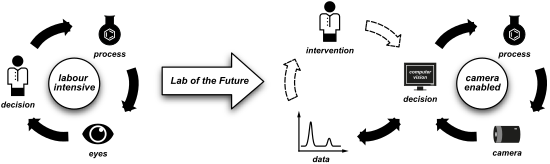
- of this device was for the preparation of a series of hydrazones. A continuous aqueous extraction to remove the excess hydrazine enabled the product to be collected in high purity (Figure 29). Other applications reported in this work include alkene epoxidation and dithiane preparation. Dispersion of


Study on the total synthesis of velbanamine: Chemoselective dioxygenation of alkenes with PIFA via a stop-and-flow strategy
Beilstein J. Org. Chem. 2013, 9, 983–990, doi:10.3762/bjoc.9.113
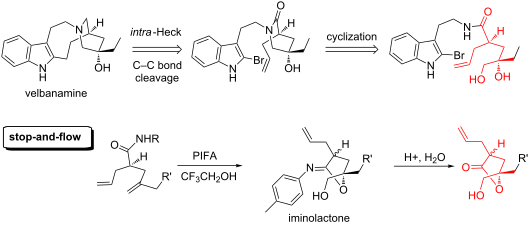
- preferentially underwent cyclization to deliver a variety of 3-susbtituted-γ-lactones (25b–d). For comparison, the mCPBA-epoxidation approach in literature always demonstrated that electron-rich alkenes are more reactive leading to the reversal of chemoselectivity [70][71]. A cyclopropane group was also


Iron-containing mesoporous aluminosilicate catalyzed direct alkenylation of phenols: Facile synthesis of 1,1-diarylalkenes
Beilstein J. Org. Chem. 2013, 9, 49–55, doi:10.3762/bjoc.9.6
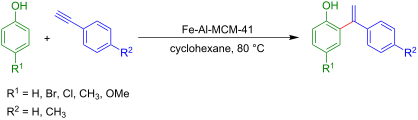
- ]. Furthermore, a variety of available reactions to functionalize the double bond, such as reductive (hydrogenation, hydrosilylation, etc.), oxidative (epoxidation, halogenations, dihydroxylation, etc.) or cycloaddition transformations, encourage such vinylation process as an attractive primary tool in organic


Polar reactions of acyclic conjugated bisallenes
Beilstein J. Org. Chem. 2013, 9, 36–48, doi:10.3762/bjoc.9.5
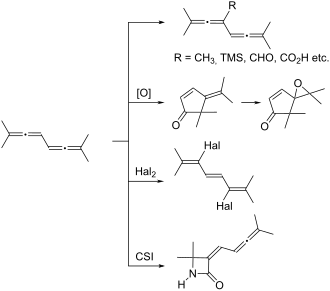
- transformations. Keywords: β-lactams; conjugated bisallenes; cyclopentenones; epoxidation; halogen addition; hydrohalogenation; ionic additions; metalation; Introduction Whereas the use of hexa-1,2,4,5-tetraene (1) and its derivatives in pericyclic reactions is well documented [2][3][4][5][6], relatively little
- hydrocarbon 30. Oxidation of conjugated bisallenes The oxidation of allenes has already been studied previously. In seminal papers Crandall and his students described the epoxidation of differently substituted monoallenes and showed that methylene oxiranes are the initial oxidation products. These, however
- , which is in equilibrium with its conformational isomer 32. Ring-opening of these strained intermediates then provides the “stretched” and the “closed” zwitterions 33 and 34, respectively. Whereas the open form 33 is intercepted by the anion derived from the epoxidation reagent, m-chlorobenzoic acid






Synthesis of a library of tricyclic azepinoisoindolinones
Beilstein J. Org. Chem. 2012, 8, 1091–1097, doi:10.3762/bjoc.8.120
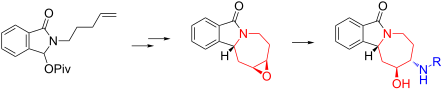
- synthesis was achieved by a subsequent alkene epoxidation and zinc-mediated aminolysis reaction. The resulting library products provided selective hits among a large number of high-throughput screens reported in PubChem, thus illustrating the utility of the novel scaffold. Keywords: chemical diversity
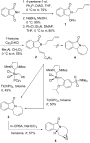
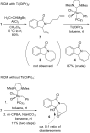
- process, we conducted a ring-closing metathesis in the absence of Ti(OiPr)4 (Scheme 2). The resulting product was different from 3, based on a TLC analysis, but proved to be quite labile during workup. Therefore, it was immediately subjected to m-CPBA epoxidation conditions to give a modest yield of the






Sonogashira–Hagihara reactions of halogenated glycals
Beilstein J. Org. Chem. 2012, 8, 675–682, doi:10.3762/bjoc.8.75
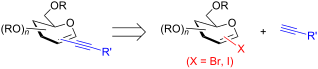
- , overnight), whereas in the case of enyne 11b, under the same reaction conditions, only the triple bond was reduced to furnish enol ether 14e selectively. In three cases we further functionalized the 1-alkylated glycals by an epoxidation/epoxide-opening sequence [30][31][32][33]. Dimethyldioxirane (DMDO) was
- used as a neutral epoxidation reagent leading to a facial-selective epoxide formation [34][35][36]. The so-obtained highly reactive acetal epoxide was either attacked by a superhydride, such as LiBHEt3 [31], or by a Lewis acidic hydrogen transfer agent, such as DIBAL-H [32][33]. In the former case, an
- SN2-type reaction takes place leading to the α-gluco-configured C-glycoside 15a in a moderate yield of 30% (Table 4). The aluminium centre coordinates the epoxide oxygen allowing the hydride to attack from the same side, leading to β-configured alkyl-C-glycosides. The epoxidation/ring-opening sequence


Intramolecular carbenoid ylide forming reactions of 2-diazo-3-keto-4-phthalimidocarboxylic esters derived from methionine and cysteine
Beilstein J. Org. Chem. 2012, 8, 433–440, doi:10.3762/bjoc.8.49
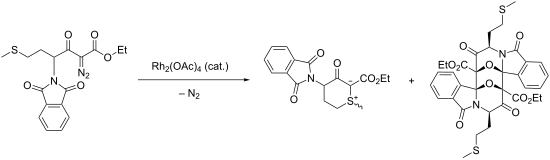
- epoxidation, aziridination and olefination reactions [12][13] are common reaction channels. The intramolecular formation of sulfonium ylides from α-diazocarbonyl compounds tethered with alkylthio or arylthio groups has been studied by the research groups of Davies [14], Moody [15], and West [16]. From α-diazo



Efficient oxidation of oleanolic acid derivatives using magnesium bis(monoperoxyphthalate) hexahydrate (MMPP): A convenient 2-step procedure towards 12-oxo-28-carboxylic acid derivatives
Beilstein J. Org. Chem. 2012, 8, 164–169, doi:10.3762/bjoc.8.17
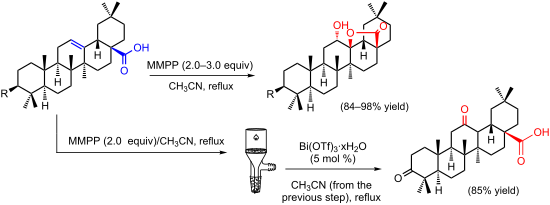
- , respectively, required higher amounts of the reagent and longer reaction times (Table 1, entries 4 and 5). The formation of the oleanolic δ-hydroxy-γ-lactones 2, 4, 6, 8 and 10, may be explained by epoxidation of the parent Δ12-oleanane compound, followed by nucleophilic attack of the 28-carboxyl group at C13





