


Search results
Search for "acidity" in Full Text gives 296 result(s) in Beilstein Journal of Organic Chemistry. Showing first 200.
Metal-free hydroarylation of the side chain carbon–carbon double bond of 5-(2-arylethenyl)-3-aryl-1,2,4-oxadiazoles in triflic acid
Beilstein J. Org. Chem. 2017, 13, 883–894, doi:10.3762/bjoc.13.89

- room temperature (see Table 2, entries 16 and 28). Presumably, at higher temperatures the second protonation takes place at the C=C double bond giving rise to reactive dications D. The acidity of H2SO4, which is lower than that of FSO3H and TfOH, is not sufficient to promote this reaction. Thus, the
- temperature (Table 2, entries 13, 16, 27, 28, and 30). Increasing the acidity of the reaction medium promotes the protonation of deactivated oxadiazoles. Thus, compound 1b in the system TfOH-SbF5 (20 mol %) reacted with benzene within 0.5 h at room temperature (Table 2, entry 9), but in less acidic neat TfOH


New approach toward the synthesis of deuterated pyrazolo[1,5-a]pyridines and 1,2,4-triazolo[1,5-a]pyridines
Beilstein J. Org. Chem. 2017, 13, 800–805, doi:10.3762/bjoc.13.80
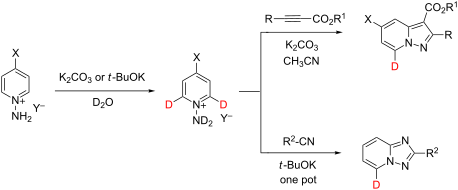
- -methoxy-N-aminopyridinium cation possesses significantly lower acidity for both N–H and C–H hydrogens possibly due to the electron-donating effect of the methoxy group. These quantum chemical data together with Zoltewicz’s work [27] suggest 7-deuterium-labeled pyrazolo[1,5-a]pyridines could be obtained
- a 93% DD for the methyl group after two runs in D2O. The 4-methoxy derivative 1c slowly underwent an H/D exchange at the 2-position of the pyridinium ring probably by reason of a lower acidity due to the electron-donating effect of the methoxy group. Thus, 5-methoxypyrazolopyridine 6 was obtained in


Continuous-flow processes for the catalytic partial hydrogenation reaction of alkynes
Beilstein J. Org. Chem. 2017, 13, 734–754, doi:10.3762/bjoc.13.73
- support material, e.g., acid/base properties [184][185], morphology, grain size [186], porosity [187], strong metal–support interactions, swelling propensity [188]). In propyne hydrogenation, for instance, catalyst resistance was shown to decrease with increasing acidity of the support [189]. In order to








Substitution of fluorine in M[C6F5BF3] with organolithium compounds: distinctions between O- and N-nucleophiles
Beilstein J. Org. Chem. 2017, 13, 703–713, doi:10.3762/bjoc.13.69
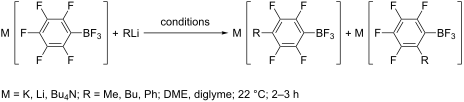
- ion pair (solution of Li[C6F5B(OMe)3] in CH2Cl2), such migration of −OMe and its subsequent elimination is hindered [42]. In the case of pentafluorophenyltrifluoroborates the similar conversion does not occur even with Li[C6F5BF3] in DME (contact ion pairs) due to the higher Lewis acidity of C6F5BF2


Unpredictable cycloisomerization of 1,11-dien-6-ynes by a common cobalt catalyst
Beilstein J. Org. Chem. 2017, 13, 639–643, doi:10.3762/bjoc.13.62
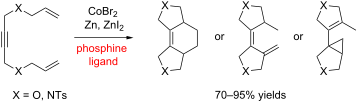
- structure to that of 1a,b. We can speculate that COOEt groups of 1l formed a chelate complex with ZnI2 and therefore strongly diminished its Lewis acidity, which is necessary for catalyst activation. All the compounds obtained were characterized by 1H and 13C NMR spectroscopy as well as high-resolution mass




Transition-metal-catalyzed synthesis of phenols and aryl thiols
Beilstein J. Org. Chem. 2017, 13, 589–611, doi:10.3762/bjoc.13.58

- chemical properties, such as acidity and nucleophilicity, and thus to some extent, the synthetic methods could be developed analogously to each other. In this context, it is valuable to compare their existing synthetic methods for better understanding, so as to inspire organic chemists to invent new


Structure–efficiency relationships of cyclodextrin scavengers in the hydrolytic degradation of organophosphorus compounds
Beilstein J. Org. Chem. 2017, 13, 417–427, doi:10.3762/bjoc.13.45
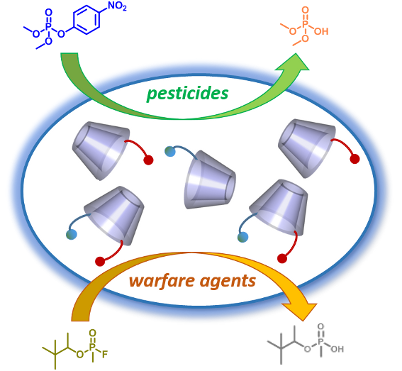
- consisted first in the selective introduction of the imidazole substituent in position 2 in unit B of 6 by making use of the higher acidity of this hydroxy group compared to the OH groups in positions 3 and 6. As expected, the substitution reaction with the benzyl-like reactant 7 led to a higher yield than




(Z)-Selective Takai olefination of salicylaldehydes
Beilstein J. Org. Chem. 2017, 13, 323–328, doi:10.3762/bjoc.13.35
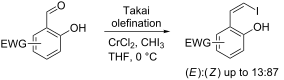
- acetylated (14) and the relevant proton is therefore absent. This implies that increased acidity is not the primary factor at play. Instead, based on the higher (Z)-selectivity observed whenever the electron-withdrawing group was closer to the aldehyde moiety (Table 2), we propose that it is withdrawal of


Spectral and DFT studies of anion bound organic receptors: Time dependent studies and logic gate applications
Beilstein J. Org. Chem. 2017, 13, 222–238, doi:10.3762/bjoc.13.25
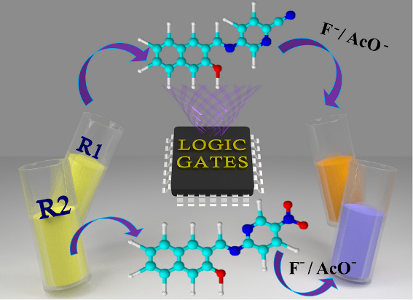
- receptors for anions have been developed based on various modes of interactions such as hydrogen bond and electrostatic interactions which rely on directionality and distance-dependent nature, respectively. Hydrogen bond formation is further tuned by the acidity of protons by virtue of the presence of


Interactions between photoacidic 3-hydroxynaphtho[1,2-b]quinolizinium and cucurbit[7]uril: Influence on acidity in the ground and excited state
Beilstein J. Org. Chem. 2017, 13, 203–212, doi:10.3762/bjoc.13.23
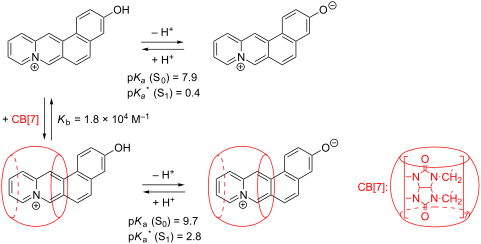
- red-shifted absorption bands and causes a dual emisson, i.e., a combination of emission bands of the hydroxyquinolizinium and its deprotonated form. Whereas this compound is a weak acid in the ground state (pKa = 7.9), it has a strongly increased acidity in the excited state (pKa* = 0.4). As a result
- acidity or basicity. In fact, it was shown that the pKa of organic acids and bases often shifts by orders of magnitude upon association with CB[n] [16][17][18][19][20][21][22][23][24], which may be used, e.g., to modify catalytic activity [6] or for sensing purposes [7]. Notably, the same effect was
- observed for the excited-state proton transfer (ESPT) of so-called photoacids. The latter are weak acids in the ground state, whereas their acidity in the excited state increases significantly [25][26][27]. As the activity of photoacids is triggered by light, they have a great potential to be employed as


New approaches to organocatalysis based on C–H and C–X bonding for electrophilic substrate activation
Beilstein J. Org. Chem. 2016, 12, 2834–2848, doi:10.3762/bjoc.12.283
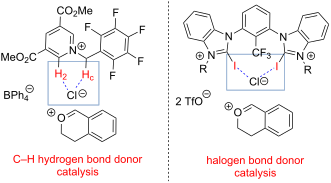
- substantial dipole moment (≈4.5 D) almost aligned with the C5–H bond and the relatively high acidity of this position (pKa(DMSO) = 27–28, for the 1H-tautomer). These heterocycles, which are easily available from 1,3-cycloaddition of alkynes and azides, can both form strong C–H bonds with hydrogen bond


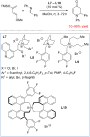
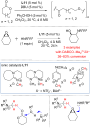


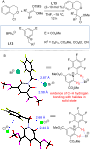
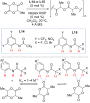


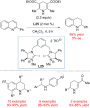


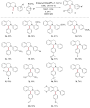
Copper-catalyzed asymmetric sp3 C–H arylation of tetrahydroisoquinoline mediated by a visible light photoredox catalyst
Beilstein J. Org. Chem. 2016, 12, 2636–2643, doi:10.3762/bjoc.12.260
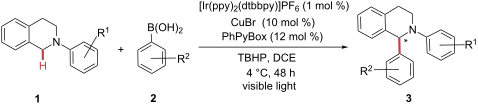
- -arylated PyBox L2 gave very good er under our reaction conditions (Table 2, entry 2). It is noteworthy that the er observed was higher when copper(I) bromide was used as a co–catalyst, compared to copper(II) bromide (Table 2, entry 3), possibly due to the Lewis acidity difference of Cu(I) and Cu(II




Construction of bis-, tris- and tetrahydrazones by addition of azoalkenes to amines and ammonia
Beilstein J. Org. Chem. 2016, 12, 2471–2477, doi:10.3762/bjoc.12.241
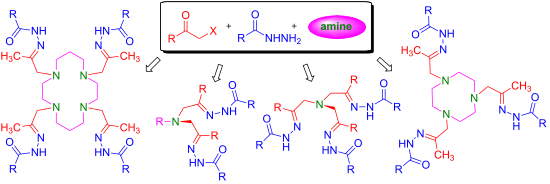
- hydrazones with starting hydrazide [51]. The presence of acetic acid and mild reaction conditions (0 °C) was essential for the synthesis of hydrazones 1c and 1d (R1 = CH3, R2 = CH3 or (CH2)6CH3), probably because of the their enhanced NH-acidity. Reaction of α-halogen hydrazones 1 with benzylamine In our




Et3B-mediated and palladium-catalyzed direct allylation of β-dicarbonyl compounds with Morita–Baylis–Hillman alcohols
Beilstein J. Org. Chem. 2016, 12, 2402–2409, doi:10.3762/bjoc.12.234
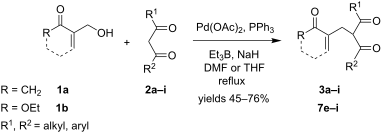
- acidity is relatively higher, led to a mixture of the mono- and bis-alkylation products 3c and 4c in 45 and 23% yields, respectively (Table 2, entries 1–3). Under the same conditions, the allylation of a variety of β-keto esters and β-diketones (Table 2, entries 4–9), in DMF at 80 °C, selectively gave the


Isosorbide and dimethyl carbonate: a green match
Beilstein J. Org. Chem. 2016, 12, 2256–2266, doi:10.3762/bjoc.12.218
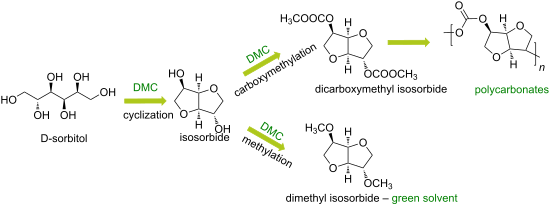
- bisphenol A in polycarbonate preparation. In this view, the main issue that limits the exploitation of this compound is its lower acidity. To overcome this problem, polycarbonates incorporating an isosorbide moiety have been synthesized via a chlorine-based approach, i.e., employing phosgene or its


Diels–Alder reactions in confined spaces: the influence of catalyst structure and the nature of active sites for the retro-Diels–Alder reaction
Beilstein J. Org. Chem. 2016, 12, 2181–2188, doi:10.3762/bjoc.12.208

- 1.9 nm (ITQ-37) [36] have also been tested. These are aluminosilicogermanates that, as the previously tested Al-zeolites or the Al-MCM-41 material, present Brønsted acidity. Interestingly, the pore diameters of ITQ-33, and more so ITQ-37 are close to the pore of the mesoporous MCM-41 presented above


Silica-supported sulfonic acids as recyclable catalyst for esterification of levulinic acid with stoichiometric amounts of alcohols
Beilstein J. Org. Chem. 2016, 12, 2173–2180, doi:10.3762/bjoc.12.207
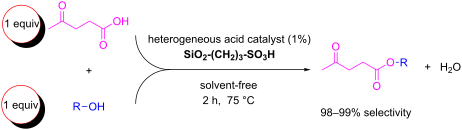
- toluene (120 mL) and the resulting supported propylmercaptane has been oxidized to propanesulfonic acid by treatment with 30% aq H2O2 (100 mL; 1 mol) for 24 h under stirring at rt, adding a few drops of concentrated sulfuric acid after 12 h. Acidity has been measured via the titration method [35] (0.51
- . Acidity has been measured via the titration method [35] (0.65 mmol H+/g). SiO2-(CH2)3-O-C6H4-SO3H: A mixture of amorphous silica gel (2.0 g) and bromopropyltrimethoxysilane (0.76 mL, 4.0 mmol) was refluxed in toluene (80 mL) under stirring for 24 hours. The resulting silica supported 3-bromopropane was
- ). Acidity has been measured via titration method [35] (0.73 mmol H+/g). Esterification reaction Levulinic acid, pentanol and the heterogeneous catalyst were stirred for 24 hours in a batch reactor under air. The acid/alcohol ratio, the reaction temperature and the amount of the catalyst were modified as

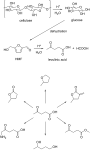


Superelectrophilic activation of 5-hydroxymethylfurfural and 2,5-diformylfuran: organic synthesis based on biomass-derived products
Beilstein J. Org. Chem. 2016, 12, 2125–2135, doi:10.3762/bjoc.12.202
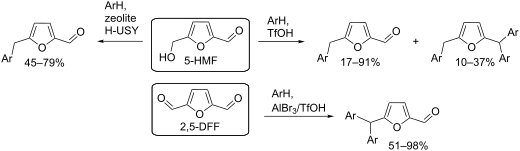
- strong Lewis acids (AlX3, X = Cl, Br) by their coordination with basic centers of organic compounds, or with acidic zeolites, possessing both Brønsted and Lewis acidity [33]. The main goal of this work was a study of reactions of 5-HMF and 2,5-DFF with arenes under electrophilic activation with Brønsted
- products. It is interesting to note that compounds 4 were not observed in reactions with zeolite (Table 4, entries 3, 10, 14 and 17), most likely, due to lower acidity of the zeolite compared to TfOH and spatial restrictions in zeolite cages, diminishing the contact between protonated aldehyde groups and


Ionic liquids as transesterification catalysts: applications for the synthesis of linear and cyclic organic carbonates
Beilstein J. Org. Chem. 2016, 12, 1911–1924, doi:10.3762/bjoc.12.181
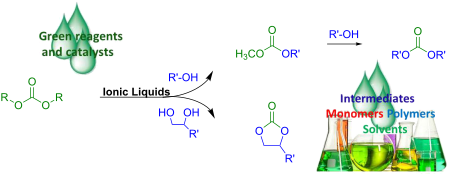
- be recovered and reused to allow quantitative conversions even after several recycles. Moreover, the study highlighted that the catalytic activity increased with increasing acidity of the ILs and particularly with cations bearing SO3H anions (Scheme 5: ILs I, II, III, and IV). The same imidazolium
- transesterification reaction of dimethyl carbonate with phenol to methyl phenyl carbonate (MPC) and diphenyl carbonate (DPhC), Deshmukh et al. studied dibutyltin oxide as a catalyst in conjunction with Brønsted and Lewis acidic ionic liquids [70]. The authors investigated the relative Lewis and Brønsted acidity of


Dinuclear thiazolylidene copper complex as highly active catalyst for azid–alkyne cycloadditions
Beilstein J. Org. Chem. 2016, 12, 1566–1572, doi:10.3762/bjoc.12.151
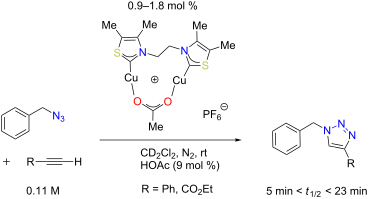
- copper(I) acetate and sodium acetate as additional base in order to deprotonate the thiazolium salt 1b and to form the bisthiazolylidene copper(I) complex 2. Due to the relatively high acidity of the thiazolium precursor (pKa ≈ 18 [44]), a weak base such as sodium acetate yields small equilibrium


Conjugate addition–enantioselective protonation reactions
Beilstein J. Org. Chem. 2016, 12, 1203–1228, doi:10.3762/bjoc.12.116
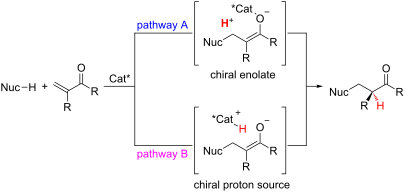
- developed organocatalytic conjugate addition–enantioselective protonations of α,β-unsaturated imides using thiols. Thiols are attractive nucleophiles due to their acidity, which facilitates deprotonation by amine bases and also reduces undesired competitive deprotonation and epimerization of the enolizable


Efficient syntheses of climate relevant isoprene nitrates and (1R,5S)-(−)-myrtenol nitrate
Beilstein J. Org. Chem. 2016, 12, 1081–1095, doi:10.3762/bjoc.12.103
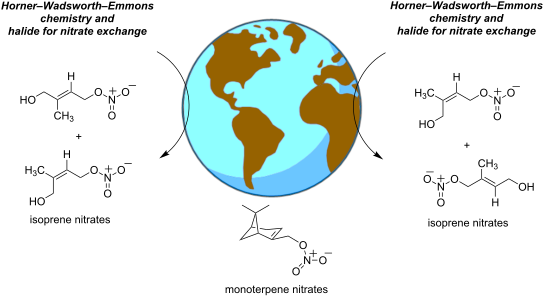
- %, interestingly the concentration of organic nitrates was found to be highly dependent on the relative humidity and seed aerosol acidity. Worthy of note this report also highlighted that “unfortunately, standards are unavailable for the expected organic nitrate products (derived from α-pinene)“ this, again


Cationic Pd(II)-catalyzed C–H activation/cross-coupling reactions at room temperature: synthetic and mechanistic studies
Beilstein J. Org. Chem. 2016, 12, 1040–1064, doi:10.3762/bjoc.12.99
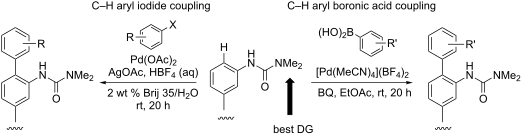
- their Lewis acidity. Cationic palladium complexes [123], in particular, possess a wide breadth of reactivity, having been used to catalyze Diels–Alder [124][125], aldol and Mannich reactions [126][127][128], Wacker oxidations [129], polymerizations of alkenes [130][131], and asymmetric 1,4-additions
- acidity of the metal center. This is a noteworthy advantage associated with the use of cationic palladium(II) catalysts. Finally, BQ oxidizes the Pd(0) that is reductively eliminated from the HPd(II)+BF4− formed to regenerate the active cationic palladium species Pd2+(BF4)2−. C–H boronic acid coupling






Reactions of N,3-diarylpropiolamides with arenes under superelectrophilic activation: synthesis of 4,4-diaryl-3,4-dihydroquinolin-2(1H)-ones and their derivatives
Beilstein J. Org. Chem. 2016, 12, 950–956, doi:10.3762/bjoc.12.93

- target products 2 are 44–98% (see Table 1). Also this reaction may be carried out under the action of other acids, e.g., TfOH–SbF5 or AlX3 (X = Cl, Br). But in the stronger acidic system TfOH–SbF5 (Hammet acidity function H0 −19, see [18]) the yields of compounds 2 were usually lower as compared to TfOH


Synthesis and fluorosolvatochromism of 3-arylnaphtho[1,2-b]quinolizinium derivatives
Beilstein J. Org. Chem. 2016, 12, 854–862, doi:10.3762/bjoc.12.84
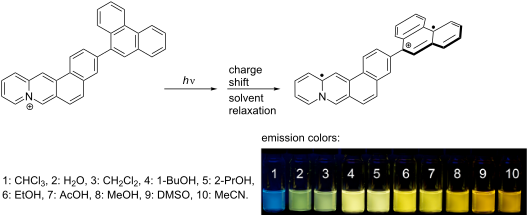
- , the Taft parameter π*, the dipole moment, μ, the acidity, SA, the basicity, SB, the dipolarity and polarizability SPP, the polarizability, SP, or the dipolarity SDP (cf. Supporting Information File 1). In all cases, the plots of the solvent parameters versus the emission energy do not disclose an





