Search results
Search for "fragmentation" in Full Text gives 258 result(s) in Beilstein Journal of Organic Chemistry. Showing first 200.
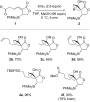
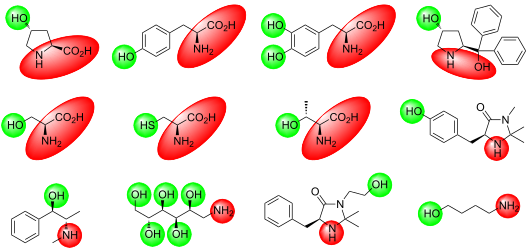
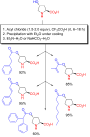
Chemoselective O-acylation of hydroxyamino acids and amino alcohols under acidic reaction conditions: History, scope and applications
Beilstein J. Org. Chem. 2015, 11, 446–468, doi:10.3762/bjoc.11.51




Cross-dehydrogenative coupling for the intermolecular C–O bond formation
Beilstein J. Org. Chem. 2015, 11, 92–146, doi:10.3762/bjoc.11.13
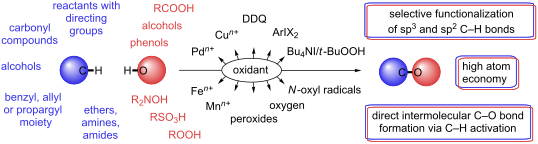
- these radicals are often non-selective and are accompanied by the formation of alcohols, carbonyl compounds, and fragmentation products. The examples of the C–O bond formation between two molecules using O-electrophiles are rare; electron-deficient peroxides with a specific structure can act as O






Come-back of phenanthridine and phenanthridinium derivatives in the 21st century
Beilstein J. Org. Chem. 2014, 10, 2930–2954, doi:10.3762/bjoc.10.312

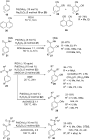
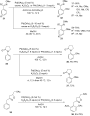
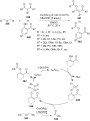
- photoinitiation in the presence of excess t-BuOK. The photoinduced ET to the amide-anion resulted in its radical anion. After fragmentation of the C–I bond, an intramolecular cyclization occurred, and after acidification of the reaction medium, the oxidized phenanthridine compounds were obtained in very good


Linear-g-hyperbranched and cyclodextrin-based amphiphilic block copolymer as a multifunctional nanocarrier
Beilstein J. Org. Chem. 2014, 10, 2696–2703, doi:10.3762/bjoc.10.284
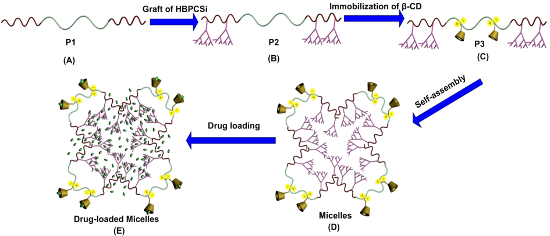
- achieve controlled drug release. An amphiphilic, triblock polymer (ABC) with hyperbranched polycarbonsilane (HBPCSi) and β-cyclodextrin (β-CD) moieties were first synthesized by the combination of a two-step reversible addition-fragmentation transfer polymerization into a pseudo-one-step hydrosilylation
- of the β-CD moieties (Scheme 1C, P3). Based on the above considerations, P1 was first synthesized via reversible addition–fragmentation transfer polymerization (RAFT), where HEMA and DMAEMA were used as the first and second monomer, respectively. To obtain P2, HBPCSi was then grafted onto the side


Photorelease of phosphates: Mild methods for protecting phosphate derivatives
Beilstein J. Org. Chem. 2014, 10, 2038–2054, doi:10.3762/bjoc.10.212
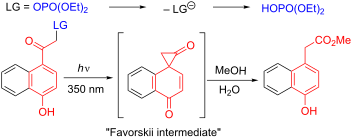
- -naphthylacetyl analogs [49] or are consumed by oxidation and fragmentation as in the case of 24. Thus, the conversion and chemical yields were low and the photolysates were complex mixtures of byproducts. In the case of 24, although the reaction efficiency was insensitive to O2 (implying singlet reactivity, not


A new charge-tagged proline-based organocatalyst for mechanistic studies using electrospray mass spectrometry
Beilstein J. Org. Chem. 2014, 10, 2027–2037, doi:10.3762/bjoc.10.211
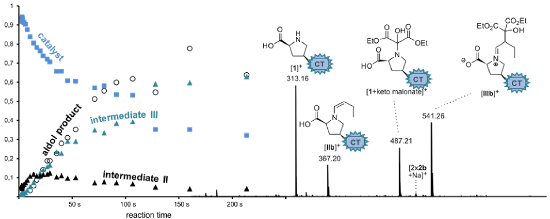
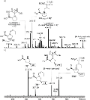
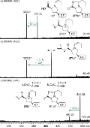
- charged proline catalyst has been tested in the direct asymmetric inverse aldol reaction between aldehydes and diethyl ketomalonate. Two intermediates in accordance with the List–Houk mechanism for enamine catalysis have been detected and characterized by gas-phase fragmentation. In addition, their
- ]+. In contrast, signals for the remaining two intermediates Ibuntagged and IVbuntagged have not been found, which probably is due to their very low concentration in the reaction equilibria as well as to their facile fragmentation during ESI. Note that the group of Metzger has successfully achieved the
- detection of a similar intermediate for the aldol reaction beween acetone and selected benzaldehydes using rather unusual and presumably extremely soft ESI conditions, and their results indeed confirm its facile fragmentation [20]. Interestingly, the signal at m/z 290.12 can be assigned to a further



Expeditive synthesis of trithiotriazine-cored glycoclusters and inhibition of Pseudomonas aeruginosa biofilm formation
Beilstein J. Org. Chem. 2014, 10, 1981–1990, doi:10.3762/bjoc.10.206
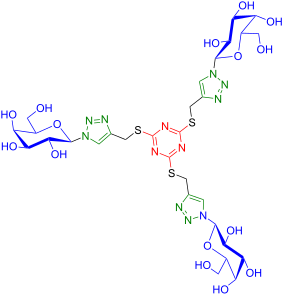
- fragmentation of the cluster core, which preceded complete deprotection of the carbohydrate groups. We were unable to obtain the deprotected glycoclusters by this route. We therefore investigated a direct route to the glycoasterisks using unprotected azidosugars, thus avoiding the final deprotection step. The


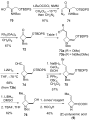
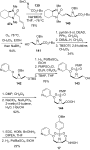
Application of cyclic phosphonamide reagents in the total synthesis of natural products and biologically active molecules
Beilstein J. Org. Chem. 2014, 10, 1848–1877, doi:10.3762/bjoc.10.195
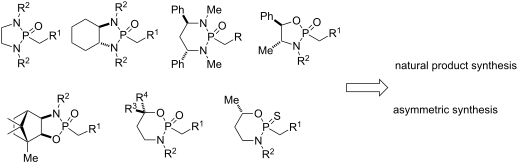
- phosphonamides, which require harsher conditions to undergo fragmentation [19], cyclic oxaphosphetane oxide 26 releases the corresponding olefin 27 upon treatment with cold acetic acid [18]. Moreover, the only weakly basic nature of the “soft” phosphonamide anion favors the attack on the carbonyl group over








Macrocyclic bis(ureas) as ligands for anion complexation
Beilstein J. Org. Chem. 2014, 10, 1834–1839, doi:10.3762/bjoc.10.193
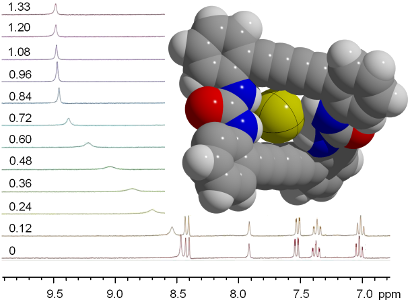
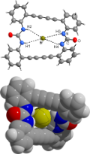
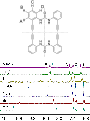
- fragmentation and rearrangement reaction had occurred. Under the applied conditions 1 is completely converted to dihydroindoloquinolinone 3 (Scheme 2). In accordance with the effortlessness of the conversion reaction, the mass spectrum of 1 is dominated by the [M/2]+ signal. The indoloquinolinone 3 forms
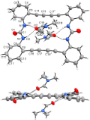
- isocyanates lead to indoloquinolinones. The crystal structure of the N-methylated congener of 3 has been determined [15]. Thermal treatment of 2 does not lead to fragmentation or sublimation of volatile material as observed for 1. Macrocycle 2 is soluble in dimethylformamide (DMF) or dimethyl sulfoxide (DMSO



Structure elucidation of female-specific volatiles released by the parasitoid wasp Trichogramma turkestanica (Hymenoptera: Trichogrammatidae)
Beilstein J. Org. Chem. 2014, 10, 767–773, doi:10.3762/bjoc.10.72
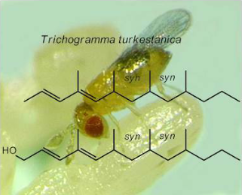
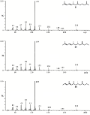
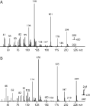
- eV EI mass spectra of the synthetic compounds to be almost identical. Though the mass spectra of 8 (Figure 3) and that of the natural product A (Figure 1) showed strong similarities, small but decisive qualitative and quantitative differences in the fragmentation pattern were obvious. In contrast to



Preparation of new alkyne-modified ansamitocins by mutasynthesis
Beilstein J. Org. Chem. 2014, 10, 535–543, doi:10.3762/bjoc.10.49
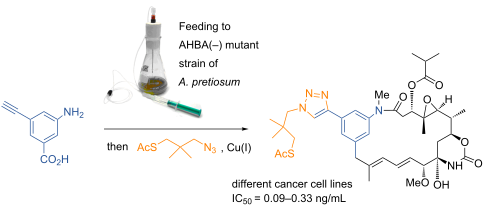
- evaluate the sterical and electronical properties of mutasynthon 11 with respect to bioprocessing, 3-amino-5-bromobenzoic acid (9) was next employed in feeding experiments. It was well processed to a series of new ansamitocin derivatives 22a–f (Scheme 5). Again, all derivatives showed common fragmentation


Direct and indirect single electron transfer (SET)-photochemical approaches for the preparation of novel phthalimide and naphthalimide-based lariat-type crown ethers
Beilstein J. Org. Chem. 2014, 10, 514–527, doi:10.3762/bjoc.10.47
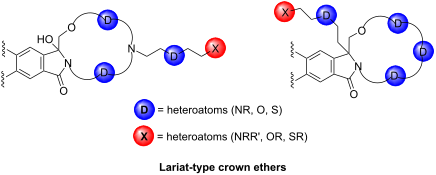
- -heterolytic fragmentation in which either an electrofugal (E+) or nucleofugal (Nu−) group is transferred from a position adjacent to respective positively and negatively charged radical centers (Scheme 1). These fragmentation reactions produce neutral radicals, which then participate in typical radical
- reactions, including C–C bond formation and addition to unsaturated centers. Because of their importance, α-heterolytic fragmentation reactions of radical anions and cations have been intensively studied from synthetic and mechanistic perspectives [11][12][13][14][15][16][17][18][19][20][21][22][23][24][25
- processes form zwitterionic biradical intermediates 3, in which a proton transfer and an α-heterolytic fragmentation proceeds, produce biradicals 7 that are precursors of the heterocyclic products 6 (Scheme 2). Photochemical reactions of naphthalimides with electron donors have also been intensively studied




Deoxygenative gem-difluoroolefination of carbonyl compounds with (chlorodifluoromethyl)trimethylsilane and triphenylphosphine
Beilstein J. Org. Chem. 2014, 10, 344–351, doi:10.3762/bjoc.10.32
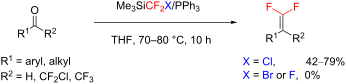
- formed in 69% yield (Table 1, entry 1). Surprisingly, it was found that in the absence of TBAC, PPh3 could be used both to promote the fragmentation of TMSCF2Cl and combine with the generated :CF2 (Table 1, entry 2). A rough comparison of the reaction temperatures showed that a lower temperature (rt) is
- ][20][21][22][23][24][25]. Initially it was speculated that it were trace amounts of nucleophilic impurities (such as chloride ions) that initiated the fragmentation of TMSCF2Cl to release :CF2 [31], which combined with PPh3 to form the ylide. However, the experiment at room temperature showed that
- activation of the C–Cl bond by PPh3 (Path B). In Path A, PPh3 firstly coordinates the silicon atom of TMSCF2Cl to form activated penta-coordinated silicon species 8 [41] and activates both the C–Si and the C–Cl bond. Next, the release of CF2 leads to silylphosphonium salt 9. Finally, the fragmentation of 9


Recent applications of the divinylcyclopropane–cycloheptadiene rearrangement in organic synthesis
Beilstein J. Org. Chem. 2014, 10, 163–193, doi:10.3762/bjoc.10.14
- pheromone 20 upon enzyme catalyzed fragmentation. Uncatalyzed DVCPR takes places to give 21 within short periods of time. The corresponding activation energies have been determined as well as the half-lifes at different temperatures. Bioassays proved that 20 was far more bioactive than 21, and since the
- 211 in solvent-dependent ratios. The sole product arising from the desired DVCPR via 208'' is the major product 210. The two remaining products arise from trans-silylation and fragmentation (208' to 209) or via ionic intermediate 208''' and fragmentation to give 211. The different product distribution
- apply the transition metal catalyzed 1,2-acyl shift with subsequent vinyl carbenoid formation. Propargylic acetate 251 (see Scheme 33) has been shown to undergo 5-exo-dig cyclization via 252 to give zwitterionic intermediate 253. A concomitant fragmentation reaction yielded vinyl-carbenoid 254. Uemura




Organobase-catalyzed three-component reactions for the synthesis of 4H-2-aminopyrans, condensed pyrans and polysubstituted benzenes
Beilstein J. Org. Chem. 2014, 10, 141–149, doi:10.3762/bjoc.10.11
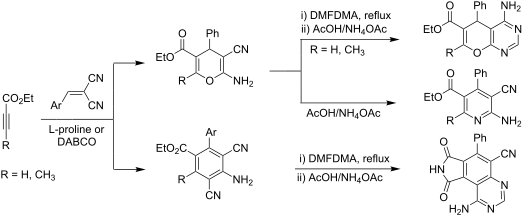
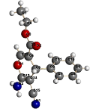
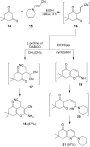
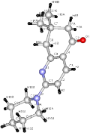
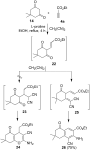
- propiolate (4a) in the presence of L-proline to produce the penta-substituted benzene derivative 13b in 60% yield (Scheme 4). In order to explain this unusual finding, we proposed that malononitrile, perhaps formed under the reaction conditions by C–C bond cleavage promoted fragmentation of 8, adds to 9 to







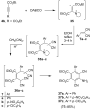


Synthesis of five- and six-membered cyclic organic peroxides: Key transformations into peroxide ring-retaining products
Beilstein J. Org. Chem. 2014, 10, 34–114, doi:10.3762/bjoc.10.6
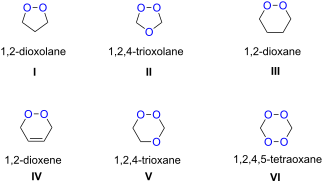
- -trioxolanes can be trapped with allyltrimethylsilane. For example, the SnCl4-mediated fragmentation of ozonides 84a–l in the presence of allyltrimethylsilane in dichloromethane gives a complex mixture of products 85–94, including dioxolanes 86a–i, 87i, 90j–l, and 91j (Scheme 25, Table 8) [256]. Treatment of






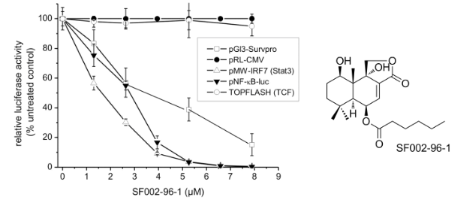
SF002-96-1, a new drimane sesquiterpene lactone from an Aspergillus species, inhibits survivin expression
Beilstein J. Org. Chem. 2013, 9, 2866–2876, doi:10.3762/bjoc.9.323
- . The flow rate was 0.45 mL/min. The fragmentor voltage was set to 140 V in the positive and negative APCI modes. The compound showed the highly characteristic fragmentation pattern in the APCI-positive mass spectrum revealing the pseudo-molecular ion [M + H]+ with m/z of 281.2. The purity of SF002-96-1
- Ac-DEVD-amino-4-methylcoumarin (AC-DEVD-AMC; Calbiochem, Bad Soden, Germany) for 2 h at 37 °C. AMC released from the cleavage of AC-DEVD-AMC was measured by a spectrofluorimeter with excitation and emission wavelengths of 355 nm and 460 nm respectively. Measurement of DNA fragmentation Colo 320 cells
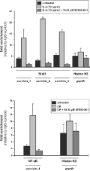
- ) Detection of DNA fragmentation by agarose gel electrophoresis after treatment of Colo 320 cells for 5 h with different concentrations of the test compound. Control: untreated cells only. (C) Morphology analysis of the cell nuclei by DAPI staining after treatment of Colo 320 cells with 26.31 µM of SF002-96-1




[2H26]-1-epi-Cubenol, a completely deuterated natural product from Streptomyces griseus
Beilstein J. Org. Chem. 2013, 9, 2841–2845, doi:10.3762/bjoc.9.319
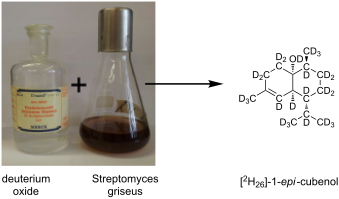
- shifts [10], stereospecific conversions along multistep biosynthetic pathways [11], hydride abstractions in oxidation steps [12], or deprotonations [13] are to be followed. Its incorporation is best observed by GC–MS, and if fragmentation mechanisms are known [14], the site of incorporation can be



AgOTf-catalyzed one-pot reactions of 2-alkynylbenzaldoximes with α,β-unsaturated carbonyl compounds
Beilstein J. Org. Chem. 2013, 9, 1949–1956, doi:10.3762/bjoc.9.231
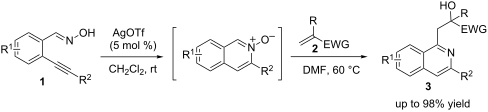
- fragmentation from 2-alkynylbenzaldoximes and α,β-unsaturated carbonyl compounds. Based on previous results [36][37][38][39][41][42][43], we expect 2-alkynylbenzaldoxime 1 to easily convert at room temperature to isoquinoline N-oxide A by a AgOTf-catalyzed cyclization. Compound A produced in situ might undergo
- a 1,3-dipolar cycloaddition with α,β-unsaturated carbonyl compound 2 leading to 2,10b-dihydro-1H-isoxazolo[3,2-a]isoquinoline intermediate B [44][45], which may then suffer a rearrangement or fragmentation resulting in compound 3 (Scheme 1) [35][36][38][42]. To demonstrate the feasibility of this


Activation of cryptic metabolite production through gene disruption: Dimethyl furan-2,4-dicarboxylate produced by Streptomyces sahachiroi
Beilstein J. Org. Chem. 2013, 9, 1768–1773, doi:10.3762/bjoc.9.205
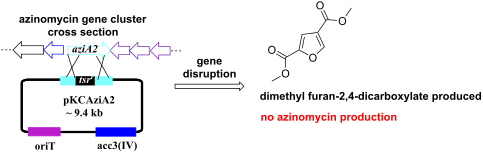
- –MS fragmentation of the compound matched that provided in the Ultra GC–DSQ (ThermoElectron, Waltham, MA) GC–MS database. The structure of the compound was determined by NMR analysis in CDCl3 (Table 1). The presence of two O-CH3 groups at C-2’ (δc 51.99, δH 3.94) and C-2” (δc 52.31, δH 3.88) and


Thermochemistry and photochemistry of spiroketals derived from indan-2-one: Stepwise processes versus coarctate fragmentations
Beilstein J. Org. Chem. 2013, 9, 1668–1676, doi:10.3762/bjoc.9.191
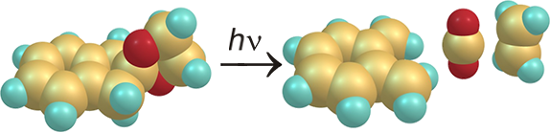
- we investigate the fragmentation reactions of cyclic ketals. Three ketals with different ring sizes derived from indan-2-one were decomposed by photolysis and pyrolysis. Particularly clean is the photolysis of the indan-2-one ketal 1, which gives o-quinodimethane, carbon dioxide and ethylene. The
- mechanism formally corresponds to a photochemically allowed coarctate fragmentation. Pyrolysis of the five-ring ketal yields a number of products. This is in agreement with the fact that coarctate fragmentation observed upon irradiation would be thermochemically forbidden, although this exclusion principle
- does not hold for chelotropic reactions. In contrast, fragmentation of the seven-ring ketal 3 is thermochemically allowed and photochemically forbidden. Upon pyrolysis of 3 several products were isolated that could be explained by a coarctate fragmentation. However, the reaction is less clean and


New tridecapeptides of the theonellapeptolide family from the Indonesian sponge Theonella swinhoei
Beilstein J. Org. Chem. 2013, 9, 1643–1651, doi:10.3762/bjoc.9.188
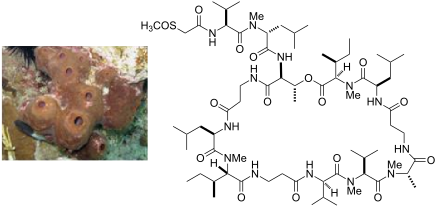
- presence of the b2 fragmentation peak at m/z 331 supported, once again, the presence of the MeS(O)Ac unit. Complete acid hydrolysis of 2 and Marfey’s analysis [21] on the hydrolysate (derivatization with L-FDAA, 1-fluoro-2,4-dinitrophenyl-5-L-alanine amide, followed by LC–MS comparison with the FDAA


Stability of SG1 nitroxide towards unprotected sugar and lithium salts: a preamble to cellulose modification by nitroxide-mediated graft polymerization
Beilstein J. Org. Chem. 2013, 9, 1589–1600, doi:10.3762/bjoc.9.181
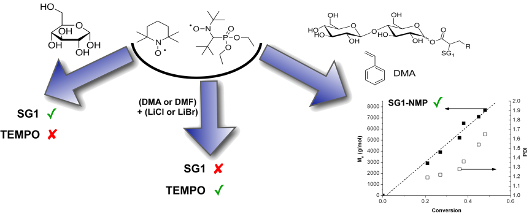
- ], reversible addition-fragmentation chain transfer (RAFT) [8][9][10], and nitroxide-mediated polymerization (NMP) [11], has opened new prospects in this research field, and permits precise tailoring of the synthetic chain length, the composition and the architecture [12]. Contrary to pullulan, dextran and


Re2O7-catalyzed reaction of hemiacetals and aldehydes with O-, S-, and C-nucleophiles
Beilstein J. Org. Chem. 2013, 9, 1526–1532, doi:10.3762/bjoc.9.174
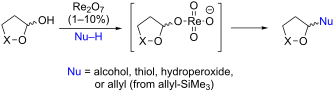
- hydroperoxide (which would presumably lead to heterolytic fragmentation) and activation of the peroxide C–O was clearly disfavored relative to activation of the alkoxide C–O bond. Rapid alkoxide metathesis was also observed in the presence of a strong Brønsted acid. Our observations suggest that the seeming


Development of an additive-controlled, SmI2-mediated stereoselective sequence: Telescoped spirocyclisation, lactone reduction and Peterson elimination
Beilstein J. Org. Chem. 2013, 9, 1443–1447, doi:10.3762/bjoc.9.163

- improved selectivity for spirolactone 2b. We believe that spirolactones such as 2b undergo retro-aldol fragmentation (to give products such as 4b) upon prolonged exposure to Lewis acidic Sm(II)/(III)-species present in the reaction mixture. Pleasingly, the process proved general, affording the desired