


Search results
Search for "microwave irradiation" in Full Text gives 252 result(s) in Beilstein Journal of Organic Chemistry. Showing first 200.
From porphyrin benzylphosphoramidate conjugates to the catalytic hydrogenation of 5,10,15,20-tetrakis(pentafluorophenyl)porphyrin
Beilstein J. Org. Chem. 2014, 10, 628–633, doi:10.3762/bjoc.10.54
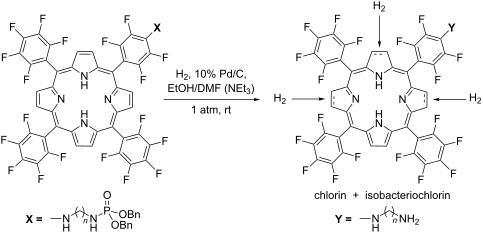
- substitution was promoted by microwave irradiation in N-methyl-2-pyrrolidinone. Attempts to remove the benzyl groups of the phosphoramidate moiety by hydrogenolysis with 10% Pd/C led to the cleavage of the P–N bond and the reduction of the macrocycle to hydroporphyrin-type derivatives. The extent of the effect
- , rendering the method inadequate. Thus, we performed the reaction by microwave irradiation witth a solution of TPPF20 and the primary aminoalkyl dibenzylphosphoramidates in N-methyl-2-pyrrolidinone (NMP) as the solvent [9]. The conversion into the new porphyrin monoaminoalkyldibenzylphosphoramidate
- conjugates 1a–c was achieved in eight minutes in 20%, 42% and 24% yields, respectively. Longer reaction times led to the formation of polysubstituted products. A significant advantage for the reaction under microwave irradiation is its applicability even in the presence of functional groups, which are prone


Isocyanide-based multicomponent reactions towards cyclic constrained peptidomimetics
Beilstein J. Org. Chem. 2014, 10, 544–598, doi:10.3762/bjoc.10.50

- desired DKPs products 168 in good to excellent yields (53–72%). Solvent effects of the Ugi reaction under microwave irradiation were considered by Santra and Andreana (Scheme 53) [146]. Protic solvents such as water gave rise to either 2.5-diketopiperazines 170 via an aza-Micheal reaction or 2-azaspiro


An oxidative amidation and heterocyclization approach for the synthesis of β-carbolines and dihydroeudistomin Y
Beilstein J. Org. Chem. 2014, 10, 471–480, doi:10.3762/bjoc.10.45
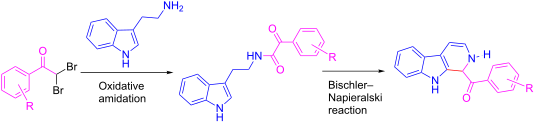
- dehydrogenation with DBU in different solvents at various temperatures also failed and did not yield the required product. Attempted oxidation of compound 7 under microwave irradiation conditions was also not successful. Probably under all aforementioned conditions, formation of the stable enol 21 might have


Synthesis of 3,4-dihydro-1,8-naphthyridin-2(1H)-ones via microwave-activated inverse electron-demand Diels–Alder reactions
Beilstein J. Org. Chem. 2014, 10, 282–286, doi:10.3762/bjoc.10.24
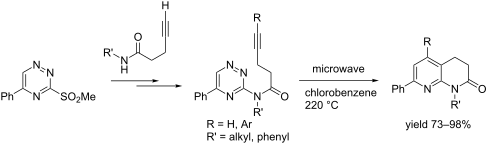
- reaction to yield 5-aryl-3,4-dihydro-1,8-naphthyridin-2(1H)-ones by an efficient synthetic route. Keywords: inverse-electron-demand Diels–Alder reaction; microwave irradiation; naphthyridin-2(1H)-ones; Sonogashira cross-coupling; 1,2,4-triazine; Introduction 1,8-Naphthyridine derivatives are an important
- -demand Diels–Alder reaction under microwave irradiation [22][23][24]. The use of 1,2,4-triazines in inverse electron-demand Diels–Alder reactions proved to be an efficient strategy for the construction of various heterocyclic compounds [25][26][27], such as azacarbazoles [28][29][30][31][32][33
- ], polycyclic condensed pyrazines [34][35], dihydropyrrolopyridines [36][37], thienopyridines and thiopyranopyridines [38][39], as well as furo- and pyranopyridines [22][23][24][40][41][42]. Reactions with microwave irradiation are well-known for their ability to reduce reaction times, increase product yields


Studies on the interaction of isocyanides with imines: reaction scope and mechanistic variations
Beilstein J. Org. Chem. 2014, 10, 12–17, doi:10.3762/bjoc.10.3
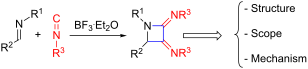
- acid, I2, Br2·SMe2 and BF3·OEt2, at temperatures ranging from rt to 80 °C. The transformations were tested under standard heating or microwave irradiation, with reaction times lasting form 30 min to 48 h. The imine 1a was generated in situ, using MS 4 Å, or previously prepared by condensation of the


Flow microreactor synthesis in organo-fluorine chemistry
Beilstein J. Org. Chem. 2013, 9, 2793–2802, doi:10.3762/bjoc.9.314
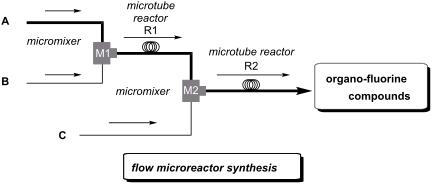
- tripeptide byproduct. Nucleophilic aromatic substitution (SNAr) chemistry contributes to creating useful materials. In 2005, Comer and Organ reported SNAr reactions of 2-fluoronitrobenzene using a flow microreactor system with microwave irradiation (Scheme 9) [69]. Toward making compound-libraries, Schwalbe


Advancements in the mechanistic understanding of the copper-catalyzed azide–alkyne cycloaddition
Beilstein J. Org. Chem. 2013, 9, 2715–2750, doi:10.3762/bjoc.9.308
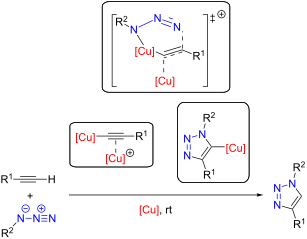
- )3]}, are also well soluble in organic solvents and do thus allow for homogeneous CuAAC reactions. They were first applied in the synthesis of neoglycoconjugates in the presence of DIPEA or DBU under microwave irradiation in toluene solution [137]. However, a recent study by Díez-González has shown




IBD-mediated oxidative cyclization of pyrimidinylhydrazones and concurrent Dimroth rearrangement: Synthesis of [1,2,4]triazolo[1,5-c]pyrimidine derivatives
Beilstein J. Org. Chem. 2013, 9, 2629–2634, doi:10.3762/bjoc.9.298
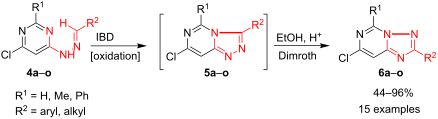
- 2, entry 6). Meanwhile, reactions in THF or ethyl acetate resulted in marginally lower yields (Table 2, entries 8 and 9). Switching to water with assistance by microwave irradiation or performing the reaction in ethanol provided even unacceptable yields (Table 2, entries 10 and 11). Further, when


New developments in gold-catalyzed manipulation of inactivated alkenes
Beilstein J. Org. Chem. 2013, 9, 2586–2614, doi:10.3762/bjoc.9.294
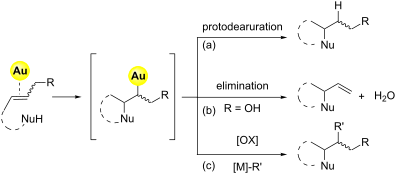
- were accessed by intramolecular addition in excellent yields (Scheme 8b). The combined use of more electrophilic phosphite-gold complexes [41][42] and enabling techniques such as microwave irradiation [43] led to consistent improvement in efficiency of the catalytic system. In particular when (Ph3O
- )PAuOTf was employed under microwave irradiation with a catalyst loading as low as 0.05 mol %, the condensation of TsNH2 to norbornene was realized in quantitative yield. In addition, the introduction of carbene ligands [44] allowed performing the intramolecular hydroamination of N-alkenyl ureas
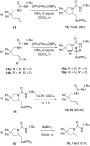
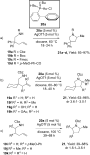
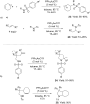
- obtained from moderate to good yields under microwave irradiation (DCE, Scheme 17c) [54]. Additionally, the stronger Lewis acid AuCl3/AgSbF6 was documented to catalyze the Markovnikov selective hydroarylation of aryl- and alkyl olefins with less-nucleophilic benzene derivatives and thiophene in good yields








Microwave-assisted synthesis of 5,6-dihydroindolo[1,2-a]quinoxaline derivatives through copper-catalyzed intramolecular N-arylation
Beilstein J. Org. Chem. 2013, 9, 2463–2469, doi:10.3762/bjoc.9.285
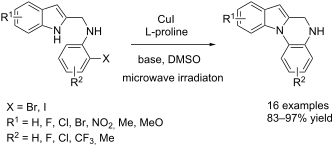
- synthesize 5,6-dihydroindolo[1,2-a]quinoxaline derivatives by CuI-catalyzed intramolecular N-arylation under microwave irradiation. This method rapidly afforded the tetracyclic products with good to excellent yields (83–97%) in short reaction times (45–60 min). Keywords: copper; 5,6-dihydroindolo[1,2-a
- ]quinoxaline; intramolecular N-arylation; microwave irradiation; Introduction The indole scaffold is considered as a privileged structure because of its ubiquitous presence in a large number of natural products and pharmaceutical agents [1][2][3][4][5][6]. In particular, indole-fused heterocycles have
- technology to conduct the intramolecular N-arylation. As a result, a similar yield was obtained under the same catalytic conditions when 1a was subjected to microwave irradiation for just one hour (Table 1, entry 2). Then, we tried to optimize the reaction conditions under microwave heating. At first


One-pot sequential synthesis of isocyanates and urea derivatives via a microwave-assisted Staudinger–aza-Wittig reaction
Beilstein J. Org. Chem. 2013, 9, 2378–2386, doi:10.3762/bjoc.9.274
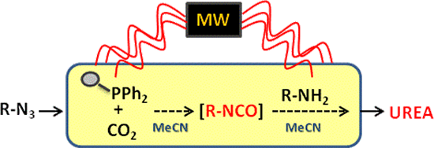
- been optimized under microwave irradiation and the scale-up experiment has been conducted under conventional conditions in a Parr reactor. The final compounds were isolated after simple filtration in almost quantitative overall yields which makes this procedure facile and rapid to execute. Keywords


Flexible synthesis of anthracycline aglycone mimics via domino carbopalladation reactions
Beilstein J. Org. Chem. 2013, 9, 2194–2201, doi:10.3762/bjoc.9.258
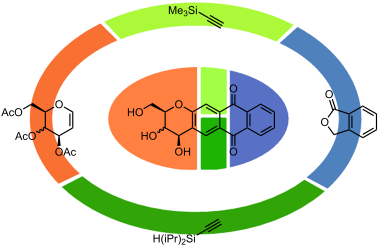
- -methylpyrrolidone (8:8:1) was used. The reaction was performed in a sealed vial at 120 °C under microwave irradiation for 3–5 h. The unusual combination of Pd(PPh3)4 and (t-Bu)3PH·BF4 as an additional ligand proved beneficial for the transformation of long-chained dialkynes. The domino reaction proceeded smoothly



Acid, silver, and solvent-free gold-catalyzed hydrophenoxylation of internal alkynes
Beilstein J. Org. Chem. 2013, 9, 2002–2008, doi:10.3762/bjoc.9.235
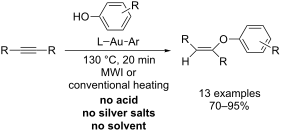
- . aChlorogold precursor (0.32–0.37 mmol), 2 equiv arylboronic acid, 2 equiv Cs2CO3, 50 °C, 20 min, iPrOH (1.5 mL), microwave irradiation. bIsolated yields. cTHF was used as the solvent. Hydrophenoxylation of alkynesa,b. aAlkyne (0.28 mmol), phenol (0.56 mmol), 130 °C, 20 min, no solvent. bIsolated yields


One-step synthesis of pyridines and dihydropyridines in a continuous flow microwave reactor
Beilstein J. Org. Chem. 2013, 9, 1957–1968, doi:10.3762/bjoc.9.232
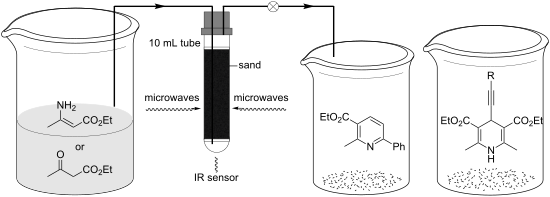
- . Strauss first demonstrated in 1994 that by combining microwave-heating technology with continuous flow processing, problems with the limited penetration depth of microwave irradiation and the physical restrictions of a standing wave cavity could be overcome [14]. A continuous flow reactor has the
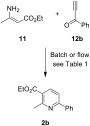
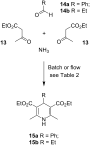
- that this cyclocondensation proceeds in a similar fashion and high efficiency under microwave irradiation [48], and that we have previously demonstrated that pyridines and pyrimidines can both be formed rapidly and efficiently from ethynyl ketones using microwave dielectric heating, the transfer of
- continuous flow reactor examined the cyclodehydration of Bohlmann–Rahtz aminodienone intermediates in the presence of a Brønsted acid catalyst [44][45]. This relatively simple cyclization reaction was utilized previously as we had already established its facility under microwave irradiation and so it




The first example of the Fischer–Hepp type rearrangement in pyrimidines
Beilstein J. Org. Chem. 2013, 9, 1819–1825, doi:10.3762/bjoc.9.212
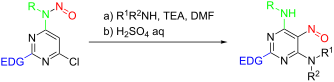
- pyrimidine core toward subsequent substitution. The usage of very harsh reaction conditions (prolonged heating for hours or days, high pressure or microwave irradiation of the reaction mixtures) is required to carry out the second SNAr reaction (Scheme 1) [9][10][11][12][13][14]. In 2012 we published a


A reductive coupling strategy towards ripostatin A
Beilstein J. Org. Chem. 2013, 9, 1533–1550, doi:10.3762/bjoc.9.175
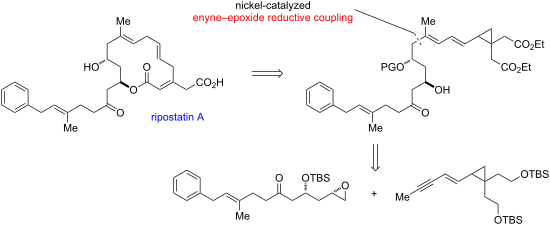
- diastereoselectivity around 10:1, with further enhancement following silyl protection and purification. Although the silylated compound 60 proved to be reluctant to form the Weinreb amide, microwave irradiation allowed this process to proceed on a reasonable time scale. Grignard addition to the Weinreb amide afforded


Thiourea-catalyzed Diels–Alder reaction of a naphthoquinone monoketal dienophile
Beilstein J. Org. Chem. 2013, 9, 1414–1418, doi:10.3762/bjoc.9.158
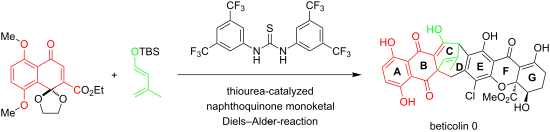
- undergo cycloaddition with diene 4 to tricycle 2, which represents the ABC-ring system of beticolin 0 (1) and other beticolins [10]. We found that dienophile 3 and diene 4 can undergo a cycloaddition by applying either thermal conditions or microwave irradiation to these both compounds (Table 1) [9


Establishing the concept of aza-[3 + 3] annulations using enones as a key expansion of this unified strategy in alkaloid synthesis
Beilstein J. Org. Chem. 2013, 9, 1170–1178, doi:10.3762/bjoc.9.131
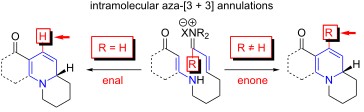
- ] annulation reaction is described here. Use of piperidinium trifluoroacetate salt as the catalyst and toluene as the solvent appears to be critical for a successful annulation. We also demonstrated for the first time that microwave irradiation can accelerate aza-[3 + 3] annulation reactions. An attempt to
- 87%, while lowering the catalyst loading from 500 mol % to 50 mol %, although the reaction temperature was raised to 150 °C. Lastly, we also examined the use of microwave irradiation [66][67] and observed a distinct rate enhancement (Table 1, entry 9). The observed reactivity difference of the
- intramolecular aza-[3 + 3] annulation reaction. Use of piperidinium trifluoroacetate salt as the catalyst and toluene as the solvent appears to be critical for a successful annulation. We also demonstrated for the first time that microwave irradiation can accelerate aza-[3 + 3] annulation reactions. An attempt


Use of 3-[18F]fluoropropanesulfonyl chloride as a prosthetic agent for the radiolabelling of amines: Investigation of precursor molecules, labelling conditions and enzymatic stability of the corresponding sulfonamides
Beilstein J. Org. Chem. 2013, 9, 1002–1011, doi:10.3762/bjoc.9.115
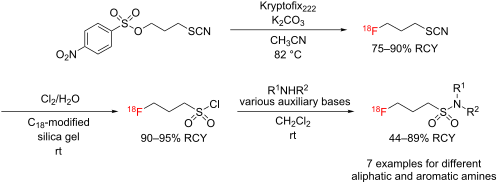
- advantageous compared to microwave irradiation (up to 50 W for 7 min, 75 °C (CH3CN), 100 °C (DMF)). Higher labelling yields were achieved when the nosyl precursor 4 was used instead of tosylate 3 (75–85% (n = 12) versus 45–55% (n = 9), respectively; Figure 3). Notably, employing DMF as solvent resulted in




Efficient Cu-catalyzed base-free C–S coupling under conventional and microwave heating. A simple access to S-heterocycles and sulfides
Beilstein J. Org. Chem. 2013, 9, 467–475, doi:10.3762/bjoc.9.50
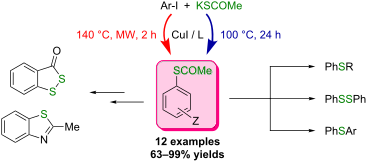
- microwave irradiation the time was drastically reduced to 2 h. Both procedures are simple and involve a low-cost catalytic system. This methodology was also applied to the “one-pot” synthesis of target heterocycles, such as 3H-benzo[c][1,2]dithiol-3-one and 2-methylbenzothiazole, alkyl aryl sulfides, diaryl
- the reactions of KSCOMe (1) with aryl iodides under a Cu/ligand/base-free system to afford S-aryl thioacetates 2 as thiol surrogates in good to excellent yields, under conventional heating and microwave irradiation as an efficient access to a variety of sulfur compounds. Results and Discussion
- yield. As a result, the simple methodology here presented could be an attractive alternative for the synthesis of polysulfides and other sulfur relevant materials (Table 3, entries 10–12). In a comparative fashion we have also performed these reactions under microwave irradiation in order to improve


Microwave-assisted three-component domino reaction: Synthesis of indolodiazepinotriazoles
Beilstein J. Org. Chem. 2013, 9, 401–405, doi:10.3762/bjoc.9.41
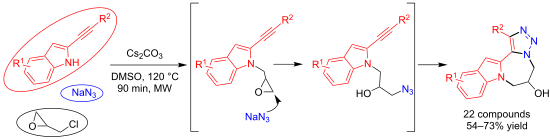
- % isolated yield (Table 1, entry 17). Thus, under microwave irradiation conditions, not only the isolated yield of 6a increased from 60% under conventional heating to 71%, but the duration of reaction was also reduced from 15 h to 1.5 h. Switching the solvent from DMSO to DMF under microwave conditions


Features of the behavior of 4-amino-5-carboxamido-1,2,3-triazole in multicomponent heterocyclizations with carbonyl compounds
Beilstein J. Org. Chem. 2012, 8, 2100–2105, doi:10.3762/bjoc.8.236
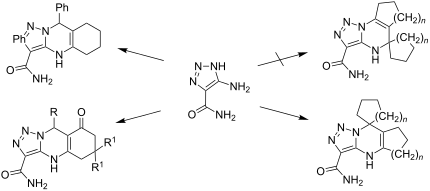
- heating under reflux (Method A), in methanol under microwave irradiation at 120 °C (Method B), or by ultrasonication at ambient temperature in acetic acid (Method C). In all these cases triazolopyrimidine 7 was isolated as the sole reaction product (Scheme 2, Table 1). In most cases the best results from


Palladium-catalyzed C–N and C–O bond formation of N-substituted 4-bromo-7-azaindoles with amides, amines, amino acid esters and phenols
Beilstein J. Org. Chem. 2012, 8, 2004–2018, doi:10.3762/bjoc.8.227
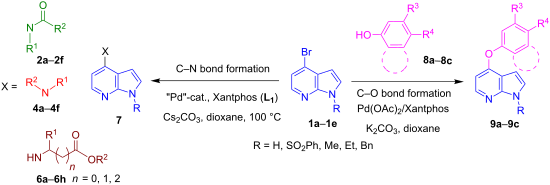
- amine counterpart under high reaction temperatures, preferably under heating to more than 180 °C or through the use of microwave irradiation, results in the amino-7-azaindole in moderate to low yield [5][7]. Primary alkylamines or anilines under similar reaction conditions provided the displacement


An efficient access to the synthesis of novel 12-phenylbenzo[6,7]oxepino[3,4-b]quinolin-13(6H)-one derivatives
Beilstein J. Org. Chem. 2012, 8, 1849–1857, doi:10.3762/bjoc.8.213
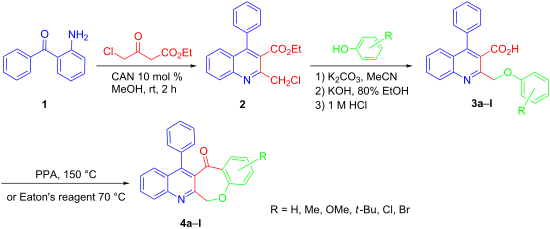
- -chloroacetoacetate did not take place, and a gummy mass was obtained as product. In this context, Muscia et al. [39] described the synthesis of ethyl 6-chloro-2-(chloromethyl)-4-phenylquinoline-3-carboxylate by the Friedländer reaction employing microwave irradiation (MW) in the presence of a catalytic amount of


Modulating the activity of short arginine-tryptophan containing antibacterial peptides with N-terminal metallocenoyl groups
Beilstein J. Org. Chem. 2012, 8, 1753–1764, doi:10.3762/bjoc.8.200
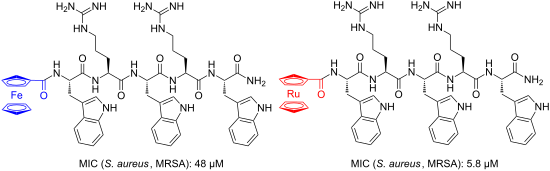
- short, Fmoc-protected amino acids were coupled in a solid-state synthesis scheme using HOBt, TBTU, and DiPEA under microwave irradiation. Using suitably protected amino acids, i.e., Fmoc-Arg(Pbf)-OH, Fmoc-Trp(Boc)-OH, and Fmoc-Lys(Boc)-OH, and polystyrene-based resin decorated with Fmoc-protected Rink





