


Search results
Search for "Grignard reagent" in Full Text gives 115 result(s) in Beilstein Journal of Organic Chemistry.
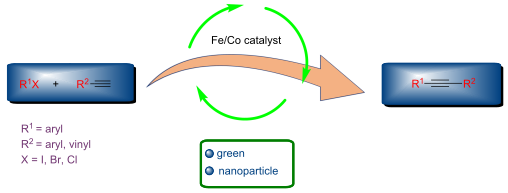
Recent developments and trends in the iron- and cobalt-catalyzed Sonogashira reactions
- Surendran Amrutha,
- Sankaran Radhika and
- Gopinathan Anilkumar
Beilstein J. Org. Chem. 2022, 18, 262–285, doi:10.3762/bjoc.18.31
- showed better yield of the coupling products. The optimized reaction conditions consisted of 5 mol % of the utilized catalyst with the dropwise addition of Grignard reagent, and 1.2 equivalents of LiBr as an effective additive in THF that resulted in good to excellent yields of the desired products. Bolm

Graphical Abstract

Scheme 1: One pot Sonogashira coupling of aryl iodides with arylynols in the presence of iron(III) chloride h...

Scheme 2: The iron-catalyzed Sonogashira coupling of aryl iodides with terminal acetylenes in water under aer...

Scheme 3: Sonogashira coupling of aryl halides and phenylacetylene in the presence of iron nanoparticles.

Scheme 4: Sonogashira coupling catalyzed by a silica-supported heterogeneous Fe(III) catalyst.

Scheme 5: Suggested catalytic cycle for the Sonogashira coupling using a silica-supported heterogeneous Fe(II...

Scheme 6: Chemoselective iron-catalyzed cross coupling of 4-bromo-1-cyclohexen-1-yltrifluromethane sulfonate ...
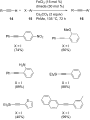
Scheme 7: Fe-catalyzed Sonogashira coupling between terminal alkynes and aryl iodides.

Scheme 8: Iron-catalyzed domino Sonogashira coupling and hydroalkoxylation.

Scheme 9: Sonogashira coupling of aryl halides and phenylacetylene in the presence of Fe(III) acetylacetonate...

Scheme 10: Sonogashira coupling of aryl iodides and alkynes with Fe(acac)3/2,2-bipyridine catalyst.

Scheme 11: Sonogashira cross-coupling of terminal alkynes with aryl iodides in the presence of Fe powder/ PPh3...

Scheme 12: α-Fe2O3 nanoparticles-catalyzed coupling of phenylacetylene with aryl iodides.

Scheme 13: Sonogashira cross-coupling reaction between phenylacetylene and 4-substituted iodobenzenes catalyze...

Scheme 14: One-pot synthesis of 2-arylbenzo[b]furans via tandem Sonogashira coupling–cyclization protocol.

Scheme 15: Suggested mechanism of the Fe(III) catalyzed coupling of o-iodophenol with acetylene derivatives.

Scheme 16: Fe3O4@SiO2/Schiff base/Fe(II)-catalyzed Sonogashira–Hagihara coupling reaction.

Scheme 17: Sonogashira coupling using the Fe(II)(bdmd) catalyst in DMF/1,4-dioxane.

Scheme 18: Synthesis of 7-azaindoles using Fe(acac)3 as catalyst.

Scheme 19: Plausible mechanistic pathway for the synthesis of 7-azaindoles.

Scheme 20: Synthesis of Co@imine-POP catalyst.

Scheme 21: Sonogashira coupling of various arylhalides and phenylacetylene in the presence of Co@imine-POP cat...

Scheme 22: Sonogashira coupling of aryl halides and phenylacetylene using Co-DMM@MNPs/chitosan.

Scheme 23: Sonogashira cross-coupling of aryl halides with terminal acetylenes in the presence of Co-NHC@MWCNT...

Scheme 24: Sonogashira cross-coupling of aryl halides with terminal acetylenes in the presence of Co nanoparti...

Scheme 25: Sonogashira coupling reaction of aryl halides with phenylacetylene in the presence of Co nanopartic...

Scheme 26: PdCoNPs-3DG nanocomposite-catalyzed Sonogashira cross coupling of aryl halide and terminal alkynes.

Scheme 27: Sonogashira cross-coupling of aryl halides and phenylacetylene in the presence of graphene-supporte...

Scheme 28: Sonogashira cross-coupling with Pd/Co ANP-PPI-graphene.

Scheme 29: Pd-Co-1(H)-catalyzed Sonogashira coupling reaction.

Scheme 30: The coupling of aryl halides with terminal alkynes using cobalt hollow nanospheres as catalyst.

Scheme 31: A plausible mechanism for the cobalt-catalyzed Sonogashira coupling reaction.

Scheme 32: Sonogashira cross-coupling reaction of arylhalides with phenylacetylene catalyzed by Fe3O4@PEG/Cu-C...

Scheme 33: Plausible mechanism of Sonogashira cross-coupling reaction catalyzed by Fe3O4@PEG/Cu-Co.

Scheme 34: Sonogashira coupling reaction of para-substituted bromobenzenes with phenylacetylene in the presenc...

Scheme 35: Possible mechanism for the visible light-assisted cobalt complex-catalyzed Sonogashira coupling. (R...

Scheme 36: Sonogashira cross-coupling of aryl halides and phenylacetylene using cobalt as additive.

Scheme 37: Plausible mechanism of Sonogashira cross-coupling reaction over [LaPd*]. (Reproduced with permissio...
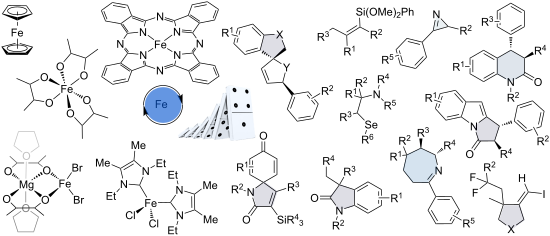
Iron-catalyzed domino coupling reactions of π-systems
- Austin Pounder and
- William Tam
Beilstein J. Org. Chem. 2021, 17, 2848–2893, doi:10.3762/bjoc.17.196
- [59]. The authors proposed a plausible catalytic cycle based on a series of mechanistic studies (Scheme 3). First, FeCl2 will react with the aryl Grignard reagent to form an aryliron complex 8 which can undergo a SET with the iodoalkane to yield the radical substrate 9. A 5-exo-dig cyclization will
- produce the pyrrolidinyl methyl radical 10 which may add to the iron center to form the Fe(III) complex 11. Reductive elimination would give rise to the final product, and transmetallation with a Grignard reagent regenerates the active Fe species. Alternatively, release of the aryl radical via ipso-attack
- species is stable enough to be selectively trapped by the less sterically demanding 2° alkyl radical 29. Reductive elimination would form the difunctionalized product and transmetallation with an aryl Grignard reagent regenerates the active Fe species 26, restarting the catalytic cycle. As driving Giese

Graphical Abstract

Figure 1: Price comparison among iron and other transition metals used in catalysis.

Scheme 1: Typical modes of C–C bond formation.

Scheme 2: The components of an iron-catalyzed domino reaction.

Scheme 3: Iron-catalyzed tandem cyclization and cross-coupling reactions of iodoalkanes 1 with aryl Grignard ...
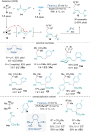
Scheme 4: Three component iron-catalyzed dicarbofunctionalization of vinyl cyclopropanes 14.
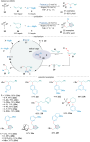
Scheme 5: Three-component iron-catalyzed dicarbofunctionalization of alkenes 21.

Scheme 6: Double carbomagnesiation of internal alkynes 31 with alkyl Grignard reagents 32.

Scheme 7: Iron-catalyzed cycloisomerization/cross-coupling of enyne derivatives 35 with alkyl Grignard reagen...
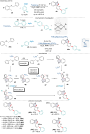
Scheme 8: Iron-catalyzed spirocyclization/cross-coupling cascade.
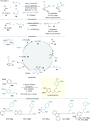
Scheme 9: Iron-catalyzed alkenylboration of alkenes 50.
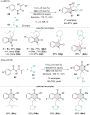
Scheme 10: N-Alkyl–N-aryl acrylamide 60 CDC cyclization with C(sp3)–H bonds adjacent to a heteroatom.

Scheme 11: 1,2-Carboacylation of activated alkenes 60 with aldehydes 65 and alcohols 67.
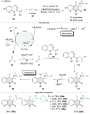
Scheme 12: Iron-catalyzed dicarbonylation of activated alkenes 68 with alcohols 67.
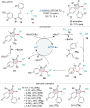
Scheme 13: Iron-catalyzed cyanoalkylation/radical dearomatization of acrylamides 75.

Scheme 14: Synergistic photoredox/iron-catalyzed 1,2-dialkylation of alkenes 82 with common alkanes 83 and 1,3...

Scheme 15: Iron-catalyzed oxidative coupling/cyclization of phenol derivatives 86 and alkenes 87.

Scheme 16: Iron-catalyzed carbosulfonylation of activated alkenes 60.

Scheme 17: Iron-catalyzed oxidative spirocyclization of N-arylpropiolamides 91 with silanes 92 and tert-butyl ...

Scheme 18: Iron-catalyzed free radical cascade difunctionalization of unsaturated benzamides 94 with silanes 92...

Scheme 19: Iron-catalyzed cyclization of olefinic dicarbonyl compounds 97 and 100 with C(sp3)–H bonds.

Scheme 20: Radical difunctionalization of o-vinylanilides 102 with ketones and esters 103.

Scheme 21: Dehydrogenative 1,2-carboamination of alkenes 82 with alkyl nitriles 76 and amines 105.

Scheme 22: Iron-catalyzed intermolecular 1,2-difunctionalization of conjugated alkenes 107 with silanes 92 and...

Scheme 23: Four-component radical difunctionalization of chemically distinct alkenes 114/115 with aldehydes 65...

Scheme 24: Iron-catalyzed carbocarbonylation of activated alkenes 60 with carbazates 117.
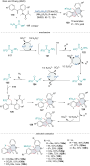
Scheme 25: Iron-catalyzed radical 6-endo cyclization of dienes 119 with carbazates 117.

Scheme 26: Iron-catalyzed decarboxylative synthesis of functionalized oxindoles 130 with tert-butyl peresters ...
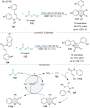
Scheme 27: Iron‑catalyzed decarboxylative alkylation/cyclization of cinnamamides 131/134.

Scheme 28: Iron-catalyzed carbochloromethylation of activated alkenes 60.

Scheme 29: Iron-catalyzed trifluoromethylation of dienes 142.

Scheme 30: Iron-catalyzed, silver-mediated arylalkylation of conjugated alkenes 115.

Scheme 31: Iron-catalyzed three-component carboazidation of conjugated alkenes 115 with alkanes 101/139b and t...

Scheme 32: Iron-catalyzed carboazidation of alkenes 82 and alkynes 160 with iodoalkanes 20 and trimethylsilyl ...

Scheme 33: Iron-catalyzed asymmetric carboazidation of styrene derivatives 115.

Scheme 34: Iron-catalyzed carboamination of conjugated alkenes 115 with alkyl diacyl peroxides 163 and acetoni...

Scheme 35: Iron-catalyzed carboamination using oxime esters 165 and arenes 166.

Scheme 36: Iron-catalyzed iminyl radical-triggered [5 + 2] and [5 + 1] annulation reactions with oxime esters ...

Scheme 37: Iron-catalyzed decarboxylative alkyl etherification of alkenes 108 with alcohols 67 and aliphatic a...

Scheme 38: Iron-catalyzed inter-/intramolecular alkylative cyclization of carboxylic acid and alcohol-tethered...

Scheme 39: Iron-catalyzed intermolecular trifluoromethyl-acyloxylation of styrene derivatives 115.

Scheme 40: Iron-catalyzed carboiodination of terminal alkenes and alkynes 180.

Scheme 41: Copper/iron-cocatalyzed cascade perfluoroalkylation/cyclization of 1,6-enynes 183/185.

Scheme 42: Iron-catalyzed stereoselective carbosilylation of internal alkynes 187.

Scheme 43: Synergistic photoredox/iron catalyzed difluoroalkylation–thiolation of alkenes 82.

Scheme 44: Iron-catalyzed three-component aminoazidation of alkenes 82.

Scheme 45: Iron-catalyzed intra-/intermolecular aminoazidation of alkenes 194.

Scheme 46: Stereoselective iron-catalyzed oxyazidation of enamides 196 using hypervalent iodine reagents 197.
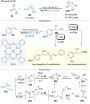
Scheme 47: Iron-catalyzed aminooxygenation for the synthesis of unprotected amino alcohols 200.

Scheme 48: Iron-catalyzed intramolecular aminofluorination of alkenes 209.
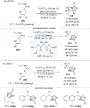
Scheme 49: Iron-catalyzed intramolecular aminochlorination and aminobromination of alkenes 209.

Scheme 50: Iron-catalyzed intermolecular aminofluorination of alkenes 82.

Scheme 51: Iron-catalyzed aminochlorination of alkenes 82.

Scheme 52: Iron-catalyzed phosphinoylazidation of alkenes 108.
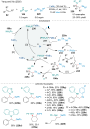
Scheme 53: Synergistic photoredox/iron-catalyzed three-component aminoselenation of trisubstituted alkenes 82.
Highly stereocontrolled total synthesis of racemic codonopsinol B through isoxazolidine-4,5-diol vinylation
- Lukáš Ďurina,
- Anna Ďurinová,
- František Trejtnar,
- Ľuboš Janotka,
- Lucia Messingerová,
- Jana Doháňošová,
- Ján Moncol and
- Róbert Fischer
Beilstein J. Org. Chem. 2021, 17, 2781–2786, doi:10.3762/bjoc.17.188
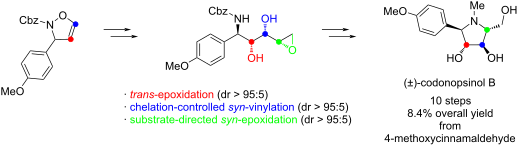
- first prepared synthetically before its isolation from natural crude material, employing a stereoselective addition of an aryl Grignard reagent to a five-membered chiral cyclic nitrone derived from ᴅ-arabinose [2]. Its analytical data were consistent with those for the later isolated natural product

Graphical Abstract

Figure 1: (−)-Codonopsinol B (1) and its N-nor-methyl analogue 2; known inhibition activities against α-gluco...

Scheme 1: Synthetic approach towards (±)-codonopsinol B (1) and its N-nor-methyl analogue 2.

Scheme 2: Synthesis of isoxazolidine-4,5-diol (±)-3. Reagents and conditions: (a) ᴅʟ-proline, CHCl3, rt, 48 h...

Scheme 3: Synthesis of final pyrrolidines (±)-1 and (±)-2. Reagents and conditions: (a) vinyl-MgBr, CeCl3, TH...

Figure 2: Molecular structure of N-Cbz-protected pyrrolidine 12 confirmed by single-crystal X-ray crystallogr...
Strategies for the synthesis of brevipolides
- Yudhi D. Kurniawan and
- A'liyatur Rosyidah
Beilstein J. Org. Chem. 2021, 17, 2399–2416, doi:10.3762/bjoc.17.157
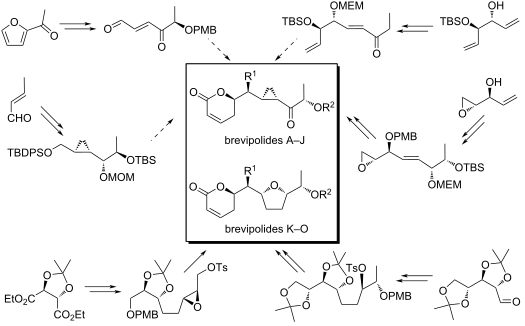
- epoxide using vinyl Grignard reagent followed by esterification with acrylic acid (35) proved to be inefficient due to low reproducibility and poor isolation of product 36. The strategy was altered by changing the terminal epoxide 34 to an allylic alcohol (95%) utilizing dimethyl sulfonium methylide

Graphical Abstract

Figure 1: Structures of brevipolides A–O (1 – 15).

Scheme 1: Retrosynthetic analysis of brevipolide H (8) by Kumaraswamy.

Scheme 2: Attempt to synthesize brevipolide H (8) by Kumaraswamy. (R,R)-Noyori cat. = RuCl[N-(tosyl)-1,2-diph...

Scheme 3: Attempt to synthesize brevipolide H (8) by Kumaraswamy (continued).

Scheme 4: Retrosynthetic analysis of brevipolide H (8) by Hou.

Scheme 5: Synthesis ent-brevipolide H (ent-8) by Hou.

Scheme 6: Retrosynthetic analysis of brevipolide H (8) by Mohapatra.

Scheme 7: Attempt to synthesize brevipolide H (8) by Mohapatra.

Scheme 8: Attempt to synthesize brevipolide H (8) by Mohapatra (continued). (+)-(IPC)2-BCl = (+)-B-chloro-dii...

Scheme 9: Retrosynthetic analysis of brevipolide H (8) by Hou.

Scheme 10: Synthesis of brevipolide H (8) by Hou.

Scheme 11: Retrosynthetic analysis of brevipolide M (13) by Sabitha.

Scheme 12: Synthesis of brevipolide M (13) by Sabitha.

Scheme 13: Retrosynthetic analysis of brevipolides M (13) and N (14) by Sabitha.

Scheme 14: Synthesis of brevipolides M (13) and N (14) by Sabitha.
Development of N-F fluorinating agents and their fluorinations: Historical perspective
- Teruo Umemoto,
- Yuhao Yang and
- Gerald B. Hammond
Beilstein J. Org. Chem. 2021, 17, 1752–1813, doi:10.3762/bjoc.17.123
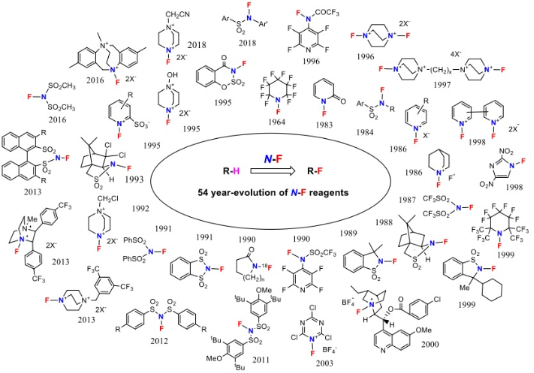
- F2/N2 system, but failed. Reagent 20-3 was synthesized using cesium fluoroxysulfate in 1991 (see section 1-15). Reagent 20-2 proved useful for the fluorination of both neutral and anionic nucleophiles under mild conditions. Scheme 45 illustrates some pertinent examples. Phenyl Grignard reagent

Graphical Abstract

Scheme 1: Fluorination with N-F amine 1-1.

Scheme 2: Preparation of N-F amine 1-1.

Scheme 3: Reactions of N-F amine 1-1.

Scheme 4: Synthesis of N-F perfluoroimides 2-1 and 2-2.

Scheme 5: Synthesis of 1-fluoro-2-pyridone (3-1).

Scheme 6: Fluorination with 1-fluoro-2-pyridone (3-1).

Figure 1: Synthesis of N-F sulfonamides 4-1a–g.
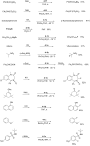
Scheme 7: Fluorination with N-F reagent 4-1b,c,f.

Scheme 8: Fluorination of alkenyllithiums with N-F 4-1h.

Scheme 9: Synthesis of N-fluoropyridinium triflate (5-4a).

Scheme 10: Synthetic methods for N-F-pyridinium salts.

Figure 2: Synthesis of various N-fluoropyridinium salts. Note: athis yield was the one by the improved method...

Scheme 11: Fluorination power order of N-fluoropyridinium salts.

Scheme 12: Fluorinations with N-F salts 5-4.

Scheme 13: Fluorination of Corey lactone 5-7 with N-F-bis(methoxymethyl) salt 5-4l.

Scheme 14: Fluorination with NFPy.

Scheme 15: Synthesis of the N-F reagent, N-fluoroquinuclidinium fluoride (6-1).

Scheme 16: Fluorinations achieved with N-F fluoride 6-1.

Scheme 17: Synthesis of N-F imides 7-1a–g.

Scheme 18: Fluorination with (CF3SO2)2NF, 7-1a.
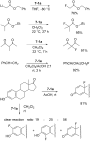
Scheme 19: Fluorination reactions of various substrates with 7-1a.

Scheme 20: Synthesis of N-F triflate 8-1.

Scheme 21: Synthesis of chiral N-fluoro sultams 9-1 and 9-2.
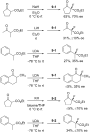
Scheme 22: Fluorination with chiral N-fluoro sultams 9-1 and 9-2.

Scheme 23: Synthesis of saccharin-derived N-fluorosultam 10-2.

Scheme 24: Fluorination with N-fluorosultam 10-2.

Scheme 25: Synthesis of N-F reagent 11-2.

Scheme 26: Fluorination with N-F reagent 11-2.

Scheme 27: Synthesis and reaction of N-fluorolactams 12-1.

Scheme 28: Synthesis of NFOBS 13-2.

Scheme 29: Fluorination with NFOBS 13-2.

Scheme 30: Synthesis of NFSI (14-2).
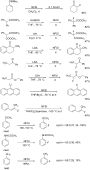
Scheme 31: Fluorination with NFSI 14-2.

Scheme 32: Synthesis of N-fluorosaccharin (15-1) and N-fluorophthalimide (15-2).

Scheme 33: Synthesis of N-F salts 16-3.
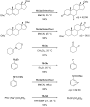
Scheme 34: Fluorination with N-F salts 16-3.

Figure 3: Monofluorination with Selectfluor (16-3a).

Figure 4: Difluorination with Selectfluor (16-3a).

Scheme 35: Transfer fluorination of Selectfluor (16-3a).
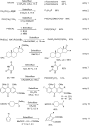
Scheme 36: Fluorination of substrates with Selectfluor (16-3a).

Scheme 37: Synthesis of chiral N-fluoro-sultam 17-2.

Scheme 38: Asymmetric fluorination with chiral 17-2.

Figure 5: Synthesis of Zwitterionic N-fluoropyridinium salts 18-2a–h.

Scheme 39: Fluorinating power order of zwitterionic N-fluoropyridinium salts.

Scheme 40: Fluorination with zwitterionic 18-2.

Scheme 41: Activation of salt 18-2h with TfOH.

Scheme 42: Synthesis of NFTh, 19-2.

Scheme 43: Fluorination with NFTh, 19-2.

Scheme 44: Synthesis of 3-fluorobenzo-1,2,3-oxathiazin-4-one 2,2-dioxide (20-2).

Scheme 45: Fluorination with 20-2.

Scheme 46: Synthesis of N-F amide 21-3.

Scheme 47: Fluorination with N-F amide 21-2.

Scheme 48: Synthesis of N,N’-difluorodiazoniabicyclo[2.2.2]octane salts 22-1.

Scheme 49: One-pot synthesis of N,N’-difluoro-1,4-diazoniabicyclo[2.2.2]octane bistetrafluoroborate salt (22-1d...

Figure 6: Fluorination of anisole with 22-1a, d, e.
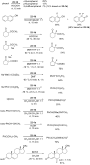
Scheme 50: Fluorination with N,N’-diF bisBF4 22-1d.

Scheme 51: Synthesis of bis-N-F reagents 23-1–5.
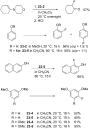
Scheme 52: Fluorination with 23-2, 4, 5.

Figure 7: Synthesis of N,N’-difluorobipyridinium salts 24-2.

Figure 8: Controlled fluorination of N,N’-diF 24-2.

Scheme 53: Fluorinating power of N,N’-diF salts 24-2 and N-F salt 5-4a.
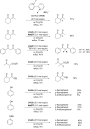
Scheme 54: Fluorination reactions with SynfluorTM (24-2b).

Scheme 55: Additional fluorination reactions with SynfluorTM (24-2b).

Scheme 56: Synthesis of N-F 25-1.

Scheme 57: Fluorination of polycyclic aromatics with 25-1.

Scheme 58: Synthesis of 26-1 and dimethyl analog 26-2.

Scheme 59: Fluorination with reagents 26-1, 26-2, 1-1, and 26-3.

Scheme 60: Synthesis of N-F reagent 27-2.

Scheme 61: Synthesis of chiral N-F reagents 27-6.

Scheme 62: Synthesis of chiral N-F 27-7–9.
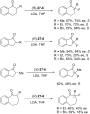
Scheme 63: Asymmetric fluorination with 27-6.

Scheme 64: Synthesis of chiral N-F reagents 28-3.

Scheme 65: Asymmetric fluorination with 28-3.

Scheme 66: Synthesis of chiral N-F reagents 28-7.

Figure 9: Asymmetric fluorination with 28-7.

Scheme 67: In situ formation of N-fluorinated cinchona alkaloids with SelectfluorTM.
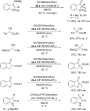
Scheme 68: Asymmetric fluorination with N-F alkaloids formed in situ.

Scheme 69: Synthesis of N-fluorocinchona alkaloids with Selectfluor.

Scheme 70: Asymmetric fluorination with 30-1–4.

Scheme 71: Transfer fluorination from various N-F reagents.

Figure 10: Asymmetric fluorination of silyl enol ethers.

Scheme 72: Synthesis of N-fluoro salt 32-2.

Scheme 73: Reactivity of N-fluorotriazinium salt 32-2.

Scheme 74: Synthesis of bulky N-fluorobenzenesulfonimide NFBSI 33-3.

Scheme 75: Comparison of NFSI and NFBSI.

Scheme 76: Synthesis of p-substituted N-fluorobenzenesulfonimides 34-3.

Figure 11: Asymmetric fluorination with 34-3 and a chiral catalyst 34-4.

Scheme 77: 1,4-Fluoroamination with Selecfluor and a chiral catalyst.

Figure 12: Asymmetric fluoroamination with 35-5a, b.

Scheme 78: Synthesis of Selectfluor analogs 35-5a, b.

Scheme 79: Synthesis of chiral dicationic DABCO-based N-F reagents 36-5.
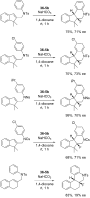
Scheme 80: Asymmetric fluorocyclization with chiral 36-5b.

Scheme 81: Synthesis of chiral 37-2a,b.

Scheme 82: Asymmetric fluorination with chiral 37-2a,b.

Scheme 83: Asymmetric fluorination with chiral 37-2b.

Scheme 84: Reaction of indene with chiral 37-2a,b.

Scheme 85: Synthesis of Me-NFSI, 38-2.

Scheme 86: Fluorination of active methine compounds with Me-NFSI.

Scheme 87: Fluorination of malonates with Me-NFSI.

Scheme 88: Fluorination of keto esters with Me-NFSI.

Scheme 89: Synthesis of N-F 39-3 derived from the ethylene-bridged Tröger’s base.

Scheme 90: Fluorine transfer from N-F 39-3.

Scheme 91: Fluorination with N-F 39-3.

Scheme 92: Synthesis of SelectfluorCN.

Scheme 93: Bistrifluoromethoxylation of alkenes using SelectfluorCN.

Figure 13: Synthesis of NFAS 41-2.

Scheme 94: Radical fluorination with different N-F reagents.

Scheme 95: Radical fluorination of alkenes with NFAS 41-2.

Scheme 96: Radical fluorination of alkenes with NFAS 41-2f.

Scheme 97: Decarboxylative fluorination with NFAS 41-2a,f.

Scheme 98: Fluorine plus detachment (FPD).

Figure 14: FPD values of representative N-F reagents in CH2Cl2 and CH3CN (in parentheses). Adapted with permis...

Scheme 99: N-F homolytic bond dissociation energy (BDE).

Figure 15: BDE values of representative N-F reagents in CH3CN. Adapted with permission from ref. [127]. Copyright 2...

Figure 16: Quantitative reactivity scale for popular N-F reagents. Adapted with permission from ref. [138], publish...

Scheme 100: SET and SN2 mechanisms.

Scheme 101: Radical clock reactions.

Scheme 102: Reaction of potassium enolate of citronellic ester with N-F reagents, 10-1, NFSI, and 8-1.

Scheme 103: Reaction of compound IV with Selectfluor (OTf) and NFSI.

Scheme 104: Reaction of TEMPO with Selecfluor.
Double-headed nucleosides: Synthesis and applications
- Vineet Verma,
- Jyotirmoy Maity,
- Vipin K. Maikhuri,
- Ritika Sharma,
- Himal K. Ganguly and
- Ashok K. Prasad
Beilstein J. Org. Chem. 2021, 17, 1392–1439, doi:10.3762/bjoc.17.98
- Wittig reaction with methylenetriphenylphosphorane (Ph3P=CH2) produced the 5′-methylene derivative [62]. Finally, oxidation with meta-chloroperbenzoic acid (mCPBA) afforded the nucleoside 97. Treatment of the nucleoside 97 with Grignard reagent PhMgBr in THF produced nucleoside 98, whose secondary

Graphical Abstract

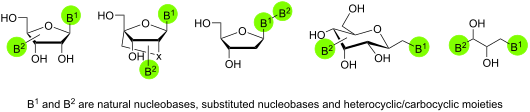
Figure 1: Double-headed nucleosides. B1 and B2 = nucleobases or heterocyclic/carbocyclic moieties; L = linker....

Scheme 1: Synthesis of 2′-(pyrimidin-1-yl)methyl- or 2′-(purin-9-yl)methyl-substituted double-headed nucleosi...

Scheme 2: Synthesis of double-headed nucleoside 7 having two cytosine moieties.

Scheme 3: Synthesis of double-headed nucleoside 2′-deoxy-2′-C-(2-(thymine-1-yl)ethyl)-uridine (11).

Scheme 4: Double-headed nucleosides 14 and 15 obtained by click reaction.

Scheme 5: Synthesis of the double-headed nucleoside 19.

Scheme 6: Synthesis of the double-headed nucleosides 24 and 25.

Scheme 7: Synthesis of double-headed nucleosides 28 and 29.

Scheme 8: Synthesis of double-headed nucleoside 33.

Scheme 9: Synthesis of double-headed nucleoside 37.

Scheme 10: Synthesis of the double-headed nucleoside 1-(5′-O-(4,4′-dimethoxytrityl)-2′-C-((4-(pyren-1-yl)-1,2,...

Scheme 11: Synthesis of triazole-containing double-headed ribonucleosides 46a–c and 50a–e.

Scheme 12: Synthesis of double-headed nucleosides 54a–g.

Scheme 13: Synthesis of double-headed nucleosides 59 and 60.

Scheme 14: Synthesis of the double-headed nucleosides 63 and 64.

Scheme 15: Synthesis of double-headed nucleosides 66a–c.

Scheme 16: Synthesis of benzoxazole-containing double-headed nucleosides 69 and 71 from 5′-amino-5′-deoxynucle...

Scheme 17: Synthesis of 4′-C-((N6-benzoyladenin-9-yl)methyl)thymidine (75) and 4′-C-((thymin-1-yl)methyl)thymi...

Scheme 18: Synthesis of double-headed nucleosides 5′-(adenine-9-yl)-5′-deoxythymidine (79) and 5′-(adenine-9-y...

Scheme 19: Synthesis of double-headed nucleosides 85–87 via reversed nucleosides methodology.

Scheme 20: Double-headed nucleosides 91 and 92 derived from ω-terminal-acetylenic sugar derivatives 90a,b.

Scheme 21: Synthesis of double-headed nucleosides 96a–g.

Scheme 22: Synthesis of double-headed nucleosides 100 and 103.

Scheme 23: Double-headed nucleosides 104 and 105 with a triazole motif.

Scheme 24: Synthesis of the double-headed nucleosides 107 and 108.

Scheme 25: Synthesis of double-headed nucleoside 110 with additional nucleobase in 5′-(S)-C-position joined th...

Scheme 26: Synthesis of double-headed nucleosides 111–113 with additional nucleobases in the 5′-(S)-C-position...

Scheme 27: Synthesis of double-headed nucleoside 114 by click reaction.

Scheme 28: Synthesis of double-headed nucleosides 118 with an additional nucleobase at the 5′-(S)-C-position.

Scheme 29: Synthesis of bicyclic double-headed nucleoside 122.

Scheme 30: Synthesis of double-headed nucleosides 125a–c derived from 2′-amino-LNA.

Scheme 31: Double-headed nucleoside 127 obtained by click reaction.

Scheme 32: Synthesis of double-headed nucleoside 130.

Scheme 33: Double-headed nucleosides 132a–d and 134a–d synthesized by Sonogashira cross coupling reaction.

Scheme 34: Synthesis of double-headed nucleosides 137 and 138 via Suzuki coupling.

Scheme 35: Synthesis of double-headed nucleosides 140 and 141 via Sonogashira cross coupling reaction.

Scheme 36: Synthesis of double-headed nucleoside 143.

Scheme 37: Synthesis of the double-headed nucleoside 146.

Scheme 38: Synthesis of 5-C-alkynyl-functionalized double-headed nucleosides 151a–d.

Scheme 39: Synthesis of 5-C-triazolyl-functionalized double-headed nucleosides 154a, b.

Scheme 40: Synthesis of double-headed nucleosides 157a–c.

Scheme 41: Synthesis of double-headed nucleoside 159, phosphoramidite 160 and the corresponding nucleotide mon...

Scheme 42: Synthesis of double-headed nucleoside 163, phosphoramidite 164 and the corresponding nucleotide mon...

Scheme 43: Synthesis of double-headed nucleoside 167, phosphoramidite 168, and the corresponding nucleotide mo...

Scheme 44: Synthesis of double-headed nucleoside 171, phosphoramidite 172, and the corresponding nucleotide mo...

Scheme 45: Synthesis of double-headed nucleoside 175, phosphoramidite 176, and the corresponding nucleotide mo...

Scheme 46: Synthesis of double-headed nucleoside 178.

Scheme 47: Synthesis of the double-headed nucleosides 181 and 183.

Scheme 48: Alternative synthesis of the double-headed nucleoside 183.

Scheme 49: Synthesis of double-headed nucleoside 188 through thermal [2 + 3] sydnone–alkyne cycloaddition reac...

Scheme 50: Synthesis of the double-headed nucleosides 190 and 191.

Scheme 51: Synthesis of 1-((5S)-2,3,4-tri-O-acetyl-5-(2,6-dichloropurin-9-yl)-β-ᴅ-xylopyranosyl)uracil (195).

Scheme 52: Synthesis of hexopyranosyl double-headed pyrimidine homonucleosides 200a–c.

Figure 2: 3′-C-Ethynyl-β-ᴅ-allopyranonucleoside derivatives 201a–f.

Scheme 53: Synthesis of 3′-C-(1,4-disubstituted-1,2,3-triazolyl)-double-headed pyranonucleosides 203–207.

Scheme 54: Synthesis of 3′-C-(1,4-disubstituted-1,2,3-triazolyl)-double-headed pyranonucleosides 208 and 209.

Scheme 55: Synthesis of 3′-C-(1,4-disubstituted-1,2,3-triazolyl)-double-headed pyranonucleoside 210.

Scheme 56: Synthesis of double-headed acyclic nucleosides (2S,3R)-1,4-bis(thymine-1-yl)butane-2,3-diol (213a) ...

Scheme 57: Synthesis of double-headed acyclic nucleosides (2R,3S)-1,4-bis(thymine-1-yl)butane-2,3-diol (213c) ...

Scheme 58: Synthesis of double-headed acetylated 1,3,4-oxadiazino[6,5-b]indolium-substituted C-nucleosides 218b...

Scheme 59: Synthesis of double-headed acyclic nucleoside 222.
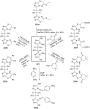
Scheme 60: Synthesis of functionalized 1,2-bis(1,2,4-triazol-3-yl)ethane-1,2-diols 223a–f.

Scheme 61: Synthesis of acyclic double-headed 1,2,4-triazino[5,6-b]indole C-nucleosides 226–231.
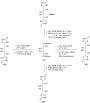
Scheme 62: Synthesis of double-headed 1,3,4-thiadiazoline, 1,3,4-oxadiazoline, and 1,2,4-triazoline acyclo C-n...

Scheme 63: Synthesis of double-headed acyclo C-nucleosides 240–242.

Scheme 64: Synthesis of double-headed acyclo C-nucleoside 246.

Scheme 65: Synthesis of acyclo double-headed nucleoside 250.

Scheme 66: Synthesis of acyclo double-headed nucleoside 253.

Scheme 67: Synthesis of acyclo double-headed nucleosides 259a–d.

Scheme 68: Synthesis of acyclo double-headed nucleoside 261.
A comprehensive review of flow chemistry techniques tailored to the flavours and fragrances industries
- Guido Gambacorta,
- James S. Sharley and
- Ian R. Baxendale
Beilstein J. Org. Chem. 2021, 17, 1181–1312, doi:10.3762/bjoc.17.90
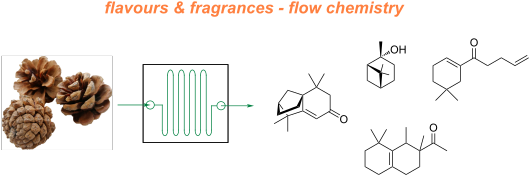

Graphical Abstract

Figure 1: Representative shares of the global F&F market (2018) segmented on their applications [1].

Figure 2: General structure of an international fragrance company [2].

Figure 3: The Michael Edwards fragrance wheel.

Figure 4: Examples of oriental (1–3), woody (4–7), fresh (8–10), and floral (11 and 12) notes.

Figure 5: A basic depiction of batch vs flow.

Scheme 1: Examples of reactions for which flow processing outperforms batch.

Scheme 2: Some industrially important aldol-based transformations.

Scheme 3: Biphasic continuous aldol reactions of acetone and various aldehydes.

Scheme 4: Aldol synthesis of 43 in flow using LiHMDS as the base.

Scheme 5: A semi-continuous synthesis of doravirine (49) involving a key aldol reaction.

Scheme 6: Enantioselective aldol reaction using 5-(pyrrolidin-2-yl)tetrazole (51) as catalyst in a microreact...

Scheme 7: Gröger's example of asymmetric aldol reaction in aqueous media.

Figure 6: Immobilised reagent column reactor types.

Scheme 8: Photoinduced thiol–ene coupling preparation of silica-supported 5-(pyrrolidin-2-yl)tetrazole 63 and...

Scheme 9: Continuous-flow approach for enantioselective aldol reactions using the supported catalyst 67.

Scheme 10: Ötvös’ employment of a solid-supported peptide aldol catalyst in flow.

Scheme 11: The use of proline tetrazole packed in a column for aldol reaction between cyclohexanone (65) and 2...

Scheme 12: Schematic diagram of an aminosilane-grafted Si-Zr-Ti/PAI-HF reactor for continuous-flow aldol and n...

Scheme 13: Continuous-flow condensation for the synthesis of the intermediate 76 to nabumetone (77) and Microi...

Scheme 14: Synthesis of ψ-Ionone (80) in continuous-flow via aldol condensation between citral (79) and aceton...

Scheme 15: Synthesis of β-methyl-ionones (83) from citral (79) in flow. The steps are separately described, an...

Scheme 16: Continuous-flow synthesis of 85 from 84 described by Gavriilidis et al.

Scheme 17: Continuous-flow scCO2 apparatus for the synthesis of 2-methylpentanal (87) and the self-condensed u...

Scheme 18: Chen’s two-step flow synthesis of coumarin (90).

Scheme 19: Pechmann condensation for the synthesis of 7-hydroxyxcoumarin (93) in flow. The setup extended to c...

Scheme 20: Synthesis of the dihydrojasmonate 35 exploiting nitro derivative proposed by Ballini et al.

Scheme 21: Silica-supported amines as heterogeneous catalyst for nitroaldol condensation in flow.

Scheme 22: Flow apparatus for the nitroaldol condensation of p-hydroxybenzaldehyde (102) to nitrostyrene 103 a...

Scheme 23: Nitroaldol reaction of 64 to 105 employing a quaternary ammonium functionalised PANF.

Scheme 24: Enantioselective nitroaldol condensation for the synthesis of 108 under flow conditions.

Scheme 25: Enatioselective synthesis of 1,2-aminoalcohol 110 via a copper-catalysed nitroaldol condensation.

Scheme 26: Examples of Knoevenagel condensations applied for fragrance components.

Scheme 27: Flow apparatus for Knoevenagel condensation described in 1989 by Venturello et al.

Scheme 28: Knoevenagel reaction using a coated multichannel membrane microreactor.

Scheme 29: Continuous-flow apparatus for Knoevenagel condensation employing sugar cane bagasse as support deve...

Scheme 30: Knoevenagel reaction for the synthesis of 131–135 in flow using an amine-functionalised silica gel. ...

Scheme 31: Continuous-flow synthesis of compound 137, a key intermediate for the synthesis of pregabalin (138)...
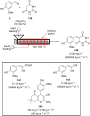
Scheme 32: Continuous solvent-free apparatus applied for the synthesis of compounds 140–143 using a TSE. Throu...

Scheme 33: Lewis et al. developed a spinning disc reactor for Darzens condensation of 144 and a ketone to furn...

Scheme 34: Some key industrial applications of conjugate additions in the F&F industry.

Scheme 35: Continuous-flow synthesis of 4-(2-hydroxyethyl)thiomorpholine 1,1-dioxide (156) via double conjugat...

Scheme 36: Continuous-flow system for Michael addition using CsF on alumina as the catalyst.

Scheme 37: Calcium chloride-catalysed asymmetric Michael addition using an immobilised chiral ligand.

Scheme 38: Continuous multistep synthesis for the preparation of (R)-rolipram (173). Si-NH2: primary amine-fun...

Scheme 39: Continuous-flow Michael addition using ion exchange resin Amberlyst® A26.

Scheme 40: Preparation of the heterogeneous catalyst 181 developed by Paixão et al. exploiting Ugi multicompon...

Scheme 41: Continuous-flow system developed by the Paixão’s group for the preparation of Michael asymmetric ad...

Scheme 42: Continuous-flow synthesis of nitroaldols catalysed by supported catalyst 184 developed by Wennemers...

Scheme 43: Heterogenous polystyrene-supported catalysts developed by Pericàs and co-workers.

Scheme 44: PANF-supported pyrrolidine catalyst for the conjugate addition of cyclohexanone (65) and trans-β-ni...

Scheme 45: Synthesis of (−)-paroxetine precursor 195 developed by Ötvös, Pericàs, and Kappe.

Scheme 46: Continuous-flow approach for the 5-step synthesis of (−)-oseltamivir (201) as devised by Hayashi an...

Scheme 47: Continuous-flow enzyme-catalysed Michael addition.

Scheme 48: Continuous-flow copper-catalysed 1,4 conjugate addition of Grignard reagents to enones. Reprinted w...

Scheme 49: A collection of commonly encountered hydrogenation reactions.

Figure 7: The ThalesNano H-Cube® continuous-flow hydrogenator.

Scheme 50: Chemoselective reduction of an α,β-unsaturated ketone using the H-Cube® reactor.

Scheme 51: Incorporation of Lindlar’s catalyst into the H-Cube® reactor for the reduction of an alkyne.

Scheme 52: Continuous-flow semi-hydrogenation of alkyne 208 to 209 using SACs with H-Cube® system.

Figure 8: The standard setups for tube-in-tube gas–liquid reactor units.

Scheme 53: Homogeneous hydrogenation of olefins using a tube-in-tube reactor setup.
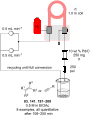
Scheme 54: Recyclable heterogeneous flow hydrogenation system.

Scheme 55: Leadbeater’s reverse tube-in-tube hydrogenation system for olefin reductions.

Scheme 56: a) Hydrogenation using a Pd-immobilised microchannel reactor (MCR) and b) a representation of the i...

Scheme 57: Hydrogenation of alkyne 238 exploiting segmented flow in a Pd-immobilised capillary reactor.

Scheme 58: Continuous hydrogenation system for the preparation of cyrene (241) from (−)-levoglucosenone (240).

Scheme 59: Continuous hydrogenation system based on CSMs developed by Hornung et al.

Scheme 60: Chemoselective reduction of carbonyls (ketones over aldehydes) in flow.

Scheme 61: Continuous system for the semi-hydrogenation of 256 and 258, developed by Galarneau et al.

Scheme 62: Continuous synthesis of biodiesel fuel 261 from lignin-derived furfural acetone (260).

Scheme 63: Continuous synthesis of γ-valerolacetone (263) via CTH developed by Pineda et al.

Scheme 64: Continuous hydrogenation of lignin-derived biomass (products 265, 266, and 267) using a sustainable...

Scheme 65: Ru/C or Rh/C-catalysed hydrogenation of arene in flow as developed by Sajiki et al.

Scheme 66: Polysilane-immobilized Rh–Pt-catalysed hydrogenation of arenes in flow by Kobayashi et al.

Scheme 67: High-pressure in-line mixing of H2 for the asymmetric reduction of 278 at pilot scale with a 73 L p...
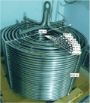
Figure 9: Picture of the PFR employed at Eli Lilly & Co. for the continuous hydrogenation of 278 [287]. Reprinted ...

Scheme 68: Continuous-flow asymmetric hydrogenation using Oppolzer's sultam 280 as chiral auxiliary.
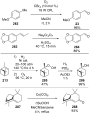
Scheme 69: Some examples of industrially important oxidation reactions in the F&F industry. CFL: compact fluor...

Scheme 70: Gold-catalysed heterogeneous oxidation of alcohols in flow.
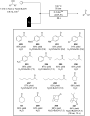
Scheme 71: Uozumi’s ARP-Pt flow oxidation protocol.

Scheme 72: High-throughput screening of aldehyde oxidation in flow using an in-line GC.

Scheme 73: Permanganate-mediated Nef oxidation of nitroalkanes in flow with the use of in-line sonication to p...

Scheme 74: Continuous-flow aerobic anti-Markovnikov Wacker oxidation.

Scheme 75: Continuous-flow oxidation of 2-benzylpyridine (312) using air as the oxidant.

Scheme 76: Continuous-flow photo-oxygenation of monoterpenes.

Scheme 77: A tubular reactor design for flow photo-oxygenation.

Scheme 78: Glucose oxidase (GOx)-mediated continuous oxidation of glucose using compressed air and the FFMR re...

Scheme 79: Schematic continuous-flow sodium hypochlorite/TEMPO oxidation of alcohols.

Scheme 80: Oxidation using immobilised TEMPO (344) was developed by McQuade et al.

Scheme 81: General protocol for the bleach/catalytic TBAB oxidation of aldehydes and alcohols.

Scheme 82: Continuous-flow PTC-assisted oxidation using hydrogen peroxide. The process was easily scaled up by...

Scheme 83: Continuous-flow epoxidation of cyclohexene (348) and in situ preparation of m-CPBA.

Scheme 84: Continuous-flow epoxidation using DMDO as oxidant.

Scheme 85: Mukayama aerobic epoxidation optimised in flow mode by the Favre-Réguillon group.

Scheme 86: Continuous-flow asymmetric epoxidation of derivatives of 359 exploiting a biomimetic iron catalyst.

Scheme 87: Continuous-flow enzymatic epoxidation of alkenes developed by Watts et al.

Scheme 88: Engineered multichannel microreactor for continuous-flow ozonolysis of 366.

Scheme 89: Continuous-flow synthesis of the vitamin D precursor 368 using multichannel microreactors. MFC: mas...

Scheme 90: Continuous ozonolysis setup used by Kappe et al. for the synthesis of various substrates employing ...

Scheme 91: Continuous-flow apparatus for ozonolysis as developed by Ley et al.

Scheme 92: Continuous-flow ozonolysis for synthesis of vanillin (2) using a film-shear flow reactor.

Scheme 93: Examples of preparative methods for ajoene (386) and allicin (388).

Scheme 94: Continuous-flow oxidation of thioanisole (389) using styrene-based polymer-supported peroxytungstat...

Scheme 95: Continuous oxidation of thiosulfinates using Oxone®-packed reactor.

Scheme 96: Continuous-flow electrochemical oxidation of thioethers.

Scheme 97: Continuous-flow oxidation of 400 to cinnamophenone (235).

Scheme 98: Continuous-flow synthesis of dehydrated material 401 via oxidation of methyl dihydrojasmonate (33).

Scheme 99: Some industrially important transformations involving Grignard reagents.

Scheme 100: Grachev et al. apparatus for continuous preparation of Grignard reagents.

Scheme 101: Example of fluidized Mg bed reactor with NMR spectrometer as on-line monitoring system.

Scheme 102: Continuous-flow synthesis of Grignard reagents and subsequent quenching reaction.

Figure 10: Membrane-based, liquid–liquid separator with integrated pressure control [52]. Adapted with permission ...

Scheme 103: Continuous-flow synthesis of 458, an intermediate to fluconazole (459).

Scheme 104: Continuous-flow synthesis of ketones starting from benzoyl chlorides.

Scheme 105: A Grignard alkylation combining CSTR and PFR technologies with in-line infrared reaction monitoring....

Scheme 106: Continuous-flow preparation of 469 from Grignard addition of methylmagnesium bromide.

Scheme 107: Continuous-flow synthesis of Grignard reagents 471.

Scheme 108: Preparation of the Grignard reagent 471 using CSTR and the continuous process for synthesis of the ...

Scheme 109: Continuous process for carboxylation of Grignard reagents in flow using tube-in-tube technology.

Scheme 110: Continuous synthesis of propargylic alcohols via ethynyl-Grignard reagent.

Scheme 111: Silica-supported catalysed enantioselective arylation of aldehydes using Grignard reagents in flow ...

Scheme 112: Acid-catalysed rearrangement of citral and dehydrolinalool derivatives.

Scheme 113: Continuous stilbene isomerisation with continuous recycling of photoredox catalyst.

Scheme 114: Continuous-flow synthesis of compound 494 as developed by Ley et al.

Scheme 115: Selected industrial applications of DA reaction.

Scheme 116: Multistep flow synthesis of the spirocyclic structure 505 via employing DA cycloaddition.

Scheme 117: Continuous-flow DA reaction developed in a plater flow reactor for the preparation of the adduct 508...

Scheme 118: Continuous-flow DA reaction using a silica-supported imidazolidinone organocatalyst.

Scheme 119: Batch vs flow for the DA reaction of (cyclohexa-1,5-dien-1-yloxy)trimethylsilane (513) with acrylon...

Scheme 120: Continuous-flow DA reaction between 510 and 515 using a shell-core droplet system.

Scheme 121: Continuous-flow synthesis of bicyclic systems from benzyne precursors.

Scheme 122: Continuous-flow synthesis of bicyclic scaffolds 527 and 528 for further development of potential ph...

Scheme 123: Continuous-flow inverse-electron hetero-DA reaction to pyridine derivatives such as 531.

Scheme 124: Comparison between batch and flow for the synthesis of pyrimidinones 532–536 via retro-DA reaction ...

Scheme 125: Continuous-flow coupled with ultrasonic system for preparation of ʟ-ascorbic acid derivatives 539 d...

Scheme 126: Two-step continuous-flow synthesis of triazole 543.

Scheme 127: Continuous-flow preparation of triazoles via CuAAC employing 546-based heterogeneous catalyst.

Scheme 128: Continuous-flow synthesis of compounds 558 through A3-coupling and 560 via AgAAC both employing the...

Scheme 129: Continuous-flow photoinduced [2 + 2] cycloaddition for the preparation of bicyclic derivatives of 5...

Scheme 130: Continuous-flow [2 + 2] and [5 + 2] cycloaddition on large scale employing a flow reactor developed...

Scheme 131: Continuous-flow preparation of the tricyclic structures 573 and 574 starting from pyrrole 570 via [...

Scheme 132: Continuous-flow [2 + 2] photocyclization of cinnamates.

Scheme 133: Continuous-flow preparation of cyclobutane 580 on a 5-plates photoreactor.

Scheme 134: Continuous-flow [2 + 2] photocycloaddition under white LED lamp using heterogeneous PCN as photocat...

Figure 11: Picture of the parallel tube flow reactor (PTFR) "The Firefly" developed by Booker-Milburn et al. a...

Scheme 135: Continuous-flow acid-catalysed [2 + 2] cycloaddition between silyl enol ethers and acrylic esters.

Scheme 136: Continuous synthesis of lactam 602 using glass column reactors.

Scheme 137: In situ generation of ketenes for the Staudinger lactam synthesis developed by Ley and Hafner.

Scheme 138: Application of [2 + 2 + 2] cycloadditions in flow employed by Ley et al.

Scheme 139: Examples of FC reactions applied in F&F industry.

Scheme 140: Continuous-flow synthesis of ibuprofen developed by McQuade et al.

Scheme 141: The FC acylation step of Jamison’s three-step ibuprofen synthesis.

Scheme 142: Synthesis of naphthalene derivative 629 via FC acylation in microreactors.

Scheme 143: Flow system for rapid screening of catalysts and reaction conditions developed by Weber et al.

Scheme 144: Continuous-flow system developed by Buorne, Muller et al. for DSD optimisation of the FC acylation ...

Scheme 145: Continuous-flow FC acylation of alkynes to yield β-chlorovinyl ketones such as 638.

Scheme 146: Continuous-flow synthesis of tonalide (619) developed by Wang et al.

Scheme 147: Continuous-flow preparation of acylated arene such as 290 employing Zr4+-β-zeolite developed by Kob...

Scheme 148: Flow system applied on an Aza-FC reaction catalysed by the thiourea catalyst 648.

Scheme 149: Continuous hydroformylation in scCO2.

Scheme 150: Two-step flow synthesis of aldehyde 655 through a sequential Heck reaction and subsequent hydroform...

Scheme 151: Single-droplet (above) and continuous (below) flow reactors developed by Abolhasani et al. for the ...

Scheme 152: Continuous hydroformylation of 1-dodecene (655) using a PFR-CSTR system developed by Sundmacher et ...

Scheme 153: Continuous-flow synthesis of the aldehyde 660 developed by Eli Lilly & Co. [32]. Adapted with permissio...

Scheme 154: Continuous asymmetric hydroformylation employing heterogenous catalst supported on carbon-based sup...

Scheme 155: Examples of acetylation in F&F industry: synthesis of bornyl (S,R,S-664) and isobornyl (S,S,S-664) ...

Scheme 156: Continuous-flow preparation of bornyl acetate (S,R,S-664) employing the oscillating flow reactor.

Scheme 157: Continuous-flow synthesis of geranyl acetate (666) from acetylation of geraniol (343) developed by ...

Scheme 158: 12-Ttungstosilicic acid-supported silica monolith-catalysed acetylation in flow.

Scheme 159: Continuous-flow preparation of cyclopentenone 676.

Scheme 160: Two-stage synthesis of coumarin (90) via acetylation of salicylaldehyde (88).

Scheme 161: Intensification process for acetylation of 5-methoxytryptamine (677) to melatonin (678) developed b...

Scheme 162: Examples of macrocyclic musky odorants both natural (679–681) and synthetic (682 and 683).

Scheme 163: Flow setup combined with microwave for the synthesis of macrocycle 686 via RCM.

Scheme 164: Continuous synthesis of 2,5-dihydro-1H-pyrroles via ring-closing metathesis.

Scheme 165: Continuous-flow metathesis of 485 developed by Leadbeater et al.

Figure 12: Comparison between RCM performed using different routes for the preparation of 696. On the left the...

Scheme 166: Continuous-flow RCM of 697 employed the solid-supported catalyst 698 developed by Grela, Kirschning...

Scheme 167: Continuous-flow RORCM of cyclooctene employing the silica-absorbed catalyst 700.

Scheme 168: Continuous-flow self-metathesis of methyl oleate (703) employing SILP catalyst 704.

Scheme 169: Flow apparatus for the RCM of 697 using a nanofiltration membrane for the recovery and reuse of the...

Scheme 170: Comparison of loadings between RCMs performed with different routes for the synthesis of 709.
N-tert-Butanesulfinyl imines in the asymmetric synthesis of nitrogen-containing heterocycles
- Joseane A. Mendes,
- Paulo R. R. Costa,
- Miguel Yus,
- Francisco Foubelo and
- Camilla D. Buarque
Beilstein J. Org. Chem. 2021, 17, 1096–1140, doi:10.3762/bjoc.17.86

- tetrahydroquinoline alkaloids (−)-angustureine (107) and (−)-cuspareine (108) reported by Sirvent et al. [119]. The diastereoselective addition of a Grignard reagent was a key step in this methodology. The addition proceeded with high diastereoselectivity in toluene, and the attack of the Grignard reagent occurred on
- N-methylation led to (−)-angustureine (107) in high overall yield (Scheme 31). The same methodology was applied to the synthesis of (−)-cuspareine (108), starting in this case from enantiomeric imine (RS)-104b, and using 2-(3,4-dimethoxyphenyl)ethylmagnesium bromide as Grignard reagent. A
- the Grignard reagent in this synthesis, with a 18% overall yield after seven steps from aldimine ent-126 (Scheme 35) [125]. The reaction of chiral α-siloxyl imine (SS)-126 with enolates derived from methyl ketones 131 was also investigated. The enolate was formed with LDA at −78 °C and reacted at the

Graphical Abstract

Scheme 1: General strategy for the enantioselective synthesis of N-containing heterocycles from N-tert-butane...

Scheme 2: Methodologies for condensation of aldehydes and ketones with tert-butanesulfinamides (1).

Scheme 3: Transition models for cis-aziridines and trans-aziridines.

Scheme 4: Mechanism for the reduction of N-tert-butanesulfinyl imines.

Scheme 5: Transition models for the addition of organomagnesium and organolithium compounds to N-tert-butanes...

Scheme 6: Synthesis of 2,2-dibromoaziridines 15 from aldimines 14 and bromoform, and proposed non-chelation-c...

Scheme 7: Diastereoselective synthesis of aziridines from tert-butanesulfinyl imines.

Scheme 8: Synthesis of vinylaziridines 22 from aldimines 14 and 1,3-dibromopropene 23, and proposed chelation...

Scheme 9: Synthesis of vinylaziridines 27 from aldimines 14 and α-bromoesters 26, and proposed transition sta...

Scheme 10: Synthesis of 2-chloroaziridines 28 from aldimines 14 and dichloromethane, and proposed transition s...

Scheme 11: Synthesis of cis-vinylaziridines 30 and 31 from aldimines 14 and bromomethylbutenolide 29.

Scheme 12: Synthesis of 2-chloro-2-aroylaziridines 36 and 32 from aldimines 14, arylnitriles 34, and silyldich...

Scheme 13: Synthesis of trifluoromethylaziridines 39 and proposed transition state of the aziridination.

Scheme 14: Synthesis of aziridines 42 and proposed state transition.

Scheme 15: Synthesis of 1-substituted 2-azaspiro[3.3]heptanes, 1-phenyl-2-azaspiro[3.4]octane and 1-phenyl-2-a...

Scheme 16: Synthesis of 1-substituted 2,6-diazaspiro[3.3]heptanes 48 from chiral imines 14 and 1-Boc-azetidine...

Scheme 17: Synthesis of β-lactams 52 from chiral imines 14 and dimethyl malonate (49).

Scheme 18: Synthesis of spiro-β-lactam 57 from chiral (RS)-N-tert-butanesulfinyl isatin ketimine 53 and ethyl ...

Scheme 19: Synthesis of β-lactam 60, a precursor of (−)-batzelladine D (61) and (−)-13-epi-batzelladine D (62)...

Scheme 20: Rhodium-catalyzed asymmetric synthesis of 3-substituted pyrrolidines 66 from chiral imine (RS)-63 a...

Scheme 21: Asymmetric synthesis of 1,3-disubstituted isoindolines 69 and 70 from chiral imine 67.

Scheme 22: Asymmetric synthesis of cis-2,5-disubstituted pyrrolidines 73 from chiral imine (RS)-71.

Scheme 23: Asymmetric synthesis of 3-hydroxy-5-substituted pyrrolidin-2-ones 77 from chiral imine (RS)-74.

Scheme 24: Asymmetric synthesis of 4-hydroxy-5-substituted pyrrolidin-2-ones 80 from chiral imines 79.

Scheme 25: Asymmetric synthesis of 3-pyrrolines 82 from chiral imines 14 and ethyl 4-bromocrotonate (81).

Scheme 26: Asymmetric synthesis of γ-amino esters 84, and tetramic acid derivative 86 from chiral imines (RS)-...

Scheme 27: Asymmetric synthesis of α-methylene-γ-butyrolactams 90 from chiral imines (Z,SS)-87 and ethyl 2-bro...

Scheme 28: Asymmetric synthesis of methylenepyrrolidines 92 from chiral imines (RS)-14 and 2-(trimethysilylmet...

Scheme 29: Synthesis of dibenzoazaspirodecanes from cyclic N-tert-butanesulfinyl imines.

Scheme 30: Stereoselective synthesis of cyclopenta[c]proline derivatives 103 from β,γ-unsaturated α-amino acid...

Scheme 31: Stereoselective synthesis of alkaloids (−)-angustureine (107) and (−)-cuspareine (108).

Scheme 32: Stereoselective synthesis of alkaloids (−)-pelletierine (112) and (+)-coniine (117).

Scheme 33: Synthesis of piperidine alkaloids (+)-dihydropinidine (122a), (+)-isosolenopsin (122b) and (+)-isos...

Scheme 34: Stereoselective synthesis of the alkaloids(+)-sedamine (125) from chiral imine (SS)-119.

Scheme 35: Stereoselective synthesis of trans-5-hydroxy-6-substituted-2-piperidinones 127 and 129 from chiral ...

Scheme 36: Stereoselective synthesis of trans-5-hydroxy-6-substituted ethanone-2-piperidinones 132 from chiral...

Scheme 37: Stereoselective synthesis of trans-3-benzyl-5-hydroxy-6-substituted-2-piperidinones 136 from chiral...

Scheme 38: Stereoselective synthesis of trans-5-hydroxy-6-substituted 2-piperidinones 139 from chiral imine 138...

Scheme 39: Stereoselective synthesis of ʟ-hydroxypipecolic acid 145 from chiral imine 144.

Scheme 40: Synthesis of 1-substituted isoquinolones 147, 149 and 151.

Scheme 41: Stereoselective synthesis of 3-substituted dihydrobenzo[de]isoquinolinones 154.

Scheme 42: Enantioselective synthesis of alkaloids (S)-1-benzyl-6,7-dimethoxy-1,2,3,4-tetrahydroisoquinoline (...

Scheme 43: Enantioselective synthesis of alkaloids (−)-cermizine B (171) and (+)-serratezomine E (172) develop...

Scheme 44: Stereoselective synthesis of (+)-isosolepnosin (177) and (+)-solepnosin (178) from homoallylamine d...

Scheme 45: Stereoselective synthesis of tetrahydroquinoline derivatives 184, 185 and 187 from chiral imines (RS...

Scheme 46: Stereoselective synthesis of pyridobenzofuran and pyridoindole derivatives 193 from homopropargylam...

Scheme 47: Stereoselective synthesis of 2-substituted 1,2,5,6-tetrahydropyridines 196 from chiral imines (RS)-...

Scheme 48: Stereoselective synthesis of 2-substituted trans-2,6-disubstituted piperidine 199 from chiral imine...

Scheme 49: Stereoselective synthesis of cis-2,6-disubstituted piperidines 200, and alkaloid (+)-241D, from chi...

Scheme 50: Stereoselective synthesis of 6-substituted piperidines-2,5-diones 206 and 1,7-diazaspiro[4.5]decane...

Scheme 51: Stereoselective synthesis of spirocyclic oxindoles 210 from chiral imines (RS)-53.

Scheme 52: Stereoselective synthesis of azaspiro compound 213 from chiral imine 211.

Scheme 53: Stereoselective synthesis of tetrahydroisoquinoline derivatives from chiral imines (RS)-214.

Scheme 54: Stereoselective synthesis of (−)-crispine A 223 from chiral imine (RS)-214.

Scheme 55: Synthesis of (−)-harmicine (228) using tert-butanesulfinamide through haloamide cyclization.

Scheme 56: Stereoselective synthesis of tetraponerines T1–T8.

Scheme 57: Stereoselective synthesis of phenanthroindolizidines 246a and (−)-tylophorine (246b), and phenanthr...

Scheme 58: Stereoselective synthesis of indoline, tetrahydroquinoline and tetrahydrobenzazepine derivatives 253...

Scheme 59: Stereoselective synthesis of (+)-epohelmin A (258) and (+)-epohelmin B (260) from aldimine (RS)-79.

Scheme 60: Stereoselective synthesis of (−)-epiquinamide (266) from chiral aldimine (SS)-261.

Scheme 61: Synthesis synthesis of (–)-hippodamine (273) and (+)-epi-hippodamine (272) using chiral sulfinyl am...

Scheme 62: Stereoselective synthesis of (+)-grandisine D (279) and (+)-amabiline (283).

Scheme 63: Stereoselective synthesis of (−)-epiquinamide (266) and (+)-swaisonine (291) from aldimine (SS)-126....

Scheme 64: Stereoselective synthesis of (+)-C(9a)-epi-epiquinamide (294).

Scheme 65: Stereoselective synthesis of (+)-lasubine II (298) from chiral aldimine (SS)-109.

Scheme 66: Stereoselective synthesis of (−)-epimyrtine (300a) and (−)-lasubine II (ent-302) from β-amino keton...

Scheme 67: Stereoselective synthesis of (−)-tabersonine (310), (−)-vincadifformine (311), and (−)-aspidospermi...

Scheme 68: Stereoselective synthesis of (+)-epohelmin A (258) and (+)-epohelmin B (260) from aldehyde 313 and ...

Scheme 69: Total synthesis of (+)-lysergic acid (323) from N-tert-butanesulfinamide (RS)-1.
Synthetic strategies of phosphonodepsipeptides
- Jiaxi Xu
Beilstein J. Org. Chem. 2021, 17, 461–484, doi:10.3762/bjoc.17.41
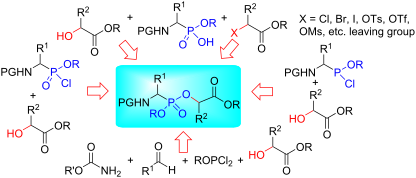
- were in situ generated from the hydroxypeptide esters 46 with a Grignard reagent (Scheme 8) [24]. To minimize the side reactions of 1-aminoalkylphosphonochloridates, a convenient method for the synthesis of phosphonodepsipeptides was described. The N-Cbz-protected 2-aminoalkylphosphinates 50 were

Graphical Abstract

Figure 1: Phosphonopeptides, phosphonodepsipeptides, peptides, and depsipeptides.

Figure 2: The diverse strategies for phosphonodepsipeptide synthesis.

Scheme 1: Synthesis of α-phosphonodepsidipeptides as inhibitors of leucine aminopeptidase.

Figure 3: Structure of 2-hydroxy-2-oxo-3-[(phenoxyacetyl)amino]-1,2-oxaphosphorinane-6-carboxylic acid (16).

Scheme 2: Synthesis of α-phosphonodepsidipeptide 17 as coupling partner for cyclen-containing phosphonodepsip...

Scheme 3: Synthesis of α-phosphonodepsidipeptides containing enantiopure hydroxy ester as VanX inhibitors.

Scheme 4: Synthesis of α-phosphonodepsidipeptides as VanX inhibitors.

Scheme 5: Synthesis of optically active α-phosphonodepsidipeptides as VanX inhibitors.

Scheme 6: The synthesis of phosphonodepsipeptides through a thionyl chloride-catalyzed esterification of N-Cb...

Scheme 7: Synthesis of α-phosphinodipeptidamide as a hapten.

Scheme 8: Synthesis of α-phosphonodepsioctapeptide 41.

Scheme 9: Synthesis of phosphonodepsipeptides via an in situ-generated phosphonochloridate.

Scheme 10: Synthesis of α-phosphonodepsitetrapeptides 58 as inhibitors of the aspartic peptidase pepsin.

Scheme 11: Synthesis of a β-phosphonodepsidipeptide library 64.

Scheme 12: Synthesis of another β-phosphonodepsidipeptide library.

Scheme 13: Synthesis of γ-phosphonodepsidipeptides.

Scheme 14: Synthesis of phosphonodepsipeptides 85 as folylpolyglutamate synthetase inhibitors.

Scheme 15: Synthesis of the γ-phosphonodepsitripeptide 95 as an inhibitor of γ-gutamyl transpeptidase.

Scheme 16: Synthesis of phosphonodepsipeptides as inhibitors and probes of γ-glutamyl transpeptidase.

Scheme 17: Synthesis of phosphonyl depsipeptides 108 via DCC-mediated condensation and oxidation.

Scheme 18: Synthesis of phosphonodepsipeptides 111 with BOP and PyBOP as coupling reagents.

Scheme 19: Synthesis of optically active phosphonodepsipeptides with BOP and PyBOP as coupling reagents.

Scheme 20: Synthesis of phosphonodepsipeptides with BroP and TPyCIU as coupling reagents.

Scheme 21: Synthesis of a phosphonodepsipeptide hapten with BOP as coupling reagent.

Scheme 22: Synthesis of phosphonodepsitripeptide with BOP as coupling reagent.

Scheme 23: Synthesis of norleucine-derived phosphonodepsipeptides 135 and 138.

Scheme 24: Synthesis of norleucine-derived phosphonodepsipeptides 141 and 144.

Scheme 25: Solid-phase synthesis of phosphonodepsipeptides.

Scheme 26: Synthesis of phosphonodepsidipeptides via the Mitsunobu reaction.

Scheme 27: Synthesis of γ-phosphonodepsipeptide via the Mitsunobu reaction.

Scheme 28: Synthesis of phosphonodepsipeptides via a multicomponent condensation reaction.

Scheme 29: Synthesis of phosphonodepsipeptides with a functionalized side-chain via a multicomponent condensat...

Scheme 30: High yielding synthesis of phosphonodepsipeptides via a multicomponent condensation.

Scheme 31: Synthesis of optically active phosphonodepsipeptides via a multicomponent condensation reaction.

Scheme 32: Synthesis of N-phosphoryl phosphonodepsipeptides.

Scheme 33: Synthesis of phosphonodepsipeptides via the alkylation of phosphonic monoesters.

Scheme 34: Synthesis of phosphonodepsipeptides as inhibitors of aspartic protease penicillopepsin.

Scheme 35: Synthesis of phosphonodepsipeptides as prodrugs.

Scheme 36: Synthesis of phosphonodepsithioxopeptides 198.

Scheme 37: Synthesis of phosphonodepsipeptides.

Scheme 38: Synthesis of phosphonodepsipeptides with C-1-hydroxyalkylphosphonic acid.

Scheme 39: Synthesis of phosphonodepsipeptides with C-1-hydroxyalkylphosphonate via the rhodium-catalyzed carb...

Scheme 40: Synthesis of phosphonodepsipeptides with a C-1-hydroxyalkylphosphonate motif via a copper-catalyzed...
Recent progress in the synthesis of homotropane alkaloids adaline, euphococcinine and N-methyleuphococcinine
- Dimas J. P. Lima,
- Antonio E. G. Santana,
- Michael A. Birkett and
- Ricardo S. Porto
Beilstein J. Org. Chem. 2021, 17, 28–41, doi:10.3762/bjoc.17.4
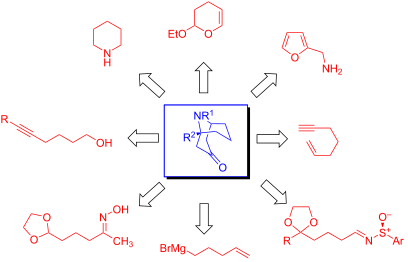
- –dehydration reactions, via intermediate anti-aldol (−)-67 (Scheme 8). The addition of Grignard reagent to the enone (E)-(−)-68 occurred anti to the group TpMo(CO)2 to give adduct (E)-69, which was used in the next step without purification. The treatment of this adduct with HCl in dioxane promoted

Graphical Abstract

Figure 1: Homotropane (azabicyclononane) systems.

Figure 2: Alkaloids (−)-adaline (1), (+)-euphococcinine (2) and (+)-N-methyleuphococcinine (3).

Scheme 1: Synthetic strategies before 1995.

Scheme 2: Synthesis (±)-adaline (1) and (±)-euphococcinine (2). Reagents and conditions: i) 1. dihydropyran, ...

Scheme 3: Synthesis (+)-euphococcinine (2). Reagents and conditions: i) H2O2, SeO2 (cat), acetone, rt, 88%; i...

Scheme 4: Synthesis (+)-euphococcinine (2). Reagents and conditions: i) 2,4-bis(4-phenoxyphenyl)-1,3-dithia-2...

Scheme 5: Synthesis of (±)-euphococcinine precursor (±)-42. Reagents and conditions: i) Bu3SnH, AIBN, toluene...

Scheme 6: Synthesis of (−)-adaline (1). Reagents and conditions: i) LiH2NBH3, THF, 40 °C, 88%; ii) TPAP, NMO,...

Scheme 7: Synthesis of (−)-adaline (1) and (−)-euphococcinine (2). Reagents and conditions: i) 1. BuLi, t-BuO...

Scheme 8: Synthesis of (−)-adaline (1). Reagents and conditions: i) Ref. [52]; ii) Et3N, TBDMSOTf, CH2Cl2, 0 °C t...

Scheme 9: Synthesis of (+)-euphococcinine (2). Reagents and conditions: i) 1. Cp2ZrCl2,AlMe3, CH2Cl2; 2. p-me...

Scheme 10: Synthesis of (−)-adaline 1. Reagents and conditions: i) 1. CuBr.DMS, Et2O/DMS, -42 ºC; 2. 1-heptyne...

Scheme 11: Synthesis of (−)-euphococcinine (2) and (−)-adaline (1). Reagents and conditions: i) 102, KHMDS, Et2...

Scheme 12: Synthesis of N-methyleuphococcinine 3. Reagents and conditions: i) 108 (1.5 equiv), 3,5-di-F-C6H3B(...
3-Acetoxy-fatty acid isoprenyl esters from androconia of the ithomiine butterfly Ithomia salapia
- Florian Mann,
- Daiane Szczerbowski,
- Lisa de Silva,
- Melanie McClure,
- Marianne Elias and
- Stefan Schulz
Beilstein J. Org. Chem. 2020, 16, 2776–2787, doi:10.3762/bjoc.16.228
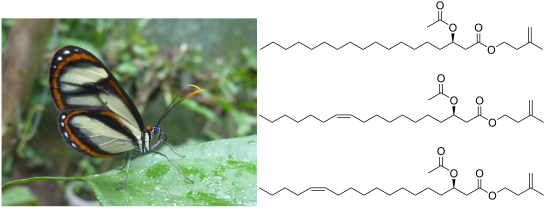
- ). A Wittig reaction with pentylphosphonium bromide resulted in bromoalkene 21 in a 9:1 Z/E-mixture. In the following step, the Grignard reagent of 21 was converted into the respective Gilman cuprate with Cu(I)I for the selective reaction with the epoxide function of (S)-22 [34]. The hydroxyester 23

Graphical Abstract

Figure 1: Extended hairs (arrow) of the androconia of a male Ithomia salapia aquinia (Photo: Melanie McClure)....

Scheme 1: Pyrrolizidine alkaloid lycopsamine (1) and the putative pheromone compounds methyl hydroxydanaidoat...

Scheme 2: Biosynthetic formation of hedycaryol (7) and α-elemol (8).

Figure 2: Total ion current chromatogram of androconial extracts of male butterflies of the two subspecies I....
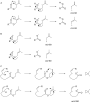
Figure 3: Proposed mass spectrometric formation of characteristic ions in prenyl and isoprenyl esters. Format...
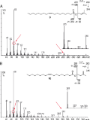
Figure 4: Mass spectra and fragmentation of A: isoprenyl (3-methyl-3-butenyl) 9-octadenoate (9) and B: prenyl...
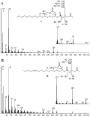
Figure 5: Mass spectra and fragmentation of A: isoprenyl 3-acetoxyoctadecanoate (11); B: isoprenyl (Z)-3-acet...

Scheme 3: Synthesis of isoprenyl 3-acetoxyoctadecanoate (11). a) IBX, EtOAc, 60 °C, 3.15 h, 99%; b) SnCl2, CH2...

Scheme 4: a) 48% HBraq, toluene, 24 h, 110 °C, 79%; b) IBX, EtOAc, 60 °C, 3.15 h, 90%; c) C5H11PPh3Br, LDA, T...
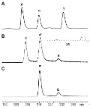
Figure 6: Separation of the enantiomers of methyl (Z)-3-hydroxy-13-octadecenoate (25) on a β-6-TBDMS hydrodex...

Scheme 5: Proposed biosynthetic pathway of fatty acids leading to the observed regioisomers of the isoprenyl ...
Disposable cartridge concept for the on-demand synthesis of turbo Grignards, Knochel–Hauser amides, and magnesium alkoxides
- Mateo Berton,
- Kevin Sheehan,
- Andrea Adamo and
- D. Tyler McQuade
Beilstein J. Org. Chem. 2020, 16, 1343–1356, doi:10.3762/bjoc.16.115
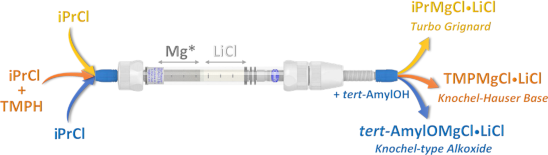
- fresh organomagnesium reagents on a discovery scale and will do so independent from the operator’s experience in flow and/or organometallic chemistry. Keywords: Knochel–Hauser base; lithium chloride; magnesium; on-demand; packed-bed reactors; plug and flow reactor; synthesizer; turbo Grignard reagent
- (1 M) at flow rates up to 15 L/h [42]. However, in these publications, alkyl chloride substrates, which are generally more cost-effective but less reactive than the corresponding bromide or iodide, are limited. Also, the use of a LiCl solution as the reaction medium to increase the Grignard reagent
- reutilization. For optimal results, 2 equivalents of Mg* (chips/powder, 1:1) and 2 equivalents of LiCl must be used at a single time. System scope: The bicomponent column was employed to obtain the turbo Grignard reagent [45] as well as sec- and n-butylmagnesium chloride–lithium chloride complexes as THF

Graphical Abstract

Figure 1: Comparing on-demand coffee and turbo Grignard pod-style machines.

Figure 2: Ranking of the 20 most cited Grignard reagents (SciFinder March 26, 2019).

Figure 3: On-demand prototype. A) Inside view of the pump with a flexible bag containing a yellow liquid layi...

Figure 4: Temperature evolution measured with thermocouples along the column outer surface at three different...

Figure 5: Stratified bicomponent column (Diba Omnifit EZ Solvent Plus) composed of magnesium (chips/powder, 1...

Scheme 1: Continuous flow synthesis of TMPMgCl⋅LiCl with a stratified packed-bed column of activated magnesiu...

Scheme 2: Continuous flow synthesis of TMPMgCl⋅LiBr with a stratified packed-bed column of activated magnesiu...

Scheme 3: Continuous flow synthesis of t-AmylOMgCl⋅LiCl with a stratified packed-bed column of activated magn...

Figure 6: Steady-state concentration stability during the conversion of iPrCl in THF (56 mL, 2.2 M) into iPrM...

Scheme 4: Synthesis of iPrMgCl⋅LiCl on the ODR prototype.

Scheme 5: Synthesis of HMDSMgCl⋅LiCl on the ODR prototype.
Recent advances in Cu-catalyzed C(sp3)–Si and C(sp3)–B bond formation
- Balaram S. Takale,
- Ruchita R. Thakore,
- Elham Etemadi-Davan and
- Bruce H. Lipshutz
Beilstein J. Org. Chem. 2020, 16, 691–737, doi:10.3762/bjoc.16.67
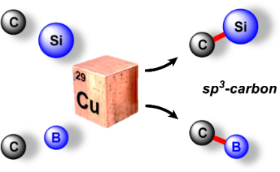
- an attempt to determine the existence of radical behavior of PhMe2Si-MgMe (2), they studied the reaction of this Grignard reagent with dodecyl tosylate (1, X = OTs), which led to the formation of dodecyl silane 3 (20%) along with tridecane 4 (3%) and dodecane 5 (36%). Similarly, dodecyl bromide (1, X
- Suginome’s reagent along with LiCl, which completely overrode the need for a Grignard reagent and led to good chemical yields of the desired product (e.g., 272). In one case examined, a bulky silyl Grignard reagent gave the linear silyl derivative selectively. In addition, a quaternary carbon bearing the

Graphical Abstract

Scheme 1: Pharmaceuticals possessing a silicon or boron atom.

Scheme 2: The first Cu-catalyzed C(sp3)–Si bond formation.

Scheme 3: Conversion of benzylic phosphate 6 to the corresponding silane.

Scheme 4: Conversion of alkyl triflates to alkylsilanes.

Scheme 5: Conversion of secondary alkyl triflates to alkylsilanes.

Scheme 6: Conversion of alkyl iodides to alkylsilanes.

Scheme 7: Trapping of intermediate radical through cascade reaction.

Scheme 8: Radical pathway for conversion of alkyl iodides to alkylsilanes.

Scheme 9: Conversion of alkyl ester of N-hydroxyphthalimide to alkylsilanes.

Scheme 10: Conversion of gem-dibromides to bis-silylalkanes.

Scheme 11: Conversion of imines to α-silylated amines (A) and the reaction pathway (B).

Scheme 12: Conversion of N-tosylimines to α-silylated amines.

Scheme 13: Screening of diamine ligands.

Scheme 14: Conversion of N-tert-butylsulfonylimines to α-silylated amines.

Scheme 15: Conversion of aldimines to nonracemic α-silylated amines.

Scheme 16: Conversion of N-tosylimines to α-silylated amines.

Scheme 17: Reaction pathway [A] and conversion of aldehydes to α-silylated alcohols [B].

Scheme 18: Conversion of aldehydes to benzhydryl silyl ethers.

Scheme 19: Conversion of ketones to 1,2-diols (A) and conversion of imines to 1,2-amino alcohols (B).

Scheme 20: Ligand screening (A) and conversion of aldehydes to α-silylated alcohols (B).

Scheme 21: Conversion of aldehydes to α-silylated alcohols.

Scheme 22: 1,4-Additions to α,β-unsaturated ketones.

Scheme 23: 1,4-Additions to unsaturated ketones to give β-silylated derivatives.

Scheme 24: Additions onto α,β-unsaturated lactones to give β-silylated lactones.

Scheme 25: Conversion of α,β-unsaturated to β-silylated lactams.

Scheme 26: Conversion of N-arylacrylamides to silylated oxindoles.

Scheme 27: Conversion of α,β-unsaturated carbonyl compounds to silylated tert-butylperoxides.

Scheme 28: Catalytic cycle for Cu(I) catalyzed α,β-unsaturated compounds.

Scheme 29: Conversion of p-quinone methides to benzylic silanes.

Scheme 30: Conversion of α,β-unsaturated ketimines to regio- and stereocontrolled allylic silanes.

Scheme 31: Conversion of α,β-unsaturated ketimines to enantioenriched allylic silanes.

Scheme 32: Regioselective conversion of dienedioates to allylic silanes.

Scheme 33: Conversion of alkenyl-substituted azaarenes to β-silylated adducts.

Scheme 34: Conversion of conjugated benzoxazoles to enantioenriched β-silylated adducts.

Scheme 35: Conversion of α,β-unsaturated carbonyl indoles to α-silylated N-alkylated indoles.

Scheme 36: Conversion of β-amidoacrylates to α-aminosilanes.

Scheme 37: Conversion of α,β-unsaturated ketones to enantioenriched β-silylated ketones, nitriles, and nitro d...

Scheme 38: Regio-divergent silacarboxylation of allenes.

Scheme 39: Silylation of diazocarbonyl compounds, (A) asymmetric and (B) racemic.

Scheme 40: Enantioselective hydrosilylation of alkenes.

Scheme 41: Conversion of 3-acylindoles to indolino-silanes.

Scheme 42: Proposed mechanism for the silylation of 3-acylindoles.

Scheme 43: Silyation of N-chlorosulfonamides.

Scheme 44: Conversion of acyl silanes to α-silyl alcohols.

Scheme 45: Conversion of N-tosylaziridines to β-silylated N-tosylamines.

Scheme 46: Conversion of N-tosylaziridines to silylated N-tosylamines.

Scheme 47: Conversion of 3,3-disubstituted cyclopropenes to silylated cyclopropanes.

Scheme 48: Conversion of conjugated enynes to 1,3-bis(silyl)propenes.

Scheme 49: Proposed sequence for the Cu-catalyzed borylation of substituted alkenes.

Scheme 50: Cu-catalyzed synthesis of nonracemic allylic boronates.

Scheme 51: Cu–NHC catalyzed synthesis of α-substituted allylboronates.

Scheme 52: Synthesis of α-chiral (γ-alkoxyallyl)boronates.

Scheme 53: Cu-mediated formation of nonracemic cis- or trans- 2-substituted cyclopropylboronates.

Scheme 54: Cu-catalyzed synthesis of γ,γ-gem-difluoroallylboronates.

Scheme 55: Cu-catalyzed hydrofunctionalization of internal alkenes and vinylarenes.

Scheme 56: Cu-catalyzed Markovnikov and anti-Markovnikov borylation of alkenes.

Scheme 57: Cu-catalyzed borylation/ortho-cyanation/Cope rearrangement.

Scheme 58: Borylfluoromethylation of alkenes.

Scheme 59: Cu-catalyzed synthesis of tertiary nonracemic alcohols.

Scheme 60: Synthesis of densely functionalized and synthetically versatile 1,2- or 4,3-borocyanated 1,3-butadi...

Scheme 61: Cu-catalyzed trifunctionalization of allenes.

Scheme 62: Cu-catalyzed selective arylborylation of arenes.

Scheme 63: Asymmetric borylative coupling between styrenes and imines.

Scheme 64: Regio-divergent aminoboration of unactivated terminal alkenes.

Scheme 65: Cu-catalyzed 1,4-borylation of α,β-unsaturated ketones.

Scheme 66: Cu-catalyzed protodeboronation of α,β-unsaturated ketones.

Scheme 67: Cu-catalyzed β-borylation of α,β-unsaturated imines.

Scheme 68: Cu-catalyzed synthesis of β-trifluoroborato carbonyl compounds.

Scheme 69: Asymmetric 1,4-borylation of α,β-unsaturated carbonyl compounds.

Scheme 70: Cu-catalyzed ACB and ACA reactions of α,β-unsaturated 2-acyl-N-methylimidazoles.

Scheme 71: Cu-catalyzed diborylation of aldehydes.

Scheme 72: Umpolung pathway for chiral, nonracemic tertiary alcohol synthesis (top) and proposed mechanism for...

Scheme 73: Cu-catalyzed synthesis of α-hydroxyboronates.

Scheme 74: Cu-catalyzed borylation of ketones.

Scheme 75: Cu-catalyzed borylation of unactivated alkyl halides.

Scheme 76: Cu-catalyzed borylation of allylic difluorides.

Scheme 77: Cu-catalyzed borylation of cyclic and acyclic alkyl halides.

Scheme 78: Cu-catalyzed borylation of unactivated alkyl chlorides and bromides.

Scheme 79: Cu-catalyzed decarboxylative borylation of carboxylic acids.

Scheme 80: Cu-catalyzed borylation of benzylic, allylic, and propargylic alcohols.
Synthesis of six-membered silacycles by borane-catalyzed double sila-Friedel–Crafts reaction
- Yafang Dong,
- Masahiko Sakai,
- Kazuto Fuji,
- Kohei Sekine and
- Yoichiro Kuninobu
Beilstein J. Org. Chem. 2020, 16, 409–414, doi:10.3762/bjoc.16.39
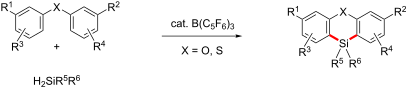
- , the transformation of the amino groups in phenoxasilin 3a into phenyl groups was carried out (Scheme 5). First, the ammonium salt 4 was prepared by treating 3a with MeOTf followed by a palladium-catalyzed cross-coupling reaction with the Grignard reagent (PhMgBr) that afforded the desired diphenylated

Graphical Abstract

Scheme 1: Synthetic methods of six-membered silacyclic compounds.

Scheme 2: Scope of dihydrosilanes. Conditions: a: conditions B (Table 1, entry 5); b: conditions A (Table 1, entry 3).
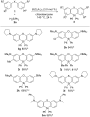
Scheme 3: Scope of diaryl ether and diaryl thioether derivatives. Conditions: a: conditions B (Table 1, entry 5); b:...

Scheme 4: Gram-scale Synthesis of 3a.

Scheme 5: Transformation of the amino groups in 3a.
Formal preparation of regioregular and alternating thiophene–thiophene copolymers bearing different substituents
- Atsunori Mori,
- Keisuke Fujita,
- Chihiro Kubota,
- Toyoko Suzuki,
- Kentaro Okano,
- Takuya Matsumoto,
- Takashi Nishino and
- Masaki Horie
Beilstein J. Org. Chem. 2020, 16, 317–324, doi:10.3762/bjoc.16.31
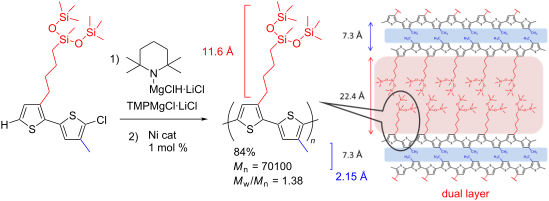
- to afford the regioregular polythiophene in which 2,5-dihalo-3-substituted thiophene 1 is employed as a monomer precursor, converting to the corresponding organometallic monomer by a halogen−magnesium exchange reaction with a Grignard reagent. The employment of 1 leading to polythiophene has been

Graphical Abstract

Scheme 1: Cross-coupling polymerization of thiophene.

Scheme 2: Polymerization of bithiophene.

Scheme 3: Preparation of chlorobithiophenes.

Scheme 4: Polymerization of chlorobithiophenes.

Figure 1: Solubility tests of alternating copolymer 6 (1 mg of material dissolved in 1 mL of the solvent).

Figure 2: XRD measurement and prediction of the bilayer lamellar structure of polymer 6c. a) XRD analysis. b)...
Combination of multicomponent KA2 and Pauson–Khand reactions: short synthesis of spirocyclic pyrrolocyclopentenones
- Riccardo Innocenti,
- Elena Lenci,
- Gloria Menchi and
- Andrea Trabocchi
Beilstein J. Org. Chem. 2020, 16, 200–211, doi:10.3762/bjoc.16.23
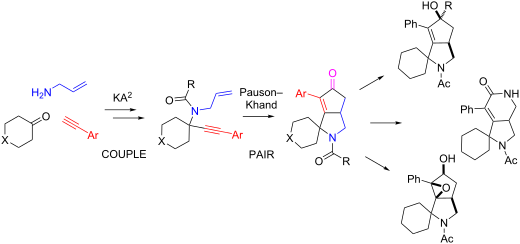
- one-pot, resulting in the generation of the stereochemically dense epoxyalcohol 37 in 68% overall yield. The treatment of compound 5 with EtMgBr as a Grignard reagent in the presence of CeCl3 gave the corresponding tertiary alcohol 38 with similar stereochemical features as of 36 in the formation of

Graphical Abstract

Figure 1: Chemical structure of representative approved drugs containing a spirocyclic moiety.

Scheme 1: Synthetic strategies for accessing pyrrolocyclopentenone derivatives, including the novel couple/pa...

Scheme 2: Couple/pair approach using combined KA2 and Pauson–Khand multicomponent reactions.

Scheme 3: Follow-up chemistry on compound 5 taking advantage of the enone chemistry. Reaction conditions. (i)...
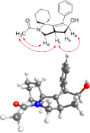
Figure 2: Top: Selected NOE contacts from NOESY 1D spectra of compound 36; bottom: low energy conformer of 36...

Figure 3: PCA plot resulting from the correlation between PC1 vs PC2, showing the positioning in the chemical...

Figure 4: PMI plot showing the skeletal diversity of compounds 3–39 (blue diamonds) with respect to the refer...
A new approach to silicon rhodamines by Suzuki–Miyaura coupling – scope and limitations
- Thines Kanagasundaram,
- Antje Timmermann,
- Carsten S. Kramer and
- Klaus Kopka
Beilstein J. Org. Chem. 2019, 15, 2569–2576, doi:10.3762/bjoc.15.250
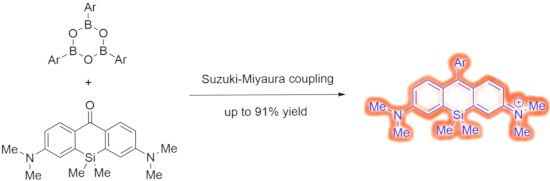
- added the double Grignard reagent 4 to methyl esters 5 [26]. A similar approach was established by Lavis, herein electrophiles (anhydrides or esters) were added to lithium or magnesium organyls 4 [27]. Johnsson and co-workers could establish dye formation by addition of aryllithium 7 to the silicon

Graphical Abstract

Scheme 1: Different synthetic approaches to silicon rhodamine dyes.

Scheme 2: Previous work from Calitree [29] and Urano [22,28] on the Suzuki–Miyaura coupling of triflates, derived from x...

Scheme 3: Optimization of cross-coupling conditions of triflate 21, derived from Si-xanthone 12, with boron s...

Scheme 4: Coupling reactions of silicon xanthone 12 with different boron species (23b–30b, 31).
Recent advances in transition-metal-catalyzed incorporation of fluorine-containing groups
- Xiaowei Li,
- Xiaolin Shi,
- Xiangqian Li and
- Dayong Shi
Beilstein J. Org. Chem. 2019, 15, 2213–2270, doi:10.3762/bjoc.15.218
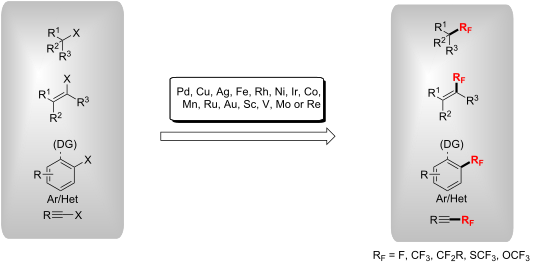
- source and behaves as a nucleophile. The electrophile, such as an alkyl chain or an aryl ring with halides or sulfonates, reacts with the fluoride source (Scheme 1a). On the other hand, in the electrophilic fluorination, the nucleophile may be a carbon anion (e.g., Grignard reagent), a compound with

Graphical Abstract

Scheme 1: The main three strategies of fluorination: nucleophilic, electrophilic and radical fluorination.

Scheme 2: Doyle’s Pd-catalyzed fluorination of allylic chlorides.

Scheme 3: Allylic fluorination of 2- and 3-substituted propenyl esters.

Scheme 4: Regioselective allylic fluorination of cinnamyl phosphorothioate esters.

Scheme 5: Palladium-catalyzed aliphatic C–H fluorination reported by Doyle.

Scheme 6: Pd-catalyzed enantioselective fluorination of α-ketoesters followed by stereoselective reduction to...

Scheme 7: Pd-catalyzed C(sp3)–H fluorination of oxindoles.

Scheme 8: C–H fluorination of 8-methylquinoline derivatives with F− reagents.

Scheme 9: Fluorination of α-cyano acetates reported by van Leeuwen.

Scheme 10: The catalytic enantioselective electrophilic C–H fluorination of α-chloro-β-keto phosphonates.

Scheme 11: Fluorination of unactivated C(sp3)–H bonds directed by the bidentate PIP auxiliary.

Scheme 12: Fluorination of C(sp3)–H bonds at the β-position of carboxylic acids.

Scheme 13: Enantioselective benzylic C–H fluorination with a chiral transient directing group.

Scheme 14: Microwave-heated Pd-catalyzed fluorination of aryl alcohols.

Scheme 15: Fluorination of aryl potassium trifluoroborates.

Scheme 16: C(sp2)–F bond formation using precatalyst [L·Pd]2(cod).

Scheme 17: Pd-catalyzed fluorination of (hetero)aryl triflates and bromides.

Scheme 18: The Pd-catalyzed C–H fluorination of arenes with Selectfluor/NFSI.

Scheme 19: Pd(II)-catalyzed ortho-monofluorination protocol for benzoic acids.

Scheme 20: Pd-catalyzed C(sp2)–H bond fluorination of 2-arylbenzothiazoles.

Scheme 21: Nitrate-promoted fluorination of aromatic and olefinic C(sp2)–H bonds and proposed mechanism.

Scheme 22: Fluorination of oxalyl amide-protected benzylamine derivatives.

Scheme 23: C–H fluorination of benzaldehydes with orthanilic acids as transient directing group.

Scheme 24: Pd(II)-catalyzed aryl C–H fluorination with various directing groups.

Scheme 25: Cu-catalyzed aliphatic, allylic, and benzylic fluorination.

Scheme 26: Cu-catalyzed SN2 fluorination of primary and secondary alkyl bromides.

Scheme 27: Copper-catalyzed fluorination of alkyl triflates.

Scheme 28: Cu-catalyzed fluorination of allylic bromides and chlorides.

Scheme 29: Synthetic strategy for the fluorination of active methylene compounds.

Scheme 30: Fluorination of β-ketoesters using a tartrate-derived bidentate bisoxazoline-Cu(II) complex.

Scheme 31: Highly enantioselective fluorination of β-ketoesters and N-Boc-oxindoles.

Scheme 32: Amide group-assisted site-selective fluorination of α-bromocarbonyl compounds.

Scheme 33: Cu-mediated aryl fluorination reported by Sanford [77].

Scheme 34: Mono- or difluorination reactions of benzoic acid derivatives.

Scheme 35: Cu-catalyzed fluorination of diaryliodonium salts with KF.
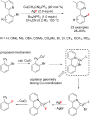
Scheme 36: Copper(I)-catalyzed cross-coupling of 2-pyridylaryl bromides.

Scheme 37: AgNO3-catalyzed decarboxylative fluorination of aliphatic carboxylic acids.

Scheme 38: The Mn-catalyzed aliphatic and benzylic C–H fluorination.

Scheme 39: Iron(II)-promoted C–H fluorination of benzylic substrates.

Scheme 40: Ag-catalyzed fluorodecarboxylation of carboxylic acids.

Scheme 41: Vanadium-catalyzed C(sp3)–H fluorination.

Scheme 42: AgNO3-catalyzed radical deboronofluorination of alkylboronates and boronic acids.

Scheme 43: Selective heterobenzylic C–H fluorination with Selectfluor reported by Van Humbeck.

Scheme 44: Fe(II)-catalyzed site-selective fluorination guided by an alkoxyl radical.

Scheme 45: Fluorination of allylic trichloroacetimidates reported by Nguyen et al.

Scheme 46: Iridium-catalyzed fluorination of allylic carbonates with TBAF(t-BuOH)4.

Scheme 47: Iridium-catalyzed asymmetric fluorination of allylic trichloroacetimidates.

Scheme 48: Cobalt-catalyzed α-fluorination of β-ketoesters.

Scheme 49: Nickel-catalyzed α-fluorination of various α-chloro-β-ketoesters.

Scheme 50: Ni(II)-catalyzed enantioselective fluorination of oxindoles and β-ketoesters.

Scheme 51: Scandium(III)-catalyzed asymmetric C–H fluorination of unprotected 3-substituted oxindoles.

Scheme 52: Iron-catalyzed directed C–H fluorination.

Scheme 53: Electrophilic silver-catalyzed Ar–F bond-forming reaction from arylstannanes.

Figure 1: Nucleophilic, electrophilic and radical CF3 sources.

Scheme 54: Cu(I)-catalyzed allylic trifluoromethylation of unactivated terminal olefins.

Scheme 55: Direct copper-catalyzed trifluoromethylation of allylsilanes.

Scheme 56: Cupper-catalyzed enantioselective trifluoromethylation of five and six-membered ring β-ketoesters.

Scheme 57: Cu-catalyzed highly stereoselective trifluoromethylation of secondary propargyl sulfonates.

Scheme 58: Remote C(sp3)–H trifluoromethylation of carboxamides and sulfonamides.

Scheme 59: Trifluoromethylation of allylsilanes with photoredox catalysis.

Scheme 60: Ag-catalyzed decarboxylative trifluoromethylation of aliphatic carboxylic acids in aqueous CH3CN.
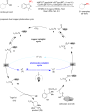
Scheme 61: Decarboxylative trifluoromethylation of aliphatic carboxylic acids via combined photoredox and copp...

Scheme 62: Palladium-catalyzed Ar–CF3 bond-forming reaction.

Scheme 63: Palladium-catalyzed trifluoromethylation of arenes with diverse heterocyclic directing groups.

Scheme 64: Pd-catalyzed trifluoromethylation of indoles as reported by Liu.

Scheme 65: Pd-catalyzed trifluoromethylation of vinyl triflates and vinyl nonaflates.

Scheme 66: Pd(II)-catalyzed ortho-trifluoromethylation of aromatic C–H bonds.

Scheme 67: Visible-light-induced Pd(OAc)2-catalyzed ortho-trifluoromethylation of acetanilides with CF3SO2Na.

Scheme 68: CuI-catalyzed trifluoromethylation of aryl- and alkenylboronic acids.

Scheme 69: Cu-catalyzed trifluoromethylation of aryl- and vinylboronic acids.

Scheme 70: Copper-catalyzed trifluoromethylation of α,β-unsaturated carboxylic acids.

Scheme 71: Formation of C(sp2)–CF3 bond catalyzed by copper(I) complex.

Scheme 72: Loh’s Cu(I)-catalyzed trifluoromethylation of enamides and electron-deficient alkenes.

Scheme 73: Copper and iron-catalyzed decarboxylative tri- and difluoromethylation.

Scheme 74: Cu-catalyzed trifluoromethylation of hydrazones developed by Bouyssi.

Scheme 75: Cu(I)-catalyzed trifluoromethylation of terminal alkenes.

Scheme 76: Cu/Ag-catalyzed decarboxylative trifluoromethylation of cinnamic acids.

Scheme 77: Copper-catalyzed direct alkenyl C–H trifluoromethylation.

Scheme 78: Copper(I/II)-catalyzed direct trifluoromethylation of styrene derivatives.

Scheme 79: Regioselective trifluoromethylation of pivalamido arenes and heteroarenes.

Scheme 80: Synthesis of trifluoromethylquinones in the presence of copper(I).
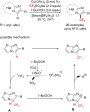
Scheme 81: Oxidative trifluoromethylation of imidazoheterocycles in ionic liquid/water.

Scheme 82: A mild and fast continuous-flow trifluoromethylation of coumarins using a CuI/CF3SO2Na/TBHP system.

Scheme 83: Copper-catalyzed oxidative trifluoromethylation of various 8-aminoquinolines.

Scheme 84: PA-directed copper-catalyzed trifluoromethylation of anilines.

Scheme 85: Trifluoromethylation of potassium vinyltrifluoroborates catalyzed by Fe(II).

Scheme 86: Alkenyl trifluoromethylation catalyzed by Ru(phen)3Cl2 as photocatalyst.

Scheme 87: Ru-catalyzed trifluoromethylation of alkenes by Akita’s group.

Scheme 88: Ir-catalyzed Cvinyl–CF3 bond formation of α,β-unsaturated carboxylic acids.

Scheme 89: Ag(I)-catalyzed denitrative trifluoromethylation of β-nitrostyrenes.

Scheme 90: Photocatalyzed direct trifluoromethylation of aryl and heteroaryl C–H bonds.

Scheme 91: Rhenium (MTO)-catalyzed direct trifluoromethylation of aromatic substrates.

Scheme 92: Trifluoromethylation of unprotected anilines under [Ir(ppy)3] catalyst.

Scheme 93: Oxidative trifluoromethylation of imidazopyridines and imidazoheterocycles.

Scheme 94: Ruthenium-catalyzed trifluoromethylation of (hetero)arenes with trifluoroacetic anhydride.

Scheme 95: Phosphovanadomolybdic acid-catalyzed direct C–H trifluoromethylation.

Scheme 96: Picolinamide-assisted ortho-trifluoromethylation of arylamines.

Scheme 97: A nickel-catalyzed C–H trifluoromethylation of free anilines.

Scheme 98: Cu-mediated trifluoromethylation of terminal alkynes reported by Qing.

Scheme 99: Huang’s C(sp)–H trifluoromethylation using Togni’s reagent.

Scheme 100: Cu-catalyzed methods for trifluoromethylation with Umemoto’s reagent.

Scheme 101: The synthesis of alkynyl-CF3 compounds in the presence of fac-[Ir(ppy)3] under visible-light irradi...

Scheme 102: Pd-catalyzed Heck reaction reported by Reutrakul.

Scheme 103: Difluoromethylation of enamides and ene-carbamates.

Scheme 104: Difluoromethylation of α,β-unsaturated carboxylic acids.

Scheme 105: Copper-catalyzed direct C(sp2)–H difluoroacetylation reported by Pannecoucke and co-workers.

Scheme 106: Difluoroalkylation of aldehyde-derived hydrazones with functionalized difluoromethyl bromides.

Scheme 107: Photoredox-catalyzed C–H difluoroalkylation of aldehyde-derived hydrazones.

Scheme 108: Synergistic ruthenium(II)-catalyzed C–H difluoromethylation reported by Ackermann.

Scheme 109: Visible-light photocatalytic decarboxylation of α,β-unsaturated carboxylic acids.

Scheme 110: Synthesis of difluorinated ketones via S-alkyl dithiocarbamates obtained from acyl chlorides and po...

Scheme 111: Synthesis of aryl and heteroaryl difluoromethylated phosphonates.

Scheme 112: Difluoroalkylation of secondary propargyl sulfonates using Cu as the catalyst.

Scheme 113: Ru(II)-mediated para-selective difluoromethylation of anilides and their derivatives.

Scheme 114: Bulky diamine ligand promoted cross-coupling of difluoroalkyl bromides.

Scheme 115: Copper-catalyzed C3–H difluoroacetylation of quinoxalinones.

Scheme 116: Copper(I) chloride-catalyzed trifluoromethylthiolation of enamines, indoles and β-ketoesters.

Scheme 117: Copper-boxmi-catalyzed asymmetric trifluoromethylthiolation of β-ketoesters.

Scheme 118: Direct Cu-catalyzed trifluoromethylthiolation of boronic acids and alkynes.

Scheme 119: Cu-catalyzed synthesis of α-trifluoromethylthio-substituted ketones.

Scheme 120: Trifluoromethylthiolation reactions promoted by diazotriflone and copper.

Scheme 121: Halide activation of N-(trifluoromethylthio)phthalimide.

Scheme 122: The visible light-promoted trifluoromethylthiolation reported by Glorius.

Scheme 123: Synthesis of α-trifluoromethylthioesters via Goossen’s approach.

Scheme 124: Photoinduced trifluoromethylthiolation of diazonium salts.

Scheme 125: Ag-mediated trifluoromethoxylation of aryl stannanes and arylboronic acids.

Scheme 126: Catalytic (hetero)aryl C–H trifluoromethoxylation under visible light.

Scheme 127: Photoinduced C–H-bond trifluromethoxylation of (hetero)arenes.
N-(1-Phenylethyl)aziridine-2-carboxylate esters in the synthesis of biologically relevant compounds
- Iwona E. Głowacka,
- Aleksandra Trocha,
- Andrzej E. Wróblewski and
- Dorota G. Piotrowska
Beilstein J. Org. Chem. 2019, 15, 1722–1757, doi:10.3762/bjoc.15.168


Graphical Abstract

Figure 1: Examples of three-carbon chirons.

Figure 2: Structures of derivatives of N-(1-phenylethyl)aziridine-2-carboxylic acid 5–8.

Figure 3: Synthetic equivalency of aziridine aldehydes 6.

Scheme 1: Synthesis of N-(1-phenylethyl)aziridine-2-carboxylates 5. Reagents and conditions: a) TEA, toluene,...

Scheme 2: Absolute configuration at C2 in (2S,1'S)-5a. Reagents and conditions: a) 20% HClO4, 80 °C, 30 h the...

Scheme 3: Major synthetic strategies for a 2-ketoaziridine scaffold [R* = (R)- or (S)-1-phenylethyl; R′ = Alk...

Scheme 4: Synthesis of cyanide (2S,1'S)-13. Reagents and conditions: a) NH3, EtOH/H2O, rt, 72 h; b) Ph3P, CCl4...

Scheme 5: Synthesis of key intermediates (R)-16 and (R)-17 for (R,R)-formoterol (14) and (R)-tamsulosin (15)....

Scheme 6: Synthesis of mitotic kinesin inhibitors (2R/S,1'R)-23. Reagents and conditions: a) H2, Pd(OH)2, EtO...

Scheme 7: Synthesis of (R)-mexiletine ((R)-24). Reagents and conditions: a) TsCl, TEA, DMAP, CH2Cl2, rt, 1 h;...

Scheme 8: Synthesis of (−)-cathinone ((S)-27). Reagents and conditions: a) PhMgBr, ether, 0 °C; b) H2, 10% Pd...

Scheme 9: Synthesis of N-Boc-norpseudoephedrine ((1S,2S)-(+)-29) and N-Boc-norephedrine ((1R,2S)-29). Reagent...

Scheme 10: Synthesis of (−)-ephedrine ((1R,2S)-31). Reagents and conditions: a) TfOMe, MeCN then NaBH3CN, rt; ...

Scheme 11: Synthesis of xestoaminol C ((2S,3R)-35), 3-epi-xestoaminol C ((2S,3S)-35) and N-Boc-spisulosine ((2S...

Scheme 12: Synthesis of ʟ-tryptophanol ((S)-41). Reagents and conditions: a) CDI, MeCN, rt, 1 h then TMSI, MeC...

Scheme 13: Synthesis of ʟ-homophenylalaninol ((S)-42). Reagents and conditions: a) NaH, THF, 0 °C to −78 °C, 1...

Scheme 14: Synthesis of ᴅ-homo(4-octylphenyl)alaninol ((R)-47) and a sphingolipid analogue (R)-48. Reagents an...

Scheme 15: Synthesis of florfenicol ((1R,2S)-49). Reagents and conditions: a) (S)-1-phenylethylamine, TEA, MeO...

Scheme 16: Synthesis of natural tyroscherin ((2S,3R,6E,8R,10R)-55). Reagents and conditions: a) I(CH2)3OTIPS, t...

Scheme 17: Syntheses of (−)-hygrine (S)-61, (−)-hygroline (2S,2'S)-62 and (−)-pseudohygroline (2S,2'R)-62. Rea...

Scheme 18: Synthesis of pyrrolidine (3S,3'R)-68, a fragment of the fluoroquinolone antibiotic PF-00951966. Rea...

Scheme 19: Synthesis of sphingolipid analogues (R)-76. Reagents and conditions: a) BnBr, Mg, THF, reflux, 6 h;...

Scheme 20: Synthesis of ᴅ-threo-PDMP (1R,2R)-81. Reagents and conditions: a) TMSCl, NaI, MeCN, rt, 1 h 50 min,...

Scheme 21: Synthesis of the sphingolipid analogue SG-14 (2S,3S)-84. Reagents and conditions: a) LiAlH4, THF, 0...

Scheme 22: Synthesis of the sphingolipid analogue SG-12 (2S,3R)-88. Reagents and conditions: a) 1-(bromomethyl...

Scheme 23: Synthesis of sphingosine-1-phosphate analogues DS-SG-44 and DS-SG-45 (2S,3R)-89a and (2S,3R)-89a. R...

Scheme 24: Synthesis of N-Boc-safingol ((2S,3S)-95) and N-Boc-ᴅ-erythro-sphinganine ((2S,3R)-95). Reagents and...

Scheme 25: Synthesis of ceramide analogues (2S,3R)-96. Reagents and conditions: a) NaBH4, ZnCl2, MeOH, −78 °C,...

Scheme 26: Synthesis of orthogonally protected serinols, (S)-101 and (R)-102. Reagents and conditions: a) BnBr...

Scheme 27: Synthesis of N-acetyl-3-phenylserinol ((1R,2R)-105). Reagents and conditions: a) AcOH, CH2Cl2, refl...

Scheme 28: Synthesis of (S)-linezolid (S)-107. Reagents and conditions: a) LiAlH4, THF, 0 °C to reflux; b) Boc2...

Scheme 29: Synthesis of (2S,3S,4R)-2-aminooctadecane-1,3,4-triol (ᴅ-ribo-phytosphingosine) (2S,3S,4R)-110. Rea...

Scheme 30: Syntheses of ᴅ-phenylalanine (R)-116. Reagents and conditions: a) AcOH, CH2Cl2, reflux, 4 h; b) MsC...

Scheme 31: Synthesis of N-Boc-ᴅ-3,3-diphenylalanine ((R)-122). Reagents and conditions: a) PhMgBr, THF, −78 °C...

Scheme 32: Synthesis of ethyl N,N’-di-Boc-ʟ-2,3-diaminopropanoate ((S)-125). Reagents and conditions: a) NaN3,...

Scheme 33: Synthesis of the bicyclic amino acid (S)-(+)-127. Reagents and conditions: a) BF3·OEt2, THF, 60 °C,...

Scheme 34: Synthesis of lacosamide, (R)-2-acetamido-N-benzyl-3-methoxypropanamide (R)-130. Reagents and condit...

Scheme 35: Synthesis of N-Boc-norfuranomycin ((2S,2'R)-133). Reagents and conditions: a) H2C=CHCH2I, NaH, THF,...

Scheme 36: Synthesis of MeBmt (2S,3R,4R,6E)-139. Reagents and conditions: a) diisopropyl (S,S)-tartrate (E)-cr...

Scheme 37: Synthesis of (+)-polyoxamic acid (2S,3S,4S)-144. Reagents and conditions: a) AD-mix-α, MeSO2NH2, t-...

Scheme 38: Synthesis of the protected 3-hydroxy-ʟ-glutamic acid (2S,3R)-148. Reagents and conditions: a) LiHMD...

Scheme 39: Synthesis of (+)-isoserine (R)-152. Reagents and conditions: a) AcCl, MeCN, rt, 0.5 h then Na2CO3, ...

Scheme 40: Synthesis of (3R,4S)-N3-Boc-3,4-diaminopentanoic acid (3R,4S)-155. Reagents and conditions: a) Ph3P...

Scheme 41: Synthesis of methyl (2S,3S,4S)-4-(dimethylamino)-2,3-dihydroxy-5-methoxypentanoate (2S,3S,4S)-159. ...

Scheme 42: Syntheses of methyl (3S,4S) 4,5-di-N-Boc-amino-3-hydroxypentanoate ((3S,4S)-164), methyl (3S,4S)-4-N...

Scheme 43: Syntheses of (3R,5S)-5-(aminomethyl)-3-(4-methoxyphenyl)dihydrofuran-2(3H)-one ((3R,5S)-168). Reage...

Scheme 44: Syntheses of a series of imidazolin-2-one dipeptides 175–177 (for R' and R'' see text). Reagents an...

Scheme 45: Syntheses of (2S,3S)-N-Boc-3-hydroxy-2-hydroxymethylpyrrolidine ((2S,3S)-179). Reagents and conditi...

Scheme 46: Syntheses of enantiomers of 1,4-dideoxy-1,4-imino-ʟ- and -ᴅ-lyxitols (2S,3R,4S)-182 and (2R,3S,4R)-...

Scheme 47: Synthesis of 1,4-dideoxy-1,4-imino-ʟ-ribitol (2S,3S,4R)-182. Reagents and conditions: a) AcOH, CH2Cl...

Scheme 48: Syntheses of 1,4-dideoxy-1,4-imino-ᴅ-arabinitol (2R,3R,4R)-182 and 1,4-dideoxy-1,4-imino-ᴅ-xylitol ...

Scheme 49: Syntheses of natural 2,5-imino-2,5,6-trideoxy-ʟ-gulo-heptitol ((2S,3R,4R,5R)-184) and its C4 epimer...

Scheme 50: Syntheses of (−)-dihydropinidine ((2S,6R)-187a) (R = C3H7) and (2S,6R)-isosolenopsins (2S,6R)-187b ...

Scheme 51: Syntheses of (+)-deoxocassine ((2S,3S,6R)-190a, R = C12H25) and (+)-spectaline ((2S,3S,6R)-190b, R ...

Scheme 52: Synthesis of (−)-microgrewiapine A ((2S,3R,6S)-194a) and (+)-microcosamine A ((2S,3R,6S)-194b). Rea...

Scheme 53: Syntheses of ʟ-1-deoxynojirimycin ((2S,3S,4S,5R)-200), ʟ-1-deoxymannojirimycin ((2S,3S,4S,5S)-200) ...

Scheme 54: Syntheses of 1-deoxy-ᴅ-galacto-homonojirimycin (2R,3S,4R,5S)-211. Reagents and conditions: a) MeONH...

Scheme 55: Syntheses of 7a-epi-hyacinthacine A1 (1S,2R,3R,7aS)-220. Reagents and conditions: a) TfOTBDMS, 2,6-...

Scheme 56: Syntheses of 8-deoxyhyacinthacine A1 ((1S,2R,3R,7aR)-221). Reagents and conditions: a) H2, Pd/C, PT...

Scheme 57: Syntheses of (+)-lentiginosine ((1S,2S,8aS)-227). Reagents and conditions: a) (EtO)2P(O)CH2COOEt, L...

Scheme 58: Syntheses of 8-epi-swainsonine (1S,2R,8S,8aR)-231. Reagents and conditions: a) Ph3P=CHCOOMe, MeOH, ...

Scheme 59: Synthesis of a protected vinylpiperidine (2S,3R)-237, a key intermediate in the synthesis of (−)-sw...

Scheme 60: Synthesis of a modified carbapenem 245. Reagents and conditions: a) AcOEt, LiHMDS, THF, −78 °C, 1.5...
Recent advances on the transition-metal-catalyzed synthesis of imidazopyridines: an updated coverage
- Gagandeep Kour Reen,
- Ashok Kumar and
- Pratibha Sharma
Beilstein J. Org. Chem. 2019, 15, 1612–1704, doi:10.3762/bjoc.15.165
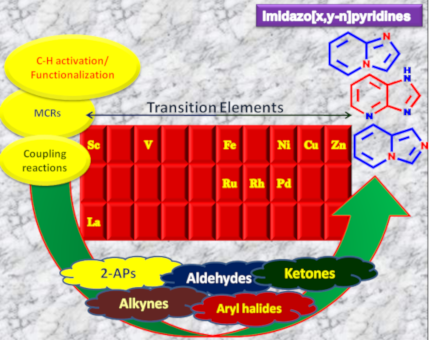

Graphical Abstract

Figure 1: Various drugs having IP nucleus.

Figure 2: Participation percentage of various TMs for the syntheses of IPs.

Scheme 1: CuI–NaHSO4·SiO2-catalyzed synthesis of imidazo[1,2-a]pyridines.

Scheme 2: Experimental examination of reaction conditions.

Scheme 3: One-pot tandem reaction for the synthesis of 2-haloimidazopyridines.

Scheme 4: Mechanistic scheme for the synthesis of 2-haloimidazopyridine.

Scheme 5: Copper-MOF-catalyzed three-component reaction (3-CR) for imidazo[1,2-a]pyridines.

Scheme 6: Mechanism for copper-MOF-driven synthesis.

Scheme 7: Heterogeneous synthesis via titania-supported CuCl2.

Scheme 8: Mechanism involving oxidative C–H functionalization.

Scheme 9: Heterogeneous synthesis of IPs.

Scheme 10: One-pot regiospecific synthesis of imidazo[1,2-a]pyridines.

Scheme 11: Vinyl azide as an unprecedented substrate for imidazo[1,2-a]pyridines.

Scheme 12: Radical pathway.

Scheme 13: Cu(I)-catalyzed transannulation approach for imidazo[1,5-a]pyridines.

Scheme 14: Plausible radical pathway for the synthesis of imidazo[1,5-a]pyridines.

Scheme 15: A solvent-free domino reaction for imidazo[1,2-a]pyridines.

Scheme 16: Cu-NPs-mediated synthesis of imidazo[1,2-a]pyridines.

Scheme 17: CuI-catalyzed synthesis of isoxazolylimidazo[1,2-a]pyridines.

Scheme 18: Functionalization of 4-bromo derivative via Sonogashira coupling reaction.

Scheme 19: A plausible reaction pathway.

Scheme 20: Cu(I)-catalyzed intramolecular oxidative C–H amidation reaction.

Scheme 21: One-pot synthetic reaction for imidazo[1,2-a]pyridine.

Scheme 22: Plausible reaction mechanism.

Scheme 23: Cu(OAc)2-promoted synthesis of imidazo[1,2-a]pyridines.

Scheme 24: Mechanism for aminomethylation/cycloisomerization of propiolates with imines.

Scheme 25: Three-component synthesis of imidazo[1,2-a]pyridines.

Figure 3: Scope of pyridin-2(1H)-ones and acetophenones.

Scheme 26: CuO NPS-promoted A3 coupling reaction.

Scheme 27: Cu(II)-catalyzed C–N bond formation reaction.

Scheme 28: Mechanism involving Chan–Lam/Ullmann coupling.

Scheme 29: Synthesis of formyl-substituted imidazo[1,2-a]pyridines.

Scheme 30: A tandem sp3 C–H amination reaction.

Scheme 31: Probable mechanistic approach.

Scheme 32: Dual catalytic system for imidazo[1,2-a]pyridines.

Scheme 33: Tentative mechanism.

Scheme 34: CuO/CuAl2O4/ᴅ-glucose-promoted 3-CCR.

Scheme 35: A tandem CuOx/OMS-2-based synthetic strategy.

Figure 4: Biomimetic catalytic oxidation in the presence of electron-transfer mediators (ETMs).

Scheme 36: Control experiment.

Scheme 37: Copper-catalyzed C(sp3)–H aminatin reaction.

Scheme 38: Reaction of secondary amines.

Scheme 39: Probable mechanistic pathway.

Scheme 40: Coupling reaction of α-azidoketones.

Scheme 41: Probable pathway.

Scheme 42: Probable mechanism with free energy calculations.

Scheme 43: MCR for cyanated IP synthesis.

Scheme 44: Substrate scope for the reaction.

Scheme 45: Reaction mechanism.

Scheme 46: Probable mechanistic pathway for Cu/ZnAl2O4-catalyzed reaction.

Scheme 47: Copper-catalyzed double oxidative C–H amination reaction.

Scheme 48: Application towards different coupling reactions.

Scheme 49: Reaction mechanism.

Scheme 50: Condensation–cyclization approach for the synthesis of 1,3-diarylated imidazo[1,5-a]pyridines.

Scheme 51: Optimized reaction conditions.

Scheme 52: One-pot 2-CR.

Scheme 53: One-pot 3-CR without the isolation of chalcone.

Scheme 54: Copper–Pybox-catalyzed cyclization reaction.

Scheme 55: Mechanistic pathway catalyzed by Cu–Pybox complex.

Scheme 56: Cu(II)-promoted C(sp3)-H amination reaction.

Scheme 57: Wider substrate applicability for the reaction.

Scheme 58: Plausible reaction mechanism.

Scheme 59: CuI assisted C–N cross-coupling reaction.

Scheme 60: Probable reaction mechanism involving sp3 C–H amination.

Scheme 61: One-pot MCR-catalyzed by CoFe2O4/CNT-Cu.

Scheme 62: Mechanistic pathway.

Scheme 63: Synthetic scheme for 3-nitroimidazo[1,2-a]pyridines.

Scheme 64: Plausible mechanism for CuBr-catalyzed reaction.

Scheme 65: Regioselective synthesis of halo-substituted imidazo[1,2-a]pyridines.

Scheme 66: Synthesis of 2-phenylimidazo[1,2-a]pyridines.

Scheme 67: Synthesis of diarylated compounds.

Scheme 68: CuBr2-mediated one-pot two-component oxidative coupling reaction.

Scheme 69: Decarboxylative cyclization route to synthesize 1,3-diarylimidazo[1,5-a]pyridines.

Scheme 70: Mechanistic pathway.

Scheme 71: C–H functionalization reaction of enamines to produce diversified heterocycles.

Scheme 72: A plausible mechanism.

Scheme 73: CuI-promoted aerobic oxidative cyclization reaction of ketoxime acetates and pyridines.

Scheme 74: CuI-catalyzed pathway for the formation of imidazo[1,2-a]pyridine.

Scheme 75: Mechanistic pathway.

Scheme 76: Mechanistic rationale for the synthesis of products.

Scheme 77: Copper-catalyzed synthesis of vinyloxy-IP.

Scheme 78: Regioselective product formation with propiolates.

Scheme 79: Proposed mechanism for vinyloxy-IP formation.

Scheme 80: Regioselective synthesis of 3-hetero-substituted imidazo[1,2-a]pyridines with different reaction su...

Scheme 81: Mechanistic pathway.

Scheme 82: CuI-mediated synthesis of 3-formylimidazo[1,2-a]pyridines.

Scheme 83: Radical pathway for 3-formylated IP synthesis.

Scheme 84: Pd-catalyzed urea-cyclization reaction for IPs.

Scheme 85: Pd-catalyzed one-pot-tandem amination and intramolecular amidation reaction.

Figure 5: Scope of aniline nucleophiles.

Scheme 86: Pd–Cu-catalyzed Sonogashira coupling reaction.

Scheme 87: One-pot amide coupling reaction for the synthesis of imidazo[4,5-b]pyridines.

Scheme 88: Urea cyclization reaction for the synthesis of two series of pyridines.

Scheme 89: Amidation reaction for the synthesis of imidazo[4,5-b]pyridines.

Figure 6: Amide scope.

Scheme 90: Pd NPs-catalyzed 3-component reaction for the synthesis of 2,3-diarylated IPs.

Scheme 91: Plausible mechanistic pathway for Pd NPs-catalyzed MCR.

Scheme 92: Synthesis of chromenoannulated imidazo[1,2-a]pyridines.

Scheme 93: Mechanism for the synthesis of chromeno-annulated IPs.

Scheme 94: Zinc oxide NRs-catalyzed synthesis of imidazo[1,2-a]azines/diazines.

Scheme 95: Zinc oxide-catalyzed isocyanide based GBB reaction.

Scheme 96: Reaction pathway for ZnO-catalyzed GBB reaction.

Scheme 97: Mechanistic pathway.

Scheme 98: ZnO NRs-catalyzed MCR for the synthesis of imidazo[1,2-a]azines.

Scheme 99: Ugi type GBB three-component reaction.

Scheme 100: Magnetic NPs-catalyzed synthesis of imidazo[1,2-a]pyridines.

Scheme 101: Regioselective synthesis of 2-alkoxyimidazo[1,2-a]pyridines catalyzed by Fe-SBA-15.

Scheme 102: Plausible mechanistic pathway for the synthesis of 2-alkoxyimidazopyridine.

Scheme 103: Iron-catalyzed synthetic approach.

Scheme 104: Iron-catalyzed aminooxygenation reaction.

Scheme 105: Mechanistic pathway.

Scheme 106: Rh(III)-catalyzed double C–H activation of 2-substituted imidazoles and alkynes.

Scheme 107: Plausible reaction mechanism.

Scheme 108: Rh(III)-catalyzed non-aromatic C(sp2)–H bond activation–functionalization for the synthesis of imid...

Scheme 109: Reactivity and selectivity of different substrates.

Scheme 110: Rh-catalyzed direct C–H alkynylation by Li et al.

Scheme 111: Suggested radical mechanism.

Scheme 112: Scandium(III)triflate-catalyzed one-pot reaction and its mechanism for the synthesis of benzimidazo...

Scheme 113: RuCl3-assisted Ugi-type Groebke–Blackburn condensation reaction.

Scheme 114: C-3 aroylation via Ru-catalyzed two-component reaction.

Scheme 115: Regioselective synthetic mechanism.

Scheme 116: La(III)-catalyzed one-pot GBB reaction.

Scheme 117: Mechanistic approach for the synthesis of imidazo[1,2-a]pyridines.

Scheme 118: Synthesis of imidazo[1,2-a]pyridine using LaMnO3 NPs under neat conditions.

Scheme 119: Mechanistic approach.

Scheme 120: One-pot 3-CR for regioselective synthesis of 2-alkoxy-3-arylimidazo[1,2-a]pyridines.

Scheme 121: Formation of two possible products under optimization of the catalysts.

Scheme 122: Mechanistic strategy for NiFe2O4-catalyzed reaction.

Scheme 123: Two-component reaction for synthesizing imidazodipyridiniums.

Scheme 124: Mechanistic scheme for the synthesis of imidazodipyridiniums.

Scheme 125: CuI-catalyzed arylation of imidazo[1,2-a]pyridines.

Scheme 126: Mechanism for arylation reaction.

Scheme 127: Cupric acetate-catalyzed double carbonylation approach.

Scheme 128: Radical mechanism for double carbonylation of IP.

Scheme 129: C–S bond formation reaction catalyzed by cupric acetate.

Scheme 130: Cupric acetate-catalyzed C-3 formylation approach.

Scheme 131: Control experiments for signifying the role of DMSO and oxygen.

Scheme 132: Mechanism pathway.

Scheme 133: Copper bromide-catalyzed CDC reaction.

Scheme 134: Extension of the substrate scope.

Scheme 135: Plausible radical pathway.

Scheme 136: Transannulation reaction for the synthesis of imidazo[1,5-a]pyridines.

Scheme 137: Plausible reaction pathway for denitrogenative transannulation.

Scheme 138: Cupric acetate-catalyzed C-3 carbonylation reaction.

Scheme 139: Plausible mechanism for regioselective C-3 carbonylation.

Scheme 140: Alkynylation reaction at C-2 of 3H-imidazo[4,5-b]pyridines.

Scheme 141: Two-way mechanism for C-2 alkynylation of 3H-imidazo[4,5-b]pyridines.

Scheme 142: Palladium-catalyzed SCCR approach.

Scheme 143: Palladium-catalyzed Suzuki coupling reaction.

Scheme 144: Reaction mechanism.

Scheme 145: A phosphine free palladium-catalyzed synthesis of C-3 arylated imidazopyridines.

Scheme 146: Palladium-mediated Buchwald–Hartwig cross-coupling reaction.

Figure 7: Structure of the ligands optimized.

Scheme 147: Palladium acetate-catalyzed direct arylation of imidazo[1,2-a]pyridines.

Scheme 148: Palladium acetate-catalyzed mechanistic pathway.

Scheme 149: Palladium acetate-catalyzed regioselective arylation reported by Liu and Zhan.

Scheme 150: Mechanism for selective C-3 arylation of IP.

Scheme 151: Pd(II)-catalyzed alkenylation reaction with styrenes.

Scheme 152: Pd(II)-catalyzed alkenylation reaction with acrylates.

Scheme 153: A two way mechanism.

Scheme 154: Double C–H activation reaction catalyzed by Pd(OAc)2.

Scheme 155: Probable mechanism.

Scheme 156: Palladium-catalyzed decarboxylative coupling.

Scheme 157: Mechanistic cycle for decarboxylative arylation reaction.

Scheme 158: Ligand-free approach for arylation of imidazo[1,2-a]pyridine-3-carboxylic acids.

Scheme 159: Mechanism for ligandless arylation reaction.

Scheme 160: NHC-Pd(II) complex assisted arylation reaction.

Scheme 161: C-3 arylation of imidazo[1,2-a]pyridines with aryl bromides catalyzed by Pd(OAc)2.

Scheme 162: Pd(II)-catalyzed C-3 arylations with aryl tosylates and mesylates.

Scheme 163: CDC reaction for the synthesis of imidazo[1,2-a]pyridines.

Scheme 164: Plausible reaction mechanism for Pd(OAc)2-catalyzed synthesis of imidazo[1,2-a]pyridines.

Scheme 165: Pd-catalyzed C–H amination reaction.

Scheme 166: Mechanism for C–H amination reaction.

Scheme 167: One-pot synthesis for 3,6-di- or 2,3,6-tri(hetero)arylimidazo[1,2-a]pyridines.

Scheme 168: C–H/C–H cross-coupling reaction of IPs and azoles catalyzed by Pd(II).

Scheme 169: Mechanistic cycle.

Scheme 170: Rh-catalyzed C–H arylation reaction.

Scheme 171: Mechanistic pathway for C–H arylation of imidazo[1,2-a]pyridine.

Scheme 172: Rh(III)-catalyzed double C–H activation of 2-phenylimidazo[1,2-a]pyridines and alkynes.

Scheme 173: Rh(III)-catalyzed mechanistic pathway.

Scheme 174: Rh(III)-mediated oxidative coupling reaction.

Scheme 175: Reactions showing functionalization of the product obtained by the group of Kotla.

Scheme 176: Mechanism for Rh(III)-catalyzed oxidative coupling reaction.

Scheme 177: Rh(III)-catalyzed C–H activation reaction.

Scheme 178: Mechanistic cycle.

Scheme 179: Annulation reactions of 2-arylimidazo[1,2-a]pyridines and alkynes.

Scheme 180: Two-way reaction mechanism for annulations reaction.

Scheme 181: [RuCl2(p-cymene)]2-catalyzed C–C bond formation reaction.

Scheme 182: Reported reaction mechanism.

Scheme 183: Fe(III) catalyzed C-3 formylation approach.

Scheme 184: SET mechanism-catalyzed by Fe(III).

Scheme 185: Ni(dpp)Cl2-catalyzed KTC coupling.

Scheme 186: Pd-catalyzed SM coupling.

Scheme 187: Vanadium-catalyzed coupling of IP and NMO.

Scheme 188: Mechanistic cycle.

Scheme 189: Selective C3/C5–H bond functionalizations by mono and bimetallic systems.

Scheme 190: rGO-Ni@Pd-catalyzed C–H bond arylation of imidazo[1,2-a]pyridine.

Scheme 191: Mechanistic pathway for heterogeneously catalyzed arylation reaction.

Scheme 192: Zinc triflate-catalyzed coupling reaction of substituted propargyl alcohols.
Syntheses and chemical properties of β-nicotinamide riboside and its analogues and derivatives
- Mikhail V. Makarov and
- Marie E. Migaud
Beilstein J. Org. Chem. 2019, 15, 401–430, doi:10.3762/bjoc.15.36
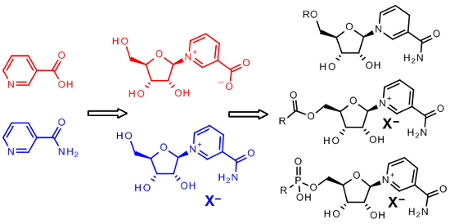
- order to manipulate the NAD+ pathway in mammalian cells and tissues. The key step in the synthesis of the NMN analogues 39–41 is the activation of the 5′-hydroxy group of the NRH acetonide 42 with a Grignard reagent, to produce the corresponding magnesium alkoxide. As illustrated by the synthesis of the

Graphical Abstract

Figure 1: Structural formulas of Nam, NA, NR+, NMN, and NAD+.

Figure 2: Main synthetic routes to nicotinamide riboside (NR+X−).

Scheme 1: Synthesis of NR+Cl− based on the reaction of peracylated chlorosugars with Nam.

Figure 3: Predominant formation of β-anomer over α-anomer of NR+X−.

Scheme 2: Synthesis of NR+Cl− by reacting 3,5-di-O-benzoyl-D-ribofuranosyl chloride (5) with Nam (1a).

Figure 4: Mechanism of the formation of the β-anomer of the glycosylated product in the case of the reaction ...

Scheme 3: Synthesis of NR+Br− by reacting bromosugars with Nam (1a).

Scheme 4: Synthesis of NR+OTf− based on the glycosylation of Nam (1a) with tetra-O-acetyl-β-D-ribofuranose (2a...

Scheme 5: Improved synthesis of NR+OTfˉ and NAR+OTfˉ based on the glycosylation of pre-silylated Nam or NA wi...

Scheme 6: Synthesis of triacetylated NAR+OTf− by glycosylation of nicotinic acid trimethylsilyl ester with te...

Scheme 7: Synthesis of NR+Cl− from NR+OTf− by means of ion exchange with sodium chloride solution.

Scheme 8: Synthesis of acylated NR+OTf− by means of ion exchange with sodium chloride.

Scheme 9: Synthesis of triacetylated derivatives of NAR+ by glycosylation of nicotinic acid esters with ribos...

Scheme 10: Synthesis of NR+OTf− from the triflate salt of ethyl nicotinate-2,3,5-triacetyl-β-D-riboside in met...

Scheme 11: Reaction of 2,3,5-tri-O-acetyl-β-phenyl nicotinate riboside triflate salt with secondary and tertia...

Scheme 12: Synthesis of NMN based on the Zincke reaction of N-(2,4-dinitrophenyl)-3-carbamoylpyridinium chlori...

Scheme 13: Synthesis of NMN based on the Zincke reaction of N-(2,4-dinitrophenyl)-3-carbamoylpyridinium chlori...

Scheme 14: Efficacious protection of 2′,3′-hydroxy groups of NR+X−.

Scheme 15: Protection of the 2′,3′-hydroxy groups of NR+Cl– with a mesitylmethylene acetal group.

Figure 5: Reduction of derivatives of NR+Xˉ into corresponding 1,2-; 1,4-; 1,6-NRH derivatives.

Figure 6: Mechanism of the reduction of the pyridinium core with dithionite as adapted from [67].

Scheme 16: Reduction of triacylated NR+OTf– derivatives by sodium dithionite followed by complete removal of a...

Figure 7: Structural formulas of iridium and rhodium catalysts (a)–(d) for regeneration of NAD(P)H from NAD(P)...

Figure 8: Two approaches to synthesis of 5′-derivatives of NR+.

Scheme 17: Synthesis of NMN starting from NR+ salt.

Scheme 18: Efficient synthesis of NMN by phosphorylation of 2′,3′-O-isopropylidene-NR+ triflate followed by re...
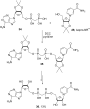
Scheme 19: Synthesis of a bisphosphonate analogue of β-NAD+ based on DCC-induced conjugation of 2′,3′-O-isopro...

Scheme 20: Synthesis of 5′-acyl and 2′,3′,5′-triacyl derivatives of NR+.

Figure 9: Structural formulas of NMN analogues 39–41.
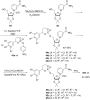
Scheme 21: Synthesis of 5′-phosphorylated derivatives of NR+ using a “reduction–modification–oxidation” approa...

Scheme 22: Synthesis of 5′-phosphorylated derivatives of NR+ using a “reduction–modification–reoxidation” appr...

Figure 10: Structural formulas of 5′-phosphorylated derivatives of NR+.

Scheme 23: Synthesis of 5′-phosphorylated derivatives of NR+ using a direct NR+ phosphorylation approach.

Figure 11: Structural formulas of amino acid NR+ conjugates.

Scheme 24: Synthesis of amino acid NR+ conjugates using NRH and protected amino acid under CDI-coupling condit...

Figure 12: Chemical structures of known isotopically labelled NR+ analogues and derivatives.

Scheme 25: Synthesis of [2′-3H]-NR+ and [2′-3H]-NMN.

Scheme 26: Synthesis of α- and β-anomers of [1′-2H]-NMN.
Reusable and highly enantioselective water-soluble Ru(II)-Amm-Pheox catalyst for intramolecular cyclopropanation of diazo compounds
- Hamada S. A. Mandour,
- Yoko Nakagawa,
- Masaya Tone,
- Hayato Inoue,
- Nansalmaa Otog,
- Ikuhide Fujisawa,
- Soda Chanthamath and
- Seiji Iwasa
Beilstein J. Org. Chem. 2019, 15, 357–363, doi:10.3762/bjoc.15.31
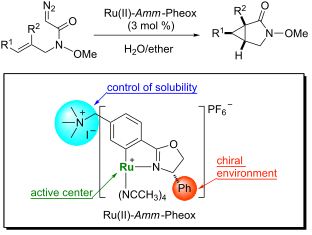
- DIBAL-H with benzylamine afforded the desired product 3 in 44% yield with 95% ee (Scheme 2, reaction 1) [52]. We then investigated the arylation of chiral cyclopropylamide 2f with Grignard reagent PhMgBr (Scheme 2, reaction 2). Only 37% of cyclopropyl ketone 4 were observed at room temperature with

Graphical Abstract

Figure 1: A comparison of the solubility of Ru(II)-Pheox (cat. 1) and Ru(II)-Amm-Pheox (cat. 2).

Scheme 1: Intramolecular cyclopropanation of various trans-allylic diazo Weinreb amide derivatives catalyzed....

Scheme 2: Synthetic transformation of cyclopropane products 2d and 2f.
Regioselective addition of Grignard reagents to N-acylpyrazinium salts: synthesis of substituted 1,2-dihydropyrazines and Δ5-2-oxopiperazines
- Valentine R. St. Hilaire,
- William E. Hopkins,
- Yenteeo S. Miller,
- Srinivasa R. Dandepally and
- Alfred L. Williams
Beilstein J. Org. Chem. 2019, 15, 72–78, doi:10.3762/bjoc.15.8

- Grignard reagent to add regioselectively to give 1,2-dihydropyrazine 3a. DFT calculations support the observations that the isolated regioisomer we obtained was the result of a thermodynamically favored 1,2-addition over a 1,6-addition [9]. It has also been shown that TMS-ketene acetals add selectively to
- conversion of 1,2-dihydropyrazines to Δ5-2-oxopiperazines, we decided to develop a one-pot approach towards their synthesis (Table 3). As described above, we first synthesized the phenyl-substituted 1,2-dihydropyrazine 4b by adding a phenyl Grignard reagent to benzyloxy-substituted N-acylpyrazinium salt in

Graphical Abstract
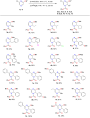
Figure 1: Regioselective addition of Grignard reagents to mono- and disubstituted pyrazinium salts (yields re...
Nucleofugal behavior of a β-shielded α-cyanovinyl carbanion
- Rudolf Knorr and
- Barbara Schmidt
Beilstein J. Org. Chem. 2018, 14, 3018–3024, doi:10.3762/bjoc.14.281
- that 13 had transferred its proton to the emerging, thermally stable [4] cleavage product 2K faster than to the residual PhCH2K (perhaps a problem of slow mixing). On the other hand, deprotonation of 13 by the Grignard reagent MeMgBr in THF was complete (quantitative CH4 evolution) within 20 min at 0

Graphical Abstract

Scheme 1: The nucleofugal carbanion unit C escapes from the alkoxides A1M1 or A1M2 (M = metal), generating th...
Scheme 2: Preparation of β-shielded α-lithioacrylonitrile 2Li and its reaction with aldehydes 4–6 to adducts 7...
Scheme 3: Reversible formation of the adduct 13 of adamantan-2-one (11).
Scheme 4: Preparation and cleavage of the adduct 18 of fluoren-9-one (15).
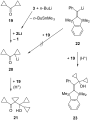
Scheme 5: Proton transfer from dicyclopropyl ketone (19) to 2Li.

Scheme 6: Metal-free release of the carbanion unit in 25 and its seizure by t-BuCH=O (→ 7); Bu = n-butyl.
Synergistic approach to polycycles through Suzuki–Miyaura cross coupling and metathesis as key steps
- Sambasivarao Kotha,
- Milind Meshram and
- Chandravathi Chakkapalli
Beilstein J. Org. Chem. 2018, 14, 2468–2481, doi:10.3762/bjoc.14.223
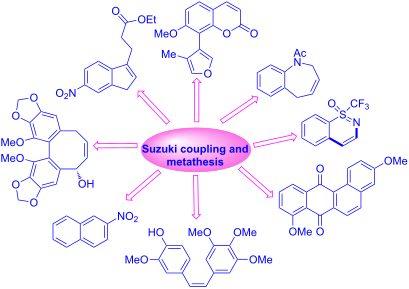
- . Then, the cyclized product was subjected to the oxidation sequence with pyridinium chlorochromate (PCC) to generate cylophane derivative 115 in 75% yield (Scheme 17). Similarly, treatment of dialdehyde 113 with a freshly prepared Grignard reagent derived from 4-bromobut-1-ene (116) afforded dialkenyl

Graphical Abstract

Figure 1: Various catalysts used for metathesis reactions.

Scheme 1: SM coupling and RCM protocol to substituted indene derivative 10.

Scheme 2: Synthesis of polycycles via SM and RCM approach.

Figure 2: Various angucyclines.

Scheme 3: SM coupling and RCM protocol to the benz[a]anthracene skeleton 26.

Scheme 4: Synthesis of substituted spirocycles via RCM and SM sequence.

Scheme 5: Synthesis of highly functionalized bis-spirocyclic derivative 37.

Scheme 6: Synthesis of spirofluorene derivatives via RCM and SM coupling sequence.

Scheme 7: Synthesis of truxene derivatives via RCM and SM coupling.

Scheme 8: Synthesis of substituted isoquinoline derivative via SM and RCM protocol.

Scheme 9: Synthesis to 8-aryl substituted coumarin 64 via RCM and SM sequence.

Scheme 10: Synthesis of cyclic sulfoximine 70 via SM and RCM as key steps.

Scheme 11: Synthesis of 1-benzazepine derivative 75 via SM and RCM as key steps.

Scheme 12: Synthesis of naphthoxepine derivative 79 via RCM followed by SM coupling.

Scheme 13: Sequential CM and SM coupling approach to Z-stilbene derivative 85.

Scheme 14: Synthesis of substituted trans-stilbene derivatives via SM coupling and RCM.

Scheme 15: Synthesis of biaryl derivatives via sequential EM, DA followed by SM coupling.

Scheme 16: Synthesis of the dibenzocyclooctadiene core of schisandrene.

Scheme 17: Synthesis of cyclophane 115 via SM coupling and RCM as key steps.

Scheme 18: Synthesis of cyclophane 120 and 122 via SM coupling and RCM as key steps.

Scheme 19: Synthesis of cyclophanes via SM and RCM.

Scheme 20: Synthesis of MK-6325 (141) via RCM and SM coupling.



