


Search results
Search for "umpolung" in Full Text gives 59 result(s) in Beilstein Journal of Organic Chemistry.
The LANCA three-component reaction to highly substituted β-ketoenamides – versatile intermediates for the synthesis of functionalized pyridine, pyrimidine, oxazole and quinoxaline derivatives
Beilstein J. Org. Chem. 2019, 15, 655–678, doi:10.3762/bjoc.15.61
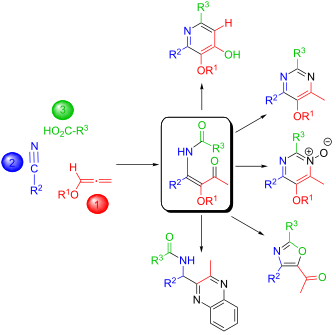
- corresponding Z-isomers occurs. It should be noted here that the protonation to the allenyl iminium species B implies an “umpolung of reactivity” of the alkoxyallene subunit converting the central allene carbon to an electrophilic center whereas this carbon is a nucleophilic center in the neutral compound. The


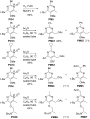


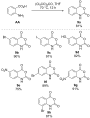
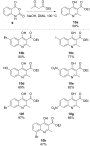
Quinolines from the cyclocondensation of isatoic anhydride with ethyl acetoacetate: preparation of ethyl 4-hydroxy-2-methylquinoline-3-carboxylate and derivatives
Beilstein J. Org. Chem. 2018, 14, 2529–2536, doi:10.3762/bjoc.14.229

- envisioned a milder alternative to the acidic conditions required for cyanide hydrolysis that would provide the side chain at the correct oxidation in one pot. To that end, we turned to masked acyl cyanide (MAC) chemistry [31] in which the reagent 20 acts as an acyl anion via umpolung reactivity [32]. With
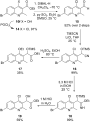
- cyanohydrin-hydrolysis route (10f→19) and an umpolung acyl addition strategy (10f→21). The development of a library of quinoline scaffolds is currently underway within our lab utilizing this synthetic process [34][35]. Experimental General procedure for isatoic anhydride synthesis 6-Bromo-2H-benzo[d][1,3
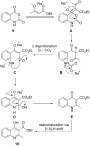
- acids with triphosgene. Substituted 2-methyl-4-hydroxyquinolines from isatoic anhydrides and ethyl acetoacetate. Mechanistic hypothesis for the cyclocondensation reaction. Quinoline synthesis with ethyl acetylpyruvate. Elaboration of the benzoic acid ethyl ester to the acetic acid residue. Umpolung




Glycosylation reactions mediated by hypervalent iodine: application to the synthesis of nucleosides and carbohydrates
Beilstein J. Org. Chem. 2018, 14, 1595–1618, doi:10.3762/bjoc.14.137
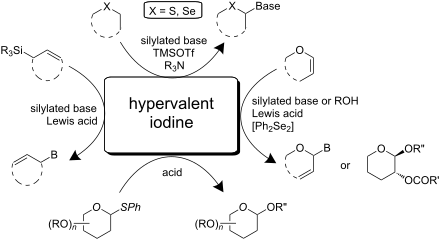
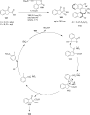
- -mediated glycosylation led us to apply the reaction to the synthesis of carbocyclic nucleosides. In addition, we were also encouraged by the study of Ochiai, who developed the Friedel–Crafts reaction via umpolung of allylsilanes using hypervalent-iodine reagents [61] and the pioneering work on C–N bond


A survey of chiral hypervalent iodine reagents in asymmetric synthesis
Beilstein J. Org. Chem. 2018, 14, 1244–1262, doi:10.3762/bjoc.14.107
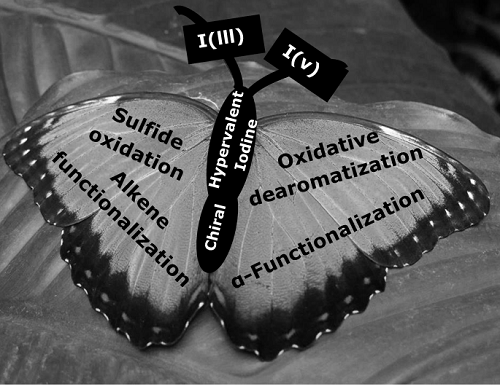
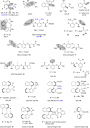
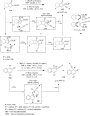
- of carbonyls were established by Wirth et al. Nucleophile transfer from silyl enol ethers 90 delivered α-functionalized carbonyls 91 with good enantioselectivity [68]. “Umpolung” reactivity and silyl-tethered enol ethers allowed the delicate synthesis of α-functionalized carbonyls (Scheme 19). C2



Cross-coupling of dissimilar ketone enolates via enolonium species to afford non-symmetrical 1,4-diketones
Beilstein J. Org. Chem. 2018, 14, 992–997, doi:10.3762/bjoc.14.84
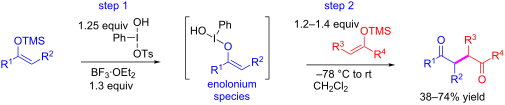
- challenge in organic synthesis. We herein report that umpolung of a ketone trimethylsilyl enol ether (1 equiv) to form a discrete enolonium species, followed by addition of as little as 1.2–1.4 equivalents of a second trimethylsilyl enol ether, provides an attractive solution to this problem. A wide array
- ; ketones; umpolung; Introduction Substituted 1,4-dicarbonyl compounds are key intermediates for the preparation of numerous natural products and active pharmaceutical ingredients (APIs) with important biological activities. This is due to the facile conversion of 1,4-dicarbonyl compounds into five
- lithium enolate followed by a second SET step to complete the transformation (Scheme 1a) [16][17]. A different approach, developed by Maulide, relies on the highly efficient umpolung of amides into enolonium species using triflic anhydride, a pyridine base and pyridine N-oxides (Scheme 1b). These


Stepwise radical cation Diels–Alder reaction via multiple pathways
Beilstein J. Org. Chem. 2018, 14, 704–708, doi:10.3762/bjoc.14.59
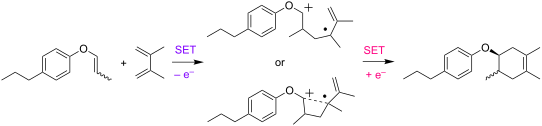
- two distinctive pathways, including “direct” and “indirect”, are possible to construct the Diels–Alder adduct. Keywords: Diels–Alder reaction; radical cation; rearrangement; single electron transfer; stepwise; Introduction Umpolung, also known as polarity inversion, is a powerful approach in
- synthetic organic chemistry to trigger reactions that are otherwise difficult or impossible. In an umpolung reaction, the normal reactivity of the molecules being studied is reversed, e.g., electrophilicity is generated from a nucleophile. The single electron transfer (SET) process has been recognized as
- the most straightforward way to induce umpolung, which has recently been carried out by means of photo- [1][2][3][4][5][6] and electrochemical [7][8][9][10][11][12] approaches. A typical example involves an oxidative SET of an electron-rich and thus nucleophilic C–C double bond. The oxidative SET


Electrochemical Corey–Winter reaction. Reduction of thiocarbonates in aqueous methanol media and application to the synthesis of a naturally occurring α-pyrone
Beilstein J. Org. Chem. 2018, 14, 547–552, doi:10.3762/bjoc.14.41
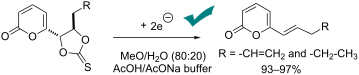
- dangerous conventional redox reagents by sustainable and inexpensive electrical current [16][17][18][19], the ease with which umpolung reactivity is achieved [20][21][22], the access to unstable intermediates of great utility in organic synthesis [23][24][25], and in most of the cases, the use of mild


Addition of dithi(ol)anylium tetrafluoroborates to α,β-unsaturated ketones
Beilstein J. Org. Chem. 2018, 14, 515–522, doi:10.3762/bjoc.14.37
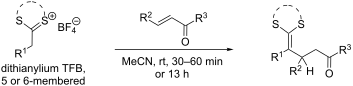
- dithiolane and dithiane protecting groups which are irreplaceable intermediates for the introduction of, e.g., fluorine via gem-difluorination [1][2]. They also allow the formation of valuable building blocks that can be used for diverse transformations in organic chemistry (e.g., Umpolung) [3]. Ketene 1,3


Transition-metal-free [3 + 3] annulation of indol-2-ylmethyl carbanions to nitroarenes. A novel synthesis of indolo[3,2-b]quinolines (quindolines)
Beilstein J. Org. Chem. 2018, 14, 194–202, doi:10.3762/bjoc.14.14
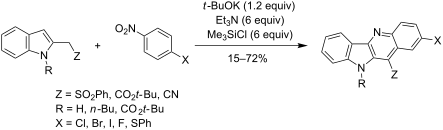
- to quinoline can be considered as an umpolung of the Skraup quinoline synthesis since it uses reversed polarity of reagents, where the C=C–NO2 fragment of the nitroarene is the electrophile reacting with an arylmethyl carbanion, the nucleophile (Scheme 2). Recently, we used the reactions of


A novel application of 2-silylated 1,3-dithiolanes for the synthesis of aryl/hetaryl-substituted ethenes and dibenzofulvenes
Beilstein J. Org. Chem. 2017, 13, 1900–1906, doi:10.3762/bjoc.13.185
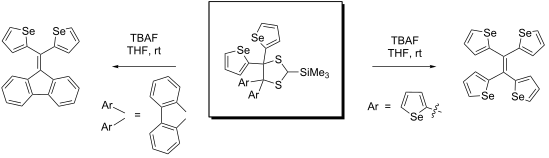
- -dithiolanes, as well as the generation of the corresponding carbanions are widely applied in the umpolung chemistry [27][28] and in the chemistry of protective groups [29][30], but tetrasubstituted ethenes have never been prepared by using this approach. Conclusion The presented study showed that 2


NHC-catalyzed cleavage of vicinal diketones and triketones followed by insertion of enones and ynones
Beilstein J. Org. Chem. 2017, 13, 1816–1822, doi:10.3762/bjoc.13.176
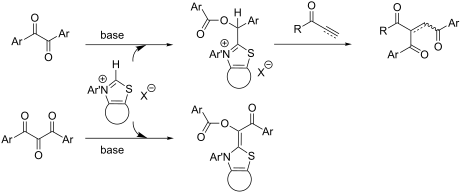
- ; N-heterocyclic carbene; ring enlargement; Stetter reaction; vicinal polyketone; Introduction N-Heterocyclic carbenes (NHCs) have been indispensable catalysts for organic synthesis, particularly for umpolung of various functional groups [1][2][3][4][5][6][7][8][9]. In the Stetter reaction, NHCs




Strategies toward protecting group-free glycosylation through selective activation of the anomeric center
Beilstein J. Org. Chem. 2017, 13, 1239–1279, doi:10.3762/bjoc.13.123

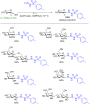
- selective deprotonation of this hydroxy group over the others. This selective creation of a better nucleophile in the presence of the other protonated hydroxy groups can be regarded as an umpolung process. Despite this seeming difficulty, some protecting-group-free strategies to synthesize glycosides and




Electron-transfer-initiated benzoin- and Stetter-like reactions in packed-bed reactors for process intensification
Beilstein J. Org. Chem. 2016, 12, 2719–2730, doi:10.3762/bjoc.12.268
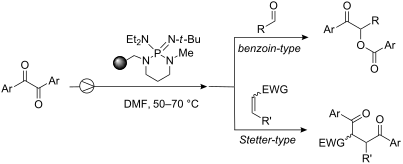
- ). Keywords: C–C coupling; continuos-flow; diketone; electron-transfer; umpolung; Introduction The polarity reversal (umpolung) of carbonyl compounds by N-heterocyclic carbene (NHC) or cyanide catalysis represents a straightforward strategy for the synthesis of valuable molecules such as, among the many
- examples, α-hydroxy ketones (benzoin reaction) and 1,4-diketones (Stetter reaction) [1][2][3][4]. The synthetic utility of the umpolung methodology has therefore spurred intensive research on process intensification through the heterogeneization of NHC catalysts [5][6][7][8][9] for facilitating the post
- described by Lupton and co-workers [15]. Our group also contributed to this area of research fabricating polystyrene monolithic columns functionalized with thiazolium salt pre-catalysts to perform umpolung racemic processes (benzoin, acyloin, and Stetter reactions) with a good level of efficiency [16]. The


A new paradigm for designing ring construction strategies for green organic synthesis: implications for the discovery of multicomponent reactions to build molecules containing a single ring
Beilstein J. Org. Chem. 2016, 12, 2420–2442, doi:10.3762/bjoc.12.236
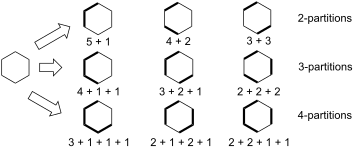
- greenness. In research practice, synthetic organic chemists rely on a combination of retrosynthetic analysis [91][92][93][94][95][96][97], similarity and analogy patterning to known reactions, bond dissociation energy and bond polarity analysis (forward and umpolung), chemical intuition, and random








Correction: Recent advances in N-heterocyclic carbene (NHC)-catalysed benzoin reactions
Beilstein J. Org. Chem. 2016, 12, 2124–2124, doi:10.3762/bjoc.12.201
- Interdisciplinary Science and Technology,Trivandrum 695 019, India.; Fax: +91 471 2491712; Tel: +91 471 2490406 10.3762/bjoc.12.201 Keywords: acyloin reaction; benzoin reaction; N-heterocyclic carbenes; organocatalysis; umpolung; On page 446, column 2, the sentence “Inoue and co-workers found that it promotes
Experimental and theoretical investigations on the high-electron donor character of pyrido-annelated N-heterocyclic carbenes
Beilstein J. Org. Chem. 2016, 12, 1884–1896, doi:10.3762/bjoc.12.178
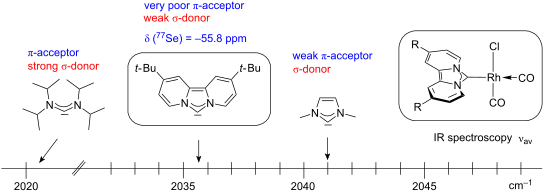
- heptafulvalene) as well as the very low N–C–N angle by X-ray structure analysis [41]. Weiss proposed this carbene to have a “built-in umpolung” [39] ability which means that there could be a participation of the dicationic bisylidene resonance form as it is usually described for carbodiphosphoranes [49] and
- low, net π-acceptor character of the dipyridocarbene. We are convinced that less electron-rich metal fragments could induce an overall π-donor character in dipyridocarbenes and could thus proof the “built-in umpolung” [39] ability proposed by Weiss and co-workers. This property might be advantageous


The aminoindanol core as a key scaffold in bifunctional organocatalysts
Beilstein J. Org. Chem. 2016, 12, 505–523, doi:10.3762/bjoc.12.50
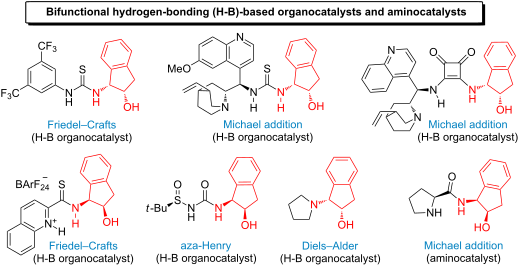
- -unsaturated compounds Fernández, Lassaleta and co-workers provided an elegant, versatile and mild umpolung strategy, which leads to key synthetic precursors using the thiourea ent-4. In this study, an organocatalytic enantioselective addition of nucleophilic N,N-dialkylhydrazones to electron-deficient β,γ


Recent advances in N-heterocyclic carbene (NHC)-catalysed benzoin reactions
Beilstein J. Org. Chem. 2016, 12, 444–461, doi:10.3762/bjoc.12.47
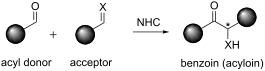
- ; benzoin reaction; N-heterocyclic carbenes; organocatalysis; umpolung; Introduction The benzoin reaction (or condensation) is named after the product it furnishes via a catalytic assembly of two molecules of aromatic aldehydes. One molecule of the aldehyde functions as an acyl anion and the other as a
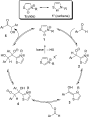
- as homo-benzoin reaction and that of two different aldehydes is known as crossed benzoin reaction. Mechanistically the reaction involves polarity reversal (umpolung) of one aldehyde to generate an acyl anion equivalent and this event is mediated by the catalyst. Alkali metal cyanides and N



Efficient synthetic protocols for the preparation of common N-heterocyclic carbene precursors
Beilstein J. Org. Chem. 2015, 11, 2318–2325, doi:10.3762/bjoc.11.252
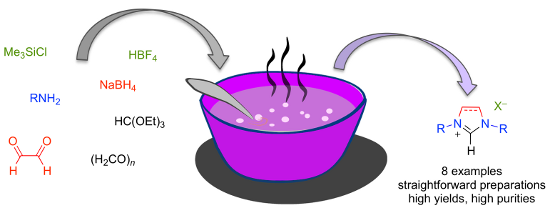
- ][23] and organic synthesis [24][25][26]. In particular, they were successfully employed for the umpolung of carbonyl compounds, sometimes in an asymmetric fashion [27][28][29]. Currently, the NHCs most frequently encountered are based on the imidazol-2-ylidene and imidazolin-2-ylidene scaffolds, which


Reaction of allene esters with Selectfluor/TMSX (X = I, Br, Cl) and Selectfluor/NH4SCN: Competing oxidative/electrophilic dihalogenation and nucleophilic/conjugate addition
Beilstein J. Org. Chem. 2015, 11, 1641–1648, doi:10.3762/bjoc.11.180
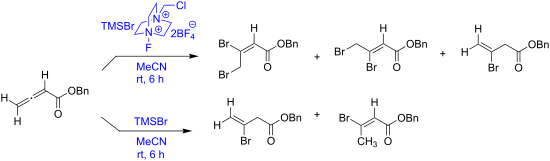
- presence of phosphane catalysts an umpolung addition takes place, whereby the nucleophilic addition occurs inversely at the beta-gamma double bond [22][23]. Vinyl azides have been prepared by hydroazidation of allenyl esters through a Michael-type addition with high regio- and stereoselectivity [24


An unusually stable chlorophosphite: What makes BIFOP–Cl so robust against hydrolysis?
Beilstein J. Org. Chem. 2015, 11, 313–322, doi:10.3762/bjoc.11.36
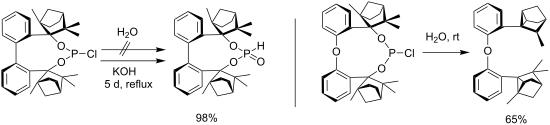
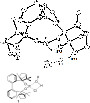
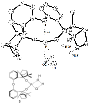
- ) were employed in enantioselective organozinc catalysis reactions [23][24][25][26], umpolung catalysis [27] and in organoaluminum [17] and chiral n-butyllithium aggregates [28][29][30][31][32][33]. The chlorophosphite BIFOP-Cl (1) is air-stable and very resistant to hydrolysis (Scheme 2) [13][15]. The


Photovoltaic-driven organic electrosynthesis and efforts toward more sustainable oxidation reactions
Beilstein J. Org. Chem. 2015, 11, 280–287, doi:10.3762/bjoc.11.32
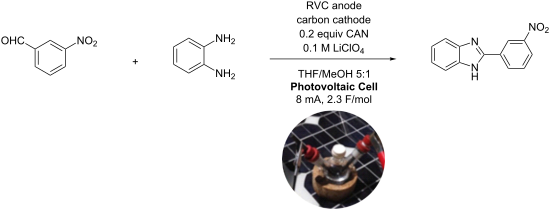
- efforts began by examining reactions where the substrate to be oxidized underwent the electron-transfer reaction directly at the electrode surface. We have employed reactions of this nature to functionalize amides [13][14] and to conduct umpolung reactions [15][16] that originate from electron-rich


A facile synthesis of functionalized 7,8-diaza[5]helicenes through an oxidative ring-closure of 1,1’-binaphthalene-2,2’-diamines (BINAMs)
Beilstein J. Org. Chem. 2015, 11, 9–15, doi:10.3762/bjoc.11.2
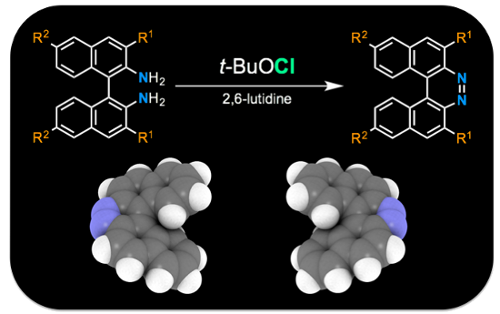
- group of 1a with t-BuOCl would generate N-monochlorinated BINAM (Int-A) and release t-BuOH. The N-chlorination would induce umpolung reactivity of the amino moiety because of the attachment of electronegative halogen species on the N atom [27][28][29][30], and thereby an intramolecular nucleophilic unit


Recent advances in the electrochemical construction of heterocycles
Beilstein J. Org. Chem. 2014, 10, 2858–2873, doi:10.3762/bjoc.10.303
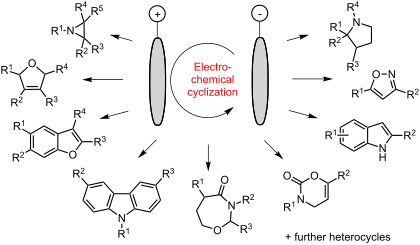
- electrochemical reaction leads to an Umpolung of the functional group with the lower redox potential, triggering the ring-closure reaction between a nucleophilic and an electrophilic site. Another possibility for an intramolecular ring closure is represented by electrochemically induced radical cyclization
- , electrochemistry represents a complementary method to conventional synthesis, due to unique selectivity and the possibility for electrochemical Umpolung. However, considering the fact that heterocycle-containing compounds represent the major part of active ingredients in pharmaceutics and crop protection, a lack




Chiral phosphines in nucleophilic organocatalysis
Beilstein J. Org. Chem. 2014, 10, 2089–2121, doi:10.3762/bjoc.10.218
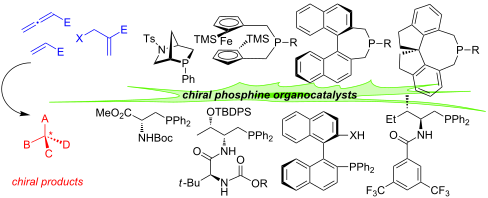
- carbonates, Michael additions, γ-umpolung additions, and acylations of alcohols. Keywords: asymmetric catalysis; chiral phosphine; nucleophilic; organocatalysis; organophosphorus; synthesis; Introduction During the past two decades, tertiary phosphine catalysts have been applied extensively in a wide range
- developments in nucleophilic chiral phosphine-catalyzed asymmetric reactions, including annulations of allenes, ketenes, alkynes, and Morita–Baylis–Hillman (MBH) carbonates with activated alkenes and imines, allylic substitution of MBH acetates and carbonates, Michael additions, γ-umpolung additions, and
- bond between the amide NH proton and the enolate oxygen atom assisted the Michael addition from the si-face of the enolate. The alternative re-face attack was blocked by the 3,5-bistrifluoromethylphenyl group (Scheme 55). 2.17 γ-Umpolung additions of allenes or alkynes In the phosphine-catalyzed





