


Search results
Search for "light" in Full Text gives 1413 result(s) in Beilstein Journal of Organic Chemistry. Showing first 200.
Enantioselective radical chemistry: a bright future ahead
Beilstein J. Org. Chem. 2025, 21, 2283–2296, doi:10.3762/bjoc.21.174
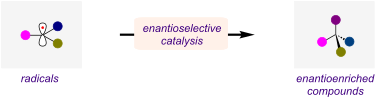
- catalysts. The drawbacks of chiral Lewis acids have been overcome to an extent using organocatalysis. The use of photochemistry to generate radicals by light-induced electron transfer has resulted in elegant enantioselective radical transformations. Several transition-metal photocatalysts [9] and organo
- . A mechanistically distinct way of achieving enantioselective radical transformations is the use of metalloradical catalysis [54]. A metalloradical is a persistent metal-centered radical species that can homolytically activate substrates without other initiators, light, or electricity. Several


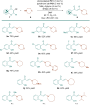
Pd-catalyzed dehydrogenative arylation of arylhydrazines to access non-symmetric azobenzenes, including tetra-ortho derivatives
Beilstein J. Org. Chem. 2025, 21, 2234–2242, doi:10.3762/bjoc.21.170
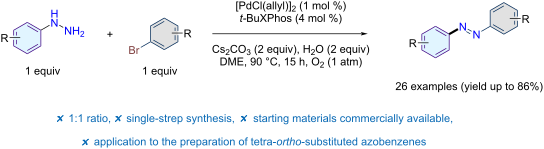
- Paris, France 10.3762/bjoc.21.170 Abstract Azobenzenes are photoresponsive compounds widely used in molecular switches, light-controlled materials, and sensors, but despite extensive studies on symmetric derivatives, efficient methods for synthesizing non-symmetric analogues remain scarce due to
- of applications, including molecular switches, sensors, and light-controlled materials [1][2][3][4][5][6][7][8]. The photoswitching behavior arises from the reversible photoisomerization between the E- and Z-forms of the azobenzene chromophore, driven by the isomerization of the N–N double bond. This


Electrochemical cyclization of alkynes to construct five-membered nitrogen-heterocyclic rings
Beilstein J. Org. Chem. 2025, 21, 2173–2201, doi:10.3762/bjoc.21.166
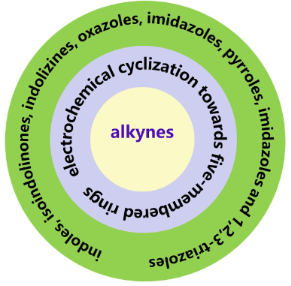
- F and cryptotrione have fused and spiro five-membered rings, respectively [25][26]. Strepsesquitriol bearing bridged five-membered rings was firstly synthesized by Li in 2024 [27]. The green fluorescent protein (GFP) core chromophore (o-LHBDI) displayed a potential application in organic light









C2 to C6 biobased carbonyl platforms for fine chemistry
Beilstein J. Org. Chem. 2025, 21, 2103–2172, doi:10.3762/bjoc.21.165
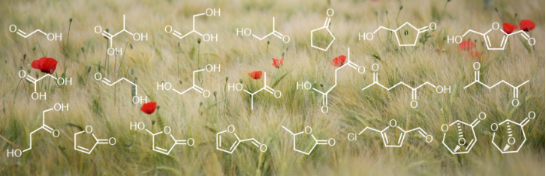
- 15) [74][75][76]. Tang et al. recently reported the environmentally friendly production of glyceraldehyde and dihydroxyacetone from using glycerol through photocatalytic oxidation under visible light using a Cuδ+-decorated WO3 photocatalyst in the presence of hydrogen peroxide (H2O2) [77]. The
- aqueous-phase reforming (APR) technology for the production of light hydrocarbons and hydrogen in a single step from aqueous organic phases [97] containing 1-hydroxypropan-2-one (acetol), ethanol, benzene-1,2-diol (catechol), acetic acid or mixtures thereof. The process was conducted over various Ni-based
- simulated solar light and molecular O2 as the oxidant, and mesoporous carbon nitride (SGCN) as the photocatalyst. The latter showed excellent photoconversion (>95%) of furfural with 33% and 42% selectivity of HFO and MAN, respectively (Scheme 35). Xiao et al. developed this method and suggested that the


Bioinspired total syntheses of natural products: a personal adventure
Beilstein J. Org. Chem. 2025, 21, 2048–2061, doi:10.3762/bjoc.21.160
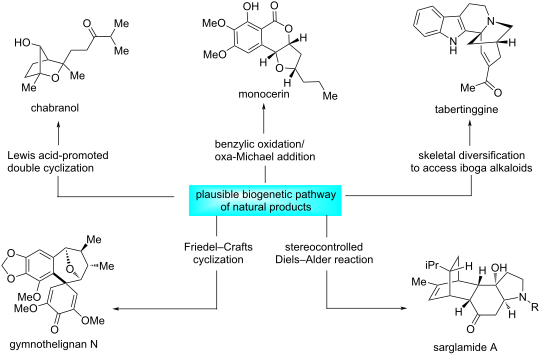
- visible light. How to design a bioinspired approach may be most attractive to synthetic chemists. Recently, Tang [16] and Jia [17] independently reviewed their remarkable bioinspired total syntheses as accounts. Tang documented their longtime carrier of learning from nature aiming to achieve better
- invented. Moreover, bioinspired total synthesis involving visible light and enzymes are new significant trends in this field, and these techniques have demonstrated great power in achieving unprecedented selectivity and reactivity. Since nature still prevails in rapid generating molecular complexity and




Solar thermal fuels: azobenzene as a cyclic photon–heat transduction platform
Beilstein J. Org. Chem. 2025, 21, 2036–2047, doi:10.3762/bjoc.21.159
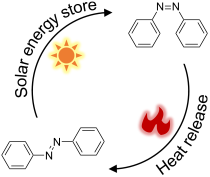
- thermal fuels have undergone significant advancements over the past four decades, emerging as a promising technology for light-to-thermal energy conversion. While these materials exhibit considerable development potential, critical challenges remain that hinder their practical implementation. In this
- ) through structural or bond rearrangements, thereby enabling solar energy storage. This reversible process is termed "energy charging", while the subsequent transformation of high-energy photoisomers back to their ground state – triggered by external stimuli such as light, heat, or catalysts – releases
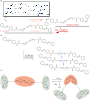
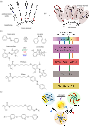
- light-harvesting carbazole units with photoresponsive azobenzene units in a unique macromolecular architecture (Figure 4c) [48]. The resulting cross-linked polycarbazole structure led to a high solar thermal storage capacity of 179.9 J/g and an extended half-life at 60 °C, increasing from 7 min for the




Understanding the origin of stereoselectivity in the photochemical denitrogenation of 2,3-diazabicyclo[2.2.1]heptene and its derivatives with non-adiabatic molecular dynamics
Beilstein J. Org. Chem. 2025, 21, 2007–2020, doi:10.3762/bjoc.21.156
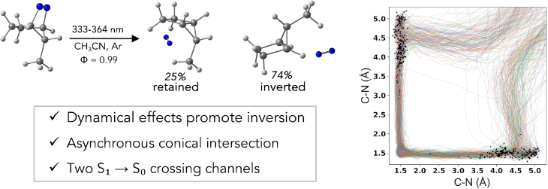
- ; stereoselectivity; Introduction Photochemical reactions utilize light as a sustainable energy source and are considered to be ‘green’ reactions [1][2]. Organic chromophores absorb light, accessing higher-lying excited state(s) that exhibit distinct reactivities, leading to bond breaking and formation, irreversibly
- are closer to the range of irradiation wavelengths of the experimentally used light source (333–364 nm). For 1, this peak is closer to experimental absorbance, λmax = 338 nm [80]. The remaining peaks, shown in blue and green for S2 and S3, respectively, absorb at higher energy than the experimental
- light source. Electronic transitions to these excited states are impossible in the experiment and thus will not be considered for this photochemical mechanistic study. DBH photodenitrogenation mechanism We then turned our attention to the photochemical reaction mechanisms leading to the formation of


Photochemical reduction of acylimidazolium salts
Beilstein J. Org. Chem. 2025, 21, 1973–1983, doi:10.3762/bjoc.21.153
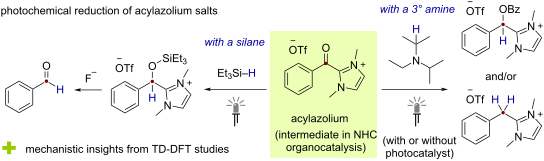
- 22, 14195 Berlin, Germany School of Natural and Environmental Sciences, Newcastle University, Bedson Building, Newcastle upon Tyne, NE1 7RU, UK 10.3762/bjoc.21.153 Abstract Light-mediated methodologies for the reduction of acylazolium species generated during N-heterocyclic carbene (NHC)-catalyzed
- reactions have been developed. Employing the simple amine, DIPEA, as the terminal reductant, products resulting from overall 2-electron or 4-electron-reduction processes could be obtained using either a photocatalytic approach under blue light irradiation or directly under UV-A light irradiation without an
- additional photocatalyst. Moreover, under the same photocatalyst-free conditions, UV-A-light-mediated reduction could be achieved using triethylsilane as the only reductant with subsequent desilylation and NHC elimination with fluoride delivering the corresponding aldehyde product. Keywords: carbenes


Asymmetric total synthesis of tricyclic prostaglandin D2 metabolite methyl ester via oxidative radical cyclization
Beilstein J. Org. Chem. 2025, 21, 1964–1972, doi:10.3762/bjoc.21.152
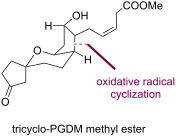
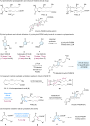
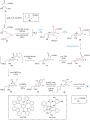
- , C11, and C12 contiguous stereogenic centers, provided important insights that influenced the design of our second-generation total synthesis. Compared with the Snider-type radical cyclization using stoichiometric amounts of metal oxidants, visible-light-induced photoredox-catalyzed radical cyclization



Rhodium-catalysed connective synthesis of diverse reactive probes bearing S(VI) electrophilic warheads
Beilstein J. Org. Chem. 2025, 21, 1924–1931, doi:10.3762/bjoc.21.150
- of each reaction was thus 200 μL, with final concentrations of 100 mM (for substrates), 500 mM (for co-substrates) and 1 mM (for catalysts). After 48 h, the outcome of the reactions was determined by analytical UPLC–MS with, additionally, evaporative light-scattering detection [22][23] to enable
- subsequently used. Panel B: yields, estimated by evaporative light scattering detection, of reactions involving combinations of substrates, co-substrates and catalysts (dash: <2% estimated yield). Highlighted combinations (green boxes) were selected for mass-directed purification. aMultiple intermolecular


Synthesis of N-doped chiral macrocycles by regioselective palladium-catalyzed arylation
Beilstein J. Org. Chem. 2025, 21, 1917–1923, doi:10.3762/bjoc.21.149
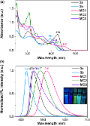
- (c) MC3. (d) Molecular arrangements of MC3. Hydrogen atoms are omitted for clarity. (a) Absorptions and (b) emissions of compounds 3a, 3b, MC1, MC2, and MC3 measured in dichloromethane at room temperature. The inset shows the photographs under UV light at 365 nm. The concentration is 10 μM




Stereoselective electrochemical intramolecular imino-pinacol reaction: a straightforward entry to enantiopure piperazines
Beilstein J. Org. Chem. 2025, 21, 1897–1908, doi:10.3762/bjoc.21.147
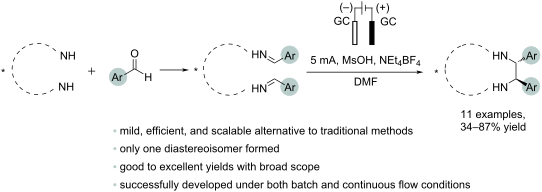
- photochemical and electrochemical methods, have been explored. Over the past two decades a variety of light-promoted imino-pinacol coupling reactions have been developed, involving the use of catalytic transition-metal complexes [35][36], organic dyes [37][38][39], and polyaromatic compounds [40][41] as
- purified through flash column chromatography on silica gel to give the isolated pure product. X-ray determined structure of chiral piperazine 2b. Synthesis of vicinal diamines via imino-pinacol coupling in the presence of metal-based reductants. Light-promoted imino-pinacol coupling for the synthesis of
- on a 0.1 mmol scale. Proposed reaction mechanism. Cyclic voltammetry investigation. Cyclic voltammetry of a 0.325 M solution of Et4NBF4 in DMF (light-blue line). Cyclic voltammetry of diimine 1a (10 mM) recorded in a 0.325 M solution of Et4NBF4 in DMF (dark-blue line). Cyclic voltammetry of diimine





Photoswitches beyond azobenzene: a beginner’s guide
Beilstein J. Org. Chem. 2025, 21, 1808–1853, doi:10.3762/bjoc.21.143
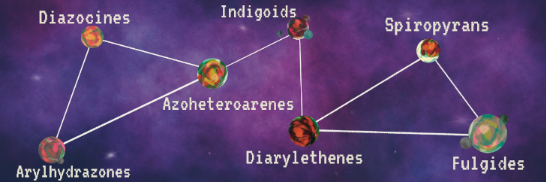
- ). Shining light will bring the molecule to a generic excited state (which is different for different photoswitch classes and substitution patterns and will not be treated in detail), which can then relax back to the ground state in either of the two wells. In cases where the two absorption spectra of the
- absence of light. Apart from some special cases where more competing mechanisms are operating [5], the thermal isomerisation typically is a first-order decay: Where I is the monitored signal at the time t, I0 the initial signal, and k the kinetic constant. Once k is known, the thermal half-life t1/2 can
- picoseconds to several years. The presence of heteroatoms also introduces H-bond donors and acceptors and metal coordination sites [11]. Like azobenzenes, E–Z isomerisation of azoheteroarenes can be triggered by light irradiation, while Z–E isomerisation proceeds through irradiation with a different




Fe-catalyzed efficient synthesis of 2,4- and 4-substituted quinolines via C(sp2)–C(sp2) bond scission of styrenes
Beilstein J. Org. Chem. 2025, 21, 1799–1807, doi:10.3762/bjoc.21.142
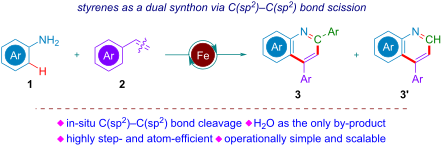
- , antibacterial, and anti-inflammatory activities [10][11][12][13]. In the field of optoelectronics, especially with 2,4-diarylquinoline derivatives, extensive studies have highlighted their applicability in organic light-emitting diode (OLED) systems as functional materials [14][15] and cutting-edge fluorescent
- light of climate change and the ongoing energy crisis, there is an urgent need to reform energy and chemical production by prioritizing environmentally sustainable methods that are both practical and broadly implementable. Styrenes are industrially important bulk chemicals [39], with an estimated global




Research progress on calixarene/pillararene-based controlled drug release systems
Beilstein J. Org. Chem. 2025, 21, 1757–1785, doi:10.3762/bjoc.21.139
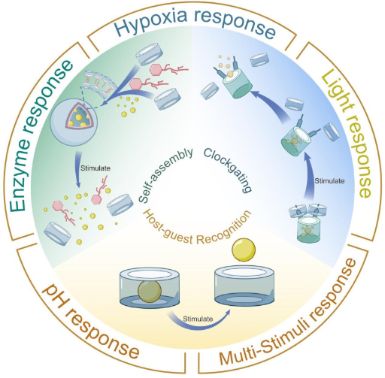
- release systems based on host–guest selective recognition, self-assembly, and nano-valves by the use of of calixarenes and pillararenes from five perspectives: pH, light, enzyme, hypoxia, and multi-stimuli combination responses. Furthermore, the article projects the future clinical application prospects
- in pH, light, and enzyme activity, the binding affinity between the guest and host molecules can be altered, thereby achieving controlled drug release and targeted delivery. (2) Drugs are loaded into self-assembled host–guest systems [29][30][31][32]. The chemical structure or properties of the host
- or guest molecules are altered upon exposure to specific stimuli, such as light, pH changes, or enzymes. This modification induces the disassembly of the host–guest complex, thereby releasing the encapsulated drugs. Fundamentally, this mechanism relies on controlling the assembly and disassembly




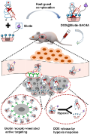


Convenient alternative synthesis of the Malassezia-derived virulence factor malassezione and related compounds
Beilstein J. Org. Chem. 2025, 21, 1730–1736, doi:10.3762/bjoc.21.135
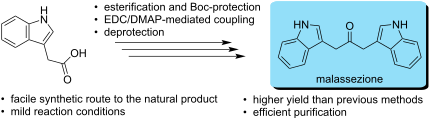
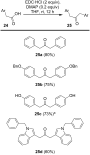
- , ON, Canada). Reactions were monitored using thin-layer chromatography on aluminium-backed silica plates (Sigma-Aldrich) using either UV-light (254 nm), iodine, KMnO4, phosphomolybdic acid, or p-anisaldehyde for visualization. Tetrahydrofuran (THF) was dried and distilled over sodium/benzophenone


Photocatalysis and photochemistry in organic synthesis
Beilstein J. Org. Chem. 2025, 21, 1645–1647, doi:10.3762/bjoc.21.128
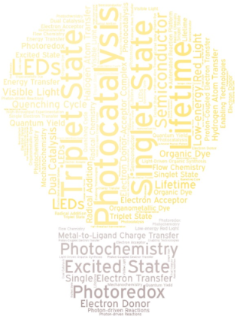
- ; photochemistry; Soon after its first reported synthesis in 1936 [1], [Ru(bpy)3]Cl2 (bpy = 2,2'-bipyridine) and its derivatives attracted significant attention due to their photophysical properties [2][3][4]. These complexes can efficiently absorb visible light through a metal-to-ligand charge transfer (MLCT
- in the presence of electron donors and acceptors. Furthermore, [Ru(bpy)3]Cl2 can engage in Förster and Dexter energy transfer processes, enabling the transfer of excited-state energy to molecules that do not themselves absorb visible light. This versatility is arguably the reason for the tremendous
- impact of [Ru(bpy)3]Cl2 on several research areas, including solar energy conversion [5], optosensing [6], photodynamic therapy [7][8] and bioimaging [9]. Scattered examples of [Ru(bpy)3]Cl2 being used as a photocatalyst for visible-light-driven organic synthesis appeared in the scientific literature as

On the aromaticity and photophysics of 1-arylbenzo[a]imidazo[5,1,2-cd]indolizines as bicolor fluorescent molecules for barium tagging in the study of double-beta decay of 136Xe
Beilstein J. Org. Chem. 2025, 21, 1627–1638, doi:10.3762/bjoc.21.126
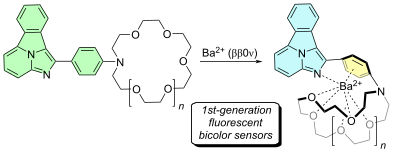
- perchlorate, as indicated in Figure 2 (X = O, Y, Z = Me). The possible coordination patterns are shown. NICS(iso) and NICSzz values at the molecular plane (z = 0) and 1 Å (z = 1) above this plane in a perpendicular direction. Points a–c correspond to the respective ring points, in light red. Perpendicular
- points at z = 1 are shown in light green. Calculateda absorption (λabs, in nm) and emission (λem, in nm) wavelengths of compound 19 at the free and barium perchlorate bound states, using different DFT functionals. Supporting Information Supporting Information File 51: Energies, calculated absorption and


Synthesis of optically active folded cyclic dimers and trimers
Beilstein J. Org. Chem. 2025, 21, 1603–1612, doi:10.3762/bjoc.21.124

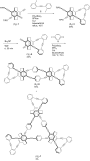
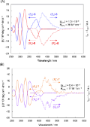
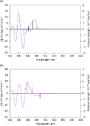
- %) as a light yellow solid. Rf = 0.73 (CHCl3/hexane = 1:2 v/v); 1H NMR (CDCl3, 500 MHz) δ 1.20 (s, 42H), 2.97–3.08 (m, 4H), 3.49–3.53 (m, 4H), 7.06 (s, 2H), 7.21 (s, 2H), 7.37–7.40 (m, 4H), 7.60–7.62 (m, 2H), 7.70–7.73 (m, 2H) ppm; 13C NMR (CDCl3, 125 MHz) δ 11.48, 18.84, 32.32, 32.57, 92.38, 93.65
- by recyclable HPLC (CH2Cl2 as an eluent) to afford (Sp)-4 (11.8 mg, 0.025 mmol, 45%) as a light yellow solid. Rf = 0.43 (CHCl3/hexane = 1:2 v/v). 1H NMR (CDCl3, 500 MHz) δ 2.98–3.09 (m, 4H), 3.39 (s, 2H), 3.43–3.55 (m, 4H), 7.09 (s, 2H), 7.21 (s, 2H), 7.37–7.41 (m, 4H), 7.62–7.65 (m, 2H), 7.70–7.73
- , respectively. Dimer (Sp)-6 (6.8 mg, 0.0062 mmol, 16%) was isolated from the first fraction by recyclable HPLC (CH2Cl2 as an eluent) as a light yellow solid. Trimer (Sp)-7 was isolated from the second fraction by recyclable HPLC (CH2Cl2 as an eluent). Further purification of (Sp)-7 was carried out using chiral



Thermodynamic equilibrium between locally excited and charge transfer states in perylene–phenothiazine dyads
Beilstein J. Org. Chem. 2025, 21, 1577–1586, doi:10.3762/bjoc.21.121
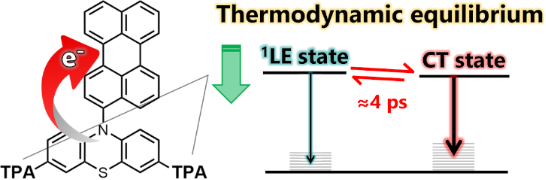
- processes underlying a wide range of applications, including artificial photosynthesis, solar energy conversion, and photocatalysis [1][2][3]. In particular, the formation of long-lived charge-separated states is crucial for efficient energy conversion and advanced photofunctions driven by light. Among




General method for the synthesis of enaminones via photocatalysis
Beilstein J. Org. Chem. 2025, 21, 1535–1543, doi:10.3762/bjoc.21.116
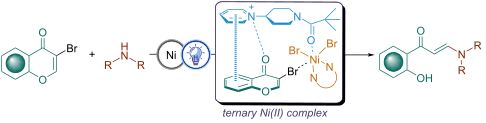
- ]. Thus, the use of visible light as an energy source provides more efficient chemical transformations and minimize the use of harmful reagents, the generation of waste and the consumption of energy, fulfilling several principles of Green Chemistry and promoting greener opportunities for organic synthesis
- [37][38]. In this context, the reactivity of enaminones under visible-light-mediated reaction conditions has attracted significant attention [39]. However, it is rather surprising that a photocatalytic approach for the synthesis of enaminones has yet to be explored. Herein, we report the first light
- while 3-iodochromone failed to provide the desired enaminone 9a (Table S7, Supporting Information File 1). Control experiments including the reaction in the absence of visible-light or photocatalyst, showed no product formation (Table 1, entries 16 and 17). Interestingly, the yield of 9a dropped to 30




Azobenzene protonation as a tool for temperature sensing
Beilstein J. Org. Chem. 2025, 21, 1528–1534, doi:10.3762/bjoc.21.115
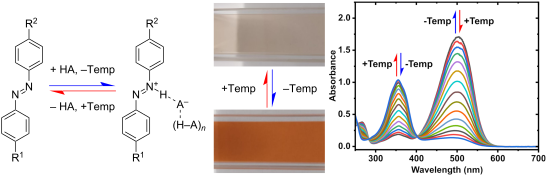
- . Keywords: azobenzene; protonation; sensing; spectral changes; temperature; Introduction Molecular switches are molecules that can reversibly shift between distinct (meta)stable states in response to external stimuli such as light, pH changes, or electric fields [1]. Over the past decades, they have
- emerged as staple building blocks in smart materials, from light-responsive norbornadienes in molecular solar thermal energy storage [2] to pH-sensitive spiropyrans in cell imaging [3], and redox-active viologens in memory junctions [4]. Among the different molecular switches azobenzenes stand out due to
- heavy metal detection [16][19] and humidity sensing [20]. The color changes can be either reversible or irreversible, depending on the mechanism of operation. Spectral tuning also enables switching with low-energy light, eliminating the need for potentially harmful UV irradiation [21]. Utilizing


Highly distinguishable isomeric states of a tripodal arylazopyrazole derivative on graphite through electron/hole-induced switching at ambient conditions
Beilstein J. Org. Chem. 2025, 21, 1496–1507, doi:10.3762/bjoc.21.112
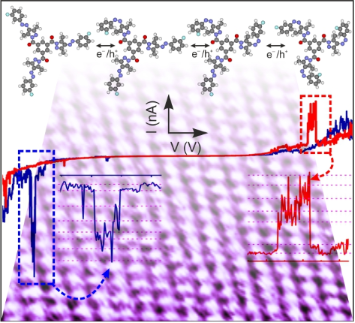
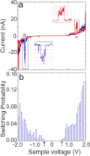
- switchable probe for light-driven reversible printing and erasing applications [29]. Besides exhibiting excellent photoswitching in solution phase, the tripodal photoswitches exhibit extended half-life of the ZZZ isomer in the solid-state as well [22][29]. The overall efficiency of the molecular switch could



Photoredox-catalyzed arylation of isonitriles by diaryliodonium salts towards benzamides
Beilstein J. Org. Chem. 2025, 21, 1480–1488, doi:10.3762/bjoc.21.110
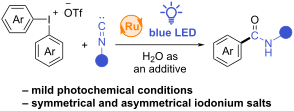
- synthesis of benzamides via the arylation of isonitriles with diaryliodonium salts under blue light irradiation (Scheme 1C). Results and Discussion We commenced our investigation by the optimization of the reaction conditions. During the preliminary experiments we tested different solvents and solvent-to
- ones [31][32][33] introducing the photocatalyst [Ru(bpy)3](PF6)2, which successfully initiated the reaction under blue light irradiation and afforded benzamide 2aa in 36% yield (Table 1, entry 2). In that case less than 2% of the iodonium salt 1a remained in the reaction medium according to the 1H NMR
- [Ru(bpy)3](PF6)2 as the photocatalyst, under an Ar atmosphere with irradiation by blue LED light (Table 1, entry 2). With the optimized conditions in hands, a series of benzamides 2aa–je were synthesized using various symmetrical diaryliodonium salts 1a–k and isonitriles (Scheme 2). The analysis of


Advances in nitrogen-containing helicenes: synthesis, chiroptical properties, and optoelectronic applications
Beilstein J. Org. Chem. 2025, 21, 1422–1453, doi:10.3762/bjoc.21.106
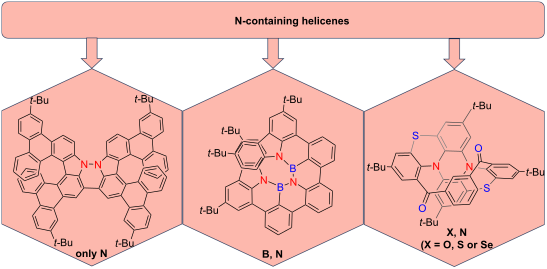
- in applications such as organic light-emitting diodes (OLEDs) [8], circularly polarized luminescence (CPL) [9], and chiral photocatalysis [10]. In the past decade, heteroatom-containing helicenes have attracted increasing attention due to their tunable optoelectronic properties and potential
- polarized organic light-emitting diodes (CP-OLEDs) based on 40 demonstrated a |gEL| of 2.2 × 10⁻³, a narrow emission bandwidth (FWHM = 49 nm), and a maximum external quantum efficiency (EQE) of 31.5%, placing it among the highest-performing multiple-resonance-induced thermally activated delayed fluorescence
- -containing derivatives showed red-shifted emission, broader FWHM, lower PLQYs, and diminished BCPL values, indicating a trade-off between extended conjugation and emissive efficiency. Yin’s group introduced 1,4-BN motifs into compounds 51a and 51b, which emitted blue-green light at 474 and 465 nm




