Search results
Search for "couplings" in Full Text gives 311 result(s) in Beilstein Journal of Organic Chemistry. Showing first 200.
Unexpected rearrangements and a novel synthesis of 1,1-dichloro-1-alkenones from 1,1,1-trifluoroalkanones with aluminium trichloride
Beilstein J. Org. Chem. 2021, 17, 404–409, doi:10.3762/bjoc.17.36
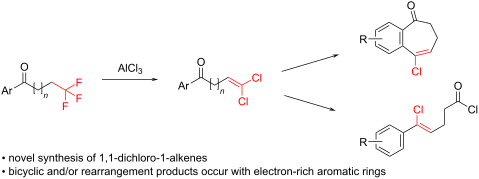
- trichloride; dichloroalkenes; Friedel–Crafts alkylation; rearrangement; trifluoroalkanes; Introduction 1,1-Dichloro-1-alkenes are valuable synthetic intermediates and have been employed in Pd-mediated cross couplings of one or both chlorine atoms [1][2][3][4][5][6][7], carbonylation reactions [8], and C–H




Selective synthesis of α-organylthio esters and α-organylthio ketones from β-keto esters and sodium S-organyl sulfurothioates under basic conditions
Beilstein J. Org. Chem. 2021, 17, 234–244, doi:10.3762/bjoc.17.24
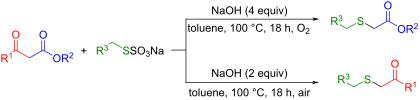
- -rich N-heterocycles [2][3][4], decarboxylative cross-coupling reactions with propiolic acid derivatives [5], Michael addition reaction [6], cross-couplings catalyzed by Pd [7] and Cu salts [8][9], the preparation of symmetrical and nonsymmetrical disulfides [10][11], and the synthesis of β-acetamido


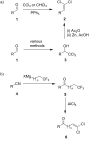
Direct synthesis of anomeric tetrazolyl iminosugars from sugar-derived lactams
Beilstein J. Org. Chem. 2021, 17, 115–123, doi:10.3762/bjoc.17.12
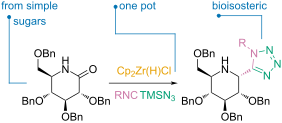
- couplings and NOE effects shown. Our previous efforts in the field of functionalization of sugar-derived lactams. Preliminary experiment in search of a procedure for the synthesis of 2-(1H-tetrazol-5-yl)-iminosugars. Synthesis of a new class of alkaloid scaffold using the presented methodology. Synthesis of a


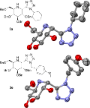


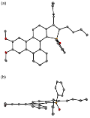
Synthesis, crystal structures and properties of carbazole-based [6]helicenes fused with an azine ring
Beilstein J. Org. Chem. 2021, 17, 11–21, doi:10.3762/bjoc.17.2
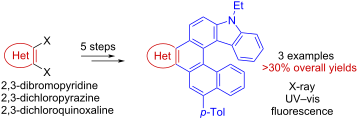
- sp. and displaying inhibitory activities towards telomerases. The classical synthetic approach for carbohelicenes is the oxidative photocyclization of stilbene derivatives [1][2][3][4][5][6][7][8][9][10][11]. The latter are generally available via the Wittig, Heck-type or McMurry couplings. It is

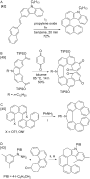


Isolation and structure determination of a tetrameric sulfonyl dilithio methandiide in solution based on crystal structure analysis and 6Li/13C NMR spectroscopic data
Beilstein J. Org. Chem. 2020, 16, 2057–2063, doi:10.3762/bjoc.16.172
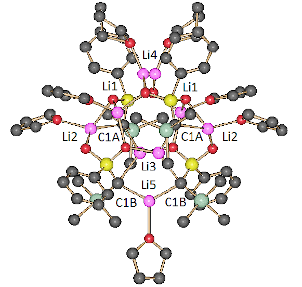
- couplings shows, however, that the carbon lithium bonds in 2a-I have a covalent contribution as generally observed for organolithiums [55]. Three mechanisms most likely contribute to the stabilization of the negative charge of the carbon atoms of tetramer (2a)4·(THF)6 and hexamer (2a)6·Li2O·(THF)6
- Symmetric carbon–lithium chain of 2a-I in THF, showing the carbon–lithium connectivities, multiplicities of the NMR signals (left), and magnitudes of 1J(6Li,13C) couplings in Hz (right) [15]. the structure of (2a)6·Li2O·(THF)6 in the crystal [15]. Color code: black, C; green, Si; yellow, S; red, O; pink, Li


Syntheses of spliceostatins and thailanstatins: a review
Beilstein J. Org. Chem. 2020, 16, 1991–2006, doi:10.3762/bjoc.16.166

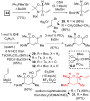
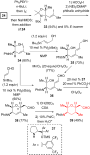
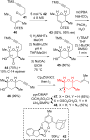
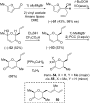
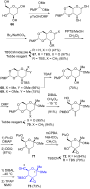
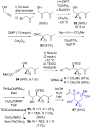
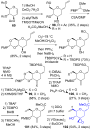
- -metathesis reaction was employed in numerous syntheses, the drawbacks of this strategy include the high catalyst loading and the excess of the olefin coupling partners. To date, the most efficient strategy for the union of the fragments relies on Pd-catalyzed sp2–sp2 couplings. Structures of spliceostatins








Polarity effects in 4-fluoro- and 4-(trifluoromethyl)prolines
Beilstein J. Org. Chem. 2020, 16, 1837–1852, doi:10.3762/bjoc.16.151
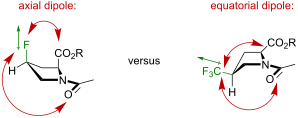
- the conformation adopted by the ring. A C4-endo conformation exhibits two vicinal J couplings with one value being large and one being small, whereas a C4-exo conformation displays two large J couplings [66] (Figure 4). A substituent at the C4-atom creates a certain preference towards one or another


When metal-catalyzed C–H functionalization meets visible-light photocatalysis
Beilstein J. Org. Chem. 2020, 16, 1754–1804, doi:10.3762/bjoc.16.147

- last decade particular attention has been focused on two modern fields, C–H bond activation, and visible-light-induced photocatalysis. Couplings through C–H bond activation involve the use of non-prefunctionalized substrates that are directly converted into more complex molecules, without the need of a
- photoredox catalysis. This interception leads to a new metallic key intermediate 3 by single-electron transfer (SET). The desired coupling product 4 is then obtained after a reductive elimination (Figure 19). Applying such an approach paved the way towards unprecedented couplings benefiting from a SET
- combination of photocatalysis and metal-catalyzed C–H activations upholds the desired couplings under, usually, mild conditions and at room temperature, while utilization of non-prefunctionalized coupling partners reduces the waste formation. Last but not least, the use of visible light, one of the most


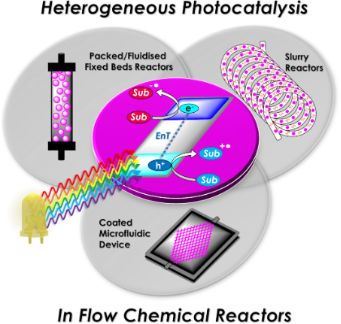
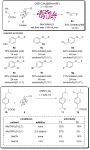
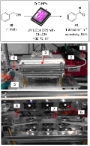
Heterogeneous photocatalysis in flow chemical reactors
Beilstein J. Org. Chem. 2020, 16, 1495–1549, doi:10.3762/bjoc.16.125










Disposable cartridge concept for the on-demand synthesis of turbo Grignards, Knochel–Hauser amides, and magnesium alkoxides
Beilstein J. Org. Chem. 2020, 16, 1343–1356, doi:10.3762/bjoc.16.115
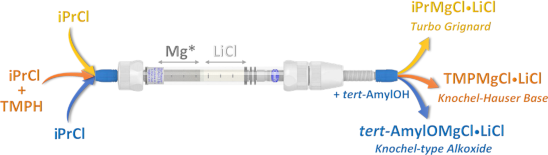
- combined with a solution-phase reagent, including: (1) copper(I) oxide to produce N-heterocyclic carbene–Cu(I) complexes for use as catalysts [13]; (2) proline to perform proline-based catalytic reactions [14]; (3) zinc powder to produce organozinc halides in tandem with Negishi couplings [15]; (4) zinc


Distinctive reactivity of N-benzylidene-[1,1'-biphenyl]-2-amines under photoredox conditions
Beilstein J. Org. Chem. 2020, 16, 1335–1342, doi:10.3762/bjoc.16.114
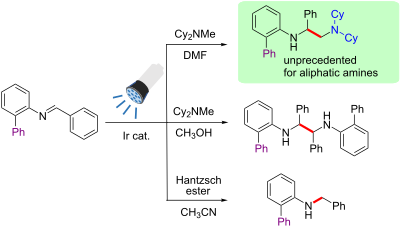
- brine. The organic layer was dried over anhydrous MgSO4 and concentrated in vacuo. The desired vicinal diamine product was purified by silica-gel column chromatography using hexane/EtOAc as the eluent. Photocatalytic transformations of imines. Substrate scope for the radical cross-couplings. Reaction


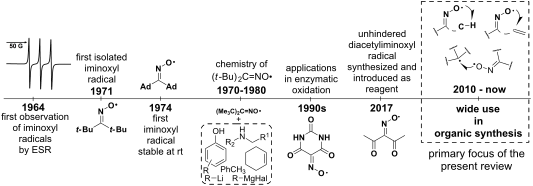
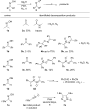
Oxime radicals: generation, properties and application in organic synthesis
Beilstein J. Org. Chem. 2020, 16, 1234–1276, doi:10.3762/bjoc.16.107




Photocatalysis with organic dyes: facile access to reactive intermediates for synthesis
Beilstein J. Org. Chem. 2020, 16, 1163–1187, doi:10.3762/bjoc.16.103
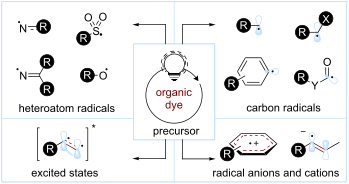
- , the ability of transition metal complexes to intercept alkyl radicals has been exploited for expanding the possibility of C–C bond formation reactions to cross-couplings. In all of these transformations, the substituents on the alkyl radical determine if it reacts as a nucleophile or an electrophile
- radicals are electrophilic, with the substitution playing an important role [133][134][135]. As they are prone to efficient HAT, C(sp3)–H couplings at remote positions have been intensively studied [128][130][132][136]. Aminyl and aminium radicals display the opposite philicity: aminyls are nucleophilic





A cyclopeptide and three oligomycin-class polyketides produced by an underexplored actinomycete of the genus Pseudosporangium
Beilstein J. Org. Chem. 2020, 16, 1100–1110, doi:10.3762/bjoc.16.97
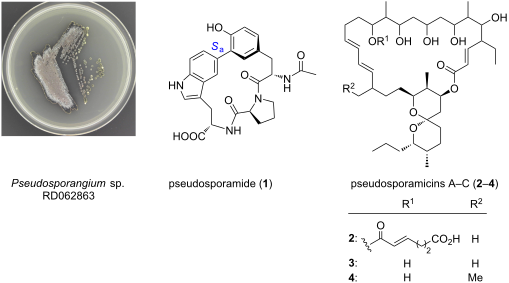
- . Protons H-8 and H-9 showed three-bond couplings (J = 8.2 Hz), while H-9 showed a weak four-bond correlation with H-5 (J = 1.9 Hz). Relatively intense cross peaks from H-5 and H-9 to the deshielded carbon C-7 (δC 152.8) suggested the oxygen functionality at the meta-position to C-5 and C-9. Intense HMBC


Suzuki–Miyaura cross coupling is not an informative reaction to demonstrate the performance of new solvents
Beilstein J. Org. Chem. 2020, 16, 1001–1005, doi:10.3762/bjoc.16.89
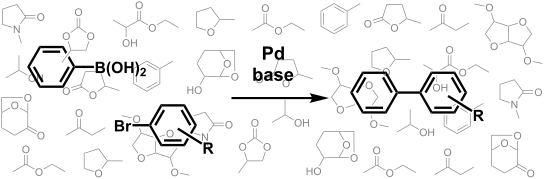
- objective of this work was to reveal if there is a relationship between the productivity of Suzuki–Miyaura cross couplings and the properties of the solvent, and whether this could be used to justify solvent selection. The choice of solvent is one variable that dictates reaction rate, selectivity
- applicable) of Suzuki–Miyaura cross couplings [8]. Despite this, the reaction is generally tolerant of a wide range of solvents (often an ether or amide solvent is used, and water is a common co-solvent). This calls into question the benefits of using Suzuki–Miyaura cross coupling as a test of new solvents
- enough to definitively establish a measurement of solvent performance in Suzuki–Miyaura cross couplings, a short optimisation study was conducted to improve the conversion to 4-phenylacetophenone in 2-MeTHF (originally 16%). Reducing the water content to an 18:1 v/v ratio and increasing the excess of


Accelerating fragment-based library generation by coupling high-performance photoreactors with benchtop analysis
Beilstein J. Org. Chem. 2020, 16, 982–988, doi:10.3762/bjoc.16.87
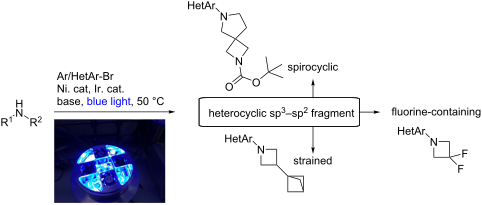
- findings on C–N cross-coupling conditions. In these works, nickel-photoredox-catalyzed cross-couplings were the most successful with success rates up to 50% [10]. This was an improvement from non-photocatalyzed conditions, where success rates of 11–33% were observed for palladium-catalyzed cross-coupling
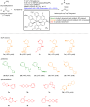
- electrochemically-mediated nickel-catalyzed cross-couplings. Electron-deficient aniline products are less prone to oxidative decomposition. BCP-amines were viable coupling partners but gave the corresponding products 1a–e in poor purities. Simple azetidines partook the reaction to give 2a–c while azaspiro[3,3



Pd-catalyzed asymmetric Suzuki–Miyaura coupling reactions for the synthesis of chiral biaryl compounds with a large steric substituent at the 2-position
Beilstein J. Org. Chem. 2020, 16, 966–973, doi:10.3762/bjoc.16.85
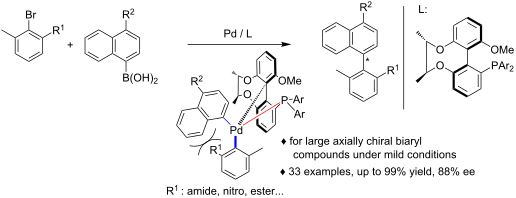
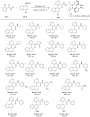
- Abstract Pd-catalyzed asymmetric Suzuki–Miyaura couplings of 3-methyl-2-bromophenylamides, 3-methyl-2-bromo-1-nitrobenzene and 1-naphthaleneboronic acids have been successfully developed and the corresponding axially chiral biaryl compounds were obtained in very high yields (up to 99%) with good
- bromobenzene substrates and the Pd···O interaction between carbonyl and palladium seem essential to achieve high enantioselectivity. Keywords: asymmetric catalysis; biaryls; monophosphine ligand; palladium catalyst; Suzuki–Miyaura couplings; Introduction Axially chiral molecules have received much attention
- efficient synthesis of this scaffold [7][8][9][10][11][12][13][14][15][16][17][18][19][20][21][22], like Hiyama [23][24], Negishi [25][26] or Suzuki–Miyaura couplings [27][28][29][30][31][32][33][34][35][36]. In these synthetic strategies, the reaction system of palladium with chiral phosphine ligands was




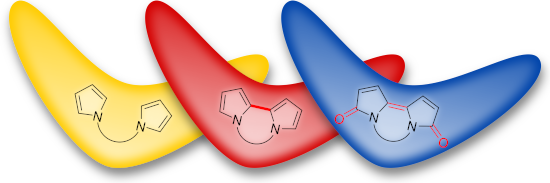
Bipyrrole boomerangs via Pd-mediated tandem cyclization–oxygenation. Controlling reaction selectivity and electronic properties
Beilstein J. Org. Chem. 2020, 16, 895–903, doi:10.3762/bjoc.16.81
- ], with FeCl3 being particularly notable for its versatility, ease of use, and low price [5]. Nevertheless, the synthetic utility of oxidative couplings is often limited by several factors [6]. Consequently, incomplete ring fusion and various side reactions, e.g., chlorination [7], or unexpected
- rearrangements, are frequently observed [8]. The use of oxidative couplings is further limited for the synthesis of strained [9][10], electron-deficient, or sterically congested aromatics [11][12][13][14]. Some of these limitations can be overcome by using prefunctionalized precursors [11], as exemplified by
- reductive Ullmann-type chemistry [15], catalytic direct arylations [11][14][16][17], photoinduced cyclodehydrochlorinations [18][19], or nucleophilic oxidative couplings [20], which may offer milder reaction conditions and superior regioselectivities, at the expense of atom and step economy [21]. The latter




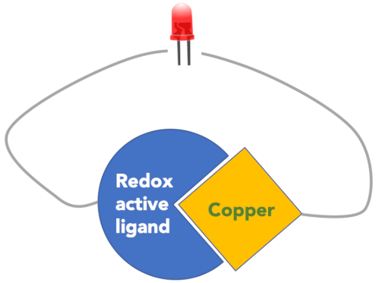
Copper catalysis with redox-active ligands
Beilstein J. Org. Chem. 2020, 16, 858–870, doi:10.3762/bjoc.16.77
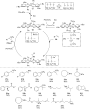
- ], and perform C–H functionalization through aerobic dearomatization of phenols [35]. These broad synthetic outcomes further led to a unified approach for the preparation of 1,2-oxy-aminoarenes by phenol–amine couplings (Scheme 10) [36]. We reported the formation of a C–N bond through copper-catalyzed



Photocatalytic deaminative benzylation and alkylation of tetrahydroisoquinolines with N-alkylpyrydinium salts
Beilstein J. Org. Chem. 2020, 16, 809–817, doi:10.3762/bjoc.16.74
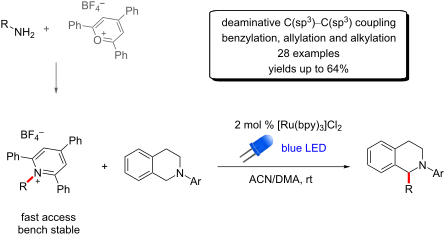
- , electrophilic alkyl radicals were used in several transformations, such as electrophilic cross couplings under nickel catalysis, either with boronic acids [35] or different (aryl)halides [36][37][38]. Furthermore, visible light-promoted uncatalyzed electron transfer via the formation of electron donor–acceptor




Efficient synthesis of dipeptide analogues of α-fluorinated β-aminophosphonates
Beilstein J. Org. Chem. 2020, 16, 756–762, doi:10.3762/bjoc.16.69
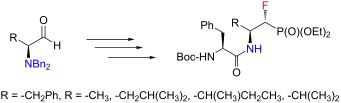
- , as well as J-couplings) a relative configuration of N,N-dibenzyl-protected α-fluoro-β-aminophosphonates 11 was established as (1R,2S), but we failed to crystallize these compounds [31]. That is why the removal of the benzyl protecting group from fluorides 11 and the transfer of the free amines 13


Combining enyne metathesis with long-established organic transformations: a powerful strategy for the sustainable synthesis of bioactive molecules
Beilstein J. Org. Chem. 2020, 16, 738–755, doi:10.3762/bjoc.16.68
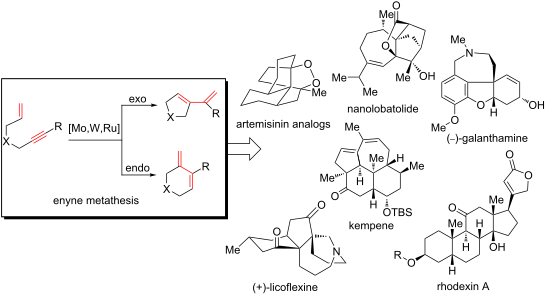
- efficiently produce key 1,3-dienic frameworks, further subjected to sequential functionalization. The main focus was placed on strategies combining enyne metathesis with traditional chemical transformations such as Diels–Alder cycloaddition, Suzuki–Miyaura or Heck cross-couplings, aromatization, epoxidation




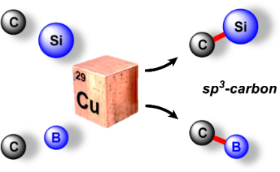
Recent advances in Cu-catalyzed C(sp3)–Si and C(sp3)–B bond formation
Beilstein J. Org. Chem. 2020, 16, 691–737, doi:10.3762/bjoc.16.67
- , Ohmiya and co-workers envisioned inverting the polarity of an aldehyde 81 via conversion into the corresponding α-alkoxyalkyl Cu(I) anion 78. Utilizing 78, which undergoes transmetallation to an initially formed Pd(II) intermediate (from oxidative addition) led to cross couplings affording benzhydryl
- silyl ethers 89–92 (Scheme 18), thus showcasing the synergistic relationship between Pd and Cu catalysis [43]. Driven by the success of earlier results, the authors utilized 78 for reductive couplings between ketones 93 and imines 97 as electrophiles to form unsymmetrical 1,2-diols 94–96 and 1,2-amino


Copper-catalyzed remote C–H arylation of polycyclic aromatic hydrocarbons (PAHs)
Beilstein J. Org. Chem. 2020, 16, 530–536, doi:10.3762/bjoc.16.49
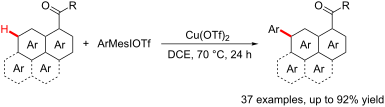
- molecules, thus having drawn much attention. Transition metal-catalyzed C–X/C–M cross-coupling reactions such as Suzuki and Stille couplings are the main approaches to achieve the arylation of PAHs [7][8][9][10][11]. However, the selective arylation of the C7-position of 1-naphthoic acid derivatives remains


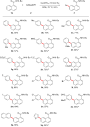


Synthesis of triphenylene-fused phosphole oxides via C–H functionalizations
Beilstein J. Org. Chem. 2020, 16, 524–529, doi:10.3762/bjoc.16.48
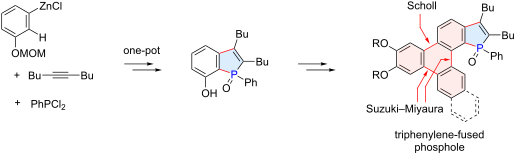
- via 1,4-cobalt migration. The resulting 7-hydroxybenzo[b]phosphole derivative was used for further π-extension through Suzuki–Miyaura couplings and a Scholl reaction, the latter closing the triphenylene ring. The absorption and emission spectra of the thus-synthesized compounds illustrated their
- converted to the triflate, and subjected to Suzuki–Miyaura couplings with 2-bromophenylboronic acid (5a) or 3-bromonaphth-2-ylboronic acid (5b) to afford the phosphole-fused biaryls 6a and 6b, respectively, in decent yields. Subsequent Suzuki–Miyaura couplings of 6a or 6b with 3,4-dialkoxyarylboronic acids