Search results
Search for "diols" in Full Text gives 199 result(s) in Beilstein Journal of Organic Chemistry.
Thermal and oxidative stability of the Ocimum basilicum L. essential oil/β-cyclodextrin supramolecular system
Beilstein J. Org. Chem. 2014, 10, 2809–2820, doi:10.3762/bjoc.10.298
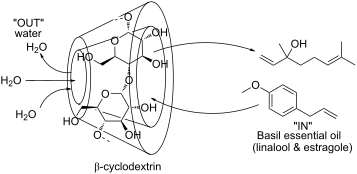
- isoaromadendrene oxide (22) (up to 0.2%), or the corresponding diols (up to 0.1%). Obtaining of O. basilicum L. essential oil/β-CD complex The O. basilicum L. essential oil/β-CD complex was obtained by using the controlled crystallization method from an ethanol/water suspension (due to the lower water solubility


Design and synthesis of novel bis-annulated caged polycycles via ring-closing metathesis: pushpakenediol
Beilstein J. Org. Chem. 2014, 10, 2664–2670, doi:10.3762/bjoc.10.280
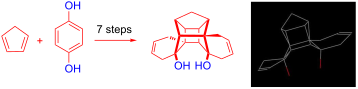
- synthesis of heptacyclic diol 22. The synthesis of diallylated hexacyclic diols. The attempted synthesis of heptacyclic diol via ring-rearrangement metathesis. Supporting Information Supporting Information File 428: Copies of 1H, 13C NMR and HRMS spectra for all new compounds. Acknowledgements We would


Regio- and stereoselective synthesis of new diaminocyclopentanols
Beilstein J. Org. Chem. 2014, 10, 2513–2520, doi:10.3762/bjoc.10.262
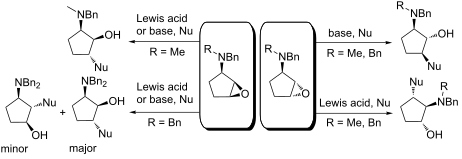
- of stereoselective epoxide opening of these cyclic amine derivatives are limited to the preparation of the corresponding diols under acidic conditions [23]. Other reported strategies involve the formation of diaminocyclohexanols from epoxides under basic conditions [24] or by activating the epoxides


De novo macrolide–glycolipid macrolactone hybrids: Synthesis, structure and antibiotic activity of carbohydrate-fused macrocycles
Beilstein J. Org. Chem. 2014, 10, 2215–2221, doi:10.3762/bjoc.10.229
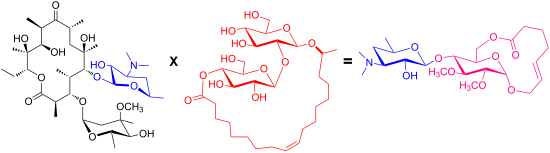
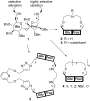
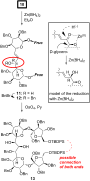
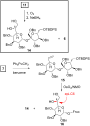
- remainder of the synthesis separately. Transacetalization of the C4,C6-O-benzylidene protecting group in methanol provided diols 9a and 9b, respectively in nearly quantitative yields. Chemoselective, DCC-mediated acylation of the primary alcohol group of 9a and 9b at 0 °C with pentenoic acid gave 10a (58


Visible light photoredox-catalyzed deoxygenation of alcohols
Beilstein J. Org. Chem. 2014, 10, 2157–2165, doi:10.3762/bjoc.10.223
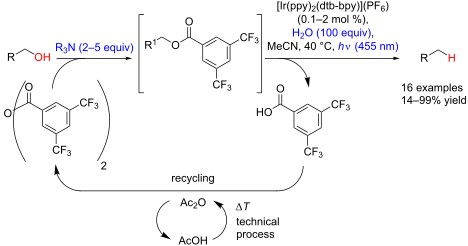
- benzylic alcohols, α-hydroxycarbonyl, and α-cyanohydrin compounds. Moreover, the selective catalytic monoacylation of diols is possible, thus allowing efficient monodeoxygenations as exemplified in the conversion of (+)-diethyl tartrate to unnatural (+)-diethyl malate. Results and Discussion Following the


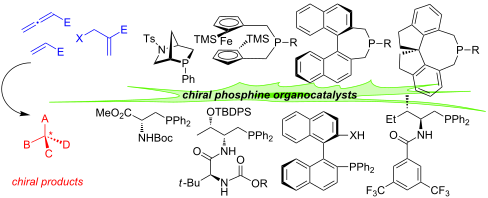
Chiral phosphines in nucleophilic organocatalysis
Beilstein J. Org. Chem. 2014, 10, 2089–2121, doi:10.3762/bjoc.10.218


Palladium-catalysed cyclisation of alkenols: Synthesis of oxaheterocycles as core intermediates of natural compounds
Beilstein J. Org. Chem. 2014, 10, 2077–2086, doi:10.3762/bjoc.10.216
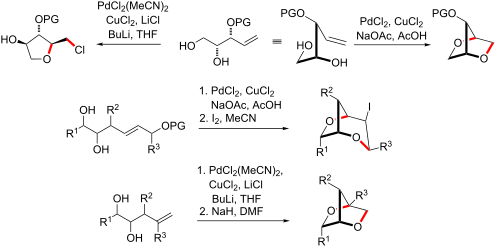
- tertiary allylic alcohol was performed in a two-step sequence. The addition of methyllithium to ester Z-17 and following deprotection of the corresponding alcohol 27 with aqueous acetic acid afforded tetraol 28 in good yield. Substrates syn-diols 33–35 (not bearing an α-O-protected group) were prepared in
- reaction with the corresponding Grignard reagent in the presence of CeCl3·2LiCl providing diols 33–35 in good overall yields and high diastereoselectivity (d.r. >20:1). Additionally, allylic acetate 37 was obtained starting from 33 in a seven-step sequence in 30% overall yield. The acetonisation of hydroxy



Reaction of selected carbohydrate aldehydes with benzylmagnesium halides: benzyl versus o-tolyl rearrangement
Beilstein J. Org. Chem. 2014, 10, 1942–1950, doi:10.3762/bjoc.10.202
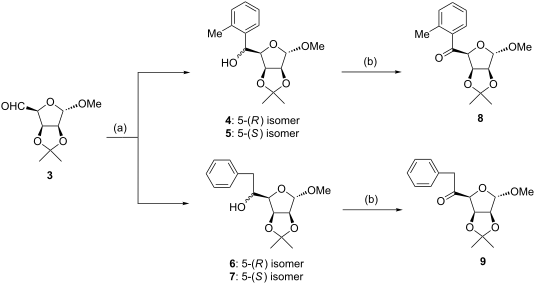
- formation (via an intermediate F) of 1-methyl-2-substituted-naphthalenes I, analogues of o-tolyl derivatives 4 and 5 (Scheme 2, final step of path 1), which were in present study, by contrast, isolated as stable products. Moreover, path 2 in Scheme 2 can be excluded, since no diols of type C (analogues of
- diols H in Scheme 3) were detected in the reaction mixture. To extend and confirm these observations, the analogous addition of 1 as well as 2 to another two representative carbohydrate aldehydes – 3-O-benzyl-1,2-O-isopropylidene-α-D-xylo-pentodialdo-1,4-furanose and 1,2:3,4-di-O-isopropylidene-α-D


Facile synthesis of 1-alkoxy-1H-benzo- and 7-azabenzotriazoles from peptide coupling agents, mechanistic studies, and synthetic applications
Beilstein J. Org. Chem. 2014, 10, 1919–1932, doi:10.3762/bjoc.10.200
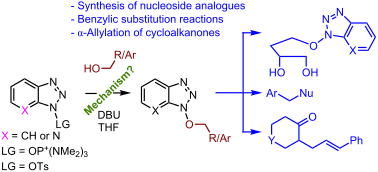
- hydroxy group, in good yields. In these reactions minor amounts of products arising by reaction at both hydroxy groups were observed. Similarly, reactions of 3-butenol gave products 4a and 4b in good to high yields, which were converted to the acyclic ribonucleoside-like diols (±)-5a and (±)-5b


Synthesis of rigid p-terphenyl-linked carbohydrate mimetics
Beilstein J. Org. Chem. 2014, 10, 1749–1758, doi:10.3762/bjoc.10.182
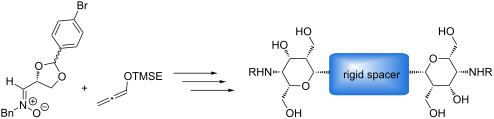
- and protection of 12a to 1,2-oxazine derivative 13. Conditions: a) 1. SnCl4, CH3CN, 4 h, −30 °C → rt; 2. TBSCl, imidazole, THF, 4 h, rt; b) NaBH4, EtOH, 4 h, −40 °C, 72%, dr 81:19; c) L-selectride, THF, 2 h, −10 °C, 73%, only 12a; d) TBSOTf, 2,6-lutidine, THF, 2 h, 0 °C. Synthesis of bicyclic diols 15


Aryl substitution of pentacenes
Beilstein J. Org. Chem. 2014, 10, 1692–1705, doi:10.3762/bjoc.10.178
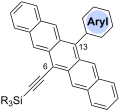
- purification step of the intermediate diols. Once formed, pentacenes 3a–h were obtained in moderate yield over two steps, as deep-blue solids. To expand the π-system in a linear fashion along the short molecular axis of the pentacene core, the general procedure described above was changed slightly, and ketone




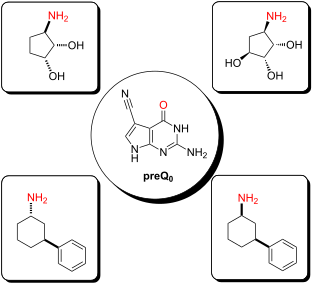
Stereoselective synthesis of carbocyclic analogues of the nucleoside Q precursor (PreQ0)
Beilstein J. Org. Chem. 2014, 10, 1333–1338, doi:10.3762/bjoc.10.135
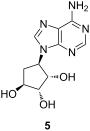
- -diol core. Our previous experience in coupling diols and triols at high temperatures with chloro-intermediate 9 showed that more than one unprotected alcohol functionality leads to complex reaction mixtures and very low yields of isolated products [29], hence we protected all hydroxy groups as esters




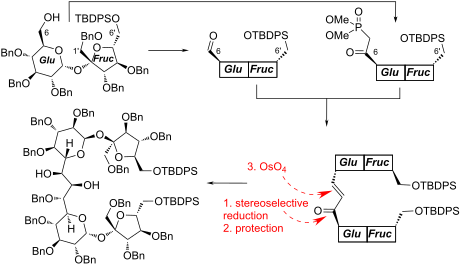
Synthesis of a sucrose dimer with enone tether; a study on its functionalization
Beilstein J. Org. Chem. 2014, 10, 1246–1254, doi:10.3762/bjoc.10.124
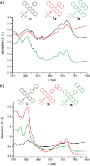
- dimolybdenum methodology offers the hard proof of the absolute configuration of the vic-diols [27][28][29]. In this methodology, dimolybdenum tetraacetate acts as auxiliary chromophore allowing the application of electronic circular dichroism (ECD) to (otherwise in ECD non-observable) vic-diols. Mo2(OAc)4 when
- mixed with a chiral diol ligand forms complexes active in ECD in which a transfer of ligand chirality to the in situ-formed complex occurs in solution. Thus, stereochemistry of vic-diols can be easily assigned based on the helicity rule developed for this class of compounds. This rule correlates the
- evidenced by the steadily increasing number of reports in the literature about its successful application in the determination of the AC of 1,2-diols [30][31][32]. Therefore, in assignment of the AC of compounds under the present study (13, 14 and 16), we decided just to take advantage of the in situ




Homogeneous and heterogeneous photoredox-catalyzed hydroxymethylation of ketones and keto esters: catalyst screening, chemoselectivity and dilution effects
Beilstein J. Org. Chem. 2014, 10, 1143–1150, doi:10.3762/bjoc.10.114
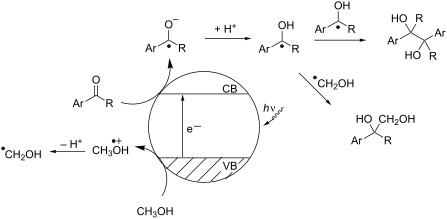
- contrast to that, photochemical redox activation is possible in the presence of titanium(IV) catalysts [19][20][21][22]. As shown in a series of papers by Sato and coworkers, carbonyl compounds 1 as well as imines couple with methanol to give the 1,2-diols or 1,2-amino alcohols, respectively, when


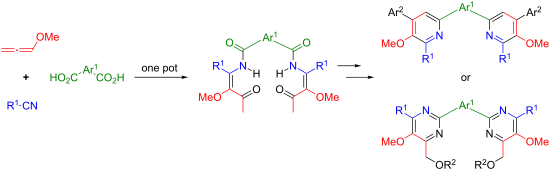
The Flögel-three-component reaction with dicarboxylic acids – an approach to bis(β-alkoxy-β-ketoenamides) for the synthesis of complex pyridine and pyrimidine derivatives
Beilstein J. Org. Chem. 2014, 10, 394–404, doi:10.3762/bjoc.10.37
- , due to the symmetry of both vicinal diols a distinction between cis- and trans-35 (σv- or C2-symmetry respectively) by NMR is still not possible. The resulting diol 35 was therefore treated with an excess of (S)-Mosher's acid chloride to obtain the bis-(R)-Mosher ester 36 [74]. TLC analysis and NMR


Concise, stereodivergent and highly stereoselective synthesis of cis- and trans-2-substituted 3-hydroxypiperidines – development of a phosphite-driven cyclodehydration
Beilstein J. Org. Chem. 2014, 10, 369–383, doi:10.3762/bjoc.10.35
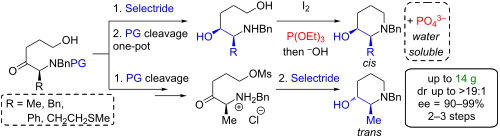
- , in an additional step, was reported to effect cyclodehydration of diols to furans and pyrans [47][48] (for recent examples for cyclodehydration protocols see [49][50]). Thereby, the volatile products were separated from O=P(OEt)3 through distillation. After our initial short communication [51] about
- was crystallized, the ketones 7a, 7b and 7d must have been enantiopure. Residual 3-chloropropanol (<15 mol % referred to 7), which was difficult to separate chromatographically, was removed after the next step either during the work up (diols 9) or chromatographically (on the sequence leading to 15a
- phase of the products 9 resulting in the crude diols 9a–d in a circa 90% purity according 1H NMR. Hence, the crude amino alcohols 9 were not further purified before the following cyclodehydration. Synthesis of cis-piperidinols B Cyclodehydration of amino alcohol syn-9a to piperidinol cis-11a under Appel


Boron-substituted 1,3-dienes and heterodienes as key elements in multicomponent processes
Beilstein J. Org. Chem. 2014, 10, 237–250, doi:10.3762/bjoc.10.19

- , 2,3-bis[(pinacolato)boryl]-1,3-diene 17, synthesized by treatment of 1,1-[bis(pinacolato)boryl]alkenes with excess of 1-bromo-1-lithioethene [56][57], were engaged in a triple aldehyde addition. 1,5-anti-Diols 18 were produced via successive Pt-catalyzed 1,4-diboration, allylboration reactions and
- . It was engaged in a one pot Diels–Alder cycloaddition with N-phenylmaleimide in the presence of various aldehydes to afford diols 39 as major diastereisomers (>95%) and in good overall yields (four steps) (Scheme 27). Conclusion Despite the synthetic potential of the boron-substituted 1,3-dienes and
- 15. Diels–Alder/cross-coupling reactions of 16. Metal catalyzed tandem Diels–Alder/hydrolysis reactions. Synthesis of anti-1,5-diols 18 by triple aldehyde addition. Catalytic enantioselective three-component hetero-[4 + 2]-cycloaddition/allylboration sequence. Synthesis of natural products using the


Synthesis of the B-seco limonoid core scaffold
Beilstein J. Org. Chem. 2014, 10, 194–208, doi:10.3762/bjoc.10.15
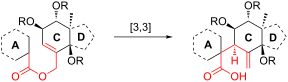
- ], which can be explained by the strong conformational rigidity of the butane-2,3-diacetal (BDA) protected trans-diequatorial diols [43] and the stereoelectronic preference for axial attack on the electron-rich C13. Luche reduction with stereoelectronically preferred axial attack of the hydride gave




Multigramme synthesis and asymmetric dihydroxylation of a 4-fluorobut-2E-enoate
Beilstein J. Org. Chem. 2013, 9, 2660–2668, doi:10.3762/bjoc.9.301
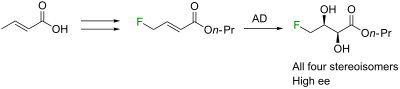
- sulfonamide which can accelerate hydrolysis and catalytic turnover was also added to the reaction mixtures [26]. Yields for the dihydroxylation chemistry were variable (44–80%); even though they are diols, these small molecules proved volatile. Reproducible yields (>55%) could be achieved if care was taken
- % respectively. The ee's were measured after conversion of the diols to the dibenzoates 29 upon stirring overnight with benzoic anhydride, DMAP and polyvinylpyridine (PVP) at room temperature. The removal of the base by filtration was facile (Scheme 6). Genuine racemate 28c was synthesised via the Upjohn
- the fluorinated diols 28a and 28b could not be achieved by the HPLC method. The very low absorbance of light at 235 nm resulted in unreliable data; small peak areas were observed for the desired compound with comparatively large peak areas for the background and trace impurities (as judged by 1H and




Flexible synthesis of anthracycline aglycone mimics via domino carbopalladation reactions
Beilstein J. Org. Chem. 2013, 9, 2194–2201, doi:10.3762/bjoc.9.258
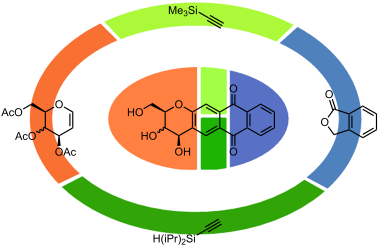
- trimethylsilyl moiety. Another approach of selective silyl ether cleavage was employed by utilization of Cs2CO3 (5.0 equiv) in methanol at 100 °C. Hydrolysis of the respective domino products 13a and 13f with in situ formed HCl in methanol furnished the diols 26a and 26b under loss of the terminal TMS group [46



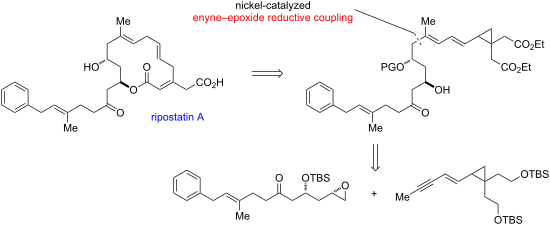
A reductive coupling strategy towards ripostatin A
Beilstein J. Org. Chem. 2013, 9, 1533–1550, doi:10.3762/bjoc.9.175
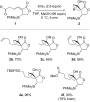
- carry out the reaction with diisopropylamine as a substitute for the thiourea catalyst. This modification afforded both the syn and anti diols in roughly a 1:1 ratio and a combined yield of 40–45%, albeit without recovery of starting material. The syn and anti diastereomers could be separated by


Development of an additive-controlled, SmI2-mediated stereoselective sequence: Telescoped spirocyclisation, lactone reduction and Peterson elimination
Beilstein J. Org. Chem. 2013, 9, 1443–1447, doi:10.3762/bjoc.9.163

- . Following a screen of reaction conditions, moderate but consistent yields were obtained when eliminations were performed in an open vessel, using undried solvents. When combined with the spirocyclisation and lactone reduction sequence, the Peterson elimination gave diols 5, with good overall yields




Thiourea-catalyzed Diels–Alder reaction of a naphthoquinone monoketal dienophile
Beilstein J. Org. Chem. 2013, 9, 1414–1418, doi:10.3762/bjoc.9.158
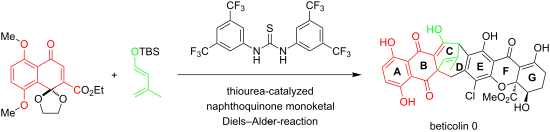
- carbenes, guanidines, thioureas, amidinium ions, diols, and Brønsted acids showed their value to give densely functionalized Diels–Alder products in high selectivities [1][2][3][4][5][6][7]. In addition, some organocatalysts enabled even the formation of quaternary centers in Diels–Alder cycloadditions [3


Copper-catalyzed aerobic aliphatic C–H oxygenation with hydroperoxides
Beilstein J. Org. Chem. 2013, 9, 1217–1225, doi:10.3762/bjoc.9.138

- aerobic oxygenation of aliphatic C–H bonds with hydroperoxides, which proceeds by 1,5-H radical shift of putative oxygen-centered radicals (O-radicals) derived from hydroperoxides followed by trapping of the resulting carbon-centered radicals with molecular oxygen. Keywords: copper; 1,4-diols; free
- could be trapped by O2 to form the new C–O bonds. Herein, we report the realization of this concept mainly for the aerobic synthesis of 1,4-diols from hydroperoxides, which could be catalyzed by the Cu(OAc)2-1,10-phenanthroline system in the presence of Et3N as a terminal reductant of the Cu(II) species
- present aerobic strategy for the synthesis of 1,4-diols by targeting methylene C–H oxygenation with various tertiary hydroperoxides 1 (Table 2). Generally, oxygenation of benzylic methylene C–H bonds proceeded smoothly to give the corresponding 1,4-diols 3 in good to moderate yields (77–51% yields) (Table


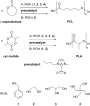
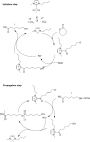
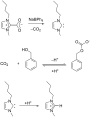
1-n-Butyl-3-methylimidazolium-2-carboxylate: a versatile precatalyst for the ring-opening polymerization of ε-caprolactone and rac-lactide under solvent-free conditions
Beilstein J. Org. Chem. 2013, 9, 647–654, doi:10.3762/bjoc.9.73
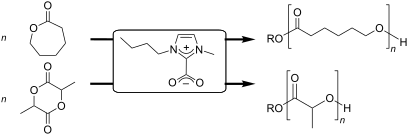
- concept was extended to the synthesis of aliphatic polycarbonates, involving the transesterification of DMC with linear alkane diols under solvent-free conditions, and based on a two-step polymerization process [50]. The high reactivity of imidazolium-2-carboxylates can be explained by their facile