


Search results
Search for "stepwise" in Full Text gives 343 result(s) in Beilstein Journal of Organic Chemistry. Showing first 200.
The reaction of arylmethyl isocyanides and arylmethylamines with xanthate esters: a facile and unexpected synthesis of carbamothioates
Beilstein J. Org. Chem. 2020, 16, 159–167, doi:10.3762/bjoc.16.18
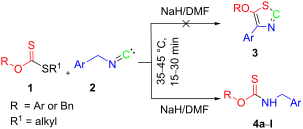
- anion, either by a stepwise or by a concerted five-membered ring transition state, followed by several subsequent steps could lead to the observed products. However, the mechanism involving all of those steps required an improbably higher overall activation energy of 173.9 kJ/mol (Figure S16, Supporting


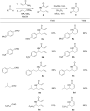
Rapid, two-pot procedure for the synthesis of dihydropyridinones; total synthesis of aza-goniothalamin
Beilstein J. Org. Chem. 2020, 16, 135–139, doi:10.3762/bjoc.16.15

- generate the desired product. This stepwise addition was successful in affording an improved 88% yield of diene 5 as well as significantly reducing the overall reaction time (Scheme 3). Treatment of diene 5 under ring-closing metathesis conditions, using Grubbs I catalyst, then proceeded to generate the



Convenient synthesis of the pentasaccharide repeating unit corresponding to the cell wall O-antigen of Escherichia albertii O4
Beilstein J. Org. Chem. 2020, 16, 106–110, doi:10.3762/bjoc.16.12
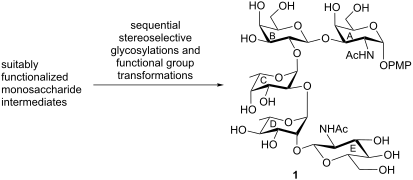
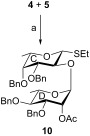
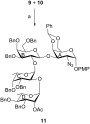
- -1C), 5.12 (br s, H-1D), 4.73 (d, J = 7.5 Hz, H-1E), 4.61 (d, J = 8.0 Hz, H-1B) in 1H NMR and at δ 102.2 (C-1E), 102.1 (C-1B), 96.8 (C-1A), 96.5 (C-1C), 96.0 (C-1D) in 13C NMR spectra]. Conclusion In summary, a convenient stepwise synthetic strategy has been developed for the synthesis of the



Photocontrolled DNA minor groove interactions of imidazole/pyrrole polyamides
Beilstein J. Org. Chem. 2020, 16, 60–70, doi:10.3762/bjoc.16.8
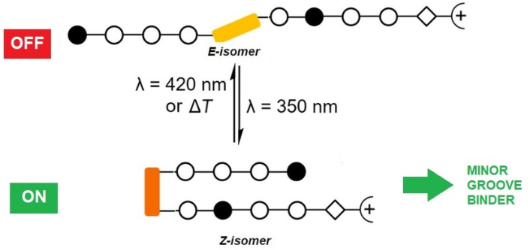
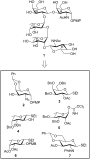
- experiments. The assembly of the photoswitchable pyrrole/imidazole polyamides (P1–P3) was performed stepwise on solid phase using the acid-labile 2-chlorotrityl resin and Fmoc as a temporary protecting group, according to the synthetic route published by the Dervan group [40]. The synthesis of the Fmoc



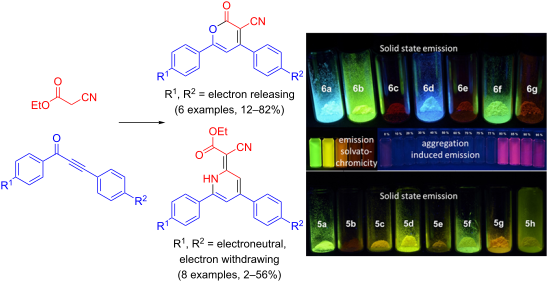
Emission solvatochromic, solid-state and aggregation-induced emissive α-pyrones and emission-tuneable 1H-pyridines by Michael addition–cyclocondensation sequences
Beilstein J. Org. Chem. 2019, 15, 2684–2703, doi:10.3762/bjoc.15.262
- 1H-pyridine 8a would have been detected. Therefore, the tentative mechanistic rationale takes into account that the formation of 1H-pyridine 5a rather proceeds via stepwise condensation of alkynone 3 with two equivalents of ethyl cyanoacetate (4) than by reaction with dimer 7 (Scheme 9). First, a




Synthesis of novel sulfide-based cyclic peptidomimetic analogues to solonamides
Beilstein J. Org. Chem. 2019, 15, 2544–2551, doi:10.3762/bjoc.15.247
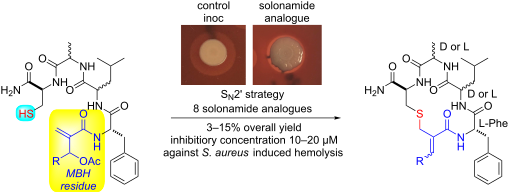
- ) and their respective carboxylic acids 3 were obtained in good yields based on previously reported procedures (Scheme 2) [35][36]. Starting from Rink Amide AM resin-bound orthogonally protected Fmoc-Cys-(Trt) 4, solonamide analogues were synthesized following stepwise Fmoc deprotection and standard


Mono- and bithiophene-substituted diarylethene photoswitches with emissive open or closed forms
Beilstein J. Org. Chem. 2019, 15, 2344–2354, doi:10.3762/bjoc.15.227
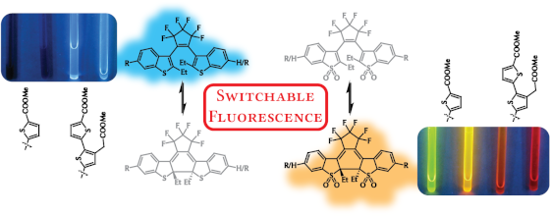
- and e–h in Figure 3B). This shift is stepwise reduced from 124 nm in the unsubstituted compounds (3→6), to 65 nm in the presence of four thiophene residues (SyTh2→SyOTh2). It is worth noting that for asymmetric compounds (AsTh2→AsOTh2), the shift (20 nm) is smaller than for symmetric DAEs having the


1,2,3-Triazolium macrocycles in supramolecular chemistry
Beilstein J. Org. Chem. 2019, 15, 2142–2155, doi:10.3762/bjoc.15.211
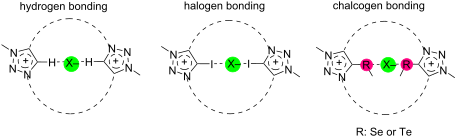
- mechanism has been proposed for the MIM macrocycle 19 involving a stepwise co-conformational progression. After the deprotonation of dibenzylammonium (DBA) sites, the rings prefer to move toward the adjacent N-methyl-1,2,3-triazolium (MTA) sites to the thermodynamically stable co-conformations rather than




Synthesis and properties of sulfur-functionalized triarylmethylium, acridinium and triangulenium dyes
Beilstein J. Org. Chem. 2019, 15, 2133–2141, doi:10.3762/bjoc.15.210
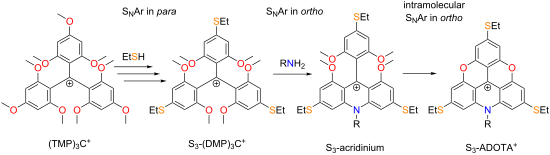
- 2) [17]. Starting from the readily available tris(2,4,6-trimethoxyphenyl)methylium salt (TMP)3C+ [18][29], stepwise replacement of the para-methoxy groups by dialkylamines provides access to a wide variety of symmetric and asymmetric triarylmethylium dyes [18][30][31]. Replacement of two o-methoxy
- reported unsuccessful attempts of SNAr reactions with sulfur nucleophiles in ortho-position of (TMP)3C+ and had to assemble the thioxanthenium part of the triangulenium ring system independently by other means [36]. Similarly, we had to use a stepwise buildup of the triangulenium systems to introduce


Synthesis of benzo[d]imidazo[2,1-b]benzoselenoazoles: Cs2CO3-mediated cyclization of 1-(2-bromoaryl)benzimidazoles with selenium
Beilstein J. Org. Chem. 2019, 15, 2029–2035, doi:10.3762/bjoc.15.199
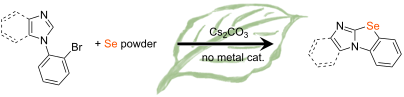
- -fluorobenzene, and Se powder under the optimized conditions, i.e., in the presence of Cs2CO3 (2 equiv) in DMF under an argon atmosphere at 150 °C. This reaction gave product 2a in only 35% yield, suggesting that the stepwise reaction via 1-(2-bromoaryl)benzimidazole 1 is superior. Next, the photophysical


A review of the total syntheses of triptolide
Beilstein J. Org. Chem. 2019, 15, 1984–1995, doi:10.3762/bjoc.15.194
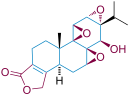
- trimethylsilyl trifluoromethanesulfonate (TMSOTf) in a diastereoselective and stepwise manner. This novel methodology provides a shorter access to the intermediate 97, which is a key intermediate for the synthesis of triptolide. Recently, photoredox catalysis has emerged as a powerful and high-yielding method


Tautomerism as primary signaling mechanism in metal sensing: the case of amide group
Beilstein J. Org. Chem. 2019, 15, 1898–1906, doi:10.3762/bjoc.15.185
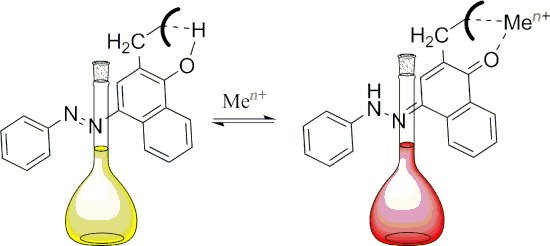
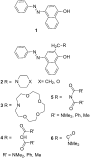
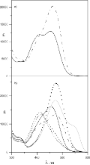
- : Theoretically predicted structure of 6K (blue), overlaid with the X-ray structure (red). Right: X-ray structure of 6, #1: x − 1, y, z; #2: x + 1, y, z; H bonds are drawn as blue dashed lines. Left: Absorption spectra of 6 with stepwise addition of Mg(ClO4)2 in acetonitrile (1 – neutral ligand; 7 – complex CMg





Nanopatterns of arylene–alkynylene squares on graphite: self-sorting and intercalation
Beilstein J. Org. Chem. 2019, 15, 1848–1855, doi:10.3762/bjoc.15.180
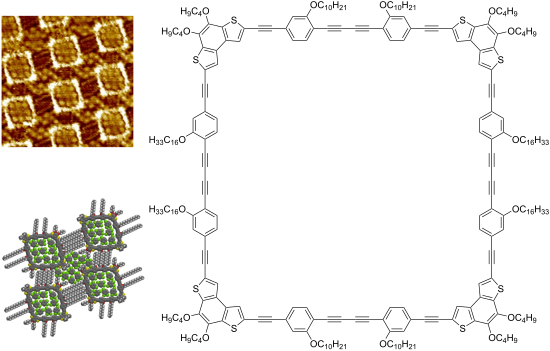
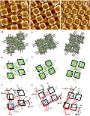
- other sides of the square is based on the Glaser coupling of acetylene-terminated precursor structures. These side chains give macrocycles with reduced symmetry. They cannot be obtained by the cyclization of small building blocks, but require the stepwise formation of more complex precursors, where the
- information of the chain arrangement in the final molecule structure (and also the 2D nanopattern) is already given in the ring precursor. Therefore, precursor structures were prepared in a stepwise coupling strategy, making use of the trimethylsilyl and the (more polar) (3-cyanopropyl)dimethylsilyl




Application of chiral 2-isoxazoline for the synthesis of syn-1,3-diol analogs
Beilstein J. Org. Chem. 2019, 15, 1840–1847, doi:10.3762/bjoc.15.179
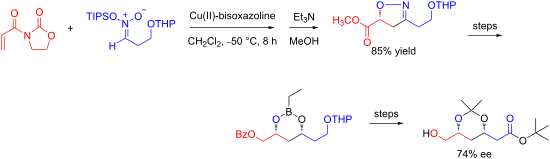
- subjected to silica gel chromatography. Compound 4 was used to determine the stereoselectivity of the cycloaddition step as well as for oxidation. Oxidation of the 2-isoxazoline 4 with Jones’ reagent gave a complicated mixture, in which the desired carboxylic acid was not observed (Scheme 2). The stepwise


Synthesis of a [6]rotaxane with singly threaded γ-cyclodextrins as a single stereoisomer
Beilstein J. Org. Chem. 2019, 15, 1829–1837, doi:10.3762/bjoc.15.177
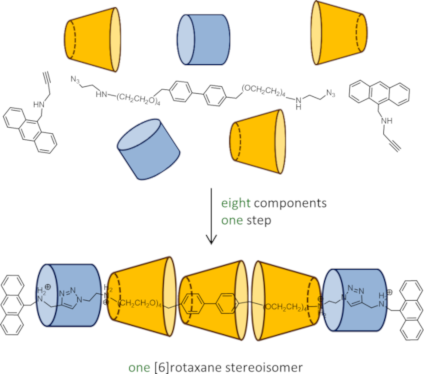
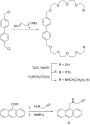
- [32][33][34][35][36]. By adopting a stepwise stoppering approach, Anderson and co-workers have synthesized a [3]rotaxane consisting of two different axles, derived from a stilbene and a cyanine, threaded through one γ-CD [33]. Inouye has also reported a [3]rotaxane with two pyrene-derived axles





The cyclopropylcarbinyl route to γ-silyl carbocations
Beilstein J. Org. Chem. 2019, 15, 1769–1780, doi:10.3762/bjoc.15.170
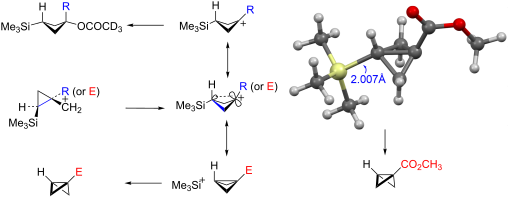
- along with 8% of the alkene 22. It is proposed (Scheme 5) that these products arise from stepwise formation of the cyclopropylcarbinyl cation 23. This cation can rearrange via migration of bond a to give the cyclobutyl cation 24. The cis-nature of the phenyl group and the hydrogen in cation 23


N-(1-Phenylethyl)aziridine-2-carboxylate esters in the synthesis of biologically relevant compounds
Beilstein J. Org. Chem. 2019, 15, 1722–1757, doi:10.3762/bjoc.15.168

- efficiently synthesized from the aldehyde (2S,1'R)-6 begining from the addition of phenylmagnesium bromide to give a 4:1 mixture of aziridine alcohols 28 (Scheme 8) [46]. They were subjected a stepwise hydrogenation to form first products of the aziridine ring opening and next N-Boc-protected


Water inside β-cyclodextrin cavity: amount, stability and mechanism of binding
Beilstein J. Org. Chem. 2019, 15, 1592–1600, doi:10.3762/bjoc.15.163
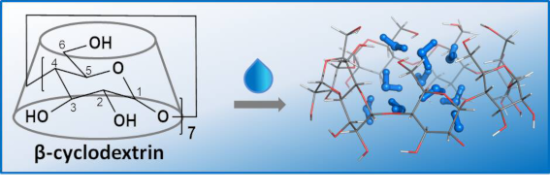
- ). Table 1 lists the enthalpies evaluated at the M062X/6-31G(d,p) level of theory for the stepwise water coordination to the host macrocycle in both the gas phase and aqueous solution. Negative ΔH1 and ΔH78 values imply favorable interactions in both media. Similar trends were observed for enthalpies
- behavior of β-CD in the temperature range from 30 °C to 200 °C, in which only its dehydration takes place, is presented in Figure 5. Both DTA and TG/DTG curves reveal one step dehydration reactions in the range 30–100 °C. This result differs from the observed stepwise weight reduction (due to water release
- location. Inside the β-CD cavern a water cluster is formed by a stepwise consecutive coordination of water guests. The cluster is stabilized by a network of hydrogen bonds mostly between the water molecules themselves and interactions between water ligands and cyclodextrin walls. The general trends


An azobenzene container showing a definite folding – synthesis and structural investigation
Beilstein J. Org. Chem. 2019, 15, 1534–1544, doi:10.3762/bjoc.15.156
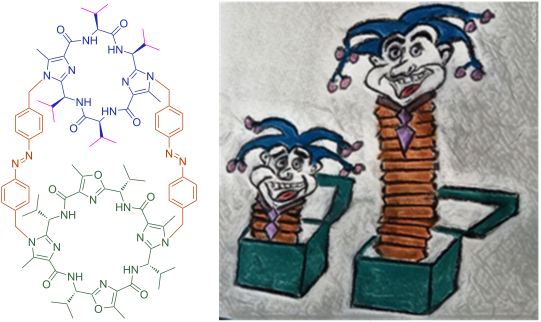
- isomerization’s resulting in a stepwise decrease of the distance of the two macrocycles. Accordingly, the distance between the recognition units at the upper and the lower macrocycle decreases stepwise as well. In the chiral container 5 two identical macrocycles are connected to each other. A further development
- . Initially, we tried to synthesize the chiral foldable container 10 starting from the macrocycles 2a and 3a in a stepwise manner. That means, we intended to react in a first step one macrocycle with two azobenzene units having each one reactive and one protected group. In a second step we wanted to transform


Superelectrophilic carbocations: preparation and reactions of a substrate with six ionizable groups
Beilstein J. Org. Chem. 2019, 15, 1515–1520, doi:10.3762/bjoc.15.153
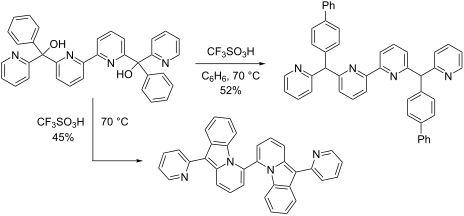
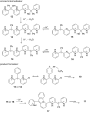
- conversions, computational and experimental data indicated that the protonated hydroxy groups (oxonium ions) are not persistent intermediates, but rather cleavage of the carbon–oxygen bond is almost instantaneous [12]. It is assumed that ionization to the carbocations occurs in a stepwise process, first
- [1,2-a]indole ring system. The conversion to product 11 also involves a stepwise process – initially forming compound 17 then a second cyclization gives the final product 11. As noted above, no cyclization product 11 was observed when the chemistry was done in the presence of benzene. Only product 10




Synthesis of pyrrolo[1,2-a]quinolines by formal 1,3-dipolar cycloaddition reactions of quinolinium salts
Beilstein J. Org. Chem. 2019, 15, 1480–1484, doi:10.3762/bjoc.15.149
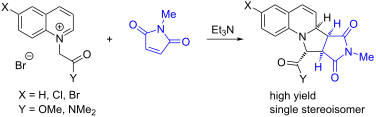
- with electron-poor alkenes occurs through a stepwise conjugate addition–cyclization process [23]. We were interested in the related quinolinium ylides that, on (formal) cycloaddition would provide pyrrolo[1,2-a]quinolines as products. These are tricyclic compounds consisting of a pyrrole ring fused


N-doped carbon dots covalently functionalized with pillar[5]arenes for Fe3+ sensing
Beilstein J. Org. Chem. 2019, 15, 1262–1267, doi:10.3762/bjoc.15.123
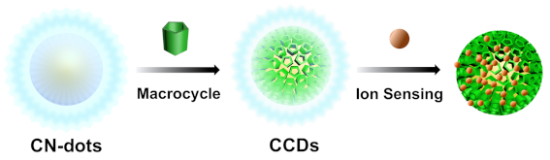
- sensing of Fe3+. In addition, the fluorescence intensity of CCDs decreased gradually with the stepwise addition of Fe3+ in the range of 0–500 μM under the excitation at 340 nm (Figure 3c). As illustrated in Figure 3d, the fluorescence intensity versus the concentration of Fe3+ ions (0–190 μM) established


Steroid diversification by multicomponent reactions
Beilstein J. Org. Chem. 2019, 15, 1236–1256, doi:10.3762/bjoc.15.121
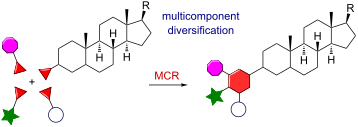
- stepwise Pd(II)-catalyzed cascade process or a [4 + 2] cycloaddition reaction, both providing the cis stereochemistry at C-2 and C-3. When the reaction was carried out with the epimer of substrate 33 (having the 5β-hydroxy group), the cis stereochemistry was also achieved at the newly formed C-2 and C-3


Precious metal-free molecular machines for solar thermal energy storage
Beilstein J. Org. Chem. 2019, 15, 1096–1106, doi:10.3762/bjoc.15.106
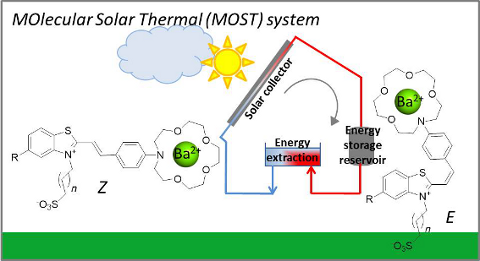
- Kofler apparatus and are uncorrected. NMR spectra were obtained on a Bruker Avance III 500 DRX 600 MHz spectrometer in DMSO-d6. The MALDI–TOF/TOF spectra were measured at Bruker “RapifeX” at MPIP, Germany. The stepwise experimental procedures for the synthesis of compounds 2–4 and characterization data




Mechanochemistry of supramolecules
Beilstein J. Org. Chem. 2019, 15, 881–900, doi:10.3762/bjoc.15.86
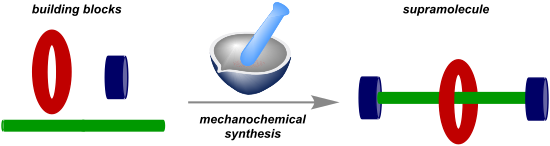
- to form supramolecular structures through self-assembly processes by exploiting the weak or non-covalent interactions [10]. Self-assembly is a kinetically reversible process which is more efficient than traditional stepwise synthesis concerning large molecules. Some recent developments in





