


Search results
Search for "halides" in Full Text gives 526 result(s) in Beilstein Journal of Organic Chemistry. Showing first 200.
Manganese/bipyridine-catalyzed non-directed C(sp3)–H bromination using NBS and TMSN3
- Kumar Sneh,
- Takeru Torigoe and
- Yoichiro Kuninobu
Beilstein J. Org. Chem. 2021, 17, 885–890, doi:10.3762/bjoc.17.74

- gram scale. The introduced bromine atom can be converted into fluorine and allyl groups. Keywords: bromination; C–H transformation; hydrogen abstraction; manganese; radical; Introduction Organic halides are versatile precursors for various synthetic protocols and are frequently used to introduce a

Graphical Abstract
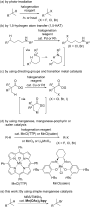
Scheme 1: Several examples of C(sp3)–H halogenation.

Scheme 2: Substrate scope. a80 °C. b45 min. c4 h. d90 °C, eGC yield of mono-brominated product 2n using mesit...

Scheme 3: Gram-scale synthesis of 2a.

Scheme 4: Conversion of the C(sp3)–Br bond.

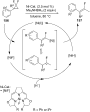
Scheme 5: Proposed mechanism of manganese-catalyzed C(sp3)–H bromination.
Synthetic reactions driven by electron-donor–acceptor (EDA) complexes
- Zhonglie Yang,
- Yutong Liu,
- Kun Cao,
- Xiaobin Zhang,
- Hezhong Jiang and
- Jiahong Li
Beilstein J. Org. Chem. 2021, 17, 771–799, doi:10.3762/bjoc.17.67

- additive to give corresponding thiophene radical 76 and aniline radical cation under irradiation with light. Then, 76 reacted with 73, giving rise to corresponding radical 77. Finally, product 74 was given via hydrogen atom transfer (Scheme 26). In contrast to (hetero)aryl halides with indispensable
- medicinal value at ambient temperature, which has a wide range of substrates, including various (hetero)aryl halides and substituted oxindoles. In 2019, Gilmour and colleagues [12] transformed the classical Stetter reaction into a radical approach, solving the long-standing problem of chemical selectivity
- , cyanides, esters, ethers, halides, and heterocycles, and various α-aminoketones (32 examples) can be yielded in 90% isolated yield. According to the author, the EDA complex had a six-membered-ring transient state, and the imine also acted as an organic base (abstracting proton from α-keto acid), proving

Graphical Abstract

Scheme 1: The electron transfer process in EDA complexes.

Scheme 2: Synthesis of benzo[b]phosphorus oxide 3 initiated by an EDA complex.

Scheme 3: Mechanism of the synthesis of quinoxaline derivative 7.

Scheme 4: Synthesis of imidazole derivative 10 initiated by an EDA complex.

Scheme 5: Synthesis of sulfamoylation product 12 initiated by an EDA complex.

Scheme 6: Mechanism of the synthesis of sulfamoylation product 12.

Scheme 7: Synthesis of indole derivative 22 initiated by an EDA complex.

Scheme 8: Synthesis of perfluoroalkylated pyrimidines 26 initiated by an EDA complex.

Scheme 9: Synthesis of phenanthridine derivative 29 initiated by an EDA complex.

Scheme 10: Synthesis of cis-tetrahydroquinoline derivative 32 initiated by an EDA complex.

Scheme 11: Mechanism of the synthesis of cis-tetrahydroquinoline derivative 32.

Scheme 12: Synthesis of phenanthridine derivative 38 initiated by an EDA complex.

Scheme 13: Synthesis of spiropyrroline derivative 40 initiated by an EDA complex.

Scheme 14: Synthesis of benzothiazole derivative 43 initiated by an EDA complex.

Scheme 15: Synthesis of perfluoroalkyl-s-triazine derivative 45 initiated by an EDA complex.

Scheme 16: Synthesis of indoline derivative 47 initiated by an EDA complex.

Scheme 17: Mechanism of the synthesis of spirocyclic indoline derivative 47.

Scheme 18: Synthesis of cyclobutane product 50 initiated by an EDA complex.

Scheme 19: Mechanism of the synthesis of spirocyclic indoline derivative 50.

Scheme 20: Synthesis of 1,3-oxazolidine compound 59 initiated by an EDA complex.

Scheme 21: Synthesis of trifluoromethylated product 61 initiated by an EDA complex.

Scheme 22: Synthesis of indole alkylation product 64 initiated by an EDA complex.

Scheme 23: Synthesis of perfluoroalkylation product 67 initiated by an EDA complex.

Scheme 24: Synthesis of hydrotrifluoromethylated product 70 initiated by an EDA complex.

Scheme 25: Synthesis of β-trifluoromethylated alkyne product 71 initiated by an EDA complex.

Scheme 26: Mechanism of the synthesis of 2-phenylthiophene derivative 74.

Scheme 27: Synthesis of allylated product 80 initiated by an EDA complex.

Scheme 28: Synthesis of trifluoromethyl-substituted alkynyl product 84 initiated by an EDA complex.

Scheme 29: Synthesis of dearomatized fluoroalkylation product 86 initiated by an EDA complex.

Scheme 30: Mechanism of the synthesis of dearomatized fluoroalkylation product 86.

Scheme 31: Synthesis of C(sp3)–H allylation product 91 initiated by an EDA complex.

Scheme 32: Synthesis of perfluoroalkylation product 93 initiated by an EDA complex.

Scheme 33: Synthesis of spirocyclic indolene derivative 95 initiated by an EDA complex.

Scheme 34: Synthesis of perfluoroalkylation product 97 initiated by an EDA complex.

Scheme 35: Synthesis of alkylated indole derivative 100 initiated by an EDA complex.

Scheme 36: Mechanism of the synthesis of alkylated indole derivative 100.

Scheme 37: Synthesis of arylated oxidized indole derivative 108 initiated by an EDA complex.

Scheme 38: Synthesis of 4-ketoaldehyde derivative 111 initiated by an EDA complex.

Scheme 39: Mechanism of the synthesis of 4-ketoaldehyde derivative 111.

Scheme 40: Synthesis of perfluoroalkylated olefin 118 initiated by an EDA complex.

Scheme 41: Synthesis of alkylation product 121 initiated by an EDA complex.

Scheme 42: Synthesis of acylation product 123 initiated by an EDA complex.

Scheme 43: Mechanism of the synthesis of acylation product 123.

Scheme 44: Synthesis of trifluoromethylation product 126 initiated by an EDA complex.

Scheme 45: Synthesis of unnatural α-amino acid 129 initiated by an EDA complex.

Scheme 46: Synthesis of thioether derivative 132 initiated by an EDA complex.

Scheme 47: Synthesis of S-aryl dithiocarbamate product 135 initiated by an EDA complex.

Scheme 48: Mechanism of the synthesis of S-aryl dithiocarbamate product 135.

Scheme 49: Synthesis of thioether product 141 initiated by an EDA complex.

Scheme 50: Mechanism of the synthesis of borate product 144.

Scheme 51: Synthesis of boronation product 148 initiated by an EDA complex.

Scheme 52: Synthesis of boration product 151 initiated by an EDA complex.

Scheme 53: Synthesis of boronic acid ester derivative 154 initiated by an EDA complex.

Scheme 54: Synthesis of β-azide product 157 initiated by an EDA complex.

Scheme 55: Decarboxylation reaction initiated by an EDA complex.

Scheme 56: Synthesis of amidated product 162 initiated by an EDA complex.

Scheme 57: Synthesis of diethyl phenylphosphonate 165 initiated by an EDA complex.

Scheme 58: Mechanism of the synthesis of diethyl phenylphosphonate derivative 165.

Scheme 59: Synthesis of (Z)-2-iodovinyl phenyl ether 168 initiated by an EDA complex.

Scheme 60: Mechanism of the synthesis of (Z)-2-iodovinyl phenyl ether derivative 168.

Scheme 61: Dehalogenation reaction initiated by an EDA complex.
Valorisation of plastic waste via metal-catalysed depolymerisation
- Francesca Liguori,
- Carmen Moreno-Marrodán and
- Pierluigi Barbaro
Beilstein J. Org. Chem. 2021, 17, 589–621, doi:10.3762/bjoc.17.53
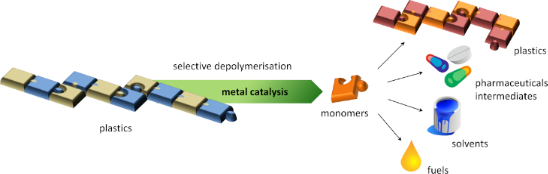
- metal (complex) catalysts, methanolysis of PLA was recently described using alkali metal halides [271]. In an optimised experiment, PLA from various goods (cups, fork, spoons, containers, Mw 120000–260000 g⋅mol−1) was converted into Me-La in up to 97% yield using 2.5 mol % KF, 180 °C microwave heating

Graphical Abstract

Figure 1: Potential classification of plastic recycling processes. The area covered by the present review is ...

Figure 2: EG produced during glycolytic depolymerisation of PET using DEG + DPG as solvent and titanium(IV) n...

Scheme 1: Simplified representation of the conversion of 1,4-PBD to C16–C44 macrocycles using Ru metathesis c...
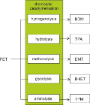
Figure 3: Main added-value monomers obtainable by catalytic depolymerisation of PET via chemolytic methods.

Scheme 2: Hydrogenolytic depolymerisation of PET by ruthenium complexes.

Scheme 3: Depolymerisation of PET via catalytic hydrosilylation by Ir(III) pincer complex.

Scheme 4: Catalytic hydrolysis (top) and methanolysis (bottom) reactions of PET.

Scheme 5: Depolymerisation of PET by glycolysis with ethylene glycol.

Figure 4: Glycolysis of PET: evolution of BHET yield over time, with and without zinc acetate catalyst (196 °...

Scheme 6: Potential activated complex for the glycolysis reaction of PET catalysed by metallated ILs and evol...

Scheme 7: One-pot, two-step process for PET repurposing via chemical recycling.
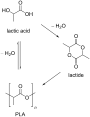
Scheme 8: Synthetic routes to PLA.

Scheme 9: Structures of the zinc molecular catalysts used for PLA-methanolysis in various works. a) See [265], b) ...

Scheme 10: Depolymerisation of PLLA by Zn–N-heterocyclic carbene complex.

Scheme 11: Salalen ligands.

Scheme 12: Catalytic hydrogenolysis of PLA.

Scheme 13: Catalytic hydrosilylation of PLA.

Scheme 14: Hydrogenative depolymerisation of PBT and PCL by molecular Ru catalysts.

Scheme 15: Glycolysis reaction of PCT by diethylene glycol.

Scheme 16: Polymerisation–depolymerisation cycle of 3,4-T6GBL.

Scheme 17: Polymerisation–depolymerisation cycle of 2,3-HDB.

Scheme 18: Hydrogenative depolymerisation of PBPAC by molecular Ru catalysts.

Scheme 19: Catalytic hydrolysis (top), alcoholysis (middle) and aminolysis (bottom) reactions of PBPAC.

Scheme 20: Hydrogenative depolymerisation of PPC (top) and PEC (bottom) by molecular Ru catalysts.

Scheme 21: Polymerisation-depolymerisation cycle of BEP.

Scheme 22: Hydrogenolysis of polyamides using soluble Ru catalysts.

Scheme 23: Catalytic depolymerisation of epoxy resin/carbon fibres composite.

Scheme 24: Depolymerisation of polyethers with metal salt catalysts and acyl chlorides.
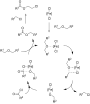
Scheme 25: Proposed mechanism for the iron-catalysed depolymerisation reaction of polyethers. Adapted with per...
Amino- and polyaminophthalazin-1(2H)-ones: synthesis, coordination properties, and biological activity
- Zbigniew Malinowski,
- Emilia Fornal,
- Agata Sumara,
- Renata Kontek,
- Karol Bukowski,
- Beata Pasternak,
- Dariusz Sroczyński,
- Joachim Kusz,
- Magdalena Małecka and
- Monika Nowak
Beilstein J. Org. Chem. 2021, 17, 558–568, doi:10.3762/bjoc.17.50
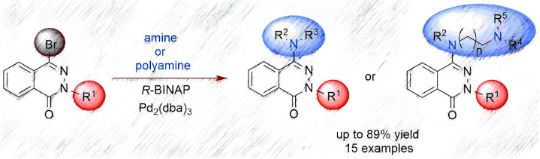
- selectively alkylated on the nitrogen atom [30][36]. For our purposes, the simple alkyl halides (MeI, iPrI), and 2-chloro-N,N-dimethylethylamine hydrochloride and 4-(2-chloroethyl)morpholine hydrochloride, were chosen as the alkylating agents. Thus, the desired N-methyl and N-isopropyl lactams 3a,b (3a R1

Graphical Abstract

Figure 1: Structure of biologically active phthalazine derivatives.

Scheme 1: Synthetic route to aminophthalazinones 5 and 6.
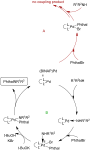
Figure 2: Proposed catalytic cycles for the amination of 4-bromophthalazinones of type 3 (Phthal: phthalazino...
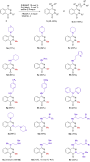
Scheme 2: Synthesis of 4-amino- and 4-polyaminophthalazinones 5 and 6 (the yields refer to the isolated compo...

Figure 3: The phthalazinone derivatives that were used to test the complexation of Cu(II) ions.

Scheme 3: The proposal of the fragmentation pathway of the Cu(II) complex with compound 7.

Figure 4: Structure of complex 17.

Figure 5: Molecular structure of complex 17 with atom numbering scheme. The anisotropic displacement paramete...
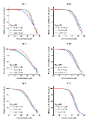
Figure 6: Determination of relative cell viability (% of control) in different cell lines (HT-29; PC-3 and L-...

Figure 7: Cytotoxic properties of the phthalazinone derivatives expressed as IC50 after 72 h of cell treatmen...
Synthetic strategies of phosphonodepsipeptides
- Jiaxi Xu
Beilstein J. Org. Chem. 2021, 17, 461–484, doi:10.3762/bjoc.17.41
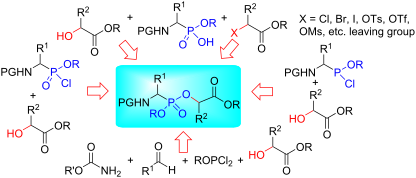
- reviewed, including the phosphonylation of hydroxy esters with phosphonochloridates, the condensation of phosphonic monoesters and hydroxy esters, the alkylation of phosphonic monoesters with 1-(alkoxycarbonyl)alkyl halides or sulfonates, multicomponent condensation of amides, aldehydes, and
- phosphonylation of hydroxy esters 2 with N-protected aminoalkylphosphonochloridates 3 (method I), reactions of N-protected aminoalkylphosphonic monoesters 4 with hydroxy esters 2 (method II) or with 1-(alkoxycarbonyl)alkyl halides or sulfonates 5 (method III), pseudo-four-component condensations (method IV), and
- ) produced the desired product 171 in 62% yield in the reaction. However, aliphatic aldehydes did not work (Scheme 32) [52]. Synthesis of phosphonodepsipeptides via the alkylation of phosphonic monoesters with 1-(alkoxycarbonyl)alkyl halides or sulfonates The alkylation of N-protected 1-aminoalkylphosphonic

Graphical Abstract

Figure 1: Phosphonopeptides, phosphonodepsipeptides, peptides, and depsipeptides.

Figure 2: The diverse strategies for phosphonodepsipeptide synthesis.

Scheme 1: Synthesis of α-phosphonodepsidipeptides as inhibitors of leucine aminopeptidase.

Figure 3: Structure of 2-hydroxy-2-oxo-3-[(phenoxyacetyl)amino]-1,2-oxaphosphorinane-6-carboxylic acid (16).

Scheme 2: Synthesis of α-phosphonodepsidipeptide 17 as coupling partner for cyclen-containing phosphonodepsip...

Scheme 3: Synthesis of α-phosphonodepsidipeptides containing enantiopure hydroxy ester as VanX inhibitors.

Scheme 4: Synthesis of α-phosphonodepsidipeptides as VanX inhibitors.

Scheme 5: Synthesis of optically active α-phosphonodepsidipeptides as VanX inhibitors.

Scheme 6: The synthesis of phosphonodepsipeptides through a thionyl chloride-catalyzed esterification of N-Cb...

Scheme 7: Synthesis of α-phosphinodipeptidamide as a hapten.

Scheme 8: Synthesis of α-phosphonodepsioctapeptide 41.

Scheme 9: Synthesis of phosphonodepsipeptides via an in situ-generated phosphonochloridate.

Scheme 10: Synthesis of α-phosphonodepsitetrapeptides 58 as inhibitors of the aspartic peptidase pepsin.

Scheme 11: Synthesis of a β-phosphonodepsidipeptide library 64.

Scheme 12: Synthesis of another β-phosphonodepsidipeptide library.

Scheme 13: Synthesis of γ-phosphonodepsidipeptides.

Scheme 14: Synthesis of phosphonodepsipeptides 85 as folylpolyglutamate synthetase inhibitors.

Scheme 15: Synthesis of the γ-phosphonodepsitripeptide 95 as an inhibitor of γ-gutamyl transpeptidase.

Scheme 16: Synthesis of phosphonodepsipeptides as inhibitors and probes of γ-glutamyl transpeptidase.

Scheme 17: Synthesis of phosphonyl depsipeptides 108 via DCC-mediated condensation and oxidation.

Scheme 18: Synthesis of phosphonodepsipeptides 111 with BOP and PyBOP as coupling reagents.

Scheme 19: Synthesis of optically active phosphonodepsipeptides with BOP and PyBOP as coupling reagents.

Scheme 20: Synthesis of phosphonodepsipeptides with BroP and TPyCIU as coupling reagents.

Scheme 21: Synthesis of a phosphonodepsipeptide hapten with BOP as coupling reagent.

Scheme 22: Synthesis of phosphonodepsitripeptide with BOP as coupling reagent.

Scheme 23: Synthesis of norleucine-derived phosphonodepsipeptides 135 and 138.

Scheme 24: Synthesis of norleucine-derived phosphonodepsipeptides 141 and 144.

Scheme 25: Solid-phase synthesis of phosphonodepsipeptides.

Scheme 26: Synthesis of phosphonodepsidipeptides via the Mitsunobu reaction.

Scheme 27: Synthesis of γ-phosphonodepsipeptide via the Mitsunobu reaction.

Scheme 28: Synthesis of phosphonodepsipeptides via a multicomponent condensation reaction.

Scheme 29: Synthesis of phosphonodepsipeptides with a functionalized side-chain via a multicomponent condensat...

Scheme 30: High yielding synthesis of phosphonodepsipeptides via a multicomponent condensation.

Scheme 31: Synthesis of optically active phosphonodepsipeptides via a multicomponent condensation reaction.

Scheme 32: Synthesis of N-phosphoryl phosphonodepsipeptides.

Scheme 33: Synthesis of phosphonodepsipeptides via the alkylation of phosphonic monoesters.

Scheme 34: Synthesis of phosphonodepsipeptides as inhibitors of aspartic protease penicillopepsin.

Scheme 35: Synthesis of phosphonodepsipeptides as prodrugs.

Scheme 36: Synthesis of phosphonodepsithioxopeptides 198.

Scheme 37: Synthesis of phosphonodepsipeptides.

Scheme 38: Synthesis of phosphonodepsipeptides with C-1-hydroxyalkylphosphonic acid.

Scheme 39: Synthesis of phosphonodepsipeptides with C-1-hydroxyalkylphosphonate via the rhodium-catalyzed carb...

Scheme 40: Synthesis of phosphonodepsipeptides with a C-1-hydroxyalkylphosphonate motif via a copper-catalyzed...
Unexpected rearrangements and a novel synthesis of 1,1-dichloro-1-alkenones from 1,1,1-trifluoroalkanones with aluminium trichloride
- Beatrice Lansbergen,
- Catherine S. Meister and
- Michael C. McLeod
Beilstein J. Org. Chem. 2021, 17, 404–409, doi:10.3762/bjoc.17.36
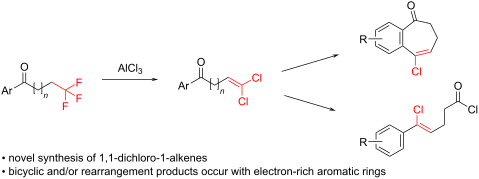
- formation of 1,1-dichloro-1-alkenones 6 from 1,1,1-trifluoroalkanones 5, which in turn are accessed by the Grignard addition of 1,1,1-trifluoroalkylmagnesium halides to nitriles (Figure 2b). It is worth noting that the 1,1,1-trifluoroalkyl halides (n = 1, 2, 3) are commercially available, whereas the
- corresponding 1,1-dichloroalkenyl halides (or 1,1,1-trichloroalkyl halides) are not. This methodology therefore represents a potentially useful access to the 1,1-dichloro-1-alkenone moiety. Findings Under initial conditions, AlCl3 was shown to invoke the conversion of 1,1,1-trifluoroalkanone 5a [25] to 1,1

Graphical Abstract

Figure 1: Examples of biologically active 1,1-dichloro-1-alkenes.
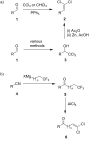
Figure 2: a) Common methods for the preparation of 1,1-dichloro-1-alkenes from aldehydes. b) This work: a two...

Scheme 1: The initial attempt for the conversion of 1,1,1-trifluoroalkanone 5a to 1,1-dichloroalkenone 6a.

Scheme 2: Substrate scope for the reaction of 1,1,1 trifluoroalkanones with AlCl3. aPurification (normal or r...

Scheme 3: Proposed mechanism for the formation of dichloroalkene 6 from trifluoroalkanone 5.

Scheme 4: Formation of bicyclic ketones 9 and 10 from 1,1,1-trifluoroalkanone 5b using 7 equivalents of AlCl3....

Scheme 5: Conversion of 1,1,1-trifluoroalkanone 5n to acid chloride 13 with AlCl3, and possible mechanism.

Scheme 6: Conversion of 1,1,1-trifluoroalkane 16 to bicycle 17 upon treatment with AlCl3, and possible mechan...
CF3-substituted carbocations: underexploited intermediates with great potential in modern synthetic chemistry
- Anthony J. Fernandes,
- Armen Panossian,
- Bastien Michelet,
- Agnès Martin-Mingot,
- Frédéric R. Leroux and
- Sébastien Thibaudeau
Beilstein J. Org. Chem. 2021, 17, 343–378, doi:10.3762/bjoc.17.32
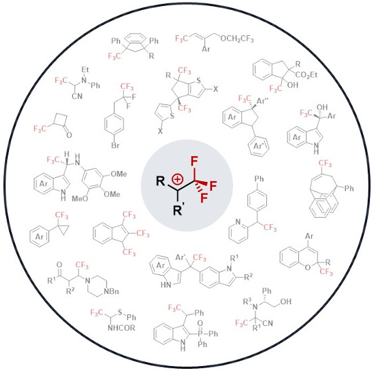
- additional phenyl ring in 35 (Figure 6). As an extension of the previous study, Liu et al. explored the solvolysis of tertiary, highly congested benzylic α-CF3-substituted halides 36 (Figure 7) [54]. Similar to their previous results, they obtained straight lines upon plotting the Hammett–Brown or Yukawa

Graphical Abstract

Figure 1: Stabilizing interaction in the CF3CH2+ carbenium ion (top) and structure of the first observable fl...

Scheme 1: Isodesmic equations accounting for the destabilizing effect of the CF3 group. ΔE in kcal⋅mol−1, cal...

Scheme 2: Stabilizing effect of fluorine atoms by resonance electron donation in carbenium ions (δ in ppm).
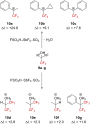
Scheme 3: Direct in situ NMR observation of α-(trifluoromethyl)carbenium ion or protonated alcohols. Δδ = δ19...

Scheme 4: Reported 13C NMR chemical shifts for the α-(trifluoromethyl)carbenium ion 10c (δ in ppm).
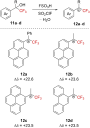
Scheme 5: Direct NMR observation of α-(trifluoromethyl)carbenium ions in situ (δ in ppm).

Scheme 6: Illustration of the ion pair solvolysis mechanism for sulfonate 13f. YOH = solvent.
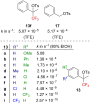
Figure 2: Solvolysis rate for 13a–i and 17.

Figure 3: Structures of allyl triflates 18 and 19 and allyl brosylate 20. Bs = p-BrC6H4SO2.

Figure 4: Structure of tosylate derivatives 21.
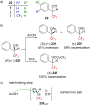
Figure 5: a) Structure of triflate derivatives 22. b) Stereochemistry outcomes of the reaction starting from (...

Scheme 7: Solvolysis reaction of naphthalene and anthracenyl derivatives 26 and 29.

Figure 6: Structure of bisarylated derivatives 34.

Figure 7: Structure of bisarylated derivatives 36.

Scheme 8: Reactivity of 9c in the presence of a Brønsted acid.

Scheme 9: Cationic electrocyclization of 38a–c under strongly acidic conditions.

Scheme 10: Brønsted acid-catalyzed synthesis of indenes 42 and indanes 43.

Scheme 11: Reactivity of sulfurane 44 in triflic acid.

Scheme 12: Solvolysis of triflate 45f in alcoholic solvents.

Scheme 13: Synthesis of labeled 18O-52.

Scheme 14: Reactivity of sulfurane 53 in triflic acid.

Figure 8: Structure of tosylates 56 and 21f.

Scheme 15: Resonance forms in benzylic carbenium ions.

Figure 9: Structure of pyrrole derivatives 58 and 59.

Scheme 16: Resonance structure 60↔60’.

Scheme 17: Ga(OTf)3-catalyzed synthesis of 3,3’- and 3,6’-bis(indolyl)methane from trifluoromethylated 3-indol...

Scheme 18: Proposed reaction mechanism.

Scheme 19: Metal-free 1,2-phosphorylation of 3-indolylmethanols.
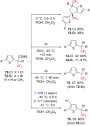
Scheme 20: Superacid-mediated arylation of thiophene derivatives.

Scheme 21: In situ mechanistic NMR investigations.

Scheme 22: Proposed mechanisms for the prenyltransferase-catalyzed condensation.

Scheme 23: Influence of a CF3 group on the allylic SN1- and SN2-mechanism-based reactions.

Scheme 24: Influence of the CF3 group on the condensation reaction.

Scheme 25: Solvolysis of 90 in TFE.

Scheme 26: Solvolysis of allyl triflates 94 and 97 and isomerization attempt of 96.

Scheme 27: Proposed mechanism for the formation of 95.

Scheme 28: Formation of α-(trifluoromethyl)allylcarbenium ion 100 in a superacid.
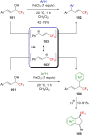
Scheme 29: Lewis acid activation of CF3-substituted allylic alcohols.
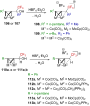
Scheme 30: Bimetallic-cluster-stabilized α-(trifluoromethyl)carbenium ions.

Scheme 31: Reactivity of cluster-stabilized α-(trifluoromethyl)carbenium ions.
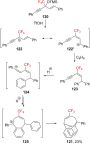
Scheme 32: α-(Trifluoromethyl)propargylium ion 122↔122’ generated from silyl ether 120 in a superacid.

Scheme 33: Formation of α-(trifluoromethyl)propargylium ions from CF3-substituted propargyl alcohols.

Scheme 34: Direct NMR observation of the protonation of some trifluoromethyl ketones in situ and the correspon...

Scheme 35: Selected resonance forms in protonated fluoroketone derivatives.

Scheme 36: Acid-catalyzed Friedel–Crafts reactions of trifluoromethyl ketones 143a,b and 147a–c.

Scheme 37: Enantioselective hydroarylation of CF3-substituted ketones.

Scheme 38: Acid-catalyzed arylation of ketones 152a–c.

Scheme 39: Reactivity of 156 in a superacid.
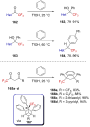
Scheme 40: Reactivity of α-CF3-substituted heteroaromatic ketones and alcohols as well as 1,3-diketones.

Scheme 41: Reactivity of 168 with benzene in the presence of a Lewis or Brønsted acid.

Scheme 42: Acid-catalyzed three-component asymmetric reaction.

Scheme 43: Anodic oxidation of amines 178a–c and proposed mechanism.

Scheme 44: Reactivity of 179b in the presence of a strong Lewis acid.

Scheme 45: Trifluoromethylated derivatives as precursors of trifluoromethylated iminium ions.

Scheme 46: Mannich reaction with trifluoromethylated hemiaminal 189.

Scheme 47: Suitable nucleophiles reacting with 192 after Lewis acid activation.

Scheme 48: Strecker reaction involving the trifluoromethylated iminium ion 187.
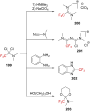
Scheme 49: Reactivity of 199 toward nucleophiles.

Scheme 50: Reactivity of 204a with benzene in the presence of a Lewis acid.

Scheme 51: Reactivity of α-(trifluoromethyl)-α-chloro sulfides in the presence of strong Lewis acids.

Scheme 52: Anodic oxidation of sulfides 213a–h and Pummerer rearrangement.

Scheme 53: Mechanism for the electrochemical oxidation of the sulfide 213a.

Scheme 54: Reactivity of (trifluoromethyl)diazomethane (217a) in HSO3F.

Figure 10: a) Structure of diazoalkanes 217a–c and b) rate-limiting steps of their decomposition.

Scheme 55: Deamination reaction of racemic 221 and enantioenriched (S)-221.

Scheme 56: Deamination reaction of labeled 221-d2. Elimination products were formed in this reaction, the yiel...

Scheme 57: Deamination reaction of 225-d2. Elimination products were also formed in this reaction in undetermi...

Scheme 58: Formation of 229 from 228 via 1,2-H-shift.

Scheme 59: Deamination reaction of 230. Elimination products were formed in this reaction, the yield of which ...

Scheme 60: Deamination of several diazonium ions. Elimination products were formed in these reactions, the yie...

Scheme 61: Solvolysis reaction mechanism of alkyl tosylates.

Scheme 62: Solvolysis outcome for the tosylates 248 and 249 in HSO3FSbF5.

Figure 11: Solvolysis rate of 248, 249, 252, and 253 in 91% H2SO4.

Scheme 63: Illustration of the reaction pathways. TsCl, pyridine, −5 °C (A); 98% H2SO4, 30 °C (B); 98% H2SO4, ...

Scheme 64: Proposed solvolysis mechanism for the aliphatic tosylate 248.

Scheme 65: Solvolysis of the derivatives 259 and 260.

Scheme 66: Solvolysis of triflate 261. SOH = solvent.

Scheme 67: Intramolecular Friedel–Crafts alkylations upon the solvolysis of triflates 264 and 267.

Scheme 68: α-CF3-enhanced γ-silyl elimination of cyclobutyltosylates 270a,b.

Scheme 69: γ-Silyl elimination in the synthesis of a large variety of CF3-substituted cyclopropanes. Pf = pent...

Scheme 70: Synthetic pathways to 281. aNMR yields.

Scheme 71: The cyclopropyl-substituted homoallylcyclobutylcarbenium ion manifold.

Scheme 72: Reactivity of CF3-substituted cyclopropylcarbinyl derivatives 287a–c. LG = leaving group.

Scheme 73: Reactivity of CF3-substituted cyclopropylcarbinyl derivatives 291a–c.

Scheme 74: Superacid-promoted dimerization or TFP.

Scheme 75: Reactivity of TFP in a superacid.

Scheme 76: gem-Difluorination of α-fluoroalkyl styrenes via the formation of a “hidden” α-RF-substituted carbe...

Scheme 77: Solvolysis of CF3-substituted pentyne 307.

Scheme 78: Photochemical rearrangement of 313.

Figure 12: Structure of 2-norbornylcarbenium ion 318 and argued model for the stabilization of this cation.

Figure 13: Structures and solvolysis rate (TFE, 25 °C) of the sulfonates 319–321. Mos = p-MeOC6H4SO2.

Scheme 79: Mechanism for the solvolysis of 323. SOH = solvent.

Scheme 80: Products formed by the hydrolysis of 328.

Scheme 81: Proposed carbenium ion intermediates in an equilibrium during the solvolysis of tosylates 328, 333,...
The preparation and properties of 1,1-difluorocyclopropane derivatives
- Kymbat S. Adekenova,
- Peter B. Wyatt and
- Sergazy M. Adekenov
Beilstein J. Org. Chem. 2021, 17, 245–272, doi:10.3762/bjoc.17.25
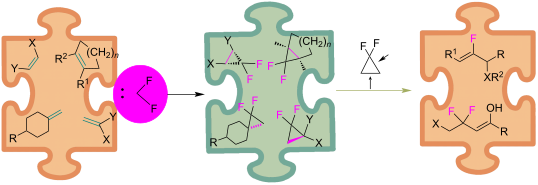
- different types of catalysts have proved effective in facilitating the ring opening of difluorocyclopropane derivatives. Lewis acids (e.g., group 13 halides and silver ions) can polarize carbonyl substituents and assist the loss of halide ions, leading to the formation of carbocation intermediates. Low

Graphical Abstract

Scheme 1: Synthesis of 1,1-difluoro-2,3-dimethylcyclopropane (2).

Scheme 2: Cyclopropanation via dehydrohalogenation of chlorodifluoromethane.

Scheme 3: Difluorocyclopropanation of methylstyrene 7 using dibromodifluoromethane and zinc.

Scheme 4: Synthesis of difluorocyclopropanes from the reaction of dibromodifluoromethane and triphenylphosphi...

Scheme 5: Generation of difluorocarbene in a catalytic two-phase system and its addition to tetramethylethyle...

Scheme 6: The reaction of methylstyrene 7 with chlorodifluoromethane (11) in the presence of a tetraarylarson...

Scheme 7: Pyrolysis of sodium chlorodifluoroacetate (12) in refluxing diglyme in the presence of alkene 13.

Scheme 8: Synthesis of boron-substituted gem-difluorocyclopropanes 16.

Scheme 9: Addition of sodium bromodifluoroacetate (17) to alkenes.

Scheme 10: Addition of sodium bromodifluoroacetate (17) to silyloxy-substituted cyclopropanes 20.

Scheme 11: Synthesis of difluorinated nucleosides.

Scheme 12: Addition of butyl acrylate (26) to difluorocarbene generated from TFDA (25).

Scheme 13: Addition of difluorocarbene to propargyl esters 27 and conversion of the difluorocyclopropenes 28 t...

Scheme 14: The generation of difluorocyclopropanes using MDFA 30.

Scheme 15: gem-Difluorocyclopropanation of styrene (32) using difluorocarbene generated from TMSCF3 (31) under...

Scheme 16: Synthesis of a gem-difluorocyclopropane derivative using HFPO (41) as a source of difluorocarbene.

Scheme 17: Cyclopropanation of (Z)-2-butene in the presence of difluorodiazirine (44).

Scheme 18: The cyclopropanation of 1-octene (46) using Seyferth's reagent (45) as a source of difluorocarbene.

Scheme 19: Alternative approaches for the difluorocarbene synthesis from trimethyl(trifluoromethyl)tin (48).

Scheme 20: Difluorocyclopropanation of cyclohexene (49).

Scheme 21: Synthesis of difluorocyclopropane derivative 53 using bis(trifluoromethyl)cadmium (51) as the diflu...

Scheme 22: Addition of difluorocarbene generated from tris(trifluoromethyl)bismuth (54).

Scheme 23: Addition of a stable (trifluoromethyl)zinc reagent to styrenes.

Scheme 24: The preparation of 2,2-difluorocyclopropanecarboxylic acids of type 58.

Scheme 25: Difluorocyclopropanation via Michael cyclization.

Scheme 26: Difluorocyclopropanation using N-acylimidazolidinone 60.

Scheme 27: Difluorocyclopropanation through the cyclization of phenylacetonitrile (61) and 1,2-dibromo-1,1-dif...

Scheme 28: gem-Difluoroolefins 64 for the synthesis of functionalized cyclopropanes 65.

Scheme 29: Preparation of aminocyclopropanes 70.

Scheme 30: Synthesis of fluorinated methylenecyclopropane 74 via selenoxide elimination.

Scheme 31: Reductive dehalogenation of (1R,3R)-75.

Scheme 32: Synthesis of chiral monoacetates by lipase catalysis.

Scheme 33: Transformation of (±)-trans-81 using Rhodococcus sp. AJ270.

Scheme 34: Transformation of (±)-trans-83 using Rhodococcus sp. AJ270.

Scheme 35: Hydrogenation of difluorocyclopropenes through enantioselective hydrocupration.

Scheme 36: Enantioselective transfer hydrogenation of difluorocyclopropenes with a Ru-based catalyst.

Scheme 37: The thermal transformation of trans-1,2-dichloro-3,3-difluorocyclopropane (84).

Scheme 38: cis–trans-Epimerization of 1,1-difluoro-2,3-dimethylcyclopropane.

Scheme 39: 2,2-Difluorotrimethylene diradical intermediate.

Scheme 40: Ring opening of stereoisomers 88 and 89.

Scheme 41: [1,3]-Rearrangement of alkenylcyclopropanes 90–92.

Scheme 42: Thermolytic rearrangement of 2,2-difluoro-1-vinylcyclopropane (90).

Scheme 43: Thermal rearrangement for ethyl 3-(2,2-difluoro)-3-phenylcyclopropyl)acrylates 93 and 95.

Scheme 44: Possible pathways of the ring opening of 1,1-difluoro-2-vinylcyclopropane.

Scheme 45: Equilibrium between 1,1-difluoro-2-methylenecyclopropane (96) and (difluoromethylene)cyclopropane 97...

Scheme 46: Ring opening of substituted 1,1-difluoro-2,2-dimethyl-3-methylenecyclopropane 98.

Scheme 47: 1,1-Difluorospiropentane rearrangement.

Scheme 48: Acetolysis of (2,2-difluorocyclopropyl)methyl tosylate (104) and (1,1-difluoro-2-methylcyclopropyl)...

Scheme 49: Ring opening of gem-difluorocyclopropyl ketones 106 and 108 by thiolate nucleophiles.

Scheme 50: Hydrolysis of gem-difluorocyclopropyl acetals 110.

Scheme 51: Ring-opening reaction of 2,2-difluorocyclopropyl ketones 113 in the presence of ionic liquid as a s...

Scheme 52: Ring opening of gem-difluorocyclopropyl ketones 113a by MgI2-initiated reaction with diarylimines 1...

Scheme 53: Ring-opening reaction of gem-difluorocyclopropylstannanes 117.

Scheme 54: Preparation of 1-fluorovinyl vinyl ketone 123 and the synthesis of 2-fluorocyclopentenone 124. TBAT...

Scheme 55: Iodine atom-transfer ring opening of 1,1-difluoro-2-(1-iodoalkyl)cyclopropanes 125a–c.

Scheme 56: Ring opening of bromomethyl gem-difluorocyclopropanes 130 and formation of gem-difluoromethylene-co...

Scheme 57: Ring-opening aerobic oxidation reaction of gem-difluorocyclopropanes 132.

Scheme 58: Dibrominative ring-opening functionalization of gem-difluorocyclopropanes 134.

Scheme 59: The selective formation of (E,E)- and (E,Z)-fluorodienals 136 and 137 from difluorocyclopropyl acet...

Scheme 60: Proposed mechanism for the reaction of difluoro(methylene)cyclopropane 139 with Br2.

Scheme 61: Thermal rearrangement of F2MCP 139 and iodine by CuI catalysis.

Scheme 62: Synthesis of 2-fluoropyrroles 142.

Scheme 63: Ring opening of gem-difluorocyclopropyl ketones 143 mediated by BX3.

Scheme 64: Lewis acid-promoted ring-opening reaction of 2,2-difluorocyclopropanecarbonyl chloride (148).

Scheme 65: Ring-opening reaction of the gem-difluorocyclopropyl ketone 106 by methanolic KOH.

Scheme 66: Hydrogenolysis of 1,1-difluoro-3-methyl-2-phenylcyclopropane (151).
Scheme 67: Synthesis of monofluoroalkenes 157.

Scheme 68: The stereoselective Ag-catalyzed defluorinative ring-opening diarylation of 1-trimethylsiloxy-2,2-d...

Scheme 69: Synthesis of 2-fluorinated allylic compounds 162.

Scheme 70: Pd-catalyzed cross-coupling reactions of gem-difluorinated cyclopropanes 161.

Scheme 71: The (Z)-selective Pd-catalyzed ring-opening sulfonylation of 2-(2,2-difluorocyclopropyl)naphthalene...

Figure 1: Structures of zosuquidar hydrochloride and PF-06700841.

Scheme 72: Synthesis of methylene-gem-difluorocyclopropane analogs of nucleosides.

Figure 2: Anthracene-difluorocyclopropane hybrid derivatives.

Figure 3: Further examples of difluorcyclopropanes in modern drug discovery.
Au(III) complexes with tetradentate-cyclam-based ligands
- Ann Christin Reiersølmoen,
- Thomas N. Solvi and
- Anne Fiksdahl
Beilstein J. Org. Chem. 2021, 17, 186–192, doi:10.3762/bjoc.17.18
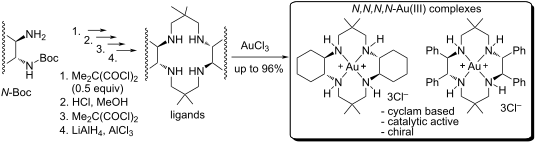
- the Au(III) complex upon substitution of all coordinating halides by nitrogen donors. We hereby present the synthesis of chiral cyclam ligands and related polyamino compounds, along with Au(III) coordination studies and evaluation of the catalytic ability of the successfully obtained Au(III) complexes

Graphical Abstract

Scheme 1: Synthetic protocols for the preparation of potential ligands 1–4.

Scheme 2: Reduction of diamides 1a,b and tetraamides 2a,b.

Scheme 3: Au(III) coordination conditions for ligands 5a,b and 6a,b. Coordination of 5b was unsuccessful.

Figure 1: 1H NMR study of the formation of complex 6a-Au(III) by AuCl3 coordination to ligand 6a.
Novel library synthesis of 3,4-disubstituted pyridin-2(1H)-ones via cleavage of pyridine-2-oxy-7-azabenzotriazole ethers under ionic hydrogenation conditions at room temperature
- Romain Pierre,
- Anne Brethon,
- Sylvain A. Jacques,
- Aurélie Blond,
- Sandrine Chambon,
- Sandrine Talano,
- Catherine Raffin,
- Branislav Musicki,
- Claire Bouix-Peter,
- Loic Tomas,
- Gilles Ouvry,
- Rémy Morgentin,
- Laurent F. Hennequin and
- Craig S. Harris
Beilstein J. Org. Chem. 2021, 17, 156–165, doi:10.3762/bjoc.17.16
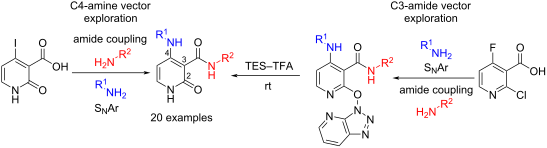
- . Finally, we turned out attention to transition metal-catalyzed formation of phenols from aryl halides [5]. After another round of screening, we successfully applied palladium-catalyzed conditions discovered by the Buchwald group [6], using KOH as the nucleophile and X-Phos as the ligand, to afford 7 in 83

Graphical Abstract

Figure 1: Retrosynthetic disconnection of our privileged kinase scaffold 1.

Scheme 1: Reagents and conditions: (a) MeOH, DIPEA, reflux, 70%; b) TBTU, DIPEA, DMF, rt, 91%.

Scheme 2: Proposed mechanistic explanation for the liberation of the Pd catalytic cycle after addition of sac...

Scheme 3: Formation of C2–OAt ether 15 using HATU. Reagents and condtions: (a) HATU, DIPEA, DCM, rt, 16 h, ((...

Scheme 4: Proposed mechanistic pathways for the transformation of Py–OAt ethers 17 to the pyridin-2H-one 1 mo...

Scheme 5: Failure to exploit logical convergent building block 26. Reagents and conditions: a) HATU, DIPEA, D...

Scheme 6: Library route to 32. Reagents and conditions: a) 4 M HClaq, reflux, 1 h, 81%; (b) EDCI, pyridine, P...
Benzothiazolium salts as reagents for the deoxygenative perfluoroalkylthiolation of alcohols
- Armin Ariamajd,
- Nils J. Gerwien,
- Benjamin Schwabe,
- Stefan Dix and
- Matthew N. Hopkinson
Beilstein J. Org. Chem. 2021, 17, 83–88, doi:10.3762/bjoc.17.8

- of an alkyl electrophile has been reported to date [35]. This process used an umpolung strategy with activation of typically electrophilic perfluoroalkylsulfenamide reagents by iodide, releasing −SC2F5 or −SC3F7 anions in situ, which could then react with a selection of alkyl halides (Scheme 1b). In

Graphical Abstract

Scheme 1: Synthetic routes towards perfluoroalkyl thioethers.

Scheme 2: Two-step synthesis of BT-SRF reagents from MBT.

Scheme 3: Plausible mechanism for the formation of thioether 3 and thionoester 4.

Scheme 4: Scope of the deoxygenative perfluoroalkylthiolation reaction using BT-SC2F5 and BT-SC3F7.
Progress in the total synthesis of inthomycins
- Bidyut Kumar Senapati
Beilstein J. Org. Chem. 2021, 17, 58–82, doi:10.3762/bjoc.17.7
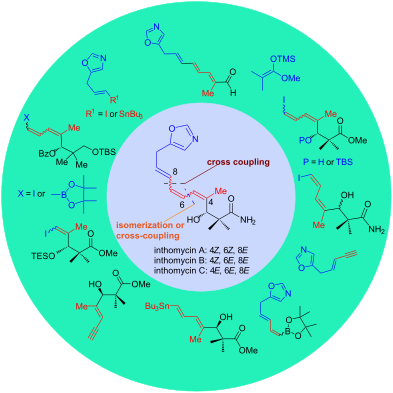
- (rac)-13 in a stereoselective manner, attention was then focused on the development of an analogous strategy towards the (Z,Z,E)- and (Z,E,E)-triene systems present in oxazolomycin A (5a) and oxazolomycin C (5c), respectively. The key steps were i) synthesis of dienyl halides, ii) synthesis of the
- required vinylstannane and iii) Stille coupling between them (Scheme 3) [39]. The required divinyl halides 36 were prepared, starting from phenylacetaldehyde (33), by using the Takai [38] or Wittig procedures [40] as shown in Scheme 3 (68% of a 3.3:1 mixture of (E,E)/(Z,E)-36b and 69% yield of a 8:1
- (Scheme 23). The aldehyde (Z)-(+)-143a was the common intermediate for the synthesis of (E)- or (Z)-selective vinyl boronates or vinyl halides (+)-145 to accomplish total syntheses of all inthomycins A–C ((+)-1, (+)-2 and (–)-3, see Scheme 25 and Scheme 26). With the key intermediate (Z)-(+)-143a in hand

Graphical Abstract

Figure 1: The inthomycins A–C (1–3) and structurally closely related compounds.

Figure 2: Syntheses of inthomycins A–C (1–3).
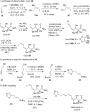
Scheme 1: The first total synthesis of racemic inthomycin A (rac)-1 by Whiting.

Scheme 2: Moloney’s synthesis of the phenyl analogue of inthomycin C ((rac)-3).
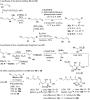
Scheme 3: Moloney’s synthesis of phenyl analogues of inthomycins A (rac-1) and B (rac-2).

Scheme 4: The first total synthesis of inthomycin B (+)-2 by R. J. K. Taylor.

Scheme 5: R. J. K. Taylor’s total synthesis of racemic inthomycin A (rac)-1.
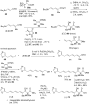
Scheme 6: The first total synthesis of inthomycin C ((+)-3) by R. J. K. Taylor.

Scheme 7: The first total synthesis of naturally occurring inthomycin C ((–)-3) by Ryu et al.

Scheme 8: Preparation of E,E-iododiene (+)-84 and Z,E- iododiene 85a.

Scheme 9: Hatakeyama’s total synthesis of inthomycin A (+)-1 and inthomycin B (+)-2.

Scheme 10: Hatakeyama’s total synthesis of inthomycin C ((–)-3).

Scheme 11: Maulide’s formal synthesis of racemic inthomycin C ((rac)-3).
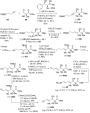
Scheme 12: Hale’s synthesis of dienylstannane (+)-69 and enyne (+)-82b intermediates.

Scheme 13: Hale’s total synthesis of inthomycin C ((+)-3).

Scheme 14: Hale and Hatakeyama’s resynthesis of (3R)-inthomycin C (−)-3 Mosher esters.

Scheme 15: Reddy’s formal syntheses of inthomycin C (+)-3 and inthomycin C ((−)-3).

Scheme 16: Synthesis of the cross-metathesis precursors (rac)-118 and 121.

Scheme 17: Donohoe’s total synthesis of inthomycin C ((−)-3).

Scheme 18: Synthesis of dienylboronic ester (E,E)-128.

Scheme 19: Synthesis of the alkenyl iodides (Z)- and (E)-130.

Scheme 20: Burton’s total synthesis of inthomycin B ((+)-2).

Scheme 21: Burton’s total synthesis of inthomycin C ((−)-3).

Scheme 22: Burton’s total synthesis of inthomycin A ((+)-1).

Scheme 23: Synthesis of common intermediate (Z)-(+)-143a.

Scheme 24: Synthesis of (Z)-and (E)-selective fragments (+)-145a–c.

Scheme 25: Kim’s total synthesis of inthomycins A (+)-1 and B (+)-2.

Scheme 26: Completion of total synthesis of inthomycin C ((–)-3) by Kim.
Silver-catalyzed synthesis of β-fluorovinylphosphonates by phosphonofluorination of aromatic alkynes
- Yajing Zhang,
- Qingshan Tian,
- Guozhu Zhang and
- Dayong Zhang
Beilstein J. Org. Chem. 2020, 16, 3086–3092, doi:10.3762/bjoc.16.258
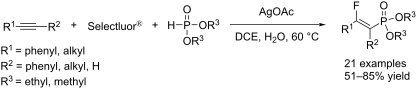
- . Substrates containing a range of functional groups, including halides (F, Cl, and Br), CF3, and even ester groups, were amenable to this transformation. The reaction was also compatible with a CN group to afford the corresponding product 2n in 69% yield. Heteroaromatic alkynes, such as 2-ethynylpyridine and

Graphical Abstract
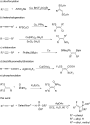
Scheme 1: Metal-catalyzed difunctionalization of unsaturated carbon–carbon bonds.
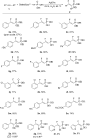
Scheme 2: Substrate scope for the synthesis of the β-fluorovinylphosphonates 2 using diethyl phosphite. React...

Scheme 3: Substrate scope for the synthesis of the β-fluorovinylphosphonates 3 using dimethyl phosphite. Reac...

Scheme 4: Radical-trapping experiments.

Scheme 5: Proposed mechanism for the silver-catalyzed phosphonofluorination of alkynes.

Scheme 6: Attempted use of a suspected phosphonofluorination intermediate to synthesize a β-fluorovinylphosph...
Amine–borane complex-initiated SF5Cl radical addition on alkenes and alkynes
- Audrey Gilbert,
- Pauline Langowski,
- Marine Delgado,
- Laurent Chabaud,
- Mathieu Pucheault and
- Jean-François Paquin
Beilstein J. Org. Chem. 2020, 16, 3069–3077, doi:10.3762/bjoc.16.256
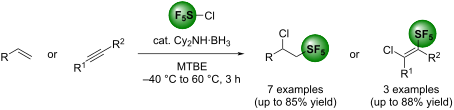
- recently, it has been shown that some of these common amine–borane complexes can also be used as radical initiators for atom transfer radical addition of alkyl halides to alkenes [48]. They were also used in the free-radical polymerization of alkene-containing monomers such as methyl methacrylate or

Graphical Abstract

Scheme 1: Dolbier’s protocol for the SF5Cl radical addition on alkenes.

Scheme 2: Proposed mechanism for the amine–borane complex-initiated radical addition of SF5Cl on alkenes.

Figure 1: Structures and acronyms of the amine-borane complexes investigated.

Scheme 3: Scope of the Et3B and the DICAB-initiated SF5Cl additions on alkenes. Unless noted otherwise, isola...

Scheme 4: Scope of the Et3B and the DICAB-initiated SF5Cl additions on alkynes. Unless noted otherwise, isola...
Deoxyfluorination of acyl fluorides to trifluoromethyl compounds by FLUOLEAD®/Olah’s reagent under solvent-free conditions
- Yumeng Liang,
- Akihito Taya,
- Zhengyu Zhao,
- Norimichi Saito and
- Norio Shibata
Beilstein J. Org. Chem. 2020, 16, 3052–3058, doi:10.3762/bjoc.16.254
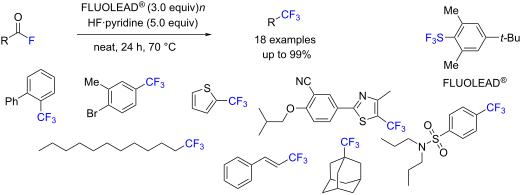
- fluorides. Acyl fluorides, which are one type of acyl halides, show distinct stability in the presence of moisture, indicating their suitable reactivity only in selected conditions [19]. In addition to our direct cross-coupling reaction method, several useful synthetic methods for the formation of acyl

Graphical Abstract

Figure 1: Ratios of CF3-containing drugs in marketed fluoro-pharmaceuticals and registered fluoro-agrochemica...

Figure 2: Selected examples of CF3-containing biologically active molecules.

Scheme 1: Transformation of acyl fluorides to trifluoromethyl compounds. a) Deoxyfluorination of acyl fluorid...

Scheme 2: The substrate scope of acyl fluorides. Reaction conditions: 1 (0.3 mmol), FLUOLEAD® (0.9 mmol, 3.0 ...

Scheme 3: Mechanism of deoxyfluorination of acyl fluorides 1 with FLUOLEAD®/Olah’s reagent to trifluoromethyl...
Chiral anion recognition using calix[4]arene-based ureido receptors in a 1,3-alternate conformation
- Tereza Horáčková,
- Jan Budka,
- Vaclav Eigner,
- Wen-Sheng Chung,
- Petra Cuřínová and
- Pavel Lhoták
Beilstein J. Org. Chem. 2020, 16, 2999–3007, doi:10.3762/bjoc.16.249
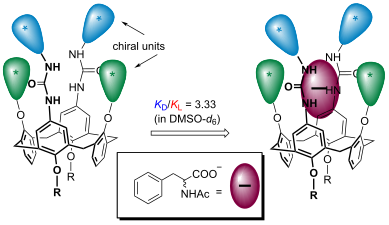
- fact, irrespective of the base or solvent used, the alkylation with appropriate n-propyl or n-hexyl halides always led to the partial cone conformation as the main product. To overcome this problematic step, we used the conditions described by Böhmer et al. [46] for a similar system bearing propyl

Graphical Abstract

Figure 1: Design of chiral calix[4]arene-based receptors for anions.

Scheme 1: Synthesis of the calix[4]arene-based chiral anionic receptors 7 and 8.

Figure 2: X-ray structure of 4a: (a) Top view into the cavity. (b) Side view of the same cavity.
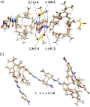
Figure 3: X-ray structure of 7a: (a) Hydrogen bonding interactions (black) in a dimeric motif, chalcogen inte...

Figure 4: X-ray structure of 7d, showing hydrogen bonds between the ureido units (green) and hydrogen bonding...

Figure 5: 1H NMR titration of 7c with N-acetyl-ᴅ-phenylalaninate and N-acetyl-ʟ-phenylalaninate (as TBA salts...
Selective recognition of ATP by multivalent nano-assemblies of bisimidazolium amphiphiles through “turn-on” fluorescence response
- Rakesh Biswas,
- Surya Ghosh,
- Shubhra Kanti Bhaumik and
- Supratim Banerjee
Beilstein J. Org. Chem. 2020, 16, 2728–2738, doi:10.3762/bjoc.16.223
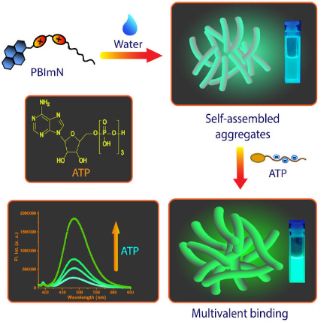
- -imidazol-1-yl)methane (5) was synthesized from imidazole (4) and CH2Br2 following a literature procedure [62][63] with slight modifications. Then, BImNs (N = 4, 10, 12, 14) were synthesized from 5 by mono-alkylation using the corresponding n-alkyl halides in DMF. Finally, PBImNs (N = 4, 10, 12, 14) were

Graphical Abstract

Figure 1: Chemical structures of (a) PBImN (N = 4, 10, 12 and 14) and (b) ATP, ADP and AMP.

Scheme 1: Schematic representation of ATP sensing by multivalent assemblies of PBImN in aqueous media.

Scheme 2: Synthetic route for the preparation of PBImNs.

Figure 2: (a) Absorption and (b) emission spectra of PBImN (50 µM) derivatives in buffer. (c) Absorption and ...

Figure 3: FESEM images of PBIm12 (a) without and (b) with ATP. (c) Emission spectral changes of PBIm12 (75 µM...

Figure 4: a) Emission changes of PBIm12 (75 µM) upon the addition of ATP, ADP, AMP and PPi in buffer. Bar dia...
Optical detection of di- and triphosphate anions with mixed monolayer-protected gold nanoparticles containing zinc(II)–dipicolylamine complexes
- Lena Reinke,
- Julia Bartl,
- Marcus Koch and
- Stefan Kubik
Beilstein J. Org. Chem. 2020, 16, 2687–2700, doi:10.3762/bjoc.16.219
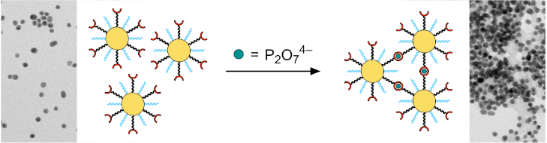
- water/methanol 1:2 (v/v). These anions caused the bright red solutions of the nanoparticles to change their color because of nanoparticle aggregation followed by precipitation, whereas halides or oxoanions such as sulfate, nitrate, or carbonate produced no effect. The sensitivity of phosphate sensing
- . AuNP-based probes for inorganic anions, for example, can serve to monitor the water quality [14][15]. An example is the probe for halides that was described by the Sessler group. It comprised AuNPs with immobilized calix[4]pyrrole residues that are known to interact with chloride and fluoride. The
- response was observed to hydrogenphosphate (and hydrogenarsenate). Other oxoanions and halides induced no visible effects and also did not interfere in diphosphate and triphosphate sensing when simultaneously present. It should be noted that other strategies of detecting diphosphate anions by using

Graphical Abstract

Figure 1: Schematic illustration of the analyte-induced crosslinking of gold nanoparticles containing a mixtu...

Scheme 1: Syntheses of the ligands rac-1 and (R)-1. Conditions: i) TsCl, NaOH, THF, 0 °C, 60 min → 25 °C, 80 ...

Scheme 2: Synthesis of ligand 2. Conditions: i) potassium phthalimide, DMF, 25 °C, 18 h, 67%; ii) 2,2'-dipico...

Figure 2: Photographs of solutions of NPrac-1 in water (0.25 mg/mL) containing different sodium salts at a co...

Figure 3: Sections of the 1H NMR spectra of solutions of NP25 in D2O/CD3OD 1:2 (v/v) between 8.9 and 3.9 ppm ...

Figure 4: Images of vials containing solutions of NP10-Zn (0.25 mg/mL) in water/methanol 1:2 (v/v) and additi...

Figure 5: Photograph of the solutions of the competition experiment. Vial (a) only contained NP10-Zn (and the...

Figure 6: UV–vis spectra of NP10-Zn (0.25 mg/mL in the initial measurement) in water/methanol 1:2 (v/v) conta...

Figure 7: TEM images of NP10-Zn (0.25 mg/mL) in water/methanol 1:2 (v/v) before (a) and after the addition of...
Catalytic trifluoromethylation of iodoarenes by use of 2-trifluoromethylated benzimidazoline as trifluoromethylating reagent
- Tatsuhiro Uchikura,
- Nanami Kamiyama,
- Taisuke Ishikawa and
- Takahiko Akiyama
Beilstein J. Org. Chem. 2020, 16, 2442–2447, doi:10.3762/bjoc.16.198
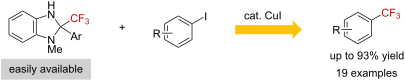
- ; catalysis; copper; fluorine chemistry; trifluoromethylation; Introduction The introduction of a trifluoromethyl group is one of the most attractive reactions in drug discovery [1][2]. In the past decade, trifluoromethylation reactions of aryl halides in the presence of transition-metal complexes were
- reported [3][4][5][6][7][8][9][10][11][12][13][14][15][16][17][18][19][20][21]. CuCF3 is a useful species for the trifluoromethylation of aryl halides and there are a number of precursors of CuCF3 for trifluoromethylation reactions. In contrast, the catalytic generation of CuCF3 was less investigated [15
- , hexafluorobenzene was added as an internal standard and the mixture analyzed by 19F NMR spectroscopy for the calculation of the NMR yield. Then, the crude products were purified by preparative TLC to give pure products 3. Trifluoromethylation of aryl halides. Scope of aryl iodides. Yields determined by 19F NMR

Graphical Abstract
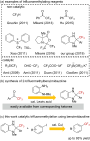
Figure 1: Trifluoromethylation of aryl halides.

Figure 2: Scope of aryl iodides. Yields determined by 19F NMR spectroscopy and used ligand is given in parent...

Figure 3: Scope of heteroaryl iodides. Yields determined by 19F NMR spectroscopy and used ligand is given in ...

Figure 4: Time course of the trifluoromethylation reaction.

Figure 5: Proposed mechanism of the catalytic cycle.
Recent developments in enantioselective photocatalysis
- Callum Prentice,
- James Morrisson,
- Andrew D. Smith and
- Eli Zysman-Colman
Beilstein J. Org. Chem. 2020, 16, 2363–2441, doi:10.3762/bjoc.16.197
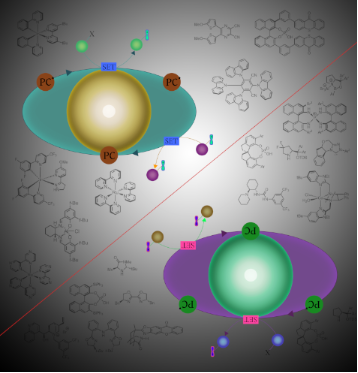
- photocatalysts used for this reaction, it is proposed the excited state of 9 is sufficiently reducing to initiate the chain mechanism through an oxidative quench. Moving away from electronically activated halides, MacMillan et al. investigated a tricatalytic system, utilising enamine, photoredox, and HAT
- ). It is notable that pyridyl ketones do not perform well in this reaction (1 example, 70:30 er). A further extension of this methodology includes the deuteration of 128 and alkyl halides 132 using D2O to afford 133 (18 examples, up to >99:1 er) and 134 (34 examples, up to 98:2 er), respectively (Scheme

Graphical Abstract

Scheme 1: Amine/photoredox-catalysed α-alkylation of aldehydes with alkyl bromides bearing electron-withdrawi...

Scheme 2: Amine/HAT/photoredox-catalysed α-functionalisation of aldehydes using alkenes.

Scheme 3: Amine/cobalt/photoredox-catalysed α-functionalisation of ketones and THIQs.

Scheme 4: Amine/photoredox-catalysed α-functionalisation of aldehydes or ketones with imines. (a) Using keton...

Scheme 5: Bifunctional amine/photoredox-catalysed enantioselective α-functionalisation of aldehydes.
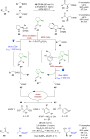
Scheme 6: Bifunctional amine/photoredox-catalysed α-functionalisation of aldehydes using amine catalysts via ...
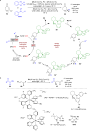
Scheme 7: Amine/photoredox-catalysed RCA of iminium ion intermediates. (a) Synthesis of quaternary stereocent...

Scheme 8: Bifunctional amine/photoredox-catalysed RCA of enones in a radical chain reaction initiated by an i...

Scheme 9: Bifunctional amine/photoredox-catalysed RCA reactions of iminium ions with different radical precur...

Scheme 10: Bifunctional amine/photoredox-catalysed radical cascade reactions between enones and alkenes with a...

Scheme 11: Amine/photocatalysed photocycloadditions of iminium ion intermediates. (a) External photocatalyst u...
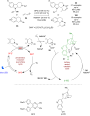
Scheme 12: Amine/photoredox-catalysed addition of acrolein (94) to iminium ions.

Scheme 13: Dual NHC/photoredox-catalysed acylation of THIQs.

Scheme 14: NHC/photocatalysed spirocyclisation via photoisomerisation of an extended Breslow intermediate.

Scheme 15: CPA/photoredox-catalysed aza-pinacol cyclisation.

Scheme 16: CPA/photoredox-catalysed Minisci-type reaction between azaarenes and α-amino radicals.
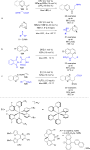
Scheme 17: CPA/photoredox-catalysed radical additions to azaarenes. (a) α-Amino radical or ketyl radical addit...
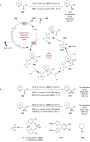
Scheme 18: CPA/photoredox-catalysed reduction of azaarene-derived substrates. (a) Reduction of ketones. (b) Ex...
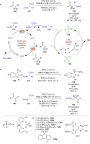
Scheme 19: CPA/photoredox-catalysed radical coupling reactions of α-amino radicals with α-carbonyl radicals. (...
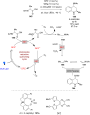
Scheme 20: CPA/photoredox-catalysed Povarov reaction.
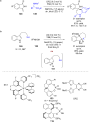
Scheme 21: CPA/photoredox-catalysed reactions with imines. (a) Decarboxylative imine generation followed by Po...

Scheme 22: Bifunctional CPA/photocatalysed [2 + 2] photocycloadditions.

Scheme 23: PTC/photocatalysed oxygenation of 1-indanone-derived β-keto esters.

Scheme 24: PTC/photoredox-catalysed perfluoroalkylation of 1-indanone-derived β-keto esters via a radical chai...
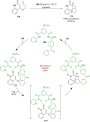
Scheme 25: Bifunctional hydrogen bonding/photocatalysed intramolecular [2 + 2] photocycloadditions of quinolon...
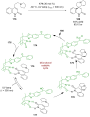
Scheme 26: Bifunctional hydrogen bonding/photocatalysed intramolecular RCA cyclisation of a quinolone.

Scheme 27: Bifunctional hydrogen bonding/photocatalysed intramolecular [2 + 2] photocycloadditions of quinolon...

Scheme 28: Bifunctional hydrogen bonding/photocatalysed [2 + 2] photocycloaddition reactions. (a) First use of...

Scheme 29: Bifunctional hydrogen bonding/photocatalysed deracemisation of allenes.

Scheme 30: Bifunctional hydrogen bonding/photocatalysed deracemisation reactions. (a) Deracemisation of sulfox...

Scheme 31: Bifunctional hydrogen bonding/photocatalysed intramolecular [2 + 2] photocycloaddition of coumarins....
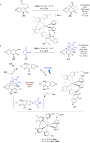
Scheme 32: Bifunctional hydrogen bonding/photocatalysed [2 + 2] photocycloadditions of quinolones. (a) Intramo...
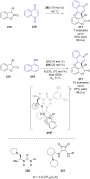
Scheme 33: Hydrogen bonding/photocatalysed formal arylation of benzofuranones.

Scheme 34: Hydrogen bonding/photoredox-catalysed dehalogenative protonation of α,α-chlorofluoro ketones.

Scheme 35: Hydrogen bonding/photoredox-catalysed reductions. (a) Reduction of 1,2-diketones. (b) Reduction of ...

Scheme 36: Hydrogen bonding/HAT/photocatalysed deracemisation of cyclic ureas.

Scheme 37: Hydrogen bonding/HAT/photoredox-catalysed synthesis of cyclic sulfonamides.
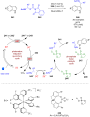
Scheme 38: Hydrogen bonding/photoredox-catalysed reaction between imines and indoles.

Scheme 39: Chiral cation/photoredox-catalysed radical coupling of two α-amino radicals.
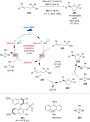
Scheme 40: Chiral phosphate/photoredox-catalysed hydroetherfication of alkenols.

Scheme 41: Chiral phosphate/photoredox-catalysed synthesis of pyrroloindolines.

Scheme 42: Chiral anion/photoredox-catalysed radical cation Diels–Alder reaction.

Scheme 43: Lewis acid/photoredox-catalysed cycloadditions of carbonyls. (a) Formal [2 + 2] cycloaddition of en...
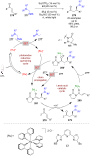
Scheme 44: Lewis acid/photoredox-catalysed RCA reaction using a scandium Lewis acid between α-amino radicals a...

Scheme 45: Lewis acid/photoredox-catalysed RCA reaction using a copper Lewis acid between α-amino radicals and...

Scheme 46: Lewis acid/photoredox-catalysed synthesis of 1,2-amino alcohols from aldehydes and nitrones using a...

Scheme 47: Lewis acid/photocatalysed [2 + 2] photocycloadditions of enones and alkenes.

Scheme 48: Meggers’s chiral-at-metal catalysts.
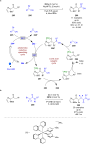
Scheme 49: Lewis acid/photoredox-catalysed α-functionalisation of ketones with alkyl bromides bearing electron...

Scheme 50: Bifunctional Lewis acid/photoredox-catalysed radical coupling reaction using α-chloroketones and α-...

Scheme 51: Lewis acid/photocatalysed RCA of enones. (a) Using aldehydes as acyl radical precursors. (b) Other ...

Scheme 52: Bifunctional Lewis acid/photocatalysis for a photocycloaddition of enones.

Scheme 53: Lewis acid/photoredox-catalysed RCA reactions of enones using DHPs as radical precursors.

Scheme 54: Lewis acid/photoredox-catalysed functionalisation of β-ketoesters. (a) Hydroxylation reaction catal...

Scheme 55: Bifunctional copper-photocatalysed alkylation of imines.

Scheme 56: Copper/photocatalysed alkylation of imines. (a) Bifunctional copper catalysis using α-silyl amines....
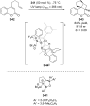
Scheme 57: Bifunctional Lewis acid/photocatalysed intramolecular [2 + 2] photocycloaddition.

Scheme 58: Bifunctional Lewis acid/photocatalysed [2 + 2] photocycloadditions (a) Intramolecular cycloaddition...

Scheme 59: Bifunctional Lewis acid/photocatalysed rearrangement of 2,4-dieneones.

Scheme 60: Lewis acid/photocatalysed [2 + 2] cycloadditions of cinnamate esters and styrenes.
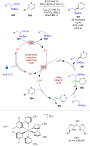
Scheme 61: Nickel/photoredox-catalysed arylation of α-amino acids using aryl bromides.

Scheme 62: Nickel/photoredox catalysis. (a) Desymmetrisation of cyclic meso-anhydrides using benzyl trifluorob...

Scheme 63: Nickel/photoredox catalysis for the acyl-carbamoylation of alkenes with aldehydes using TBADT as a ...

Scheme 64: Bifunctional copper/photoredox-catalysed C–N coupling between α-chloro amides and carbazoles or ind...
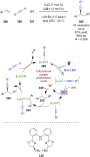
Scheme 65: Bifunctional copper/photoredox-catalysed difunctionalisation of alkenes with alkynes and alkyl or a...

Scheme 66: Copper/photoredox-catalysed decarboxylative cyanation of benzyl phthalimide esters.

Scheme 67: Copper/photoredox-catalysed cyanation reactions using TMSCN. (a) Propargylic cyanation (b) Ring ope...

Scheme 68: Palladium/photoredox-catalysed allylic alkylation reactions. (a) Using alkyl DHPs as radical precur...
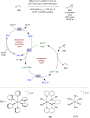
Scheme 69: Manganese/photoredox-catalysed epoxidation of terminal alkenes.
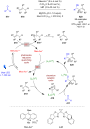
Scheme 70: Chromium/photoredox-catalysed allylation of aldehydes.
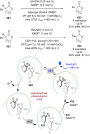
Scheme 71: Enzyme/photoredox-catalysed dehalogenation of halolactones.

Scheme 72: Enzyme/photoredox-catalysed dehalogenative cyclisation.

Scheme 73: Enzyme/photoredox-catalysed reduction of cyclic imines.

Scheme 74: Enzyme/photocatalysed enantioselective reduction of electron-deficient alkenes as mixtures of (E)/(Z...

Scheme 75: Enzyme/photoredox catalysis. (a) Deacetoxylation of cyclic ketones. (b) Reduction of heteroaromatic...

Scheme 76: Enzyme/photoredox-catalysed synthesis of indole-3-ones from 2-arylindoles.

Scheme 77: Enzyme/HAT/photoredox catalysis for the DKR of primary amines.

Scheme 78: Bifunctional enzyme/photoredox-catalysed benzylic C–H hydroxylation of trifluoromethylated arenes.
Chan–Evans–Lam N1-(het)arylation and N1-alkеnylation of 4-fluoroalkylpyrimidin-2(1H)-ones
- Viktor M. Tkachuk,
- Oleh O. Lukianov,
- Mykhailo V. Vovk,
- Isabelle Gillaizeau and
- Volodymyr A. Sukach
Beilstein J. Org. Chem. 2020, 16, 2304–2313, doi:10.3762/bjoc.16.191

- promising building blocks for further functionalization, including (het)aryl or alkenyl substitution at the N1 atom. However, direct arylation of 1 with aryl halides under Ullmann reaction conditions is a low-efficiency process giving only complex mixtures. It is likely that the harsh thermal conditions

Graphical Abstract

Figure 1: Summary of the previous and present studies.

Scheme 1: Chan–Evans–Lam reaction of 4-trifluoromethylpyrimidin-2(1H)-one 1а with (het)aryl boronic acid 2b–w...

Scheme 2: Chan–Evans–Lam reaction of 4-trifluoromethylpyrimidin-2(1H)-one (1а) with (het)aryl- and alkenylbor...

Scheme 3: Chan–Evans–Lam reaction of pyrimidin-2(1H)-ones 1b–h with phenylboronic acid (2a).
Regiodivergent synthesis of functionalized pyrimidines and imidazoles through phenacyl azides in deep eutectic solvents
- Paola Vitale,
- Luciana Cicco,
- Ilaria Cellamare,
- Filippo M. Perna,
- Antonio Salomone and
- Vito Capriati
Beilstein J. Org. Chem. 2020, 16, 1915–1923, doi:10.3762/bjoc.16.158
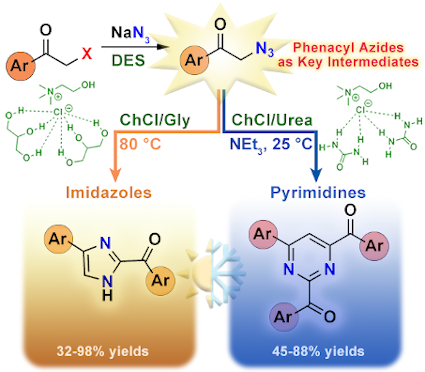
- °C) in the presence or absence of bases (Et3N). Keywords: deep eutectic solvents; imidazoles; phenacyl azides; phenacyl halides; pyrimidines; Introduction In a world with dwindling petroleum resources, the setting up of more and more sustainable routes for the preparation of heterocyclic compounds
- (g) heterogeneous “click” cycloaddition reactions [15] using DESs as environmentally responsible and non-innocent reaction media. Telescoped, one-pot transformations of phenacyl halides to symmetrical 2,5-disubstituted pyrazines (A), through phenacyl azides as intermediates, were also found to take
- separation of the organic layer from water, and removal of the volatiles under reduced pressure. To examine the scope and limitation of this transformation, various functionalized phenacyl halides (1c–i) were tested as substrates. As can be seen from the results compiled in Scheme 3, the reaction is amenable

Graphical Abstract

Scheme 1: One-pot synthesis of 2,5-diarylpyrazines (A) (path a) or 2-aroyl-(4 or 5)-aryl-(1H)-imidazoles (B) ...

Scheme 2: Transformation of phenacyl bromide (1a) in ChCl/Gly into phenacyl azide (2a) and 2-benzoyl-(4 or 5)...

Scheme 3: Synthesis of 2-aroyl-(4 or 5)-aryl-(1H)-imidazoles 3. Scope of the reaction. Typical conditions: 1 ...

Scheme 4: Proposed mechanism for the formation of 2-aroyl-(4 or 5)-aryl-(1H)-imidazoles 3/3' from α-phenacyl ...

Scheme 5: Proposed mechanism for the formation of 2-benzoyl-(4 or 5)-phenyl-(1H)-imidazoles 3a/3a' and 2,4-di...

Scheme 6: Scope of the synthesis of 2,4-diaroyl-6-arylpyrimidines 7. Typical conditions: 2 (0.3 mmol), Et3N (...
Design, synthesis and application of carbazole macrocycles in anion sensors
- Alo Rüütel,
- Ville Yrjänä,
- Sandip A. Kadam,
- Indrek Saar,
- Mihkel Ilisson,
- Astrid Darnell,
- Kristjan Haav,
- Tõiv Haljasorg,
- Lauri Toom,
- Johan Bobacka and
- Ivo Leito
Beilstein J. Org. Chem. 2020, 16, 1901–1914, doi:10.3762/bjoc.16.157
- synthesis to access up to –[CH2]10– macrocycles or acyl halides to access up to –[CH2]14– macrocycles. Seventy-five receptor–anion complexes were modelled and studied with COSMO-RS, in addition to all free host molecules. In order to predict initial selectivity towards carboxylates, 1H NMR relative
- anions also represented different parts of the Hofmeister series. Chloride and nitrate are also common in real-world samples that such sensors might be used to analyse. Fluoride and iodide represented halides at opposite ends of the Hofmeister series. The selectivity pattern for the control membrane

Graphical Abstract

Figure 1: The biscarbazolylurea moiety.

Figure 2: The structure of the solid-contact ion-selective electrode (sensor): a) glassy carbon as the electr...

Figure 3: Studied receptor molecules.

Figure 4: MC001 and MC003 lowest energy conformers (COSMO-RS) showing intramolecular bonds. Color coding: whi...

Figure 5: a) Complex of MC008 with acetate; b) complex of MC006 with formate; c) complex of MC007 with lactat...
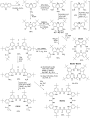
Scheme 1: The synthetic pathway to receptors CZ016 and MC001–MC014. The reaction yield for 2–3a/3b is given a...

Figure 6: Binding affinities of the studied receptors towards different carboxylates in DMSO-d6/H2O (99.5%:0....

Figure 7: Impedance spectra of sensors with each of the membranes. The spectra were recorded in 0.1 M sodium ...

Figure 8: Calibration curves for each of the membranes. The calibrations were performed by diluting 0.1 M sod...

Figure 9: The influence of solution pH on the potential responses of the sensor prototypes (three sensors for...

Figure 10: Potentiometric selectivity coefficients of interfering anions (relative to acetate) determined usin...
On the hydrolysis of diethyl 2-(perfluorophenyl)malonate
- Ilya V. Taydakov and
- Mikhail A. Kiskin
Beilstein J. Org. Chem. 2020, 16, 1863–1868, doi:10.3762/bjoc.16.153
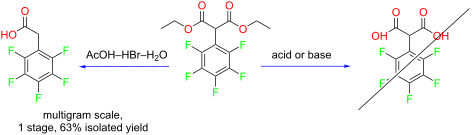
- , hydrolysis of the ester with a mixture of HBr and AcOH gave 2-(perfluorophenyl)acetic acid in a good preparative yield of 63%. A significant advantage of this new approach to 2-(perfluorophenyl)acetic acid is that handling toxic substances such as cyanides and perfluorinated benzyl halides is avoided

Graphical Abstract

Figure 1: Phenylmalonic acids.

Scheme 1: Synthesis of diethyl 2-phenylmalonate (4).

Scheme 2: Synthesis of diethyl 2-(perfluorophenyl)malonate (3).

Figure 2: Esters of fluorine-substituted 2-phenylmalonic acids.

Scheme 3: Hydrolysis of diethyl 2-(perfluorophenyl)malonate (3).

Figure 3: Molecular structure of 2-(perfluorophenyl)acetic acid (12).

Scheme 4: Formation of 2-(perfluorophenyl)acetic acid (12).
When metal-catalyzed C–H functionalization meets visible-light photocatalysis
- Lucas Guillemard and
- Joanna Wencel-Delord
Beilstein J. Org. Chem. 2020, 16, 1754–1804, doi:10.3762/bjoc.16.147

- ., the organic Acr–H2 molecule (Figure 23). In this study, 35 examples of the targeted coupling products were afforded in good to excellent yields. Various synthetically relevant functional groups, including halides, esters, amides, ethers, ketones, and aldehydes were compatible with the protocol. This
- very efficient at room temperature while applying blue LED irradiation. Two slightly modified catalytic systems composed of a [Ru(p-cymene)Cl2]2 catalyst and either K2CO3 or KOAc bases promoted the direct meta-selective C(sp2)–H alkylation with secondary and tertiary alkyl halides, delivering the

Graphical Abstract

Figure 1: Concept of dual synergistic catalysis.

Figure 2: Classification of catalytic systems involving two catalysts.

Figure 3: General mechanism for the dual nickel/photoredox catalytic system.

Figure 4: General mechanisms for C–H activation catalysis involving different reoxidation strategies.

Figure 5: Indole synthesis via dual C–H activation/photoredox catalysis.

Figure 6: Proposed mechanism for the indole synthesis via dual catalysis.

Figure 7: Oxidative Heck reaction on arenes via the dual catalysis.

Figure 8: Proposed mechanism for the Heck reaction on arenes via dual catalysis.

Figure 9: Oxidative Heck reaction on phenols via the dual catalysis.

Figure 10: Proposed mechanism for the Heck reaction on phenols via dual catalysis.

Figure 11: Carbazole synthesis via dual C–H activation/photoredox catalysis.

Figure 12: Proposed mechanism for the carbazole synthesis via dual catalysis.

Figure 13: Carbonylation of enamides via the dual C–H activation/photoredox catalysis.

Figure 14: Proposed mechanism for carbonylation of enamides via dual catalysis.

Figure 15: Annulation of benzamides via the dual C–H activation/photoredox catalysis.

Figure 16: Proposed mechanism for the annulation of benzamides via dual catalysis.

Figure 17: Synthesis of indoles via the dual C–H activation/photoredox catalysis.

Figure 18: Proposed mechanism for the indole synthesis via dual catalysis.

Figure 19: General concept of dual catalysis merging C–H activation and photoredox catalysis.

Figure 20: The first example of dual catalysis merging C–H activation and photoredox catalysis.

Figure 21: Proposed mechanism for the C–H arylation with diazonium salts via dual catalysis.

Figure 22: Dual catalysis merging C–H activation/photoredox using diaryliodonium salts.

Figure 23: Direct arylation via the dual catalytic system reported by Xu.

Figure 24: Direct arylation via dual catalytic system reported by Balaraman.

Figure 25: Direct arylation via dual catalytic system reported by Guo.

Figure 26: C(sp3)–H bond arylation via the dual Pd/photoredox catalytic system.

Figure 27: Acetanilide derivatives acylation via the dual C–H activation/photoredox catalysis.

Figure 28: Proposed mechanism for the C–H acylation with α-ketoacids via dual catalysis.

Figure 29: Acylation of azobenzenes via the dual catalysis C–H activation/photoredox.

Figure 30: C2-acylation of indoles via the dual C–H activation/photoredox catalysis.

Figure 31: Proposed mechanism for the C2-acylation of indoles with aldehydes via dual catalysis.

Figure 32: C2-acylation of indoles via the dual C–H activation/photoredox catalysis.

Figure 33: Perfluoroalkylation of arenes via the dual C–H activation/photoredox catalysis.

Figure 34: Proposed mechanism for perfluoroalkylation of arenes via dual catalysis.

Figure 35: Sulfonylation of 1-naphthylamides via the dual C–H activation/photoredox catalysis.

Figure 36: Proposed mechanism for sulfonylation of 1-naphthylamides via dual catalysis.

Figure 37: meta-C–H Alkylation of arenes via visible-light metallaphotocatalysis.

Figure 38: Alternative procedure for meta-C–H alkylation of arenes via metallaphotocatalysis.

Figure 39: Proposed mechanism for meta-C–H alkylation of arenes via metallaphotocatalysis.

Figure 40: C–H borylation of arenes via visible-light metallaphotocatalysis.

Figure 41: Proposed mechanism for C–H borylation of arenes via visible-light metallaphotocatalysis.

Figure 42: Undirected C–H aryl–aryl cross coupling via dual gold/photoredox catalysis.

Figure 43: Proposed mechanism for the undirected C–H aryl–aryl cross-coupling via dual catalysis.

Figure 44: Undirected C–H arylation of (hetero)arenes via dual manganese/photoredox catalysis.

Figure 45: Proposed mechanism for the undirected arylation of (hetero)arenes via dual catalysis.

Figure 46: Photoinduced C–H arylation of azoles via copper catalysis.

Figure 47: Photo-induced C–H chalcogenation of azoles via copper catalysis.

Figure 48: Decarboxylative C–H adamantylation of azoles via dual cobalt/photoredox catalysis.

Figure 49: Proposed mechanism for the C–H adamantylation of azoles via dual catalysis.

Figure 50: General mechanisms for the “classical” (left) and Cu-free variant (right) Sonogoshira reaction.

Figure 51: First example of a dual palladium/photoredox catalysis for Sonogashira-type couplings.

Figure 52: Arylation of terminal alkynes with diazonium salts via dual gold/photoredox catalysis.

Figure 53: Proposed mechanism for the arylation of terminal alkynes via dual catalysis.

Figure 54: C–H Alkylation of alcohols promoted by H-atom transfer (HAT).

Figure 55: Proposed mechanism for the C–H alkylation of alcohols promoted by HAT.

Figure 56: C(sp3)–H arylation of latent nucleophiles promoted by H-atom transfer.

Figure 57: Proposed mechanism for the C(sp3)–H arylation of latent nucleophiles promoted by HAT.

Figure 58: Direct α-arylation of alcohols promoted by H-atom transfer.

Figure 59: Proposed mechanism for the direct α-arylation of alcohols promoted by HAT.

Figure 60: C–H arylation of amines via dual Ni/photoredox catalysis.

Figure 61: Proposed mechanism for the C–H arylation of amines via dual Ni/photoredox catalysis.

Figure 62: C–H functionalization of nucleophiles via excited ketone/nickel dual catalysis.

Figure 63: Proposed mechanism for the C–H functionalization enabled by excited ketones.

Figure 64: Selective sp3–sp3 cross-coupling promoted by H-atom transfer.

Figure 65: Proposed mechanism for the selective sp3–sp3 cross-coupling promoted by HAT.

Figure 66: Direct C(sp3)–H acylation of amines via dual Ni/photoredox catalysis.

Figure 67: Proposed mechanism for the C–H acylation of amines via dual Ni/photoredox catalysis.

Figure 68: C–H hydroalkylation of internal alkynes via dual Ni/photoredox catalysis.

Figure 69: Proposed mechanism for the C–H hydroalkylation of internal alkynes.

Figure 70: Alternative procedure for the C–H hydroalkylation of ynones, ynoates, and ynamides.

Figure 71: Allylic C(sp3)–H activation via dual Ni/photoredox catalysis.

Figure 72: Proposed mechanism for the allylic C(sp3)–H activation via dual Ni/photoredox catalysis.

Figure 73: Asymmetric allylation of aldehydes via dual Cr/photoredox catalysis.

Figure 74: Proposed mechanism for the asymmetric allylation of aldehydes via dual catalysis.

Figure 75: Aldehyde C–H functionalization promoted by H-atom transfer.

Figure 76: Proposed mechanism for the C–H functionalization of aldehydes promoted by HAT.

Figure 77: Direct C–H arylation of strong aliphatic bonds promoted by HAT.

Figure 78: Proposed mechanism for the C–H arylation of strong aliphatic bonds promoted by HAT.

Figure 79: Direct C–H trifluoromethylation of strong aliphatic bonds promoted by HAT.

Figure 80: Proposed mechanism for the C–H trifluoromethylation of strong aliphatic bonds.



