Search results
Search for "Lewis acids" in Full Text gives 249 result(s) in Beilstein Journal of Organic Chemistry. Showing first 200.
Visible light photoredox-catalyzed deoxygenation of alcohols
Beilstein J. Org. Chem. 2014, 10, 2157–2165, doi:10.3762/bjoc.10.223
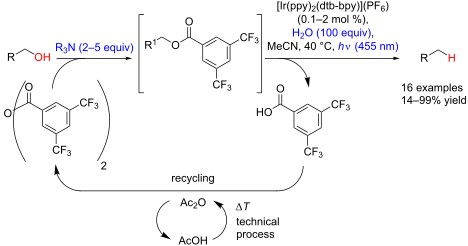
- -hydroxycarbonyl compounds 6b–e turned out to be amenable for the desoxygenation process (Table 4). Especially interesting from a preparative point of view, the monodeoxygenation of diethyl tartrate to maleate could be achieved from 6e in excellent yields (Table 4, entry 5). Notably, after screening various Lewis
- acids (Supporting Information File 1) it was found that 6e could be selectively prepared by copper(II) chloride-catalyzed benzoylation of diol 8 with anhydride 9, which in turn can be generated from its acid 5 by treatment with acetic anhydride (Scheme 6). Since acetic anhydride is technically being


Synthesis of 2-substituted tryptophans via a C3- to C2-alkyl migration
Beilstein J. Org. Chem. 2014, 10, 1991–1998, doi:10.3762/bjoc.10.207
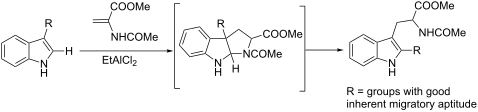
- such as trifluoroethanol (TFE) did not accelerate the reaction and still gave low yields after 24 h (Table 1, entry 5). Next, we tested the effect of different acids on the reaction. Although some Lewis acids such as TiCl4, SnCl4, and Sc(OTf)3 did not show beneficial effects (Table 1, entries 6–8), a


Synthesis of a bifunctional cytidine derivative and its conjugation to RNA for in vitro selection of a cytidine deaminase ribozyme
Beilstein J. Org. Chem. 2014, 10, 1906–1913, doi:10.3762/bjoc.10.198
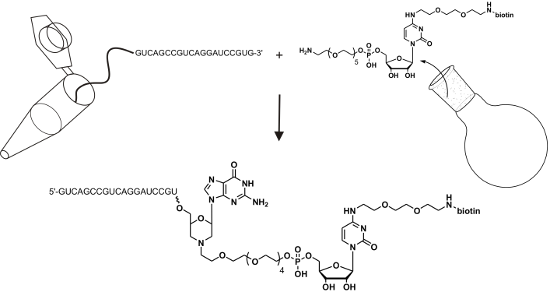
- of Boc-protected amines can be selectively cleaved with Lewis acids [40]. Thus, stirring of 9 in anhydrous DCM with ZnBr2 delivered the free amine 10 with a yield of 82% (Figure 4). To this, biotin was coupled by in situ activation of the carboxylic acid as an NHS-ester using 1-ethyl-3-(3


Expedient synthesis of 1,6-anhydro-α-D-galactofuranose, a useful intermediate for glycobiological tools
Beilstein J. Org. Chem. 2014, 10, 1651–1656, doi:10.3762/bjoc.10.172
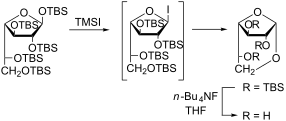
- leaving group at C-1, and the electron-donating nature of the TBS groups. Thus, while compounds 13 [38] and 14 [39] were prepared by treatment with Lewis acids of fully protected precursors and proved to be stable and therefore useful as synthetic intermediates, attempts to prepare compound 15 by


Homogeneous and heterogeneous photoredox-catalyzed hydroxymethylation of ketones and keto esters: catalyst screening, chemoselectivity and dilution effects
Beilstein J. Org. Chem. 2014, 10, 1143–1150, doi:10.3762/bjoc.10.114
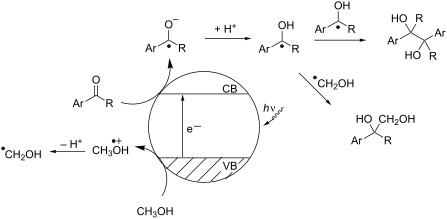
- hydroxymethylation in the presence of additional strong Lewis acids such as AlCl3 or BF3. These compounds alone did not show catalytic activity in methanol, only in combination with Ti(OiPr)4. With the optimal homogenous reaction conditions in hand, we applied several other aromatic and aliphatic open chain and


cis–trans Isomerization of silybins A and B
Beilstein J. Org. Chem. 2014, 10, 1047–1063, doi:10.3762/bjoc.10.105
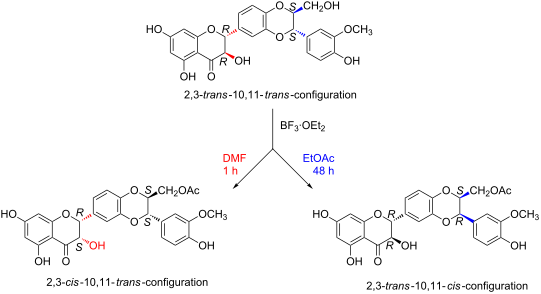
- to be the most suitable Lewis acid for silybin isomerization (Table 1). Other Lewis acids either gave lower isomerization yields (SnCl4), did not work at all, or even caused decomposition. Toluene-4-sulfonic acid, as a representative protic acid, gave no reaction under the same conditions. In this


A convenient enantioselective decarboxylative aldol reaction to access chiral α-hydroxy esters using β-keto acids
Beilstein J. Org. Chem. 2014, 10, 969–974, doi:10.3762/bjoc.10.95
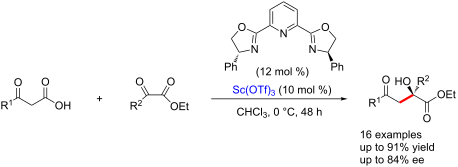
- one point-binding aldehydes and two-point binding β-keto acids under mild reaction conditions. The lack of strong Lewis acids or very basic intermediates enabled it to tolerate functionalities that would normally be incompatible with ester enolates, for instance, hydroxy groups, phenols, enolizable
- investigating different Lewis acids with various chiral PyBox ligands 4–8 (Table 1), we discovered that Sc(OTf)3 and tridentate PyBox ligand 6a could promote the decarboxylative aldol reaction of β-keto acid 1a with α-keto ester 2a in excellent yield with high enantioselectivity in toluene (Table 1, entry 9


Domino reactions of 2H-azirines with acylketenes from furan-2,3-diones: Competition between the formation of ortho-fused and bridged heterocyclic systems
Beilstein J. Org. Chem. 2014, 10, 784–793, doi:10.3762/bjoc.10.74

- [41][43][46]. It was found that water [37], Brønsted [44][48] and Lewis acids [40][41][43] facilitate the formation of pyrazine derivatives. 2H-Azirines undergo ring opening on electronic excitation to give nitrile ylides [50]. Nitrile ylide formation under thermal conditions even from such strained


Silver and gold-catalyzed multicomponent reactions
Beilstein J. Org. Chem. 2014, 10, 481–513, doi:10.3762/bjoc.10.46
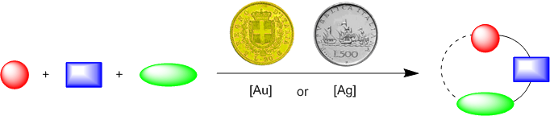
- carbophilic Lewis acids even if their use as σ-activators has been rarely reported. Recently, transformations involving Au(I)/Au(III)-redox catalytic systems have been reported in the literature. In this review we highlight all these aspects of silver and gold-mediated processes and their application in


An oxidative amidation and heterocyclization approach for the synthesis of β-carbolines and dihydroeudistomin Y
Beilstein J. Org. Chem. 2014, 10, 471–480, doi:10.3762/bjoc.10.45
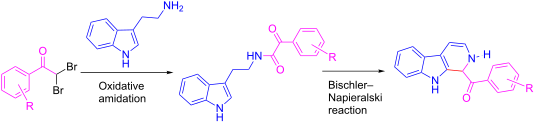
- the yield of 7 under Bischler–Napieralski cyclodehydration reaction conditions using POCl3 as the Lewis acid were proved to be futile. This prompted us to test the efficiency of other Lewis acids in this cyclodehydration reaction. The Bischler–Napieralski cyclodehydration reaction was then carried out
- with different Lewis acids such as BF3·Et2O, SnCl4, TiCl4 etc., in mutiple solvents under various reaction conditions. The best conversion was obtained when the reaction was conducted in BF3·Et2O in ether at 25–30 °C and the product dihydro-β-carboline 7 was isolated in 55% of yield. The formation of


Efficient carbon-Ferrier rearrangement on glycals mediated by ceric ammonium nitrate: Application to the synthesis of 2-deoxy-2-amino-C-glycoside
Beilstein J. Org. Chem. 2014, 10, 300–306, doi:10.3762/bjoc.10.27
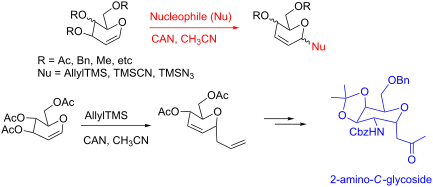
- synthesis of C-glycosides [12][13][14]. Among these, the Ferrier rearrangement [15] of glycals with protic acids [5][16][17] or Lewis acids [18][19][20][21][22] and carbon nucleophiles such as allylsilanes [23], silylacetylenes [24], silyl enol ethers [25], olefins [26], and organozinc reagents [27] has
- glycosyl amino acids [52] to name but a few. Amongst the various reported methods to prepare these compounds [53][54][55], the most common method is via C-glycosylation of 2-aminosugars [56][57][58], which is challenging owing to the incompatibility of protic or Lewis acids with amino and amido


Synthesis of five- and six-membered cyclic organic peroxides: Key transformations into peroxide ring-retaining products
Beilstein J. Org. Chem. 2014, 10, 34–114, doi:10.3762/bjoc.10.6
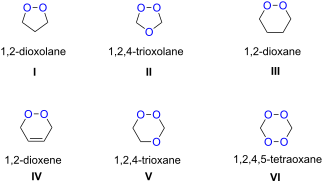
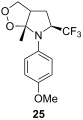
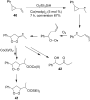
- formed as the major reaction products depending on the nature of the substituents and the Lewis acid (Scheme 27, Table 9) [257]. The reaction of trialkylsilylperoxyacetals with alkenes in the presence of Lewis acids also proceeds through the formation of peroxycarbenium ions. For example, the reaction of






An efficient method for the construction of polysubstituted 4-pyridones via self-condensation of β-keto amides mediated by P2O5 and catalyzed by zinc bromide
Beilstein J. Org. Chem. 2013, 9, 2681–2687, doi:10.3762/bjoc.9.304
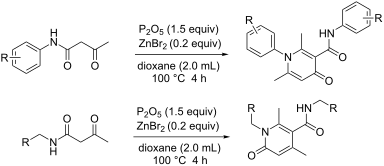
- conditions (Scheme 5). We were astonished to find that the results only included the self-condensation products (2a, 2l, 2j) and achieved not the cross-condensation products. It is well known that Lewis acids can activate β-keto amides [32]. Under mild conditions, phosphorus pentoxide (P2O5) is often used as


Garner’s aldehyde as a versatile intermediate in the synthesis of enantiopure natural products
Beilstein J. Org. Chem. 2013, 9, 2641–2659, doi:10.3762/bjoc.9.300
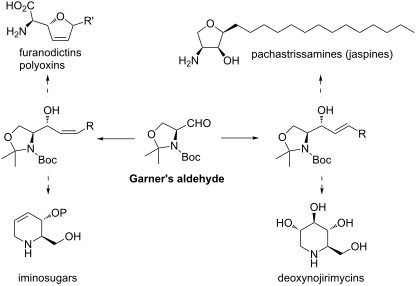
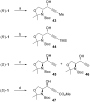
- in the presence of 100 mol % of TiCl4 in THF gave a 5:1 (anti/syn) mixture of adducts 20 and 21. Tetrahydrofuran coordinates quite strongly to Lewis acids, which increases the electron density at the metal atom. This lowers the metal atom’s ability to coordinate to other Lewis bases, such as the
- that of Al, the low reactivity of organylzirconocene chlorides towards carbonyl compounds is puzzling. It is likely that the presence of two sterically demanding cyclopentadienyl (Cp) groups is at least partially responsible for their low reactivity. Suzuki noticed that Lewis acids promote C–C-bond
- enough to inverse the selectivity (Table 1, entries 10, 11, 16 and 17). Less coordinating solvents, such as toluene or CH2Cl2 can also affect the selectivity. A greater effect on the selectivity can be reached by the addition of Lewis acids. Usually Zn(II)-salts give fair to good syn-selectivities (Table




New developments in gold-catalyzed manipulation of inactivated alkenes
Beilstein J. Org. Chem. 2013, 9, 2586–2614, doi:10.3762/bjoc.9.294
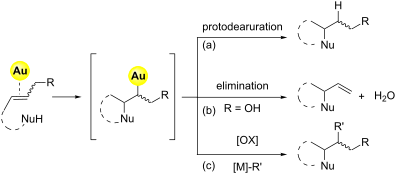
- deuterated compounds 14a,b permitted to confirm the anti-diastereoselective hydroamination of the double bond. (Scheme 5b). Interestingly, although 14 represents a likely intermediate of the reaction course, when it was treated with various Brønsted and Lewis acids, the expected product 16 was not observed






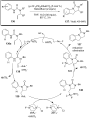


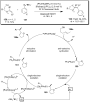
Ambient gold-catalyzed O-vinylation of cyclic 1,3-diketone: A vinyl ether synthesis
Beilstein J. Org. Chem. 2013, 9, 2537–2543, doi:10.3762/bjoc.9.288
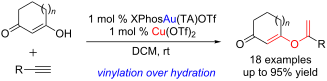
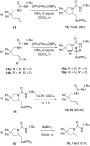
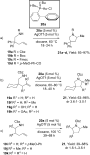
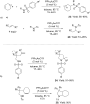
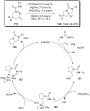
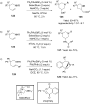
- selectivity for the diketone addition over hydration was maintained as shown in Table 1. Solvent screening shown in Scheme 2 proved that the trace amount of acid from chloroform decomposition was crucial for the optimal performance, which likely helped the protodeauration. Other Lewis acids have also been


Synthetic scope and DFT analysis of the chiral binap–gold(I) complex-catalyzed 1,3-dipolar cycloaddition of azlactones with alkenes
Beilstein J. Org. Chem. 2013, 9, 2422–2433, doi:10.3762/bjoc.9.280
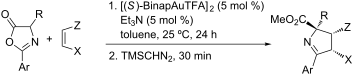
- oxazolone 5aa and NPM catalyzed by [(Sa)-Binap-AuTFA]2. In previous works, we have demonstrated that the stereoselectivity of the 1,3-DC employing chiral metallic Lewis acids arises from the blockage of one of the prochiral faces [34]. Starting from this selected conformation of the catalyst, our results


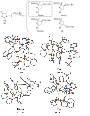


Synthesis of mucin-type O-glycan probes as aminopropyl glycosides
Beilstein J. Org. Chem. 2013, 9, 1867–1872, doi:10.3762/bjoc.9.218
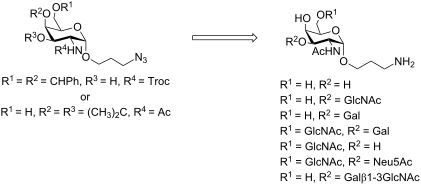
- and acceptors that both have a free hydroxy group [27]. In this report, we employed the difference in reactivity of trichloroacetimidates and thioglycoside donors. In general, trichloroacetimidates are activated by strong Lewis acids such as TMSOTf [28], while the more stable thioglycosides require


Gold(I)-catalyzed formation of furans from γ-acyloxyalkynyl ketones
Beilstein J. Org. Chem. 2013, 9, 1774–1780, doi:10.3762/bjoc.9.206
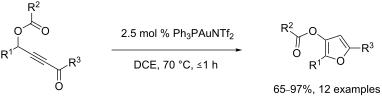
- ability of gold cations to act as π or σ Lewis acids (Scheme 3) [21][55][56]. Intramolecular [1,4]-addition of the acyloxy function by oxophilic activation of γ-acyloxyalkynyl ketones could lead to the formation of gold allenolate A, which is in equilibrium with both Z or E vinylgold B and C [57


Zinc–gold cooperative catalysis for the direct alkynylation of benzofurans
Beilstein J. Org. Chem. 2013, 9, 1763–1767, doi:10.3762/bjoc.9.204
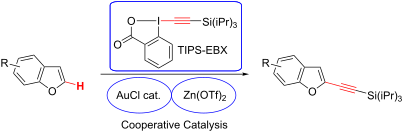
- (OTf)2 in catalytic amount led to a lower yield (Table 1, entry 9), and a larger excess resulted in decomposition of the starting material only (Table 1, entry 10). Although other Lewis acids could also be used (Table 1, entries 11 and 12) [29], no better results than with Zn(OTf)2 were obtained (Table


Synthesis of the reported structure of piperazirum using a nitro-Mannich reaction as the key stereochemical determining step
Beilstein J. Org. Chem. 2013, 9, 1737–1744, doi:10.3762/bjoc.9.200
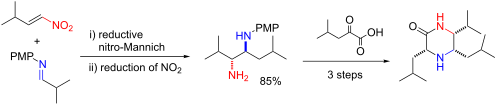
- . Enantioselective reactions have been controlled by asymmetric metal-centred Lewis acids; chiral hydrogen bond donors, in particular by the use of asymmetric thiourea organocatalysts, chiral Brønsted acids, phase-transfer catalysts and Brønsted base catalysts [3][15][25][26][27][28][29][30][31][32][33][34][35][36


Gallium-containing polymer brush film as efficient supported Lewis acid catalyst in a glass microreactor
Beilstein J. Org. Chem. 2013, 9, 1698–1704, doi:10.3762/bjoc.9.194
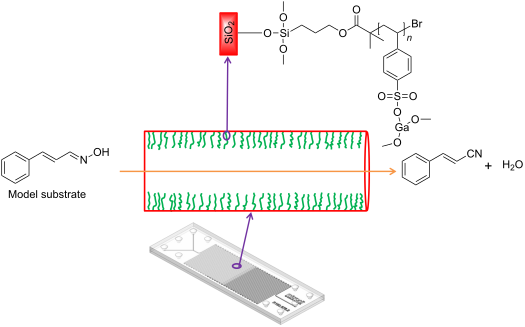
- sulfonate groups of the PSS polymer brushes was incorporated. Upon slow deactivation the catalytic activity of the microreactor can be easily reactivated to its initial value by flowing through a solution of GaCl3. We believe that this approach has a wider scope and can be used to anchor other Lewis acids


Organocatalyzed enantioselective desymmetrization of aziridines and epoxides
Beilstein J. Org. Chem. 2013, 9, 1677–1695, doi:10.3762/bjoc.9.192
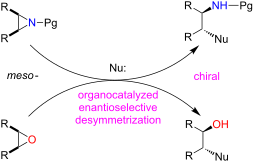
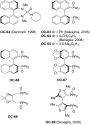
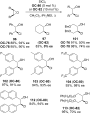
- -aziridines and meso-epoxides by metal-based Lewis acids cooperating with chiral ligands has been well established [16][17][18][19][20][21][22][23][24][25][26][27][28]. However, the enantioselective desymmetrization of meso-aziridines and meso-epoxides catalyzed by small chiral organic molecules has only








A Lewis acid-promoted Pinner reaction
Beilstein J. Org. Chem. 2013, 9, 1572–1577, doi:10.3762/bjoc.9.179
- esters; Lewis acids; Pinner reaction; Ritter reaction; Introduction In 1877 Pinner and Klein discovered the proton-induced imidate syntheses [1][2]. They passed anhydrous gaseous hydrogen chloride through a mixture of isobutyl alcohol and benzonitrile. A crystalline product precipitated, which they
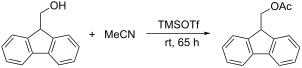
- 1, entries 2 and 3). The 3% yield in acetonitrile/water (10:1) suggests that water is detrimental in the Pinner reaction. Among various tested Lewis acids, the best results were obtained with aluminium tribromide at 50 °C (65%, Table 1, entry 5) and with trimethylsilyl triflate at room temperature


True and masked three-coordinate T-shaped platinum(II) intermediates
Beilstein J. Org. Chem. 2013, 9, 1352–1382, doi:10.3762/bjoc.9.153
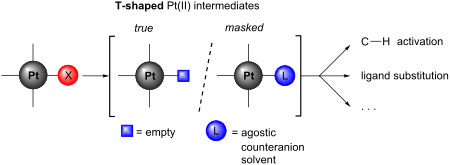
- * and IMes hampering the approach of the CH bond to the metal center. Once again, Lewis acids as acetonitrile can access the empty site, which means that a potential reactant molecule can coordinate to the metal for further reactions. Masked T-shaped via agostic interaction The agostic interaction [29
- generated [41] by methide abstraction from the neutral derivative cis-[Pt(Me)2(PiPr3)2] by using highly electrophilic Lewis acids such as B(C6F5)3 or [CPh3][1-H-closo-CB11Me11] (with the concomitant formation of MeB(C6F5)3− or MeCPh3, respectively). This synthetic route uses the same procedure described by