


Search results
Search for "Michael addition" in Full Text gives 327 result(s) in Beilstein Journal of Organic Chemistry. Showing first 200.
Recent applications of chiral calixarenes in asymmetric catalysis
- Mustafa Durmaz,
- Erkan Halay and
- Selahattin Bozkurt
Beilstein J. Org. Chem. 2018, 14, 1389–1412, doi:10.3762/bjoc.14.117
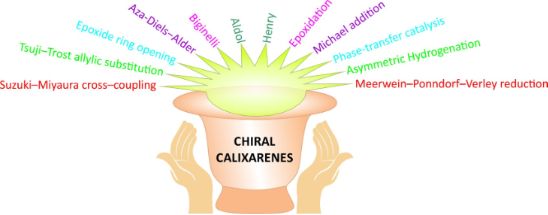
- reaction in the following order: phase-transfer catalysis, Henry reaction, Suzuki–Miyaura cross-coupling and Tsuji–Trost allylic substitution, hydrogenation, Michael addition, aldol and multicomponent Biginelli reactions, epoxidation, Meerwein−Ponndorf−Verley reduction, aza-Diels−Alder and epoxide ring
- conformationally rigid calixarenes were used. Hydrogenation of 41a catalyzed by Rh/40b yielded (R)-42a quantitatively with 98% ee. The high catalytic activity of ligands 40 could be ascribed to combining of an effective bite-angle control with that of circular rigid platform. Michael addition It is known that the
- asymmetric Michael addition reaction of thiophenol could be catalyzed by inherently chiral calixarenes bearing amino alcohol/phenol structure [47][48]. In order to see the effect of the diarylmethanol moiety, Shirakawa and Shimizu used 43 (Figure 6) as organocatalyst in the Michael addition reaction between

Graphical Abstract

Figure 1: Inherently chiral calix[4]arene-based phase-transfer catalysts.

Scheme 1: Asymmetric alkylations of 3 catalyzed by (±)-1 and (±)-2 under phase-transfer conditions.

Scheme 2: Synthesis of chiral calix[4]arene-based phase-transfer catalyst 7 and structure of O’Donnell’s N-be...

Scheme 3: Asymmetric alkylation of glycine derivative 3 catalyzed by calixarene-based phase-transfer catalyst ...

Figure 2: Calix[4]arene-amides used as phase-transfer catalysts.

Scheme 4: Phase-transfer alkylation of 3 catalyzed by calixarene-triamide 12.

Scheme 5: Synthesis of inherently chiral calix[4]arenes 20a/20b substituted at the lower rim. Reaction condit...

Scheme 6: Asymmetric Henry reaction between 21 and 22 catalyzed by 20a/20b.

Figure 3: Proposed transition state model of asymmetric Henry reaction.

Scheme 7: Synthesis of enantiomerically pure phosphinoferrocenyl-substituted calixarene ligands 27–29.

Scheme 8: Asymmetric coupling reaction of aryl boronates and aryl halides in the presence of calixarene mono ...

Scheme 9: Asymmetric allylic alkylation in the presence of calix[4]arene ligand (S,S)-29.

Figure 4: Structure of inherently chiral oxazoline calix[4]arenes applied in the palladium-catalyzed Tsuji–Tr...

Scheme 10: Asymmetric Tsuji–Trost reaction in the presence of calix[4]arene ligands 36–39.

Figure 5: BINOL-derived calix[4]arene-diphosphite ligands.

Scheme 11: Asymmetric hydrogenation of 41a and 41b catalyzed by in situ-generated catalysts comprised of [Rh(C...

Figure 6: Inherently chiral calix[4]arene 43 containing a diarylmethanol structure.

Scheme 12: Asymmetric Michael addition reaction of 44 with 45 catalyzed by 43.

Figure 7: Calix[4]arene-based chiral primary amine–thiourea catalysts.

Scheme 13: Asymmetric Michael addition of 48 with 49 catalyzed by 47a and 47b.

Scheme 14: Enantioselective Michael addition of 51 to 52 catalyzed by calix[4]arene thioureas.

Scheme 15: Synthesis of calix[4]arene-based tertiary amine–thioureas 54–56.

Scheme 16: Asymmetric Michael addition of 34 and 57 to nitroalkenes 49 catalyzed by 54b.

Scheme 17: Synthesis of p-tert-butylcalix[4]arene bis-squaramide derivative 64.

Scheme 18: Asymmetric Michael addition catalyzed by 64.

Scheme 19: Synthesis of chiral p-tert-butylphenol analogue 68.

Figure 8: Novel prolinamide organocatalysts based on the calix[4]arene scaffold.

Scheme 20: Asymmetric aldol reactions of 72 with 70 and 71 catalyzed by 69b.

Scheme 21: Synthesis of p-tert-butylcalix[4]arene-based chiral organocatalysts 75 and 78 derived from L-prolin...

Scheme 22: Synthesis of upper rim-functionalized calix[4]arene-based L-proline derivative 83.

Scheme 23: Synthesis and proposed structure of Calix-Pro-MN (86).

Figure 9: Calix[4]arene-based L-proline catalysts containing ester, amide and acid units.

Scheme 24: Synthesis of calix[4]arene-based prolinamide 92.

Scheme 25: Calixarene-based catalysts for the aldol reaction of 21 with 70.

Scheme 26: Asymmetric aldol reactions of 72 with cyclic ketones catalyzed by calix[4]arene-based chiral organo...

Figure 10: A proposed structure for catalyst 92 in H2O.

Scheme 27: Synthetic route for organocatalyst 98.

Scheme 28: Asymmetric aldol reactions catalyzed by 99.

Figure 11: Proposed catalytic environment for catalyst 99 in the presence of water.

Scheme 29: Asymmetric aldol reactions between 94 and 72 catalyzed by 55a.

Scheme 30: Enantioselective Biginelli reactions catalyzed by 69f.

Scheme 31: Synthesis of calix[4]arene–(salen) complexes.

Scheme 32: Enantioselective epoxidation of 108 catalyzed by 107a/107b.

Scheme 33: Synthesis of inherently chiral calix[4]arene catalysts 111 and 112.

Scheme 34: Enantioselective MPV reduction.

Scheme 35: Synthesis of chiral calix[4]arene ligands 116a–c.

Scheme 36: Asymmetric MPV reduction with chiral calix[4]arene ligands.

Scheme 37: Chiral AlIII–calixarene complexes bearing distally positioned chiral substituents.

Scheme 38: Asymmetric MPV reduction in the presence of chiral calix[4]arene diphosphites.

Scheme 39: Synthesis of enantiomerically pure inherently chiral calix[4]arene phosphonic acid.

Scheme 40: Asymmetric aza-Diels–Alder reactions catalyzed by (cR,pR)-121.

Scheme 41: Asymmetric ring opening of epoxides catalyzed by (cR,pR)-121.
One hundred years of benzotropone chemistry
- Arif Dastan,
- Haydar Kilic and
- Nurullah Saracoglu
Beilstein J. Org. Chem. 2018, 14, 1120–1180, doi:10.3762/bjoc.14.98

Graphical Abstract

Scheme 1: Tropone (1), tropolone (2) and their resonance structures.

Figure 1: Natural products containing a tropone nucleus.

Figure 2: Possible isomers 11–13 of benzotropone.

Scheme 2: Synthesis of benzotropones 11 and 12.

Scheme 3: Oxidation products of benzotropylium fluoroborate (16).

Scheme 4: Oxidation of 7-bromo-5H-benzo[7]annulene (22).

Scheme 5: Synthesis of 4,5-benzotropone (11) using o-phthalaldehyde (27).

Scheme 6: Synthesis of 4,5-benzotropone (11) starting from oxobenzonorbornadiene 31.

Scheme 7: Acid-catalyzed cleavage of oxo-bridge of 34.

Scheme 8: Synthesis of 4,5-benzotropone (11) from o-xylylene dibromide (38).

Scheme 9: Synthesis of 4,5-benzotropone (11) via the carbene adduct 41.

Scheme 10: Heck coupling strategy for the synthesis of 11.

Scheme 11: Synthesis of benzofulvalenes via carbonyl group of 4,5-benzotropone (11).

Figure 3: Some cycloheptatrienylium cations.

Scheme 12: Synthesis of condensation product 63 and its subsequent oxidative cyclization products.

Figure 4: A novel series of benzo[7]annulenes prepared from 4,5-benzotropone (11).

Scheme 13: Preparation of substituted benzo[7]annulene 72 using the Mukaiyama-Michael reaction.

Figure 5: Possible benzo[7]annulenylidenes 73–75.

Scheme 14: Thermal and photochemical decomposition of 7-diazo-7H-benzo[7]annulene (76) and the trapping of int...

Scheme 15: Synthesis of benzoheptafulvalene 86.

Scheme 16: Synthesis of 7-(diphenylmethylene)-7H-benzo[7]annulene (89).

Scheme 17: Reaction of 4,5-benzotropone (11) with dimethyl diazomethane.

Scheme 18: Synthesis of dihydrobenzomethoxyazocine 103.

Scheme 19: Synthesis and reducibility of benzo-homo-2-methoxyazocines.

Scheme 20: Synthesis of 4,5-benzohomotropones 104 and 115 from 4,5-benzotropones 11 and 113.

Scheme 21: A catalytic deuterogenation of 4,5-benzotropone (11) and synthesis of 5-monosubstituted benzo[7]ann...

Scheme 22: Synthesis of methyl benzo[7]annulenes 131 and 132.

Scheme 23: Ambident reactivity of halobenzo[7]annulenylium cations 133a/b.

Scheme 24: Preparation of benzo[7]annulenylidene–iron complexes 147.

Scheme 25: Synthesis of 1-ethynylbenzotropone (150) and the etheric compound 152 from 4,5-benzotropone (11) wi...

Scheme 26: Thermal decomposition of 4,5-benzotropone (11).

Scheme 27: Reaction of 4,5-benzotropone (11) with 1,2-ethanediol and 1,2-ethanedithiol.

Scheme 28: Conversions of 1-benzosuberone (162) to 2,3-benzotropone (12).

Scheme 29: Synthesis strategies for 2,3-bezotropone (12) using 1-benzosuberones.

Scheme 30: Oxidation-based synthesis of 2,3-benzotropone (12) via 1-benzosuberone (162).

Scheme 31: Synthesis of 2,3-benzotropone (12) from α-tetralone (171) via ring-expansion.

Scheme 32: Preparation of 2,3-benzotropone (12) by using of benzotropolone 174.

Figure 6: Benzoheptafulvenes as condensation products of 2,3-benzotropone (12).

Scheme 33: Conversion of 2,3-benzotropone (12) to tosylhydrazone salt 182 and gem-dichloride 187.

Figure 7: Benzohomoazocines 191–193 and benzoazocines 194–197.

Scheme 34: From 2,3-benzotropone (12) to carbonium ions 198–201.

Scheme 35: Cycloaddition reactions of 2,3-benzotropone (12).
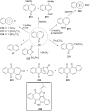
Scheme 36: Reaction of 2,3-benzotropone (12) with various reagents and compounds.

Figure 8: 3,4-Benzotropone (13) and its resonance structure.

Scheme 37: Synthesis of 6,7-benzobicyclo[3.2.0]hepta-3,6-dien-2-one (230).

Figure 9: Photolysis and thermolysis products of 230.

Figure 10: Benzotropolones and their tautomeric structures.

Scheme 38: Synthesis strategies of 4,5-benzotropolone (238).

Scheme 39: Synthesis protocol for 2-hydroxy-4,5-benzotropone (238) using oxazole-benzo[7]annulene 247.

Figure 11: Some quinoxaline and pyrazine derivatives 254–256 prepared from 4,5-benzotropolone (238).

Scheme 40: Nitration product of 4,5-benzotropolone (238) and its isomerization to 1-nitro-naphthoic acid (259)....

Scheme 41: Synthesis protocol for 6-hydroxy-2,3-benzotropone (239) from benzosuberone (162).
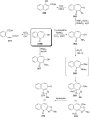
Scheme 42: Various reactions via 6-hydroxy-2,3-benzotropone (239).

Scheme 43: Photoreaction of 6-hydroxy-2,3-benzotropone (239).

Scheme 44: Synthesis of 7-hydroxy-2,3-benzotropone (241) from benzosuberone (162).

Scheme 45: Synthesis strategy for 7-hydroxy-2,3-benzotropone (241) from ketone 276.

Scheme 46: Synthesis of 7-hydroxy-2,3-benzotropone (241) from β-naphthoquinone (280).

Scheme 47: Synthesis of 7-hydroxy-2,3-benzotropone (241) from bicyclic endoperoxide 213.

Scheme 48: Synthesis of 7-hydroxy-2,3-benzotropone (241) by ring-closing metathesis.

Figure 12: Various monosubstitution products 289–291 of 7-hydroxy-2,3-benzotropone (241).

Scheme 49: Reaction of 7-hydroxy-2,3-benzotropone (241) with various reagents.

Scheme 50: Synthesis of 4-hydroxy-2,3-benzotropones 174 and 304 from diketones 300/301.

Scheme 51: Catalytic hydrogenation of diketones 300 and 174.

Scheme 52: Synthesis of halo-benzotropones from alkoxy-naphthalenes 306, 307 and 310.

Figure 13: Unexpected byproducts 313–315 during synthesis of chlorobenzotropone 309.

Figure 14: Some halobenzotropones and their cycloadducts.

Scheme 53: Multisep synthesis of 2-chlorobenzotropone 309.

Scheme 54: A multistep synthesis of 2-bromo-benzotropone 26.

Scheme 55: A multistep synthesis of bromo-2,3-benzotropones 311 and 316.

Scheme 56: Oxidation reactions of 8-bromo-5H-benzo[7]annulene (329) with some oxidants.

Scheme 57: Synthesis of 2-bromo-4,5-benzotropone (26).

Scheme 58: Synthesis of 6-chloro-2,3-benzotropone (335) using LiCl and proposed intermediate 336.

Scheme 59: Reaction of 7-bromo-2,3-benzotropone (316) with methylamine.

Scheme 60: Reactions of bromo-2,3-benzotropones 26 and 311 with dimethylamine.

Scheme 61: Reactions of bromobenzotropones 311 and 26 with NaOMe.

Scheme 62: Reactions of bromobenzotropones 26 and 312 with t-BuOK in the presence of DPIBF.

Scheme 63: Cobalt-catalyzed reductive cross-couplings of 7-bromo-2,3-benzotropone (316) with cyclic α-bromo en...

Figure 15: Cycloadduct 357 and its di-π-methane rearrangement product 358.

Scheme 64: Catalytic hydrogenation of 2-chloro-4,5-benzotropone (311).

Scheme 65: Synthesis of dibromo-benzotropones from benzotropones.

Scheme 66: Bromination/dehydrobromination of benzosuberone (162).

Scheme 67: Some transformations of isomeric dibromo-benzotropones 261A/B.

Scheme 68: Transformations of benzotropolone 239B to halobenzotropolones 369–371.

Figure 16: Bromobenzotropolones 372–376 and 290 prepared via bromination/dehydrobromination strategy.

Scheme 69: Synthesis of some halobenzotropolones 289, 377 and 378.

Figure 17: Bromo-chloro-derivatives 379–381 prepared via chlorination.

Scheme 70: Synthesis of 7-iodo-3,4-benzotropolone (382).

Scheme 71: Hydrogenation of bromobenzotropolones 369 and 370.

Scheme 72: Debromination reactions of mono- and dibromides 290 and 375.

Figure 18: Nitratation and oxidation products of some halobenzotropolenes.
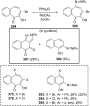
Scheme 73: Azo-coupling reactions of some halobenzotropolones 294, 375 and 378.

Figure 19: Four possible isomers of dibenzotropones 396–399.

Figure 20: Resonance structures of tribenzotropone (400).

Scheme 74: Two synthetic pathways for tribenzotropone (400).

Scheme 75: Synthesis of tribenzotropone (400) from dibenzotropone 399.

Scheme 76: Synthesis of tribenzotropone (400) from 9,10-phenanthraquinone (406).

Scheme 77: Synthesis of tribenzotropone (400) from trifluoromethyl-substituted arene 411.

Figure 21: Dibenzosuberone (414).

Figure 22: Reduction products 415 and 416 of tribenzotropone (400).

Figure 23: Structures of tribenzotropone dimethyl ketal 417 and 4-phenylfluorenone (412) and proposed intermed...

Figure 24: Structures of benzylidene- and methylene-9H-tribenzo[a,c,e][7]annulenes 419 and 420 and chiral phos...

Figure 25: Structures of tetracyclic alcohol 422, p-quinone methide 423 and cation 424.

Figure 26: Structures of host molecules 425–427.

Scheme 78: Synthesis of non-helical overcrowded derivatives syn/anti-431.

Figure 27: Hexabenzooctalene 432.

Figure 28: Structures of possible eight isomers 433–440 of naphthotropone.

Scheme 79: Synthesis of naphthotropone 437 starting from 1-phenylcycloheptene (441).

Scheme 80: Synthesis of 10-hydroxy-11H-cyclohepta[a]naphthalen-11-one (448) from diester 445.

Scheme 81: Synthesis of naphthotropone 433.

Scheme 82: Synthesis of naphthotropones 433 and 434 via cycloaddition reaction.

Scheme 83: Synthesis of naphthotropone 434 starting from 452.

Figure 29: Structures of tricarbonyl(tropone)irons 458, and possible cycloadducts 459.

Scheme 84: Synthesis of naphthotropone 436.

Scheme 85: Synthesis of precursor 465 for naphthotropone 435.

Scheme 86: Generation of naphthotropone 435 from 465.

Figure 30: Structures of tropylium cations 469 and 470.

Figure 31: Structures of tropylium ions 471+.BF4−, 472+.BF4−, and 473+.BF4−.

Scheme 87: Synthesis of tropylium ions 471+.BF4− and 479+.ClO4−.

Scheme 88: Synthesis of 1- and 2-methylanthracene (481 and 482) via carbene–carbene rearrangement.

Figure 32: Trapping products 488–490.

Scheme 89: Generation and chemistry of a naphthoannelated cycloheptatrienylidene-cycloheptatetraene intermedia...

Scheme 90: Proposed intermediates and reaction pathways for adduct 498.

Scheme 91: Exited-state intramolecular proton transfer of 505.

Figure 33: Benzoditropones 506 and 507.

Scheme 92: Synthesis of benzoditropone 506e.

Scheme 93: Synthetic approaches for dibenzotropone 507 via tropone (1).

Scheme 94: Formation mechanisms of benzoditropone 507 and 516 via 515.

Scheme 95: Synthesis of benzoditropones 525 and 526 from pyromellitic dianhydride (527).

Figure 34: Possible three benzocyclobutatropones 534–536.

Scheme 96: Synthesis of benzocyclobutatropones 534 and 539.

Scheme 97: Synthesis attempts for benzocyclobutatropone 545.

Scheme 98: Generation and trapping of symmetric benzocyclobutatropone 536.

Scheme 99: Synthesis of chloro-benzocyclobutatropone 552 and proposed mechanism of fluorenone derivatives.

Scheme 100: Synthesis of tropolone analogue 559.

Scheme 101: Synthesis of tropolones 561 and 562.

Figure 35: o/p-Tropoquinone rings (563 and 564) and benzotropoquinones (565–567).

Scheme 102: Synthesis of benzotropoquinone 566.

Scheme 103: Synthesis of benzotropoquinone 567 via a Diels–Alder reaction.

Figure 36: Products 575–577 through 1,2,3-benzotropoquinone hydrate 569.

Scheme 104: Structures 578–582 prepared from tropoquinone 567.

Figure 37: Two possible structures 583 and 584 for dibenzotropoquinone, and precursor compound 585 for 583.
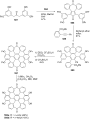
Scheme 105: Synthesis of saddle-shaped ketone 592 using dibenzotropoquinone 584.
Methyl isocyanide as a convertible functional group for the synthesis of spirocyclic oxindole γ-lactams via post-Ugi-4CR/transamidation/cyclization in a one-pot, three-step sequence
- Amarendar Reddy Maddirala and
- Peter R. Andreana
Beilstein J. Org. Chem. 2018, 14, 875–883, doi:10.3762/bjoc.14.74
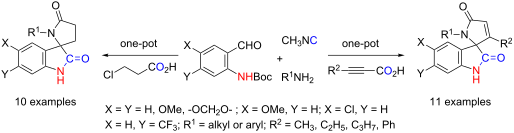
- cyclization product 7a and not the 4-exo-dig-cyclization compound 7a' (Scheme 3). We rationalized, as per Baldwin’s rules, that the 5-endo-dig cyclization of a 1,4-Michael addition was more favorable than the 4-exo-dig-cyclization [50][51]. The structure of compound 7a was definitively confirmed by X-ray
- a 1,4-Michael addition to form an exclusive 5-endo-trig cyclization of 5-chloro-1'-phenylspiro[indoline-3,2'-pyrrolidine]-2,5'-dione (8a, Scheme 5). Compound 8a was unequivocally confirmed by both, mass spectral analysis and NMR. Encouraged by the results, we prepared a library of spiro[indoline-3,2

Graphical Abstract

Scheme 1: Previously reported post-Ugi-4CR methods for the synthesis of 2-oxindoles and spirocyclic 2-oxindol...

Scheme 2: Post-Ugi-4CR/transamidation/cyclization sequence.

Scheme 3: Base-promoted intramolecular 5-endo-dig cyclization.

Figure 1: ORTEP diagram of compound 7a.

Figure 2: Readily and synthetically accessible starting materials.

Scheme 4: Reaction scope with varying combinations of substrates.

Scheme 5: Synthesis of 5-chloro-1'-phenylspiro[indoline-3,2'-pyrrolidine]-2,5'-dione (8a).

Figure 3: Small molecule library of spiro[indoline-3,2'-pyrrolidine]-2,5'-dione analogs.

Scheme 6: Method applicability for the one-pot synthesis of 5-HT6 receptor antagonist 8j [53].
Investigations towards the stereoselective organocatalyzed Michael addition of dimethyl malonate to a racemic nitroalkene: possible route to the 4-methylpregabalin core structure
- Denisa Vargová,
- Rastislav Baran and
- Radovan Šebesta
Beilstein J. Org. Chem. 2018, 14, 553–559, doi:10.3762/bjoc.14.42
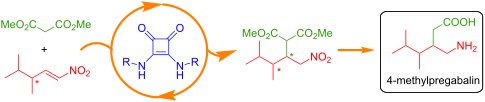
- medicines and can be obtained by organocatalytic Michael additions. We show here the stereoselective synthesis of 4-methylpregabalin stereoisomers using a Michael addition of dimethyl malonate to a racemic nitroalkene. The key step of the synthesis operates as a kinetic resolution with a chiral squaramide
- catalyst. Furthermore, specific organocatalysts can provide respective stereoisomers of the key Michael adduct in up to 99:1 er. Keywords: kinetic resolution; Michael addition; organocatalysis; pregabalin; squaramide; Introduction Asymmetric organocatalysis has considerably broadened possibilities for
- . Stereoselective Michael addition, one of the most important organocatalytic reactions [8] usually serves as a key stereoinduction transformation. Earlier studies, performed by Hayashi and Wang employed iminium activation to perform the enantioselective addition of nitromethane to enals for syntheses of baclofen

Graphical Abstract

Figure 1: Structures of pregabalin and methylpregabalin.

Scheme 1: Synthesis of the nitroalkene 6.

Scheme 2: Catalyst screening in the Michael addition of dimethyl malonate to nitroalkene 6.

Scheme 3: Synthesis of catalysts (Sa,R,R)-C8 and (Sa,S,S)-C8.

Figure 2: Transition state models for the reaction of (R)-6 with dimethyl malonate using catalyst C7 (M06-2X/...

Scheme 4: Synthesis of 4-methylpregabalin (1).
Fluorogenic PNA probes
- Tirayut Vilaivan
Beilstein J. Org. Chem. 2018, 14, 253–281, doi:10.3762/bjoc.14.17
- extended backbone at the ligation site [91]. Examples of the fluorogenic templated ligation of PNA are given in Table 1 which include the simple native chemical ligation of two fluorophore-labeled probes [92], formation of cyanine dyes [93][94], fluorogenic Michael addition [95][96] and cross-linking of

Graphical Abstract

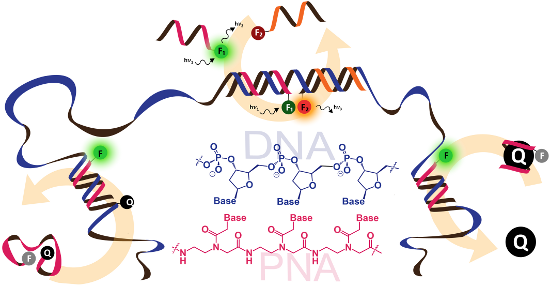
Figure 1: The design of classical DNA molecular beacons.

Figure 2: Structures of DNA and selected PNA systems.

Figure 3: Various binding modes of PNA to double stranded DNA including triplex formation, triplex invasion, ...

Figure 4: The design and working principle of the PNA beacons according to (A) Ortiz et al. [41] and (B) Armitage...

Figure 5: The design of "stemless" PNA beacons.

Figure 6: The applications of PNA openers to facilitate the binding of PNA beacons to double stranded DNA [40,47].

Figure 7: The working principle of snap-to-it probes that employed metal chelation to bring the dyes in close...

Figure 8: Examples of pre-formed dye-labeled PNA monomers and functionalizable PNA monomers.

Figure 9: Dual-labeled PNA beacons with end-stacking or intercalating quencher.

Figure 10: The working principle of hybrid PNA-peptide beacons for detection of (A) proteins [80] and (B) protease...

Figure 11: The working principle of binary probes.

Figure 12: The working principle of nucleic acid templated fluorogenic reactions leading to a (A) ligated prod...

Figure 13: Catalytic cycles in fluorogenic nucleic acid templated reactions [90].

Figure 14: The working principle of strand displacement probes.

Figure 15: (A) Examples of CPP successfully used with labeled PNA probes. (B) The use of single-labeled PNA pr...

Figure 16: The concept of PNA–GO platform for DNA/RNA sensing.

Figure 17: Single-labeled fluorogenic PNA probes.

Figure 18: Examples of environment sensitive fluorescent labels that have been incorporated into PNA probes as...

Figure 19: The mechanism of fluorescence change in TO dye.
Figure 20: Fluorescent nucleobases capable of hydrogen bonding that have been incorporated into PNA probes.

Figure 21: Comparison of the designs of the (A) light-up PNA probe and (B) FIT PNA probe.

Figure 22: The structures of TO and its analogues that have successfully been used in FIT PNA probes.

Figure 23: The working principle of dual-labeled FIT PNA probes [222,223].
5-Aminopyrazole as precursor in design and synthesis of fused pyrazoloazines
- Ranjana Aggarwal and
- Suresh Kumar
Beilstein J. Org. Chem. 2018, 14, 203–242, doi:10.3762/bjoc.14.15
- ) and α,β-unsaturated ketones 24 (Scheme 3) in the ionic solvent [bmim]Br at 90 °C with excellent yield. Variation of the aryl substituents on the α,β-unsaturated ketones 24 has no significant effect on the reaction. The reaction was proposed to occur through a sequence of Michael addition, cyclization
- = tert-butyl) the reaction results in the formation of pyrazolo[1,5-a]pyrimidine derivative 90 as an additional product. The authors proposed that the bulky group had significantly slowed down the rate of electrophilic aromatic substitution at C-4 on 1H-pyrazol-5-amine due to which the aza-Michael
- addition becomes competitive at N-1 which ultimately provides pyrazolo[1,5-a]pyrimidine derivative 90 as additional product (Scheme 25). The synthesized pyrazolo[3,4-b]pyridines 89 were found to be good mGluR5 positive allosteric modulators (PAMs) and therefore can be used to develop antipsychotic drugs to

Graphical Abstract

Figure 1: Selected examples of drugs with fused pyrazole rings.

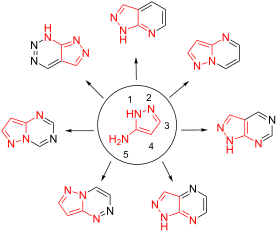
Figure 2: Typical structures of some fused pyrazoloazines from 5-aminopyrazoles.

Scheme 1: Regiospecific synthesis of 4 and 6-trifluoromethyl-1H-pyrazolo[3,4-b]pyridines.

Scheme 2: Synthesis of pyrazolo[3,4-b]pyridine-6-carboxylates.

Scheme 3: Synthesis of 1,4,6-triaryl-1H-pyrazolo[3,4-b]pyridines with ionic liquid .

Scheme 4: Synthesis of coumarin-based isomeric tetracyclic pyrazolo[3,4-b]pyridines.

Scheme 5: Synthesis of 6-substituted pyrazolo[3,4-b]pyridines under Heck conditions.

Scheme 6: Microwave-assisted palladium-catalyzed synthesis of pyrazolo[3,4-b]pyridines.

Scheme 7: Acid-catalyzed synthesis of pyrazolo[3,4-b]pyridines via enaminones.

Scheme 8: Synthesis of pyrazolo[3,4-b]pyridines via aza-Diels–Alder reaction.

Scheme 9: Synthesis of macrocyclane fused pyrazolo[3,4-b]pyridine derivatives.

Scheme 10: Three-component synthesis of 4,7-dihydro-1H-pyrazolo[3,4-b]pyridine derivatives.

Scheme 11: Ultrasonicated synthesis of spiro[indoline-3,4'-pyrazolo[3,4-b]pyridine]-2,6'(1'H)-diones.

Scheme 12: Synthesis of spiro[indoline-3,4'-pyrazolo[3,4-b]pyridine] derivatives under conventional heating co...

Scheme 13: Nanoparticle-catalyzed synthesis of pyrazolo[3,4-b]pyridine-spiroindolinones.

Scheme 14: Microwave-assisted multicomponent synthesis of spiropyrazolo[3,4-b]pyridines.

Scheme 15: Unexpected synthesis of naphthoic acid-substituted pyrazolo[3,4-b]pyridines.

Scheme 16: Multicomponent synthesis of variously substituted pyrazolo[3,4-b]pyridine derivatives.

Scheme 17: Three-component synthesis of 4,7-dihydropyrazolo[3,4-b]pyridines and pyrazolo[3,4-b]pyridines.

Scheme 18: Synthesis of pyrazolo[3,4-b]pyridine-5-spirocycloalkanediones.

Scheme 19: Ultrasound-mediated three-component synthesis of pyrazolo[3,4-b]pyridines.

Scheme 20: Multicomponent synthesis of 4-aryl-3-methyl-1-phenyl-4,6,8,9-tetrahydropyrazolo [3,4-b]thiopyrano[4...

Scheme 21: Synthesis of 2,3-dihydrochromeno[4,3-d]pyrazolo[3,4-b]pyridine-1,6-diones.

Scheme 22: FeCl3-catalyzed synthesis of o-hydroxyphenylpyrazolo[3,4-b]pyridine derivatives.

Scheme 23: Ionic liquid-mediated synthesis of pyrazolo[3,4-b]pyridines.

Scheme 24: Microwave-assisted synthesis of pyrazolo[3,4-b]pyridines.

Scheme 25: Multicomponent synthesis of pyrazolo[3,4-b]pyridine-5-carbonitriles.

Scheme 26: Unusual domino synthesis of 4,7-dihydropyrazolo[3,4-b]pyridine-5-nitriles.

Scheme 27: Synthesis of 4,5,6,7-tetrahydro-4H-pyrazolo[3,4-b]pyridines under conventional heating and ultrasou...

Scheme 28: L-Proline-catalyzed synthesis of of pyrazolo[3,4-b]pyridine.

Scheme 29: Microwave-assisted synthesis of 5-aminoarylpyrazolo[3,4-b]pyridines.

Scheme 30: Microwave-assisted multi-component synthesis of pyrazolo[3,4-e]indolizines.

Scheme 31: Synthesis of fluoropropynyl and fluoroalkyl substituted pyrazolo[1,5-a]pyrimidine.

Scheme 32: Acid-catalyzed synthesis of pyrazolo[1,5-a]pyrimidine derivatives.

Scheme 33: Chemoselective and regiospecific synthesis of 2-(3-methylpyrazol-1’-yl)-5-methylpyrazolo[1,5-a]pyri...

Scheme 34: Regioselective synthesis of 7-trifluoromethylpyrazolo[1,5-a]pyrimidines.

Scheme 35: Microwave-assisted synthesis of 7-trifluoromethylpyrazolo[1,5-a]pyrimidine carboxylates.

Scheme 36: Microwave and ultrasound-assisted synthesis of 7-trifluoromethylpyrazolo[1,5-a]pyrimidines.

Scheme 37: Base-catalyzed unprecedented synthesis of pyrazolo[1,5-a]pyrimidines via C–C bond cleavage.

Scheme 38: Synthesis of aminobenzothiazole/piperazine linked pyrazolo[1,5-a]pyrimidines.

Scheme 39: Synthesis of aminoalkylpyrazolo[1,5-a]pyrimidine-7-amines.

Scheme 40: Synthesis of pyrazolo[1,5-a]pyrimidines from condensation of 5-aminopyrazole 126 and ethyl acetoace...

Scheme 41: Synthesis of 7-aminopyrazolo[1,5-a]pyrimidines.

Scheme 42: Unexpected synthesis of 7-aminopyrazolo[1,5-a]pyrimidines under solvent free and solvent-mediated c...

Scheme 43: Synthesis of N-(4-aminophenyl)-7-aryloxypyrazolo[1,5-a]pyrimidin-5-amines.

Scheme 44: Base-catalyzed synthesis of 5,7-diarylpyrazolo[1,5-a]pyrimidines.

Scheme 45: Synthesis of 6,7-dihydropyrazolo[1,5-a]pyrimidines in PEG-400.

Scheme 46: Synthesis of 7-heteroarylpyrazolo[1,5-a]pyrimidine-3-carboxamides.

Scheme 47: Synthesis of 7-heteroarylpyrazolo[1,5-a]pyrimidine derivatives under conventional heating and micro...

Scheme 48: Synthesis of N-aroylpyrazolo[1,5-a]pyrimidine-5-amines.

Scheme 49: Regioselective synthesis of ethyl pyrazolo[1,5-a]pyrimidine-7-carboxylate.

Scheme 50: Sodium methoxide-catalyzed synthesis of 3-cyano-6,7-diarylpyrazolo[1,5-a]pyrimidines.

Scheme 51: Synthesis of various pyrazolo[3,4-d]pyrimidine derivatives.

Scheme 52: Synthesis of hydrazinopyrazolo[3,4-d]pyrimidine derivatives.

Scheme 53: Synthesis of N-arylidinepyrazolo[3,4-d]pyrimidin-5-amines.

Scheme 54: Synthesis of pyrazolo[3,4-d]pyrimidinyl-4-amines.

Scheme 55: Iodine-catalyzed synthesis of pyrazolo[3,4-d]pyrimidinones.

Scheme 56: Synthesis of ethyl 6-amino-2H-pyrazolo[3,4-d]pyrimidine-4-carboxylate.

Scheme 57: Synthesis of 4-substituted-(3,6-dihydropyran-4-yl)-1H-pyrazolo[3,4-d]pyrimidines.

Scheme 58: Synthesis of 1-(2,4-dichlorophenyl)pyrazolo[3,4-d]pyrimidin-4-yl carboxamides.

Scheme 59: Synthesis of 5-(1,3,4-thidiazol-2-yl)pyrazolo[3,4-d]pyrimidine.

Scheme 60: One pot POCl3-catalyzed synthesis of 1-arylpyrazolo[3,4-d]pyrimidin-4-ones.

Scheme 61: Synthesis of 4-amino-N1,C3-dialkylpyrazolo[3,4-d]pyrimidines under Suzuki conditions.

Scheme 62: Microwave-assisted synthesis of pyrazolo[3,4-b]pyrazines.

Scheme 63: Synthesis and derivatization of pyrazolo[3,4-b]pyrazine-5-carbonitriles.

Scheme 64: Synthesis of 2-thioxo-pyrazolo[1,5-a][1,3,5]triazin-4-ones.

Scheme 65: Synthesis of 2,3-dihydropyrazolo[1,5-a][1,3,5]triazin-4(1H)-one.

Scheme 66: Synthesis of pyrazolo[1,5-a][1,3,5]triazine-8-carboxylic acid ethyl ester.

Scheme 67: Microwave-assisted synthesis of 4,7-dihetarylpyrazolo[1,5-a][1,3,5]triazines.

Scheme 68: Alternative synthetic route to 4,7-diheteroarylpyrazolo[1,5-a][1,3,5]triazines.

Scheme 69: Synthesis of 4-aryl-2-ethylthio-7-methylpyrazolo[1,5-a][1,3,5]triazines.

Scheme 70: Microwave-assisted synthesis of 4-aminopyrazolo[1,5-a][1,3,5]triazine.

Scheme 71: Synthesis of pyrazolo[3,4-d][1,2,3]triazines from pyrazol-5-yl diazonium salts.

Scheme 72: Synthesis of 2,5-dihydropyrazolo[3,4-e][1,2,4]triazines.

Scheme 73: Synthesis of pyrazolo[5,1-c][1,2,4]triazines via diazopyrazolylenaminones.

Scheme 74: Synthesis of pyrazolo[5,1-c][1,2,4]triazines in presence of sodium acetate.

Scheme 75: Synthesis of various 7-diazopyrazolo[5,1-c][1,2,4]triazine derivatives.

Scheme 76: One pot synthesis of pyrazolo[5,1-c][1,2,4]triazines.

Scheme 77: Synthesis of 4-amino-3,7,8-trinitropyrazolo-[5,1-c][1,2,4]triazines.

Scheme 78: Synthesis of tricyclic pyrazolo[5,1-c][1,2,4]triazines by azocoupling reaction.
Gram-scale preparation of negative-type liquid crystals with a CF2CF2-carbocycle unit via an improved short-step synthetic protocol
- Tatsuya Kumon,
- Shohei Hashishita,
- Takumi Kida,
- Shigeyuki Yamada,
- Takashi Ishihara and
- Tsutomu Konno
Beilstein J. Org. Chem. 2018, 14, 148–154, doi:10.3762/bjoc.14.10
- addition reaction, a Michael addition reaction, giving rise to the corresponding magnesium enolate Int-L. The subsequent hydrolysis of Int-L then leads to the γ-hydroxyketone 8a', which easily tautomerizes into the more stable 5-membered hemiacetal 8a. From the above insight into the reaction mechanism, if

Graphical Abstract

Figure 1: Typical examples of previously reported negative-type liquid crystals containing a CF2CF2-carbocycl...

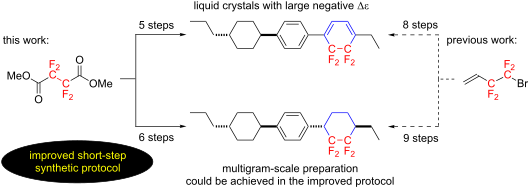
Scheme 1: Improved short-step synthetic protocol for multicyclic mesogens 1 and 2.

Scheme 2: Short-step approach to CF2CF2-containing carbocycles.

Figure 2: (a) Expected products of over-reaction in the Grignard reaction of dimethyl tetrafluorosuccinate (7...

Scheme 3: Mechanism for the reaction of γ-keto ester 6 with vinyl Grignard reagents.

Scheme 4: First multigram-scale preparation of CF2CF2-containing multicyclic mesogens.
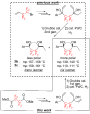
Scheme 5: Stereochemical assignment of the ring-closing metathesis products.
Fluorescent nucleobase analogues for base–base FRET in nucleic acids: synthesis, photophysics and applications
- Mattias Bood,
- Sangamesh Sarangamath,
- Moa S. Wranne,
- Morten Grøtli and
- L. Marcus Wilhelmsson
Beilstein J. Org. Chem. 2018, 14, 114–129, doi:10.3762/bjoc.14.7
- ammonia in MeOH, followed by cyclization by refluxing deprotected 8 with KF in EtOH. Presumably, a transient Michael addition of the hydroxy group to the C6 position of compound 6 increases the reactivity of the C5 position towards substitution. Standard dimethoxytritylation of compounds 7 and 8 furnished

Graphical Abstract

Figure 1: a) Angles and unit vectors used to define the relative orientations of the donor and acceptor trans...

Figure 2: Notable recent examples of fluorescent base analogues. For cnA and dnA the attachment point to the ...

Scheme 1: Synthesis of the tricyclic cytosine aromatic core [39]. (a) Ethylene glycol, K2CO3, 120 °C, 1 h, 40%; (...
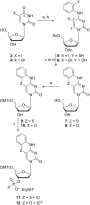
Scheme 2: Synthesis of protected tC and tCO deoxyribose phosphonates [41]. (a) Ac2O, pyridine, rt; (b) 2-mesityle...
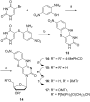
Scheme 3: Synthesis of protected tCnitro deoxyribose phosphoramidite [14]. a) aq NaOH, 24 h, reflux; b) EtOH, HCl...

Scheme 4: Improved synthesis of tC and tC derivatives, where R = H, 7-MeO or 8-MeO [47]. a) H2NNH2 followed by H2O...

Scheme 5: Improved synthesis of tCO derivatives [47]. a) Ac2O, pyridine, 16 h, rt, 85%; b) PPh3, CCl4, DCM, 5 h, ...
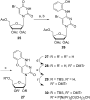
Scheme 6: Synthesis of protected tCO ribose phosphoramidite [50]. a) MesSO2Cl, DIPEA, MeCN, 4 h, rt; b) 2-aminoph...

Scheme 7: Synthesis of protected deoxyribose qA [51]. a) N-(tert-Butoxycarbonyl)-2-(trimethylstannyl)aniline, (Ph3...

Scheme 8: Synthesis of protected deoxyribose qA for DNA SPS [53]. a) AcCl, MeOH, rt, 40 min; b) p-toluoyl chlorid...

Scheme 9: Synthesis of qA derivatives. a) EtI, Cs2CO3, DMF, 4 h, rt, 90%; b) HBPin, Pd(PPh3)4, Et3N, 1,4-diox...

Scheme 10: Synthesis of quadracyclic adenine base–base FRET pair. a) HCHO, NaOH, MeCN, H2O, 50 °C, 1 h; b) TBD...

Figure 3: Absorption and emission of tC (dashed line) and tCO (solid line) in dsDNA. The absorption below 300...

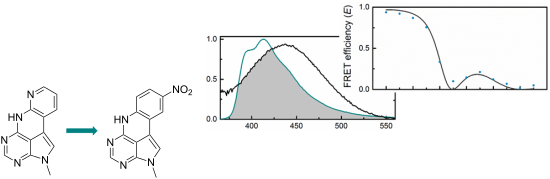
Figure 4: Spectral overlap between the emission of qAN1 (cyan) and the absorption of qAnitro (black) in dsDNA...

Figure 5: Example of typical FRET efficiency as a function of number of base pairs separating the donor and a...

Figure 6: FRET efficiency as a function of number of base pairs separating the donor (qAN1) and acceptor (qAn...
From dipivaloylketene to tetraoxaadamantanes
- Gert Kollenz and
- Curt Wentrup
Beilstein J. Org. Chem. 2018, 14, 1–10, doi:10.3762/bjoc.14.1

- reaction (Scheme 7), and not in the final products, which are not prone to decarboxylation: the stable bis-carboxylic acid 24 can be obtained by hydrogenolysis of the dibenzyl ester 23 (Scheme 6) [30]. The reaction may be seen as a decarboxylative [31][32] oxa-Michael addition (Scheme 7) and may be related

Graphical Abstract
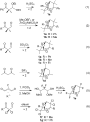
Scheme 1: Synthetic routes to 2,4,6,8-tetraoxaadamantanes.

Scheme 2: Conversion of dipivaloylketene (2) to bisdioxines (2,6,9-trioxabicyclo[3.3.1]nona-3,7-dienes) 4 and...

Scheme 3: 2,6,9-Trioxabicyclo[3.3.1]nonadienes (bisdioxines, 9–13) derived from dipivaloylketene (2).

Scheme 4: Mechanisms of formation of bisdioxine acid derivatives from dimer 3.

Scheme 5: Recently reported synthesis of chromenobisdioxines.

Scheme 6: Formation of tetraoxaadamantanes.

Scheme 7: Decarboxylative hydrolysis and oxa-Michael-type ring closure.

Scheme 8: Oxime and hydrazine derivatives of bisdioxines and tetraoxaadamantanes.

Figure 1: Bistetraoxaadamantane derivatives.

Scheme 9: Inward-pointing isocyanate, urethane and carbamate groups in bisdioxines. The diisocyanate is obtai...
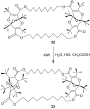
Scheme 10: Microwave-assisted tetraoxaadamantane formation.
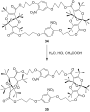
Scheme 11: Cyclic bisdioxine ester derivative 34 forming a single mono-tetraoxaadamantane.

Figure 2: Cyclic bisdioxine derivative not forming a tetraoxaadamantane due to reduced cavity size.

Figure 3: The bisdioxine-calix[6]arene derivative 37 complexes Cs+ but does not form a tetraoxaadamantane der...
CF3SO2X (X = Na, Cl) as reagents for trifluoromethylation, trifluoromethylsulfenyl-, -sulfinyl- and -sulfonylation. Part 1: Use of CF3SO2Na
- Hélène Guyon,
- Hélène Chachignon and
- Dominique Cahard
Beilstein J. Org. Chem. 2017, 13, 2764–2799, doi:10.3762/bjoc.13.272
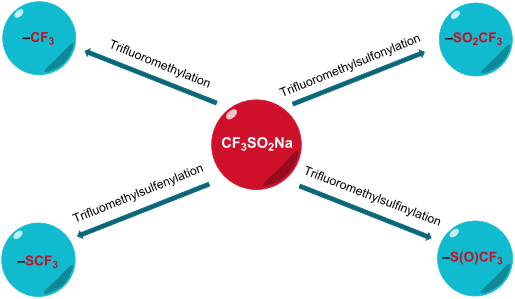

Graphical Abstract

Scheme 1: Trifluoromethylation of enol acetates by Langlois.

Scheme 2: Trifluoromethylation of (het)aryl enol acetates.

Scheme 3: Mechanism for the trifluoromethylation of enol acetates.

Scheme 4: Oxidative trifluoromethylation of unactivated olefins and mechanistic pathway.
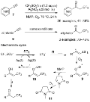
Scheme 5: Oxidative trifluoromethylation of acetylenic substrates.

Scheme 6: Metal free trifluoromethylation of styrenes.

Scheme 7: Synthesis of α-trifluoromethylated ketones by oxytrifluoromethylation of heteroatom-functionalised ...
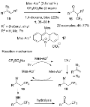
Scheme 8: Catalysed photoredox trifluoromethylation of vinyl azides.

Scheme 9: Oxidative difunctionalisation of alkenyl MIDA boronates.

Scheme 10: Synthesis of β-trifluoromethyl ketones from cyclopropanols.

Scheme 11: Aryltrifluoromethylation of allylic alcohols.

Scheme 12: Cascade multicomponent synthesis of nitrogen heterocycles via azotrifluoromethylation of alkenes.

Scheme 13: Photocatalytic azotrifluoromethylation of alkenes with aryldiazonium salts and CF3SO2Na.

Scheme 14: Copper-promoted intramolecular aminotrifluoromethylation of alkenes with CF3SO2Na.

Scheme 15: Oxytrifluoromethylation of alkenes with CF3SO2Na and hydroxamic acid.

Scheme 16: Manganese-catalysed oxytrifluoromethylation of styrene derivatives.

Scheme 17: Oxytrifluoromethylation of alkenes with NMP/O2 and CF3SO2Na.

Scheme 18: Intramolecular oxytrifluoromethylation of alkenes.

Scheme 19: Hydrotrifluoromethylation of styrenyl alkenes and unactivated aliphatic alkenes.

Scheme 20: Hydrotrifluoromethylation of electron-deficient alkenes.

Scheme 21: Hydrotrifluoromethylation of alkenes by iridium photoredox catalysis.

Scheme 22: Iodo- and bromotrifluoromethylation of alkenes by CF3SO2Na/I2O5 or CF3SO2Na / NaBrO3.

Scheme 23: N-methyl-9-mesityl acridinium and visible-light-induced chloro-, bromo- and SCF3 trifluoromethylati...

Scheme 24: Carbotrifluoromethylation of N-arylacrylamides with CF3SO2Na / TBHP by Lipshutz.

Scheme 25: Carbotrifluoromethylation of N-arylacrylamides with CF3SO2Na/TBHP reported by Lei.

Scheme 26: Carbotrifluoromethylation of N-arylacrylamides with CF3SO2Na/(NH4)2S2O8.

Scheme 27: Metal-free carbotrifluoromethylation of N-arylacrylamides with CF3SO2Na/K2S2O8 reported by Wang.

Scheme 28: Metal-free carbotrifluoromethylation of N-arylacrylamides with CF3SO2Na/PIDA reported by Fu.

Scheme 29: Metal-free cascade trifluoromethylation/cyclisation of N-arylmethacrylamides (a) and enynes (b) wit...

Scheme 30: Trifluoromethylation/cyclisation of N-arylcinnamamides: Synthesis of 3,4-disubstituted dihydroquino...

Scheme 31: Trifluoromethylation/cyclisation of aromatic-containing unsaturated ketones.

Scheme 32: Chemo- and regioselective cascade trifluoromethylation/heteroaryl ipso-migration of unactivated alk...

Scheme 33: Copper-mediated 1,2-bis(trifluoromethylation) of alkenes.

Scheme 34: Trifluoromethylation of aromatics with CF3SO2Na reported by Langlois.

Scheme 35: Baran’s oxidative C–H trifluoromethylation of heterocycles.

Scheme 36: Trifluoromethylation of acetanilides and anilines.

Scheme 37: Trifluoromethylation of heterocycles in water.

Scheme 38: Trifluoromethylation of coumarins in a continuous-flow reactor.

Scheme 39: Oxidative trifluoromethylation of coumarins, quinolines and pyrimidinones.

Scheme 40: Oxidative trifluoromethylation of pyrimidinones and pyridinones.

Scheme 41: Phosphovanadomolybdic acid-catalysed direct C−H trifluoromethylation.

Scheme 42: Oxidative trifluoromethylation of imidazopyridines and imidazoheterocycles.

Scheme 43: Oxidative trifluoromethylation of imidazoheterocycles and imidazoles in ionic liquid/water.
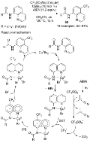
Scheme 44: Oxidative trifluoromethylation of 8-aminoquinolines.

Scheme 45: Oxidative trifluoromethylation of various 8-aminoquinolines using the supported catalyst CS@Cu(OAc)2...

Scheme 46: Oxidative trifluoromethylation of the naphthylamide 70.

Scheme 47: Oxidative trifluoromethylation of various arenes in the presence of CF3SO2Na and sodium persulfate.
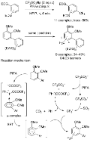
Scheme 48: Trifluoromethylation of electron-rich arenes and unsymmetrical biaryls with CF3SO2Na in the presenc...

Figure 1: Trifluoromethylated coumarin and flavone.

Scheme 49: Metal-free trifluoromethylation catalysed by a photoredox organocatalyst.

Scheme 50: Quinone-mediated trifluoromethylation of arenes and heteroarenes.

Scheme 51: Metal- and oxidant-free photochemical trifluoromethylation of arenes.

Scheme 52: Copper-mediated trifluoromethylation of arenediazonium tetrafluoroborates.

Scheme 53: Oxidative trifluoromethylation of aryl- and heteroarylboronic acids.
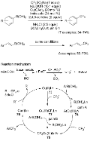
Scheme 54: Oxidative trifluoromethylation of aryl- and vinylboronic acids.

Scheme 55: Oxidative trifluoromethylation of unsaturated potassium organotrifluoroborates.

Scheme 56: Oxidative trifluoromethylation of (hetero)aryl- and vinyltrifluoroborates.

Scheme 57: Copper−catalysed decarboxylative trifluoromethylation of cinnamic acids.

Scheme 58: Iron-mediated decarboxylative trifluoromethylation of α,β-unsaturated carboxylic acids.

Scheme 59: Cu/Ag-catalysed decarboxylative trifluoromethylation of cinnamic acids.

Scheme 60: I2O5-Promoted decarboxylative trifluoromethylation of cinnamic acids.

Scheme 61: Silver(I)-catalysed denitrative trifluoromethylation of β-nitrostyrenes.
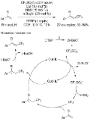
Scheme 62: Copper-catalysed direct trifluoromethylation of styrene derivatives.
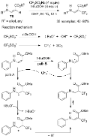
Scheme 63: Transition-metal-free synthesis of β-trifluoromethylated enamines.

Scheme 64: I2O5-mediated iodotrifluoromethylation of alkynes.

Scheme 65: Silver-catalysed tandem trifluoromethylation/cyclisation of aryl isonitriles.

Scheme 66: Photoredox trifluoromethylation of 2-isocyanobiphenyls.

Scheme 67: Trifluoromethylation of potassium alkynyltrifluoroborates with CF3SO2Na.
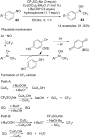
Scheme 68: N-trifluoromethylation of nitrosoarenes with CF3SO2Na (SQ: semiquinone).

Scheme 69: Trifluoromethylation of disulfides with CF3SO2Na.

Scheme 70: Trifluoromethylation of thiols with CF3SO2Na/I2O5.
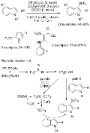
Scheme 71: Electrophilic trifluoromethylsulfenylation by means of CF3SO2Na/(EtO)2P(O)H/CuCl/DMSO.

Scheme 72: Electrophilic trifluoromethylsulfenylation by means of CF3SO2Na/(EtO)2P(O)H/TMSCl.
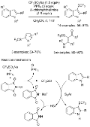
Scheme 73: Electrophilic trifluoromethylsulfenylation by means of CF3SO2Na/PPh3/N-chlorophthalimide.

Scheme 74: Electrophilic trifluoromethylsulfenylation by means of CF3SO2Na/PCl3.

Scheme 75: Electrophilic trifluoromethylsulfenylation by means of CF3SO2Na/PCl3.

Scheme 76: Trifluoromethylsulfenylation of aryl iodides with in situ generated CuSCF3 (DMI: 1,3-dimethyl-2-imi...

Scheme 77: Pioneering trifluoromethylsulfinylation of N, O, and C-nucleophiles.

Scheme 78: Trifluoromethylsulfinylation of (1R,2S)-ephedrine (Im: imidazole; DIEA: N,N-diisopropylethylamine).

Scheme 79: Trifluoromethylsulfinylation of substituted benzenes with CF3SO2Na/CF3SO3H.

Scheme 80: Trifluoromethylsulfinylation of indoles with CF3SO2Na/P(O)Cl3.

Scheme 81: Trifluoromethylsulfinylation of indoles with CF3SO2Na/PCl3.

Scheme 82: Formation of triflones from benzyl bromides (DMA: dimethylacetamide).

Scheme 83: Formation of α-trifluoromethylsulfonyl ketones, esters, and amides.

Scheme 84: Allylic trifluoromethanesulfonylation of aromatic allylic alcohols.

Scheme 85: Copper-catalysed couplings of aryl iodonium salts with CF3SO2Na.

Scheme 86: Palladium-catalysed trifluoromethanesulfonylation of aryl triflates and chlorides with CF3SO2Na.

Scheme 87: Copper-catalysed coupling of arenediazonium tetrafluoroborates with CF3SO2Na.

Scheme 88: Synthesis of phenyltriflone via coupling of benzyne with CF3SO2Na.

Scheme 89: Synthesis of 1-trifluoromethanesulfonylcyclopentenes from 1-alkynyl-λ3-bromanes and CF3SO2Na.

Scheme 90: One-pot synthesis of functionalised vinyl triflones.

Scheme 91: Regioselective synthesis of vinyltriflones from styrenes.

Scheme 92: Trifluoromethanesulfonylation of alkynyl(phenyl) iodonium tosylates by CF3SO2Na.

Scheme 93: Synthesis of thio- and selenotrifluoromethanesulfonates.
Dialkyl dicyanofumarates and dicyanomaleates as versatile building blocks for synthetic organic chemistry and mechanistic studies
- Grzegorz Mlostoń and
- Heinz Heimgartner
Beilstein J. Org. Chem. 2017, 13, 2235–2251, doi:10.3762/bjoc.13.221
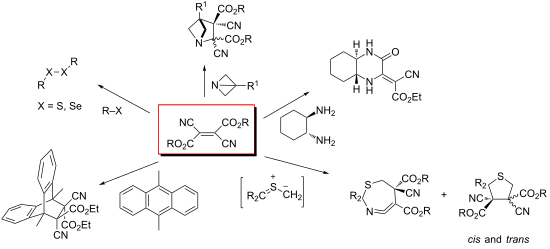
- (α-styryl)furan (47) with dimethyl dicyanofumarate (E-1b). Acid-catalyzed Michael addition of enolizable ketones of type 49 to E-1. Reaction of diethyl dicyanofumarate (E-1a) with ammonia NH3. Reaction of dialkyl dicyanofumarates E-1 with primary and secondary amines. Reaction of dialkyl
- perhydroquinoxaline derivative 73. Synthesis of ethyl 7-aminopteridin-6-carboxylates 75 via a domino reaction. Synthesis of morhpolin-2-ones 80 from E-1 and β-aminoalcohols 78 through an initial aza-Michael addition and subsequent heterocyclization step. Reaction of 3-amino-5-arylpyrazoles 81 with dialkyl

Graphical Abstract

Figure 1: Dialkyl dicyanofumarates E-1 and dicyanomaleates Z-1.

Scheme 1: Methods for the synthesis of dialkyl dicyanofumarates E-1 from alkyl cyanoacetates 2.

Scheme 2: Methods for the synthesis of dialkyl dicyanofumarates E-1 from alkyl bromoacetates 3.

Scheme 3: Reaction of dimethyl dicyanofumarate (E-1b) with dimethoxycarbene [(MeO)2C:] generated in situ from...

Scheme 4: Cyclopropanation of diethyl dicyanofumarate (E-1a) through reaction with the thiophene derived sulf...

Scheme 5: Cyclopropanation of dimethyl dicyanofumarate (E-1b) through a stepwise reaction with the in situ ge...

Scheme 6: The [2 + 2]-cycloadditions of dimethyl dicyanofumarate (E-1b) with electron-rich ethylenes 20 and 22...

Scheme 7: The [2 + 2]-cycloaddition of isomeric dimethyl dicyanofumarate (E-1b) and dicyanomaleate (Z-1b) wit...

Scheme 8: Non-concerted [2 + 2]-cycloaddition between E-1b and bicyclo[2.1.0]pentene (27).

Scheme 9: Stepwise [3 + 2]-cycloadditions of some thiocarbonyl S-methanides with dialkyl dicyanofumarates E-1...

Scheme 10: Stepwise [3 + 2]-cycloadditions of dimethyl dicyanofumarate (E-1b) and dimethyl dicyanomaleate (Z-1b...

Scheme 11: [3 + 2]-Cycloaddition of diazomethane with dimethyl dicyanofumarate (E-1b) leading to 1H-pyrazole d...

Scheme 12: Reversible Diels–Alder reaction of fulvenes 36 with diethyl dicyanofumarate (E-1a).

Scheme 13: [4 + 2]-Cycloaddition of 9,10-dimethylanthracene (39b) and E-1a.

Scheme 14: Stepwise [4 + 2]-cycloaddition of dimethyl dicyanofumarate (E-1b) with electron-rich 1,1-dimethoxy-...

Scheme 15: Formal [4 + 2]-cycloaddition of 3,4-di(α-styryl)furan (47) with dimethyl dicyanofumarate (E-1b).

Scheme 16: Acid-catalyzed Michael addition of enolizable ketones of type 49 to E-1.

Scheme 17: Reaction of diethyl dicyanofumarate (E-1a) with ammonia NH3.

Scheme 18: Reaction of dialkyl dicyanofumarates E-1 with primary and secondary amines.

Scheme 19: Reaction of dialkyl dicyanofumarates E-1 with 1-azabicyclo[1.1.0]butanes 55.

Scheme 20: Formation of pyrazole derivatives in the reaction of hydrazines with E-1.

Scheme 21: Formation of 5-aminopyrazole-3,4-dicarboxylate 65 via heterocyclization reactions.

Scheme 22: Reactions of aryl- and hetarylcarbohydrazides 67 with E-1a.

Scheme 23: Multistep reaction leading to perhydroquinoxaline derivative 73.

Scheme 24: Synthesis of ethyl 7-aminopteridin-6-carboxylates 75 via a domino reaction.

Scheme 25: Synthesis of morhpolin-2-ones 80 from E-1 and β-aminoalcohols 78 through an initial aza-Michael add...

Scheme 26: Reaction of 3-amino-5-arylpyrazoles 81 with dialkyl dicyanofumarates E-1 via competitive nucleophil...

Scheme 27: Heterocyclization reaction of thiosemicarbazone 86 with E-1a.

Scheme 28: Formation of diethyl 4-cyano-5-oxotetrahydro-4H-chromene-3,4-dicarboxylate (90) from E-1a via heter...

Scheme 29: Reaction of dialkyl dicyanofumarates E-1 with cysteamine (92).

Scheme 30: Formation of disulfides through reaction of thiols with E-1a.

Scheme 31: Formation of CT salts of E-1 with Mn2+ and Cr2+ metallocenes through one-electron transfer.

Scheme 32: Oxidation of diethyl dicyanofumarate (E-1a) with H2O2 to give oxirane 101.

Scheme 33: The aziridination of E-1b through nitrene addition.
Conjugated nitrosoalkenes as Michael acceptors in carbon–carbon bond forming reactions: a review and perspective
- Yaroslav D. Boyko,
- Valentin S. Dorokhov,
- Alexey Yu. Sukhorukov and
- Sema L. Ioffe
Beilstein J. Org. Chem. 2017, 13, 2214–2234, doi:10.3762/bjoc.13.220
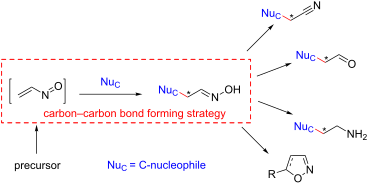
- 10.3762/bjoc.13.220 Abstract Despite of their chemical instability and high reactivity, conjugated nitrosoalkenes are useful intermediates in target-oriented organic synthesis. The present review deals with carbon–carbon bond forming reactions involving Michael addition to α-nitrosoalkenes with a
- particular focus on recent developments in this methodology and its use in total synthesis. Keywords: carbon–carbon bond formation; Michael addition; nitrosoalkenes; oximes; total synthesis; Introduction Conjugated nitrosoalkenes (NSA) are close analogs of α-nitroalkenes, which are important Michael
- , Michael addition of C-nucleophiles to α-nitrosoalkenes opens access to synthetically valuable α-branched oximes, which can be further utilized as useful intermediates in total synthesis. The high potential of this carbon–carbon bond-forming strategy has been recognized since 1970s in works of Corey

Graphical Abstract

Scheme 1: Precursors of nitrosoalkenes NSA.

Scheme 2: Reactions of cyclic α-chlorooximes 1 with 1,3-dicarbonyl compounds.

Scheme 3: C-C-coupling of N,N-bis(silyloxy)enamines 3 with 1,3-dicarbonyl compounds.

Scheme 4: Reaction of N,N-bis(silyloxy)enamines 3 with nitronate anions.

Scheme 5: Reaction of α-chlorooximes TBS ethers 2 with ester enolates.

Scheme 6: Assembly of bicyclooctanone 14 via an intramolecular cyclization of nitrosoalkene NSA2.

Scheme 7: A general strategy for the assembly of bicyclo[2.2.1]heptanes via an intramolecular cyclization of ...

Scheme 8: Stereochemistry of Michael addition to cyclic nitrosoalkene NSA3.

Scheme 9: Stereochemistry of Michael addition to acyclic nitrosoalkenes NSA4.

Scheme 10: Stereochemistry of Michael addition to γ-alkoxy nitrosoalkene NSA5.

Scheme 11: Oppolzer’s total synthesis of 3-methoxy-9β-estra(1,3,5(10))trien(11,17)dione (25).

Scheme 12: Oppolzer’s total synthesis of (+/−)-isocomene.

Figure 1: Alkaloids synthesized using stereoselective Michael addition to conjugated nitrosoalkenes.

Scheme 13: Weinreb’s total synthesis of alstilobanines A, E and angustilodine.

Scheme 14: Weinreb’s approach to the core structure of apparicine alkaloids.

Scheme 15: Weinreb’s synthesis of (+/−)-myrioneurinol via stereoselective conjugate addition of malonate to ni...

Scheme 16: Reactions of cyclic α-chloro oximes with Grignard reagents.

Scheme 17: Corey’s synthesis of (+/−)-perhydrohistrionicotoxin.

Scheme 18: Addition of Gilman’s reagents to α,β-epoxy oximes 53.

Scheme 19: Addition of Gilman’s reagents to α-chlorooximes.

Scheme 20: Reaction of silyl nitronate 58 with organolithium reagents via nitrosoalkene NSA12.

Scheme 21: Reaction of β-ketoxime sulfones 61 and 63 with lithium acetylides.

Scheme 22: Electrophilic addition of nitrosoalkenes NSA14 to electron-rich arenes.

Scheme 23: Addition of nitrosoalkenes NSA14 to pyrroles and indoles.

Scheme 24: Reaction of phosphinyl nitrosoalkenes NSA15 with indole.

Scheme 25: Reaction of pyrrole with α,α’-dihalooximes 70.

Scheme 26: Synthesis of indole-derived psammaplin A analogue 72.

Scheme 27: Synthesis of tryptophanes by reduction of oximinoalkylated indoles 68.

Scheme 28: Ottenheijm’s synthesis of neoechinulin B analogue 77.

Scheme 29: Synthesis of 1,2-dihydropyrrolizinones 82 via addition of pyrrole to ethyl bromopyruvate oxime.

Scheme 30: Kozikowski’s strategy to indolactam-based alkaloids via addition of indoles to ethyl bromopyruvate ...

Scheme 31: Addition of cyanide anion to nitrosoalkenes and subsequent cyclization to 5-aminoisoxazoles 86.

Scheme 32: Et3N-catalysed addition of trimethylsilyl cyanide to N,N-bis(silyloxy)enamines 3 leading to 5-amino...

Scheme 33: Addition of TMSCN to allenyl N-siloxysulfonamide 89.

Scheme 34: Reaction of nitrosoallenes NSA16 with malodinitrile and ethyl cyanoacetic ester.

Scheme 35: [4 + 1]-Annulation of nitrosoalkenes NSA with sulfonium ylides 92.

Scheme 36: Reaction of diazo compounds 96 with nitrosoalkenes NSA.

Scheme 37: Tandem Michael addition/oxidative cyclization strategy to isoxazolines 100.
Phosphonic acid: preparation and applications
- Charlotte M. Sevrain,
- Mathieu Berchel,
- Hélène Couthon and
- Paul-Alain Jaffrès
Beilstein J. Org. Chem. 2017, 13, 2186–2213, doi:10.3762/bjoc.13.219
- depolymerization of cellulose [18] and the synthesis of dihydropyrimidine derivatives [19]. The monosodium salt of phosphonic acids were also employed as organocatalysts for Michael addition [20]. The capacity of phosphonic acids to increase the solubility of organic compounds in water was employed to develop

Graphical Abstract

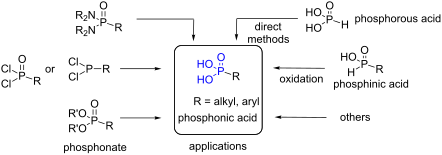
Figure 1: Summary of the synthetic routes to prepare phosphonic acids detailed in this review. The numbers in...

Figure 2: Chemical structure of dialkyl phosphonate, phosphonic acid and illustration of the simplest phospho...

Figure 3: Illustration of some phosphonic acid exhibiting bioactive properties. A) Phosphonic acids for biome...

Figure 4: Illustration of the use of phosphonic acids for their coordination properties and their ability to ...

Figure 5: Hydrolysis of dialkyl phosphonate to phosphonic acid under acidic conditions.

Figure 6: Examples of phosphonic acids prepared by hydrolysis of dialkylphosphonate with HCl 35% at reflux (16...

Figure 7: A) and B) Observation of P–C bond breaking during the hydrolysis of phosphonate with concentrated H...

Figure 8: Mechanism of the hydrolysis of dialkyl phosphonate with HCl in water.

Figure 9: Hydrolysis of bis-tert-butyl phosphonate 28 into phosphonic acid 29 [137].

Figure 10: A) Hydrolysis of diphenyl phosphonate into phosphonic acid in acidic media. B) Examples of phosphon...

Figure 11: Suggested mechanism occurring for the first step of the hydrolysis of diphenyl phosphonate into pho...

Figure 12: A) Hydrogenolysis of dibenzyl phosphonate to phosphonic acid. B) Compounds 33, 34 and 35 were prepa...

Figure 13: A) Preparation of phosphonic acid from diphenyl phosphonate with the Adam’s catalyst. B) Compounds ...

Figure 14: Suggested mechanism for the preparation of phosphonic acid from dialkyl phosphonate using bromotrim...

Figure 15: A) Reaction of the phosphonate-thiophosphonate 37 with iodotrimethylsilane followed by methanolysis...

Figure 16: Synthesis of hydroxymethylenebisphosphonic acid by reaction of tris(trimethylsilyl) phosphite with ...

Figure 17: Synthesis of the phosphonic acid disodium salt 48 by reaction of mono-hydrolysed phosphonate 47 wit...

Figure 18: Phosphonic acid synthesized by the sequence 1) bromotrimethylsilane 2) methanolysis or hydrolysis. ...

Figure 19: Polyphosphonic acids and macromolecular compounds prepared by the hydrolysis of dialkyl phosphonate...

Figure 20: Examples of organometallic complexes functionalized with phosphonic acids that were prepared by the...

Figure 21: Side reaction observed during the hydrolysis of methacrylate monomer functionalized with phosphonic...

Figure 22: Influence of the reaction time during the hydrolysis of compound 76.

Figure 23: Dealkylation of dialkyl phosphonates with boron tribromide.

Figure 24: Dealkylation of diethylphosphonate 81 with TMS-OTf.

Figure 25: Synthesis of substituted phenylphosphonic acid 85 from the phenyldichlorophosphine 83.

Figure 26: Hydrolysis of substituted phenyldichlorophosphine oxide 86 under basic conditions.

Figure 27: A) Illustration of the synthesis of chiral phosphonic acids from phosphonodiamides. B) Examples of ...

Figure 28: A) Illustration of the synthesis of the phosphonic acid 98 from phosphonodiamide 97. B) Use of cycl...

Figure 29: Synthesis of tris(phosphonophenyl)phosphine 109.

Figure 30: Moedritzer–Irani reaction starting from A) primary amine or B) secondary amine. C) Examples of phos...

Figure 31: Phosphonic acid-functionalized polymers prepared by Moedritzer–Irani reaction.

Figure 32: Reaction of phosphorous acid with imine in the absence of solvent.

Figure 33: A) Reaction of phosphorous acid with nitrile and examples of aminomethylene bis-phosphonic acids. B...

Figure 34: Reaction of carboxylic acid with phosphorous acid and examples of compounds prepared by this way.

Figure 35: Synthesis of phosphonic acid by oxidation of phosphinic acid (also identified as phosphonous acid).

Figure 36: Selection of reaction conditions to prepare phosphonic acids from phosphinic acids.

Figure 37: Synthesis of phosphonic acid from carboxylic acid and white phosphorus.

Figure 38: Synthesis of benzylphosphonic acid 136 from benzaldehyde and red phosphorus.

Figure 39: Synthesis of graphene phosphonic acid 137 from graphite and red phosphorus.
Regiodivergent condensation of 5-alkoxycarbonyl-1H-pyrrol-2,3-diones with cyclic ketazinones en route to spirocyclic scaffolds
- Alexey Yu. Dubovtsev,
- Maksim V. Dmitriev,
- Аndrey N. Maslivets and
- Michael Rubin
Beilstein J. Org. Chem. 2017, 13, 2179–2185, doi:10.3762/bjoc.13.218
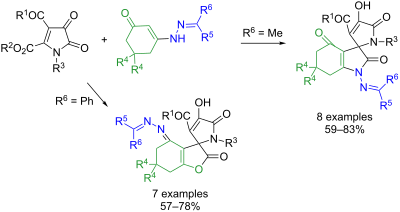
- cyclocondensation of six-membered cyclic enamines 1 (vinylogous secondary amides) with 5-methoxycarbonyl-1H-pyrrolediones 2 [39][40][41]. This transformation involved the Michael addition of an enamine to the α,β-unsaturated carbonyl fragment of a pyrroledione and subsequent 5-exo-trig intramolecular nucleophilic
- involving Michael addition followed by intramolecular transesterification. Remarkably, the resulting bridged products 12 have reversed regiochemistry as compared to the earlier-described cycloadducts 5 (Scheme 1). It should also be pointed out that all of these products were formed as single 10-endo

Graphical Abstract
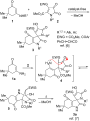
Scheme 1: Spirocyclization of enamines with 5-methoxycarbonyl-1H-pyrrolediones.

Scheme 2: Non-catalyzed spirocyclization of enoles (vinylogous carbonates and carbamates) with 5-methoxycarbo...

Scheme 3: Acid-catalyzed spirocyclization of enoles (vinylogous carboxylates) with 5-alkoxycarbonyl-1H-pyrrol...

Figure 1: ORTEP drawing of compound 12ab (CCDC 1546062) showing 50% probability amplitude displacement ellips...

Scheme 4: Formation of mono-imines and mono-hydrazones of 1,3-cyclohexanediones and tautomeric equilibrium be...
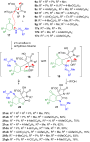
Scheme 5: Spirocyclizations involving non-bulky ketazinones 17 and 5-alkoxycarbonyl-1H-pyrrolediones 9.

Figure 2: ORTEP drawing of compound 21ab (CCDC 1546063) showing 50% probability amplitude displacement ellips...

Figure 3: ORTEP drawing of compound 22a (CCDC 1546065) showing 50% probability amplitude displacement ellipso...

Scheme 6: Spirocyclizations involving bulky ketazinones 22 and 5-alkoxycarbonyl-1H-pyrrolediones 9.

Figure 4: ORTEP drawing of compound 23aa (CCDC 1546064) showing 50% probability amplitude displacement ellips...
Preparation of imidazo[1,2-a]-N-heterocyclic derivatives with gem-difluorinated side chains
- Layal Hariss,
- Kamal Bou Hadir,
- Mirvat El-Masri,
- Thierry Roisnel,
- René Grée and
- Ali Hachem
Beilstein J. Org. Chem. 2017, 13, 2115–2121, doi:10.3762/bjoc.13.208
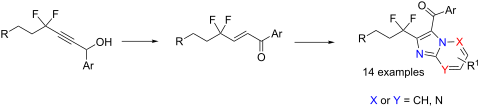
- (II) acetate-catalyzed aerobic oxidative amination and it proceeds through a tandem Michael addition followed by an intramolecular oxidative amination. Therefore, our target molecules A could be synthesized by the oxidative coupling of 2-aminopyridines with α,β-unsaturated ketones B, themselves easily
- demonstrate the regiochemistry of the reaction. These cascade reactions proceed first through a Michael addition of the primary amine on the enone, followed by an intramolecular cyclization by the pyridine/pyrimidine nucleus. Unfortunately, no crystal structure could be obtained for the imidazopyrimidines and

Graphical Abstract

Figure 1: Representative examples of bioactive imidazo[1,2-a]pyridines, imidazo[1,2-a]pyrimidines, imidazopyr...

Scheme 1: Retrosynthetic scheme for the preparation of our target molecules A.

Scheme 2: Synthesis of enones 6 with a gem-difluoroalkyl side chain.

Scheme 3: Synthesis of 7a.

Figure 2: Structures of 7a and 7e by X-ray crystallography analysis.

Scheme 4: One-pot synthesis of 7a.
Mechanochemical synthesis of small organic molecules
- Tapas Kumar Achar,
- Anima Bose and
- Prasenjit Mal
Beilstein J. Org. Chem. 2017, 13, 1907–1931, doi:10.3762/bjoc.13.186
- -poor aromatic aldehydes and aromatic ring of the organocatalyst plays a crucial role for excellent yield and selectivity. Apparently the solvent-free system enhances the rigidity of the transition state for more selective reactions under mechanochemical activation. Michael addition Generally strong
- bases like NaOH, KOH, NaOEt etc. have been used as catalyst for the Michael addition of 1,3-dicarbonyl compounds to α,β-unsaturated ketones. In 2004, Wang and co-workers first reported a mechanochemical Michael reaction of 1,3-dicarbonyl compounds with chalcones and azachalcones using the mild base
- K2CO3 (Scheme 3). Michael adducts were isolated with good to excellent yield (76–99%) in a high-speed vibration mill (HSVM) within 10–60 min [51]. Bolm and co-workers reported an organocatalytic asymmetric version of Michael addition reaction under planetary-milling (PM) conditions. Differently

Graphical Abstract

Scheme 1: Mechanochemical aldol condensation reactions [48].

Scheme 2: Enantioselective organocatalyzed aldol reactions under mechanomilling. a) Based on binam-(S)-prolin...

Scheme 3: Mechanochemical Michael reaction [51].

Scheme 4: Mechanochemical organocatalytic asymmetric Michael reaction [52].

Scheme 5: Mechanochemical Morita–Baylis–Hillman (MBH) reaction [53].

Scheme 6: Mechanochemical Wittig reactions [55].

Scheme 7: Mechanochemical Suzuki reaction [56].

Scheme 8: Mechanochemical Suzuki–Miyaura coupling by LAG [57].

Scheme 9: Mechanochemical Heck reaction [59].

Scheme 10: a) Sonogashira coupling under milling conditions. b) The representative example of a double Sonogas...

Scheme 11: Copper-catalyzed CDC reaction under mechanomilling [67].

Scheme 12: Asymmetric alkynylation of prochiral sp3 C–H bonds via CDC [68].

Scheme 13: Fe(III)-catalyzed CDC coupling of 3-benzylindoles [69].

Scheme 14: Mechanochemical synthesis of 3-vinylindoles and β,β-diindolylpropionates [70].

Scheme 15: Mechanochemical C–N bond construction using anilines and arylboronic acids [78].

Scheme 16: Mechanochemical amidation reaction from aromatic aldehydes and N-chloramine [79].

Scheme 17: Mechanochemical CDC between benzaldehydes and benzyl amines [81].

Scheme 18: Mechanochemical protection of -NH2 and -COOH group of amino acids [85].

Scheme 19: Mechanochemical Ritter reaction [87].

Scheme 20: Mechanochemical synthesis of dialkyl carbonates [90].

Scheme 21: Mechanochemical transesterification reaction using basic Al2O3 [91].

Scheme 22: Mechanochemical carbamate synthesis [92].

Scheme 23: Mechanochemical bromination reaction using NaBr and oxone [96].

Scheme 24: Mechanochemical aryl halogenation reactions using NaX and oxone [97].

Scheme 25: Mechanochemical halogenation reaction of electron-rich arenes [88,98].

Scheme 26: Mechanochemical aryl halogenation reaction using trihaloisocyanuric acids [100].

Scheme 27: Mechanochemical fluorination reaction by LAG method [102].

Scheme 28: Mechanochemical Ugi reaction [116].

Scheme 29: Mechanochemical Passerine reaction [116].

Scheme 30: Mechanochemical synthesis of α-aminonitriles [120].

Scheme 31: Mechanochemical Hantzsch pyrrole synthesis [121].

Scheme 32: Mechanochemical Biginelli reaction by subcomponent synthesis approach [133].

Scheme 33: Mechanochemical asymmetric multicomponent reaction[134].

Scheme 34: Mechanochemical Paal–Knorr pyrrole synthesis [142].

Scheme 35: Mechanochemical synthesis of benzothiazole using ZnO nano particles [146].

Scheme 36: Mechanochemical synthesis of 1,2-di-substituted benzimidazoles [149].

Scheme 37: Mechanochemical click reaction using an alumina-supported Cu-catalyst [152].

Scheme 38: Mechanochemical click reaction using copper vial [155].

Scheme 39: Mechanochemical indole synthesis [157].

Scheme 40: Mechanochemical synthesis of chromene [158].

Scheme 41: Mechanochemical synthesis of azacenes [169].

Scheme 42: Mechanochemical oxidative C-P bond formation [170].

Scheme 43: Mechanochemical C–chalcogen bond formation [171].

Scheme 44: Solvent-free synthesis of an organometallic complex.

Scheme 45: Selective examples of mechano-synthesis of organometallic complexes. a) Halogenation reaction of Re...

Scheme 46: Mechanochemical activation of C–H bond of unsymmetrical azobenzene [178].

Scheme 47: Mechanochemical synthesis of organometallic pincer complex [179].

Scheme 48: Mechanochemical synthesis of tris(allyl)aluminum complex [180].

Scheme 49: Mechanochemical Ru-catalyzed olefin metathesis reaction [181].

Scheme 50: Rhodium(III)-catalyzed C–H bond functionalization under mechanochemical conditions [182].

Scheme 51: Mechanochemical Csp2–H bond amidation using Ir(III) catalyst [183].

Scheme 52: Mechanochemical Rh-catalyzed Csp2–X bond formation [184].

Scheme 53: Mechanochemical Pd-catalyzed C–H activation [185].

Scheme 54: Mechanochemical Csp2–H bond amidation using Rh catalyst.

Scheme 55: Mechanochemical synthesis of indoles using Rh catalyst [187].

Scheme 56: Mizoroki–Heck reaction of aminoacrylates with aryl halide in a ball-mill [58].

Scheme 57: IBX under mechanomilling conditions [8].

Scheme 58: Thiocarbamoylation of anilines; trapping of reactive aryl-N-thiocarbamoylbenzotriazole intermediate...
Solvent-free sonochemistry: Sonochemical organic synthesis in the absence of a liquid medium
- Deborah E. Crawford
Beilstein J. Org. Chem. 2017, 13, 1850–1856, doi:10.3762/bjoc.13.179
- that alternative products can be formed using this technique, as with ball milling. The Knoevenagel condensation [18], Michael addition [19] and Biginelli reactions [20] amongst others have been instigated by ultrasonic irradiation in the presence of solvents such as pyridine and methanol, resulting in

Graphical Abstract

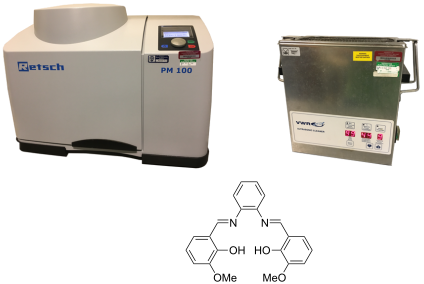
Figure 1: Typical laboratory employed planetary ball mill and ultrasonic bath.

Scheme 1: Reaction between o-vanillin and 1,2-phenylenediamine by ultrasonic irradiation for 60 minutes.

Figure 2: o-Vanillin in its flake form and 1,2-phenylenediamine in its bead form.

Figure 3: Clear separation of the reagents observed, with orange coated beads of 1,2-phenylenediamine residin...

Figure 4: Chemical structures of the products obtained from the reaction between o-vanillin and 1,2-phenylene...

Figure 5: Reaction mixture before and after ultrasonic irradiation for 60 minutes.

Figure 6: 1H NMR spectrum of diimine 1 in CDCl3/EtOD.

Scheme 2: Aldol reaction between ninhydrin and dimedone to form 2.

Figure 7: 1H NMR spectrum of 1,3-indandione 2 in DMSO-d6.
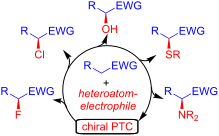
Chiral phase-transfer catalysis in the asymmetric α-heterofunctionalization of prochiral nucleophiles
- Johannes Schörgenhumer,
- Maximilian Tiffner and
- Mario Waser
Beilstein J. Org. Chem. 2017, 13, 1753–1769, doi:10.3762/bjoc.13.170
- -oxygenation reactions above, also the introduction of a nitrogen-based functionality alpha to a carbonyl group can be achieved by several complementary strategies. One powerful option is to carry out Michael addition-initiated aziridination reactions of α,β-unsaturated carbonyl acceptors [18][138][139][140

Graphical Abstract

Scheme 1: Generally accepted ion-pairing mechanism between the chiral cation Q+ of a PTC and an enolate and s...

Scheme 2: Reported asymmetric α-fluorination of β-ketoesters 1 using different chiral PTCs.

Scheme 3: Asymmetric α-fluorination of benzofuranones 4 with phosphonium salt PTC F1.

Scheme 4: Asymmetric α-fluorination of 1 with chiral phosphate-based catalysts.

Scheme 5: Anionic PTC-catalysed α-fluorination of enamines 7 and ketones 10.

Scheme 6: PTC-catalysed α-chlorination reactions of β-ketoesters 1.

Scheme 7: Shioiri’s seminal report of the asymmetric α-hydroxylation of 15 with chiral ammonium salt PTCs.

Scheme 8: Asymmetric ammonium salt-catalysed α-hydroxylation using oxygen together with a P(III)-based reduct...

Scheme 9: Asymmetric ammonium salt-catalysed α-photooxygenations.

Scheme 10: Asymmetric ammonium salt-catalysed α-hydroxylations using organic oxygen-transfer reagents.

Scheme 11: Asymmetric triazolium salt-catalysed α-hydroxylation with in situ generated peroxy imidic acid 24.

Scheme 12: Phase-transfer-catalysed dearomatization of phenols and naphthols.

Scheme 13: Ishihara’s ammonium salt-catalysed oxidative cycloetherification.

Scheme 14: Chiral phase-transfer-catalysed α-sulfanylation reactions.

Scheme 15: Chiral phase-transfer-catalysed α-trifluoromethylthiolation of β-ketoesters 1.

Scheme 16: Chiral phase-transfer-catalysed α-amination of β-ketoesters 1 using diazocarboxylates 38.

Scheme 17: Asymmetric α-fluorination of benzofuranones 4 using diazocarboxylates 38 in the presence of phospho...

Scheme 18: Anionic phase-transfer-catalysed α-amination of β-ketoesters 1 with aryldiazonium salts 41.

Scheme 19: Triazolium salt L-catalysed α-amination of different prochiral nucleophiles with in situ activated ...

Scheme 20: Phase-transfer-catalysed Neber rearrangement.
Bifunctional organocatalysts for the asymmetric synthesis of axially chiral benzamides
- Ryota Miyaji,
- Yuuki Wada,
- Akira Matsumoto,
- Keisuke Asano and
- Seijiro Matsubara
Beilstein J. Org. Chem. 2017, 13, 1518–1523, doi:10.3762/bjoc.13.151
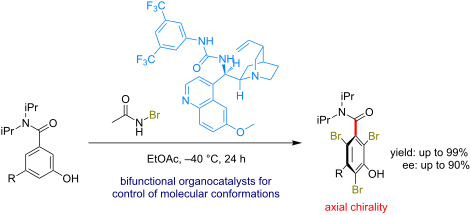
- reactions to occur. Organocatalysts have also been employed in several asymmetric cyclization reactions via intramolecular hetero-Michael addition [7][8][9][10][11][12][13][14][15][16]. In these reactions, multipoint recognition by the catalysts favors the specific conformations of the substrates in the

Graphical Abstract

Figure 1: Brominating reagents.

Scheme 1: Optimization of the substituents of the amide group. Reactions were run using 1 (0.1 mmol), 3a (0.0...
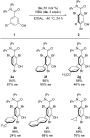
Scheme 2: Substrate scope. Reactions were run using 1 (0.1 mmol), 3a (0.01 mmol), and 4a (0.3 mmol) in EtOAc ...

Scheme 3: Reactions of substrates with substituted phenols.

Scheme 4: Reactions of monobrominated substrates.

Scheme 5: Rotational barriers of substrates and intermediates calculated at the B3YLP/6-31G(d) level of theor...

Scheme 6: Reaction of substrate with protected phenol.
Construction of highly enantioenriched spirocyclopentaneoxindoles containing four consecutive stereocenters via thiourea-catalyzed asymmetric Michael–Henry cascade reactions
- Yonglei Du,
- Jian Li,
- Kerong Chen,
- Chenglin Wu,
- Yu Zhou and
- Hong Liu
Beilstein J. Org. Chem. 2017, 13, 1342–1349, doi:10.3762/bjoc.13.131
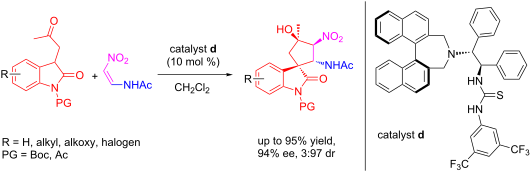
- -catalyzed Michael addition/intramolecular silyl nitronate-olefin cycloaddition (ISOC)/fragmentation sequence to produce highly enantioenriched spirocyclopentaneoxindoles containing an oxime functional group from easily accessible 3-allyl-substituted oxindoles and nitroolefins, which has received wide
- addition, the electrophilicity of the reacting carbon center of nitrovinylacetamide is likely enhanced by H-bonding, thereby enabling the Michael addition to construct a unique quaternary stereogenic center complex A which would cyclize concurrently via Henry reaction to give the product 3 and regenerates

Graphical Abstract

Figure 1: Representative spirooxindole natural products.

Scheme 1: Construction of spirocyclopentaneoxindole scaffolds.
Scheme 2: Scope of enantioselective synthesis of spirooxindoles. Reaction conditions: catalyst d (0.01 mmol),...

Scheme 3: A plausible mechanism.
Strategies toward protecting group-free glycosylation through selective activation of the anomeric center
- A. Michael Downey and
- Michal Hocek
Beilstein J. Org. Chem. 2017, 13, 1239–1279, doi:10.3762/bjoc.13.123

- incubation with the sugar in aqueous buffer at pH 10. In all cases the Michael addition took place regioselectively at the anomeric position of the carbohydrate moiety. Each of the two surface-modification steps as well as the incubation steps was characterized using X-ray photoelectron spectroscopy (XPS) to

Graphical Abstract

Scheme 1: Solution-state conformations of D-glucose.

Scheme 2: Enzymatic synthesis of oligosaccharides.

Scheme 3: Enzymatic synthesis of a phosphorylated glycoprotein containing a mannose-6-phosphate (M6P)-termina...

Scheme 4: A) Selected GTs-mediated syntheses of oligosaccharides and other biologically active glycosides. B)...

Scheme 5: Enzymatic synthesis of nucleosides.

Scheme 6: Fischer glycosylation strategies.

Scheme 7: The basis of remote activation (adapted from [37]).

Scheme 8: Classic remote activation employing a MOP donor to access α-anomeric alcohols, carboxylates, and ph...

Figure 1: Synthesis of monoprotected glycosides from a (3-bromo-2-pyridyloxy) β-D-glycopyranosyl donor under ...

Scheme 9: Plausible mechanism for the synthesis of α-galactosides. TBDPS = tert-butyldiphenylsilyl.

Scheme 10: Synthesis of the 6-O-monoprotected galactopyranoside donor for remote activation.

Scheme 11: UDP-galactopyranose mutase-catalyzed isomerization of UDP-Galp to UDP-Galf.

Scheme 12: Synthesis of the 1-thioimidoyl galactofuranosyl donor.

Scheme 13: Glycosylation of MeOH using a self-activating donor in the absence of an external activator. a) Syn...

Scheme 14: The classical Lewis acid-catalyzed glycosylation.

Figure 2: Unprotected glycosyl donors used for the Lewis acid-catalyzed protecting group-free glycosylation r...

Scheme 15: Four-step synthesis of the phenyl β-galactothiopyranosyl donor.

Scheme 16: Protecting-group-free C3′-regioselective glycosylation of sucrose with α–F Glc.

Scheme 17: Synthesis of the α-fluoroglucosyl donor.

Figure 3: Protecting-group-free glycosyl donors and acceptors used in the Au(III)-catalyzed glycosylation.

Scheme 18: Synthesis of the mannosyl donor used in the study [62].

Scheme 19: The Pd-catalyzed stereoretentive glycosylation of arenes using anomeric stannane donors.

Scheme 20: Preparation of the protecting-group-free α and β-stannanes from advanced intermediates for stereoch...

Figure 4: Selective anomeric activating agents providing donors for direct activation of the anomeric carbon.

Scheme 21: One-step access to sugar oxazolines or 1,6-anhydrosugars.

Scheme 22: Enzymatic synthesis of a chitoheptaose using a mutant chitinase.

Scheme 23: One-pot access to glycosyl azides [73], dithiocarbamates [74], and aryl thiols using DMC activation and sub...

Scheme 24: Plausible reaction mechanism.

Scheme 25: Protecting-group-free synthesis of anomeric thiols from unprotected 2-deoxy-2-N-acetyl sugars.

Scheme 26: Protein conjugation of TTL221-PentK with a hyaluronan hexasaccharide thiol.

Scheme 27: Proposed mechanism.

Scheme 28: Direct two-step one-pot access to glycoconjugates through the in situ formation of the glycosyl azi...

Scheme 29: DMC as a phosphate-activating moiety for the synthesis of diphosphates. aβ-1,4-galactose transferas...

Figure 5: Triazinylmorpholinium salts as selective anomeric activating agents.

Scheme 30: One-step synthesis of DBT glycosides from unprotected sugars in aqueous medium.

Scheme 31: Postulated mechanism for the stereoselective formation of α-glycosides.

Scheme 32: DMT-donor synthesis used for metal-catalyzed glycosylation of simple alcohols.
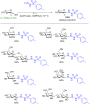
Figure 6: Protecting group-free synthesis of glycosyl sulfonohydrazides (GSH).
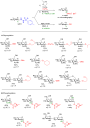
Figure 7: The use of GSHs to access 1-O-phosphoryl and alkyl glycosides. A) Glycosylation of aliphatic alcoho...

Scheme 33: A) Proposed mechanism of glycosylation. B) Proposed mechanism for stereoselective azidation of the ...

Scheme 34: Mounting GlcNAc onto a sepharose solid support through a GSH donor.

Scheme 35: Lawesson’s reagent for the formation of 1,2-trans glycosides.

Scheme 36: Protecting-group-free protein conjugation via an in situ-formed thiol glycoside [98].

Scheme 37: pH-Specific glycosylation to functionalize SAMs on gold.

Figure 8: Protecting-group-free availability of phenolic glycosides under Mitsunobu conditions. DEAD = diethy...

Scheme 38: Accessing hydroxyazobenzenes under Mitsunobu conditions for the study of photoswitchable labels. DE...

Scheme 39: Stereoselective protecting-group-free glycosylation of D-glucose to provide the β-glucosyl benzoic ...

Figure 9: Direct synthesis of pyranosyl nucleosides from unactivated and unprotected ribose using optimized M...

Figure 10: Direct synthesis of furanosyl nucleosides from 5-O-monoprotected ribose in a one-pot glycosylation–...

Figure 11: Synthesis of ribofuranosides using a monoprotected ribosyl donor via an anhydrose intermediate.

Figure 12: C5′-modified nucleosides available under our conditions.

Scheme 40: Plausible reaction mechanism for the formation of the anhydrose.

Figure 13: Direct glycosylation of several aliphatic alcohols using catalytic Ti(Ot-Bu)4 in the presence of D-...

Figure 14: Access to glycosides using catalytic PPh3 and CBr4.

Figure 15: Access to ribofuranosyl glycosides as the major product under catalytic conditions. aLiOCl4 (2.0 eq...
A strategic approach to [6,6]-bicyclic lactones: application towards the CD fragment of DHβE
- Tue Heesgaard Jepsen,
- Emil Glibstrup,
- François Crestey,
- Anders A. Jensen and
- Jesper Langgaard Kristensen
Beilstein J. Org. Chem. 2017, 13, 988–994, doi:10.3762/bjoc.13.98
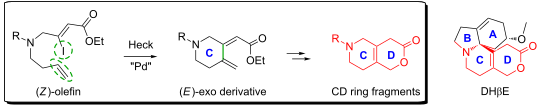
- carboxylic acid 25 in these apolar solvents was the reason. However, addition of small amounts of MeOH in order to increase polarity was detrimental and led to decomposition upon heating. Since the desired cyclization could be also approached as an intramolecular Michael addition we attempted to mediate the

Graphical Abstract

Figure 1: DHβE and related structures. The Ki values of the compounds at the rat α4β2 nAChR subtype determine...

Scheme 1: First strategy towards the CD fragment (Ts-strategy). i) TsCl, TEA, DCM, 0 °C. ii) NaH, DMF, 0 °C, ...

Scheme 2: First strategy towards the CD fragment (Cbz-strategy). i) R-Cl, TEA, CH2Cl2, 0 °C. ii) NaH, DMF, 0 ...

Scheme 3: Second strategy towards the CD fragment. i) 4-Bromobut-1-ene, K2CO3, acetone, 70 °C. ii) n-BuLi, TH...

Figure 2: The binding affinities of compounds 9 and 26 at the rat α4β2 nAChR. a) The AB fragment was evaluate...
Automating multistep flow synthesis: approach and challenges in integrating chemistry, machines and logic
- Chinmay A. Shukla and
- Amol A. Kulkarni
Beilstein J. Org. Chem. 2017, 13, 960–987, doi:10.3762/bjoc.13.97

Graphical Abstract

Figure 1: A number of experiments for various optimization algorithms [46].

Figure 2: Symbols used for block and P&ID diagrams.

Scheme 1: Multistep synthesis of olanzapine (Hartwig et al. [10])

Figure 3: (A) Block diagram representation of the process shown in Scheme 1, (B) piping and instrumentation diagram o...

Scheme 2: Multistep flow synthesis for tamoxifen (Murray et al. [11]).

Figure 4: (A) Block diagram representation of the process shown in Scheme 2, (B) piping and instrumentation diagram o...

Figure 5: (A) Block diagram representation of the process shown in Scheme 3, (B) piping and instrumentation diagram o...

Scheme 3: Multistep flow synthesis of rufinamide (Zhang et al. [14]).

Figure 6: (A) Block diagram representation of the process shown in Scheme 4, (B) piping and instrumentation diagram o...

Scheme 4: Multistep synthesis for (±)-Oxomaritidine (Baxendale et al. [9]).

Figure 7: (A) Block diagram representation of the process shown in Scheme 5, (B) piping and instrumentation diagram o...

Scheme 5: Multistep synthesis for ibuprofen (Snead and Jamison [60]).

Scheme 6: Multistep synthesis for cinnarizine and buclizine derivatives (Borukhova et al. [23])
Figure 8: (A) Block diagram representation of the process shown in Scheme 6, (B) piping and instrumentation diagram o...

Scheme 7: Multistep synthesis for (S)-rolipram (Tsubogo et al. [4])

Figure 9: (A) Block diagram representation of the process shown in Scheme 7 (colours for each reactor shows different...

Figure 10: (A) Block diagram representation of the process shown in Scheme 8, (B) piping and instrumentation diagram o...

Scheme 8: Multistep synthesis for amitriptyline (Kupracz and Kirschning [7]).
Sulfamide chemistry applied to the functionalization of self-assembled monolayers on gold surfaces
- Loïc Pantaine,
- Vincent Humblot,
- Vincent Coeffard and
- Anne Vallée
Beilstein J. Org. Chem. 2017, 13, 648–658, doi:10.3762/bjoc.13.64
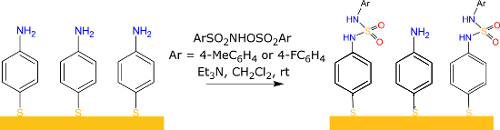
- have been investigated for the immobilization of a target molecule through a reaction with the terminal groups of the SAMs. The most common methods to covalently functionalize these materials involve the Huisgen cycloaddition between an azide and an alkyne [8][9], Thiol-Michael addition [10][11], amide

Graphical Abstract

Scheme 1: General strategy for surface functionalization based on sulfamide chemistry.

Scheme 2: Synthesis of the reference molecule sulfamide 1.

Figure 1: Contact angles of the gold surface, the 4-ATP SAM, the 4-ATP SAM after reaction with ArSO2NHOSO2Ar ...
Figure 2: (a) IR spectra of sulfamide 1 in bulk (solid state) (bottom) and adsorbed on gold (top). (b) PM-IRR...

Figure 3: High resolution S2p and N1s XPS spectra of the 4-ATP SAM, the 4-ATP SAM after reaction with 4-FC6H4...

Figure 4: High resolution S2p and N1s XPS spectra of the SAM 1 before (top) and after hydrolysis (bottom). Ri...
Synthesis of new pyrrolidine-based organocatalysts and study of their use in the asymmetric Michael addition of aldehydes to nitroolefins
- Alejandro Castán,
- Ramón Badorrey,
- José A. Gálvez and
- María D. Díaz-de-Villegas
Beilstein J. Org. Chem. 2017, 13, 612–619, doi:10.3762/bjoc.13.59
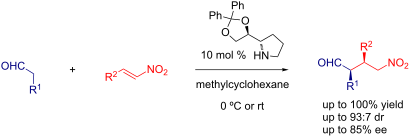
- organocatalysts with a bulky substituent at C2 were synthesized from chiral imines derived from (R)-glyceraldehyde acetonide by diastereoselective allylation followed by a sequential hydrozirconation/iodination reaction. The new compounds were found to be effective organocatalysts for the Michael addition of
- aldehydes to nitroolefins and enantioselectivities up to 85% ee were achieved. Keywords: enantioselective synthesis; Michael addition; organocatalysis; pyrrolidines; synthetic methods; Introduction In the first decades of the 21st century, the enantioselective organocatalysis has witnessed a tremendous
- chiral pool, we have now focused on the synthesis of new chiral pyrrolidines capable of creating a sterically demanding environment due to the presence of a bulky 2,2-disubstituted-1,3-dioxolan-4-yl moiety at C2 from chiral imines derived from (R)-glyceraldehyde. The Michael addition of aldehydes to

Graphical Abstract

Figure 1: Strategy for the preparation of 2-substituted pyrrolidines C.

Scheme 1: Synthesis of the new organocatalyst OC1.

Scheme 2: Synthesis of new organocatalyst OC2.

Scheme 3: Synthesis of new organocatalyst OC3.

Scheme 4: Synthesis of new organocatalysts OC4–OC10.

Scheme 5: Synthesis of new organocatalyst OC11.



