Search results
Search for "allyl" in Full Text gives 525 result(s) in Beilstein Journal of Organic Chemistry. Showing first 200.
Recent advances in photocatalyzed reactions using well-defined copper(I) complexes
Beilstein J. Org. Chem. 2020, 16, 451–481, doi:10.3762/bjoc.16.42
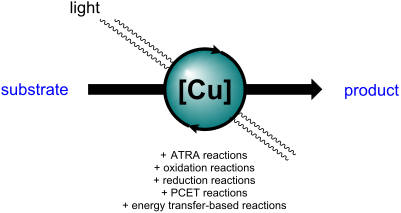
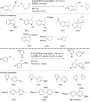
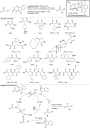
- ) [25]. This copper-catalyzed photocatalytic reduction generated an aryl radical that was trapped with various allylating reagents. First, the phenyl radical generated from the corresponding diphenyliodonium salt was added to various allyl sulfones substituted in the 2-position. The products were
- isolated in moderate to good yields. Using the more reactive allyl sulfone, a panel of symmetrical diaryliodonium salts was reacted, giving the products in good yields. The authors conducted some mechanistic studies and suggested a plausible catalytic cycle involving [Cu(I)]/[Cu(I)]*/[Cu(II)] species. The
- allylation reaction using the [Cu(I)(dpp)(binc)]BF4 complex (Scheme 16) [32]. The reaction of α-bromomalonates with allyl- and crotylsilanes afforded the allylated products in good yields. To explain the reaction outcome, the authors suggested a reduction of the α-bromomalonate by the excited Cu(I) complex








Architecture and synthesis of P,N-heterocyclic phosphine ligands
Beilstein J. Org. Chem. 2020, 16, 362–383, doi:10.3762/bjoc.16.35
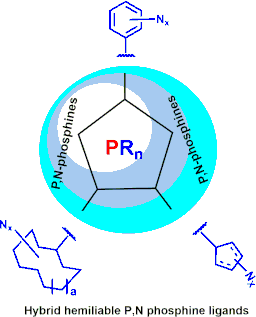
- [45][46]. The complimentary effect of P and N can help stabilizing different catalytic species that are produced during catalytic transformations [11][47]. P,N-phosphine ligands can effect regioselective control, due to the trans-effect as exhibited in π-allyl metal complexes, where substitution




Combination of multicomponent KA2 and Pauson–Khand reactions: short synthesis of spirocyclic pyrrolocyclopentenones
Beilstein J. Org. Chem. 2020, 16, 200–211, doi:10.3762/bjoc.16.23
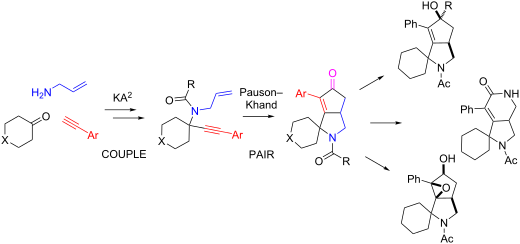
- different compounds, such as (−)-kainic acid [51][52]. Previous similar approaches reported only planar pyrrolocyclopentenones starting from propargyl alcohol–cobalt complexes and allyl amides [50], or carbohydrate-derived allylpropargylamine [49] (Scheme 1a). Results and Discussion Cyclohexanone (1) and




Functionalization of the imidazo[1,2-a]pyridine ring in α-phosphonoacrylates and α-phosphonopropionates via microwave-assisted Mizoroki–Heck reaction
Beilstein J. Org. Chem. 2020, 16, 15–21, doi:10.3762/bjoc.16.3

- substrates, a mixture of regioisomers, resulting from α- and β-arylation, was formed (see Supporting Information File 1, Figures S16 and S17, S32 and S33) [21]. In case of the reaction with allyl alcohol, the generated products isomerized in situ to give the saturated aldehydes, compounds 12, 21, and 22, a


Synthesis of C-glycosyl phosphonate derivatives of 4-amino-4-deoxy-α-ʟ-arabinose
Beilstein J. Org. Chem. 2020, 16, 9–14, doi:10.3762/bjoc.16.2
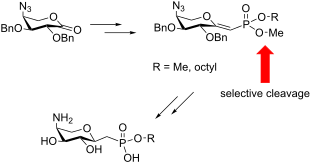
- preliminary experiments, Lewis acid cleavage using BBr3, BCl3, and TiCl4, respectively, was not successful, although the latter reagent had previously been used to deprotect two benzyl groups from an allyl glycoside containing a 4-amino-4-deoxy-ʟ-arabinose residue [36]. Cleavage of the benzyl protecting


Regioselectivity of glycosylation reactions of galactose acceptors: an experimental and theoretical study
Beilstein J. Org. Chem. 2019, 15, 2982–2989, doi:10.3762/bjoc.15.294
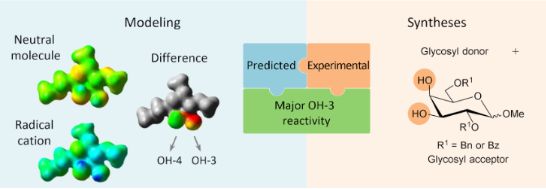
- ]. The observation that 13β was formed (Table 1, entry 4) helped to understand the reaction performance and the relative reactivity of hydroxy groups. With the 2,3,4,6-tetra-O-benzyl-β-ᴅ-Galp trichloroacetimidate donor, regioselectivity in favor of the OH-3 group of 1α [32] or allyl 2,6-di-O-benzyl-α- or


Why do thioureas and squaramides slow down the Ireland–Claisen rearrangement?
Beilstein J. Org. Chem. 2019, 15, 2948–2957, doi:10.3762/bjoc.15.290
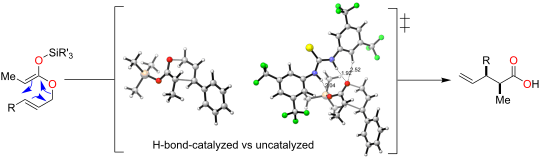
- rearrangement; silyl ketene acetals; Introduction The Ireland–Claisen rearrangement is a reaction converting allyl esters to γ,δ-unsaturated carboxylic acids. Its key step is a [3,3]-sigmatropic rearrangement of a silyl ketene acetal, which is generated in situ by deprotonation of an allyl ester using a strong
- stereospecificity make this transformation synthetically appealing [12][13]. Allyl esters of various carboxylic acids undergo rearrangement as their lithium enolates or silyl ketene acetals and the corresponding acids were isolated in 75–80% yields. Accordingly, the Ireland–Claisen rearrangement of lithium enolates
- generated from allyl fluoroacetates gave the corresponding α-fluoro-γ,δ-unsaturated acids [14]. The Ireland–Claisen rearrangement of Et3N-solvated enolates showed higher reactivity as well as diastereoselectivity when compared with analogous reactions in THF [15]. The required ester enolates are typically


A review of asymmetric synthetic organic electrochemistry and electrocatalysis: concepts, applications, recent developments and future directions
Beilstein J. Org. Chem. 2019, 15, 2710–2746, doi:10.3762/bjoc.15.264
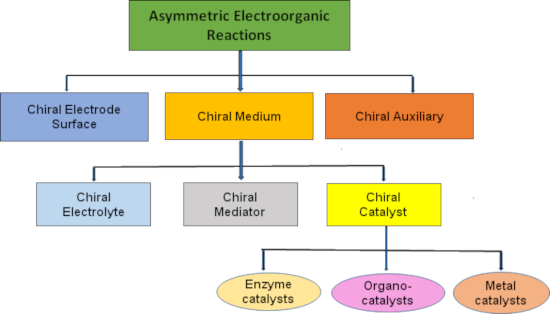
- stereocenters 88 were obtained in good yields and enatioselectivities [69]. In 2002, Dunach’s group explored an electroreductive method for the cleavage of the allyl group of β-keto ester 89 followed by the transfer of the same to the carbonyl group to afford a mixture of 91 (major), 92 and 93 (Scheme 33






Unexpected one-pot formation of the 1H-6a,8a-epiminotricyclopenta[a,c,e][8]annulene system from cyclopentanone, ammonia and dimethyl fumarate. Synthesis of highly strained polycyclic nitroxide and EPR study
Beilstein J. Org. Chem. 2019, 15, 2664–2670, doi:10.3762/bjoc.15.259

- assignment was based on the single-crystal X-ray analysis (Figure 4) and a possible mechanism for this hydroxylation is shown in Scheme 4. Oxidation of amines with peracids is known to proceed through oxoammonium cation formation [12]. The close proximity of this reactive group to the allyl hydrogen results


Indium-mediated C-allylation of melibiose
Beilstein J. Org. Chem. 2019, 15, 2458–2464, doi:10.3762/bjoc.15.238
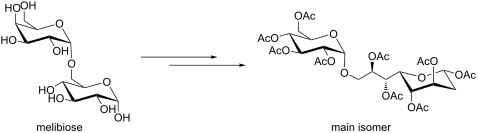
- )-2,3,4,5,6-penta-O-acetyl-7,8,9-trideoxy-ᴅ-glycero-ʟ-gulo-8,9-nonenitol (2-syn) and 2’,3’,4’,6’-tetra-O-acetyl-α-ᴅ-galactopyranosyl-(1’→1)-2,3,4,5,6-penta-O-acetyl-7,8,9-trideoxy-ʟ-glycero-ʟ-gulo-8,9-nonenitol (2-anti): Indium (263 mg, 2.29 mmol, 4 equiv) and allyl bromide (420 mg, 3.47 mmol, 6 equiv) were


Current understanding and biotechnological application of the bacterial diterpene synthase CotB2
Beilstein J. Org. Chem. 2019, 15, 2355–2368, doi:10.3762/bjoc.15.228
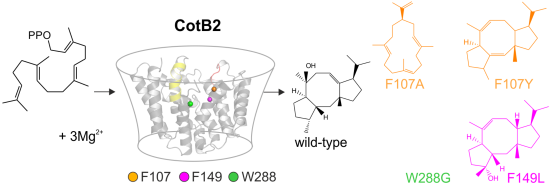
- ) [12] to the acyclic terpene synthase substrate geranylgeranyl diphosphate 3 (GGDP) [1][13][14][15][16]. Following initial substrate binding and folding in a product-like conformation, the cyclization reaction can be subdivided into three steps: (1) generation of a reactive allyl carbocation as a


Functionalization of 4-bromobenzo[c][2,7]naphthyridine via regioselective direct ring metalation. A novel approach to analogues of pyridoacridine alkaloids
Beilstein J. Org. Chem. 2019, 15, 2304–2310, doi:10.3762/bjoc.15.222
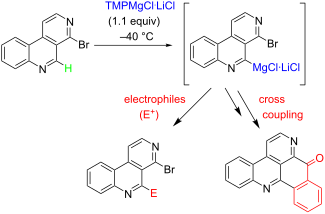
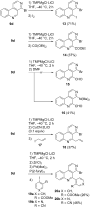
- ]. Reaction of allyl iodide (17) with metalated 9d after addition of catalytic amounts of CuCN∙2LiCl led to the formation of the 5-allyl compound 18 in 37% yield. Metalation of 9d using TMPMgCl∙LiCl and subsequent transmetalation with ZnCl2 followed by Negishi cross-coupling reaction in the presence of Pd(dba




Recent advances in transition-metal-catalyzed incorporation of fluorine-containing groups
Beilstein J. Org. Chem. 2019, 15, 2213–2270, doi:10.3762/bjoc.15.218
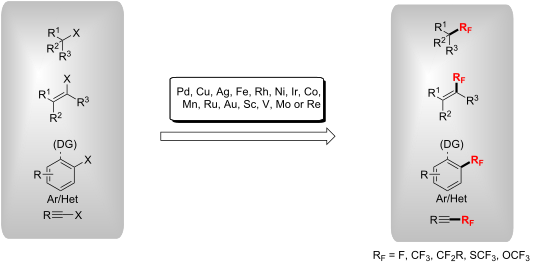
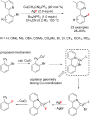
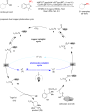
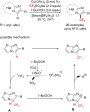
- that the allylic fluorination was achieved by an SN2-type attack of fluoride on an electrophilic Pd(II)-allyl intermediate. One year later, the same author extended this method to a highly regio- and enantioselective fluorination of acyclic allylic chlorides. Compared to the previous process, this
- reaction used a different chiral bisphosphine ligand resulting in larger bite angles and afforded the products in good yields (Scheme 2b) [36]. A palladium-catalyzed method for the formation of allylic C–F bonds from allyl p-nitrobenzoate using TBAF(t-BuOH)4 as the fluoride source was explored by
- formation of fluorinated products with an overall retention of the stereochemical configuration suggests a mechanism wherein a palladium-π-allyl intermediate undergoes a rapid π-σ-π isomerization. In 2013, the first example of an allylic C–H fluorination reaction of simple alkenes with Et3N·3HF as a








Synthesis and anion binding properties of phthalimide-containing corona[6]arenes
Beilstein J. Org. Chem. 2019, 15, 1976–1983, doi:10.3762/bjoc.15.193
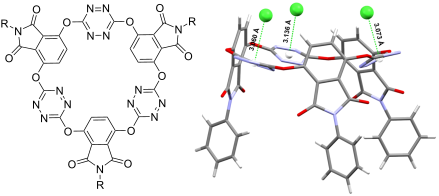
- -dichlorotetrazine [48] (2) under very mild conditions. The one-pot macrocyclic condensation reaction went to completion within 0.5 h to afford the corresponding O6-corona[3]arene[3]tetrazines 3a–c as the only macrocyclic ring products in yields of 38% to 63%. We then prepared N-allyl (1d), N-(2-(2-hydroxyethoxy


Halide metathesis in overdrive: mechanochemical synthesis of a heterometallic group 1 allyl complex
Beilstein J. Org. Chem. 2019, 15, 1856–1863, doi:10.3762/bjoc.15.181
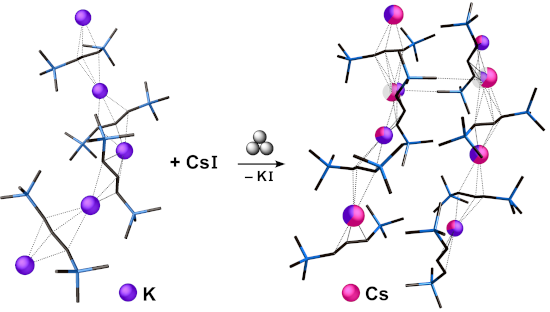
- thermodynamic driving forces, intra-alkali metal exchange is one of the most challenging metathetical exchanges to attempt, especially when conducted without solvent. Nevertheless, grinding together the bulky potassium allyl [KA']∞ (A' = [1,3-(SiMe3)2C3H3]–) and CsI produces the heterometallic complex [CsKA'2
- between M'X and MX becomes particularly small? Here we describe the application of mechanochemistry in an organometallic context to examine alkali metal halide exchange unassisted by solvents. The organic group used is the bulky 1,3-bis(trimethylsilyl)allyl anion, [1,3-(SiMe3)2C3H3]− ([A']−) [13][14], for
- unreactive, even under mechanochemical conditions [20]. The iodides, in contrast, have the smallest lattice energies and thus should be the most easily disrupted and liable to exchange. Although several metal compounds of the allyl anion [A']– were potential candidates for the present study, the need for a


N-(1-Phenylethyl)aziridine-2-carboxylate esters in the synthesis of biologically relevant compounds
Beilstein J. Org. Chem. 2019, 15, 1722–1757, doi:10.3762/bjoc.15.168

- allyl ether (2R,1'R,1''R)-135 which in the presence of Grubbs 1st generation catalyst produced (2R,1'R,1''R)-136. Transformation of the aziridine portion of 136 into an amino acid fragment of norfuranomycin (2S,2'R)-133 was accomplished starting from the hydrolytic opening of the aziridine ring and was
- )-135 instead of the allyl residue opened the way to synthesis of ʟ-(+)-furanomycin and its 5'-epimer. MeBmt (2S,3R,4R,6E)-139 is a nonproteinogenic amino acid found as a constituent of the naturally occurring cyclic peptide cyclosporine currently in medical use as immunosuppressant [89]. Syntheses of
- hydrolysis. Installation of the allyl group at the nitrogen atom required prior derivatization as an oxazolidin-2-one and Birch reduction to furnish 204. To construct a properly functionalized piperidine ring olefin metathesis was performed to supply the key intermediate 205. Taking advantage of the steric


Different reactivity of phosphorylallenes under the action of Brønsted or Lewis acids: a crucial role of involvement of the P=O group in intra- or intermolecular interactions at the formation of cationic intermediates
Beilstein J. Org. Chem. 2019, 15, 1491–1504, doi:10.3762/bjoc.15.151
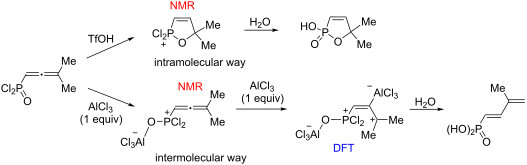
- calculations. Hydrolysis of these species resulted in the formation of phosphoryl-substituted allyl alcohols and 1,3-butadienes. A strong coordination of the oxygen of the P=O group with AlCl3 prevented the formation of cyclic 1,2-oxaphospholium ions and played a crucial role in the different reactivity of
- –H (Table 1). These species are formed by protonation of the central carbon atom of the allene system that gives the corresponding allyl cations, which undergo cyclization onto the oxygen of the P=O group. These ions have similar NMR data: the signal of the new proton H4 is located in the range 6.30
- oxaphospholium ion E1 (Table 1) through an intermediate formation of allyl cation E (Scheme 1). Ion E1 is transformed very fast into another species; after one minute new signals appear in the NMR spectra (see 31P NMR monitoring of this process in Figure 2), and after 12 hours it is completely converted to this




Synthesis and biological evaluation of truncated derivatives of abyssomicin C as antibacterial agents
Beilstein J. Org. Chem. 2019, 15, 1468–1474, doi:10.3762/bjoc.15.147
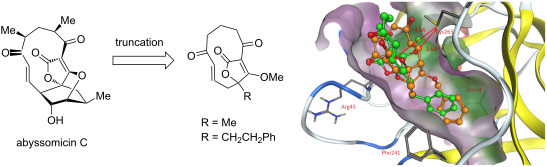
- intermediates, building blocks 4 and 5 (4, R = Me and 5, R = CH2CH2Ph) were synthesized starting with allyldioxazaborolidine 11, an allyl-transfer reagent that was prepared as previously reported (Scheme 3) [27]. Allylation of methyl pyruvate (12) or 13 (synthesized from dimethyl oxalate and phenethylmagnesium


Borylation and rearrangement of alkynyloxiranes: a stereospecific route to substituted α-enynes
Beilstein J. Org. Chem. 2019, 15, 1416–1424, doi:10.3762/bjoc.15.141
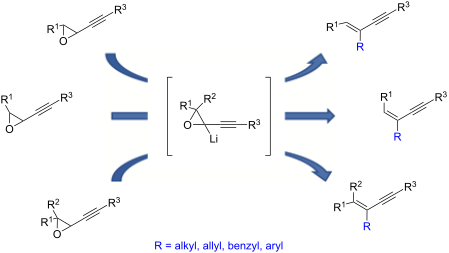
- allyl groups could be transferred as well, although slightly lower yields were observed (Table 2, entries 8–11). Even an alkyl group could be transferred and interestingly, the best yields were achieved with this kind of group (Table 2, entries 12 and 13). It is worth noting that the same stereochemical
- corresponding carbenoid, especially with increasing temperature. Once the oxiranyllithium species is formed (A in Scheme 3), oxiranylborate complexes B are obtained by the addition of aryl-, benzyl-, allyl- or alkylboronic esters. This was clearly evidenced by the fast disappearance of the coloration linked to
- ][42]. From the results we so far gained, a migratory order could be assessed for the present reaction: Bu ≥ EDG-substitued Ar > EWG-substitued Ar ≥ Ar ≥ benzyl > allyl, and it appears that the larger the other substituents on the boron atom are, the easier the transfer is. A possible transition state


Robust perfluorophenylboronic acid-catalyzed stereoselective synthesis of 2,3-unsaturated O-, C-, N- and S-linked glycosides
Beilstein J. Org. Chem. 2019, 15, 1275–1280, doi:10.3762/bjoc.15.125
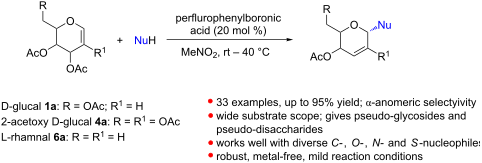
- δ 6.01 (H2, H3) [19][21]. Using the optimized conditions in Table 1, entry 4, we then examined the substrate scope. Therefore, glucal 1a was reacted with various O-nucleophiles (using primary, secondary, tertiary, allyl, propargyl alcohols and sugars), C-nucleophiles (using trimethylsilyl cyanide



Alkylation of lithiated dimethyl tartrate acetonide with unactivated alkyl halides and application to an asymmetric synthesis of the 2,8-dioxabicyclo[3.2.1]octane core of squalestatins/zaragozic acids
Beilstein J. Org. Chem. 2019, 15, 1194–1202, doi:10.3762/bjoc.15.116
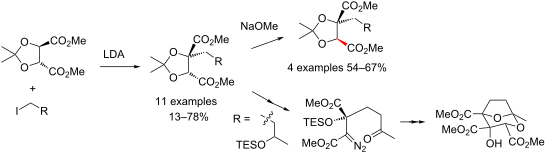
- -dipropylated product 34a also being separately isolated, in 7% yield. Other primary ‘non-activated’ alkyl iodides also led to alkylated tartrates 33b,c and the corresponding dialkylated side-products 34b,c (Scheme 9). Under our modified alkylation conditions, ‘activated’ bromides (benzyl, allyl and prenyl


Electrophilic oligodeoxynucleotide synthesis using dM-Dmoc for amino protection
Beilstein J. Org. Chem. 2019, 15, 1116–1128, doi:10.3762/bjoc.15.108
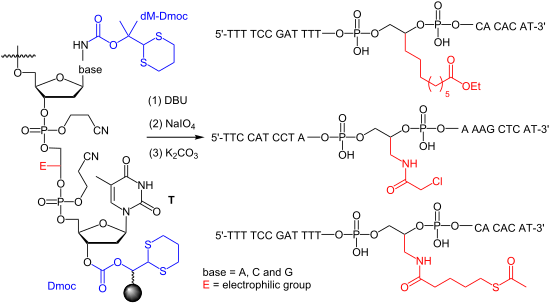
- as linker to enable deprotection and cleavage under milder basic conditions [32]. The palladium-labile allyl groups were also used for amino protection [33][34]. The o-nitrobenzyl function was used as linker to enable photo cleavage [34]. However, these methods are still not ideal. The phenoxyacetyl


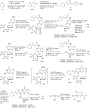




Switchable selectivity in Pd-catalyzed [3 + 2] annulations of γ-oxy-2-cycloalkenones with 3-oxoglutarates: C–C/C–C vs C–C/O–C bond formation
Beilstein J. Org. Chem. 2019, 15, 1107–1115, doi:10.3762/bjoc.15.107
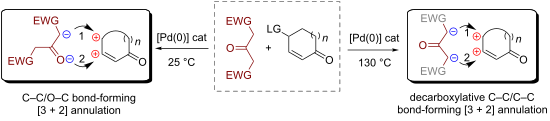
- considerations in mind, a plausible mechanism for this annulation is proposed for the reaction between dimethyl 3-oxoglutarate (1a) and 2-cyclohexenone 4-benzoate (2a). The reaction starts with an oxidative addition of the bis-electrophile 2a onto the Pd(0) complex to generate η3-allyl complex B from the
- transient η2-alkene complex A (steps a and b). Deprotonation of the pro-nucleophile 1a by the counter-anion of the η3-allyl-Pd complex exchanges the benzoate for the enolate anion (step c) [50], and following C–C bond formation from the resulting anion-scrambled complex C leads to the Pd(0) complex D (step


Diastereo- and enantioselective preparation of cyclopropanol derivatives
Beilstein J. Org. Chem. 2019, 15, 752–760, doi:10.3762/bjoc.15.71
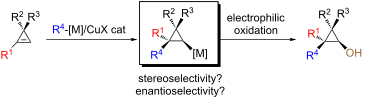
- excellent enantiomeric ratios could also be achieved (Scheme 7) [89]. However, the enantioselective and catalytic copper-catalyzed carbomagnesiation reaction gave poor enantiomeric ratios for the addition of vinyl, aryl and allyl groups and alternative strategies have been recently developed in our research


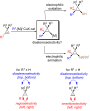


The LANCA three-component reaction to highly substituted β-ketoenamides – versatile intermediates for the synthesis of functionalized pyridine, pyrimidine, oxazole and quinoxaline derivatives
Beilstein J. Org. Chem. 2019, 15, 655–678, doi:10.3762/bjoc.15.61
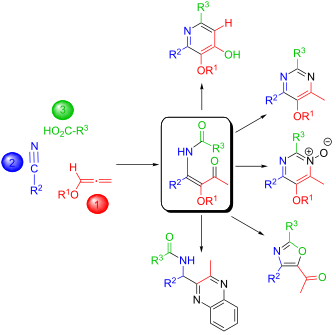
- the solvent methanol to the double bond provided compound PO27 as major product (Scheme 17) [32]. It was not studied whether the use of other solvents can suppress this addition reaction. The allyl-substituted β-ketoenamide KE7 was converted under the standard conditions into condensation product PO28