Search results
Search for "19F)" in Full Text gives 324 result(s) in Beilstein Journal of Organic Chemistry. Showing first 200.
Ortho-ester-substituted diaryliodonium salts enabled regioselective arylocyclization of naphthols toward 3,4-benzocoumarins
Beilstein J. Org. Chem. 2024, 20, 841–851, doi:10.3762/bjoc.20.76
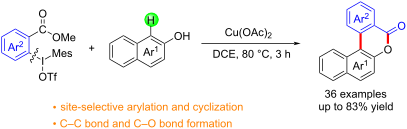
- and characterization data of all products, copies of 1H, 13C, 19F NMR spectra of all compounds. Acknowledgements The authors thank the Research Center of Analysis and Test of the East China University of Science and Technology for the help on the characterization and Professor Zhen-Jiang Xu from SIOC


Synthesis of new representatives of A3B-type carboranylporphyrins based on meso-tetra(pentafluorophenyl)porphyrin transformations
Beilstein J. Org. Chem. 2024, 20, 767–776, doi:10.3762/bjoc.20.70
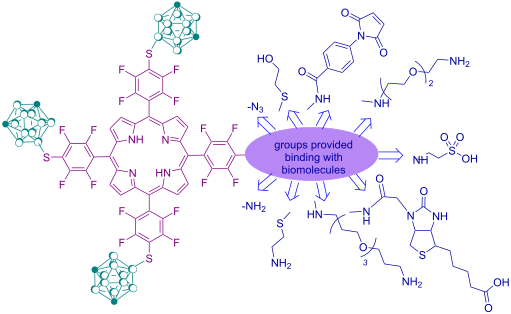
- carborane A3B-porphyrin were also synthesized based on the amino-substituted A3B-porphyrin. The structures of the prepared carboranylporphyrins were determined by UV–vis, IR, 1H, 19F, 11B NMR spectroscopic data and MALDI mass spectrometry. Keywords: bioconjugation; carboranes; fluorine; porphyrin; SNAr
- substituent of porphyrins 3, 5, 11, 12, 14, 18–20, 23, 24, and 26 were also observed supporting the structures of these compounds (see Supporting Information File 1, experimental and Figures S1–S14 for details). The 19F NMR spectra were also in good agreement with the structures of the synthesized compounds
- functionality was supported by the design of conjugates containing maleimide and biotin substituents. The structures of prepared carboranylporphyrins were determined by UV–vis, IR, 1H 19F, 11B NMR spectroscopic data and MALDI mass spectrometry. Synthesis of porphyrins 2 and 3. Synthesis of carborane


Synthesis of 2,2-difluoro-1,3-diketone and 2,2-difluoro-1,3-ketoester derivatives using fluorine gas
Beilstein J. Org. Chem. 2024, 20, 460–469, doi:10.3762/bjoc.20.41
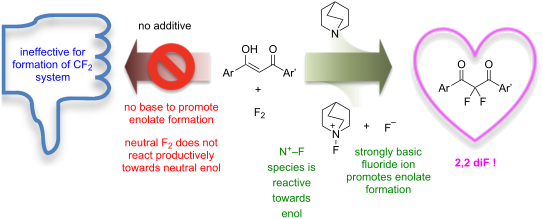
- reaction of compound 1a with Selectfluor in acetonitrile (MeCN) gave high yields of the monofluorinated product 2a with no difluorinated product being observed by 19F NMR analysis of the product mixture after 5 h (Scheme 1). In contrast, attempts to fluorinate 1a with one equivalent of fluorine gas in MeCN
- gave no noticeable conversion on analysis by 19F NMR spectroscopy, and a large excess of fluorine led to formation of a dark brown tar from which no useful product could be isolated. On the bases of these failed attempts, coupled with our previous experiences with the DBM scaffold [16][17][36], we used
- the crude yields of fluorinated products were estimated by 19F NMR integration (monofluoro product 2a, δF −189.9 ppm; difluoro product 3a, δF −102.7 ppm) (Table 1, entry 3). Using excess fluorine or DABCO (entries 5 and 6 in Table 1) led to the formation of tars, while 0.1 equiv of DABCO (entry 7


(E,Z)-1,1,1,4,4,4-Hexafluorobut-2-enes: hydrofluoroolefins halogenation/dehydrohalogenation cascade to reach new fluorinated allene
Beilstein J. Org. Chem. 2024, 20, 452–459, doi:10.3762/bjoc.20.40
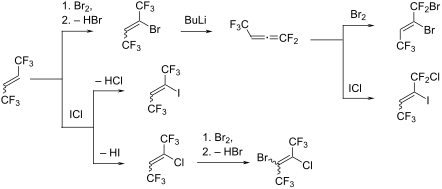
- .20.40 Abstract A series of 2,3-dihalo-1,1,1,4,4,4-hexafluorobutanes and 2-halo-1,1,1,4,4,4-hexafluorobut-2-enes were prepared from commercially available hydrofluoroolefins 1,1,1,4,4,4-hexafluorobut-2-enes and their 1H, 19F and 13C chemical shifts measured. Some reactions of synthesized 2-halo
- of stereoisomers in 2:1 ratio. After isolation by distillation, 2,3-dibromo-1,1,1,4,4,4-hexafluorobutane (2) was characterized by 1H, 19F, 13C NMR and mass spectra. We studied the reaction of dibromoalkane 2 with various bases such as DBU, Hünig’s base (iPr2NEt), and potassium hydroxide (Table 1). In
- all cases, except the reaction in diglyme (Table 1, entry 5), a mixture of (E)- and (Z)-2-bromo-1,1,1,4,4,4-hexafluorobut-2-enes (3a,b) in a ratio of 2:1 was formed. The configuration of the isomers was determined by the 5JFFcis coupling constant in the 19F{H} NMR spectrum (ca. 0 Hz for (Z)-isomer and


Mono or double Pd-catalyzed C–H bond functionalization for the annulative π-extension of 1,8-dibromonaphthalene: a one pot access to fluoranthene derivatives
Beilstein J. Org. Chem. 2024, 20, 427–435, doi:10.3762/bjoc.20.37
- from Acros. KOPiv (95%) was purchased from Doug Discovery. These compounds were not purified before use. All reagents were weighed and handled in air. All reactions were carried out under an inert atmosphere with standard Schlenk techniques. 1H, 19F and 13C NMR spectra were recorded on Bruker Avance
- data of synthesized compounds. Supporting Information File 44: Copies of 1H, 19F, and 13C NMR spectra. Acknowledgements We are grateful to Dr. Elsa Caytan for NMR experiments. Part of this work has been performed using the PRISM core facility (Biogenouest, Univ Rennes, Univ Angers, INRAE, CNRS, FRANCE


Photochromic derivatives of indigo: historical overview of development, challenges and applications
Beilstein J. Org. Chem. 2024, 20, 228–242, doi:10.3762/bjoc.20.23
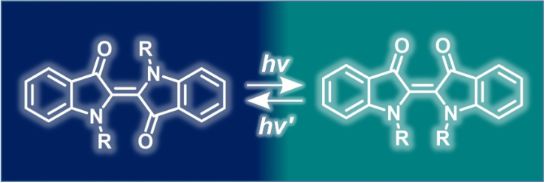
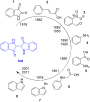
- -donating group, 19a) to 6.8 h (in the presence of electron-withdrawing group, 19f) depending on the effect of the substituents in the aryl groups. Further insights into the photoisomerization mechanism of N,N'-diarylindigos were provided in 2022 using steady-state and time-resolved spectroscopy experiments





Chiral phosphoric acid-catalyzed transfer hydrogenation of 3,3-difluoro-3H-indoles
Beilstein J. Org. Chem. 2024, 20, 205–211, doi:10.3762/bjoc.20.20
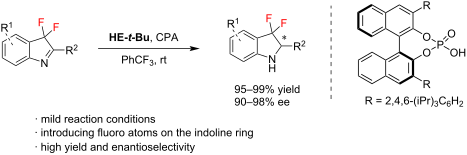
- and the reaction mixture was stirred at room temperature for 3 h. After concentrating the mixture, the residue was purified by column chromatography on silica gel using a mixture of petroleum ether/ethyl acetate 30:1 (v/v) as the eluent to afford products 2. The yields were determined by 19F NMR


Comparison of glycosyl donors: a supramer approach
Beilstein J. Org. Chem. 2024, 20, 181–192, doi:10.3762/bjoc.20.18
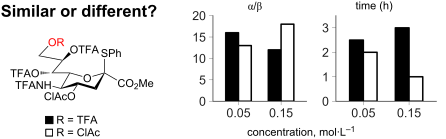
- after immersion in a 1:10 (v/v) mixture of 85% aq H3PO4 and 95% aq EtOH. 1H, 13C, and 19F NMR spectra of solutions in CDCl3 and acetone-d6 were recorded on a Bruker AVANCE-600 instrument at 600 MHz for 1H and 151 MHz for 13C or on a Bruker AM-300 instrument at 300 MHz for 1H, 75 MHz for 13C, and 282 MHz
- for 19F NMR. The 1H chemical shifts are given relative to the signal of the residual CHCl3 (δH 7.27) or acetone-d5 (δH 2.05), the 13C chemical shifts were measured relative to the signal of CDCl3 (δC 77.0) or acetone-d6 (δC 29.92). The 19F chemical shifts are given relative to the external signal of
- (q, JC,F = 285, CF3), 115.2 (q, JC,F = 288, CF3), 127.6, 129.6, 130.6, 136.0 (Ph), 156.4 (q, JC,F = 45, COCF3), 156.9 (q, JC,F = 44, COCF3), 158.0 (q, JC,F = 39, COCF3), 166.2, 167.5, 168.4 (COCH2Cl, CO2Me); 19F NMR (282 MHz, CDCl3, δ, ppm) −76.8 (NHCOCF3), −75.7, −75.2 (OCOCF3); HRESIMS (m/z): [M



Visible-light-induced radical cascade cyclization: a catalyst-free synthetic approach to trifluoromethylated heterocycles
Beilstein J. Org. Chem. 2024, 20, 118–124, doi:10.3762/bjoc.20.12
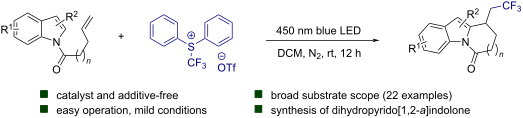
- . The addition of a typical radical scavenger – TEMPO (2,2,6,6-tetramethylpiperidin-1-yloxyl) significantly inhibited the reaction (as shown in Scheme 3), suggesting the involvement of radical species during the reaction process. Moreover, the radical trapping product was detected and confirmed via 19F




NMRium: Teaching nuclear magnetic resonance spectra interpretation in an online platform
Beilstein J. Org. Chem. 2024, 20, 25–31, doi:10.3762/bjoc.20.4

- quiz material for intermediate to more advanced students. A third group of exercises includes additional experiments e.g., NOESY or 1D NOE spectra and 1D/2D heteronuclear experiments including nuclei such as 15N or 19F [43]. For all three exercise collections, students may draw a derived structure and


1-Butyl-3-methylimidazolium tetrafluoroborate as suitable solvent for BF3: the case of alkyne hydration. Chemistry vs electrochemistry
Beilstein J. Org. Chem. 2023, 19, 1966–1981, doi:10.3762/bjoc.19.147
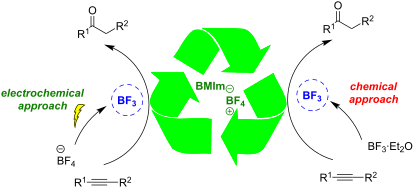
- and anion of the IL as the length of the side alkyl chain increases, which makes the BF4‒/water interaction more effective. Although Saihara and co-workers demonstrated that BF4‒ hydrolysis generates HF, which reacts with the surrounding glass container yielding SiF62‒ (signal at −130 ppm in 19F NMR
- spectrum) [106], we never detected such a peak in 19F NMR spectra of the neat IL, analysed after reaction work-up, keeping it under vacuum to completely eliminate diethyl ether traces before NMR analysis. It should be mentioned that the solution was kept in the NMR tubes only for the time necessary to
- -chelate. In fact, the following convincing peaks were found in the NMR spectra: a singlet at 6.11 ppm, along with a quartet at 4.68 ppm (1H NMR spectrum), a peak at 83.3 ppm (13C NMR spectrum) and a singlet at −139.1 ppm (19F NMR spectrum) [109]. A simple washing with distilled water gave the


Substituent-controlled construction of A4B2-hexaphyrins and A3B-porphyrins: a mechanistic evaluation
Beilstein J. Org. Chem. 2023, 19, 1832–1840, doi:10.3762/bjoc.19.135
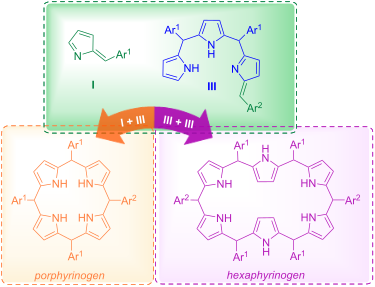
- -tosylimines. Experimental General method: All reagents and solvents were purchased from Sigma-Aldrich, Fisher Scientific, or Acros Organics and were used without further purification. 1H NMR (400 MHz), 13C NMR (100 MHz), and 19F NMR (376 MHz) spectra were recorded on a Bruker 400, Ultra Shield high
- -performance digital FT-NMR spectrometer. Data for 1H NMR, 13C NMR, and 19F NMR are reported as follows: chemical shift (δ, ppm), multiplicity (s = singlet, d = doublet, t = triplet, m = multiplet, q= quartet, bs = broad singlet, dd = doublet of doublets, td = triplet of doublets, qd = quartet of doublets



A novel recyclable organocatalyst for the gram-scale enantioselective synthesis of (S)-baclofen
Beilstein J. Org. Chem. 2023, 19, 1811–1824, doi:10.3762/bjoc.19.133

- 22.8, 14.2 ppm; 19F NMR −63.1 ppm; HRESI(+)-MS (m/z): [M + H+] calcd for C94H144F6N5O7, 1569.0970; found, 1569.957. General procedure for the solvent screening of stereoselective Michael addition of acetylacetone to trans-β-nitrostyrene First, trans-β-nitrostyrene (12, 11.9 mg, 0.08 mmol) and the


Morpholine-mediated defluorinative cycloaddition of gem-difluoroalkenes and organic azides
Beilstein J. Org. Chem. 2023, 19, 1545–1554, doi:10.3762/bjoc.19.111
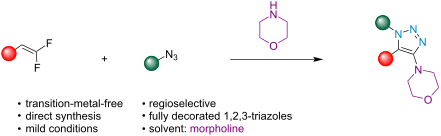
- 19F NMR spectroscopy to monitor the consumption of the gem-difluoro starting material 1, which was completely consumed within 16 h (Figure 3). However, a 48 h time course gave a superior yield (Table 1, entry 13 vs entry 20). We hypothesize this might be due to the volatile nature of the gem
- . Additionally, 30% of the aniline byproduct was also isolated, which explains the modest yields of this reaction and the sluggish nature. To investigate the mechanism of the current transformation, we conducted a series of experiments including a time course of the reaction using 19F NMR spectroscopy (Figure 3
- and beyond. The Z-geometry of INT-1 was determined from its 3JH−F coupling constant of 35.7 Hz in the 1H NMR with a matching J value in the 19F NMR. This is in agreement with Cao’s report on the geometry of N-(α-fluorovinyl)azoles [33]. The configurations of the E- and Z-isomers were determined by


Cyclization of 1-aryl-4,4,4-trichlorobut-2-en-1-ones into 3-trichloromethylindan-1-ones in triflic acid
Beilstein J. Org. Chem. 2023, 19, 1460–1470, doi:10.3762/bjoc.19.105
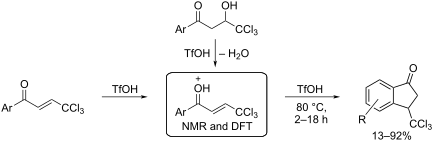
- of enones 2a,e,n with an excess (5 equiv) of AlBr3 or AlCl3 in CH2Cl2 solution at room temperature for 3 days afforded complex mixtures of compounds. Then, the protonation of compounds 1 and 2 in TfOH was investigated by means of NMR spectroscopy. According to the 1H, 13C, and 19F NMR data, hydroxy
- -protonated forms B is substantially delocalized from the carbonyl group to vinyl carbon C3. For fluorophenyl-substituted compounds and cations 1d and Ad, 2d and Bd, also a large downfield shift of the corresponding fluorine signals is observed in the 19F NMR spectra (∆δ = 25.3–25.7 ppm), which shows a
- ketones 1a,c,f,i into the corresponding enones 2 and indanones 3 in TfOH at 80 °C for shorter reaction time under the conditions of incomplete conversion of the starting compounds.a 1H, 13C, and 19F NMR data of compounds 1, and 2 in CDCl3 and their O-protonated forms A, and B, respectively, in TfOH


Application of N-heterocyclic carbene–Cu(I) complexes as catalysts in organic synthesis: a review
Beilstein J. Org. Chem. 2023, 19, 1408–1442, doi:10.3762/bjoc.19.102
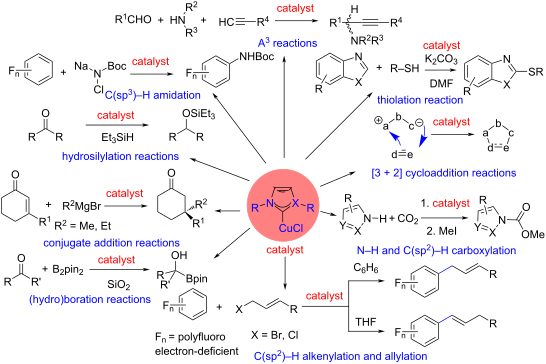
- NEt3·3HF, AgHF2 could also be used. The complexes were found to be air-stable in the solid state and moderately stable in solution. They were unambiguously characterized on the basis of NMR studies including 19F NMR and X-ray crystal analysis. With the IMes ligand, an air-stable bis(NHC)Cu(I) complex






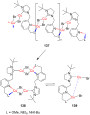


Radical ligand transfer: a general strategy for radical functionalization
Beilstein J. Org. Chem. 2023, 19, 1225–1233, doi:10.3762/bjoc.19.90
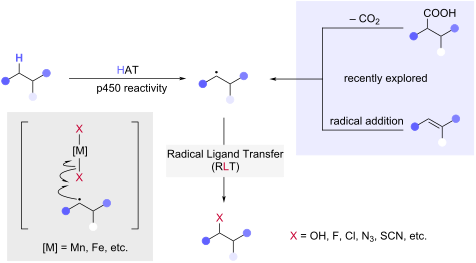
- . To close the cycle and reform the oxo ligand on the Mn(V) species, a stoichiometric amount of iodosylbenzene is used in the reaction. While initial development of this reaction focused on incorporating the stable 19F, subsequent study expanded the scope to RLT of the unstable 18F radioisotope, an


Direct C2–H alkylation of indoles driven by the photochemical activity of halogen-bonded complexes
Beilstein J. Org. Chem. 2023, 19, 575–581, doi:10.3762/bjoc.19.42
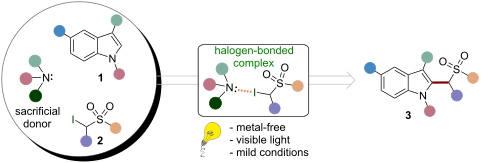
- found to shift to lower ppm values because the Hα nuclei have been affected by higher electron density caused by the formation of the halogen-bonded complex between 2a and DABCO. To confirm that the shift of Hα was indeed produced by a halogen-bonding interaction, 19F NMR analysis of compound 2d, which


Access to cyclopropanes with geminal trifluoromethyl and difluoromethylphosphonate groups
Beilstein J. Org. Chem. 2023, 19, 541–549, doi:10.3762/bjoc.19.39
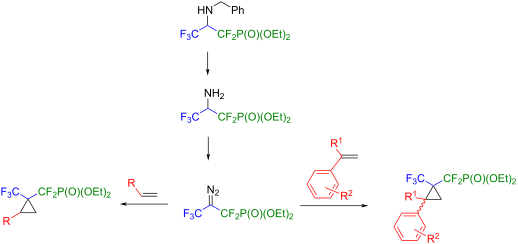
- stereochemistry of the main isomer, the 19F,1H-HOESY NMR spectrum of compound 6c was recorded. The spectrum shows direct correlation of one fluorine nucleus of the difluoromethyl phosphonate group with two cyclopropane protons at 1.75 and 2.91 ppm, respectively. Thus, it is conceivable that the major
- Pr2 and Pr4 (ΔG = −42.5 and −43.3 kcal·mol−1; cis-6c), respectively. This is consistent with the experimental results, since two sets of signals corresponding to the diastereoisomers trans-6c and cis-6c are always observed in the 19F NMR spectrum of the crude mixture, with a slight preference for the
- slight preference for one diastereoisomer. The presented results turn of a new page for the future of diazo chemistry. 19F,1H-HOESY spectrum of compound 6c. Previous works (A–D) and the extension (this work). Synthesis of diethyl 2-diazo-1,1,3,3,3-pentafluoropropylphosphonate (5). Scope of the

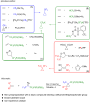


Dipeptide analogues of fluorinated aminophosphonic acid sodium salts as moderate competitive inhibitors of cathepsin C
Beilstein J. Org. Chem. 2023, 19, 434–439, doi:10.3762/bjoc.19.33
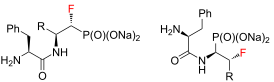
- , obtaining white powders with a yield of 99% in each case. The resulting sodium salts of phosphonic acids 9 and 11 were subjected to 1H, 13C, 19F, and 31P NMR spectroscopic analysis as well as mass spectrometry (MS) confirming their purity. The spectroscopic data of 9 and 11 are in agreement with the


Catalytic aza-Nazarov cyclization reactions to access α-methylene-γ-lactam heterocycles
Beilstein J. Org. Chem. 2023, 19, 66–77, doi:10.3762/bjoc.19.6

- 19b–d in good yields (54–69%). We were pleased to see that the CF3-substituted aza-Nazarov product 19e was isolated as single diastereomer in 76% yield along with only 8% of the minor diastereomer. Surprisingly, aza-Nazarov products 19f with a 4-Cl substituent on the phenyl ring as well as 19g and 19h
- -Nazarov cyclization. X-ray crystal structure of compound 19l. Examples of aza-Nazarov reactions. Aza-Nazarov cyclization on gram scale. Scope of the aza-Nazarov cyclization with acyclic imines. aThe syntheses of aza-Nazarov products 19b, 19c, and 19f were described previously [35]. bThe reaction was


Simple synthesis of multi-halogenated alkenes from 2-bromo-2-chloro-1,1,1-trifluoroethane (halothane)
Beilstein J. Org. Chem. 2022, 18, 1567–1574, doi:10.3762/bjoc.18.167
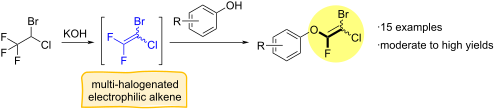
- experiments with the aim of identifying further applications of 2 will be reported in due course. Experimental General information 1H NMR, 19F NMR and 13C NMR spectra were recorded on JEOL ECZ 400S spectrometers. Chemical shifts of 1H NMR are reported in ppm from tetramethylsilane (TMS) as an internal
- standard. Chemical shifts of 13C NMR are reported in ppm from the center line of a triplet at 77.16 ppm for deuteriochloroform. Chemical shifts of 19F NMR are reported in ppm from CFCl3 as an internal standard. All data are reported as follows: chemical shifts, relative integration value, multiplicity (s
- ), 153.9; 19F NMR (376 MHz, CDCl3) δ −80.5 (s, 1F), −80.6 (s, 1F); EIMS m/z: 250, 252 [M]+; HREIMS: [M]+ calcd for C8H5BrClFO, 249.9196, 251.9176; found, 249.9202, 251.9172. (3-Chloro-4-fluoro-4-phenoxybut-3-en-1-yn-1-yl)trimethylsilane (7): To a solution of 2a (0.5 mmol), bis(triphenylphosphine)palladium


Heterogeneous metallaphotoredox catalysis in a continuous-flow packed-bed reactor
Beilstein J. Org. Chem. 2022, 18, 1123–1130, doi:10.3762/bjoc.18.115
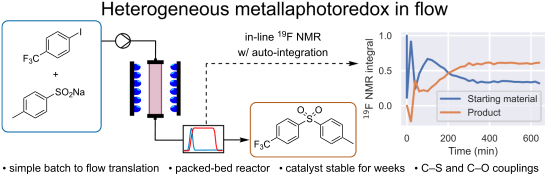
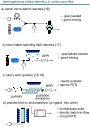
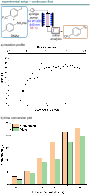
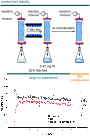
- enabled straightforward reaction monitoring via 19F NMR. To this end, a 1 T benchtop NMR equipped with a flow cell was connected to the reactor outlet and used to acquire a series of spectra. In particular, a series of 128 repetitions with a 90° pulse width and a relatively long repetition time of 5.2 s
- outlet. First, we verified that the NMR yield calculated directly from the benchtop 19F NMR spectrum was in good agreement with the high-field NMR yields calculated with an internal standard (see Supporting Information File 1, Table S1). Then, a program was developed to monitor the reaction yield over
- time by automatically acquiring, processing and integrating the 19F NMR spectrum of the reaction mixture flowing in the spectrometer (see relevant code in Supporting Information File 3). In particular, the python packages flowchem [35] and nmrglue [36] were used to control the spectrometer and process





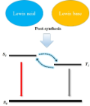
Post-synthesis from Lewis acid–base interaction: an alternative way to generate light and harvest triplet excitons
Beilstein J. Org. Chem. 2022, 18, 825–836, doi:10.3762/bjoc.18.83
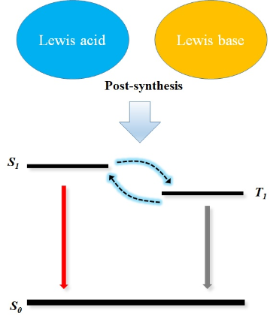
- reaction. In order to clarify the coordination reaction of nitrogen atoms, Bazan’s group designed a conjugated polymer containing pyridine and thiazole groups and small molecule 15 (Figure 8) and compared the 1H NMR spectra and 19F NMR spectra after the addition of 1 equivalent B(C6F5)3 at various
- temperatures from 230 to 300 K (see Figure 9) [43]. As shown in Figure 9a, when the temperature reached 280 K, the aromatic resonances became intense, implying the appearance of a new species, which was assigned to the Lewis acid–base adduct. Fifteen new resonance peaks were also observed in the 19F NMR
- small molecule 15 containing pyridine and thiazole groups reported by Bazan et al. and pyridine groups-containing diketopyrrolopyrroles (DPP) 16–18 investigated by Huang et al. (a) 1H NMR spectra in the aromatic region and (b) 19F NMR spectra of compound 15 (top) and the mixture with 1 equivalent B(C6F5


Direct C–H amination reactions of arenes with N-hydroxyphthalimides catalyzed by cuprous bromide
Beilstein J. Org. Chem. 2022, 18, 647–652, doi:10.3762/bjoc.18.65
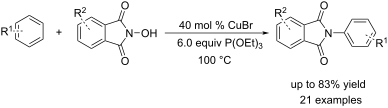
- . A plausible reaction mechanism. Optimization of the reaction conditions.a Supporting Information Supporting Information File 48: Synthetic schemes for products, characterization data, and copies of 1H, 13C, and 19F NMR spectra. Funding We gratefully acknowledge funding from Jiangsu Provincial