Search results
Search for "photophysical properties" in Full Text gives 208 result(s) in Beilstein Journal of Organic Chemistry. Showing first 200.
Substituted nitrogen-bridged diazocines
Beilstein J. Org. Chem. 2021, 17, 1503–1508, doi:10.3762/bjoc.17.107
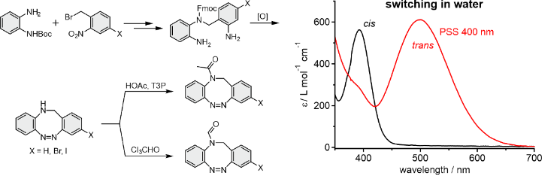
- acetyl group at the CH2NR-bridge and bromo- or iodo-substituents at the distant phenyl ring. The photophysical properties were investigated in acetonitrile and water. As compared to previous approaches the yields of the intramolecular azo cyclizations were increased (from ≈40 to 60%) using an oxidative
- Diazocines (bridged azobenzenes) are frequently used photoswitches with outstanding photophysical properties. Parent diazocine (CH2–CH2-bridged) exhibits well-separated n–π* transitions, which allow excellent photoconversion between the Z and E configurations ((Z→E)385 nm = 92%, (E→Z)525 nm > 99% in n-hexane
- anhydride of acetic acid and T3P (propanephosphonic acid anhydride). The formylation of NH-diazocines 9a–c was accomplished with chloral [23] under non-acidic conditions. Investigation of the photophysical properties The UV–vis spectra of diazocines 10a–c, and 11a–c were recorded in acetonitrile at 25 °C


Free-radical cyclization approach to polyheterocycles containing pyrrole and pyridine rings
Beilstein J. Org. Chem. 2021, 17, 1490–1498, doi:10.3762/bjoc.17.105
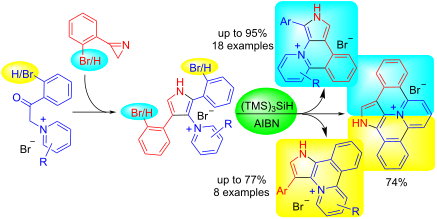
- complexes, Au(I) [20], Ir(III) [21] and Eu(III) [22] (Scheme 1). According to the calculations, the isomeric pyrido[2,1-a]pyrrolo[3,4-c]isoquinoline system B (Scheme 1) should have no less interesting photophysical properties [17], than skeleton A but its synthesis is still a challenge. In particular


Design, synthesis and photophysical properties of novel star-shaped truxene-based heterocycles utilizing ring-closing metathesis, Clauson–Kaas, Van Leusen and Ullmann-type reactions as key tools
Beilstein J. Org. Chem. 2021, 17, 1374–1384, doi:10.3762/bjoc.17.96
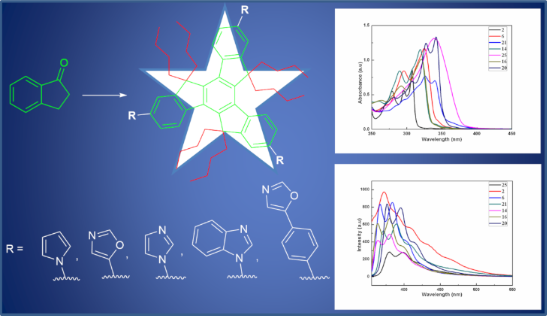
- -closing metathesis (RCM), Clauson–Kaas and Ullmann-type coupling reactions as key steps. Moreover, we have also assembled some other interesting heterocyclic systems possessing oxazole, imidazole, benzimidazole, and benzoxazole in the framework of truxene. Additionally, the preliminary photophysical
- properties (absorption and emission) for these versatile systems has been revealed. Keywords: Clauson–Kaas reaction; heterocycles; ring-closing metathesis; truxene; Ullmann-type coupling; Van Leusen reaction; Introduction The two-dimensional phenylene-based π-conjugated star-shaped architectures has
- functional materials and the opportunities are now open. Herein, we have assembled diverse truxene scaffolds containing heterocyclic systems involving trimerization, ring-closing metathesis, Clauson–Kaas and Van Leusen reactions as vital steps. Moreover, we have revealed the preliminary photophysical


Synthesis of dibenzosuberenone-based novel polycyclic π-conjugated dihydropyridazines, pyridazines and pyrroles
Beilstein J. Org. Chem. 2021, 17, 719–729, doi:10.3762/bjoc.17.61
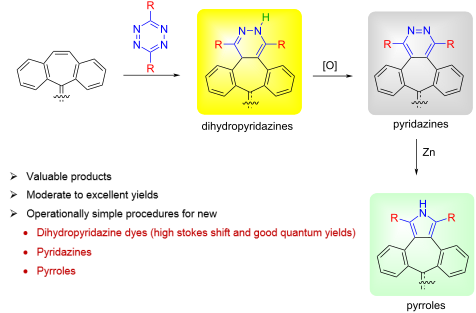
- exhibit photophysical properties such as photosensitization [13], fluorescence, and aggregation-induced emission (AIE) [14][15][16]. π-Conjugated polycyclic hydrocarbons (CPHs) containing polycyclic heteroaromatic molecules (PHAs) and aza-polycyclic aromatic hydrocarbons (aza-PAHs) have been attracting
- functional groups at the 3- and 6-positions of s-tetrazine on inverse electron-demand Diels–Alder cycloaddition reactions with a dibenzosuberenone (1) and the photophysical properties of dihydropyridazines. The corresponding pyridazines and pyrroles were obtained from dihydropyridazines. Finally, we
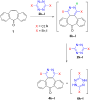
- investigated the photophysical properties of dihydropyridazines. Results and Discussion Synthesis In the first part of the study, we focused on the inverse electron-demand Diels–Alder cycloaddition reactions of dibenzosuberenone (1) with s-tetrazines 2a–l (Figure 2), which were synthesized according to the




Synthesis, structural characterization, and optical properties of benzo[f]naphtho[2,3-b]phosphoindoles
Beilstein J. Org. Chem. 2021, 17, 671–677, doi:10.3762/bjoc.17.56
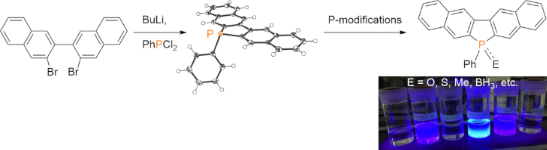
- benzonaphthophosphoindole planes (Figure 2b). The photophysical properties of the synthesized phospholes were evaluated. The corresponding data are shown in Figure 3 and Table 2. Parent compound 2 shows the absorption maximum (λmax) at 362 nm, which is longer than that of 2,2′-binaphthyl (λmax = 300 nm) [24]. The
- ]. Unfortunately, the electrochemistry of some compounds could not be determined under the conditions available to us. Therefore, computational investigations are particularly useful for understanding the trends of the electrochemical and photophysical properties of molecular materials. Density functional theory


Exploring the possibility of using fluorine-involved non-conjugated electron-withdrawing groups for thermally activated delayed fluorescence emitters by TD-DFT calculation
Beilstein J. Org. Chem. 2021, 17, 210–223, doi:10.3762/bjoc.17.21
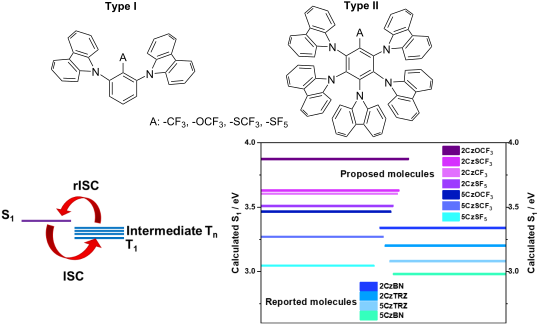
- [28][29]. Results and Discussion We employed density functional theory (DFT) and TD-DFT calculations to predict the photophysical properties of these emitters in order to assess their potential as TADF emitters for OLEDs. All ground-state calculations were performed using PBE0/6-31G(d,p) in the gas


Tuning the solid-state emission of liquid crystalline nitro-cyanostilbene by halogen bonding
Beilstein J. Org. Chem. 2021, 17, 124–131, doi:10.3762/bjoc.17.13
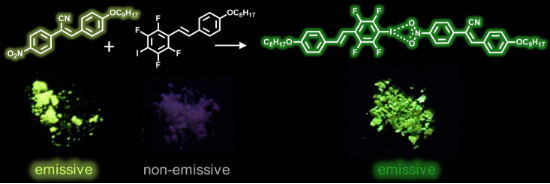
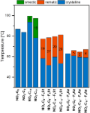
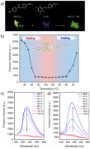
- fluoroiodoazobenzenes with varying fluorination degree at the iodobenzene moiety was used to investigate the impact of halogen bonding on the properties of the assemblies. Since cyanostilbene molecules are known to show aggregation-induced emission (AIE) behaviour the photophysical properties of the resulting
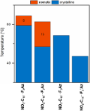
- supramolecular entities in the solid state. This effect was also confirmed by the fluorescence behaviour (see paragraph on photophysical properties) and affects mainly the transition from the nematic to crystalline phase. In addition, it was observed that only assemblies with an odd number of carbon atoms in the
- -induced emission properties were combined with alkoxystilbazoles to form hydrogen-bonded mesogens. Since NO2-Cn is known to be fluorescent, we were curious how the formation of the halogen-bonded complexes affects the AIE behaviour of NO2-Cn. Therefore, we studied the photophysical properties of 1:1






Synthesis, crystal structures and properties of carbazole-based [6]helicenes fused with an azine ring
Beilstein J. Org. Chem. 2021, 17, 11–21, doi:10.3762/bjoc.17.2
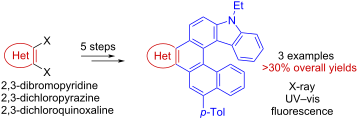
- distortion angle of 50.5° is the smallest in the series. The photophysical properties of the synthesized [6]helicenes were compared to the parent carbazole-based [6]helicene. A spectrophotometric analysis of the quinoxaline-fused helicene displayed a moderate absorption red-shift (19 nm) and reduced optical
- . Sonogashira coupling of compounds 7 with p-tolylacetylene. Acid-induced isomerization of compounds 9 into carbazole-based [6]helicenes 10. Comparison of X-ray data of the carbazole-based [6]helicenes (atomic numbering does not correspond to IUPAC nomenclature). Photophysical properties of carbazole-based [6

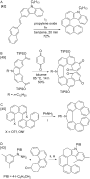


Naphthalonitriles featuring efficient emission in solution and in the solid state
Beilstein J. Org. Chem. 2020, 16, 2960–2970, doi:10.3762/bjoc.16.246
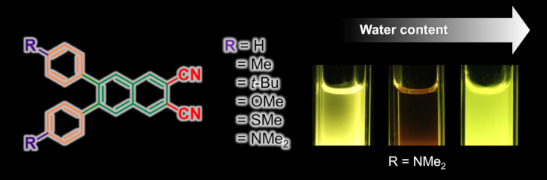
- , the π-donor nature of the substituents on the phenyl ring constitutes the main parameter that influences the photophysical properties, such as excited state lifetimes and photoluminescence quantum yields. Hence, a series of highly luminescent materials from deep blue to red emission depending on
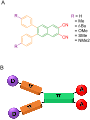
- reports on the DSE behavior of 6,7-disubstituted naphthalene-2,3-dicarbonitrile derivatives so far. Herein we have designed and synthesized donor–acceptor (D–A) naphthalonitriles (NCNs) symmetrically γ-disubstituted with two p-functionalized phenyl moieties and investigated their photophysical properties
- from pure organic solvents to water, in which aggregates are formed. Thus, the photophysical properties of all compounds were investigated in THF and in different ratios of THF/water to study aggregate dispersions at room temperature, and the aggregates were further analyzed by DLS. The results showed



Styryl-based new organic chromophores bearing free amino and azomethine groups: synthesis, photophysical, NLO, and thermal properties
Beilstein J. Org. Chem. 2020, 16, 2282–2296, doi:10.3762/bjoc.16.189
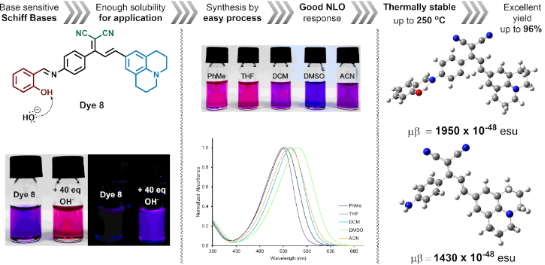
- dicyanomethylene group as an acceptor and different para-substituted alkylamines as donors. Morever as a proton-sensitive group a pyridin-2-yl substituent was attached to the para-position of the phenyl moiety in both series of compounds. The photophysical properties of the dyes were examined in various solvents
- azomethine group are one of the most widely used organic dyes because of their easy and cheap synthetic accessibility through various methodologies and suitable photophysical properties. In addition, they exhibit a broad range of biological activities such as antimicrobial, antifungal, antiviral, and
- temperature (Figure 2, Table 1, and Table S1 in Supporting Information File 1). The dyes showed generally good solubility in organic solvents. However, the dyes 8–12 had a low solubility in MeOH. Therefore, the photophysical properties of the dyes 8–12 could not be investigated in this solvent. The Dimroth


Et3N/DMSO-supported one-pot synthesis of highly fluorescent β-carboline-linked benzothiophenones via sulfur insertion and estimation of the photophysical properties
Beilstein J. Org. Chem. 2020, 16, 1740–1753, doi:10.3762/bjoc.16.146
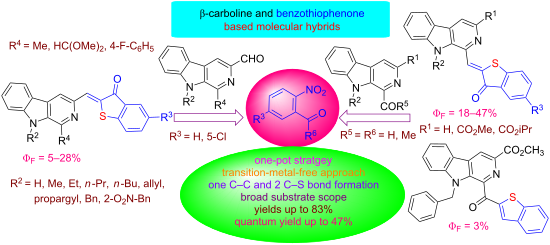
- excellent light-emitting properties with quantum yields (ΦF) up to 47%. Keywords: benzothiophene; β-carboline; metal-free; photophysical properties; sulfur insertion; Introduction The pyrido[3,4-b]indole moiety, commonly referred as β-carboline, is the core unit of about one quarter of all natural
- measurement of UV–vis absorption and fluorescence emission of the samples, stock solutions of 1.0 mM concentration were prepared using analytical grade CHCl3 as the solvent, and diluted to the final concentration of 4.0 μM. Next, we carefully measured the photophysical properties at room temperature including
- = 18%) in this series (Table 2 and Figure 3). The presence of a benzyl group at R2 (2hA), improved the photophysical properties including a higher quantum yield (ΦF = 47%). With variation of the substituents at the R1 position, a regular pattern of fluorescence was observed, i.e., CO2iPr > CO2Me > H


Clickable azide-functionalized bromoarylaldehydes – synthesis and photophysical characterization
Beilstein J. Org. Chem. 2020, 16, 1683–1692, doi:10.3762/bjoc.16.139
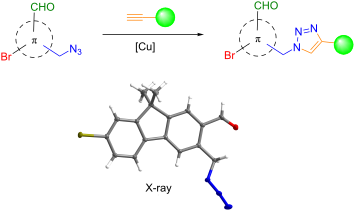
- alkynes, exhibiting different degrees of steric demand, was performed in high efficiency. Finally, we investigated the photophysical properties of the azide-functionalized arenes and their covalently linked triazole derivatives to gain deeper insight towards the effect of these covalent linkers on the
- *) character of the T2 state. Although phosphorescent organic compounds are well investigated with respect to their photophysical properties in the crystalline state, in solution or physically embedded in polymer matrices, there is a significant lack of possibilities [61] for their targeted covalent attachment
- triazole 45 in 83% yield. Photophysical properties Finally, we examined the photophysical properties of both the azides and the triazoles. UV–vis absorption measurements of para-bromobenzaldehyde 3 and ortho-bromobenzaldehyde 4 as well as the corresponding triazoles 33–40 were conducted in chloroform


Heterogeneous photocatalysis in flow chemical reactors
Beilstein J. Org. Chem. 2020, 16, 1495–1549, doi:10.3762/bjoc.16.125
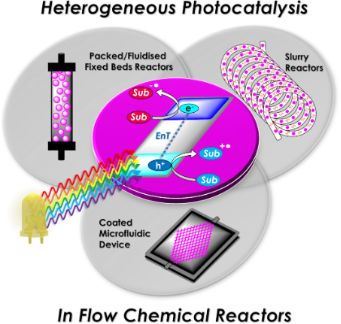
- has shifted the paradigms of photochemistry, opening new avenues of research with safer and scalable processes that can be readily implemented in academia and industry. Current state-of-the-art photocatalysts are homogeneous transition metal complexes that have favourable photophysical properties
- photophysical properties and surface structure of HPCats are more challenging to characterise and requires specialised techniques that are not readily available and often require multidisciplinary collaborations [44]. Additionally, the penetration of light through the bulk of the HPCat is difficult and can
- via physisorption. However, functionalised molecules and ions can strongly bind through chemisorption by covalent bonds, hydrogen bonding, or electrostatic attraction and have been shown to influence the photophysical properties of TiO2, generally causing a bathochromic shift of the absorption











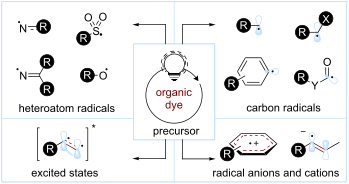
Photocatalysis with organic dyes: facile access to reactive intermediates for synthesis
Beilstein J. Org. Chem. 2020, 16, 1163–1187, doi:10.3762/bjoc.16.103





Development of fluorinated benzils and bisbenzils as room-temperature phosphorescent molecules
Beilstein J. Org. Chem. 2020, 16, 1154–1162, doi:10.3762/bjoc.16.102
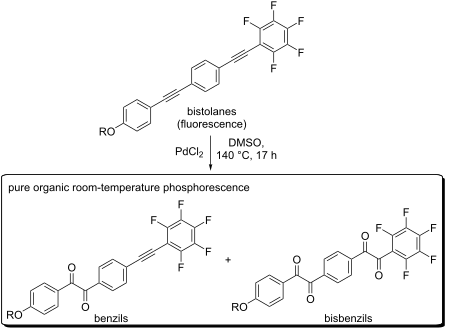
- transition-metal-complex-based phosphores for biomedical and technological applications owing to their abundance and nontoxicity. This article discloses the design, synthesis, and photophysical properties of fluorinated benzil and bisbenzil derivatives as potential pure organic room-temperature
- photophysical properties of the benzil and bisbenzil derivatives in toluene at 25 °C showed both fluorescence with a photoluminescence (PL) band at a maximum wavelength (λPL) of around 400 nm and phosphorescence with a PL band at a λPL of around 560 nm. Interestingly, intersystem crossing effectively caused
- examined the synthesis of novel benzil- and bisbenzil-type molecules via oxidation of fluorinated and nonfluorinated bistolane derivatives and evaluated their photophysical properties in detail. Results and Discussion Synthesis This study was initiated with the synthesis of fluorinated bisbenzil



Synthesis and properties of quinazoline-based versatile exciplex-forming compounds
Beilstein J. Org. Chem. 2020, 16, 1142–1153, doi:10.3762/bjoc.16.101
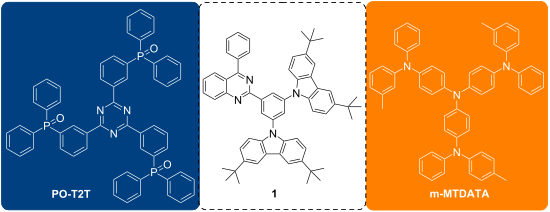
- , bearing a quinazoline unit as the acceptor core and carbazole, dimethyldihydroacridine, or phenothiazine donor moieties, were designed and synthesized in two steps including a facile copper-catalyzed cyclization and a nucleophilic aromatic substitution reaction. The photophysical properties of the
- solid sample of compound 1 (e, inset). Synthesis of quinazoline derivatives 1–3. Conditions: i) ammonium acetate, copper(II) chloride, isopropanol, reflux, 24 h; ii) donor moiety (D), NaH, DMF, reflux, 24 h. Electrochemical characteristics. Photophysical properties of compound 1–3. Funding This project


Synthesis of esters of diaminotruxillic bis-amino acids by Pd-mediated photocycloaddition of analogs of the Kaede protein chromophore
Beilstein J. Org. Chem. 2020, 16, 1111–1123, doi:10.3762/bjoc.16.98
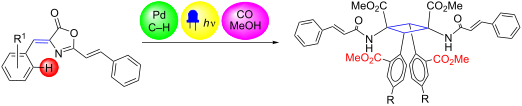
- precursors of the photoconvertible chromophore of the Kaede protein, an imidazolone with outstanding photophysical properties [31][32][33][34][35][36][37][38]. It is clear from Figure 2b that the molecular skeleton contains different reactive functional groups, which offer a variety of structural


Synthesis of novel multifunctional carbazole-based molecules and their thermal, electrochemical and optical properties
Beilstein J. Org. Chem. 2020, 16, 1066–1074, doi:10.3762/bjoc.16.93
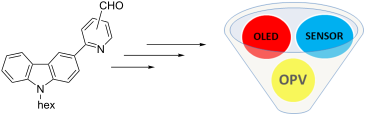
- component), whereas the link by conjugation between the same functionalities in 7a is missing. The resulting stronger ICT component in 7b explains the big difference in photophysical properties. Experimental All reagents were standard reagent grade and purchased from Sigma-Aldrich, Merck and Alfa Aesar


Aryl-substituted acridanes as hosts for TADF-based OLEDs
Beilstein J. Org. Chem. 2020, 16, 989–1000, doi:10.3762/bjoc.16.88
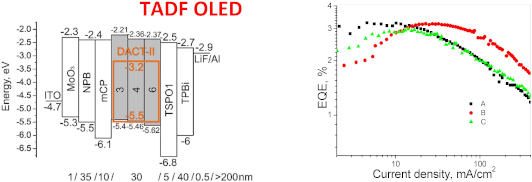
- molecular weights resulting in a stronger intermolecular interaction and by larger volumes restricting molecular motion. These observations confirm that compounds 3–5 can be used for the preparation of thin amorphous layers on substrates. Photophysical properties The absorption and photoluminescence (PL




Aldehydes as powerful initiators for photochemical transformations
Beilstein J. Org. Chem. 2020, 16, 833–857, doi:10.3762/bjoc.16.76
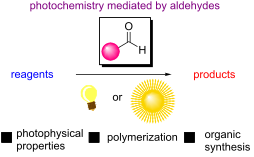
- ) aldehydes have as photoinitiators. The photophysical properties and photoreactivity of benzaldehyde are initially provided, followed by applications of aldehydes as initiators for polymerization reactions. Finally, the applications to date regarding aldehydes as photoinitiators in organic synthesis are
- are useful photocatalysts, the corresponding aldehydes are not so widely utilized to promote chemical reactions. In this review, our goal was to summarize the photophysical properties of aromatic aldehydes, highlight the use of aldehydes as photoinitiators in polymerization reactions, and provide all
- examples where aldehydes were employed as photoinitiators in organic synthesis. Review Photophysical properties of carbonyl compounds The interest in the interaction of aldehydes with light to promote reactions can be traced many years back. In 1966, Davies and co-worker studied the energy transfer from






One-pot synthesis of dicyclopenta-fused peropyrene via a fourfold alkyne annulation
Beilstein J. Org. Chem. 2020, 16, 791–797, doi:10.3762/bjoc.16.72
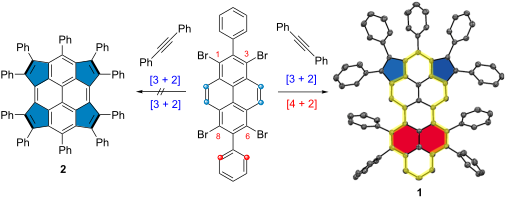
- pentagons could be realized [11][12][13][14][15][16][17]. Among them, the cyclopenta-fused pyrenes are an important class of CP-PAHs owing to their unique physical and photophysical properties, such as high electron affinities and anomalous fluorescence [17][18][19][20]. However, the reported synthetic


Towards triptycene functionalization and triptycene-linked porphyrin arrays
Beilstein J. Org. Chem. 2020, 16, 763–777, doi:10.3762/bjoc.16.70
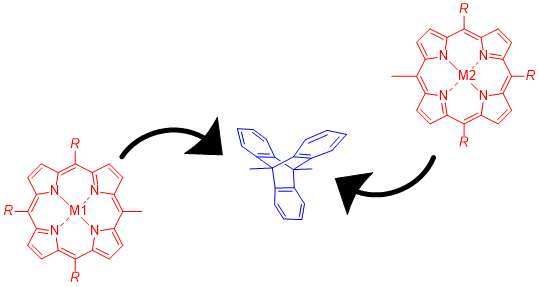
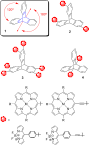
- and electrochemical properties of the porphyrins by increasing the size of the aromatic π-system [16]. In contrast, our approach described herein deviates significantly from previous studies by examining how isolating the individual porphyrin units affects the overall photophysical properties of the
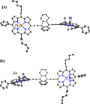
- properties of triptycene complexes The photophysical properties of the five new triptycene-liked porphyrin/BODIPY compounds 7, 9, 14, 16 and 18 were investigated in preliminary studies for their suitability as model compounds for electron transfer in the context of artificial photosynthesis. Similar Soret





Synthesis of C70-fragment buckybowls bearing alkoxy substituents
Beilstein J. Org. Chem. 2020, 16, 681–690, doi:10.3762/bjoc.16.66
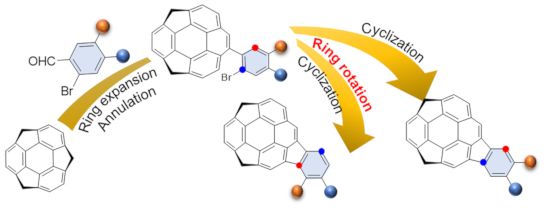
- hydrogen bonds (C37∙∙∙O1, C11∙∙∙O2, C40∙∙∙O4) (Figure 5c). Photophysical properties of the dialkoxides were investigated by UV–vis and emission spectroscopies (Figure 6). UV–vis spectra of 5a and 5b well reflected the electric property of 1, showing two strong bands observed at around 280–300 nm and 330


Direct borylation of terrylene and quaterrylene
Beilstein J. Org. Chem. 2020, 16, 621–627, doi:10.3762/bjoc.16.58
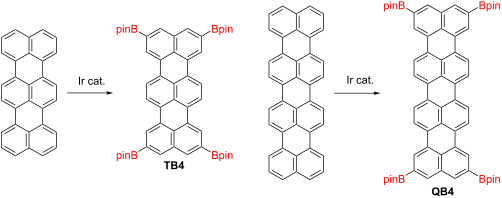
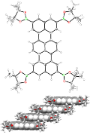
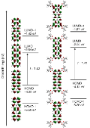
- photophysical properties of TB4 are also unchanged by the substituents because the carbon atoms at 2,5,10,13-positions have less coefficients on its HOMO and LUMO, estimated by theoretical calculations. Finally, the same borylation reaction was applied for quaterrylene, resulting in the formation of soluble





Regioselectively α- and β-alkynylated BODIPY dyes via gold(I)-catalyzed direct C–H functionalization and their photophysical properties
Beilstein J. Org. Chem. 2020, 16, 587–595, doi:10.3762/bjoc.16.53
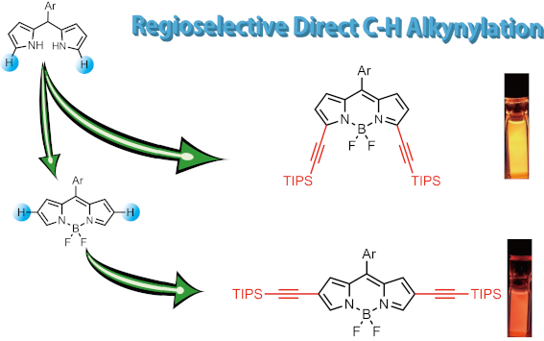
- . Depending on the position of the ethynyl substituent in the BODIPY skeleton, the photophysical properties of the resulting α- and β-substituted BODIPYs are notably altered. The lowest S0–S1 transition absorbance and fluorescence bands are both bathochromically shifted as the number of substituents increases
- , while the emission quantum yields of the β-ethynylated derivatives are significantly lower than those of α-ethynylated ones. The current method should be useful for fine-tuning of the photophysical properties of BODIPY dyes as well as for constructing BODIPY-based building cores for functional π
- afford α-monoethynyl and α,α'-diethynyl-substituted BODIPYs 3 and 4, respectively. The resulting ethynylated BODIPY isomers demonstrated site-dependent photophysical properties. Results and Discussion Synthesis and characterization To prepare the α,α'-diethynyl BODIPY 4a, 5-mesityldipyrromethane 2 was