


Search results
Search for "H2O2" in Full Text gives 162 result(s) in Beilstein Journal of Organic Chemistry.
Total synthesis of a Streptococcus pneumoniae serotype 12F CPS repeating unit hexasaccharide
- Peter H. Seeberger,
- Claney L. Pereira and
- Subramanian Govindan
Beilstein J. Org. Chem. 2017, 13, 164–173, doi:10.3762/bjoc.13.19
- a mixture of AcOH/H2O/t-BuOH prior to ester hydrolysis using LiOH/H2O2 enabled the hexasaccharide 1 to be obtained in 37% yield (Scheme 9). Conclusion The first total synthesis of the S. pneumoniae serotype 12F capsular polysaccharide repeating unit hexasaccharide 1 was achieved by means of a linear
- (0.5 M in MeOH) in MeOH, ii. NaOH (4 M, 2 M, 1 M, 0.5 M, 0.1 M) solution in THF, iii. H2O2, LiOH, THF, H2O; successful sequence (d) Pd/C, AcOH, H2O, t-BuOH (e) H2O2, LiOH, THF, H2O, 37% over two steps. Supporting Information Supporting Information File 44: Experimental details and full

Graphical Abstract

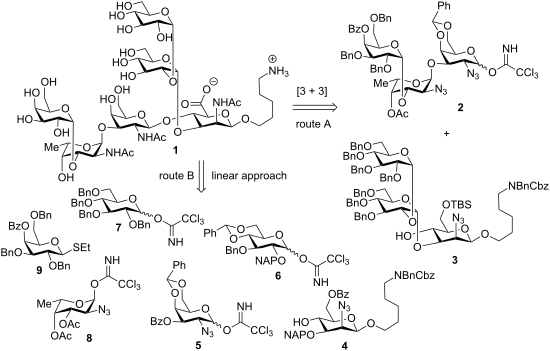
Figure 1: Structure of the S. pneumoniae serotype 12F capsular polysaccharide repeating unit [15].

Scheme 1: Retrosynthetic analyses of the S. pneumoniae hexasaccharide 1.

Scheme 2: Attempted synthesis of mannosazide building block 15. Reagents and conditions: (a) levulinic acid, ...

Scheme 3: Synthesis of mannosazide building block 18. Reagents and conditions: (a) TBSCl, imidazole, DCM, 0 °...

Scheme 4: Synthesis of the reducing-end trisaccharide 3. Reagents and conditions: (a) TMSOTf, (CH3CH2)2O/CH2Cl...

Scheme 5: Synthesis of monosaccharide building blocks 8, 9 and 26. Reagents and conditions: (a) acetic anhydr...

Scheme 6: Synthesis of the non-reducing end trisaccharide 2. Reagents and conditions: (a) TMSOTf, CH2Cl2, −30...

Scheme 7: Attempted synthesis of hexasaccharide repeating unit 36 via a convergent [3 + 3] glycosylation stra...

Scheme 8: Linear assembly of fully protected hexasaccharide 51. Reagents and conditions: (a) DDQ, CH2Cl2/MeOH...

Scheme 9: Global deprotection to furnish S. pneumonia serotype 12F repeating unit hexasaccharide 1. Reagents ...
Stabilization of nanosized titanium dioxide by cyclodextrin polymers and its photocatalytic effect on the degradation of wastewater pollutants
- Tamás Zoltán Agócs,
- István Puskás,
- Erzsébet Varga,
- Mónika Molnár and
- Éva Fenyvesi
Beilstein J. Org. Chem. 2016, 12, 2873–2882, doi:10.3762/bjoc.12.286
- environments, can set up a photo-Fenton system with H2O2 produced in situ generating OH radicals of high oxidizing capacity [42][43]. Nitrate could also produce OH radicals when absorbing UV light, but the low concentration of nitrate in tap water can insignificantly contribute to enhancing photodegradation

Graphical Abstract

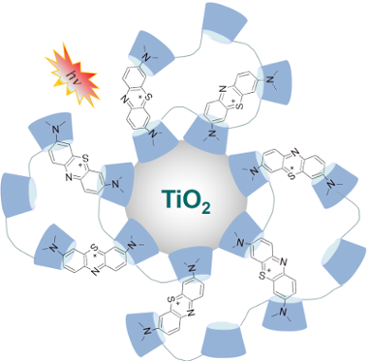
Figure 1: Adsorption of β-CD on the surface of nanoTiO2 [37].

Figure 2: Turbidity of nanoTiO2 dispersion (0.02%) in the presence of 1% HPBCD-P (green diamond) and 1% CMBCD...

Figure 3: Aggregation effect of 0.1% NaCl on 0.02% nanoTiO2 dispersion in the absence (green curve) and prese...

Figure 4: Aggregation effect of tap water on 0.02% nanoTiO2 dispersion in the absence (green curve) and prese...
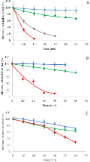
Figure 5: Photodegradation of MB in aqueous solutions: distilled water (A), 0.1% NaCl solution (B) and tap wa...

Figure 6: Photodegradation of IBR in distilled water examining the drug itself (blue circle), and in the pres...
A new protocol for the synthesis of 4,7,12,15-tetrachloro[2.2]paracyclophane
- Donghui Pan,
- Yanbin Wang and
- Guomin Xiao
Beilstein J. Org. Chem. 2016, 12, 2443–2449, doi:10.3762/bjoc.12.237
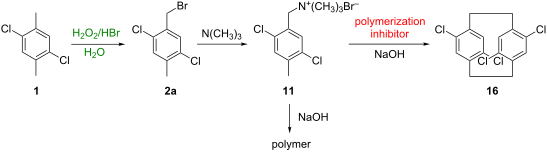
- precursor of parylene D, from 2,5-dichloro-p-xylene. In the first bromination step, with H2O2–HBr as a bromide source, this procedure becomes organic-waste-free and organic-solvent-free and can appropriately replace the existing bromination methods. The Winberg elimination–dimerization step, using aqueous
- sodium hydroxide solution instead of silver oxide for anion exchange, results in a significant improvement in product yield. Furthermore, four substituted [2.2]paracyclophanes were also prepared in this convenient way. Keywords: bromination; dimerization; H2O2–HBr system; paracyclophane; polymerization
- drawbacks such as low atom efficiency and the requirement of reagent residue elimination [14]. In contrast to traditional brominating reagents, the H2O2–HBr system, which generates active bromine in situ, is a convenient and green brominating agent [15]. Furthermore, the use of the H2O2–HBr couple improves

Graphical Abstract

Figure 1: Chemical structures of parylene N, parylene C, and parylene D.

Figure 2: Chemical structures of [2.2]paracyclophane and 4,7,12,15-tetrachloro[2.2]paracyclophane.

Scheme 1: Synthesis of substituted (4-methylbenzyl)trimethylammonium bromides from substituted (4-methylbenzy...
Silica-supported sulfonic acids as recyclable catalyst for esterification of levulinic acid with stoichiometric amounts of alcohols
- Raimondo Maggi,
- N. Raveendran Shiju,
- Veronica Santacroce,
- Giovanni Maestri,
- Franca Bigi and
- Gadi Rothenberg
Beilstein J. Org. Chem. 2016, 12, 2173–2180, doi:10.3762/bjoc.12.207
- toluene (120 mL) and the resulting supported propylmercaptane has been oxidized to propanesulfonic acid by treatment with 30% aq H2O2 (100 mL; 1 mol) for 24 h under stirring at rt, adding a few drops of concentrated sulfuric acid after 12 h. Acidity has been measured via the titration method [35] (0.51

Graphical Abstract
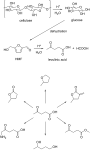
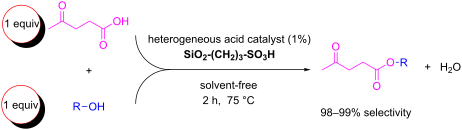
Scheme 1: Synthesis of levulinic acid from ligno-cellulosic feedstocks and its principal uses to access fine ...

Figure 1: Anchoring methodologies: a) impregnation; b) covalent binding.

Figure 2: Activity of the supported sulfonic acid catalyst within the first six cycles. Reaction conditions: ...
Stereo- and regioselectivity of the hetero-Diels–Alder reaction of nitroso derivatives with conjugated dienes
- Lucie Brulíková,
- Aidan Harrison,
- Marvin J. Miller and
- Jan Hlaváč
Beilstein J. Org. Chem. 2016, 12, 1949–1980, doi:10.3762/bjoc.12.184
- TiO2 nanoparticle assemblies using H2O2 [51]. Geminal chloronitroso compounds are synthesized or in situ generated from their corresponding oximes by chlorination. As halogen source elemental chlorine [52][53][54], nitrosyl chloride [55], alkyl hypochlorites [56], N-chlorourea [57], tert-butyl

Graphical Abstract

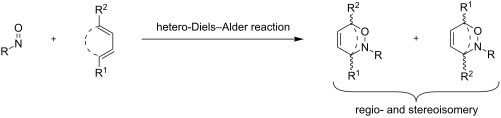
Scheme 1: Nitroso hetero-Diels–Alder reaction.

Scheme 2: The hetero-Diels–Alder reaction between thebaine (4) and an acylnitroso dienophile 5.

Figure 1: Examples of nitroso dienophiles frequently used in hetero-Diels–Alder reaction studies.

Scheme 3: Synthesis of arylnitroso species by substitution of a trifluoroborate group [36].
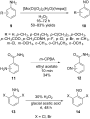
Scheme 4: Synthesis of arylnitroso compounds by amine oxidation.

Scheme 5: Synthesis of arylnitroso compounds by hydroxylamine oxidation.

Scheme 6: Synthesis of chloronitroso compounds by the treatment of a nitronate anion with oxalyl chloride.

Scheme 7: Non-oxidative routes to acylnitroso species.

Figure 2: RB3LYP/6-31G* computed energies (in kcal·mol−1) and bond lengths for exo and endo-transition states...

Scheme 8: Hetero-Diels–Alder cycloadditions of diene 28 and nitroso dienophiles 29.

Figure 3: Relative reactivity (ΔE#) and regioselectivity (Δ) for hetero-Diels–Alder of 28 and nitroso dienoph...

Scheme 9: Reaction of chiral 1-phosphono-1,3-butadiene 31 with nitroso dienophiles 32.

Scheme 10: Hetero-Diels–Alder reactions of hydroxamic acids 35 with various dienes 37.

Scheme 11: General regioselectivity of the nitroso hetero-Diels–Alder reaction observed with unsymmetrical die...

Scheme 12: Effect of the nitroso species on the regioselectivity for weakly directing 2-substituted dienes.

Scheme 13: Regioselectivity of 1,4-disubstituted dienes 51.

Scheme 14: Nitroso hetero-Diels–Alder reaction between Boc-nitroso compound 54 and dienes 55.

Scheme 15: Nitroso hetero-Diels–Alder reaction between Wightman reagent 58 and dienes 59.

Scheme 16: Regioselective reaction of 3-dienyl-2-azetidinones 62 with nitrosobenzene (47).

Scheme 17: The regioselective reaction of 1,3-butadienes 65 with various nitroso heterodienophiles 66.

Scheme 18: Catalysis of the nitroso hetero-Diels–Alder reaction by vanadium in the presence of the oxidant CHP...

Figure 4: 1,2-Oxazines synthesized in solution with moderate to high regioselectivity, showing the favored re...

Figure 5: 1,2-Oxazines synthesized in the solid phase with moderate to high regioselectivity, showing the fav...

Scheme 19: Regioselectivity of solution-phase nitroso hetero-Diels–Alder reaction with acyl and aryl nitroso d...

Scheme 20: Favored regioisomeric outcome for the solution and solid-phase reactions, giving hetero-Diels–Alder...

Figure 6: Favored regioisomers and regioisomeric ratios for 1,2-oxazines synthesized in solid phase (91, 93, ...

Scheme 21: Regiocontrol of the reaction between 3-dienyl-2-azetidinones and nitrosobenzene due to change in a ...

Scheme 22: Regiocontrol of the reaction between diene 111 and 2-methyl-6-nitrosopyridine (112) due to metal co...

Scheme 23: Asymmetric hetero-Diels–Alder reactions reported by Vasella [56].

Scheme 24: Asymmetric hetero-Diels–Alder reaction of cyclohexa-1,3-diene (120) with acylnitroso dienophile 119....

Scheme 25: Asymmetric induction with L-proline derivatives 124–126.

Scheme 26: Asymmetric cycloaddition of the acylnitroso compound 136 to diene 135.

Scheme 27: Asymmetric induction with arylmenthol-based nitroso dienophiles 142.

Scheme 28: Cycloaddition of silyloxycyclohexadiene 145 to the acylnitroso dienophile derived from (+)-camphors...

Scheme 29: Asymmetric reaction of O-isopropylidene-protected cis-cyclohexa-3,5-diene-1,2-diol 147 with mannofu...

Scheme 30: Synthesis of synthon 152 from 2-methoxyphenol 150 and chiral auxiliary 151.

Scheme 31: Asymmetric nitroso hetero-Diels–Alder reaction with Wightman chloronitroso reagent 58.

Scheme 32: Asymmetric 1,2-oxazine synthesis using chiral cyclic diene 157 and the application of this reaction...

Scheme 33: Asymmetric 1,2-oxazine synthesis using a chiral diene reported by Jones et al. [75]. aRegioisomeric rat...

Scheme 34: The nitroso hetero-Diels–Alder reaction of acyclic oxazolidine-substituted diene 170 and chiral 1-s...

Scheme 35: The nitroso hetero-Diels–Alder reaction of acyclic lactam-substituted diene 176 with various acylni...

Scheme 36: The hetero-Diels–Alder reaction of acylnitroso dienophile.

Scheme 37: The hetero-Diels–Alder reaction of arylnitroso dienophiles using Lewis acids.

Scheme 38: Asymmetric hetero-Diels–Alder reactions of chiral alkyl N-dienylpyroglutamates.

Scheme 39: Catalytic asymmetric arylnitroso reaction between mono-substituted 1,3-cyclohexadiene 196 and disub...

Figure 7: Plausible chelate intermediate complexes formed during the hetero-Diels–Alder reaction to give 1,2-...

Scheme 40: Catalytic asymmetric nitroso hetero-Diels–Alder between cyclic dienes and 2-nitrosopyridine.

Scheme 41: The reason for the increased enantioselectivity of stereoisomer 212 compared with stereoisomer 213.

Scheme 42: The copper-catalyzed nitroso hetero-Diels–Alder reaction of 6-methyl-2-nitrosopyridine (199) with p...

Scheme 43: Asymmetric nitroso hetero-Diels–Alder reaction of nitrosoarenes with dienylcarbamates catalyzed by ...

Scheme 44: The enantioselective hetero-Diels–Alder reaction between nitrosobenzene and (E)-2,4-pentadien-1-ol (...

Scheme 45: Asymmetric nitroso hetero-Diels–Alder reaction using tartaric acid ester chelation of the diene and...
Rearrangements of organic peroxides and related processes
- Ivan A. Yaremenko,
- Vera A. Vil’,
- Dmitry V. Demchuk and
- Alexander O. Terent’ev
Beilstein J. Org. Chem. 2016, 12, 1647–1748, doi:10.3762/bjoc.12.162
- > perbenzoic acid > peracetic acid >> H2O2 > t-BuOOH [196]. The migratory ability of substituents in the Criegee intermediate decreases in the following series: tertiary alkyl > cyclohexyl > secondary alkyl > benzyl > phenyl > primary alkyl > cyclopentyl, cyclopropyl > methyl. In some cases, stereoelectronical
- hydrogen peroxide. Oxidizing systems containing hydrogen peroxide as the oxidizing agent allow the usual and asymmetric oxidation of the substrate to the target product with high conversion and yield. In recent years, the inexpensive, commercially available, and environmentally friendly H2O2 was utilized
- theoretically studied mechanism of the oxidation reaction promoted by H2O2 and the Lewis acid BF3 [217][219]. In the first step, the hydrogen peroxide–boron trifluoride complex 8 reacts with ketone 9 to form adduct 10. The latter intermediate rearranges through transition state 11 into the tetrahedral

Graphical Abstract
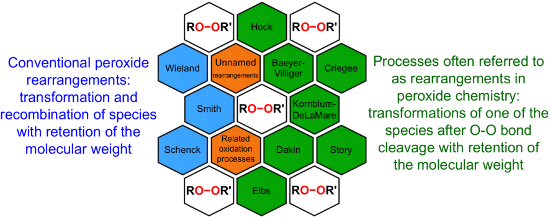
Figure 1: The named transformations considered in this review.

Scheme 1: The Baeyer–Villiger oxidation.

Scheme 2: The general mechanism of the peracid-promoted Baeyer–Villiger oxidation.

Scheme 3: General mechanism of the Lewis acid-catalyzed Baeyer–Villiger rearrangement.

Scheme 4: The theoretically studied mechanism of the BV oxidation reaction promoted by H2O2 and the Lewis aci...

Scheme 5: Proton movements in the transition states of the Baeyer–Villiger oxidation.

Scheme 6: The dependence of the course of the Baeyer–Villiger oxidation on the type of O–O-bond cleavage in t...
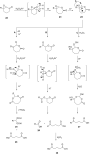
Scheme 7: The acid-catalyzed Baeyer–Villiger oxidation of cyclic epoxy ketones 22.

Scheme 8: Oxidation of isophorone oxide 29.

Scheme 9: Synthesis of acyl phosphate 32 from acyl phosphonate 31.

Scheme 10: Synthesis of aflatoxin B2 (36).

Scheme 11: The Baeyer–Villiger rearrangement of ketones 37 to lactones 38.

Scheme 12: Synthesis of 3,4-dimethoxybenzoic acid (40) via Baeyer–Villiger oxidation.

Scheme 13: Oxone transforms α,β-unsaturated ketones 43 into vinyl acetates 44.

Scheme 14: The Baeyer–Villiger oxidation of ketones 45 using diaryl diselenide and hydrogen peroxide.

Scheme 15: Baeyer–Villiger oxidation of (E)-2-methylenecyclobutanones.

Scheme 16: Oxidation of β-ionone (56) by H2O2/(BnSe)2 with formation of (E)-2-(2,6,6-trimethylcyclohex-1-en-1-...

Scheme 17: The mechanism of oxidation of ketones 58a–f by hydrogen peroxide in the presence of arsonated polys...

Scheme 18: Oxidation of ketone (58b) by H2O2 to 6-methylcaprolactone (59b) catalyzed by Pt complex 66·BF4.

Scheme 19: Oxidation of ketones 67 with H2O2 in the presence of [(dppb}Pt(µ-OH)]22+.

Scheme 20: The mechanism of oxidation of ketones 67 in the presence of [(dppb}Pt(µ-OH)]22+ and H2O2.

Scheme 21: Oxidation of benzaldehydes 69 in the presence of the H2O2/MeReO3 system.

Scheme 22: Oxidation of acetophenones 72 in the presence of the H2O2/MeReO3 system.

Scheme 23: Baeyer–Villiger oxidation of 2-adamantanone (45c) in the presence of Sn-containing mesoporous silic...

Scheme 24: Aerobic Baeyer–Villiger oxidation of ketones 76 using metal-free carbon.

Scheme 25: A regioselective Baeyer-Villiger oxidation of functionalized cyclohexenones 78 into a dihydrooxepin...

Scheme 26: The oxidation of aldehydes and ketones 80 by H2O2 catalyzed by Co4HP2Mo15V3O62.

Scheme 27: The cleavage of ketones 82 with hydrogen peroxide in alkaline solution.

Scheme 28: Oxidation of ketones 85 to esters 86 with H2O2–urea in the presence of KHCO3.

Scheme 29: Mechanism of the asymmetric oxidation of cyclopentane-1,2-dione 87a with the Ti(OiPr)4/(+)DET/t-BuO...

Scheme 30: The oxidation of cis-4-tert-butyl-2-fluorocyclohexanone (93) with m-chloroperbenzoic acid.

Scheme 31: The mechanism of the asymmetric oxidation of 3-substituted cyclobutanone 96a in the presence of chi...

Scheme 32: Enantioselective Baeyer–Villiger oxidation of cyclic ketones 98.

Scheme 33: Regio- and enantioselective Baeyer–Villiger oxidation of cyclic ketones 101.

Scheme 34: The proposed mechanism of the Baeyer–Villiger oxidation of acetal 105f.

Scheme 35: Synthesis of hydroxy-10H-acridin-9-one 117 from tetramethoxyanthracene 114.

Scheme 36: The Baeyer–Villiger oxidation of the fully substituted pyrrole 120.

Scheme 37: The Criegee rearrangement.

Scheme 38: The mechanism of the Criegee reaction of a peracid with a tertiary alcohol 122.

Scheme 39: Criegee rearrangement of decaline ethylperoxoate 127 into ketal 128.

Scheme 40: The ionic cleavage of 2-methoxy-2-propyl perester 129.

Scheme 41: The Criegee rearrangement of α-methoxy hydroperoxide 136.
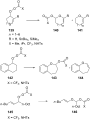
Scheme 42: Synthesis of enol esters and acetals via the Criegee rearrangement.

Scheme 43: Proposed mechanism of the transformation of 1-hydroperoxy-2-oxabicycloalkanones 147a–d.

Scheme 44: Transformation of 3-hydroxy-1,2-dioxolanes 151 into diketone derivatives 152.

Scheme 45: Criegee rearrangement of peroxide 153 with the mono-, di-, and tri-O-insertion.

Scheme 46: The sequential Criegee rearrangements of adamantanes 157a,b.

Scheme 47: Synthesis of diaryl carbonates 160a–d from triarylmethanols 159a–d through successive oxygen insert...

Scheme 48: The synthesis of sesquiterpenes 162 from ketone 161 with a Criegee rearrangement as one key step.

Scheme 49: Synthesis of trans-hydrindan derivatives 164, 165.

Scheme 50: The Hock rearrangement.

Scheme 51: The general scheme of the cumene process.

Scheme 52: The Hock rearrangement of aliphatic hydroperoxides.
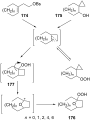
Scheme 53: The mechanism of solvolysis of brosylates 174a–c and spiro cyclopropyl carbinols 175a–c in THF/H2O2....

Scheme 54: The fragmentation mechanism of hydroperoxy acetals 178 to esters 179.

Scheme 55: The acid-catalyzed rearrangement of phenylcyclopentyl hydroperoxide 181.

Scheme 56: The peroxidation of tertiary alcohols in the presence of a catalytic amount of acid.

Scheme 57: The acid-catalyzed reaction of bicyclic secondary alcohols 192 with hydrogen peroxide.

Scheme 58: The photooxidation of 5,6-disubstituted 3,4-dihydro-2H-pyrans 196.

Scheme 59: The oxidation of tertiary alcohols 200a–g, 203a,b, and 206.

Scheme 60: Transformation of functional peroxide 209 leading to 2,3-disubstitued furans 210 in one step.

Scheme 61: The synthesis of carbazoles 213 via peroxide rearrangement.

Scheme 62: The construction of C–N bonds using the Hock rearrangement.

Scheme 63: The synthesis of moiety 218 from 217 which is a structural motif in the antitumor–antibiotic of CC-...

Scheme 64: The in vivo oxidation steps of cholesterol (219) by singlet oxygen.

Scheme 65: The proposed mechanism of the rearrangement of cholesterol-5α-OOH 220.

Scheme 66: Photochemical route to artemisinin via Hock rearrangement of 223.

Scheme 67: The Kornblum–DeLaMare rearrangement.

Scheme 68: Kornblum–DeLaMare transformation of 1-phenylethyl tert-butyl peroxide (225).

Scheme 69: The synthesis 4-hydroxyenones 230 from peroxide 229.

Scheme 70: The Kornblum–DeLaMare rearrangement of peroxide 232.

Scheme 71: The reduction of peroxide 234.

Scheme 72: The Kornblum–DeLaMare rearrangement of endoperoxide 236.

Scheme 73: The rearrangement of peroxide 238 under Kornblum–DeLaMare conditions.

Scheme 74: The proposed mechanism of rearrangement of peroxide 238.

Scheme 75: The Kornblum–DeLaMare rearrangement of peroxides 242a,b.

Scheme 76: The base-catalyzed rearrangements of bicyclic endoperoxides having electron-withdrawing substituent...

Scheme 77: The base-catalyzed rearrangements of bicyclic endoperoxides 249a,b having electron-donating substit...

Scheme 78: The base-catalyzed rearrangements of bridge-head substituted bicyclic endoperoxides 251a,b.

Scheme 79: The Kornblum–DeLaMare rearrangement of hydroperoxide 253.

Scheme 80: Synthesis of β-hydroxy hydroperoxide 254 from endoperoxide 253.

Scheme 81: The amine-catalyzed rearrangement of bicyclic endoperoxide 263.

Scheme 82: The base-catalyzed rearrangement of meso-endoperoxide 268 into 269.

Scheme 83: The photooxidation of 271 and subsequent Kornblum–DeLaMare reaction.

Scheme 84: The Kornblum–DeLaMare rearrangement as one step in the oxidation reaction of enamines.

Scheme 85: The Kornblum–DeLaMare rearrangement of 3,5-dihydro-1,2-dioxenes 284, 1,2-dioxanes 286, and tert-but...

Scheme 86: The Kornblum–DeLaMare rearrangement of epoxy dioxanes 290a–d.

Scheme 87: Rearrangement of prostaglandin H2 292.

Scheme 88: The synthesis of epicoccin G (297).

Scheme 89: The Kornblum–DeLaMare rearrangement used in the synthesis of phomactin A.

Scheme 90: The Kornblum–DeLaMare rearrangement in the synthesis of 3H-quinazolin-4-one 303.

Scheme 91: The Kornblum–DeLaMare rearrangement in the synthesis of dolabriferol (308).

Scheme 92: Sequential transformation of 3-substituted 2-pyridones 309 into 3-hydroxypyridine-2,6-diones 311 in...

Scheme 93: The Kornblum–DeLaMare rearrangement of peroxide 312 into hydroxy enone 313.

Scheme 94: The Kornblum–DeLaMare rearrangement in the synthesis of polyfunctionalized carbonyl compounds 317.

Scheme 95: The Kornblum–DeLaMare rearrangement in the synthesis of (Z)-β-perfluoroalkylenaminones 320.

Scheme 96: The Kornblum–DeLaMare rearrangement in the synthesis of γ-ketoester 322.

Scheme 97: The Kornblum–DeLaMare rearrangement in the synthesis of diterpenoids 326 and 328.

Scheme 98: The synthesis of natural products hainanolidol (331) and harringtonolide (332) from peroxide 329.

Scheme 99: The synthesis of trans-fused butyrolactones 339 and 340.

Scheme 100: The synthesis of leucosceptroid C (343) and leucosceptroid P (344) via the Kornblum–DeLaMare rearra...

Scheme 101: The Dakin oxidation of arylaldehydes or acetophenones.

Scheme 102: The mechanism of the Dakin oxidation.

Scheme 103: A solvent-free Dakin reaction of aromatic aldehydes 356.

Scheme 104: The organocatalytic Dakin oxidation of electron-rich arylaldehydes 358.

Scheme 105: The Dakin oxidation of electron-rich arylaldehydes 361.

Scheme 106: The Dakin oxidation of arylaldehydes 358 in water extract of banana (WEB).

Scheme 107: A one-pot approach towards indolo[2,1-b]quinazolines 364 from indole-3-carbaldehydes 363 through th...

Scheme 108: The synthesis of phenols 367a–c from benzaldehydes 366a-c via acid-catalyzed Dakin oxidation.

Scheme 109: Possible transformation paths of the highly polarized boric acid coordinated H2O2–aldehyde adduct 3...

Scheme 110: The Elbs oxidation of phenols 375 to hydroquinones.

Scheme 111: The mechanism of the Elbs persulfate oxidation of phenols 375 affording p-hydroquinones 376.

Scheme 112: Oxidation of 2-pyridones 380 under Elbs persulfate oxidation conditions.

Scheme 113: Synthesis of 3-hydroxy-4-pyridone (384) via an Elbs oxidation of 4-pyridone (382).

Scheme 114: The Schenck rearrangement.

Scheme 115: The Smith rearrangement.

Scheme 116: Three main pathways of the Schenck rearrangement.

Scheme 117: The isomerization of hydroperoxides 388 and 389.

Scheme 118: Trapping of dioxacyclopentyl radical 392 by oxygen.

Scheme 119: The hypothetical mechanism of the Schenck rearrangement of peroxide 394.

Scheme 120: The autoxidation of oleic acid (397) with the use of labeled isotope 18O2.

Scheme 121: The rearrangement of 18O-labeled hydroperoxide 400 under an atmosphere of 16O2.

Scheme 122: The rearrangement of the oleate-derived allylic hydroperoxides (S)-421 and (R)-425.

Scheme 123: Mechanisms of Schenck and Smith rearrangements.

Scheme 124: The rearrangement and cyclization of 433.

Scheme 125: The Wieland rearrangement.

Scheme 126: The rearrangement of bis(triphenylsilyl) 439 or bis(triphenylgermyl) 441 peroxides.

Scheme 127: The oxidative transformation of cyclic ketones.

Scheme 128: The hydroxylation of cyclohexene (447) in the presence of tungstic acid.

Scheme 129: The oxidation of cyclohexene (447) under the action of hydrogen peroxide.

Scheme 130: The reaction of butenylacetylacetone 455 with hydrogen peroxide.

Scheme 131: The oxidation of bridged 1,2,4,5-tetraoxanes.

Scheme 132: The proposed mechanism for the oxidation of bridged 1,2,4,5-tetraoxanes.

Scheme 133: The rearrangement of ozonides.

Scheme 134: The acid-catalyzed oxidative rearrangement of malondialdehydes 462 under the action of H2O2.

Scheme 135: Pathways of the Lewis acid-catalyzed cleavage of dialkyl peroxides 465 and ozonides 466.

Scheme 136: The mechanism of the transformation of (tert-butyldioxy)cyclohexanedienones 472.

Scheme 137: The synthesis of Vitamin K3 from 472a.

Scheme 138: Proposed mechanism for the transformation of 478d into silylated endoperoxide 479d.

Scheme 139: The rearrangement of hydroperoxide 485 to form diketone 486.

Scheme 140: The base-catalyzed rearrangement of cyclic peroxides 488a–g.

Scheme 141: Synthesis of chiral epoxides and aldols from peroxy hemiketals 491.

Scheme 142: The multistep transformation of (R)-carvone (494) to endoperoxides 496a–e.

Scheme 143: The decomposition of anthracene endoperoxide 499.

Scheme 144: Synthesis of esters 503 from aldehydes 501 via rearrangement of peroxides 502.

Scheme 145: Two possible paths for the base-promoted decomposition of α-azidoperoxides 502.

Scheme 146: The Story decomposition of cyclic diperoxide 506a.

Scheme 147: The Story decomposition of cyclic triperoxide 506b.

Scheme 148: The thermal rearrangement of endoperoxides A into diepoxides B.

Scheme 149: The transformation of peroxide 510 in the synthesis of stemolide (511).

Scheme 150: The possible mechanism of the rearrangement of endoperoxide 261g.

Scheme 151: The photooxidation of indene 517.

Scheme 152: The isomerization of ascaridole (523).

Scheme 153: The isomerization of peroxide 525.

Scheme 154: The thermal transformation of endoperoxide 355.

Scheme 155: The photooxidation of cyclopentadiene (529) at a temperature higher than 0 °C.

Scheme 156: The thermal rearrangement of endoperoxides 538a,b.

Scheme 157: The transformation of peroxides 541.

Scheme 158: The thermal rearrangements of strained cyclic peroxides.

Scheme 159: The thermal rearrangement of diacyl peroxide 551 in the synthesis of C4-epi-lomaiviticin B core 553....

Scheme 160: The 1O2 oxidation of tryptophan (554) and rearrangement of dioxetane intermediate 555.

Scheme 161: The Fe(II)-promoted cleavage of aryl-substituted bicyclic peroxides.

Scheme 162: The proposed mechanism of the Fe(II)-promoted rearrangement of 557a–c.

Scheme 163: The reaction of dioxolane 563 with Fe(II) sulfate.

Scheme 164: Fe(II)-promoted rearrangement of 1,2-dioxane 565.

Scheme 165: Fe(II) cysteinate-promoted rearrangement of 1,2-dioxolane 568.

Scheme 166: The transformation of 1,2-dioxanes 572a–c under the action of FeCl2.

Scheme 167: Fe(II) cysteinate-promoted transformation of tetraoxane 574.

Scheme 168: The CoTPP-catalyzed transformation of bicyclic endoperoxides 600a–d.

Scheme 169: The CoTPP-catalyzed transformation of epoxy-1,2-dioxanes.

Scheme 170: The Ru(II)-catalyzed reactions of 1,4-endoperoxide 261g.

Scheme 171: The Ru(II)-catalyzed transformation as a key step in the synthesis of elyiapyrone A (610) from 1,4-...

Scheme 172: Peroxides with antimalarial activity.

Scheme 173: The interaction of iron ions with artemisinin (616).

Scheme 174: The interaction of FeCl2 with 1,2-dioxanes 623, 624.

Scheme 175: The mechanism of reaction 623 and 624 with Fe(II)Cl2.

Scheme 176: The reaction of bicyclic natural endoperoxides G3-factors 631–633 with FeSO4.

Scheme 177: The transformation of terpene cardamom peroxide 639.
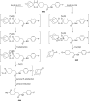
Scheme 178: The different ways of the cleavage of tetraoxane 643.

Scheme 179: The LC–MS analysis of interaction of tetraoxane 646 with iron(II)heme 647.

Scheme 180: The rearrangement of 3,6-epidioxy-1,10-bisaboladiene (EDBD, 649).

Scheme 181: Easily oxidized substrates.

Scheme 182: Biopathway of synthesis of prostaglandins.

Scheme 183: The reduction and rearrangements of isoprostanes.

Scheme 184: The partial mechanism for linoleate 658 oxidation.

Scheme 185: The transformation of lipid hydroperoxide.

Scheme 186: The acid-catalyzed cleavage of the product from free-radical oxidation of cholesterol (667).

Scheme 187: Two pathways of catechols oxidation.

Scheme 188: Criegee-like or Hock-like rearrangement of the intermediate hydroperoxide 675 in dioxygenase enzyme...

Scheme 189: Carotinoides 679 cleavage by carotenoid cleavage dioxygenases.
Automated glycan assembly of a S. pneumoniae serotype 3 CPS antigen
- Markus W. Weishaupt,
- Stefan Matthies,
- Mattan Hurevich,
- Claney L. Pereira,
- Heung Sik Hahm and
- Peter H. Seeberger
Beilstein J. Org. Chem. 2016, 12, 1440–1446, doi:10.3762/bjoc.12.139
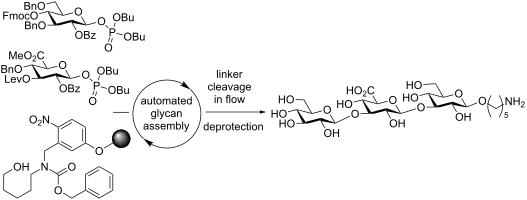
- trisaccharide 5. Reagents and conditions: a) LiOH, H2O2, THF, −5 °C to rt; b) NaOH, MeOH, 0 °C to rt; c) Pd(OH)2/C, MeOH/H2O/AcOH (50:25:1 v/v/v), 71% over 3 steps. Supporting Information Supporting Information File 184: Experimental details as well as full characterization of all new compounds

Graphical Abstract

Figure 1: Disaccharide repeating unit of the S. pneumoniae serotype 3 CPS.

Figure 2: Building blocks and solid support for the automated solid-phase synthesis of S. pneumoniae serotype...

Scheme 1: Attempted assembly of SP3 trisaccharide 5 using glycosyl phosphate building blocks 1 and 2. Reagent...

Figure 3: HPLC chromatogram of the crude products of the attempted AGA of SP3 trisaccharide 5; conditions: YM...

Scheme 2: Attempted AGA of SP3 trisaccharide 9 using glycosyl phosphate building blocks 1 and 3. Reagents and...

Figure 4: HPLC chromatogram of the crude products of the attempted AGA of SP3 trisaccharide 9; conditions: YM...

Scheme 3: Automated synthesis of linker-bound glucuronic acid 10 using glycosyl phosphate building block 1. R...

Scheme 4: Automated synthesis of SP3 trisaccharide 5 using glycosyl phosphate building blocks 1 and 2. Reagen...

Figure 5: HPLC chromatogram of the crude products of the automated solid-phase SP3 trisaccharide 5 synthesis;...

Scheme 5: Global deprotection of SP3 trisaccharide 5. Reagents and conditions: a) LiOH, H2O2, THF, −5 °C to r...
Nucleic acids through condensation of nucleosides and phosphorous acid in the presence of sulfur
- Tuomas Lönnberg
Beilstein J. Org. Chem. 2016, 12, 670–673, doi:10.3762/bjoc.12.67
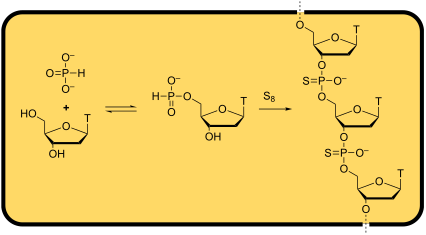
- polymerization. Proposed oxidants for prebiotic phosphite chemistry include H2O2 and Fe(III). The present paper describes the polymerization of thymidine and triethylammonium phosphite, with elemental sulfur acting as the oxidant. Up to pentameric oligonucleotides with internucleosidic phosphorothioate linkages

Graphical Abstract

Figure 1: 31P NMR spectrum (162 MHz, D2O) of the crude product mixture after refluxing equimolar amounts of t...
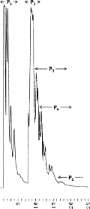
Figure 2: IE HPLC trace of the crude product mixture after refluxing equimolar amounts of thymidine and triet...
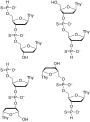
Figure 3: Possible structures of the most abundant product.

Figure 4: IE HPLC traces of (A) a mixture of tetrameric products, (B) the product mixture after desulfurizati...
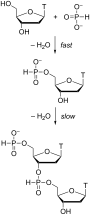
Scheme 1: Phosphitylation and subsequent dimerization of thymidine.
Aluminacyclopentanes in the synthesis of 3-substituted phospholanes and α,ω-bisphospholanes
- Vladimir A. D’yakonov,
- Alevtina L. Makhamatkhanova,
- Rina A. Agliullina,
- Leisan K. Dilmukhametova,
- Tat’yana V. Tyumkina and
- Usein M. Dzhemilev
Beilstein J. Org. Chem. 2016, 12, 406–412, doi:10.3762/bjoc.12.43
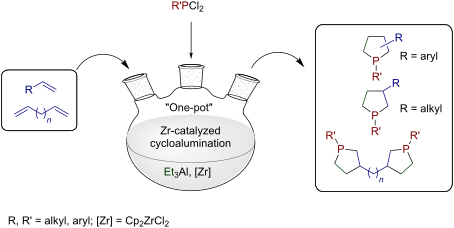
- additional asymmetric centre С(1′) in the substituent, and the total yield of these compounds is 90–93%. Phospholanes 2а–h readily react with H2O2 in chloroform, owing to the presence of a lone electron pair at phosphorus to give phospholane 1-oxides 3а–h in quantitative yields. The reaction of 2а–h with S8
- (10d), 1,4-bis(1-methylphospholan-3-yl)butane (10e), and 1,6-bis(1-phenylphospholan-3-yl)hexane (10с) in 85 % yields. Similarly to phospholanes 2a–h, the resulting bisphospholanes 10a–c readily react with H2O2 in chloroform or with elemental sulfur to furnish the corresponding bisphospholane 1,1

Graphical Abstract

Scheme 1: Synthesis of 3-substituted phospholanes according to earlier data [14-17].

Scheme 2: Synthesis of 3-substituted phospholanes.

Scheme 3: Synthesis of 3-substituted phospholane oxides and sulfides.

Scheme 4: Synthesis of 3-substituted 7a–f and 2-substituted 8a–f phospholanes.

Scheme 5: Synthesis of bisphospholanes.

Scheme 6: Synthesis of bisphospholane-1,1'-oxides and bisphospholane-1,1'-sulfides.

Scheme 7: Synthesis of the molybdenum complex (3-hexyl(benzyl)-1-phenyl(methyl)phospholane)Mo(CO)5.

Scheme 8: Synthesis of molybdenum complexes (1,2(1,6)-bis(1-phenylphospholan-3-yl)ethane(hexane))Mo(CO)5.
Diastereoselective synthesis of new O-alkylated and C-branched inositols and their corresponding fluoro analogues
- Charlotte Collet,
- Françoise Chrétien,
- Yves Chapleur and
- Sandrine Lamandé-Langle
Beilstein J. Org. Chem. 2016, 12, 353–361, doi:10.3762/bjoc.12.39
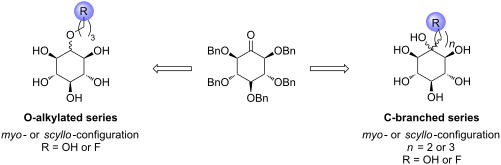
- bromide under classical conditions in the presence of NaH at reflux [44] to afford myo-9 and scyllo-9 in good yield of 80% and 82%, respectively. The hydroxylated arm was obtained by hydroboration using BH3 on the unsaturated compounds myo-9 and scyllo-9 followed by an oxidation with H2O2/NaOH allowing
- , after hydroboration using BH3 in THF at 0 °C followed by conventional oxidation using H2O2/NaOH, in 70–80% yield. Subsequent catalytic hydrogenation under pressure with Pd(OH)2 as the catalyst [45] allowed to obtaining quantitatively the fully hydroxylated inositols myo-3, scyllo-3, myo-4 and scyllo-4
- , iPrOH, rt, 2 h, 58 and 30%; b) allyl bromide, NaH, 70 °C, 2 h, 80–82%; c) BH3, THF, rt, 6 h then H2O2, NaOH, rt, 12 h, 75–78%; d) Pd(OH)2, MeOH/CH2Cl2/H2O 10:10:1 (v/v/v), 45 psi, 18 h, quantitative. Synthesis of O-alkylated fluorinated inositol derivatives 2. Synthesis of C-alkenylated inositol

Graphical Abstract

Figure 1: Structures of targeted synthetic inositol derivatives.

Scheme 1: Synthesis of O-alkylated inositol derivatives 1. Reagents and conditions: a) NaBH4, iPrOH, rt, 2 h,...

Scheme 2: Synthesis of O-alkylated fluorinated inositol derivatives 2.

Scheme 3: Synthesis of C-alkenylated inositol intermediates.

Figure 2: nOe correlations for C-alkenylated inositol intermediates.

Scheme 4: Synthesis of C-branched inositol derivatives 3 and 4.

Scheme 5: Synthesis of C-branched fluorinated inositol derivatives 5. Reagents and conditions: a) TrCl, DMAP ...

Scheme 6: Synthesis of C-branched fluorinated inositol derivatives 6. Reagents and conditions: a) TrCl, DMAP ...
Synthesis and reactivity of aliphatic sulfur pentafluorides from substituted (pentafluorosulfanyl)benzenes
- Norbert Vida,
- Jiří Václavík and
- Petr Beier
Beilstein J. Org. Chem. 2016, 12, 110–116, doi:10.3762/bjoc.12.12
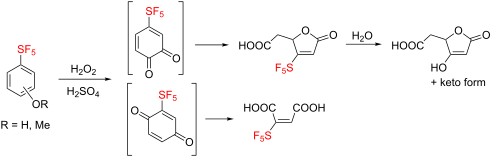
- maleic acid derivative 4 in the product mixture. Control experiments in which 8 or 3 were reacted with H2O2/H2SO4 did not provide 4. This suggests that 4 may be formed by a second hydroxylation of 6 to 9. The second electrophilic aromatic hydroxylation is a favorable process because 6 is a more activated
- 12. To test this hypothesis, both 10 and 11 were subjected to oxidation by H2O2/H2SO4 mixture. Indeed, the yield of 3 decreased considerably while the yield of 4 increased somewhat but still remains low (Scheme 3). The presumed intermediate 2-(pentafluorosulfanyl)-1,4-benzoquinone (12) in the pathway
- substituents ortho to the SF5 group are relatively uncommon [21]. Reduction with sodium dithionite [20] provided aminophenol 14 in good overall yield and oxidation with MnO2 [22] gave benzoquinone 12 also in a good yield. Further oxidation with H2O2/H2SO4 resulted in a mixture of four SF5-containing products

Graphical Abstract

Scheme 1: Oxidation of SF5-anisole and phenol. 19F NMR yields are shown (isolated yields in parentheses).

Scheme 2: Proposed mechanism for the formation of 3 and 4 from SF5 aromatics 1 and 2.

Scheme 3: Oxidation of anisole 10 and phenol 11. 19F NMR yields are given.

Scheme 4: Synthesis of para-benzoquinone 12 and oxidation to maleic acid 4. 19F NMR yields are shown, in pare...

Scheme 5: Catalytic hydrogenation and Diels–Alder reaction of benzoquinone 12.

Figure 1: Optimized geometries of transition states of Diels–Alder reaction of cyclopentadiene with 12. Selec...

Scheme 6: Decomposition of 3 in water.

Scheme 7: Formation of acids 5, 18 and 19 from lactone 3.

Scheme 8: Synthesis of maleic anhydride 20 and Diels–Alder adducts 21.

Scheme 9: Reaction of maleic acid 4 with diazomethane.

Scheme 10: Decarboxylation of maleic acid 4 to acrylic acid 23 in DMSO and the preparation of deuterium labell...
Photoinduced 1,2,3,4-tetrahydropyridine ring conversions
- Baiba Turovska,
- Henning Lund,
- Viesturs Lūsis,
- Anna Lielpētere,
- Edvards Liepiņš,
- Sergejs Beljakovs,
- Inguna Goba and
- Jānis Stradiņš
Beilstein J. Org. Chem. 2015, 11, 2166–2170, doi:10.3762/bjoc.11.234
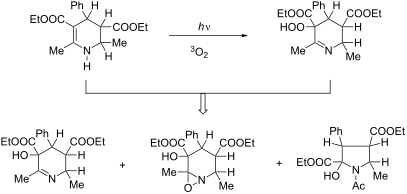
- contains the mixture of 3, 4 and 5. The same product mixture was obtained if the solution of 1 is treated with concentrated H2O2 or Fenton reagent. The reaction starts even if the irradiation wavelengths only partially cover the absorption band of 1. It explains also the observed fact that during the

Graphical Abstract

Figure 1: Electrochemical oxidation of 1 in deareated (blue) and O2 saturated (red) solutions of CH2Cl2/0.1 M...

Figure 2: The X-ray structures of compounds 1 and 2.

Figure 3: Decrease of the UV absorption band of compound 1 under irradiation (254 nm) in air-saturated CHCl3, ...

Scheme 1: Photoinduced reaction of 1 in O2 saturated CHCl3 under irradiation by intensive sunlight.

Scheme 2: Heterocycle transformations of 1 in air saturated CHCl3 solutions.

Scheme 3: Proposed mechanism of conversion of oxaziridine 4 to 5.

Figure 4: The X-ray structures of compounds 4 and 5.
Stereoselective synthesis of hernandulcin, peroxylippidulcine A, lippidulcines A, B and C and taste evaluation
- Marco G. Rigamonti and
- Francesco G. Gatti
Beilstein J. Org. Chem. 2015, 11, 2117–2124, doi:10.3762/bjoc.11.228
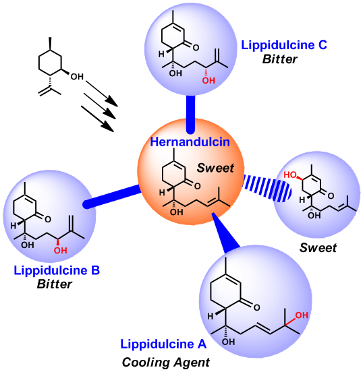
- quantitative yield (Scheme 3). However, any attempt of isolating each isomer of peroxylippidulcine by column chromatography technique failed. In addition, the singlet dark oxidation (H2O2 with a catalytic amount of Na2MoO4 at 55 °C) was tested, but without success [33]. Then, we tried to separate 2a–c by means

Graphical Abstract
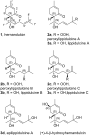
Figure 1: Hernandulcin and other bisabolanic derivatives extracted from Lippia dulcis.

Scheme 1: Synthesis of (+)-neoisopulegol. Reagents and conditions: (a) Jones reagent, acetone, 0 °C, 3 h; (b)...

Scheme 2: Reagents and conditions: (a) (i) t-BuOK, BuLi, hexane, −10 °C/rt; 2 h; (ii) BrCH2CH=C(CH3)2; −10°C/...

Scheme 3: Reagents and conditions: (a) cat. methylene blue, light, bubbling O2, CH2Cl2/MeOH 4:1, rt, 15 h; (b...
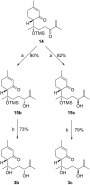
Scheme 4: Reagents and conditions: (a) (S)-MeCBS or (R)-MeCBS for 15b or 15c, respectively, BH3·Me2S, −78 °C ...
Selected synthetic strategies to cyclophanes
- Sambasivarao Kotha,
- Mukesh E. Shirbhate and
- Gopalkrushna T. Waghule
Beilstein J. Org. Chem. 2015, 11, 1274–1331, doi:10.3762/bjoc.11.142
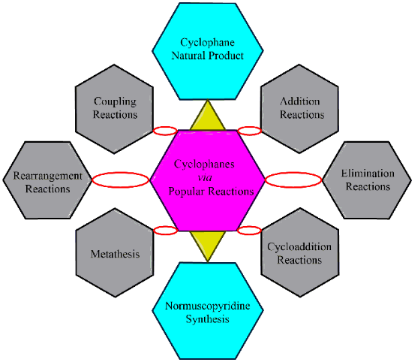

Graphical Abstract

Figure 1: General representation of cyclophanes.

Figure 2: cyclophanes one or more with heteroatom.

Figure 3: Metathesis catalysts 12–17 and C–C coupling catalyst 18.

Figure 4: Natural products containing the cyclophane skeleton.

Figure 5: Turriane family of natural products.

Scheme 1: Synthesis of [3]ferrocenophanes through Mannich reaction. Reagents and conditions: (i) excess HNMe2...

Scheme 2: Synthesis of cyclophanes through Michael addition. Reagents and conditions: (i) xylylene dibromide,...

Scheme 3: Synthesis of normuscopyridine analogue 37 through an oxymercuration–oxidation strategy. Reagents an...

Scheme 4: Synthesis of tribenzocyclotriyne 39 through Castro–Stephens coupling reaction. Reagents and conditi...

Scheme 5: Synthesis of cyclophane 43 through Glaser–Eglinton coupling. Reagents and conditions: (i) 9,10-bis(...

Scheme 6: Synthesis of the macrocyclic C-glycosyl cyclophane through Glaser coupling. Reagents and conditions...

Scheme 7: Synthesis of cyclophane-containing complex 49 through Glaser–Eglinton coupling reaction. Reagents a...

Scheme 8: Synthesis of cyclophane 53 through Glaser–Eglinton coupling. Reagents and conditions: (i) K2CO3, ac...

Figure 6: Cyclophanes 54–56 that have been synthesized through Glaser–Eglinton coupling.

Figure 7: Synthesis of tetrasubstituted [2.2]paracyclophane 57 and chiral cyclophyne 58 through Eglinton coup...

Scheme 9: Synthesis of cyclophane through Glaser–Hay coupling reaction. Reagents and conditions: (i) CuCl2 (1...

Scheme 10: Synthesis of seco-C/D ring analogs of ergot alkaloids through intramolecular Heck reaction. Reagent...

Scheme 11: Synthesis of muscopyridine 73 via Kumada coupling. Reagents and conditions: (i) 72, THF, ether, 20 ...

Scheme 12: Synthesis of the cyclophane 79 via McMurry coupling. Reagents and conditions: (i) 75, decaline, ref...

Scheme 13: Synthesis of stilbenophane 81 via McMurry coupling. Reagents and conditions: (i) TiCl4, Zn, pyridin...

Scheme 14: Synthesis of stilbenophane 85 via McMurry coupling. Reagents and conditions: (i) NBS (2 equiv), ben...
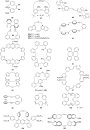
Figure 8: List of cyclophanes prepared via McMurry coupling reaction as a key step.

Scheme 15: Synthesis of paracyclophane by cross coupling involving Pd(0) catalyst. Reagents and conditions: (i...

Scheme 16: Synthesis of the cyclophane 112 via the pinacol coupling and 113 by RCM. Reagents and conditions: (...

Scheme 17: Synthesis of cyclophane derivatives 122a–c via Sonogoshira coupling. Reagents and conditions: (i) C...

Scheme 18: Synthesis of cyclophane 130 via Suzuki–Miyaura reaction as a key step. Reagents and conditions: (i)...

Scheme 19: Synthesis of the mycocyclosin via Suzuki–Miyaura cross coupling. Reagents and conditions: (i) benzy...

Scheme 20: Synthesis of cyclophanes via Wurtz coupling reaction Reagents and conditions: (i) PhLi, Et2O, C6H6,...

Scheme 21: Synthesis of non-natural glycophanes using alkyne metathesis. Reagents and conditions: (i) G-I (12)...

Figure 9: Synthesis of cyclophanes via ring-closing alkyne metathesis.

Scheme 22: Synthesis of crownophanes by cross-enyne metathesis. Reagents and conditions: (i) G-II (13), 5 mol ...

Scheme 23: Synthesis of (−)-cylindrocyclophanes A (156) and (−)-cylindrocyclophanes F (155). Reagents and cond...

Scheme 24: Synthesis of cyclophane 159 derivatives via SM cross-coupling and RCM. Reagents and conditions: (i)...

Scheme 25: Sexithiophene synthesis via cross metathesis. Reagents and conditions: (i) 161, Pd(PPh3)4, K2CO3, T...

Scheme 26: Synthesis of pyrrole-based cyclophane using enyne metathesis. Reagents and conditions: (i) Se, chlo...

Scheme 27: Synthesis of macrocyclic derivatives by RCM. Reagents and conditions: (i) G-I/G-II, CH2Cl2, 0.005 M...

Scheme 28: Synthesis of enantiopure β-lactam-based dienyl bis(dihydrofuran) 179. Reagents and conditions: (i) ...

Scheme 29: Synthesis of a [1.1.6]metaparacyclophane derivative 183 via SM cross coupling. Reagents and conditi...

Scheme 30: Synthesis of a [1.1.6]metaparacyclophane derivative 190 via SM cross coupling. Reagents and conditi...

Scheme 31: Template-promoted synthesis of cyclophanes involving RCM. Reagents and conditions: (i) acenaphthene...

Scheme 32: Synthesis of [3.4]cyclophane derivatives 200 via SM cross coupling and RCM. Reagents and conditions...
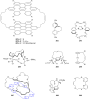
Figure 10: Examples for cyclophanes synthesized by RCM.

Scheme 33: Synthesis of the longithorone C framework assisted by fluorinated auxiliaries. Reagents and conditi...

Scheme 34: Synthesis of the longithorone framework via RCM. Reagents and conditions: (i) 213, NaH, THF, rt, 10...

Scheme 35: Synthesis of floresolide B via RCM as a key step. Reagents and conditions: (i) G-II (13, 0.1 equiv)...

Scheme 36: Synthesis of normuscopyridine (223) by the RCM strategy. Reagents and condition: (i) Mg, THF, hexen...

Scheme 37: Synthesis of muscopyridine (73) via RCM. Reagents and conditions: (i) 225, NaH, THF, 0 °C to rt, 1....

Scheme 38: Synthesis of muscopyridine (73) via RCM strategy. Reagents and conditions: (i) NaH, n-BuLi, 5-bromo...

Scheme 39: Synthesis of pyridinophane derivatives 223 and 245. Reagents and conditions: (i) PhSO2Na, TBAB, CH3...

Scheme 40: Synthesis of metacyclophane derivatives 251 and 253. Reagents and conditions: (i) 240, NaH, THF, rt...

Scheme 41: Synthesis of normuscopyridine and its higher analogues. Reagents and conditions: (i) alkenyl bromid...

Scheme 42: Synthesis of fluorinated ferrocenophane 263 via a [2 + 2] cycloaddition. Reagents and conditions: (...

Scheme 43: Synthesis of [2.n]metacyclophanes 270 via a [2 + 2] cycloaddition. Reagents and conditions: (i) Ac2...

Scheme 44: Synthesis of metacyclophane 273 by a [2 + 2 + 2] co-trimerization. Reagents and conditions: (i) [Rh...

Scheme 45: Synthesis of paracyclophane 276 via a [2 + 2 + 2] cycloaddition reaction. Reagents and conditions: ...

Scheme 46: Synthesis of cyclophane 278 via a [2 + 2 + 2] cycloaddition reaction. Reagents and conditions: (i) ...

Scheme 47: Synthesis of cyclophane 280 via a [2 + 2 + 2] cycloaddition. Reagents and conditions: (i) [(Rh(cod)(...

Scheme 48: Synthesis of taxane framework by a [2 + 2 + 2] cycloaddition. Reagents and conditions: (i) Cp(CO)2 ...

Scheme 49: Synthesis of cyclophane 284 and 285 via a [2 + 2 + 2] cycloaddition reaction. Reagents and conditio...

Scheme 50: Synthesis of pyridinophanes 293a,b and 294a,b via a [2 + 2 + 2] cycloaddition. Reagents and conditi...

Scheme 51: Synthesis of pyridinophanes 296 and 297 via a [2 + 2 + 2] cycloaddition. Reagents and conditions: (...

Scheme 52: Synthesis of triazolophane by a 1,3-dipolar cycloaddition. Reagents and conditions: (i) propargyl b...

Scheme 53: Synthesis of glycotriazolophane 309 by a click reaction. Reagents and conditions: (i) LiOH, H2O, Me...

Figure 11: Cyclophanes 310 and 311 prepared via click chemistry.

Scheme 54: Synthesis of cyclophane via the Dötz benzannulation. Reagents and conditions: (i) THF, 100 °C, 12 h...

Scheme 55: Synthesis of [6,6]metacyclophane by a Dötz benzannulation. Reagents and conditions: (i) THF, 100 °C...

Scheme 56: Synthesis of cyclophanes by a Dötz benzannulation. Reagents and conditions: (i) THF, 65 °C, 3 h; (i...

Scheme 57: Synthesis of muscopyridine (73) via an intramolecular DA reaction of ketene. Reagents and condition...

Scheme 58: Synthesis of bis[10]paracyclophane 336 via Diels–Alder reaction. Reagents and conditions: (i) DMAD,...

Scheme 59: Synthesis of [8]paracyclophane via DA reaction. Reagents and conditions: (i) maleic anhydride, 3–5 ...

Scheme 60: Biomimetic synthesis of (−)-longithorone A. Reagents and conditions: (i) Me2AlCl, CH2Cl2, −20 °C, 7...

Scheme 61: Synthesis of sporolide B (349) via a [4 + 2] cycloaddition reaction. Reagents and conditions: (i) P...

Scheme 62: Synthesis of the framework of (+)-cavicularin (352) via a [4 + 2] cycloaddition. Reagents and condi...

Scheme 63: Synthesis of oxazole-containing cyclophane 354 via Beckmann rearrangement. Reagents and conditions:...

Scheme 64: Synthesis of cyclophanes 360a–c via benzidine rearrangement. Reagents and conditions: (i) 356a–d, K2...

Scheme 65: Synthesis of cyclophanes 365a–c via benzidine rearrangement. Reagents and conditions: (i) BocNHNH2,...

Scheme 66: Synthesis of metacyclophane 367 via Ciamician–Dennstedt rearrangement. Reagents and conditions: (i)...

Scheme 67: Synthesis of cyclophane by tandem Claisen rearrangement and RCM as key steps. Reagents and conditio...

Scheme 68: Synthesis of cyclophane derivative 380. Reagents and conditions: (i) K2CO3, CH3CN, allyl bromide, r...

Scheme 69: Synthesis of metacyclophane via Cope rearrangement. Reagents and conditions: (i) MeOH, NaBH4, rt, 1...

Scheme 70: Synthesis of cyclopropanophane via Favorskii rearrangement. Reagents and conditions: (i) Br2, CH2Cl2...

Scheme 71: Cyclophane 389 synthesis via photo-Fries rearrangement. Reagents and conditions: (i) DMAP, EDCl/CHCl...

Scheme 72: Synthesis of normuscopyridine (223) via Schmidt rearrangement. Reagents and conditions: (i) ethyl s...

Scheme 73: Synthesis of crownophanes by tandem Claisen rearrangement. Reagents and conditions: (i) diamine, Et3...

Scheme 74: Attempted synthesis of cyclophanes via tandem Claisen rearrangement and RCM. Reagents and condition...

Scheme 75: Synthesis of muscopyridine via alkylation with 2,6-dimethylpyridine anion. Reagents and conditions:...

Scheme 76: Synthesis of cyclophane via Friedel–Craft acylation. Reagents and conditions: (i) CS2, AlCl3, 7 d, ...

Scheme 77: Pyridinophane 418 synthesis via Friedel–Craft acylation. Reagents and conditions: (i) 416, AlCl3, CH...

Scheme 78: Cyclophane synthesis involving the Kotha–Schölkopf reagent 421. Reagents and conditions: (i) NBS, A...

Scheme 79: Cyclophane synthesis involving the Kotha–Schölkopf reagent 421. Reagents and conditions: (i) BEMP, ...

Scheme 80: Cyclophane synthesis by coupling with TosMIC. Reagents and conditions: (i) (a) ClCH2OCH3, TiCl4, CS2...

Scheme 81: Synthesis of diaza[32]cyclophanes and triaza[33]cyclophanes. Reagents and conditions: (i) DMF, NaH,...

Scheme 82: Synthesis of cyclophane 439 via acyloin condensation. Reagents and conditions: (i) Na, xylene, 75%;...

Scheme 83: Synthesis of multibridged binuclear cyclophane 442 by aldol condensation. Reagents and conditions: ...

Scheme 84: Synthesis of various macrolactones. Reagents and conditions: (i) iPr2EtN, DMF, 77–83%; (ii) TBDMSCl...

Scheme 85: Synthesis of muscone and muscopyridine via Yamaguchi esterification. Reagents and conditions: (i) 4...

Scheme 86: Synthesis of [5]metacyclophane via a double elimination reaction. Reagents and conditions: (i) LiBr...

Figure 12: Cyclophanes 466–472 synthesized via Hofmann elimination.

Scheme 87: Synthesis of cryptophane via Baylis–Hillman reaction. Reagents and conditions: (i) methyl acrylate,...

Scheme 88: Synthesis of cyclophane 479 via double Chichibabin reaction. Reagents and conditions: (i) excess 478...

Scheme 89: Synthesis of cyclophane 483 via double Chichibabin reaction. Reagents and conditions: (i) 481, OH−;...

Scheme 90: Synthesis of cyclopeptide via an intramolecular SNAr reaction. Reagents and conditions: (i) TBAF, T...

Scheme 91: Synthesis of muscopyridine (73) via C-zip ring enlargement reaction. Reagents and conditions: (i) H...

Figure 13: Mechanism of the formation of compound 494.

Scheme 92: Synthesis of indolophanetetraynes 501a,b using the Nicholas reaction as a key step. Reagents and co...

Scheme 93: Synthesis of cyclophane via radical cyclization. Reagents and conditions: (i) cyclododecanone, phen...

Scheme 94: Synthesis of (−)-cylindrocyclophanes A (156) and (−)-cylindrocyclophanes F (155). Reagents and cond...

Scheme 95: Cyclophane synthesis via Wittig reaction. Reagents and conditions: (i) LiOEt (2.1 equiv), THF, −78 ...

Figure 14: Representative examples of cyclophanes synthesized via Wittig reaction.

Scheme 96: Synthesis of the [6]paracyclophane via isomerization of Dewar benzene. Reagents and conditions: (i)...
One-pot odourless synthesis of thioesters via in situ generation of thiobenzoic acids using benzoic anhydrides and thiourea
- Mohammad Abbasi and
- Reza Khalifeh
Beilstein J. Org. Chem. 2015, 11, 1265–1273, doi:10.3762/bjoc.11.141
- containing Et3N and a thick brick-red liquid was formed. Next, H2O (1 mL) and H2O2 (1.2 mmol) were added to the reaction mixture and the resulting solution was stirred for 1 h at room temperature. Extractive work-up with EtOAc followed by silica gel column chromatography afforded benzoyl disulfide in 91

Graphical Abstract

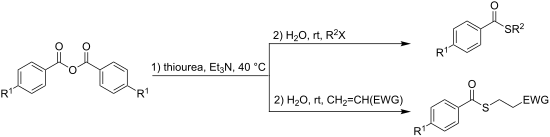
Scheme 1: One-pot procedure for the preparation of thioesters.

Scheme 2: Reaction of benzoyl chloride, thiourea and butyl acrylate.

Scheme 3: A proposed reaction pathway.
New palladium–oxazoline complexes: Synthesis and evaluation of the optical properties and the catalytic power during the oxidation of textile dyes
- Rym Hassani,
- Mahjoub Jabli,
- Yakdhane Kacem,
- Jérôme Marrot,
- Damien Prim and
- Béchir Ben Hassine
Beilstein J. Org. Chem. 2015, 11, 1175–1186, doi:10.3762/bjoc.11.132
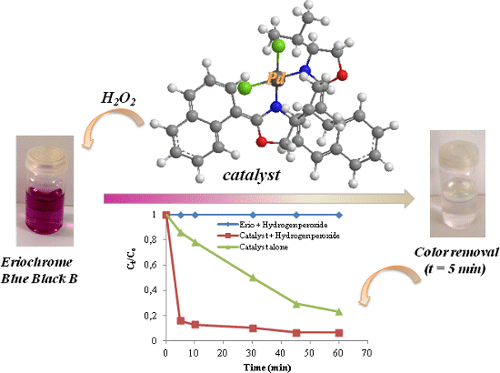
- gap energy values (Eg) ranging between 2.34 and 3.21 eV. Their catalytic activities were tested for the degradation of Eriochrome Blue Black B (a model of azo dyes) in the presence of an ecological oxidant (H2O2). The efficiency of the decolorization has been confirmed via UV–visible spectroscopic
- analysis and the factors affecting the degradation phenomenon have been studied. The removal of the Eriochrome reached high yields. We have found that the complex 9 promoted 84% of color elimination within 5 min (C0 = 30 mg/L, T = 22 °C, pH 7, H2O2 = 0.5 mL) and the energetic parameters have been also
- conditions (t = 10 min, C0 = 30 mg/L, 10 mg of the catalyst, amount of H2O2 = 0.5 mL). Among the six compounds, catalyst 9 was found to be the most active during this study because the corresponding solution became almost colorless within five minutes (Figure 4). As also clearly depicted in Figure 5, the

Graphical Abstract

Figure 1: Structure of Eriochrome Blue Black B.

Scheme 1: Cyclopalladation reactions of (S)-4-isopropyl-2-(naphthalen-1-yl)oxazoline.

Scheme 2: Synthesis of cyclopalladated complex from bis-oxazoline.

Figure 2: ORTEP drawing of the complex 8.

Scheme 3: Synthesis of the bis(oxazoline) coordinated complexes.

Figure 3: ORTEP drawing of the complex 9.

Figure 4: Change in color removal in the presence of different catalysts within 10 min (before filtration). T...

Figure 5: Change in color removal in the presence of different catalysts (after filtration over 10 min).

Figure 6: Evolution of the color degradation against time using Eriochrome plus H2O2, the complex plus H2O2 o...

Figure 7: Change of the concentration of the Erio solution with the variation of H2O2 dose.

Figure 8: Evolution of the color removal against initial dye concentration.

Figure 9: Change of the color removal versus temperature.

Figure 10: Recycling experiments for Erio removal (C0 = 30 ppm, 20 mL) in the presence of catalyst 9 at pH 7 a...

Scheme 4: Proposed mechanism of decolorization.
Properties of PTFE tape as a semipermeable membrane in fluorous reactions
- Brendon A. Parsons,
- Olivia Lin Smith,
- Myeong Chae and
- Veljko Dragojlovic
Beilstein J. Org. Chem. 2015, 11, 980–993, doi:10.3762/bjoc.11.110
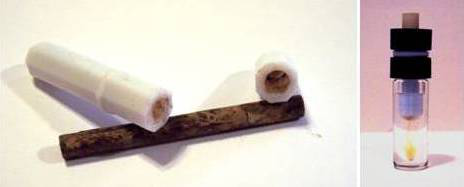
- height of the oxalate–rubrene solution in the delivery tube (Figure 12), even over an extended period of time. This indicates that solvent transport was not necessarily a requirement for the delivery of the H2O2 reagent. From the directionality of the PV-PTFE chemiluminescence reaction and lack of change
- in solvent volume in the delivery tube, we conclude that PTFE tape is permeable to small H2O2 molecules but not to the considerably larger oxalate or rubrene molecules. In the reactions where hydrogen peroxide was dissolved in acetonitrile/water (2:1) or tert-butanol/water (2:1) mixtures, the column
- on the left and (b) in the vial in the experiment on the right. (c) The experimental set up with the lights on and (d) lights off. The orange solution contains an oxalate/rubrene mixture in dimethyl phthalate and the clear solution is 10% aqueous H2O2. Progression of PV-PTFE chemiluminescence with

Graphical Abstract
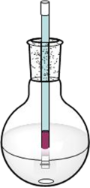
Figure 1: PV-PTFE reaction design.

Figure 2: Solvent uptake in the delivery of bromine into dichloromethane (a) 0 min, (b) 0.50 min, (c) 0.83 mi...

Figure 3: Solvent column heights of bromine delivery into dichloromethane (○) and ethyl acetate. (♦).

Figure 4: Reproducibility of bromine delivery into a) dichloromethane and b) ethyl acetate. In each case thre...

Figure 5: Height of the solvent column in the course of the bromination of cyclohexene in (a) dichloromethane...

Figure 6: Height of the solvent column in the course of the bromination of cyclohexene in ethyl acetate (♦) a...

Figure 7: Solvent uptake when the delivery tube is inserted to a shallow depth. The solvent uptake stopped on...

Scheme 1: Iodolactonization of unsaturated diester 1 with iodine monochloride in dichlormethane.

Figure 8: (a) The delivery tube is immersed into the solution and there is a considerable solvent uptake. (b)...

Figure 9: Transport of dyed dimethyl phthalate in dichloromethane after (a) 0 h, (b) 1 h, (c) 2 h, (d) 3 h an...

Figure 10: Transport of dyed dimethyl phthalate in ethyl acetate after (a) 0 h, (b) 0.17 h, (c) 1 h, (d) 3 h, ...

Scheme 2: Chemiluminescence reaction of diaryl oxalate esters oxidized by hydrogen peroxide in the presence o...

Figure 11: When the diaryl oxalate was oxidized by aqueous peroxide solution, chemiluminescence was observed o...

Figure 12: Progression of PV-PTFE chemiluminescence with aqueous peroxide solution in the vial after (a) 10 mi...

Figure 13: Progression of PV-PTFE chemiluminescence with acetonitrile–aqueous peroxide solution in the vial af...

Figure 14: Diffusion of dimethyl phthalate assisted by tert-butanol through PTFE was visualized in a chemilumi...

Figure 15: Corrosion of aluminum resulting from bromine applied directly to metal.

Figure 16: Discoloration of aluminum from bromine applied to PTFE tape on metal.

Figure 17: After stirring bars were cut open, some iron bars were found to be corroded.

Figure 18: (a) Diffusion of bromine through a bulk PTFE from stirring bar into dichloromethane after 2 h. (b) ...
Figure 19: Diffusion of bromine through a PTFE tube.

Figure 20:
(a) The reaction of benzene and bromine in the absence of a stirring bar (![[Graphic 1]](/bjoc/content/inline/1860-5397-11-110-i3.png?max-width=637&scale=1.18182) ), in the presence of a n...
), in the presence of a n...
Probing multivalency in ligand–receptor-mediated adhesion of soft, biomimetic interfaces
- Stephan Schmidt,
- Hanqing Wang,
- Daniel Pussak,
- Simone Mosca and
- Laura Hartmann
Beilstein J. Org. Chem. 2015, 11, 720–729, doi:10.3762/bjoc.11.82
- (96% H2SO4 and 30% H2O2, 3:1). The coverslips were rinsed with ultra-pure water and dried in a nitrogen stream. Amine surfaces were prepared via chemical vapor deposition of 3-aminopropyltriethoxysilane (APTES) (50 µL) on a freshly cleaned coverslip were placed in a desiccator and vacuum was applied

Graphical Abstract

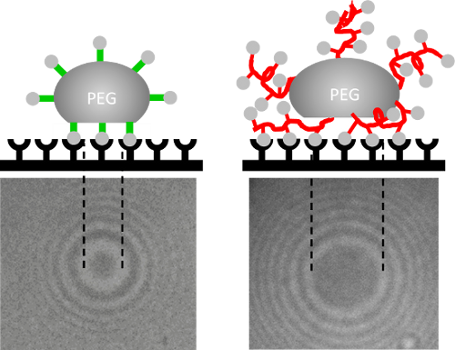
Figure 1: SCP adhesion measurement sketch (top): A mannose-functionalized PEG-SCP sediments onto a Concanaval...

Scheme 1: PEG functionalization is based on radical benzophenone photochemistry and subsequent addition of ca...

Figure 2: A) ATR–FTIR spectroscopy signifying carbonyl group at around 1720 cm−1 and successful grafting; B) ...

Figure 3: A) CA functionalization degree as a function of the irradiation time. The solid line represents an ...

Figure 4: A) Increased mannose densities as schematically shown lead to increased contact areas. For the PEG-...
Eosin Y-catalyzed visible-light-mediated aerobic oxidative cyclization of N,N-dimethylanilines with maleimides
- Zhongwei Liang,
- Song Xu,
- Wenyan Tian and
- Ronghua Zhang
Beilstein J. Org. Chem. 2015, 11, 425–430, doi:10.3762/bjoc.11.48
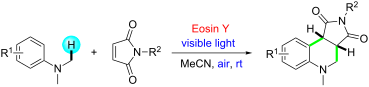
- −. The HOO− will be subsequently protonated to yield H2O2 as the by-product. H2O2 was detected after the reaction was completed by using KI/starch indicator (see the Supporting Information File 1). The involvement of radical pathway was supported by experimental result that the reaction was suppressed in

Graphical Abstract

Scheme 1: Visible-light-induced sp3 C–H bond functionalization of tertiary amines.
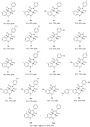
Scheme 2: Substrate scope for aerobic oxidative cyclization of N,N-dimethylanilines with maleimides.

Scheme 3: A proposed reaction mechanism.
Electrochemical oxidation of cholesterol
- Jacek W. Morzycki and
- Andrzej Sobkowiak
Beilstein J. Org. Chem. 2015, 11, 392–402, doi:10.3762/bjoc.11.45
- compounds 11 (20%) and 12 (43%) were formed. Second, during the reaction with hydrogen peroxide as an oxidant under non-electrochemical conditions no products were detected, which indicates that the role of dioxygen is not the source of electrochemically generated H2O2. Furthermore, the epoxide 10 was not

Graphical Abstract

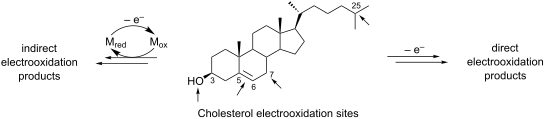
Figure 1: Preferential sites of cholesterol electrooxidation.

Scheme 1: Functionalization of the cholesterol side chain.

Scheme 2: Oxidation of cholestane-3β,5α,6β-triol triacetate (3) with the Gif system.

Scheme 3: Electrochemical oxidation of cholesteryl acetate (1a) with dioxygen and iron–picolinate complexes.

Scheme 4: Electrochemical chlorination of cholesterol catalyzed by FeCl3.

Scheme 5: Electrochemical chlorination of Δ5-steroids.

Scheme 6: Electrochemical bromination of Δ5-steroids in different solvents.

Scheme 7: Direct electrochemical acetoxylation of cholesterol at the allylic position.

Scheme 8: Direct anodic oxidation of cholesterol in dichloromethane.

Scheme 9: A plausible mechanism of the electrochemical oxidation of cholesterol in dichloromethane.

Scheme 10: The electrochemical formation of glycosides and glycoconjugates.

Scheme 11: Efficient electrochemical oxidation of cholesterol to cholesta-4,6-dien-3-one (24).
Switching the reaction pathways of electrochemically generated β-haloalkoxysulfonium ions – synthesis of halohydrins and epoxides
- Akihiro Shimizu,
- Ryutaro Hayashi,
- Yosuke Ashikari,
- Toshiki Nokami and
- Jun-ichi Yoshida
Beilstein J. Org. Chem. 2015, 11, 242–248, doi:10.3762/bjoc.11.27

- -I was synthesized using I2 and H2O2; see Supporting Information File 1) indicated that the addition of I+ and DMSO across the C–C double bond was anti-selective as anticipated. Synthesis of halohydrins and epoxides from various alkenes The present method was successfully applied to the synthesis of

Graphical Abstract

Scheme 1: Synthesis of halohydrins and epoxides through β-haloalkoxysulfonium ions generated by the reaction ...

Scheme 2: Proposed reaction mechanisms for the syntheses of bromohydrin 5a-Br and epoxide 6a.

Scheme 3: Mechanistic study using 18O-DMSO.
Electrochemical selenium- and iodonium-initiated cyclisation of hydroxy-functionalised 1,4-dienes
- Philipp Röse,
- Steffen Emge,
- Jun-ichi Yoshida and
- Gerhard Hilt
Beilstein J. Org. Chem. 2015, 11, 174–183, doi:10.3762/bjoc.11.18

- (IV), mCPBA, FeCl3 or H2O2 have been reported [40][41][42][43][44][45]. A more efficient and versatile method is the electrochemical generation of halonium ions. Thereby, it is possible to accumulate the halonium ions in solution and to add those to a substrate in a separated process (“pool” method

Graphical Abstract

Scheme 1: Cobalt-catalysed 1,4-hydrovinylation.

Scheme 2: Electrochemical selenoalkoxylation of 2.

Scheme 3: Electrochemical iodoalkoxylation of 2.
Cross-dehydrogenative coupling for the intermolecular C–O bond formation
- Igor B. Krylov,
- Vera A. Vil’ and
- Alexander O. Terent’ev
Beilstein J. Org. Chem. 2015, 11, 92–146, doi:10.3762/bjoc.11.13
- -immobilized manganese phthalocyanine/H2O2aq [166], a Ni(II) complex/H2O2aq [167], and ZnBr2/H2O2 [168]. The oxidative C–O coupling of aromatic aldehydes 181 with cycloalkanes 182 was accomplished in the presence of the Cu(OAc)2/t-BuOOH system to prepare products 183. This reaction is unusual in that it

Graphical Abstract

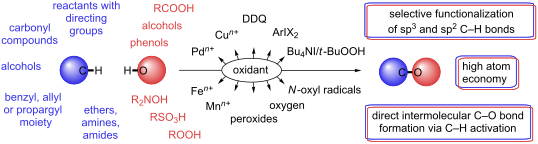
Scheme 1: Cross-dehydrogenative coupling.

Scheme 2: Cross-dehydrogenative C–O coupling.

Scheme 3: Regioselective ortho-acetoxylation of meta-substituted arylpyridines and N-arylamides.

Scheme 4: ortho-Acyloxylation and alkoxylation of arenes directed by pyrimidine, benzoxazole, benzimidazole a...

Scheme 5: Cu(OAc)2/AgOTf/O2 oxidative system in the ortho-alkoxylation of arenes.
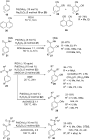
Scheme 6: Pd(OAc)2/persulfate oxidative system in the ortho-alkoxylation and acetoxylation of arenes with nit...
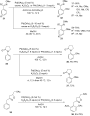
Scheme 7: ortho-Acetoxylation and methoxylation of O-methyl aryl oximes, N-phenylpyrrolidin-2-one, and (3-ben...

Scheme 8: Ruthenium-catalyzed ortho-acyloxylation of acetanilides.

Scheme 9: Acetoxylation and alkoxylation of arenes with amide directing group using Pd(OAc)2/PhI(OAc)2 oxidat...

Scheme 10: Alkoxylation of azoarenes, 2-aryloxypyridines, picolinamides, and N-(1-methyl-1-(pyridin-2-yl)ethyl...

Scheme 11: Acetoxylation of compounds containing picolinamide and quinoline-8-amine moieties using the Pd(OAc)2...

Scheme 12: (CuOH)2CO3 catalyzed oxidative ortho-etherification using air as oxidant.

Scheme 13: Copper-catalyzed aerobic alkoxylation and aryloxylation of arenes containing pyridine-N-oxide moiet...

Scheme 14: Cobalt-catalyzed aerobic alkoxylation of arenes and alkenes containing pyridine N-oxide moiety.

Scheme 15: Non-symmetric double-fold C–H ortho-acyloxylation.

Scheme 16: N-nitroso directed ortho-alkoxylation of arenes.

Scheme 17: Selective alkoxylation and acetoxylation of alkyl groups.

Scheme 18: Acetoxylation of 2-alkylpyridines and related compounds.

Scheme 19: Acyloxylation and alkoxylation of alkyl fragments of substrates containing amide or sulfoximine dir...

Scheme 20: Palladium-catalyzed double sp3 C–H alkoxylation of N-(quinolin-8-yl)amides for the synthesis of sym...

Scheme 21: Copper-catalyzed acyloxylation of methyl groups of N-(quinolin-8-yl)amides.

Scheme 22: One-pot acylation and sp3 C–H acetoxylation of oximes.

Scheme 23: Possible mechanism of oxidative esterification catalyzed by N-heterocyclic nucleophilic carbene.

Scheme 24: Oxidative esterification employing stoichiometric amounts of aldehydes and alcohols.

Scheme 25: Selective oxidative coupling of aldehydes with alcohols in the presence of amines.

Scheme 26: Iodine mediated oxidative esterification.

Scheme 27: Oxidative C–O coupling of benzyl alcohols with methylarenes under the action of Bu4NI/t-BuOOH syste...

Scheme 28: Oxidative coupling of methyl- and ethylarenes with aromatic aldehydes under the action of Bu4NI/t-B...

Scheme 29: Cross-dehydrogenative C–O coupling of aldehydes with t-BuOOH in the presence of Bu4NI.

Scheme 30: Bu4NI-catalyzed α-acyloxylation reaction of ethers and ketones with aldehydes and t-BuOOH.

Scheme 31: Oxidative coupling of aldehydes with N-hydroxyimides and hexafluoroisopropanol.

Scheme 32: Oxidative coupling of alcohols with N-hydroxyimides.

Scheme 33: Oxidative coupling of aldehydes and primary alcohols with N-hydroxyimides using (diacetoxyiodo)benz...

Scheme 34: Proposed mechanism of the oxidative coupling of aldehydes and N-hydroxysuccinimide under action of ...

Scheme 35: Oxidative coupling of aldehydes with pivalic acid (172).

Scheme 36: Oxidative C–O coupling of aldehydes with alkylarenes using the Cu(OAc)2/t-BuOOH system.

Scheme 37: Copper-catalyzed acyloxylation of C(sp3)-H bond adjacent to oxygen in ethers using benzyl alcohols.

Scheme 38: Oxidative C–O coupling of aromatic aldehydes with cycloalkanes.

Scheme 39: Ruthenium catalyzed cross-dehydrogenative coupling of primary and secondary alcohols.

Scheme 40: Cross-dehydrogenative C–O coupling reactions of β-dicarbonyl compounds with sulfonic acids, acetic ...

Scheme 41: Acyloxylation of ketones, aldehydes and β-dicarbonyl compounds using carboxylic acids and Bu4NI/t-B...

Scheme 42: Acyloxylation of ketones using Bu4NI/t-BuOOH system.

Scheme 43: Cross-dehydrogenative C–O coupling of β-dicarbonyl compounds and their heteroanalogues with N-hydro...

Scheme 44: Cross-dehydrogenative C–O coupling of β-dicarbonyl compounds and their heteroanalogues with t-BuOOH....

Scheme 45: Oxidative C–O coupling of 2,6-dialkylphenyl-β-keto esters and thioesters with tert-butyl hydroxycar...

Scheme 46: α’-Acyloxylation of α,β-unsaturated ketones using KMnO4.

Scheme 47: Possible mechanisms of the acetoxylation at the allylic position of alkenes by Pd(OAc)2.

Scheme 48: Products of the oxidation of terminal alkenes by Pd(II)/AcOH/oxidant system.

Scheme 49: Acyloxylation of terminal alkenes with carboxylic acids.

Scheme 50: Synthesis of linear E-allyl esters by cross-dehydrogenative coupling of terminal alkenes wih carbox...

Scheme 51: Pd(OAc)2-catalyzed acetoxylation of Z-vinyl(triethylsilanes).

Scheme 52: α’-Acetoxylation of α-acetoxyalkenes with copper(II) chloride in acetic acid.

Scheme 53: Oxidative acyloxylation at the allylic position of alkenes and at the benzylic position of alkylare...

Scheme 54: Copper-catalyzed alkoxylation of methylheterocyclic compounds using di-tert-butylperoxide as oxidan...

Scheme 55: Oxidative C–O coupling of methylarenes with β-dicarbonyl compounds or phenols.

Scheme 56: Copper-catalyzed esterification of methylbenzenes with cyclic ethers and cycloalkanes.

Scheme 57: Oxidative C–O coupling of carboxylic acids with toluene catalyzed by Pd(OAc)2.

Scheme 58: Oxidative acyloxylation at the allylic position of alkenes with carboxylic acids using the Bu4NI/t-...

Scheme 59: Cross-dehydrogenative C–O coupling of carboxylic acids with alkylarenes using the Bu4NI/t-BuOOH sys...

Scheme 60: Oxidative C–O cross-coupling of methylarenes with ethyl or isopropylarenes.

Scheme 61: Phosphorylation of benzyl C–H bonds using the Bu4NI/t-BuOOH oxidative system.

Scheme 62: Selective C–H acetoxylation of 2,3-disubstituted indoles.

Scheme 63: Acetoxylation of benzylic position of alkylarenes using DDQ as oxidant.

Scheme 64: C–H acyloxylation of diarylmethanes, 3-phenyl-2-propen-1-yl acetate and dimethoxyarene using DDQ.

Scheme 65: Cross-dehydrogenative C–O coupling of 1,3-diarylpropylenes and 1,3-diarylpropynes with alcohols.

Scheme 66: One-pot azidation and C–H acyloxylation of 3-chloro-1-arylpropynes.

Scheme 67: Cross-dehydrogenative C–O coupling of 1,3-diarylpropylenes, (E)-1-phenyl-2-isopropylethylene and is...

Scheme 68: Cross-dehydrogenative C–O coupling of alkylarenes and related compounds with N-hydroxyphthalimide.

Scheme 69: Acetoxylation at the benzylic position of alkylarenes mediated by N-hydroxyphthalimide.

Scheme 70: C–O coupling of methylarenes with aromatic carboxylic acids employing the NaBrO3/NaHSO3 system.

Scheme 71: tert-Butyl peroxidation of allyl, propargyl and benzyl ethers catalyzed by Fe(acac)3.

Scheme 72: Cross-dehydrogenative C–O coupling of ethers with carboxylic acids mediated by Bu4NI/t-BuOOH system....

Scheme 73: Oxidative acyloxylation of dimethylamides and dioxane with 2-aryl-2-oxoacetic acids accompanied by ...

Scheme 74: tert-Butyl peroxidation of N-benzylamides and N-allylbenzamide using the Bu4NI/t-BuOOH system.

Scheme 75: Cross-dehydrogenative C–O coupling of aromatic carboxylic acids with ethers using Fe(acac)3 as cata...

Scheme 76: Cross-dehydrogenative C–O coupling of cyclic ethers with 2-hydroxybenzaldehydes using iron carbonyl...
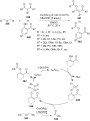
Scheme 77: Cross-dehydrogenative C–O coupling of ethers with β-dicarbonyl compounds and phenols using copper c...

Scheme 78: Cross-dehydrogenative C–O coupling of 2-hydroxybenzaldehyde with dioxane catalyzed by Cu2(BPDC)2(BP...

Scheme 79: Ruthenium chloride-catalyzed acyloxylation of β-lactams.

Scheme 80: Ruthenium-catalyzed tert-butyl peroxydation amides and acetoxylation of β-lactams.

Scheme 81: PhI(OAc)2-mediated α,β-diacetoxylation of tertiary amines.

Scheme 82: Electrochemical oxidative methoxylation of tertiary amines.

Scheme 83: Cross-dehydrogenative C–O coupling of ketene dithioacetals with carboxylic acids in the presence of...

Scheme 84: Cross-dehydrogenative C–O coupling of enamides with carboxylic acids using iodosobenzene as oxidant....

Scheme 85: Oxidative alkoxylation, acetoxylation, and tosyloxylation of acylanilides using PhI(O(O)CCF3)2 in t...

Scheme 86: Proposed mechanism of the oxidative C–O coupling of actetanilide with O-nucleophiles in the presenc...

Scheme 87: Three-component coupling of aldehydes, anilines and alcohols involving oxidative intermolecular C–O...

Scheme 88: Oxidative coupling of phenols with alcohols.

Scheme 89: 2-Acyloxylation of quinoline N-oxides with arylaldehydes in the presence of the CuOTf/t-BuOOH syste...

Scheme 90: Cross-dehydrogenative C–O coupling of azoles with primary alcohols.

Scheme 91: Oxidation of dipyrroles to dipyrrins and subsequent oxidative alkoxylation in the presence of Na3Co...

Scheme 92: Oxidative dehydrogenative carboxylation of alkanes and cycloalkanes to allylic esters.

Scheme 93: Pd-catalyzed acetoxylation of benzene.
Multicomponent versus domino reactions: One-pot free-radical synthesis of β-amino-ethers and β-amino-alcohols
- Bianca Rossi,
- Nadia Pastori,
- Simona Prosperini and
- Carlo Punta
Beilstein J. Org. Chem. 2015, 11, 66–73, doi:10.3762/bjoc.11.10
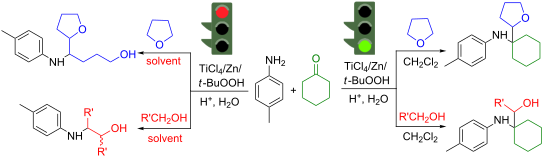
- aldehyde or ketone, and a suitable source of nucleophilic radicals (Nu–H = formamide [24][25], methanol [26][27], ethers [28]), in the presence of titanium chlorides, and slowly dropping a solution of hydroperoxide (H2O2 or tert-butyl hydroperoxide (t-BuOOH)) into the reaction medium (Scheme 1). Aqueous

Graphical Abstract

Scheme 1: Nucleophilic radical addition to imines mediated by titanium salts.

Scheme 2: Radical domino approach to the synthesis of β-aminoacohols triggered by titanium salts.

Scheme 3: Competitive imine formation from THF.

Scheme 4: Reaction mechanism.

Scheme 5: Domino reaction in the presence of ethanol.
Preparation of neuroprotective condensed 1,4-benzoxazepines by regio- and diastereoselective domino Knoevenagel–[1,5]-hydride shift cyclization reaction
- László Tóth,
- Yan Fu,
- Hai Yan Zhang,
- Attila Mándi,
- Katalin E. Kövér,
- Tünde-Zita Illyés,
- Attila Kiss-Szikszai,
- Balázs Balogh,
- Tibor Kurtán,
- Sándor Antus and
- Péter Mátyus
Beilstein J. Org. Chem. 2014, 10, 2594–2602, doi:10.3762/bjoc.10.272
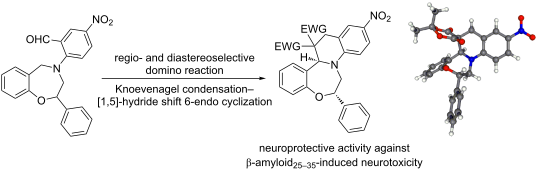
- . Separated enantiomers of the products were characterized by HPLC-ECD data, which allowed their configurational assignment on the basis of TDDFT-ECD calculation of the solution conformers. Two compounds showed neuroprotective activities against hydrogen peroxide (H2O2) or β-amyloid25–35 (Aβ25–35)-induced
- preparation of condensed O,N-heterocycles with the 1,2,8,9-tetrahydro-7bH-quinolino[1,2-d][1,4]benzoxazepine skeleton, the neuroprotective activities of which were tested against hydrogen peroxide (H2O2), Alzheimer's amyloid β-peptide fragment Aβ25–35 and oxygen–glucose deprivation (OGD)-induced neurotoxicity
- rac-5 were tested against hydrogen peroxide (H2O2), β-amyloid-25-35 (Aβ25–35) and oxygen–glucose deprivation (OGD)-induced neurotoxicity in human neuroblastoma SH-SY5Y cells [22]. The preliminary screenings showed that rac-7a at 10 µM concentration displayed neuroprotective activity against H2O2

Graphical Abstract

Figure 1: Pharmacologically active derivatives 1–4 containing the 1,4-benzoxazepine moiety or its analogue.

Scheme 1: Domino Knoevenagel–[1,5]-hydride shift cyclization reaction for the preparation of condensed 1,4-be...

Scheme 2: i) a) NaN3, CF3COOH, b) H2O, Δ (77%); ii) LiAlH4, dry THF, Δ (80%); iii) 11b, K2CO3, toluene, Δ (71...

Figure 2: Lowest-energy conformers of a) trans-(2S,15aS)-7a (>99.9%) with the replacement of the N-methyl gro...

Figure 3: Lowest-energy conformers of a) cis-(2R,15aS)-7a (99.4%) with the replacement of the N-methyl groups...

Figure 4: HPLC-ECD spectra of the first-eluting (black curve) and second-eluting (red curve) enantiomers of a...

Figure 5: Protective effect of compound 7a on hydrogen peroxide-induced neurotoxicity in SH-SY5Y cells. ##P <...

Figure 6: Protective effect of compound 7b on β-amyloid25–35-induced neurotoxicity in SH-SY5Y cells. ##P < 0....



