


Search results
Search for "adduct" in Full Text gives 611 result(s) in Beilstein Journal of Organic Chemistry. Showing first 200.
Enolates ambushed – asymmetric tandem conjugate addition and subsequent enolate trapping with conventional and less traditional electrophiles
Beilstein J. Org. Chem. 2023, 19, 593–634, doi:10.3762/bjoc.19.44
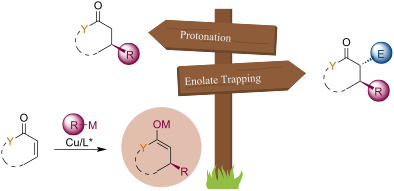
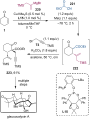
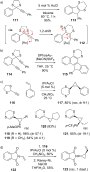
- reaction with the α-aminoether 118. This reagent released an iminium ion into the reaction medium that reacted with the Al enolate 117 [66]. Furthermore, the Mannich adduct was then reacted with Grignard reagents that replaced the dimethylamino group (Scheme 30). Alexakis and co-workers also investigated
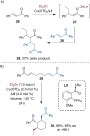
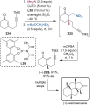
- acryloyloxazolidinone 183, the reaction gave the expected aldol product 184 in good yields and diastereomeric ratios with a preference toward the syn-adduct (Scheme 47A). Interestingly, when they used methacryloyloxazolidinone 185 as a Michael acceptor, the X-ray analysis of the product showed a rearranged structure
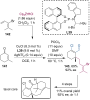
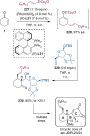
- silylation/aldol cyclization sequence where the diastereoselectivity of the reaction is determined by the Si nucleophile used [90]. Using Me2PhSiZnX·2LiX in combination with ligand L21 leads to the trans adduct, while Me2PhSiBpin together with L30 provides the cis product. Consequently, the authors have








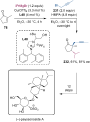
Transition-metal-catalyzed domino reactions of strained bicyclic alkenes
Beilstein J. Org. Chem. 2023, 19, 487–540, doi:10.3762/bjoc.19.38
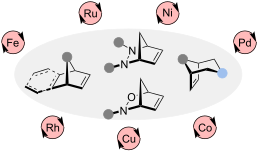
- undergoing reductive elimination to afford to [2 + 2] adduct, β-oxygen elimination followed by E/Z isomerization and intramolecular lactonization generates the annulated coumarin scaffold. In 2003, the Cheng lab extended on this Ni-catalyzed ring-opening strategy [31]. It was noted the addition of 1.5
- final ring-opened adduct 37. Copper-catalyzed reactions In 2009, Pineschi and co-workers explored the Cu-catalyzed rearrangement/allylic alkylation of 2,3-diazabicyclo[2.2.1]heptenes 47 with Grignard reagents 48 (Scheme 8) [41]. The reaction is thought to proceed via the Lewis acid-catalyzed [3,4
- derivatives 85. The reaction was amenable for both electron-rich and deficient indoles. When the reaction was attempted on electron-deficient oxabicyclic alkene derivatives, it was observed the reaction did not undergo dehydration to give the 2-naphthyl product, rather the ring-opened 1,2-hydroxy adduct. When


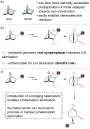









Transition-metal-catalyzed C–H bond activation as a sustainable strategy for the synthesis of fluorinated molecules: an overview
Beilstein J. Org. Chem. 2023, 19, 448–473, doi:10.3762/bjoc.19.35
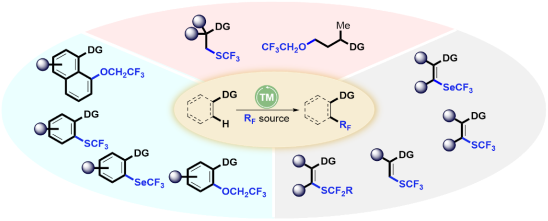
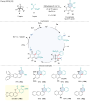
- of adduct J. The product 26 is released via a reductive elimination step, generating at the same time the reduced cobalt Cp*Co(I), which is converted to the active catalyst after oxidation. The same year, Yoshino and Matsunaga described a similar methodology, using the cobalt(III) complex [Cp*Co








Mechanochemical solid state synthesis of copper(I)/NHC complexes with K3PO4
Beilstein J. Org. Chem. 2023, 19, 440–447, doi:10.3762/bjoc.19.34
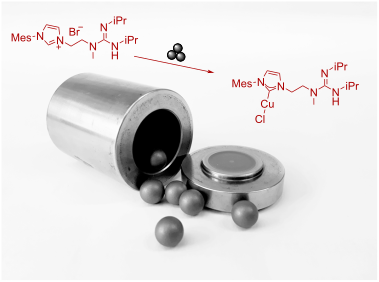
- such as n-BuLi or NaOt-Bu (in various equivalents, Table 1, entries 1 and 2) or weak bases (Et3N, K2CO3 or K3PO4, Table 1, entries 3–5) either did give no conversion to 5 at all or delivered a catalytically inactive complex, which we assign to a CO2 adduct of 5 (Table 1, entry 4) [51][52]. We
- hypothesize that in this CO2 adduct, the guanidine moiety is unavailable to perform its assisting part in catalysis through hydrogen-bonding interaction [48]. As additional evidence to support the formation of the CO2 adduct of 5, we can show that bubbling of CO2 through a solution of 5 leads to catalytically
- inactive complexes (see Supporting Information File 1 for details). This also supports the notion that during catalytic ester hydrogenation, the guanidinium moiety acts as a hydrogen bond donor to the esters [48]. The formation of a CO2 adduct hinders the ability to form hydrogen bonds. Furthermore


Asymmetric synthesis of a stereopentade fragment toward latrunculins
Beilstein J. Org. Chem. 2023, 19, 428–433, doi:10.3762/bjoc.19.32
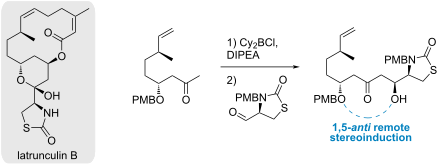
- (13,14)-bond of 1 and 2, respectively. Conversely, we envisaged an alternative disconnection to form the (16,17)- or the (14,15)-bond of 1 and 2, through an aldol reaction of aldehyde 8 readily available from ʟ-cysteine, leading to aldol adduct 7 (Figure 2, route B). The methyl ketone partner 9 could be




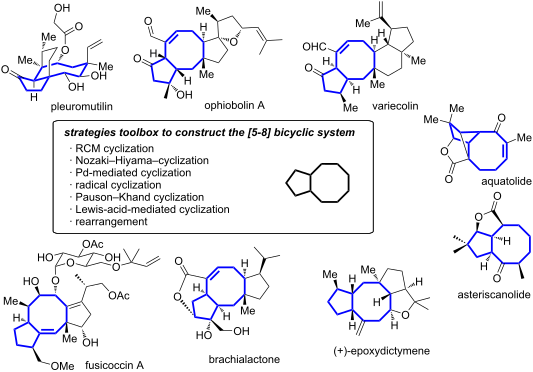
Strategies to access the [5-8] bicyclic core encountered in the sesquiterpene, diterpene and sesterterpene series
Beilstein J. Org. Chem. 2023, 19, 245–281, doi:10.3762/bjoc.19.23
- 31 and oxazolidinone 32 (Scheme 5) [26]. Subsequently, compound 33 was converted in four steps into aldehyde 34 which was engaged in a coupling reaction with bromoketone 35 according to Utimoto conditions to furnish the A-C-D adduct 36 as a single stereoisomer in high yield. Of note, the Utimoto
- . Despite the relative simplicity of substrate 99, the reaction was running in the exclusive presence of G-II catalyst and necessitated a high catalyst loading (30 mol %) to eventually furnish modest yields. The presence of two major byproducts was also noticed, namely the cross metathesis adduct resulting
- from 2 equivalents of 99 and the cross metathesis adduct resulting from 99 and a styrene unit coming from the catalyst. In addition, the corresponding RCM on the alkene analogue of 99 did not proceed either with G-II or Schrock catalysts, showcasing the substrate sensitivity of this reaction. 1.3


Germacrene B – a central intermediate in sesquiterpene biosynthesis
Beilstein J. Org. Chem. 2023, 19, 186–203, doi:10.3762/bjoc.19.18

- -workers [19], through a sequence of reduction to the alcohol, acetylation and reduction with lithium in ammonia (Scheme 3A) [20], and its structure was unambiguously assigned by X-ray crystallography of a silver nitrate adduct [21]. From natural sources, the compound was first obtained from Humulus






Identification and determination of the absolute configuration of amorph-4-en-10β-ol, a cadinol-type sesquiterpene from the scent glands of the African reed frog Hyperolius cinnamomeoventris
Beilstein J. Org. Chem. 2023, 19, 167–175, doi:10.3762/bjoc.19.16
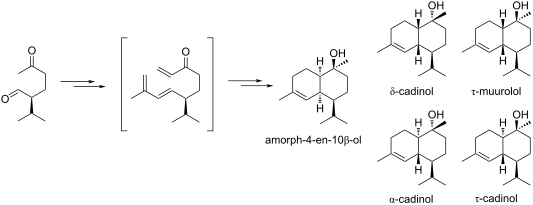
- adduct with 18 that was readily separable from the target ketones. Following the optimization of reaction conditions, a change of solvent to THF was shown to be as equally effective as toluene (Table 1, entry 10). The ketones S-9, S-10, and S-11 were obtained in a ratio of 1:6.9:5.2, indicating a higher


Nostochopcerol, a new antibacterial monoacylglycerol from the edible cyanobacterium Nostochopsis lobatus
Beilstein J. Org. Chem. 2023, 19, 133–138, doi:10.3762/bjoc.19.13
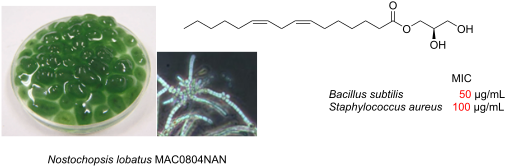
- based on a sodium adduct pseudomolecular ion at m/z 349.2348 [M + Na]+ observed by high-resolution ESITOFMS (calcd for C19H34NaO4+, 349.2349). Three degrees of unsaturation, calculated from the molecular formula, were accounted for by a carboxyl group (δC 175.3) and two double bonds (δC 130.9, 130.6


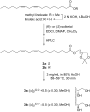
1,4-Dithianes: attractive C2-building blocks for the synthesis of complex molecular architectures
Beilstein J. Org. Chem. 2023, 19, 115–132, doi:10.3762/bjoc.19.12
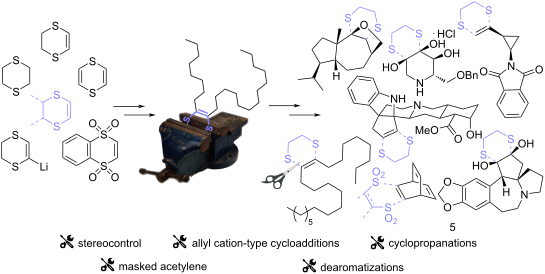
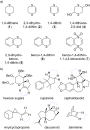
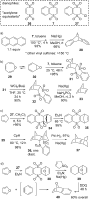
- at room temperature to form the expected Diels–Alder adduct 32, while non-cyclic vinyl disulfones require heating to 80 °C for 20–48 h. Deoxygenation of the epoxide and desulfonylation with sodium amalgam affords barrelene (33) in an excellent overall yield from oxepin. The chlorinated 1,4-dithiin
- -tetroxide ring gives the cyclohexa-1,4-diene intermediate 39. This intermediate can then be easily oxidized to afford the aromatic adduct 40, which is the known cycloaddition product of furan and benzyne. Although this synthetic equivalent of benzyne requires a lengthy work-around, all synthetic operations
- -adduct dithiin 42 in quantitative yield. Although 2,5-dimethylhexa-2,4-diene cannot possibly adopt a coplanar single-cis conformation, and is therefore completely unreactive in Diels–Alder reactions as a diene, its 1,4-dithiane-tethered version in 41 must show a sufficient proximity between the terminal










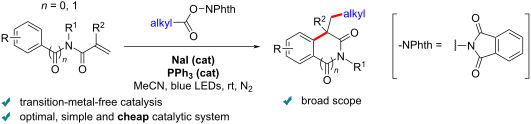
NaI/PPh3-catalyzed visible-light-mediated decarboxylative radical cascade cyclization of N-arylacrylamides for the efficient synthesis of quaternary oxindoles
Beilstein J. Org. Chem. 2023, 19, 57–65, doi:10.3762/bjoc.19.5
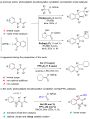
- a TEMPO-trapped adduct (4) was detected by HRMS (Scheme 4a). Moreover, the radical-mediated ring-opening product 3am could be obtained with 66% yield in a radical clock experiment when redox-active ester 5 was engaged to react with acrylamide 1a under standard conditions (Scheme 4b). Finally, it




Synthetic study toward tridachiapyrone B
Beilstein J. Org. Chem. 2022, 18, 1741–1748, doi:10.3762/bjoc.18.183
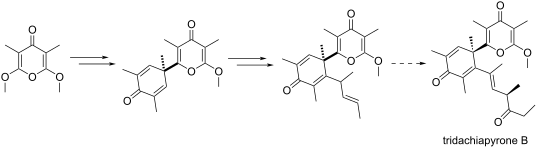
- desired 1,2-adduct 17 in 50% yield [41]. To perform the anionic oxy-Cope rearrangement, alcohol 17 was exposed to t-BuOK, in the presence of 18-crown-6 ether (−78 °C to rt) [42]. However, these conditions did not trigger the rearrangement and the starting material was recovered. On the other hand


Total synthesis of grayanane natural products
Beilstein J. Org. Chem. 2022, 18, 1707–1719, doi:10.3762/bjoc.18.181
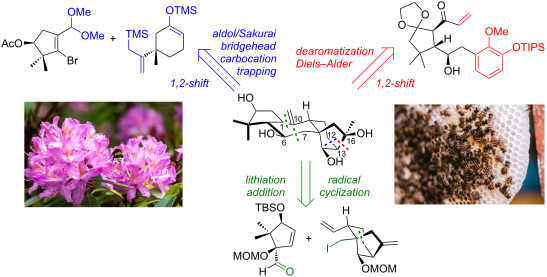
- corresponding ketone was achieved using Dess–Martin periodinane with a pyridine buffer. Addition of Me3SiCH2Li efficiently afforded the Peterson adduct 33. The 1,1-disubtituted alkene was then submitted to Mukaiyma hydration to form the tertiary alcohol, in presence of Mn(dpm)3, PhSiH3 and O2. Then, the ketone
- was selectively reduced in the presence of LiEt3BH, while the Peterson adduct was eliminated concurrently, upon heating. Finally, treatment with H2SO4 allowed total deprotection of the MOM ethers, leading to the formation of principinol D, in complete correspondence with reported spectral data




A novel spirocyclic scaffold accessed via tandem Claisen rearrangement/intramolecular oxa-Michael addition
Beilstein J. Org. Chem. 2022, 18, 1649–1655, doi:10.3762/bjoc.18.177
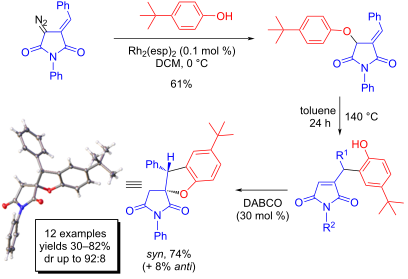
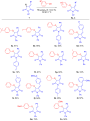
- Discussion The initial attempt to involve DAS 1b in the Rh2(esp)2-catalyzed insertion reaction with 4-(tert-butyl)phenol was successful. The initial adduct 5b was not purified and was heated at 140 °C in toluene to give compound 6b in 47% yield over two steps (Scheme 2). No further optimization of the



A novel bis-triazole scaffold accessed via two tandem [3 + 2] cycloaddition events including an uncatalyzed, room temperature azide–alkyne click reaction
Beilstein J. Org. Chem. 2022, 18, 1636–1641, doi:10.3762/bjoc.18.175
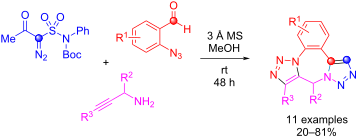
- scaffolds. Recently, we reported a novel, metal-free synthesis of 1,5-disubstituted 1,2,3-triazoles via a three-component reaction of α-acetyl-α-diazomethanesulfonamide (1) with aldehydes and amines [4]. The reaction proceeded, presumably, through the formation of the initial 1,2,3-triazoline adduct 2 [5
- propargylamine. The reaction was allowed to go to completion in 48 h at room temperature whereupon the reaction mixture was absorbed on silica and subjected to column chromatography for isolation of the product. To our sheer amazement, the product turned out to be not the initial adduct 4a but rather 9H-benzo[f


Synthetic study toward the diterpenoid aberrarone
Beilstein J. Org. Chem. 2022, 18, 1625–1628, doi:10.3762/bjoc.18.173
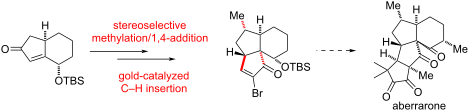
- functional transformation from 10, which itself would be prepared through methylation and conjugate addition from Pauson–Khand adduct 11. This cyclopentenone could be readily accessed from 1,7-enyne 12 which could be obtained through the reported procedure [35] from the commercially available 5-hexenoic acid


Functionalization of imidazole N-oxide: a recent discovery in organic transformations
Beilstein J. Org. Chem. 2022, 18, 1575–1588, doi:10.3762/bjoc.18.168
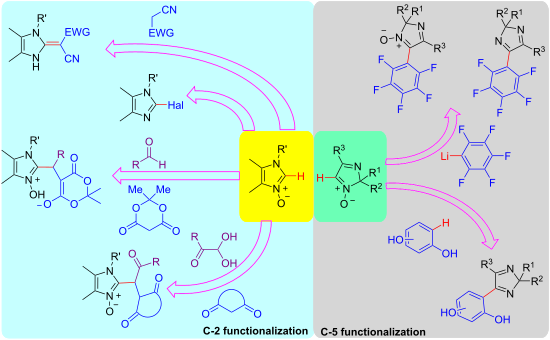
- ), acted as the nucleophile to attack the C-5 position of 2H-imidazole 1-oxides 9a–h to form the σH-adduct 14. The use of a deoxygenation agent in the mixture led to the formation of the desired products 10a–h via “addition–elimination” (SNH AE, path A) from the adduct 14 with the elimination of the good


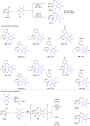


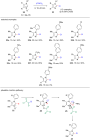

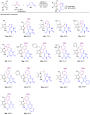


Oxa-Michael-initiated cascade reactions of levoglucosenone
Beilstein J. Org. Chem. 2022, 18, 1457–1462, doi:10.3762/bjoc.18.151
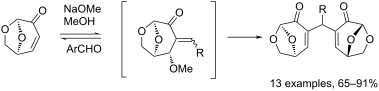
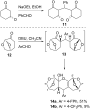
- and not the 1:1 product 6a was the major product (Table 1, entry 1 and Figure 2), presumably due to the equilibria and thermodynamics favoring adduct 5. The Hantzsch dihydropyridine synthesis, and aldol/Michael sequences such as the reaction of hydroxytropolones with aromatic aldehydes give similar


1,4,6,10-Tetraazaadamantanes (TAADs) with N-amino groups: synthesis and formation of boron chelates and host–guest complexes
Beilstein J. Org. Chem. 2022, 18, 1424–1434, doi:10.3762/bjoc.18.148
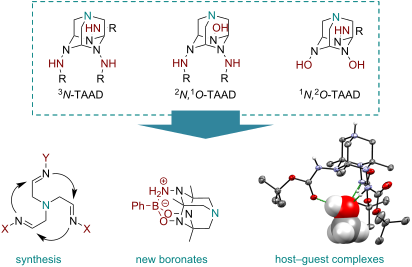
- equilibrium to the adamantane form by forming a stable boronate adduct 18 having a diamantane structure through the reaction with phenylboronic acid. Note that product 18 contains an unprecedented 2,4-dioxa-1,5,7,10-tetraaza-3-boraadamantane motif (Scheme 4). This result demonstrates that N-amino-substituted






B–N/B–H Transborylation: borane-catalysed nitrile hydroboration
Beilstein J. Org. Chem. 2022, 18, 1332–1337, doi:10.3762/bjoc.18.138
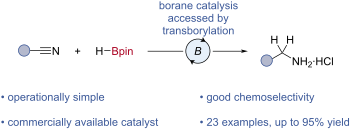
- reaction temperature of 60 °C means both routes are viable under the reaction conditions. It should be noted that treatment of a nitrile with excess H-B-9-BBN has been shown to form an N-B-9-BBN iminyl H-B-9-BBN adduct [43], suggesting route B may be favoured. Experimental calculation of the reaction


Cytochrome P450 monooxygenase-mediated tailoring of triterpenoids and steroids in plants
Beilstein J. Org. Chem. 2022, 18, 1289–1310, doi:10.3762/bjoc.18.135
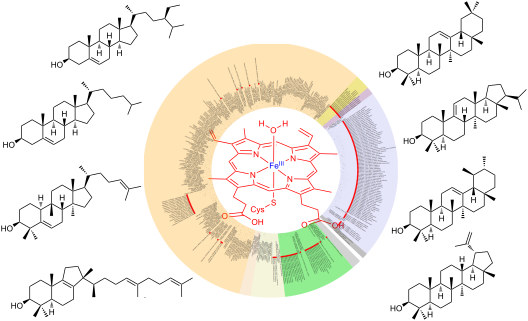
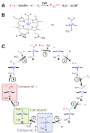
- charge, can then efficiently bind molecular oxygen (step 3), leading to dioxygen adduct D. Transfer of an additional electron from a reducing partner such as cytochrome P450 reductase (step 4) generates peroxo intermediate E, which upon protonation (step 5) gives hydroperoxo intermediate F, also called




Modular synthesis of 2-furyl carbinols from 3-benzyldimethylsilylfurfural platforms relying on oxygen-assisted C–Si bond functionalization
Beilstein J. Org. Chem. 2022, 18, 1256–1263, doi:10.3762/bjoc.18.131
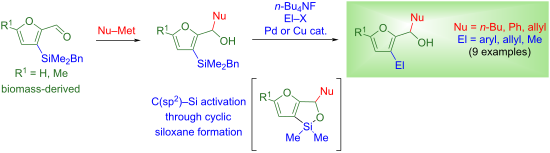
- of benzaldehyde led to the formation of adduct 14 (in 75% yield), which arose from the addition of a benzyl carbanion 17 to benzaldehyde. The generation of such a nucleophile strongly suggests the formation of pentavalent silicon intermediate 15 [27], which then produced a (stabilized) benzylic


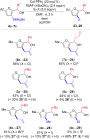
Derivatives of benzo-1,4-thiazine-3-carboxylic acid and the corresponding amino acid conjugates
Beilstein J. Org. Chem. 2022, 18, 1195–1202, doi:10.3762/bjoc.18.124
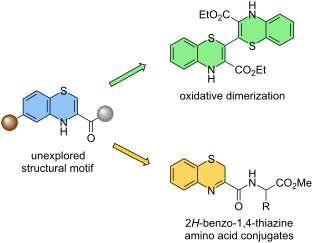
- either the salt 16a·HCl or the free amine 16a in good to excellent yield (Scheme 3). We also explored the asymmetric catalytic hydrogenation of adduct 14. Our first attempt at the reduction using organocatalyzed transfer hydrogenation was unsuccessful (see Supporting Information File 1). The (R)-Ru(OAc)2
Lewis acid-catalyzed Pudovik reaction–phospha-Brook rearrangement sequence to access phosphoric esters
Beilstein J. Org. Chem. 2022, 18, 1188–1194, doi:10.3762/bjoc.18.123
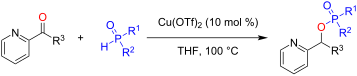
- the standard substrates to test the suitable conditions for the O-phosphination product 3aa. Delightfully, in the presence of 10 mol % Cu(OTf)2 in toluene at 100 °C, the desired product 3aa was obtained in 62% yield, and no Pudovik adduct 4aa was detected (Table 1, entry 1). Inspired by this result
- . Additional experiments were conducted in order to clarify the reaction mechanism. Under standard conditions, only pyridin-2-ylmethyl diphenylphosphinate (3aa) was produced, and the Pudovik adduct (hydroxy(pyridin-2-yl)methyl)diphenylphosphine oxide (4aa) was not detected (Scheme 4a). The control experiment
- (1a) and 2-pyridinecarboxaldehyde (2a) undergo the Pudovik reaction to produce the intermediate adduct 4aa. Then, Cu(OTf)2 coordinates with 4aa to form the intermediate Int-A, which goes through the phospha-Brook rearrangement process to form Int-B. Finally, Int-B is transformed into the product 3aa




Electro-conversion of cumene into acetophenone using boron-doped diamond electrodes
Beilstein J. Org. Chem. 2022, 18, 1154–1158, doi:10.3762/bjoc.18.119

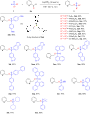
- propose a reaction mechanism (Table 2). First, we carried out the electrolysis of 1 in MeCN–MeOH to confirm whether the reaction intermediate is a radical or cationic species (Table 2, entry 1). As a result, methyl cumyl ether, a methoxy adduct to the benzyl position of 1, was obtained as the main product





