


Search results
Search for "lithium" in Full Text gives 454 result(s) in Beilstein Journal of Organic Chemistry. Showing first 200.
N-(1-Phenylethyl)aziridine-2-carboxylate esters in the synthesis of biologically relevant compounds
Beilstein J. Org. Chem. 2019, 15, 1722–1757, doi:10.3762/bjoc.15.168

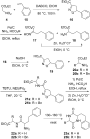
- lithium enolate of methyl 4-methoxyphenylacetate would give the β-hydroxyester 169 which when treated with Lewis acid experienced the aziridine ring cleavage with simultaneous dihydrofuran-2-one ring closure to produce 170 contaminated with small amounts of the corresponding furan-2(5H)-one 171
- salts in a similar way [33]. However, to introduce the hydroxy group at C3 of the piperidine ring addition of a lithium acetylide to the aziridine aldehyde (2S,1'R)-6 was performed (Scheme 51) instead of alkylation (Scheme 50). Two diastereoisomeric acetylenic alcohols were formed in the reaction with
- lithium ethyl propiolate in an 8:2 ratio, and the major product 191 had the required configuration. After protection of the hydroxy group in 191 Weinreb amide 192 was prepared to facilitate the installation of the respective alkyl chains in ketones 193a and 193b. They were transformed into


Synthesis and biological evaluation of truncated derivatives of abyssomicin C as antibacterial agents
Beilstein J. Org. Chem. 2019, 15, 1468–1474, doi:10.3762/bjoc.15.147
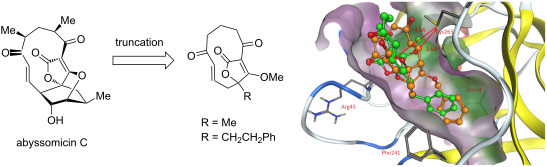
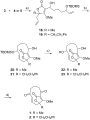
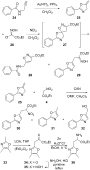
- allyldioxazaborolidine 11), respectively. The tetronate building blocks 4 and 5 were further converted to the corresponding enolates using lithium diisopropylamide and allowed to react with the common key intermediate 3 to afford the hydroxyalkylated products 18 and 19, in 78% and 59% yield, respectively (Scheme 4


Borylation and rearrangement of alkynyloxiranes: a stereospecific route to substituted α-enynes
Beilstein J. Org. Chem. 2019, 15, 1416–1424, doi:10.3762/bjoc.15.141
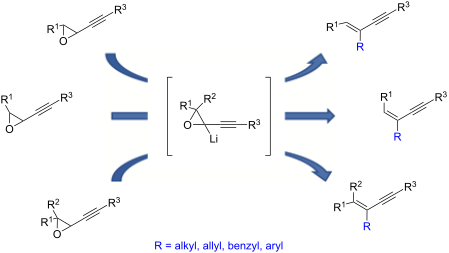
- rearrangement of the so-formed alkynyloxiranyl borates. This stereospecific process overall transfers the cis or trans-stereochemistry of the starting alkynyloxiranes to the resulting 1,3-enynes. Keywords: boron; enyne; lithium; oxirane; rearrangement; Introduction Lithiated oxiranes are useful intermediates
- lithium observed by X-ray diffraction in the lithiated o-trifluoromethylstyrene oxide [37] may be further elongated due to hindrance introduced by the trans-substituent adjacent to the lithium atom of the second oxirane in the dimer (Scheme 2, entry 5). Such effect may facilitate the formation of the


Anomeric sugar boronic acid analogues as potential agents for boron neutron capture therapy
Beilstein J. Org. Chem. 2019, 15, 1355–1359, doi:10.3762/bjoc.15.135
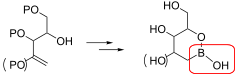
- lithium ion) that dissipate all their energy in a path of the order of a cell diameter (5–9 μm) in biological tissues, which gives them the potential for precise cell damage. Highly selective delivery, accumulation of boron in tumor tissues and proper subcellular distribution are required to achieve a


Alkylation of lithiated dimethyl tartrate acetonide with unactivated alkyl halides and application to an asymmetric synthesis of the 2,8-dioxabicyclo[3.2.1]octane core of squalestatins/zaragozic acids
Beilstein J. Org. Chem. 2019, 15, 1194–1202, doi:10.3762/bjoc.15.116
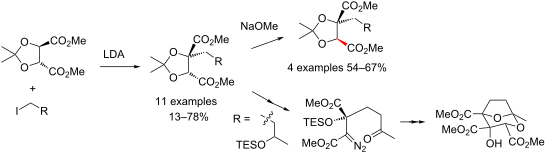
- pseudoaxial methyl of the gem-dimethyl group [18][24]; it was proposed that the axial methyl group directed electrophile incorporation away from itself (Scheme 4). The fragile nature of the lithium ester enolate of dimethyl tartrate acetonide (to β-elimination with loss of acetone) was evident from Seebach’s


Heck- and Suzuki-coupling approaches to novel hydroquinone inhibitors of calcium ATPase
Beilstein J. Org. Chem. 2019, 15, 971–975, doi:10.3762/bjoc.15.94
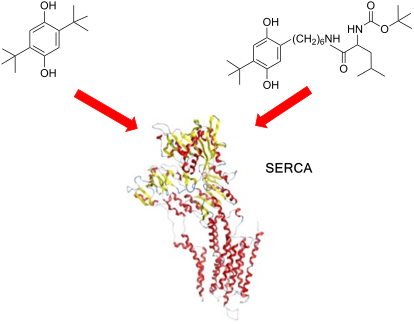
- appended. Unfortunately, reactions of 6 and 8 utilizing catalytic hydrogenation, lithium aluminium hydride by itself as well as with added aluminium chloride or samarium iodide produced only trace amounts of an amine (e.g., 9). When samarium iodide was used as the reagent, the only discernible product (not
- , followed by addition of bromide 5a, potassium phosphate and PdCl2(dppf)2 in DMF at 85 °C for 3.5 h gave the coupled product 10 in 47–63% yields (Scheme 3). In contrast to the case of the Heck coupling products (6 and 8, Scheme 2), nitrile 10 underwent facile reduction with lithium aluminium hydride. The


Catalytic asymmetric oxo-Diels–Alder reactions with chiral atropisomeric biphenyl diols
Beilstein J. Org. Chem. 2019, 15, 955–962, doi:10.3762/bjoc.15.92
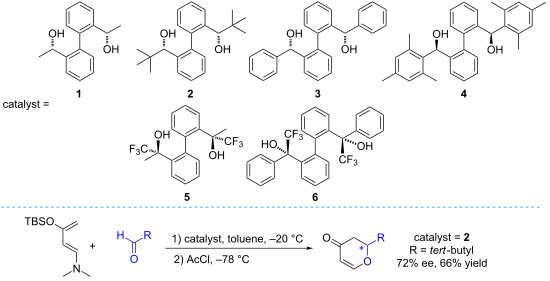
- removing the chiral-resolving menthyl substituent with lithium aluminium hydride (LAH), the enantioselectivity of (R)-d was higher than 99% ee when checked with HPLC (Supporting Information File 1, Figure S3). Catalyst 4 was then obtained by homo-coupling of (R)-d with Ni(PPh3)3Br2/Zn with 37% yield. The


Efficient synthesis of 4-substituted-ortho-phthalaldehyde analogues: toward the emergence of new building blocks
Beilstein J. Org. Chem. 2019, 15, 721–726, doi:10.3762/bjoc.15.67
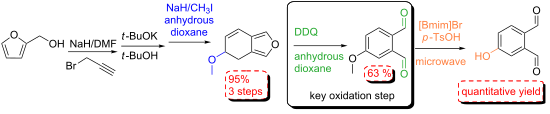
- deprotection agent was tested, trimethylsilyl iodide, as it was recently published by Danjou et al. [24] as a removal agent of methoxy groups on calixarenes architectures. Although we succeeded with the removal of methoxy groups, both aldehydes were reduced. Furthermore, the lithium chloride/N,N
- -dimethylformamide system was tested according to the study of Fang et al. [25] revealing that the methoxy group in the meta-position of an electron-withdrawing substituents can be removed under microwave irradiation. However, when testing the system on 5b, no reaction occurred. Another experiment with lithium


Selective benzylic C–H monooxygenation mediated by iodine oxides
Beilstein J. Org. Chem. 2019, 15, 602–609, doi:10.3762/bjoc.15.55
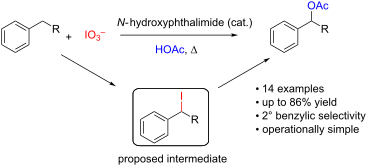
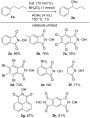
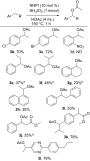
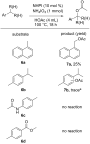
- NHPI-catalyzed C–H acetoxylation reaction yielded the ester product 3a in moderate (42%) yield. This contrasts with orthoperiodic acid (H5IO6), which yielded only electrophilic arene iodination. The use of alkali metal iodate salts such as lithium, sodium, and potassium iodate as the terminal oxidant




Synthesis and biological investigation of (+)-3-hydroxymethylartemisinin
Beilstein J. Org. Chem. 2019, 15, 567–570, doi:10.3762/bjoc.15.51
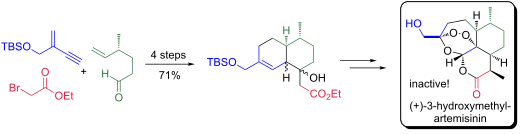
- min, 95%; c) i. DBU, DCM, rt, 1 d; ii. TBAF, THF, 0 °C, 10 min, 87% (over two steps). LDA = lithium diisopropylamide, HMPA = hexamethylphosphoramide, DBU = 1,8-diazabicyclo[5.4.0]undec-7-ene, TESCl = triethylsilyl chloride. Supporting Information Supporting Information File 206: Experimental part.


Synthesis of nonracemic hydroxyglutamic acids
Beilstein J. Org. Chem. 2019, 15, 236–255, doi:10.3762/bjoc.15.22
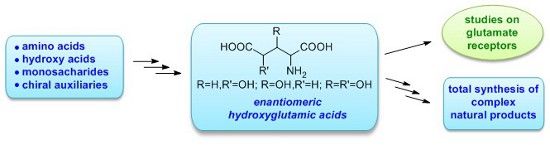
- of a chiral auxiliary with lithium dibutylcuprate. Next, titanium tetrachloride-catalyzed cyanation secured another carboxy group and after a few transformations an oxazolidinone (4S,5R)-39 was obtained as a major (7:1) product readily purified chromatographically. To complete the synthesis of (2S,3R
- electrophilic hydroxylation at C4 When the lithium enolate of dimethyl N-Cbz-L-glutamate 63 was treated with Davis oxaziridine, an inseparable 9:1 mixture of diastereoisomers was formed with (2S,4S)-64 predominating (Scheme 16) [74]. For sodium and potassium enolates diastereoselectivity of the hydroxylation
- [86][87][88] or a Diels–Alder reaction using acylnitroso compounds [89]. However, when compared with these multistep approaches hydroxylation of pyroglutamic acid derivatives seems to be the simplest option. Treatment of the lithium enolate of benzyl N-Boc-pyroglutamate (S)-86 with Davis oxaziridine


Catalysis of linear alkene metathesis by Grubbs-type ruthenium alkylidene complexes containing hemilabile α,α-diphenyl-(monosubstituted-pyridin-2-yl)methanolato ligands
Beilstein J. Org. Chem. 2019, 15, 194–209, doi:10.3762/bjoc.15.19
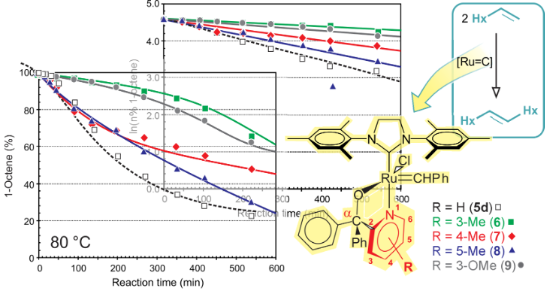
- (RCM) of dialkenes, ring-opening metathesis polymerisation (ROMP), isomerisation of alkenes and cross-metathesis (CM) of alkenes [7]. The complexes were synthesized by reacting the lithium salts of the corresponding pyridinyl alcohols with [RuCl2(=CHC6H5)(P(iPr3))2]. These complexes catalysed inter
- with GxF/0.45 µm GHP membrane (PALL) was used to filter the lithium salt from the precatalyst. Experimental procedures Precatalyst synthesis: The well-established methods of Herrmann et al. [23] and Van Der Schaaf et al. [7] were used to synthesize precatalysts 6–9. This is illustrated in Scheme 2


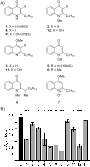
Synthesis and biological activity of methylated derivatives of the Pseudomonas metabolites HHQ, HQNO and PQS
Beilstein J. Org. Chem. 2019, 15, 187–193, doi:10.3762/bjoc.15.18
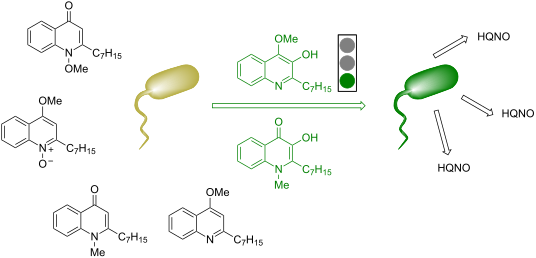
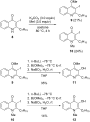
- PQS such as formylation followed by oxidation failed when applied to OMe-HHQ (3). Alternatively, ortho-metalation next to the methoxy group of OMe-HHQ (3) followed by borylation/oxidation was investigated. Several trials using different lithium bases failed and only small amounts of oxidation products
- in the benzylic position could be observed. Instead of direct ortho-metalation, a strategy based on halogen–lithium exchange proved to be more suitable. To this end, HHQ (1) was converted into 3I-HHQ (8) following a literature procedure [21]. 3I-HHQ (8) was then methylated using the MeI/K2CO3
- hand, the halogen-lithium exchange was attempted. Treatment of 9 with n-butyllithium at −78 °C followed by the addition of B(OMe)3 and finally in situ oxidation using sodium perborate provided the desired 4OMe-PQS derivative 11 in moderate yield (35%, Scheme 3). The same procedure could be applied to




Systematic synthetic study of four diastereomerically distinct limonene-1,2-diols and their corresponding cyclic carbonates
Beilstein J. Org. Chem. 2019, 15, 130–136, doi:10.3762/bjoc.15.13
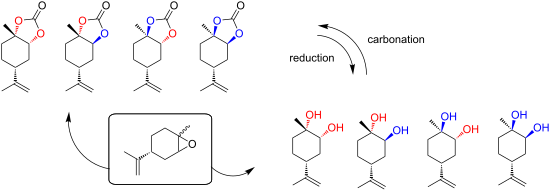
- previous study was 3 MPa [27], 5 MPa CO2 was applied in the present study to promote a higher consumption of LO. The result showed the isolated yields were improved to 84% yield for 1a and 30% yield for 1d. In our previous report, 1d was reduced by lithium aluminium hydride (LAH) to obtain the


Nucleofugal behavior of a β-shielded α-cyanovinyl carbanion
Beilstein J. Org. Chem. 2018, 14, 3018–3024, doi:10.3762/bjoc.14.281
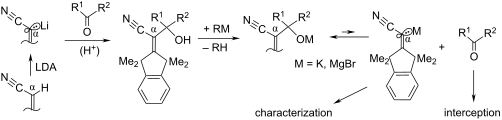
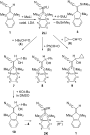
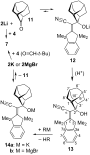
- with those of 7–9. Complete NMR assignments for the 2-hydroxyadamantan-2-yl part of 13 were achieved with the two-dimensional NOESY and HSQC techniques at rt. Except for the OH signal, all other resonances were changed only insignificantly on cooling to −60 °C. Cleavage of 13 via the lithium alkoxide
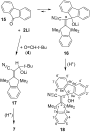
- widths at −45 °C. Formation of the primary lithium alkoxide 16 (Scheme 4) was shown to be readily reversible as follows. Without protolysis and work-up of the green-colored solution, 16 was kept in THF at rt for 30 min and then treated with t-BuCH=O (4; 1.5 equiv); after a further period of 2 hours at rt
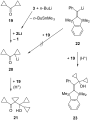
- ; this provided a first evidence for the retro-addition process with an alkenylmetal intermediate. These fissions were slow in case of the magnesium alkoxide but rapid for the lithium or potassium alkoxides at ambient temperatures. (iii) The alternative trapping [3] of the carbonyl component by means of



1,8-Bis(dimethylamino)naphthyl-2-ketimines: Inside vs outside protonation
Beilstein J. Org. Chem. 2018, 14, 2940–2948, doi:10.3762/bjoc.14.273
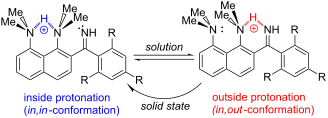
- Synthesis of DMAN-ortho-ketimines and their cations Target compounds 4a–7a were synthesised by techniques previously developed in our laboratory (Scheme 4) [7][8]. Compounds 4a–6a were obtained by the treatment of the ortho-lithium derivative 8 with the corresponding nitrile (path a). Unfortunately, the




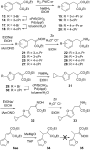
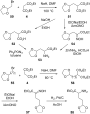
Unnatural α-amino ethyl esters from diethyl malonate or ethyl β-bromo-α-hydroxyiminocarboxylate
Beilstein J. Org. Chem. 2018, 14, 2853–2860, doi:10.3762/bjoc.14.264
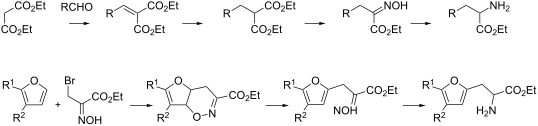
- the stronger lithium diisopropylamide. We do not have an explanation for this observation, although such oximation was achieved (in a low yield) when starting from the phenyl-bearing analogue 36 as described below. We suggest a somehow forbidding cation chelation by the oxygen of the furan ring which
- slightly different approach was used for the preparation of the even more hindered β,β-dimethyl aminoester 41. Treatment of the monoester 39 [12][13] with lithium diisopropylamide and isoamyl nitrite overnight was once again not really successful as a rather poor 15% yield of the corresponding α
- ester 2af were of (only) 56% and 54%, respectively. Later on, when using a 1:1 proportion of compounds 47 and 48af, a slightly improved yield of 50% was achieved when switching from ammonium bicarbonate to lithium carbonate (note d in Table 2) or in the case of the preparation of compound 2ag switching



Synthesis of unnatural α-amino esters using ethyl nitroacetate and condensation or cycloaddition reactions
Beilstein J. Org. Chem. 2018, 14, 2846–2852, doi:10.3762/bjoc.14.263
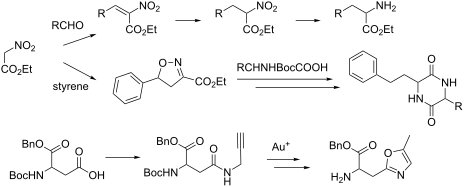
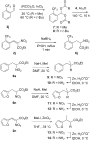
- improve this transformation (trials with manganese(III) acetate were not successful either). We then resorted to a different approach to prepare the oxazole-bearing α-amino ester 36 from 2,4,5-trimethyloxazole (33). Deprotonation of this compound was achieved using lithium diisopropylamide (LDA) and this



Domino ring-opening–ring-closing enyne metathesis vs enyne metathesis of norbornene derivatives with alkynyl side chains. Construction of condensed polycarbocycles
Beilstein J. Org. Chem. 2018, 14, 2708–2714, doi:10.3762/bjoc.14.248
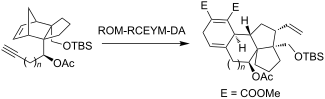
- retigeranic acids, the norbornene derivative 16 was chosen. Addition of lithium (trimethylsilyl)acetylide to the lactol 5 followed by desilylation by using methanolic K2CO3 afforded diol 15 (Scheme 4). The primary hydroxy group in compound 15 was selectively protected to produce the silyl ether 16 in 95




Transition metal-free oxidative and deoxygenative C–H/C–Li cross-couplings of 2H-imidazole 1-oxides with carboranyl lithium as an efficient synthetic approach to azaheterocyclic carboranes
Beilstein J. Org. Chem. 2018, 14, 2618–2626, doi:10.3762/bjoc.14.240

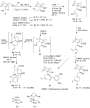
- -oxides 1a–d and carboranyl lithium 2. The reactions were carried out in accordance with the optimized coupling conditions according to the "addition–elimination" SNH(AE) or "addition–oxidation" SNH(AO) pathways (Table 1 and Table 2). Optimization of the reaction conditions for the C–H/C–Li cross-coupling


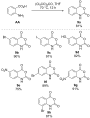
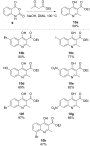
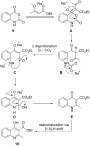
Quinolines from the cyclocondensation of isatoic anhydride with ethyl acetoacetate: preparation of ethyl 4-hydroxy-2-methylquinoline-3-carboxylate and derivatives
Beilstein J. Org. Chem. 2018, 14, 2529–2536, doi:10.3762/bjoc.14.229

- heterocycle at position 4 is installed by Suzuki coupling with iodide 3a that is synthesized in three steps from ethyl aryl oxalate 4a. The α-ketoester side chain at position 3 was installed by selective halogen-metal exchange of iodide 5a with isopropylmagnesium chloride lithium chloride complex followed by
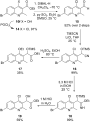
- tartrate. Subsequent oxidation of the primary alcohol to the aldehyde 15 was accomplished with the pyridine sulfur trioxide complex in 52% yield over two-steps [29]. The carbon atom at the acid oxidation state was installed by addition of trimethylsilyl cyanide to the aldehyde 15 in the presence of lithium




Stereoselective total synthesis and structural revision of the diacetylenic diol natural products strongylodiols H and I
Beilstein J. Org. Chem. 2018, 14, 2313–2320, doi:10.3762/bjoc.14.206
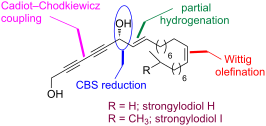
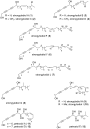
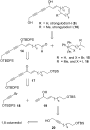
- lithium(trimethylsilyl)acetylide to get the coupled product 24. The latter compound on further treatment with K2CO3 in MeOH [26] furnished the desilylated propargylic alcohol 19 (Scheme 2). The copper(I)-catalyzed Cadiot–Chodkiewicz [27] cross-coupling reaction between bromoalkyne 18 [28] and terminal



Dynamic light scattering studies of the effects of salts on the diffusivity of cationic and anionic cavitands
Beilstein J. Org. Chem. 2018, 14, 2212–2219, doi:10.3762/bjoc.14.195
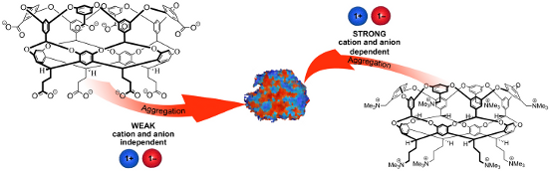
- titration with various halide salts. The fifteen salts studied were a matrix of the alkali metal cations Li+, Na+, K+, and Cs+ in combination with the halides F− through I−, the one omission being poorly soluble lithium fluoride (maximum solubility = 0.134 g mL−1). Unsurprisingly, given the pKa values of


β-Hydroxy sulfides and their syntheses
Beilstein J. Org. Chem. 2018, 14, 1668–1692, doi:10.3762/bjoc.14.143
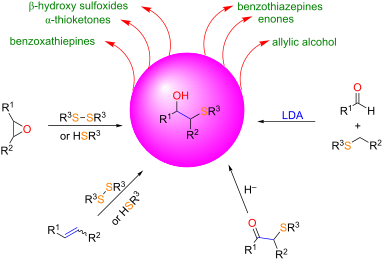
- weakness it required long reaction times (5 days). In 1997, Shibasaki and colleagues reported a gallium-lithium bis(binaphthoxide) complex 43, easily prepared from GaCl3, (R)-binaphthol and butyllithium in THF, as a catalyst for the asymmetric opening of symmetrical epoxides in the presence of 4 Å
- ranged from –78 °C to room temperature. The use of amines, alcohols as well as alkyl and arylthiols as nucleophiles failed to provide the corresponding products. A year later, Antilla and co-workers found lithium-binol phosphate 64 to be an efficient catalyst for the desymmetrization of meso-epoxides
- complex. Enantioselective ring-opening reaction of stilbene oxides with ArSH catalyzed by a C2-symmetric chiral bipyridyldiol–titanium complex. Asymmetric desymmetrization of meso-epoxides using BINOL-based Brønsted acid catalysts. Lithium-BINOL-phosphate-catalyzed desymmetrization of meso-epoxides with


Mild and selective reduction of aldehydes utilising sodium dithionite under flow conditions
Beilstein J. Org. Chem. 2018, 14, 1529–1536, doi:10.3762/bjoc.14.129
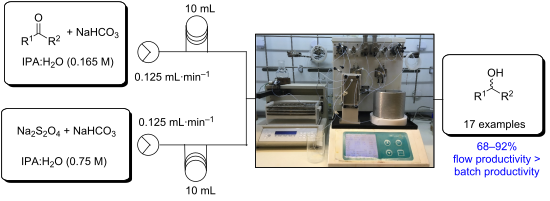
- reduction utilizing solid mixes of sodium borohydride, lithium chloride and celite [12], and the Ley group were able to demonstrate a green transfer hydrogenation of ketones under flow using catalytic lithium tert-butoxide in isopropanol [13]. We recently published a batch–flow hybrid synthesis of the





