


Search results
Search for "calibration" in Full Text gives 358 result(s) in Beilstein Journal of Nanotechnology. Showing first 200.
Polydopamine-coated Au nanorods for targeted fluorescent cell imaging and photothermal therapy
Beilstein J. Nanotechnol. 2019, 10, 794–803, doi:10.3762/bjnano.10.79
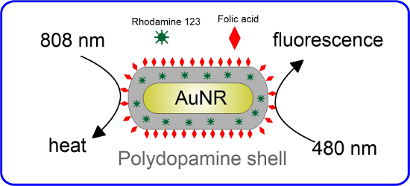
- . First, from the differential peak adsorption 0.035 and the calibration curve (Figure S2 in Supporting Information File 1), the molar concentration of bound dye molecules is 1.5 µM. Taking into account the estimated number concentration 1012 mL−1 of AuNRs (Section S1 in Supporting Information File 1), we
- -folate nanocomposites. Supporting Information S1. Calculation of the AuNR concentration; S2. Calibration curve for determination of rhodamine 123 concentration; S3. Dynamic light scattering study of nanocomposites at different pH values. Supporting Information File 168: Additional experimental data


Review of time-resolved non-contact electrostatic force microscopy techniques with applications to ionic transport measurements
Beilstein J. Nanotechnol. 2019, 10, 617–633, doi:10.3762/bjnano.10.62
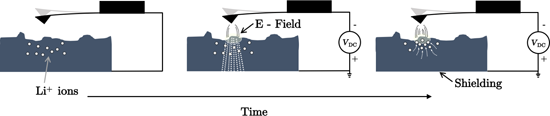
- is off by approximately a factor of 5, while the tip radii are significantly smaller than the true tip radius (ca. 30 nm). These results are not surprising as there are many potential sources of error that can affect the absolute value of the force including the calibration of the cantilever spring
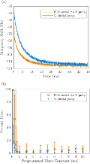
- time constant τ to generate a calibration curve (Figure 7a). They observed statistically significant differences in the measured signal in differences in τ down to 10 ns, which they designated as the minium attainable time resolution. The authors then utilized tFP to study differences in local charging
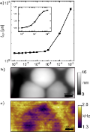
- time constants, τ, and stretching factors, β. “(a) Calibration curve for a range of characteristic times of exponential decay (τ) (inset shows a zoom-in for shorter times). (b) Topography





Biomimetic synthesis of Ag-coated glasswing butterfly arrays as ultra-sensitive SERS substrates for efficient trace detection of pesticides
Beilstein J. Nanotechnol. 2019, 10, 578–588, doi:10.3762/bjnano.10.59
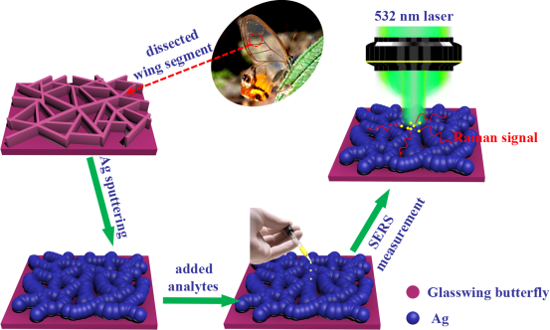
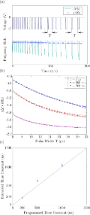
- ) Raman spectra of CV at different concentrations from 10−6 M to 10−11 M on Ag-G.b.-20 substrate. (d) Linear calibration plot between the Raman intensities and CV concentrations in the log–log scale at the 1172 cm−1 and 1370 cm−1 peaks (the error bars were calculated based on five independent measurements
- intensities of the main peaks at 1078, 1185 and 1576 cm−1 in different concentrations. (c) Linear calibration plot between the Raman intensities and acephate concentrations. (d) Raman spectra of 10−8 mg/mL acephate collected by using the Ag-G.b.-20 substrate. Linear relationships between CV concentrations (10


Hydrophilicity and carbon chain length effects on the gas sensing properties of chemoresistive, self-assembled monolayer carbon nanotube sensors
Beilstein J. Nanotechnol. 2019, 10, 565–577, doi:10.3762/bjnano.10.58
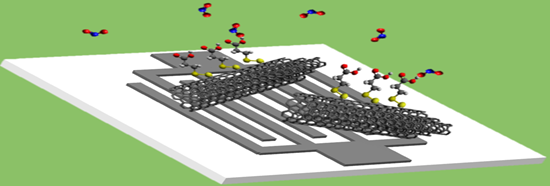
- concentrations of nitrogen dioxide, in a real application these effects could be compensated for via the use of a humidity sensor and an appropriate calibration. The presence of an adsorbed water layer on hydrophilic thiol sensors and the reported water-mediated adsorption of nitrogen dioxide could explain the
- approach was employed to study the response towards ethanol vapors. These results are summarized in Figure 8, where it can be observed that the highest sensitivity towards ethanol (i.e., slope of the calibration curves shown in Figure 8b) is obtained for the hydrophilic SAM having a short length carbon
- to nitrogen dioxide exposure and recovery cycles in air, and b) calibration curves for the different nitrogen dioxide concentrations tested. Electrostatic interactions pathways between –COOH functional groups and nitrogen dioxide (a, b), water (c, d) and ethanol (e, f). Calibration curves for


Mechanical and thermodynamic properties of Aβ42, Aβ40, and α-synuclein fibrils: a coarse-grained method to complement experimental studies
Beilstein J. Nanotechnol. 2019, 10, 500–513, doi:10.3762/bjnano.10.51
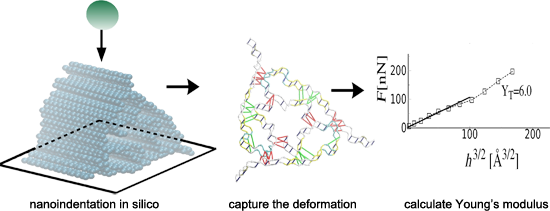
- ], AFM base-force spectroscopy [51], or by the design of sophisticated microelectromechanical systems (MEMS) [52]. These techniques have been successfully used to predict the elastic properties of several biomolecules. However, OT are limited to applied loads below 0.1 nN and AFM has delicate calibration
- stable at higher temperatures (thermophilic character) among the other two-fold and three-fold β-amyloids. The calibration of our room temperature is 0.35ε/kB. In particular, the folding temperature (Tf) defined in our CG model at P0 equal to 0.5 gives Tf equal to 0.38, 0.42, 0.44, 0.46, and 0.48 in
- units of ε/kB for the amyloids with the PDB entries 2LMO, 2MJ4, 2NAO, 5OQV, and 2MVX, respectively. With our calibration of ε, the difference between the most (PDB ID: 2MVX) and least (PDB ID: 2LMO) thermophilic fibrils is of the order of 85 °C. Our results indicate that the α-syn fibril is thermally


Polymorphic self-assembly of pyrazine-based tectons at the solution–solid interface
Beilstein J. Nanotechnol. 2019, 10, 494–499, doi:10.3762/bjnano.10.50
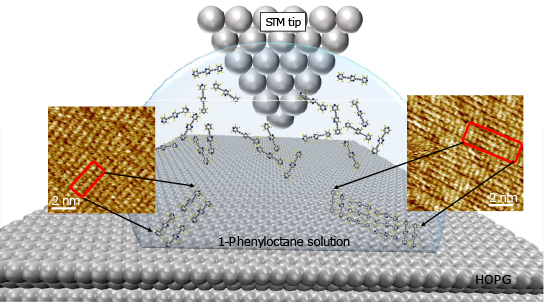
- means of split-image technique [21] in which both the adsorbate layer and the substrate are recorded with molecular and atomic resolution, respectively, in a single frame. The details of calibration and correction of STM images is given in the section 5 of Supporting Information File 1. A 5 μL droplet


Reduced graphene oxide supported C3N4 nanoflakes and quantum dots as metal-free catalysts for visible light assisted CO2 reduction
Beilstein J. Nanotechnol. 2019, 10, 448–458, doi:10.3762/bjnano.10.44
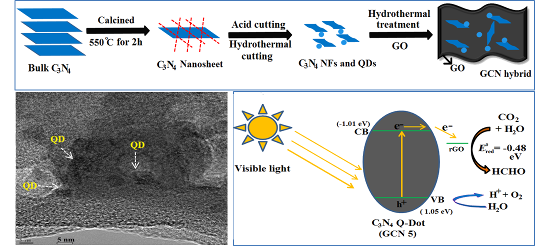
- -1,4-dihydro-2,6-lutidine (DDL) complex between HCHO and the Nash reagent. The optical intensity of this complex is then measured at λmax = 412 nm using a UV–vis spectrophotometer, and the final concentration of the produced HCHO was measured using a standard calibration curve (Supporting Information
- a standard calibration curve. The photoactivity usually depends on the quantity of catalyst and light intensity, therefore the CO2 photoreduction efficiency can also be measured by the apparent quantum yield (AQY), where AQY can be calculated according to Equation 1. The number of electrons required





Thermal control of the defunctionalization of supported Au25(glutathione)18 catalysts for benzyl alcohol oxidation
Beilstein J. Nanotechnol. 2019, 10, 228–237, doi:10.3762/bjnano.10.21
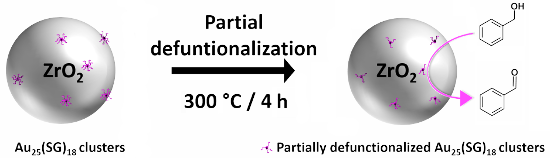
- programmed from 30 °C to 180 °C, injector and FID detector set at 220 °C, and using N2 as carrier gas. External calibration was carried out by injecting distinct standard solutions of benzyl alcohol and benzaldehyde with dodecane. UV–visible spectroscopy was performed with Agilent UV 8453 UV–visible




Wet chemistry route for the decoration of carbon nanotubes with iron oxide nanoparticles for gas sensing
Beilstein J. Nanotechnol. 2019, 10, 105–118, doi:10.3762/bjnano.10.10
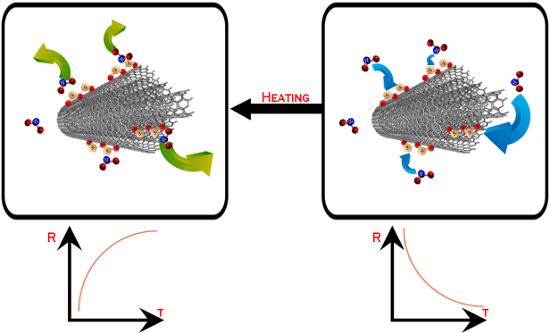
- concentration and the value of RG was fixed as the value of resistance at a fixed time after an NO2 exposure of 10 minutes. Figure 8 shows the calibration curves for different concentrations of NO2. Response (%) is defined as 100 × (RG – R0)/R0. As derived from Figure 8, Sample B with a 1:1 decoration ratio




Bidirectional biomimetic flow sensing with antiparallel and curved artificial hair sensors
Beilstein J. Nanotechnol. 2019, 10, 32–46, doi:10.3762/bjnano.10.4
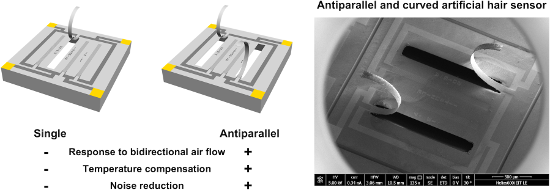
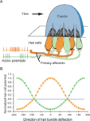
- ) implementation of a Wheatstone half-bridge circuit with two static and two variable resistors (strain gauges). Calibration curve for the single and antiparallel artificial hair sensors. Dots indicate measurement values and the lines represent curve fittings for visual guidance. For the single cantilever, a


Apparent tunneling barrier height and local work function of atomic arrays
Beilstein J. Nanotechnol. 2018, 9, 3048–3052, doi:10.3762/bjnano.9.283
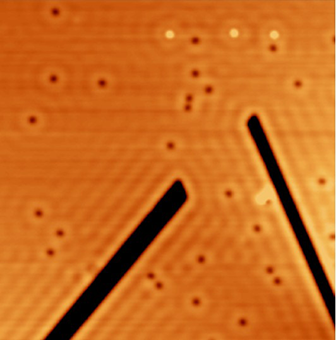
- tip apex. The absolute values are obtained using the calibration of the piezoelectric transducer, which leads to an estimated uncertainty of 10%. The ratios between them, however, are not affected. The maximal apparent barrier height is measured on Cu adatoms. It exceeds the minimal value, which is


Electrostatic force microscopy for the accurate characterization of interphases in nanocomposites
Beilstein J. Nanotechnol. 2018, 9, 2999–3012, doi:10.3762/bjnano.9.279
- of the time (in several comparable samples) measured with different probes. Since, as in this section, experimental data and simulations for a large set of samples were compared, only the results obtained with a specific probe will be presented. Tip calibration The first step to compare experimental
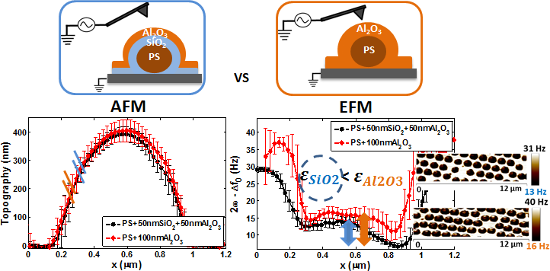
- permittivity of 2.6 was obtained that fit with the experimental data (0.08% error) (Table 1). Step A: PS + 100 nm Al2O3 and PS + 100 nm SiO2 (shell calibration) In step A (Figure 5 – shell calibration), the average topography profiles obtained by AFM image analysis (Figure 8a) between PS + 100 nm Al2O3 and PS
- simulations to allow for the calculation of the apparent permittivity of the shells, particularly SiO2. PS was modeled with a permittivity of 2.6, deduced during the calibration process (Table 1). For Al2O3, the dielectric permittivity of 9.8 was in accordance with the experimental data (error = 3.2%), and




Time-resolved universal temperature measurements using NaYF4:Er3+,Yb3+ upconverting nanoparticles in an electrospray jet
Beilstein J. Nanotechnol. 2018, 9, 2916–2924, doi:10.3762/bjnano.9.270
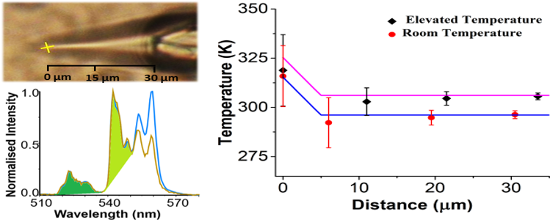
- ability to be used as a universal temperature sensor. Herein, we introduce a universal calibration protocol for NaYF4:Er3+,Yb3+ upconverting nanoparticles that is robust to environmental changes and gives a precise temperature measurement. We used this new procedure to calculate the temperature profile
- temperature measurement if the entire peak shape is integrated in the calibration. Our universal calibration circumvents this problem and can be used for time-resolved applications. The temperature at the end of the Taylor cone increases due to the creation of a whispering gallery mode cavity with 980 nm
- problems when using the luminescence intensity ratio (LIR) to measure temperature unless a calibration is done under identical conditions. We find that this problem can be circumvented by integrating the S-band just over the wavelength range from 536 to 548 nm (the first two peaks in the S-band). The S


Variation of the photoluminescence spectrum of InAs/GaAs heterostructures grown by ion-beam deposition
Beilstein J. Nanotechnol. 2018, 9, 2794–2801, doi:10.3762/bjnano.9.261
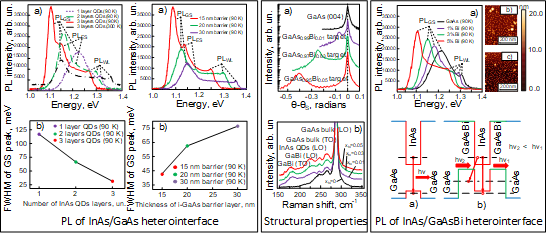
- photoluminescence spectrum of the heterostructures. The heterostructures were synthesized by using an IBD system [21]. The deposition experiments were performed on GaAs(100) substrates. The deposition of the material was carried out by sputtering the target with an Ar+ ion beam. Calibration dependencies of InAs and
- methods for the formation of heterostructures, we note that the average lateral sizes of quantum dots are the same, and their height, in the case of IBD, is higher. The reasons for this may be related to the difference in the formation of growth fluxes. In IBD, much depends on the calibration of the


Magnetic and luminescent coordination networks based on imidazolium salts and lanthanides for sensitive ratiometric thermometry
Beilstein J. Nanotechnol. 2018, 9, 2775–2787, doi:10.3762/bjnano.9.259
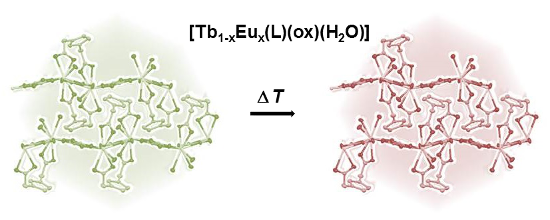
- ′-dicarboxylate) with Sm = 4.47%·K−1 at 333 K [65] and Eu@UiO-(2,2′-bipyridine-5,5′-dicarboxylate) with Sm = 2.19%·K−1 at 293 K [67] (value recalculated and corrected using the published calibration curve). Two other thermometers have a performance similar to ours, Eu0.089Tb0.9911[2,6-di(2′,4′-dicarboxylphenyl
- calibration curves, resulting from the fit considering a linear function for Δ1, Δ(T) = Δ0 + mT (r2 = 0.998) and second-order polynomial functions, Δ(T) = Δ0 + a1T + a2T2, for Δ2 (r2 = 0.999) and Δ3 (r2 = 0.999). The bars depict the errors in the thermometric parameter resulting from the propagation of the



Comparative biological effects of spherical noble metal nanoparticles (Rh, Pd, Ag, Pt, Au) with 4–8 nm diameter
Beilstein J. Nanotechnol. 2018, 9, 2763–2774, doi:10.3762/bjnano.9.258
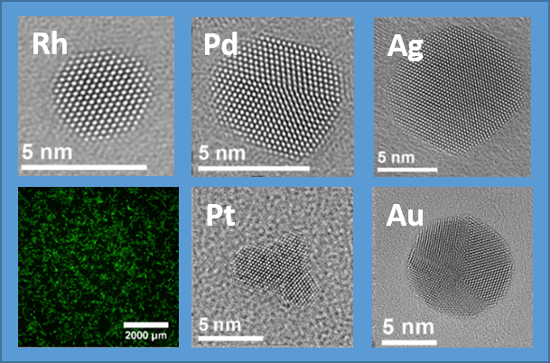
- ). Two sucrose solutions (8 wt % and 24 wt %) formed a density gradient which was capped with 0.5 mL dodecane as a stabilizing agent. The calibration standard was a poly(vinyl chloride) (PVC) latex in water with a particle size of 483 nm provided by CPS Instruments. The calibration was carried out prior


Optimization of Mo/Cr bilayer back contacts for thin-film solar cells
Beilstein J. Nanotechnol. 2018, 9, 2700–2707, doi:10.3762/bjnano.9.252
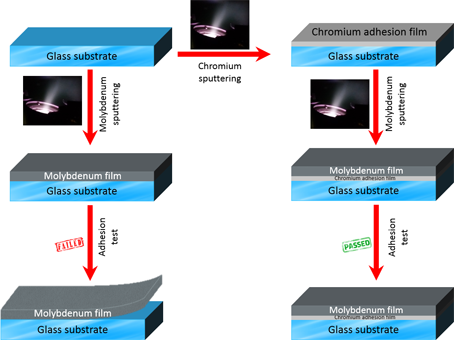
- regions were acquired with 10 eV pass energy and about 0.4 eV spectral resolution to discriminate the substructure of the spectral lines. Ar+ ion cluster etching was employed for XPS depth profiling and the calibration was carried out using a typical Mo on glass sample with sputtering rate of 15.5 nm/s


Size-selected Fe3O4–Au hybrid nanoparticles for improved magnetism-based theranostics
Beilstein J. Nanotechnol. 2018, 9, 2684–2699, doi:10.3762/bjnano.9.251
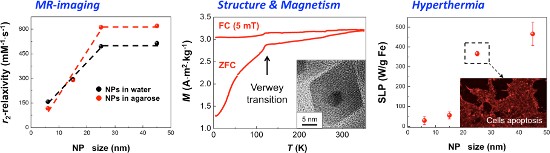
- dissolved in aqua regia using the calibration curve for the standard samples in 0.1–1 mg·mL−1 concentration range. X-ray diffraction patterns were measured from 2θ = 30° to 120° at a scan rate of 0.1° per step and 3 s per point using the X-ray powder diffractometer Rigaku Ultima IV with Co Kα radiation and


Pattern generation for direct-write three-dimensional nanoscale structures via focused electron beam induced deposition
Beilstein J. Nanotechnol. 2018, 9, 2581–2598, doi:10.3762/bjnano.9.240
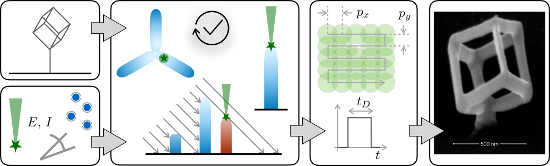
- inclination angles as calibration data. Based on this calibration data, for each deposit edge in the target structure, an appropriate beam displacement velocity is chosen. We use a different approach based on the three-dimensional pitch Π3D, as stated before (see Equation 2). As the 3D deposition speed sF has
- speed sF. This is a computationally intensive task. Here we follow a different approach based on an initial deposition experiment for calibration. First, the target 3D structure is deposited by using the pattern file generated by the code with the height-dependent deposition speed correction deactivated
- calibration experiment at a similar height z3D,i ≈ ζ would compensate for the reduced precursor coverage effect because ne = le/sF. Now we have For the set of values {(hi+1 − hi)/(z3D,i+1 − z3D,i)} vs the heights {z3D,i} obtained from the calibration experiment we perform a polynomial fit and obtain n ≤ 3




Enhanced antineoplastic/therapeutic efficacy using 5-fluorouracil-loaded calcium phosphate nanoparticles
Beilstein J. Nanotechnol. 2018, 9, 2499–2515, doi:10.3762/bjnano.9.233
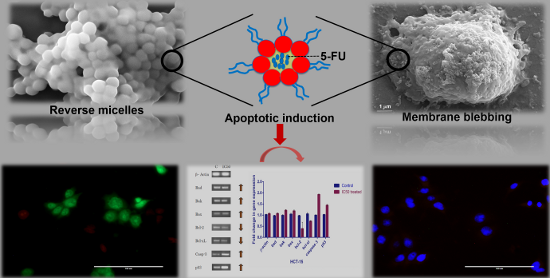
- efficiency in CaP@5-FU NPs The entrapment efficiency of 5-FU in CaP NPs was estimated by UV absorption studies. Initially, a calibration curve of 5-FU dissolved in PBS was determined by a Lasany double-beam L1 2800 UV–visible spectrometer. The standard curve (plotted at 265 nm, 0–50 μg/mL, R = 0.999) was


Intrinsic ultrasmall nanoscale silicon turns n-/p-type with SiO2/Si3N4-coating
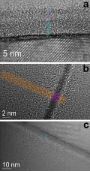
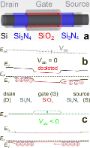
Beilstein J. Nanotechnol. 2018, 9, 2255–2264, doi:10.3762/bjnano.9.210
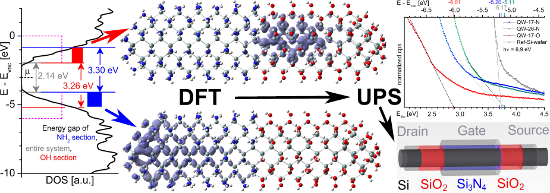
- energy of 8.9 eV and a photon flux of 2 × 10¹² s−1. The incident angle of the UV beam onto the sample was 50° with respect to the sample surface normal, and excited electrons were collected with an electron analyzer along the normal vector of the sample surface. The energy calibration of the UPS was





Filling nanopipettes with apertures smaller than 50 nm: dynamic microdistillation
Beilstein J. Nanotechnol. 2018, 9, 2181–2187, doi:10.3762/bjnano.9.204
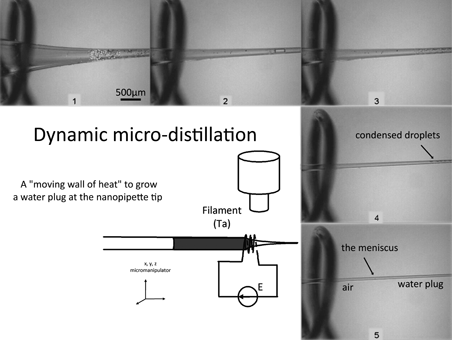
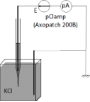
- diameter are usually in the expected range for a given set of parameters. Due to variations in the builder calibration, this set of parameters can change from one puller to another. The very end of each tip is always different and has to be characterized. Here, we determined tip shape and aperture via


A scanning probe microscopy study of nanostructured TiO2/poly(3-hexylthiophene) hybrid heterojunctions for photovoltaic applications
Beilstein J. Nanotechnol. 2018, 9, 2087–2096, doi:10.3762/bjnano.9.197
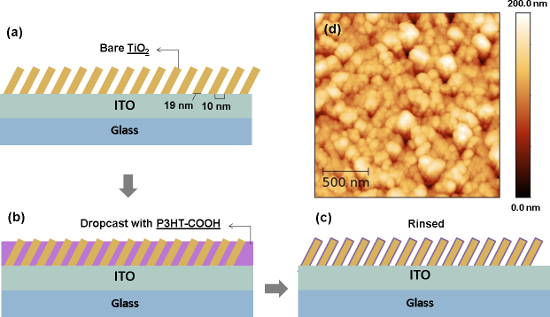
- are the workfunction of the tip and the sample, respectively. In this work, no calibration of the tip workfunction was necessary, as only the Vcpd variations between the materials constituting the photovoltaic blends and their modifications with incoming light were to be measured. These Vcpd


High-throughput synthesis of modified Fresnel zone plate arrays via ion beam lithography
Beilstein J. Nanotechnol. 2018, 9, 2049–2056, doi:10.3762/bjnano.9.194
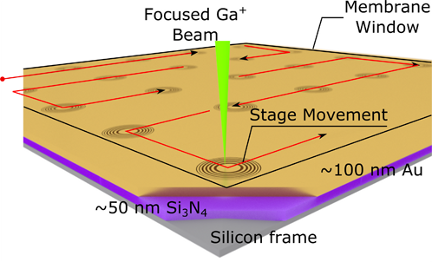
- were resolved in both x- and y-direction with high sharpness and contrast, revealing the defects in the test object coming from its fabrication process. In order to test the ultimate resolution of the optic, the certified calibration standard BAM L-200 sample was imaged at 1.12 eV. The raw gray-scale


A differential Hall effect measurement method with sub-nanometre resolution for active dopant concentration profiling in ultrathin doped Si1−xGex and Si layers
Beilstein J. Nanotechnol. 2018, 9, 1926–1939, doi:10.3762/bjnano.9.184
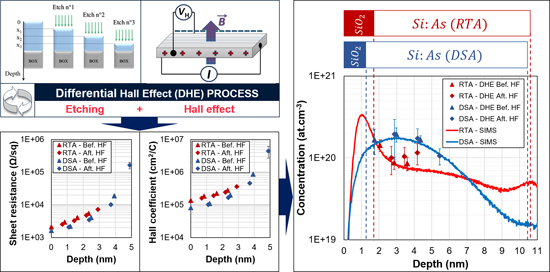
- context, the optimization of existing characterisation techniques for the measurement of dopant activation at the semiconductor surface (or the development of new ones) is therefore decisive for both the improvement of the fabrication processes and the calibration of the related technology CAD (TCAD





