Search results
Search for "Wittig reaction" in Full Text gives 133 result(s) in Beilstein Journal of Organic Chemistry.
Total synthesis of leopolic acid A, a natural 2,3-pyrrolidinedione with antimicrobial activity
Beilstein J. Org. Chem. 2016, 12, 1624–1628, doi:10.3762/bjoc.12.159
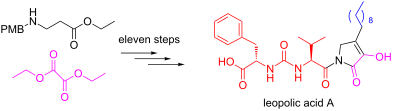
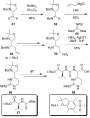
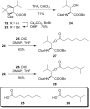
- DIBAL-H gave the corresponding primary alcohol, which was converted into bromide 5 by Appel reaction with PPh3 and CBr4. The phosphonium salt obtained from this bromide was subjected to a Wittig reaction with nonanal, to afford compound 6 [12]. Attempts to remove the PMB protecting group (CAN, DDQ, TFA


Muraymycin nucleoside-peptide antibiotics: uridine-derived natural products as lead structures for the development of novel antibacterial agents
Beilstein J. Org. Chem. 2016, 12, 769–795, doi:10.3762/bjoc.12.77
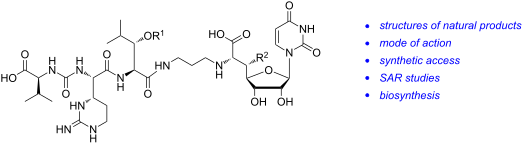
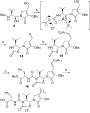
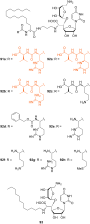
- muraymycins. The latest and optimised synthesis is shown in Scheme 2 [92]. Oxidation of the isopropylidene-protected uridine 12 to the 5'-aldehyde and a Wittig reaction [93] gave olefin 13. The key step was a subsequent asymmetric Sharpless aminohydroxylation [94] furnishing (5'S,6'S)-nucleosyl amino acid 14









Hydroquinone–pyrrole dyads with varied linkers
Beilstein J. Org. Chem. 2016, 12, 89–96, doi:10.3762/bjoc.12.10
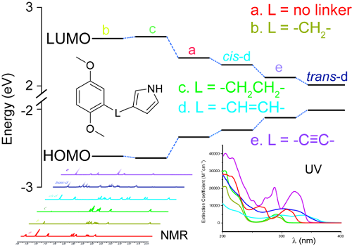
- material, a Wittig reaction was chosen as an alternative. The Wittig reaction approach is shown in Scheme 2. In this reaction, phosphonium salt 7 was prepared in quantitative yield from 5 and triphenylphosphine by reflux in toluene, according to a procedure reported for dimethoxybenzyl chloride [21]. The


Synthesis of α,β-unsaturated esters via a chemo-enzymatic chain elongation approach by combining carboxylic acid reduction and Wittig reaction
Beilstein J. Org. Chem. 2015, 11, 2245–2251, doi:10.3762/bjoc.11.243
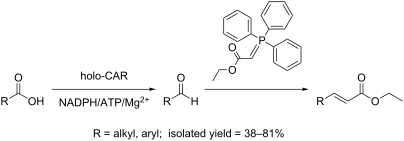
- chain elongation approach to access α,β-unsaturated esters by combining an enzymatic carboxylic acid reduction and Wittig reaction. Recently, we have found that Mycobacterium sp. was able to reduce phenylacetic acid (1a) to 2-phenyl-1-ethanol (1c) and two sequences in the Mycobacterium sp. genome had
- aromatic and aliphatic carboxylic acids, including ibuprofen. The Mycobacterium CAR catalyzed carboxylic acid reduction to give aldehydes, followed by a Wittig reaction to afford the products α,β-unsaturated esters with extension of two carbon atoms, demonstrating a new chemo-enzymatic method for the
- synthesis of these important compounds. Keywords: α,β-unsaturated esters; carboxylic acid reductase; chemoenzymatic synthesis; reduction; Wittig reaction; Introduction α,β-Unsaturated esters are versatile building blocks for organic synthesis and of significant importance for industrial applications [1][2

A new approach to ferrocene derived alkenes via copper-catalyzed olefination
Beilstein J. Org. Chem. 2015, 11, 2072–2078, doi:10.3762/bjoc.11.223
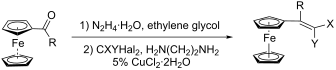
- methods for the preparation of ethynylferrocenes [24][25][26][27][28][29]. In most cases, the key reagents for the synthesis of ethynylferrocene are the corresponding mono- and dihalogenvinylferrocene derivatives. These compounds are generally prepared using a variation of the Wittig reaction (the Corey


Preparation of conjugated dienoates with Bestmann ylide: Towards the synthesis of zampanolide and dactylolide using a facile linchpin approach
Beilstein J. Org. Chem. 2015, 11, 1815–1822, doi:10.3762/bjoc.11.197
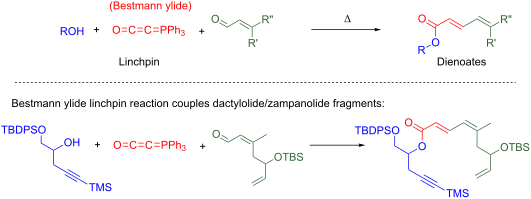
- , if the α-phosphoranylidene ester or amide is formed in the presence of an aldehyde, ketone or ester, an additional in situ Wittig reaction can occur [12][13][14][15][16][17][18]. In this way, amides, esters and thioesters can be obtained through three-component couplings [14][16]. Intramolecular
- and Michael addition, followed by a Wittig reaction [19][20]. Although the utility of the Bestmann ylide in the synthesis of acyclic α,β-unsaturated esters and dienamides has already been reported [11][13][16], its application to the synthesis of α,β,γ,δ-unsaturated esters (i.e., dienoates) remains
- uncharted. In this paper, a three-component reaction between α,β-unsaturated aldehydes, alcohols and the Bestmann ylide is described. The scope of this esterification–Wittig reaction sequence in the synthesis of α,β,γ,δ-unsaturated esters is studied, and the method is applied in an approach towards the


Cross-metathesis reaction of α- and β-vinyl C-glycosides with alkenes
Beilstein J. Org. Chem. 2015, 11, 1392–1397, doi:10.3762/bjoc.11.150

- vinyl β-C-deoxyribofuranoside was based on transformation of 6-O-tert-butyldiphenylsilyl-3,5-dideoxy-5-iodo-L-lyxo-hexofuranose [14]. A reaction sequence relying on Horner–Wadsworth–Emmons/ring closure–halogenation/Ramberg–Bäcklund/Wittig reaction gave rise to the equimolar mixture of styryl α- and β-C


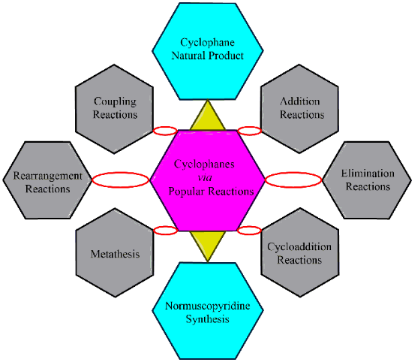
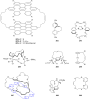
Selected synthetic strategies to cyclophanes
Beilstein J. Org. Chem. 2015, 11, 1274–1331, doi:10.3762/bjoc.11.142






Direct access to pyrido/pyrrolo[2,1-b]quinazolin-9(1H)-ones through silver-mediated intramolecular alkyne hydroamination reactions
Beilstein J. Org. Chem. 2015, 11, 416–424, doi:10.3762/bjoc.11.47
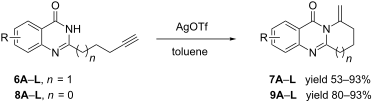
- -insertion reaction [7], the cycloaddition of anthranilic acid iminoketene to a methyl butyrolactam through a sulfinamide anhydride intermediate [9], the intramolecular aza-Wittig reaction with an azide substrate [10], and the cycloaddition of anthranilamide [11]. For the synthesis of vasicinone (5


Attempts to prepare an all-carbon indigoid system
Beilstein J. Org. Chem. 2015, 11, 363–372, doi:10.3762/bjoc.11.42

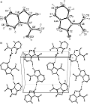
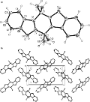
- , and then oxidizing the presumably resulting carbanion to 21 (a known compound [19]) with Cu(OTf)2, which gave cleaner results than the chloride employed previously. Unfortunately, all efforts to convert 21 into 4 failed. Thus neither the Wittig reaction of 21 (MeP(Ph)3Br/n-BuLi, THF) nor its treatment





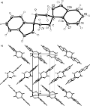


Electrochemical selenium- and iodonium-initiated cyclisation of hydroxy-functionalised 1,4-dienes
Beilstein J. Org. Chem. 2015, 11, 174–183, doi:10.3762/bjoc.11.18

- adopt a Z-configuration. Accordingly, the products of type 2 are formed in high selectivity in terms of regio- and diastereomeric control. The starting materials of type 1 were generated from the aromatic aldehydes and allyltriphenylphosphonium bromide in a Wittig reaction following a known protocol [53


Indium-mediated allylation in carbohydrate synthesis: A short and efficient approach towards higher 2-acetamido-2-deoxy sugars
Beilstein J. Org. Chem. 2014, 10, 2230–2234, doi:10.3762/bjoc.10.231
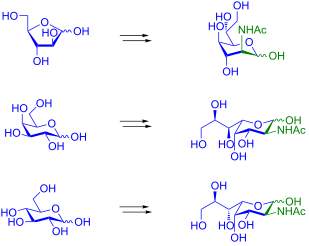
- decomposition of these labile compounds. Conversion of the carbonyl moiety to an acetal group followed by treatment with azide nucleophiles also failed to yield any desired products. Therefore we decided to mask the aldehyde as an olefin. A Wittig reaction with methyl (triphenylphosphoranylidene)acetate (Ph3P


Photochemical approach to functionalized benzobicyclo[3.2.1]octene structures via fused oxazoline derivatives from 4- and 5-(o-vinylstyryl)oxazoles
Beilstein J. Org. Chem. 2014, 10, 2222–2229, doi:10.3762/bjoc.10.230
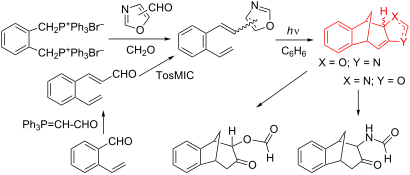
- isocyanide (TosMIC) [38][39]. For the preparation of 5-(2-vinylstyryl)oxazole (2) by this method 3-(2-vinylphenyl)acrylaldehyde (6) was needed. This new o-substituted phenylacrylaldehyde 6 was prepared using (formylmethylene)triphenylphosphorane by a Wittig reaction from o-vinylbenzaldehyde (5). The yield of


Palladium-catalysed cyclisation of alkenols: Synthesis of oxaheterocycles as core intermediates of natural compounds
Beilstein J. Org. Chem. 2014, 10, 2077–2086, doi:10.3762/bjoc.10.216
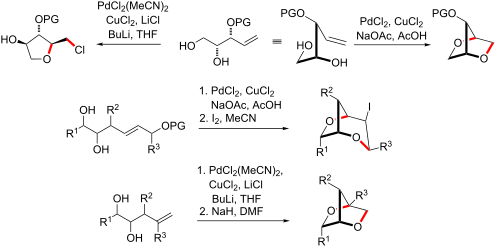
- –Wadsworth–Emmons olefination of aldehyde 15 furnished the corresponding separable mixture of Z and E alkenes 16 and 17. In the case of utilising stabilised phosphorane ylides, the Wittig reaction provided only Z alkenes 18 and 19. Following acidic hydrolysis provided α-O-benzyl substrates 20–23 in good

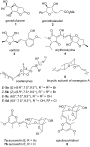


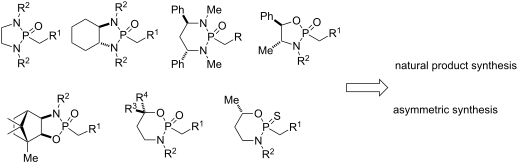
Application of cyclic phosphonamide reagents in the total synthesis of natural products and biologically active molecules
Beilstein J. Org. Chem. 2014, 10, 1848–1877, doi:10.3762/bjoc.10.195
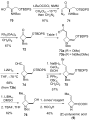
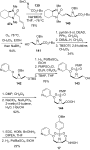
- ]. Kishi and co-workers adopted a convergent approach to fumonisin B2, with the molecule being cleaved into three main fragments 103–105 [45][46]. The connection of 103 and 104 under formation of the fumonisin backbone would employ a Wittig reaction, followed by attachment of two molecules of








Multicomponent reactions in nucleoside chemistry
Beilstein J. Org. Chem. 2014, 10, 1706–1732, doi:10.3762/bjoc.10.179
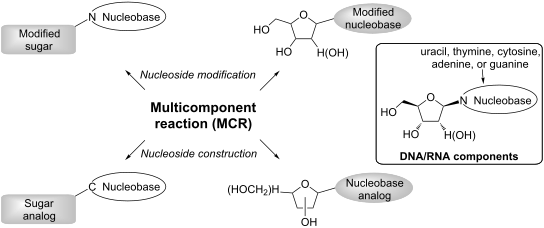
- group has developed the synthesis of D-glucopyranose-derived counterparts of compounds 25 and 26 [73]. The formation of an intermediate imine from a sugar azide and an aldehyde by Staudinger/aza-Wittig reaction was the key step of the synthesis. 2. The Kabachnik–Fields reaction The Kabachnik–Fields


Streptopyridines, volatile pyridine alkaloids produced by Streptomyces sp. FORM5
Beilstein J. Org. Chem. 2014, 10, 1421–1432, doi:10.3762/bjoc.10.146
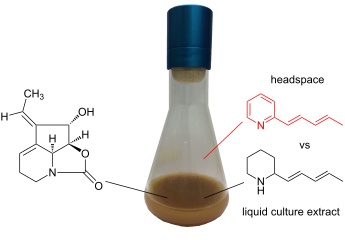
- synthesized by Wittig reaction using different conditions (Scheme 1). A Wittig–Schlosser reaction [15] starting from a commercially available 5:1 E/Z-mixture of 1-bromobut-2-ene (17) led to preferentially (1E)-configured products. After conversion of 17 into the respective Wittig salt 18 and reaction with 2
- ]+ (17), 146 (29), 133 (11), 132 (100), 119 (17), 118 (30), 117 (47), 106 (25), 93 (77), 79 (17), 78 /14), 65 (18), 51 (13), 39 (19); HREIMS m/z: calcd for C10H13N, 147.1048; found, 147.1054; GC (BPX-5) I = 1208. The synthesis of compounds 9 and 12 was achieved by Wittig reaction starting with the
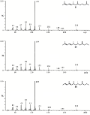
- )pyridine (streptopyridine A, 9), c) 2-((1E,3E)-penta-1,3-dien-1-yl)pyridine (streptopyridine B, 12). Total ion chromatograms of the product mixtures of isomers 9–12 synthesized under E-selective (a) and Z-selective Wittig reaction conditions (b). Structures of piperidine derivatives 20–26. a) Mass spectrum


Amino acid motifs in natural products: synthesis of O-acylated derivatives of (2S,3S)-3-hydroxyleucine
Beilstein J. Org. Chem. 2014, 10, 1135–1142, doi:10.3762/bjoc.10.113
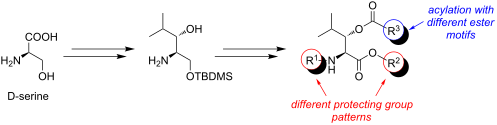
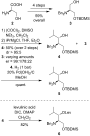
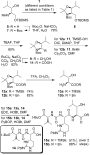
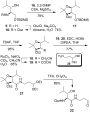
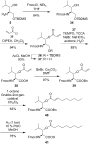
- investigated, but resulted in a moderate yield of 32% only (reaction not displayed). One-pot Swern oxidation to the corresponding aldehyde and subsequent Wittig reaction with stabilized Wittig reagent 32 led to α,β-unsaturated ester 33 in 85% yield. After simultaneous reduction of the double bond and cleavage




Structure elucidation of female-specific volatiles released by the parasitoid wasp Trichogramma turkestanica (Hymenoptera: Trichogrammatidae)
Beilstein J. Org. Chem. 2014, 10, 767–773, doi:10.3762/bjoc.10.72
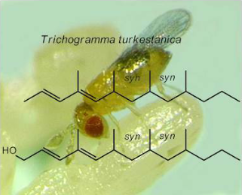
- position 2 underwent ca. 6% epimerization to yield 7 as a mixture of 4 stereoisomers. The synthesis of 2,6,8,12-tetramethyltrideca-2,4-diene (8) was completed by Wittig reaction using (3-methylbut-2-en-1-yl)triphenylphosphonium bromide [15]. As expected, the obtained mixture of all possible stereoisomers
- , followed by oxidation, yielded the aldehyde 10, which was chain elongated by Wittig reaction with [(2E)-1-methylbut-2-en-1-yl]triphenylphosphonium bromide [17] to afford the protected dienol 11 as a mixture of 4 racemates. This was due to partial epimerization at position 2 of the aldehyde 10 and the less
- corresponding deoxygenation steps) would produce the carbon skeleton of a 4,6,8,10-tetramethyltrideca-2,4-diene (15). Thus, from a biosynthetic point of view, the structure would be reasonable and follow established principles. To test the validity of our assumption, we transformed 13 into 15 by Wittig reaction



Asymmetric total synthesis of a putative sex pheromone component from the parasitoid wasp Trichogramma turkestanica
Beilstein J. Org. Chem. 2014, 10, 761–766, doi:10.3762/bjoc.10.71
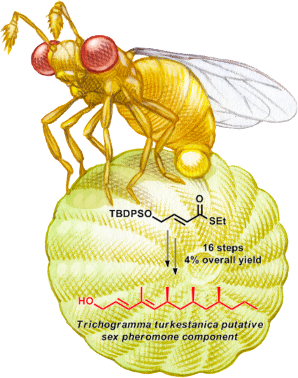
- the reduction of 13 with DIBALH is a clean reaction, affording essentially pure 2 after work-up, the preparation of pure 13 was highly desirable. A stepwise olefination approach was therefore considered. Wittig reaction of aldehyde 11 with phosphorane 14 to give 15 was carried out first (Scheme 4) [27
- account for the observed 1H NMR signals. As the Wittig reaction of 11 did afford 15, although with the simultaneous formation of an inseparable side-product, we were curious to see how the analogous Horner–Wadsworth–Emmons olefination towards 15 would perform. Thus, aldehyde 11 was freshly prepared and
- intermediate, leading to a mixture of double bond isomers. The impurity previously observed as a result of the Wittig reaction was not present. In addition, the E- and Z-isomers could be separated using column chromatography affording pure E-15 in 45% yield. Reduction of 15 was achieved using DIBALH, affording


Synthesis of (2S,3R)-3-amino-2-hydroxydecanoic acid and its enantiomer: a non-proteinogenic amino acid segment of the linear pentapeptide microginin
Beilstein J. Org. Chem. 2014, 10, 667–671, doi:10.3762/bjoc.10.59
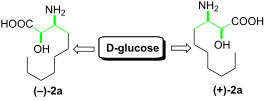
- -pentodialdo-1,4-furanose (3b) which was obtained from D-glucose in good yield as reported earlier [33]. Thus, the Wittig reaction of 3b followed by hydrogenation (10% Pd/C) gave 4-heptyl-D-threose derivative 5b (Scheme 3). Hydrolysis of 1,2-O-isopropylidene (TFA:H2O) followed by oxidative cleavage of the


Synthesis of complex intermediates for the study of a dehydratase from borrelidin biosynthesis
Beilstein J. Org. Chem. 2014, 10, 634–640, doi:10.3762/bjoc.10.55
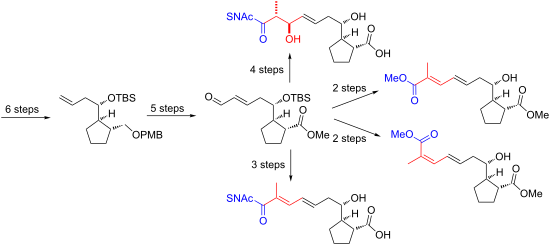
- . Synthesis of reference compounds We exploited a Wittig reaction with a suitable stabilized phosphorane for the synthesis of (E,E)-diene 6a (Scheme 4). The Wittig compound 24 was obtained in two steps from 2-bromopropionic acid following synthetic procedures described for its acetic acid analogue and the
- % yield by a Wittig reaction with stabilized phosphorane 26. The Z-isomer 10b was synthesized by Still–Gennari olefination using phosphonate 27 in 47% yield. The yield for the deprotection step was satisfying (61% for 7a and 57% for 7b) in both cases, indicating that both isomers are configurationally


Deoxygenative gem-difluoroolefination of carbonyl compounds with (chlorodifluoromethyl)trimethylsilane and triphenylphosphine
Beilstein J. Org. Chem. 2014, 10, 344–351, doi:10.3762/bjoc.10.32
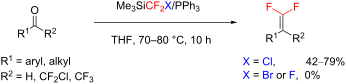
- . Conclusion: Similar to many other Wittig-type gem-difluoroolefination reactions in the presence of PPh3, the reaction of TMSCF2Cl with aldehydes and activated ketones is effective. Keywords: (chlorodifluoromethyl)trimethylsilane; difluorocarbene; gem-difluoroolefin; organo-fluorine; Wittig reaction; ylide


Recent applications of the divinylcyclopropane–cycloheptadiene rearrangement in organic synthesis
Beilstein J. Org. Chem. 2014, 10, 163–193, doi:10.3762/bjoc.10.14
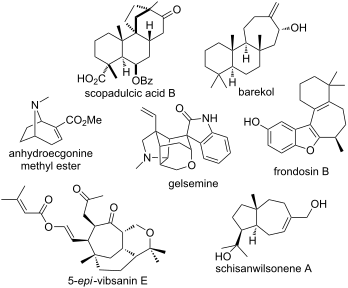
- elusive cis-divinylcyclopropane (9) was characterized ten years later by Brown and coworkers [3] using a low temperature and very short-timed Wittig reaction between cis-vinylcarbaldehyde 11 and methylenetriphenylphoshorane. This review summarizes the recent synthetic applications of the
- rearrangement was followed by MOM-cleavage. Oxidation furnished an intermediate aldehyde, followed by Wacker oxidation and the Anders–Gaßner variant [106][107][108][109] of the Wittig reaction to furnish 5-epi-vibsanin E (115). Echavarren and coworkers [110] used a DVCPR to target the sesquiterpenoid
- reaction of dihydrooxepine 325 (see Scheme 38) to access vinylcyclopropane carbaldehyde 326, which was in situ converted into the corresponding imine 327 using an aza-Wittig reaction. Subsequent vinylcyclopropane carbimine–dihydroazepine rearrangement furnished cyclic 328 in excellent yield. Conclusion The




Total synthesis of the endogenous inflammation resolving lipid resolvin D2 using a common lynchpin
Beilstein J. Org. Chem. 2013, 9, 2762–2766, doi:10.3762/bjoc.9.310
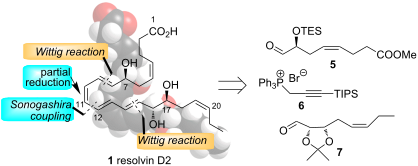
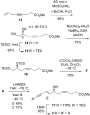
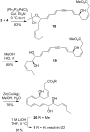
- Abstract The total synthesis of the endogenous inflammation resolving eicosanoid resolvin D2 (1) is described. The key steps involved a Wittig reaction between aldehyde 5 and the ylide derived from phosphonium salt 6 to give enyne 17 and condensation of the same ylide with aldehyde 7 to afford enyne 11
- ; resolvin D2; Sonogashira coupling; total synthesis; Wittig reaction; Introduction The resolution of inflammation is a tightly governed active process effectively mediated by a range of bioactive polyunsaturated fatty acids, peptides and proteins. In 2002, a new family of endogenously generated lipid
- using the common linchpin phosphorus ylide derived from phosphonium salt 6 [21][22] and each of the homochiral aldehydes 5 and 7 [9]. Synthesis of vinyl iodide 4 The synthesis of fragment 4 began with the production of the aldehyde 7 as shown in Scheme 2. A Wittig reaction between hemiacetal 8 [23] and