Search results
Search for "transition states" in Full Text gives 224 result(s) in Beilstein Journal of Organic Chemistry. Showing first 200.
Highly selective Diels–Alder and Heck arylation reactions in a divergent synthesis of isoindolo- and pyrrolo-fused polycyclic indoles from 2-formylpyrrole
Beilstein J. Org. Chem. 2020, 16, 1320–1334, doi:10.3762/bjoc.16.113
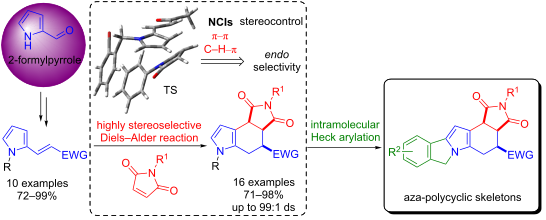
- aromatization of the polycyclic intermediates provides the corresponding polycyclic pyrrolo-isoindoles and isoindolo-pyrrolo-indoles. A theoretical study on the stereoselective Diels–Alder reactions, carried out by calculating the endo/exo transition states, revealed the assistance of non-covalent interactions


Preparation of 2-phospholene oxides by the isomerization of 3-phospholene oxides
Beilstein J. Org. Chem. 2020, 16, 818–832, doi:10.3762/bjoc.16.75
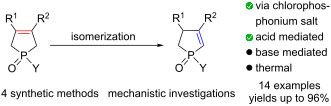
- oxide, while the corresponding 2-phospholene oxides 4a or 7 are the preferred isomers for the unsubstituted or methyl-substituted phospholene oxide derivatives (Table 5, entries 1–3). According to the thermodynamic data without the consideration of the reaction mechanisms and transition states (Table 5




The reaction of arylmethyl isocyanides and arylmethylamines with xanthate esters: a facile and unexpected synthesis of carbamothioates
Beilstein J. Org. Chem. 2020, 16, 159–167, doi:10.3762/bjoc.16.18
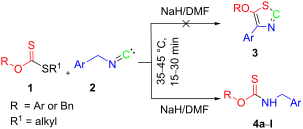
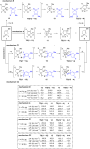
- shown in Scheme 2. For simplicity, the reaction of benzyl isocyanide (2a) with O-benzyl S-methyl dithiocarbonate (1a) was chosen for the calculations, forming the intermediates Int1–3 via the most probable transition states TS1–3, respectively, which, after hydrolysis, formed the observed product 4a. To
- with Gaussian 09 [36]. The HF/6-31G(d) level of theory in the gas phase was only used to locate the transition state geometries. An intrinsic reaction coordinate (IRC) analysis was conducted for each transition state studied in this work to confirm that the transition states were associated with the
- respective minima. The final IRC structures were further optimized (Figure S14, Supporting Information File 1). The geometries of all reactants, transition states, and intermediates were then fully optimized at the B3LYP/6-311++G(d,p) level of theory in the DMF solvent phase using the polarized continuum


Synthesis of C-glycosyl phosphonate derivatives of 4-amino-4-deoxy-α-ʟ-arabinose
Beilstein J. Org. Chem. 2020, 16, 9–14, doi:10.3762/bjoc.16.2
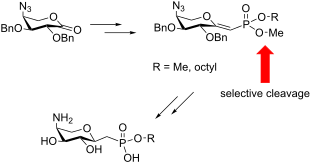
- -benzyl-protected gluco and galacto derivatives [20][27][30][31]. In addition to exocyclic glycals mimicking putative planar transition states of substrates involved in enzymatic reactions, such as glycosyl transfer, mutase, and epimerization, endo-glycals are also of interest [21][22][32][33][34][35


Why do thioureas and squaramides slow down the Ireland–Claisen rearrangement?
Beilstein J. Org. Chem. 2019, 15, 2948–2957, doi:10.3762/bjoc.15.290
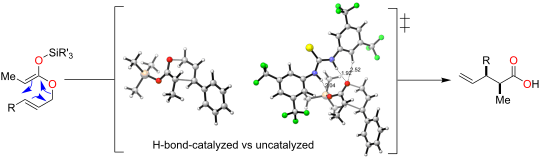
- difficult due to their rather nonpolar transition states, which are difficult to be addressed by catalysts [29]. Several stereoselective [3,3]-sigmatropic rearrangements are realized with chiral Brønsted acids [30][31][32][33][34]. Jacobsen reported guanidinium-catalyzed enantioselective Claisen
- activate the enolates or the corresponding silyl ketene acetals or stabilize the corresponding transition states. In addition, chiral organocatalysts could induce diastereo- as well as enantioselectivity. Therefore, we examined the Ireland–Claisen rearrangement of ester 1c in the presence of a range of
- rearrangements proceed via isopolar transition states and, therefore solvent effects are rather small. For this reason and due to the complete lack of enantioselectivity, at this stage, we did not investigate other solvents with the catalysts collected in Figure 1. In order to gain further insight into the


A combinatorial approach to improving the performance of azoarene photoswitches
Beilstein J. Org. Chem. 2019, 15, 2753–2764, doi:10.3762/bjoc.15.266
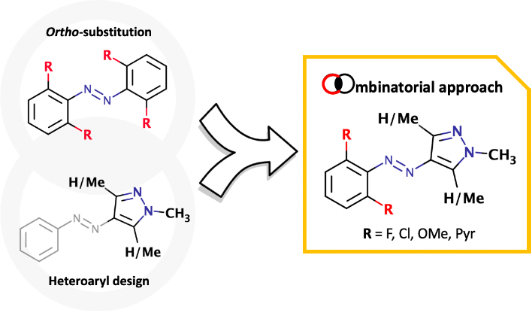
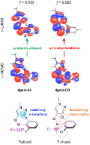
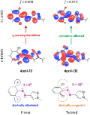
- derivatives are predicted to occur through a transition state in which the N atom next to the benzene ring linearizes in an inversion mechanism (see B-type transition states in Figure 2 for 4pzH-F2 and 4pzMe-F2, and Figure S1 in Supporting Information File 1 for the rest of di-ortho-substituted photoswitches
- the possible conformers both in the Z- and E-forms were fully optimized by using the hybrid exchange-correlation PBE0 functional [37] including the Grimme’s dispersion correction in its latest version (D3) [38]. The split-valence Pople’s basis set 6-31G** was used throughout [39]. Transition states
- were optimized by using the Berny algorithm at the same level of theory [40]. Theoretical calculations were carried out in the gas phase. Theoretical kinetic studies were carried out at the PBE0-D3/6-31G** level of theory by considering all possible transition states and minimum-energy conformers for




Acid-catalyzed rearrangements in arenes: interconversions in the quaterphenyl series
Beilstein J. Org. Chem. 2019, 15, 2655–2663, doi:10.3762/bjoc.15.258
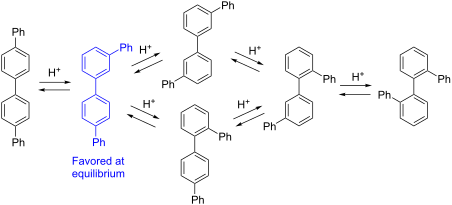
- computations on carbocation intermediates and transition states were carried out with the B3LYP functional and 6-31+G(d,p) basis set, using the polarizable continuum model in dichloroethane to model solvation [42]. Each stationary point was characterized as a minimum or transition state by vibrational


Thermal stability of N-heterocycle-stabilized iodanes – a systematic investigation
Beilstein J. Org. Chem. 2019, 15, 2311–2318, doi:10.3762/bjoc.15.223
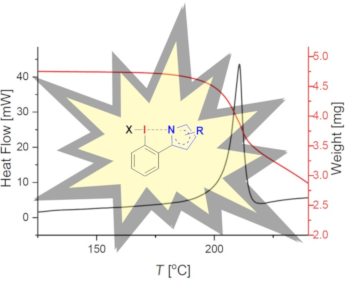
- electrophilic hypervalent iodine atom in its ground state or directly influences its reactivity by stabilizing reactive intermediates or transition states. In recent years, a plethora of cyclic and pseudocyclic iodanes have been developed with covalently attached stabilizing ligands L2 and applied in a variety


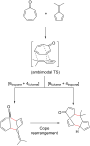
An overview of the cycloaddition chemistry of fulvenes and emerging applications
Beilstein J. Org. Chem. 2019, 15, 2113–2132, doi:10.3762/bjoc.15.209
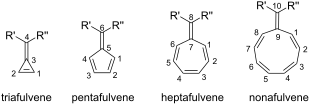
- (2a’) derivatives would lead to higher energy anti-aromatic transition states [1][2][9][15]. Additionally, upon conversion to the dipole forms (Scheme 1), the fulvene loses total planarity through the exocyclic carbon sp2 → sp3 hybridisation, allowing some loss of energy (and gain in stability





The cyclopropylcarbinyl route to γ-silyl carbocations
Beilstein J. Org. Chem. 2019, 15, 1769–1780, doi:10.3762/bjoc.15.170
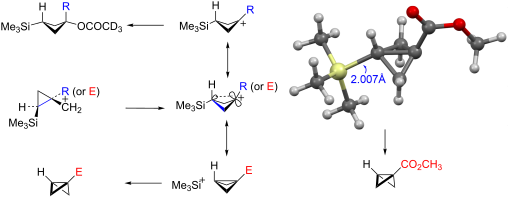
- spectra of new compounds. Supporting Information File 74: M062X/6-611+G** calculated structures, energies, and Cartesian coordinates for carbocations and transition states.


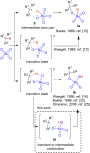
Transient and intermediate carbocations in ruthenium tetroxide oxidation of saturated rings
Beilstein J. Org. Chem. 2019, 15, 1552–1562, doi:10.3762/bjoc.15.158
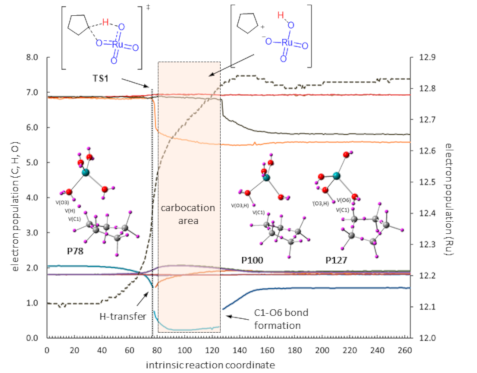
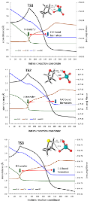
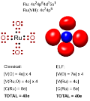
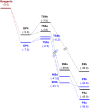
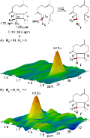
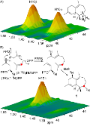
- can lead to different products in a ratio that depends on reaction dynamics [31][32][33]. The study of molecular dynamics trajectories has allowed characterization of ambimodal transition states in reactions involving carbocations [34][35]. We have demonstrated computationally the presence of








Anomeric sugar boronic acid analogues as potential agents for boron neutron capture therapy
Beilstein J. Org. Chem. 2019, 15, 1355–1359, doi:10.3762/bjoc.15.135
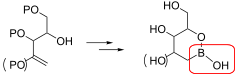
- stereoselectivity in the hydroboration reaction we hypothesized the transition states bearing to the two epimers. We assumed that borane would react firstly with the free hydroxy group generating an intermediate alkoxyborane, and that the hydroboration reaction occurs intramolecularly on such intermediate. Based on
- these premises, two transition states can be identified (Figure 4) for the hydroboration reaction on each of the two diastereotopic faces of the double bond. The transition state deriving from the attack on the si face, which leads to the arabino-configurated product, contains two destabilizing
- conserved into the analogues). Structures of boron analogues. Synthetic strategy. Postulated transition states for the hydroboration reaction. Synthesis of 2-deoxy analogue 8. Synthesis of 2,3-dideoxy analogue 11. Supporting Information Supporting Information File 488: Experimental procedures and


Enantioselective Diels–Alder reaction of anthracene by chiral tritylium catalysis
Beilstein J. Org. Chem. 2019, 15, 1304–1312, doi:10.3762/bjoc.15.129
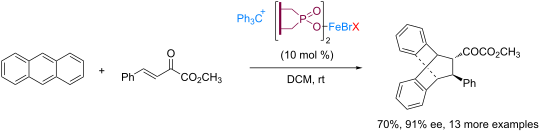
- sulfonylhydrazine 6 (1.2 equiv) in CH2Cl2 led to the desired N-tosylhydrazone 7 in 83% yield and with 82% ee (Scheme 3b). The absolute configuration was assigned on the basis of the structure of 7, which was confirmed unambiguously by an X-ray crystallographic study [39]. Tentative transition states to account for


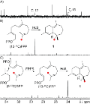
Mechanistic investigations on multiproduct β-himachalene synthase from Cryptosporangium arvum
Beilstein J. Org. Chem. 2019, 15, 1008–1019, doi:10.3762/bjoc.15.99
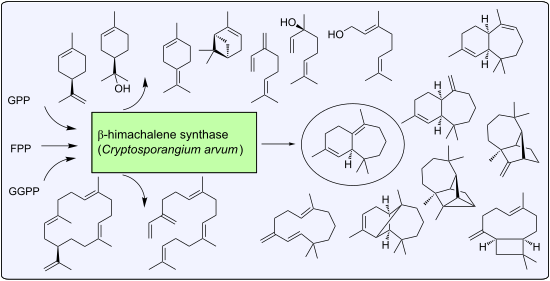
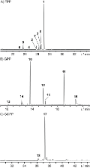
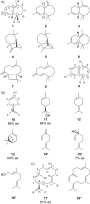
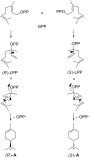
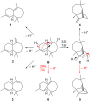
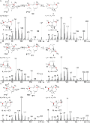
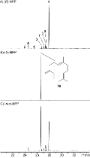
- vanished crosspeak. Combining the information deduced from the extensive incubation experiments stated above, a structural model for the reactive conformation of cation D is proposed (Figure S19, Supporting Information File 1). This intermediate, or structurally related transition states for the





An anomalous addition of chlorosulfonyl isocyanate to a carbonyl group: the synthesis of ((3aS,7aR,E)-2-ethyl-3-oxo-2,3,3a,4,7,7a-hexahydro-1H-isoindol-1-ylidene)sulfamoyl chloride
Beilstein J. Org. Chem. 2019, 15, 931–936, doi:10.3762/bjoc.15.89
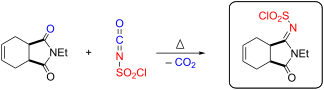
- and B, we use the notation A/B throughout the article. Figure 3 shows the relative energy profile for the reaction mechanism shown in Scheme 4. The rate-determining steps for the formation of 10, 11, and 12 are the transition states 9/14, 9/11, and 9/12, respectively. The difference between the




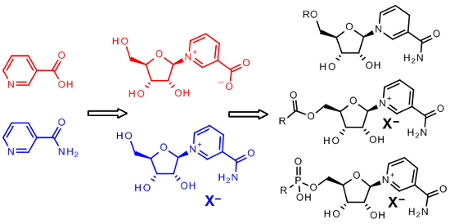
Syntheses and chemical properties of β-nicotinamide riboside and its analogues and derivatives
Beilstein J. Org. Chem. 2019, 15, 401–430, doi:10.3762/bjoc.15.36






Study on the regioselectivity of the N-ethylation reaction of N-benzyl-4-oxo-1,4-dihydroquinoline-3-carboxamide
Beilstein J. Org. Chem. 2019, 15, 388–400, doi:10.3762/bjoc.15.35
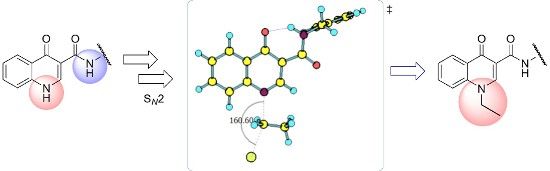
- media considered, the N–C–Br bond angle (α) on the transition states were slightly higher for the carboxamide group (Table 3). These results are consistent with the one previously found. As already shown, the oxoquinoline conjugate base is more stabilized when compared to the carboxamide one. Such
- . Table 4 illustrates the optimized geometry for the transition states for each possible reaction path. The comparison of the two possible reaction paths shows that although N-ethylation of the carboxamide site is associated with a lower energy barrier, addition of solvent stabilizes the transition state
- . Since experimentally, this is not observed, it can be concluded that only the N–H site of oxoquinoline undergoes deprotonation. That is, the conjugate base of the carboxamide is not generated in the process. Observing the predicted N–C–Br (α) angle in the calculated transition states, none of the


Sigmatropic rearrangements of cyclopropenylcarbinol derivatives. Access to diversely substituted alkylidenecyclopropanes
Beilstein J. Org. Chem. 2019, 15, 333–350, doi:10.3762/bjoc.15.29
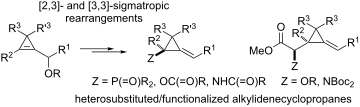
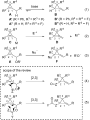
- ’ were considered which would lead to five-membered ring transition states in which the aryl group occupies a preferential pseudo-equatorial or a less favorable pseudo-axial orientation, respectively (Scheme 3) [33][34]. The authors also showed that phosphine oxide (E)-3f could be reduced to the
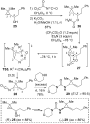
- leading to zwitterronic intermediates 8 and 8’. This would result in an increase of conformational flexibility thereby facilitating the nucleophilic displacement of the ammonium by the phosphinite through transition states TS1 and TS2 (SN2-type process), respectively. Oxaphospholanium zwitterions 9 and 9
- activation barriers of the reactions leading to 8 and 8’, regardless of the aromatic substituent. Since 8 and 8’ were in rapid equilibrium with phosphinite 6, the diastereoselectivity should depend on the relative stabilities of the transition states TS1 and TS’1. An electron-donating group at the para







Synthesis of 1,2-divinylcyclopropanes by metal-catalyzed cyclopropanation of 1,3-dienes with cyclopropenes as vinyl carbene precursors
Beilstein J. Org. Chem. 2019, 15, 285–290, doi:10.3762/bjoc.15.25

- refluxed in toluene (24 h) partial isomerization was observed (endo/exo = 1:1.6). This behavior can be attributed to the high substitution at one of the alkenes, which might lead to sterically overcrowded transition states required for the rearrangement [27]. Besides, the diastereoisomeric mixture of 3j




Silanediol versus chlorosilanol: hydrolyses and hydrogen-bonding catalyses with fenchole-based silanes
Beilstein J. Org. Chem. 2019, 15, 167–186, doi:10.3762/bjoc.15.17
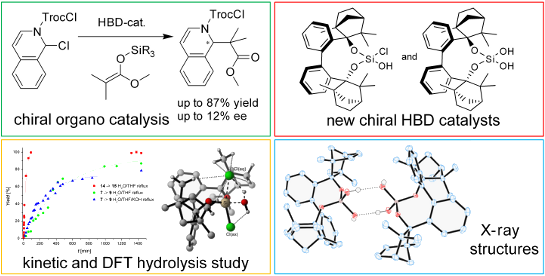
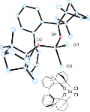
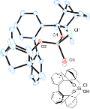
- points/transition states, as well as experimental details can be found in Supporting Information File 1. CCDC-1833170 (BIFOXSiCl2 (7)), CCDC-1833171 (BIFOXSiCl(OH) (8)), CCDC-1833172 (BIFOXSi(OH)2 (9, dimer)), CCDC-1833173 (BIFOXSi(OH)2 (9, tetramer)), CCDC-1833174 (BIFOXSiCl(OH) 8·acetone) and CCDC








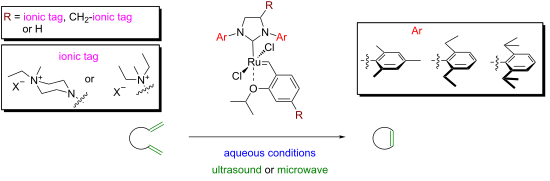
Ammonium-tagged ruthenium-based catalysts for olefin metathesis in aqueous media under ultrasound and microwave irradiation
Beilstein J. Org. Chem. 2019, 15, 160–166, doi:10.3762/bjoc.15.16
- Marcus postulated a trans-phase hydrogen bonding from water OH groups to H-bond acceptor sites of organic reactants contributing to a stabilisation of organic transition states enables the on-water catalysis [77]. Ben-Amotz et al. demonstrated that the effect of the water OH groups depends either on the


Computational characterization of enzyme-bound thiamin diphosphate reveals a surprisingly stable tricyclic state: implications for catalysis
Beilstein J. Org. Chem. 2019, 15, 145–159, doi:10.3762/bjoc.15.15
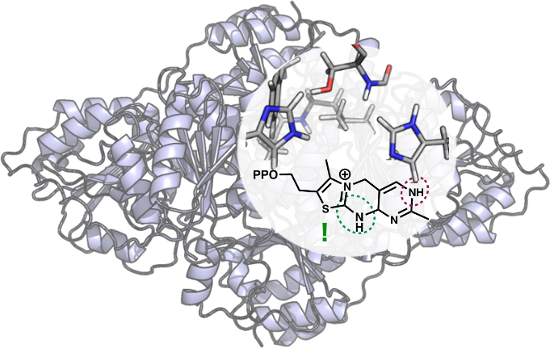
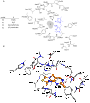
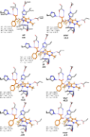
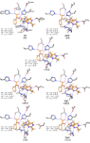
- the substrate analog inhibitor, (R)-mandelate. In that study all intermediates and transition states were located and characterized. Intriguingly, we identified the tricyclic TCH+ state of the cofactor as an off-cycle intermediate species. It was found to be about 5 kcal/mol lower in energy than the




The activity of indenylidene derivatives in olefin metathesis catalysts
Beilstein J. Org. Chem. 2018, 14, 2956–2963, doi:10.3762/bjoc.14.275
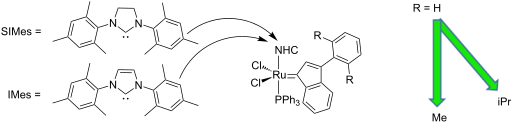
- saturated NHC is considered, the substitution reduces dramatically the barriers of the first two transition states. Then the cycle I→VI is more exothermic with the substituted systems. On the other hand, the unsaturated system does not reduce the energy barriers with the substituted indenylidene moieties


Stereodivergent approach in the protected glycal synthesis of L-vancosamine, L-saccharosamine, L-daunosamine and L-ristosamine involving a ring-closing metathesis step
Beilstein J. Org. Chem. 2018, 14, 2949–2955, doi:10.3762/bjoc.14.274
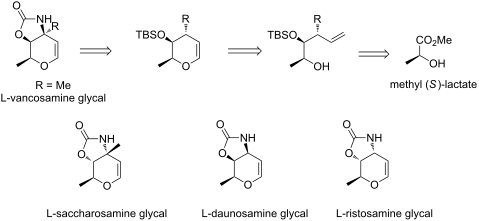
- )-geometry of the crotylboronate, while the 2,3-anti relationship can be rationalized by invoking Cornforth-like transition states [40][41][42][43]. Eventually, silylation of the homoallylic alcohol 12b afforded the expected compound 13b in 68% overall yield from 5 after purification, compared to 29% using a


Green synthesis of new chiral 1-(arylamino)imidazo[2,1-a]isoindole-2,5-diones from the corresponding α-amino acid arylhydrazides in aqueous medium
Beilstein J. Org. Chem. 2018, 14, 2923–2930, doi:10.3762/bjoc.14.271
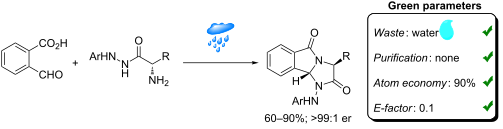
- imino-carboxylic acid form likely evolves to its iminium-carboxylate form B [50]. This last intermediate involves the existence of two possible transition states for the cyclization of the imidazolidinone core of which one of them is favored by an intramolecular hydrogen bond (Scheme 5). This control is