Search for "multicomponent" in Full Text gives 340 result(s) in Beilstein Journal of Organic Chemistry. Showing first 200.
Beilstein J. Org. Chem. 2020, 16, 1875–1880, doi:10.3762/bjoc.16.155
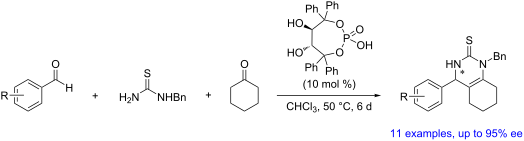
Graphical Abstract
Scheme 1: Synthesis of chiral phosphoric acid 3.
Scheme 2: Synthesis of methylated chiral phosphoric acid 7.
Scheme 3: Control experiment with catalyst 7.
Figure 1: A plausible chiral transition-state structure in the Biginelli-like reaction catalyzed by phosphori...
Beilstein J. Org. Chem. 2020, 16, 1805–1819, doi:10.3762/bjoc.16.148
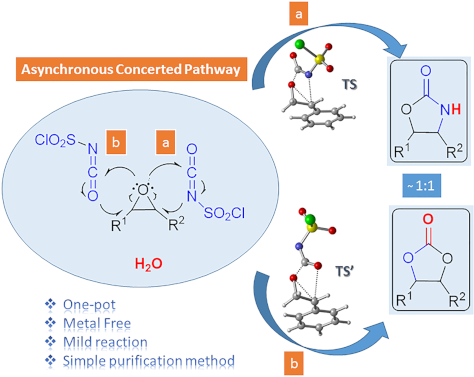
Graphical Abstract
Scheme 1: Oxazolidinone (1), five-membered cyclic carbonate (2) and some important compounds containing an ox...
Scheme 2: Proposed mechanisms by Keshava Murthy and Dhar [41] and De Meijere and co-workers [42].
Figure 1: Possible pathways for the formation of oxazolidinone intermediates 10 and 11. Optimized transition ...
Figure 2: Potential energy profile related to the formation of oxazolidinone intermediates 10 and 11 at the P...
Figure 3: IRC calculated for the formation of (a) 10 and (b) 11 at M06-2X/6-31+G(d,p) level. I-1, I-15, I-35, ...
Figure 4: Optimized geometries for the stationary points for the formation of 10 at PCM(DCM)/M06-2X/6-31+G(d,...
Scheme 3: Proposed mechanisms for the formation of oxazolidinone 9f.
Figure 5: Potential energy profiles for paths 1a (blue), 1b (red), 2 (green) and relative Gibbs free energies...
Figure 6: Optimized geometries for the stationary points of path 1b at PCM(DCM)/M06-2X/6-31+G(d,p)//M06-2X/6-...
Scheme 4: Proposed mechanism for the formation of five-membered cyclic carbonate 8f.
Figure 7: Potential energy profile and relative Gibbs free energies (kcal/mol) in DCM related to the formatio...
Figure 8: Optimized geometries for the stationary points of step 1 for the formation of 16 at PCM(DCM)/M06-2X...
Figure 9: Optimized geometries for the stationary points of step 2 for the formation of 17 at PCM(DCM)/M06-2X...
Figure 10: Optimized geometries for the stationary points of step 3 for the formation of PC8 at PCM(DCM)/M06-2...
Beilstein J. Org. Chem. 2020, 16, 1447–1455, doi:10.3762/bjoc.16.120
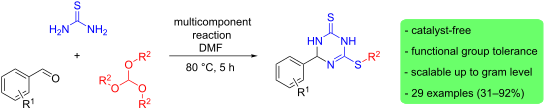
Graphical Abstract
Figure 1: Selected examples of triazinethione-containing bioactive compounds.
Scheme 1: Strategies for the synthesis of triazinethiones.
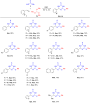
Scheme 2: Aldehyde substrate scope of three-component reaction of aldehydes, thiourea and trimethyl orthoform...
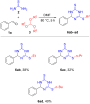
Scheme 3: Orthoformate substrate scope of the three component reaction of benzaldehyde, thiourea, and orthofo...
Scheme 4: Gram-scale synthesis of 6aa.
Figure 2: X-ray structure of 6-(methylthio)-4-phenyl-3,4-dihydro-1,3,5-triazine-2(1H)-thione (6aa) with therm...
Scheme 5: Control experiments for investigation of the mechanism.
Scheme 6: Plausible mechanism.
Beilstein J. Org. Chem. 2020, 16, 1225–1233, doi:10.3762/bjoc.16.106
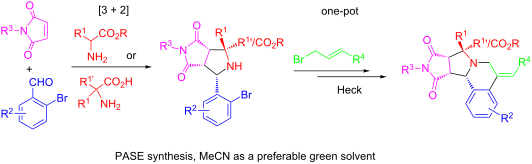
Graphical Abstract
Figure 1: Bioactive pyrrolo[2,1-a]isoquinolines and hexahydropyrrolo[2,1-a]isoquinolines.
Scheme 1: [3 + 2] Cycloaddition with amino esters or amino acids.
Scheme 2: Scaffolds derived from the initial [3 + 2] adducts.
Scheme 3: [3 + 2] Cycloaddition with amino esters or amino acids. Conditions: 1:3:4 (1.2:1:1.1), Et3N (1.5 eq...
Scheme 4: Synthesis of pyrrolo[2,1-a]isoquinolines 9. Reaction conditions: 5 (0.5 mmol, 1 equiv), 7 (3 equiv)...
Scheme 5: Synthesis of pyrrolo[2,1-a]isoquinolines 11. Reaction conditions: 6 (0.5 mmol, 1 equiv), 7 (3 equiv...
Scheme 6: Synthesis of pyrrolo[2,1-a]isoquinolines 12. Reaction conditions: 5 or 6 (0.5 mmol, 1 equiv), cinna...
Scheme 7: Plausible mechanism for the synthesis of 9a.
Beilstein J. Org. Chem. 2020, 16, 1022–1050, doi:10.3762/bjoc.16.91
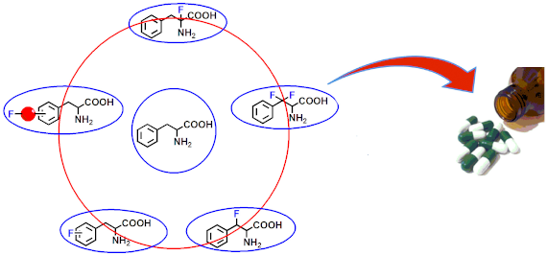
Graphical Abstract
Figure 1: Categories I–V of fluorinated phenylalanines.
Scheme 1: Synthesis of fluorinated phenylalanines via Jackson’s method.
Scheme 2: Synthesis of all-cis-tetrafluorocyclohexylphenylalanines.
Scheme 3: Synthesis of ʟ-4-[sulfono(difluoromethyl)]phenylalanine (nPt: neopentyl, TCE: trichloroethyl).
Scheme 4: Synthesis of ʟ-4-[sulfono(difluoromethyl)]phenylalanine derivatives 17.
Scheme 5: Synthesis of fluorinated Phe analogues from Cbz-protected aminomalonates.
Scheme 6: Synthesis of tetrafluorophenylalanine analogues via the 3-methyl-4-imidazolidinone auxiliary 25.
Scheme 7: Synthesis of tetrafluoro-Phe derivatives via chiral auxiliary 31.
Scheme 8: Synthesis of 2,5-difluoro-Phe and 2,4,5-trifluoro-Phe via Schöllkopf reagent 34.
Scheme 9: Synthesis of 2-fluoro- and 2,6-difluoro Fmoc-Phe derivatives starting from chiral auxiliary 39.
Scheme 10: Synthesis of 2-[18F]FPhe via chiral auxiliary 43.
Scheme 11: Synthesis of FPhe 49a via photooxidative cyanation.
Scheme 12: Synthesis of FPhe derivatives via Erlenmeyer azalactone synthesis.
Scheme 13: Synthesis of (R)- and (S)-2,5-difluoro Phe via the azalactone method.
Scheme 14: Synthesis of 3-bromo-4-fluoro-(S)-Phe (65).
Scheme 15: Synthesis of [18F]FPhe via radiofluorination of phenylalanine with [18F]F2 or [18F]AcOF.
Scheme 16: Synthesis of 4-borono-2-[18F]FPhe.
Scheme 17: Synthesis of protected 4-[18F]FPhe via arylstannane derivatives.
Scheme 18: Synthesis of FPhe derivatives via intermediate imine formation.
Scheme 19: Synthesis of FPhe derivatives via Knoevenagel condensation.
Scheme 20: Synthesis of FPhe derivatives 88a,b from aspartic acid derivatives.
Scheme 21: Synthesis of 2-(2-fluoroethyl)phenylalanine derivatives 93 and 95.
Scheme 22: Synthesis of FPhe derivatives via Zn2+ complexes.
Scheme 23: Synthesis of FPhe derivatives via Ni2+ complexes.
Scheme 24: Synthesis of 3,4,5-trifluorophenylalanine hydrochloride (109).
Scheme 25: Synthesis of FPhe derivatives via phenylalanine aminomutase (PAM).
Scheme 26: Synthesis of (R)-2,5-difluorophenylalanine 115.
Scheme 27: Synthesis of β-fluorophenylalanine via 2-amino-1,3-diol derivatives.
Scheme 28: Synthesis of β-fluorophenylalanine derivatives via the oxazolidinone chiral auxiliary 122.
Scheme 29: Synthesis of β-fluorophenylalanine from pyruvate hemiketal 130.
Scheme 30: Synthesis of β-fluorophenylalanine (136) via fluorination of β-hydroxyphenylalanine (137).
Scheme 31: Synthesis of β-fluorophenylalanine from aziridine derivatives.
Scheme 32: Synthesis of β-fluorophenylalanine 136 via direct fluorination of pyruvate esters.
Scheme 33: Synthesis of β-fluorophenylalanine via fluorination of ethyl 3-phenylpyruvate enol using DAST.
Scheme 34: Synthesis of β-fluorophenylalanine derivatives using photosensitizer TCB.
Scheme 35: Synthesis of β-fluorophenylalanine derivatives using Selectflour and dibenzosuberenone.
Scheme 36: Synthesis of protected β-fluorophenylalanine via aziridinium intermediate 150.
Scheme 37: Synthesis of β-fluorophenylalanine derivatives via fluorination of α-hydroxy-β-aminophenylalanine d...
Scheme 38: Synthesis of β-fluorophenylalanine derivatives from α- or β-hydroxy esters 152a and 155.
Scheme 39: Synthesis of a series of β-fluoro-Phe derivatives via Pd-catalyzed direct fluorination of β-methyle...
Scheme 40: Synthesis of series of β-fluorinated Phe derivatives using quinoline-based ligand 162 in the Pd-cat...
Scheme 41: Synthesis of β,β-difluorophenylalanine derivatives from 2,2-difluoroacetaldehyde derivatives 164a,b....
Scheme 42: Synthesis of β,β-difluorophenylalanine derivatives via an imine chiral auxiliary.
Scheme 43: Synthesis of α-fluorophenylalanine derivatives via direct fluorination of protected Phe 174.
Figure 2: Structures of PET radiotracers of 18FPhe derivatives.
Figure 3: Structures of melfufen (179) and melphalan (180) anticancer drugs.
Figure 4: Structure of gastrazole (JB95008, 181), a CCK2 receptor antagonist.
Figure 5: Dual CCK1/CCK2 antagonist 182.
Figure 6: Structure of sitagliptin (183), an antidiabetic drug.
Figure 7: Structure of retaglpitin (184) and antidiabetic drug.
Figure 8: Structure of evogliptin (185), an antidiabetic drug.
Figure 9: Structure of LY2497282 (186) a DPP-4 inhibitor for the treatment of type II diabetes.
Figure 10: Structure of ulimorelin (187).
Figure 11: Structure of GLP1R (188).
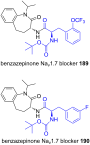
Figure 12: Structures of Nav1.7 blockers 189 and 190.
Beilstein J. Org. Chem. 2020, 16, 917–955, doi:10.3762/bjoc.16.83
Graphical Abstract
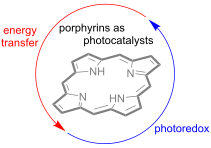
Figure 1: Chemical structures of the porphyrinoids and their absorption spectra: in bold are highlighted the ...
Figure 2: Photophysical and photochemical processes (Por = porphyrin). Adapted from [12,18].
Figure 3: Main dual photocatalysts and their oxidative/reductive excited state potentials, including porphyri...
Scheme 1: Photoredox alkylation of aldehydes with diazo acetates using porphyrins and a Ru complex. aUsing a ...
Scheme 2: Proposed mechanism for the alkylation of aldehydes with diazo acetates in the presence of TPP.
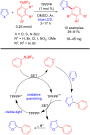
Scheme 3: Arylation of heteroarenes with aryldiazonium salts using TPFPP as photocatalyst, and corresponding ...
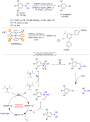
Scheme 4: A) Scope with different aryldiazonium salts and enol acetates. B) Photocatalytic cycles and compari...
Scheme 5: Photoarylation of isopropenyl acetate A) Comparison between batch and continuous-flow approaches an...
Scheme 6: Dehalogenation induced by red light using thiaporphyrin (STPP).
Scheme 7: Applications of NiTPP as both photoreductant and photooxidant.
Scheme 8: Proposed mechanism for obtaining tetrahydroquinolines by reductive quenching.
Scheme 9: Selenylation and thiolation of anilines.
Scheme 10: NiTPP as photoredox catalyst in oxidative and reductive quenching, in comparison with other photoca...
Scheme 11: C–O bond cleavage of 1-phenylethanol using a cobalt porphyrin (CoTMPP) under visible light.
Scheme 12: Hydration of terminal alkynes by RhIII(TSPP) under visible light irradiation.
Scheme 13: Regioselective photocatalytic hydro-defluorination of perfluoroarenes by RhIII(TSPP).
Scheme 14: Formation of 2-methyl-2,3-dihydrobenzofuran by intramolecular hydro-functionalization of allylpheno...
Scheme 15: Photocatalytic oxidative hydroxylation of arylboronic acids using UNLPF-12 as heterogeneous photoca...
Scheme 16: Photocatalytic oxidative hydroxylation of arylboronic acids using MOF-525 as heterogeneous photocat...
Scheme 17: Preparation of the heterogeneous photocatalyst CNH.
Scheme 18: Photoinduced sulfonation of alkenes with sulfinic acid using CNH as photocatalyst.
Scheme 19: Sulfonic acid scope of the sulfonation reactions.
Scheme 20: Regioselective sulfonation reaction of arimistane.
Scheme 21: Synthesis of quinazolin-4-(3H)-ones.
Scheme 22: Selective photooxidation of aromatic benzyl alcohols to benzaldehydes using Pt/PCN-224(Zn).
Scheme 23: Photooxidation of benzaldehydes to benzoic acids using Pt or Pd porphyrins.
Scheme 24: Photocatalytic reduction of various nitroaromatics using a Ni-MOF.
Scheme 25: Photoinduced cycloadditions of CO2 with epoxides by MOF1.
Figure 4: Electronic configurations of the species of oxygen. Adapted from [66].
Scheme 26: TPP-photocatalyzed generation of 1O2 and its application in organic synthesis. Adapted from [67-69].
Scheme 27: Pericyclic reactions involving singlet oxygen and their mechanisms. Adapted from [67].
Scheme 28: First scaled up ascaridole preparation from α-terpinene.
Scheme 29: Antimalarial drug synthesis using an endoperoxidation approach.
Scheme 30: Photooxygenation of colchicine.
Scheme 31: Synthesis of (−)-pinocarvone from abundant (+)-α-pinene.
Scheme 32: Seeberger’s semi-synthesis of artemisinin.
Scheme 33: Synthesis of artemisinin using TPP and supercritical CO2.
Scheme 34: Synthesis of artemisinin using chlorophyll a.
Scheme 35: Quercitol stereoisomer preparation.
Scheme 36: Photocatalyzed preparation of naphthoquinones.
Scheme 37: Continuous endoperoxidation of conjugated dienes and subsequent rearrangements leading to oxidized ...
Scheme 38: The Opatz group total synthesis of (–)-oxycodone.
Scheme 39: Biomimetic syntheses of rhodonoids A, B, E, and F.
Scheme 40: α-Photooxygenation of chiral aldehydes.
Scheme 41: Asymmetric photooxidation of indanone β-keto esters by singlet oxygen using PTC as a chiral inducer...
Scheme 42: Asymmetric photooxidation of both β-keto esters and β-keto amides by singlet oxygen using PTC-2 as ...
Scheme 43: Bifunctional photo-organocatalyst used for the asymmetric oxidation of β-keto esters and β-keto ami...
Scheme 44: Mechanism of singlet oxygen oxidation of sulfides to sulfoxides.
Scheme 45: Controlled oxidation of sulfides to sulfoxides using protonated porphyrins as photocatalysts. aIsol...
Scheme 46: Photochemical oxidation of sulfides to sulfoxides using PdTPFPP as photocatalyst.
Scheme 47: Controlled oxidation of sulfides to sulfoxides using SnPor@PAF as a photosensitizer.
Scheme 48: Syntheses of 2D-PdPor-COF and 3D-Pd-COF.
Scheme 49: Photocatalytic oxidation of A) thioanisole to methyl phenyl sulfoxide and B) various aryl sulfides,...
Scheme 50: General mechanism for oxidation of amines to imines.
Scheme 51: Oxidation of secondary amines to imines.
Scheme 52: Oxidation of secondary amines using Pd-TPFPP as photocatalyst.
Scheme 53: Oxidative amine coupling using UNLPF-12 as heterogeneous photocatalyst.
Scheme 54: Synthesis of Por-COF-1 and Por-COF-2.
Scheme 55: Photocatalytic oxidation of amines to imines by Por-COF-2.
Scheme 56: Photocyanation of primary amines.
Scheme 57: Synthesis of ᴅ,ʟ-tert-leucine hydrochloride.
Scheme 58: Photocyanation of catharanthine and 16-O-acetylvindoline using TPP.
Scheme 59: Photochemical α-functionalization of N-aryltetrahydroisoquinolines using Pd-TPFPP as photocatalyst.
Scheme 60: Ugi-type reaction with 1,2,3,4-tetrahydroisoquinoline using molecular oxygen and TPP.
Scheme 61: Ugi-type reaction with dibenzylamines using molecular oxygen and TPP.
Scheme 62: Mannich-type reaction of tertiary amines using PdTPFPP as photocatalyst.
Scheme 63: Oxidative Mannich reaction using UNLPF-12 as heterogeneous photocatalyst.
Scheme 64: Transformation of amines to α-cyanoepoxides and the proposed mechanism.
Beilstein J. Org. Chem. 2020, 16, 738–755, doi:10.3762/bjoc.16.68
Graphical Abstract
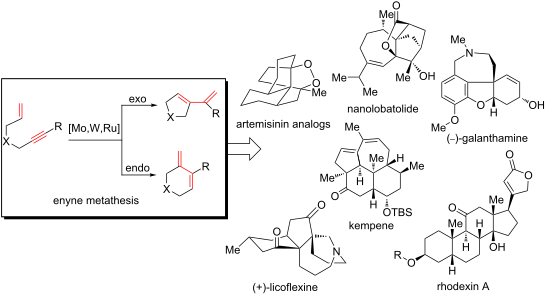
Scheme 1: Intramolecular (A) and intermolecular (B) enyne metathesis reactions.
Scheme 2: Ene–yne and yne–ene mechanisms for intramolecular enyne metathesis reactions.
Scheme 3: Metallacarbene mechanism in intermolecular enyne metathesis.
Scheme 4: The Oguri strategy for accessing artemisinin analogs 1a–c through enyne metathesis.
Scheme 5: Access to the tetracyclic core of nanolobatolide (2) via tandem enyne metathesis followed by an Eu(...
Scheme 6: Synthesis of (−)-amphidinolide E (3) using an intermolecular enyne metathesis as the key step.
Scheme 7: Synthesis of amphidinolide K (4) by an enyne metathesis route.
Scheme 8: Trost synthesis of des-epoxy-amphidinolide N (5) [72].
Scheme 9: Enyne metathesis between the propargylic derivative and the allylic alcohol in the synthesis of the...
Scheme 10: Synthetic route to amphidinolide N (6a).
Scheme 11: Synthesis of the stereoisomeric precursors of amphidinolide V (7a and 7b) through alkyne ring-closi...
Scheme 12: Synthesis of the anthramycin precursor 8 from ʟ-methionine by a tandem enyne metathesis–cross metat...
Scheme 13: Synthesis of (−)‐clavukerin A (9) and (−)‐isoclavukerin A (10) by an enyne metathesis route startin...
Scheme 14: Synthesis of (−)-isoguaiene (11) through an enyne metathesis as the key step.
Scheme 15: Synthesis of erogorgiaene (12) by a tandem enyne metathesis/cross metathesis sequence using the sec...
Scheme 16: Synthesis of (−)-galanthamine (13) from isovanilin by an enyne metathesis.
Scheme 17: Application of enyne metathesis for the synthesis of kempene diterpenes 14a–c.
Scheme 18: Synthesis of the alkaloid (+)-lycoflexine (15) through enyne metathesis.
Scheme 19: Synthesis of the AB subunits of manzamine A (16a) and E (16b) by enyne metathesis.
Scheme 20: Jung's synthesis of rhodexin A (17) by enyne metathesis/cross metathesis reactions.
Scheme 21: Total synthesis of (−)-flueggine A (18) and (+)-virosaine B (19) from Weinreb amide by enyne metath...
Scheme 22: Access to virgidivarine (20) and virgiboidine (21) by an enyne metathesis route.
Scheme 23: Enyne metathesis approach to (−)-zenkequinone B (22).
Scheme 24: Access to C-aryl glycoside 23 by an intermolecular enyne metathesis/Diels–Alder cycloaddition.
Scheme 25: Synthesis of spiro-C-aryl glycoside 24 by a tandem intramolecular enyne metathesis/Diels–Alder reac...
Scheme 26: Pathways to (−)-exiguolide (25) by Trost’s Ru-catalyzed enyne cross-coupling and cross-metathesis [94].
Beilstein J. Org. Chem. 2020, 16, 663–669, doi:10.3762/bjoc.16.63
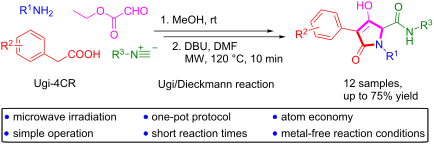
Graphical Abstract
Figure 1: Structures of natural tetramic acid derivatives with more clinical relevance.
Scheme 1: Synthetic strategy of compound 7a.
Scheme 2: Scope of the Ugi/Dieckmann cyclization reaction route to lead to pyrrolopyridinones 7a–l. aYield of...
Scheme 3: Postulated reaction mechanism.
Beilstein J. Org. Chem. 2020, 16, 638–644, doi:10.3762/bjoc.16.60
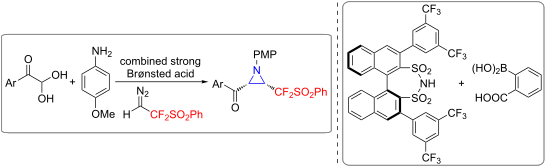
Graphical Abstract
Scheme 1: Preparation of chiral aziridines from fluorinated diazo reagents.
Scheme 2: Substrate scope of chiral CF2-substituted aziridines from PhSO2CF2CHN2. General reaction conditions...
Scheme 3: Scale-up experiment to 4a and further synthetic transformations.
Beilstein J. Org. Chem. 2020, 16, 551–586, doi:10.3762/bjoc.16.52
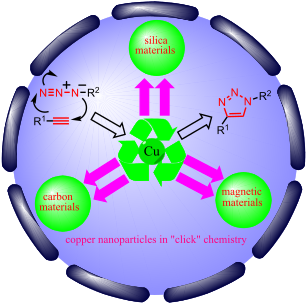
Graphical Abstract
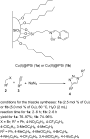
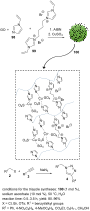
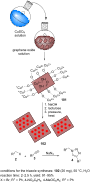
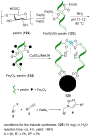
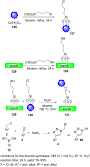
Scheme 1: Chemical structure of the catalysts 1a and 1b and their catalytic application in CuAAC reactions.
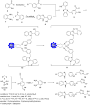
Scheme 2: Synthetic route to the catalyst 11 and its catalytic application in CuAAC reactions.
Scheme 3: Synthetic route of dendrons, illustrated using G2-AMP 23.
Scheme 4: The catalytic application of CuYAu–Gx-AAA–SBA-15 in a CuAAC reaction.
Scheme 5: Synthetic route to the catalyst 36.
Scheme 6: Application of the catalyst 36 in CuAAC reactions.
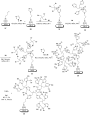
Scheme 7: The synthetic route to the catalyst 45 and catalytic application of 45 in “click” reactions.
Scheme 8: Synthetic route to the catalyst 48 and catalytic application of 48 in “click” reactions.
Scheme 9: Synthetic route to the catalyst 58 and catalytic application of 58 in “click” reactions.
Scheme 10: Synthetic route to the catalyst 64 and catalytic application of 64 in “click” reactions.
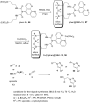
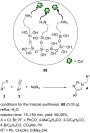
Scheme 11: Chemical structure of the catalyst 68 and catalytic application of 68 in “click” reactions.
Scheme 12: Chemical structure of the catalyst 69 and catalytic application of 69 in “click” reactions.
Scheme 13: Synthetic route to, and chemical structure of the catalyst 74.
Scheme 14: Application of the cayalyst 74 in “click” reactions.
Scheme 15: Synthetic route to, and chemical structure of the catalyst 78 and catalytic application of 78 in “c...
Scheme 16: Synthetic route to the catalyst 85.
Scheme 17: Application of the catalyst 85 in “click” reactions.
Scheme 18: Synthetic route to the catalyst 87 and catalytic application of 87 in “click” reactions.
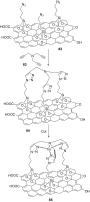
Scheme 19: Chemical structure of the catalyst 88 and catalytic application of 88 in “click” reactions.
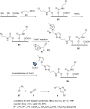
Scheme 20: Synthetic route to the catalyst 90 and catalytic application of 90 in “click” reactions.
Scheme 21: Synthetic route to the catalyst 96 and catalytic application of 96 in “click” reactions.
Scheme 22: Synthetic route to the catalyst 100 and catalytic application of 100 in “click” reactions.
Scheme 23: Synthetic route to the catalyst 102 and catalytic application of 23 in “click” reactions.
Scheme 24: Synthetic route to the catalysts 108–111.
Scheme 25: Catalytic application of 108–111 in “click” reactions.
Scheme 26: Synthetic route to the catalyst 121 and catalytic application of 121 in “click” reactions.
Scheme 27: Synthetic route to 125 and application of 125 in “click” reactions.
Scheme 28: Synthetic route to the catalyst 131 and catalytic application of 131 in “click” reactions.
Scheme 29: Synthetic route to the catalyst 136.
Scheme 30: Application of the catalyst 136 in “click” reactions.
Scheme 31: Synthetic route to the catalyst 141 and catalytic application of 141 in “click” reactions.
Scheme 32: Synthetic route to the catalyst 144 and catalytic application of 144 in “click” reactions.
Scheme 33: Synthetic route to the catalyst 149 and catalytic application of 149 in “click” reactions.
Scheme 34: Synthetic route to the catalyst 153 and catalytic application of 153 in “click” reactions.
Scheme 35: Synthetic route to the catalyst 155 and catalytic application of 155 in “click” reactions.
Scheme 36: Synthetic route to the catalyst 157 and catalytic application of 157 in “click” reactions.
Scheme 37: Synthetic route to the catalyst 162.
Scheme 38: Application of the catalyst 162 in “click” reactions.
Scheme 39: Synthetic route to the catalyst 167 and catalytic application of 167 in “click” reactions.
Scheme 40: Synthetic route to the catalyst 169 and catalytic application of 169 in “click” reactions.
Scheme 41: Synthetic route to the catalyst 172.
Scheme 42: Application of the catalyst 172 in “click” reactions.
Beilstein J. Org. Chem. 2020, 16, 281–289, doi:10.3762/bjoc.16.27
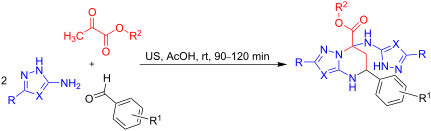
Graphical Abstract
Scheme 1: Synthesis of tetrahydroazolopyrimidine derivatives.
Scheme 2: Various multicomponent reactions involving pyruvic acids (pyruvates) and different α-aminoazoles.
Scheme 3: Synthesis of 4-arylamino-substituted tetrahydroquinolines.
Scheme 4: Ultrasound-assisted multicomponent reactions of 3-amino-1,2,4-triazole or 5-amino-1H-pyrazole-4-car...
Scheme 5: Synthesis of 3-cyano-7-(4-methoxyphenyl)-4,7-dihydropyrazolo[1,5-a]pyrimidine-5-carboxylic acid (7)....
Scheme 6: Proposed reaction mechanism.
Figure 1: Alternative structures A and B for the tetrahydroazolopyrimidines 4.
Figure 2: Molecular structure of ethyl 5-(4-bromophenyl)-3-cyano-7-((4-cyano-1H-pyrazol-5-yl)amino)-4,5,6,7-t...
Figure 3: Chains of 4g molecules in the crystal phase.
Beilstein J. Org. Chem. 2020, 16, 200–211, doi:10.3762/bjoc.16.23
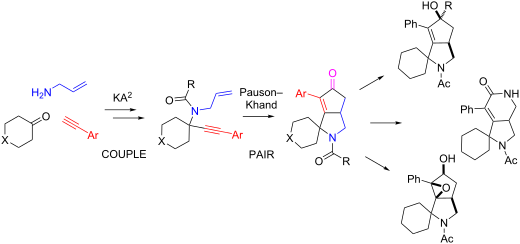
Graphical Abstract
Figure 1: Chemical structure of representative approved drugs containing a spirocyclic moiety.
Scheme 1: Synthetic strategies for accessing pyrrolocyclopentenone derivatives, including the novel couple/pa...
Scheme 2: Couple/pair approach using combined KA2 and Pauson–Khand multicomponent reactions.
Scheme 3: Follow-up chemistry on compound 5 taking advantage of the enone chemistry. Reaction conditions. (i)...
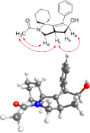
Figure 2: Top: Selected NOE contacts from NOESY 1D spectra of compound 36; bottom: low energy conformer of 36...
Figure 3: PCA plot resulting from the correlation between PC1 vs PC2, showing the positioning in the chemical...
Figure 4: PMI plot showing the skeletal diversity of compounds 3–39 (blue diamonds) with respect to the refer...
Beilstein J. Org. Chem. 2019, 15, 2684–2703, doi:10.3762/bjoc.15.262
Graphical Abstract
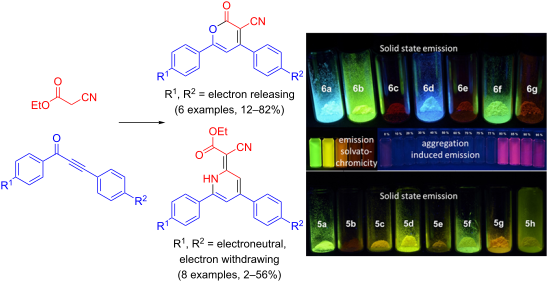
Scheme 1: Consecutive three-component alkynylation–Michael addition–cyclocondensation (AMAC) synthesis of α-p...
Scheme 2: Consecutive pseudo-four-component alkynylation–Michael addition–cyclocondensation (AMAC) synthesis ...
Scheme 3: Consecutive pseudo-four-component alkynylation–Michael addition–cyclocondensation (AMAC) synthesis ...
Scheme 4: Model system for the optimization of the Michael addition–cyclocondensation reaction step to 1H-pyr...
Scheme 5: Formation of α-pyrone 6a and 1H-pyridine 5a at 20 °C.
Scheme 6: Formation of α-pyrone 6a starting from alkynone 3b having an electron-donating substituent.
Scheme 7: Formation of 1H-pyridine 5b starting from alkynone 3d having an electron-withdrawing substituent.
Scheme 8: Formation of 1H-pyridine 8a by Michael addition–cyclocondensation reaction.
Scheme 9: Mechanistic rationale for the formation of the 1H-pyridine 5a.
Scheme 10: Formation of 1H-pyridine 8a from alkynone 3b and dimer 7.
Figure 1: Molecular structure of 1H-pyridine 5a (50% thermal ellipsoids), showing the intramolecular N–H···O ...
Figure 2: Supramolecular C–H···N [36-39] and C–H···π [40-49] interactions around the 6-positioned phenyl ring in 5a. Detail...
Figure 3: 1H-Pyridine derivatives 5 as solids under daylight (top), under UV light (λexc = 365 nm, c(5) = 10−4...
Figure 4: Selected normalized absorption (solid lines) and emission (dashed lines) spectra of 1H-pyridines 5a...
Figure 5: Selected normalized emission spectra of 1H-pyridine 5a and 5b in the solid state at T = 298 K.
Figure 6: Selected normalized absorption (solid lines) and emission (dashed lines) spectra of 1H-pyridines 8a...
Figure 7: Solid-state luminescence of 1H-pyridines 5a, 8a and 8b (λexc = 365 nm).
Figure 8: α-Pyrones 6 as solids under daylight (top), selected derivatives under UV light (λexc = 365 nm, c(6...
Figure 9: Selected normalized absorption spectra of α-pyrones 6a, 6b, 6d, and 6e recorded in dichloromethane ...
Figure 10: Selected normalized absorption (solid lines) and emission (dashed lines) spectra of α-pyrones 6c, 6e...
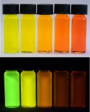
Figure 11: Absorption (top) and fluorescence (bottom) of compound 6c with variable solvent polarity (left to t...
Figure 12: Absorption (solid lines) and emission (dashed lines) spectra of α-pyrone 6c in five solvents of dif...
Figure 13: Lippert plot for α-pyrone 6c (n = x, r2 = 0.970).
Figure 14: Normalized emission spectra of selected α-pyrones 6a–d,f in the solid state at T = 298 K.
Figure 15: Fluorescence of compound 6e in different THF/water fractions (top, λexc = 365 nm, handheld UV lamp)...
Figure 16: Selected DFT-computed (B3LYP 6-311G**) Kohn–Sham FMOs for 1H-pyridines 5f and 5g representing contr...
Figure 17: Selected DFT-computed (B3LYP 6-311G**) Kohn–Sham FMOs for 1H-pyridines 6a, 6c, 6e, 6f, and 6g and r...
Beilstein J. Org. Chem. 2019, 15, 2664–2670, doi:10.3762/bjoc.15.259
Graphical Abstract
Scheme 1: Synthesis of compound 1.
Figure 1: X-ray structure of compound 1 (one of the two enantiomers present in the crystal).
Scheme 2: Possible mechanism for the formation of 1.
Figure 2: A possible mechanism for the trans-position of the methyne hydrogens in the azepine ring: the elect...
Figure 3: Selective formation of a single diastereomer in the 1,3-dipolar cycloaddition reaction.
Scheme 3: Synthesis of nitroxide 6.
Figure 4: X-ray structure of compound 6 (one of the two enantiomers present in the crystal).
Scheme 4: A proposed mechanism for nitroxide 6 synthesis.
Figure 5: A, B) Temperature dependence of the electron spin relaxation times in water/glycerol at X-band freq...
Beilstein J. Org. Chem. 2019, 15, 2447–2457, doi:10.3762/bjoc.15.237
Graphical Abstract
Figure 1: Bioactive molecules containing a tetrazole, pyridone or isoquinolone ring.
Scheme 1: Approaches for the synthesis of tetrazoles and isoquinolones and their interplay as designed in thi...
Scheme 2: Scope of the Ugi-azide-4CR/deprotection/acylation sequence. Ugi-azide-4CR conducted at the 2.0 mmol...
Scheme 3: Influence of substituents R and R2 on the reaction outcome. For compounds 4k–m the overall yield in...
Scheme 4: Influence of the alkyne and R1 substituent on the reaction outcome.
Scheme 5: Scope of acrylic, heterocyclic and ring-fused N-acylaminomethyl tetrazole substrates.
Scheme 6: Proposed reaction mechanism using substrates 1a and 3a.
Beilstein J. Org. Chem. 2019, 15, 2390–2397, doi:10.3762/bjoc.15.231
Graphical Abstract
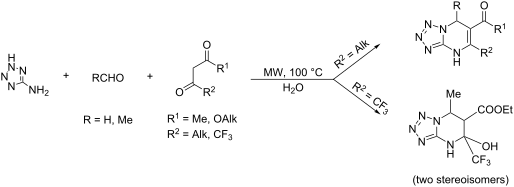
Scheme 1: Three synthetic approaches to dihydrotetrazolo[1,5-a]pyrimidines.
Scheme 2: Three-component reaction of 1, 7a,b and 8a–d in water.
Figure 1: Molecular structure of 9a according to X-ray data. Displacement ellipsoids are shown at the 50% pro...
Scheme 3: Three-component reaction of 5-aminotetrazole (1) with formaldehyde (7a) and acetylacetone (10).
Scheme 4: a) Three-component reaction of 5-aminotetrazole (1) with acetaldehyde (7b) and ethyl 4,4,4-trifluor...
Beilstein J. Org. Chem. 2019, 15, 2213–2270, doi:10.3762/bjoc.15.218
Graphical Abstract
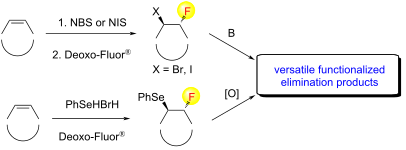
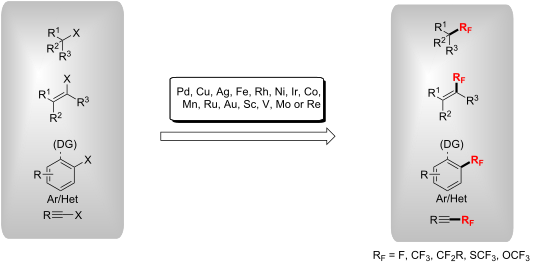
Scheme 1: The main three strategies of fluorination: nucleophilic, electrophilic and radical fluorination.
Scheme 2: Doyle’s Pd-catalyzed fluorination of allylic chlorides.
Scheme 3: Allylic fluorination of 2- and 3-substituted propenyl esters.
Scheme 4: Regioselective allylic fluorination of cinnamyl phosphorothioate esters.
Scheme 5: Palladium-catalyzed aliphatic C–H fluorination reported by Doyle.
Scheme 6: Pd-catalyzed enantioselective fluorination of α-ketoesters followed by stereoselective reduction to...
Scheme 7: Pd-catalyzed C(sp3)–H fluorination of oxindoles.
Scheme 8: C–H fluorination of 8-methylquinoline derivatives with F− reagents.
Scheme 9: Fluorination of α-cyano acetates reported by van Leeuwen.
Scheme 10: The catalytic enantioselective electrophilic C–H fluorination of α-chloro-β-keto phosphonates.
Scheme 11: Fluorination of unactivated C(sp3)–H bonds directed by the bidentate PIP auxiliary.
Scheme 12: Fluorination of C(sp3)–H bonds at the β-position of carboxylic acids.
Scheme 13: Enantioselective benzylic C–H fluorination with a chiral transient directing group.
Scheme 14: Microwave-heated Pd-catalyzed fluorination of aryl alcohols.
Scheme 15: Fluorination of aryl potassium trifluoroborates.
Scheme 16: C(sp2)–F bond formation using precatalyst [L·Pd]2(cod).
Scheme 17: Pd-catalyzed fluorination of (hetero)aryl triflates and bromides.
Scheme 18: The Pd-catalyzed C–H fluorination of arenes with Selectfluor/NFSI.
Scheme 19: Pd(II)-catalyzed ortho-monofluorination protocol for benzoic acids.
Scheme 20: Pd-catalyzed C(sp2)–H bond fluorination of 2-arylbenzothiazoles.
Scheme 21: Nitrate-promoted fluorination of aromatic and olefinic C(sp2)–H bonds and proposed mechanism.
Scheme 22: Fluorination of oxalyl amide-protected benzylamine derivatives.
Scheme 23: C–H fluorination of benzaldehydes with orthanilic acids as transient directing group.
Scheme 24: Pd(II)-catalyzed aryl C–H fluorination with various directing groups.
Scheme 25: Cu-catalyzed aliphatic, allylic, and benzylic fluorination.
Scheme 26: Cu-catalyzed SN2 fluorination of primary and secondary alkyl bromides.
Scheme 27: Copper-catalyzed fluorination of alkyl triflates.
Scheme 28: Cu-catalyzed fluorination of allylic bromides and chlorides.
Scheme 29: Synthetic strategy for the fluorination of active methylene compounds.
Scheme 30: Fluorination of β-ketoesters using a tartrate-derived bidentate bisoxazoline-Cu(II) complex.
Scheme 31: Highly enantioselective fluorination of β-ketoesters and N-Boc-oxindoles.
Scheme 32: Amide group-assisted site-selective fluorination of α-bromocarbonyl compounds.
Scheme 33: Cu-mediated aryl fluorination reported by Sanford [77].
Scheme 34: Mono- or difluorination reactions of benzoic acid derivatives.
Scheme 35: Cu-catalyzed fluorination of diaryliodonium salts with KF.
Scheme 36: Copper(I)-catalyzed cross-coupling of 2-pyridylaryl bromides.
Scheme 37: AgNO3-catalyzed decarboxylative fluorination of aliphatic carboxylic acids.
Scheme 38: The Mn-catalyzed aliphatic and benzylic C–H fluorination.
Scheme 39: Iron(II)-promoted C–H fluorination of benzylic substrates.
Scheme 40: Ag-catalyzed fluorodecarboxylation of carboxylic acids.
Scheme 41: Vanadium-catalyzed C(sp3)–H fluorination.
Scheme 42: AgNO3-catalyzed radical deboronofluorination of alkylboronates and boronic acids.
Scheme 43: Selective heterobenzylic C–H fluorination with Selectfluor reported by Van Humbeck.
Scheme 44: Fe(II)-catalyzed site-selective fluorination guided by an alkoxyl radical.
Scheme 45: Fluorination of allylic trichloroacetimidates reported by Nguyen et al.
Scheme 46: Iridium-catalyzed fluorination of allylic carbonates with TBAF(t-BuOH)4.
Scheme 47: Iridium-catalyzed asymmetric fluorination of allylic trichloroacetimidates.
Scheme 48: Cobalt-catalyzed α-fluorination of β-ketoesters.
Scheme 49: Nickel-catalyzed α-fluorination of various α-chloro-β-ketoesters.
Scheme 50: Ni(II)-catalyzed enantioselective fluorination of oxindoles and β-ketoesters.
Scheme 51: Scandium(III)-catalyzed asymmetric C–H fluorination of unprotected 3-substituted oxindoles.
Scheme 52: Iron-catalyzed directed C–H fluorination.
Scheme 53: Electrophilic silver-catalyzed Ar–F bond-forming reaction from arylstannanes.
Figure 1: Nucleophilic, electrophilic and radical CF3 sources.
Scheme 54: Cu(I)-catalyzed allylic trifluoromethylation of unactivated terminal olefins.
Scheme 55: Direct copper-catalyzed trifluoromethylation of allylsilanes.
Scheme 56: Cupper-catalyzed enantioselective trifluoromethylation of five and six-membered ring β-ketoesters.
Scheme 57: Cu-catalyzed highly stereoselective trifluoromethylation of secondary propargyl sulfonates.
Scheme 58: Remote C(sp3)–H trifluoromethylation of carboxamides and sulfonamides.
Scheme 59: Trifluoromethylation of allylsilanes with photoredox catalysis.
Scheme 60: Ag-catalyzed decarboxylative trifluoromethylation of aliphatic carboxylic acids in aqueous CH3CN.
Scheme 61: Decarboxylative trifluoromethylation of aliphatic carboxylic acids via combined photoredox and copp...
Scheme 62: Palladium-catalyzed Ar–CF3 bond-forming reaction.
Scheme 63: Palladium-catalyzed trifluoromethylation of arenes with diverse heterocyclic directing groups.
Scheme 64: Pd-catalyzed trifluoromethylation of indoles as reported by Liu.
Scheme 65: Pd-catalyzed trifluoromethylation of vinyl triflates and vinyl nonaflates.
Scheme 66: Pd(II)-catalyzed ortho-trifluoromethylation of aromatic C–H bonds.
Scheme 67: Visible-light-induced Pd(OAc)2-catalyzed ortho-trifluoromethylation of acetanilides with CF3SO2Na.
Scheme 68: CuI-catalyzed trifluoromethylation of aryl- and alkenylboronic acids.
Scheme 69: Cu-catalyzed trifluoromethylation of aryl- and vinylboronic acids.
Scheme 70: Copper-catalyzed trifluoromethylation of α,β-unsaturated carboxylic acids.
Scheme 71: Formation of C(sp2)–CF3 bond catalyzed by copper(I) complex.
Scheme 72: Loh’s Cu(I)-catalyzed trifluoromethylation of enamides and electron-deficient alkenes.
Scheme 73: Copper and iron-catalyzed decarboxylative tri- and difluoromethylation.
Scheme 74: Cu-catalyzed trifluoromethylation of hydrazones developed by Bouyssi.
Scheme 75: Cu(I)-catalyzed trifluoromethylation of terminal alkenes.
Scheme 76: Cu/Ag-catalyzed decarboxylative trifluoromethylation of cinnamic acids.
Scheme 77: Copper-catalyzed direct alkenyl C–H trifluoromethylation.
Scheme 78: Copper(I/II)-catalyzed direct trifluoromethylation of styrene derivatives.
Scheme 79: Regioselective trifluoromethylation of pivalamido arenes and heteroarenes.
Scheme 80: Synthesis of trifluoromethylquinones in the presence of copper(I).
Scheme 81: Oxidative trifluoromethylation of imidazoheterocycles in ionic liquid/water.
Scheme 82: A mild and fast continuous-flow trifluoromethylation of coumarins using a CuI/CF3SO2Na/TBHP system.
Scheme 83: Copper-catalyzed oxidative trifluoromethylation of various 8-aminoquinolines.
Scheme 84: PA-directed copper-catalyzed trifluoromethylation of anilines.
Scheme 85: Trifluoromethylation of potassium vinyltrifluoroborates catalyzed by Fe(II).
Scheme 86: Alkenyl trifluoromethylation catalyzed by Ru(phen)3Cl2 as photocatalyst.
Scheme 87: Ru-catalyzed trifluoromethylation of alkenes by Akita’s group.
Scheme 88: Ir-catalyzed Cvinyl–CF3 bond formation of α,β-unsaturated carboxylic acids.
Scheme 89: Ag(I)-catalyzed denitrative trifluoromethylation of β-nitrostyrenes.
Scheme 90: Photocatalyzed direct trifluoromethylation of aryl and heteroaryl C–H bonds.
Scheme 91: Rhenium (MTO)-catalyzed direct trifluoromethylation of aromatic substrates.
Scheme 92: Trifluoromethylation of unprotected anilines under [Ir(ppy)3] catalyst.
Scheme 93: Oxidative trifluoromethylation of imidazopyridines and imidazoheterocycles.
Scheme 94: Ruthenium-catalyzed trifluoromethylation of (hetero)arenes with trifluoroacetic anhydride.
Scheme 95: Phosphovanadomolybdic acid-catalyzed direct C–H trifluoromethylation.
Scheme 96: Picolinamide-assisted ortho-trifluoromethylation of arylamines.
Scheme 97: A nickel-catalyzed C–H trifluoromethylation of free anilines.
Scheme 98: Cu-mediated trifluoromethylation of terminal alkynes reported by Qing.
Scheme 99: Huang’s C(sp)–H trifluoromethylation using Togni’s reagent.
Scheme 100: Cu-catalyzed methods for trifluoromethylation with Umemoto’s reagent.
Scheme 101: The synthesis of alkynyl-CF3 compounds in the presence of fac-[Ir(ppy)3] under visible-light irradi...
Scheme 102: Pd-catalyzed Heck reaction reported by Reutrakul.
Scheme 103: Difluoromethylation of enamides and ene-carbamates.
Scheme 104: Difluoromethylation of α,β-unsaturated carboxylic acids.
Scheme 105: Copper-catalyzed direct C(sp2)–H difluoroacetylation reported by Pannecoucke and co-workers.
Scheme 106: Difluoroalkylation of aldehyde-derived hydrazones with functionalized difluoromethyl bromides.
Scheme 107: Photoredox-catalyzed C–H difluoroalkylation of aldehyde-derived hydrazones.
Scheme 108: Synergistic ruthenium(II)-catalyzed C–H difluoromethylation reported by Ackermann.
Scheme 109: Visible-light photocatalytic decarboxylation of α,β-unsaturated carboxylic acids.
Scheme 110: Synthesis of difluorinated ketones via S-alkyl dithiocarbamates obtained from acyl chlorides and po...
Scheme 111: Synthesis of aryl and heteroaryl difluoromethylated phosphonates.
Scheme 112: Difluoroalkylation of secondary propargyl sulfonates using Cu as the catalyst.
Scheme 113: Ru(II)-mediated para-selective difluoromethylation of anilides and their derivatives.
Scheme 114: Bulky diamine ligand promoted cross-coupling of difluoroalkyl bromides.
Scheme 115: Copper-catalyzed C3–H difluoroacetylation of quinoxalinones.
Scheme 116: Copper(I) chloride-catalyzed trifluoromethylthiolation of enamines, indoles and β-ketoesters.
Scheme 117: Copper-boxmi-catalyzed asymmetric trifluoromethylthiolation of β-ketoesters.
Scheme 118: Direct Cu-catalyzed trifluoromethylthiolation of boronic acids and alkynes.
Scheme 119: Cu-catalyzed synthesis of α-trifluoromethylthio-substituted ketones.
Scheme 120: Trifluoromethylthiolation reactions promoted by diazotriflone and copper.
Scheme 121: Halide activation of N-(trifluoromethylthio)phthalimide.
Scheme 122: The visible light-promoted trifluoromethylthiolation reported by Glorius.
Scheme 123: Synthesis of α-trifluoromethylthioesters via Goossen’s approach.
Scheme 124: Photoinduced trifluoromethylthiolation of diazonium salts.
Scheme 125: Ag-mediated trifluoromethoxylation of aryl stannanes and arylboronic acids.
Scheme 126: Catalytic (hetero)aryl C–H trifluoromethoxylation under visible light.
Scheme 127: Photoinduced C–H-bond trifluromethoxylation of (hetero)arenes.
Beilstein J. Org. Chem. 2019, 15, 2142–2155, doi:10.3762/bjoc.15.211
Graphical Abstract
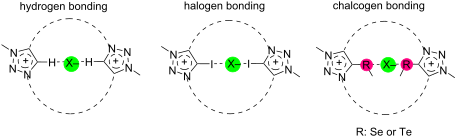
Figure 1: Hydrogen, halogen or chalcogen bonding to anions within a bistriazolium macrocycle.
Figure 2: Main synthetic strategies towards macrocyclic triazoliums.
Figure 3: Chemical structure of compound 1 (1a, 1b and 1c) and 2.
Figure 4: Chemical structure of compound 3 and 4.
Figure 5: Chemical structure of compound 5.
Figure 6: Chemical structure of compound 6.
Figure 7: Chemical structure of compound 7.
Figure 8: Chemical structure of compound 8.
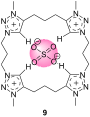
Figure 9: Chemical structures of compound 9.
Figure 10: Chemical structures of compound 10, 11 and 12.
Figure 11: Chemical structure of compound 13.
Figure 12: Chemical structure of compound 15 including the sigma-connected TCNQ dimer.
Figure 13: Chemical structure of compound 16 for the kinetic resolution of epoxides.
Figure 14: Chemical structure of compound 17a (bisnaphtho crown ether shown).
Figure 15: Jump rope in molecular double-lasso compounds 18.
Figure 16: Chemical structure of compound 19 and acid–base triggered motions.
Beilstein J. Org. Chem. 2019, 15, 1974–1975, doi:10.3762/bjoc.15.192
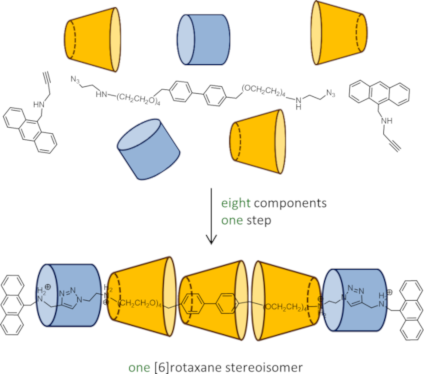
Beilstein J. Org. Chem. 2019, 15, 1829–1837, doi:10.3762/bjoc.15.177
Graphical Abstract
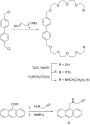
Scheme 1: Synthesis of the axle and stopper building blocks 1 and 2.
Scheme 2: Synthesis of [n]rotaxanes 3R to 6R. Note that the position and orientation of the γ-CD are arbitrar...
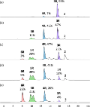
Figure 1: LC–MS analysis of the reaction mixture of the [n]rotaxane synthesis in the presence of (a) 0.5; (b)...
Figure 2: Partial 1H NMR spectra (500 MHz, D2O, 298 K) of (a) 6R; (b) 5R; and (c) 4R.
Figure 3: (a) All the possible sequences of a [6]rotaxane with two CB[6] and three γ-CD interlocked on an axl...
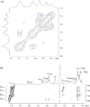
Figure 4: Partial (a) COSY spectrum (500 MHz, D2O, 298 K) and (b) NOESY (500 MHz, D2O, 298 K) of 4R showing t...
Figure 5: Possible structures of 5R assuming no fast shuttling of the γ-CD along the axle.
Beilstein J. Org. Chem. 2019, 15, 1822–1828, doi:10.3762/bjoc.15.176
Graphical Abstract
Scheme 1: Concept: Alkene difuctionalization by four-component radical reaction using xanthates, alkenes, CO ...
Figure 1: Vicinal difunctionalization of alkenes by four-component radical cascade reaction using xanthogenat...
Figure 2: Proposed radical chain mechanism.
Beilstein J. Org. Chem. 2019, 15, 1612–1704, doi:10.3762/bjoc.15.165
Graphical Abstract
Figure 1: Various drugs having IP nucleus.
Figure 2: Participation percentage of various TMs for the syntheses of IPs.
Scheme 1: CuI–NaHSO4·SiO2-catalyzed synthesis of imidazo[1,2-a]pyridines.
Scheme 2: Experimental examination of reaction conditions.
Scheme 3: One-pot tandem reaction for the synthesis of 2-haloimidazopyridines.
Scheme 4: Mechanistic scheme for the synthesis of 2-haloimidazopyridine.
Scheme 5: Copper-MOF-catalyzed three-component reaction (3-CR) for imidazo[1,2-a]pyridines.
Scheme 6: Mechanism for copper-MOF-driven synthesis.
Scheme 7: Heterogeneous synthesis via titania-supported CuCl2.
Scheme 8: Mechanism involving oxidative C–H functionalization.
Scheme 9: Heterogeneous synthesis of IPs.
Scheme 10: One-pot regiospecific synthesis of imidazo[1,2-a]pyridines.
Scheme 11: Vinyl azide as an unprecedented substrate for imidazo[1,2-a]pyridines.
Scheme 12: Radical pathway.
Scheme 13: Cu(I)-catalyzed transannulation approach for imidazo[1,5-a]pyridines.
Scheme 14: Plausible radical pathway for the synthesis of imidazo[1,5-a]pyridines.
Scheme 15: A solvent-free domino reaction for imidazo[1,2-a]pyridines.
Scheme 16: Cu-NPs-mediated synthesis of imidazo[1,2-a]pyridines.
Scheme 17: CuI-catalyzed synthesis of isoxazolylimidazo[1,2-a]pyridines.
Scheme 18: Functionalization of 4-bromo derivative via Sonogashira coupling reaction.
Scheme 19: A plausible reaction pathway.
Scheme 20: Cu(I)-catalyzed intramolecular oxidative C–H amidation reaction.
Scheme 21: One-pot synthetic reaction for imidazo[1,2-a]pyridine.
Scheme 22: Plausible reaction mechanism.
Scheme 23: Cu(OAc)2-promoted synthesis of imidazo[1,2-a]pyridines.
Scheme 24: Mechanism for aminomethylation/cycloisomerization of propiolates with imines.
Scheme 25: Three-component synthesis of imidazo[1,2-a]pyridines.
Figure 3: Scope of pyridin-2(1H)-ones and acetophenones.
Scheme 26: CuO NPS-promoted A3 coupling reaction.
Scheme 27: Cu(II)-catalyzed C–N bond formation reaction.
Scheme 28: Mechanism involving Chan–Lam/Ullmann coupling.
Scheme 29: Synthesis of formyl-substituted imidazo[1,2-a]pyridines.
Scheme 30: A tandem sp3 C–H amination reaction.
Scheme 31: Probable mechanistic approach.
Scheme 32: Dual catalytic system for imidazo[1,2-a]pyridines.
Scheme 33: Tentative mechanism.
Scheme 34: CuO/CuAl2O4/ᴅ-glucose-promoted 3-CCR.
Scheme 35: A tandem CuOx/OMS-2-based synthetic strategy.
Figure 4: Biomimetic catalytic oxidation in the presence of electron-transfer mediators (ETMs).
Scheme 36: Control experiment.
Scheme 37: Copper-catalyzed C(sp3)–H aminatin reaction.
Scheme 38: Reaction of secondary amines.
Scheme 39: Probable mechanistic pathway.
Scheme 40: Coupling reaction of α-azidoketones.
Scheme 41: Probable pathway.
Scheme 42: Probable mechanism with free energy calculations.
Scheme 43: MCR for cyanated IP synthesis.
Scheme 44: Substrate scope for the reaction.
Scheme 45: Reaction mechanism.
Scheme 46: Probable mechanistic pathway for Cu/ZnAl2O4-catalyzed reaction.
Scheme 47: Copper-catalyzed double oxidative C–H amination reaction.
Scheme 48: Application towards different coupling reactions.
Scheme 49: Reaction mechanism.
Scheme 50: Condensation–cyclization approach for the synthesis of 1,3-diarylated imidazo[1,5-a]pyridines.
Scheme 51: Optimized reaction conditions.
Scheme 52: One-pot 2-CR.
Scheme 53: One-pot 3-CR without the isolation of chalcone.
Scheme 54: Copper–Pybox-catalyzed cyclization reaction.
Scheme 55: Mechanistic pathway catalyzed by Cu–Pybox complex.
Scheme 56: Cu(II)-promoted C(sp3)-H amination reaction.
Scheme 57: Wider substrate applicability for the reaction.
Scheme 58: Plausible reaction mechanism.
Scheme 59: CuI assisted C–N cross-coupling reaction.
Scheme 60: Probable reaction mechanism involving sp3 C–H amination.
Scheme 61: One-pot MCR-catalyzed by CoFe2O4/CNT-Cu.
Scheme 62: Mechanistic pathway.
Scheme 63: Synthetic scheme for 3-nitroimidazo[1,2-a]pyridines.
Scheme 64: Plausible mechanism for CuBr-catalyzed reaction.
Scheme 65: Regioselective synthesis of halo-substituted imidazo[1,2-a]pyridines.
Scheme 66: Synthesis of 2-phenylimidazo[1,2-a]pyridines.
Scheme 67: Synthesis of diarylated compounds.
Scheme 68: CuBr2-mediated one-pot two-component oxidative coupling reaction.
Scheme 69: Decarboxylative cyclization route to synthesize 1,3-diarylimidazo[1,5-a]pyridines.
Scheme 70: Mechanistic pathway.
Scheme 71: C–H functionalization reaction of enamines to produce diversified heterocycles.
Scheme 72: A plausible mechanism.
Scheme 73: CuI-promoted aerobic oxidative cyclization reaction of ketoxime acetates and pyridines.
Scheme 74: CuI-catalyzed pathway for the formation of imidazo[1,2-a]pyridine.
Scheme 75: Mechanistic pathway.
Scheme 76: Mechanistic rationale for the synthesis of products.
Scheme 77: Copper-catalyzed synthesis of vinyloxy-IP.
Scheme 78: Regioselective product formation with propiolates.
Scheme 79: Proposed mechanism for vinyloxy-IP formation.
Scheme 80: Regioselective synthesis of 3-hetero-substituted imidazo[1,2-a]pyridines with different reaction su...
Scheme 81: Mechanistic pathway.
Scheme 82: CuI-mediated synthesis of 3-formylimidazo[1,2-a]pyridines.
Scheme 83: Radical pathway for 3-formylated IP synthesis.
Scheme 84: Pd-catalyzed urea-cyclization reaction for IPs.
Scheme 85: Pd-catalyzed one-pot-tandem amination and intramolecular amidation reaction.
Figure 5: Scope of aniline nucleophiles.
Scheme 86: Pd–Cu-catalyzed Sonogashira coupling reaction.
Scheme 87: One-pot amide coupling reaction for the synthesis of imidazo[4,5-b]pyridines.
Scheme 88: Urea cyclization reaction for the synthesis of two series of pyridines.
Scheme 89: Amidation reaction for the synthesis of imidazo[4,5-b]pyridines.
Figure 6: Amide scope.
Scheme 90: Pd NPs-catalyzed 3-component reaction for the synthesis of 2,3-diarylated IPs.
Scheme 91: Plausible mechanistic pathway for Pd NPs-catalyzed MCR.
Scheme 92: Synthesis of chromenoannulated imidazo[1,2-a]pyridines.
Scheme 93: Mechanism for the synthesis of chromeno-annulated IPs.
Scheme 94: Zinc oxide NRs-catalyzed synthesis of imidazo[1,2-a]azines/diazines.
Scheme 95: Zinc oxide-catalyzed isocyanide based GBB reaction.
Scheme 96: Reaction pathway for ZnO-catalyzed GBB reaction.
Scheme 97: Mechanistic pathway.
Scheme 98: ZnO NRs-catalyzed MCR for the synthesis of imidazo[1,2-a]azines.
Scheme 99: Ugi type GBB three-component reaction.
Scheme 100: Magnetic NPs-catalyzed synthesis of imidazo[1,2-a]pyridines.
Scheme 101: Regioselective synthesis of 2-alkoxyimidazo[1,2-a]pyridines catalyzed by Fe-SBA-15.
Scheme 102: Plausible mechanistic pathway for the synthesis of 2-alkoxyimidazopyridine.
Scheme 103: Iron-catalyzed synthetic approach.
Scheme 104: Iron-catalyzed aminooxygenation reaction.
Scheme 105: Mechanistic pathway.
Scheme 106: Rh(III)-catalyzed double C–H activation of 2-substituted imidazoles and alkynes.
Scheme 107: Plausible reaction mechanism.
Scheme 108: Rh(III)-catalyzed non-aromatic C(sp2)–H bond activation–functionalization for the synthesis of imid...
Scheme 109: Reactivity and selectivity of different substrates.
Scheme 110: Rh-catalyzed direct C–H alkynylation by Li et al.
Scheme 111: Suggested radical mechanism.
Scheme 112: Scandium(III)triflate-catalyzed one-pot reaction and its mechanism for the synthesis of benzimidazo...
Scheme 113: RuCl3-assisted Ugi-type Groebke–Blackburn condensation reaction.
Scheme 114: C-3 aroylation via Ru-catalyzed two-component reaction.
Scheme 115: Regioselective synthetic mechanism.
Scheme 116: La(III)-catalyzed one-pot GBB reaction.
Scheme 117: Mechanistic approach for the synthesis of imidazo[1,2-a]pyridines.
Scheme 118: Synthesis of imidazo[1,2-a]pyridine using LaMnO3 NPs under neat conditions.
Scheme 119: Mechanistic approach.
Scheme 120: One-pot 3-CR for regioselective synthesis of 2-alkoxy-3-arylimidazo[1,2-a]pyridines.
Scheme 121: Formation of two possible products under optimization of the catalysts.
Scheme 122: Mechanistic strategy for NiFe2O4-catalyzed reaction.
Scheme 123: Two-component reaction for synthesizing imidazodipyridiniums.
Scheme 124: Mechanistic scheme for the synthesis of imidazodipyridiniums.
Scheme 125: CuI-catalyzed arylation of imidazo[1,2-a]pyridines.
Scheme 126: Mechanism for arylation reaction.
Scheme 127: Cupric acetate-catalyzed double carbonylation approach.
Scheme 128: Radical mechanism for double carbonylation of IP.
Scheme 129: C–S bond formation reaction catalyzed by cupric acetate.
Scheme 130: Cupric acetate-catalyzed C-3 formylation approach.
Scheme 131: Control experiments for signifying the role of DMSO and oxygen.
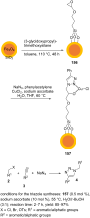
Scheme 132: Mechanism pathway.
Scheme 133: Copper bromide-catalyzed CDC reaction.
Scheme 134: Extension of the substrate scope.
Scheme 135: Plausible radical pathway.
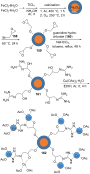
Scheme 136: Transannulation reaction for the synthesis of imidazo[1,5-a]pyridines.
Scheme 137: Plausible reaction pathway for denitrogenative transannulation.
Scheme 138: Cupric acetate-catalyzed C-3 carbonylation reaction.
Scheme 139: Plausible mechanism for regioselective C-3 carbonylation.
Scheme 140: Alkynylation reaction at C-2 of 3H-imidazo[4,5-b]pyridines.
Scheme 141: Two-way mechanism for C-2 alkynylation of 3H-imidazo[4,5-b]pyridines.
Scheme 142: Palladium-catalyzed SCCR approach.
Scheme 143: Palladium-catalyzed Suzuki coupling reaction.
Scheme 144: Reaction mechanism.
Scheme 145: A phosphine free palladium-catalyzed synthesis of C-3 arylated imidazopyridines.
Scheme 146: Palladium-mediated Buchwald–Hartwig cross-coupling reaction.
Figure 7: Structure of the ligands optimized.
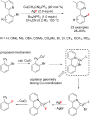
Scheme 147: Palladium acetate-catalyzed direct arylation of imidazo[1,2-a]pyridines.
Scheme 148: Palladium acetate-catalyzed mechanistic pathway.
Scheme 149: Palladium acetate-catalyzed regioselective arylation reported by Liu and Zhan.
Scheme 150: Mechanism for selective C-3 arylation of IP.
Scheme 151: Pd(II)-catalyzed alkenylation reaction with styrenes.
Scheme 152: Pd(II)-catalyzed alkenylation reaction with acrylates.
Scheme 153: A two way mechanism.
Scheme 154: Double C–H activation reaction catalyzed by Pd(OAc)2.
Scheme 155: Probable mechanism.
Scheme 156: Palladium-catalyzed decarboxylative coupling.
Scheme 157: Mechanistic cycle for decarboxylative arylation reaction.
Scheme 158: Ligand-free approach for arylation of imidazo[1,2-a]pyridine-3-carboxylic acids.
Scheme 159: Mechanism for ligandless arylation reaction.
Scheme 160: NHC-Pd(II) complex assisted arylation reaction.
Scheme 161: C-3 arylation of imidazo[1,2-a]pyridines with aryl bromides catalyzed by Pd(OAc)2.
Scheme 162: Pd(II)-catalyzed C-3 arylations with aryl tosylates and mesylates.
Scheme 163: CDC reaction for the synthesis of imidazo[1,2-a]pyridines.
Scheme 164: Plausible reaction mechanism for Pd(OAc)2-catalyzed synthesis of imidazo[1,2-a]pyridines.
Scheme 165: Pd-catalyzed C–H amination reaction.
Scheme 166: Mechanism for C–H amination reaction.
Scheme 167: One-pot synthesis for 3,6-di- or 2,3,6-tri(hetero)arylimidazo[1,2-a]pyridines.
Scheme 168: C–H/C–H cross-coupling reaction of IPs and azoles catalyzed by Pd(II).
Scheme 169: Mechanistic cycle.
Scheme 170: Rh-catalyzed C–H arylation reaction.
Scheme 171: Mechanistic pathway for C–H arylation of imidazo[1,2-a]pyridine.
Scheme 172: Rh(III)-catalyzed double C–H activation of 2-phenylimidazo[1,2-a]pyridines and alkynes.
Scheme 173: Rh(III)-catalyzed mechanistic pathway.
Scheme 174: Rh(III)-mediated oxidative coupling reaction.
Scheme 175: Reactions showing functionalization of the product obtained by the group of Kotla.
Scheme 176: Mechanism for Rh(III)-catalyzed oxidative coupling reaction.
Scheme 177: Rh(III)-catalyzed C–H activation reaction.
Scheme 178: Mechanistic cycle.
Scheme 179: Annulation reactions of 2-arylimidazo[1,2-a]pyridines and alkynes.
Scheme 180: Two-way reaction mechanism for annulations reaction.
Scheme 181: [RuCl2(p-cymene)]2-catalyzed C–C bond formation reaction.
Scheme 182: Reported reaction mechanism.
Scheme 183: Fe(III) catalyzed C-3 formylation approach.
Scheme 184: SET mechanism-catalyzed by Fe(III).
Scheme 185: Ni(dpp)Cl2-catalyzed KTC coupling.
Scheme 186: Pd-catalyzed SM coupling.
Scheme 187: Vanadium-catalyzed coupling of IP and NMO.
Scheme 188: Mechanistic cycle.
Scheme 189: Selective C3/C5–H bond functionalizations by mono and bimetallic systems.
Scheme 190: rGO-Ni@Pd-catalyzed C–H bond arylation of imidazo[1,2-a]pyridine.
Scheme 191: Mechanistic pathway for heterogeneously catalyzed arylation reaction.
Scheme 192: Zinc triflate-catalyzed coupling reaction of substituted propargyl alcohols.
Beilstein J. Org. Chem. 2019, 15, 1523–1533, doi:10.3762/bjoc.15.155
Graphical Abstract
Scheme 1: Synthetic routes to O-thiocarbamates and dithiocarbamates.
Scheme 2: Substrate scope of isocyanides. aReaction conditions: 1 (1 mmol), S8 (2 mmol), 2a (2mmol), NaH (2 m...
Scheme 3: Substrate scope of alcohols. Reaction conditions: 1a (1 mmol), S8 (2 mmol), 2 (2mmol), NaH (2 mmol)...
Scheme 4: Substrate scope of thiols. Reaction conditions: 1a (1 mmol), S8 (1.2 mmol), 4 (2 mmol), NaOH (2 mmo...
Scheme 5: Scaled-up synthesis for 3a.
Scheme 6: Multicomponent domino synthesis of quinazolinone 7.
Scheme 7: Control experiments.
Scheme 8: Proposed mechanism.
Beilstein J. Org. Chem. 2019, 15, 1505–1514, doi:10.3762/bjoc.15.152
Graphical Abstract
Figure 1: Bis-amido-tris-amine macrocycle BATA-MC.
Figure 2: (a) Number distribution plot with particle size in DLS, (b) SEM image and (c) TEM image showing the...
Figure 3: Dependence of the yield of compound 4a on the reaction time using BATA-MC.
Figure 4: Yields of product 4a at different catalyst loading.
Scheme 1: BATA-MC-catalyzed synthesis of 4,5-dihydropyrrolo[2,3,4-kl]acridinones.
Scheme 2: BATA-MC-catalyzed synthesis of pyrrolo[2,3,4-kl]acridinone derivatives.
Figure 5: X-ray single crystal structure of 4d (CCDC 1898008).
Scheme 3: Probable mechanism illustrated for the synthesis of 4a using BATA-MC. For the sake of simplicity, w...
Figure 6: Representation of BATA-MC nanoreactor.
Figure 7: The reusability of the nanoreactor for the synthesis of 4a.
Beilstein J. Org. Chem. 2019, 15, 1425–1433, doi:10.3762/bjoc.15.142
Graphical Abstract
Scheme 1: Case study of a complex synthesis, parallel reactions. 10 possible synthesis STMs in green, other 1...
Scheme 2: Ordered reactions of the above complex synthesis to a main reaction set and connected parallel reac...
Scheme 3: Section A–J case study of Scheme 2 with operations of yoa calculation.
Scheme 4: Sequential synthesis and fragment linking of a decapeptide with comparison of results in Equations ...
Scheme 5: U-4CR with 17 precursors in the total synthesis of Et-743 (1) [14].
Scheme 6: Synthesis of 4 as key step of (+)-20S-camptothecin (3) total synthesis.